
When procuring restaurant table tops wholesale or vetting a commercial restaurant table manufacturer, a large share of premature dining room failures originate beneath the visible surface. Budget catalog tabletops commonly fail via three mechanical modes: (1) "Potato-Chip" Cupping in unconditioned solid wood cured at high ambient moisture content, (2) Edge Seam Swelling in unsealed particleboard cores exposed to wet sanitizer wipe-downs, and (3) Spider-Plate Screw Tearout when short wood screws loosen under patron leaning loads. By specifying configurable commercial constructions from Ron Group's commercial restaurant table tops production line—such as 12mm Sintered Stone paired with multi-ply birch subtops, Kiln-Dried Hardwood with optional recessed steel C-channels, and pre-embedded M8 threaded inserts (where matched to factory bases)—operators can significantly mitigate premature table wobble and structural replacement churn over a long commercial service lifecycle.
Leave a thin slice of raw potato on a warm kitchen counter overnight. By morning, the top surface has dried out faster than the bottom surface, and the flat slice has curled into a saddle-shaped potato chip.
Now take a wooden toothpick, push it into a slice of damp white bread, and hang a five-pound iron skillet from it. The toothpick rips straight out of the bread in half a second.
Those two kitchen experiments—The Potato Chip Warp and The Wet-Bread Toothpick Tearout—illustrate the core mechanical failure modes that plague restaurant operators who buy residential-grade restaurant table tops wholesale from generic e-commerce suppliers.
In a high-turn restaurant, a dining table is not a piece of decorative living room furniture. It is an industrial workbench subjected to hot cookware, frequent chemical sanitizer wipe-downs across the day, and heavy patrons pressing downward leverage onto the table edge when pushing themselves up from a booth.
As a dedicated commercial restaurant table manufacturer in Foshan, we help buyers specify tabletop cores, edge profiles, and base attachment hardware engineered to resist seasonal warping and fastener pullout under commercial dining loads.
1. The 4 Commercial Tabletop Substrates: An Engineering Spec Matrix
Before requesting a wholesale quote, every hospitality buyer and interior specifier should match the tabletop substrate to the venue's operational use case, cleaning protocol, and budget tier.
Here is the comparative engineering matrix covering the four core commercial tabletop material families available from our restaurant table factory China division (specific thickness, core construction, and subtop backing are configured per project BOM):
| Substrate Family & Typical Use Case | Surface Hardness & Heat Tolerance | Moisture & Sanitizer Resistance | Common Failure Mode in Low-Spec Tops | Configurable Factory Engineering Options (Per Project BOM) |
|---|---|---|---|---|
| 1. Sintered Stone + Multi-Ply Subtop (Steakhouses, upscale bistros, high-turn casual) |
Mohs Level ~6–7 High surface heat resistance (protective trivets recommended for extreme cast-iron sizzle platters to prevent localized thermal shock) |
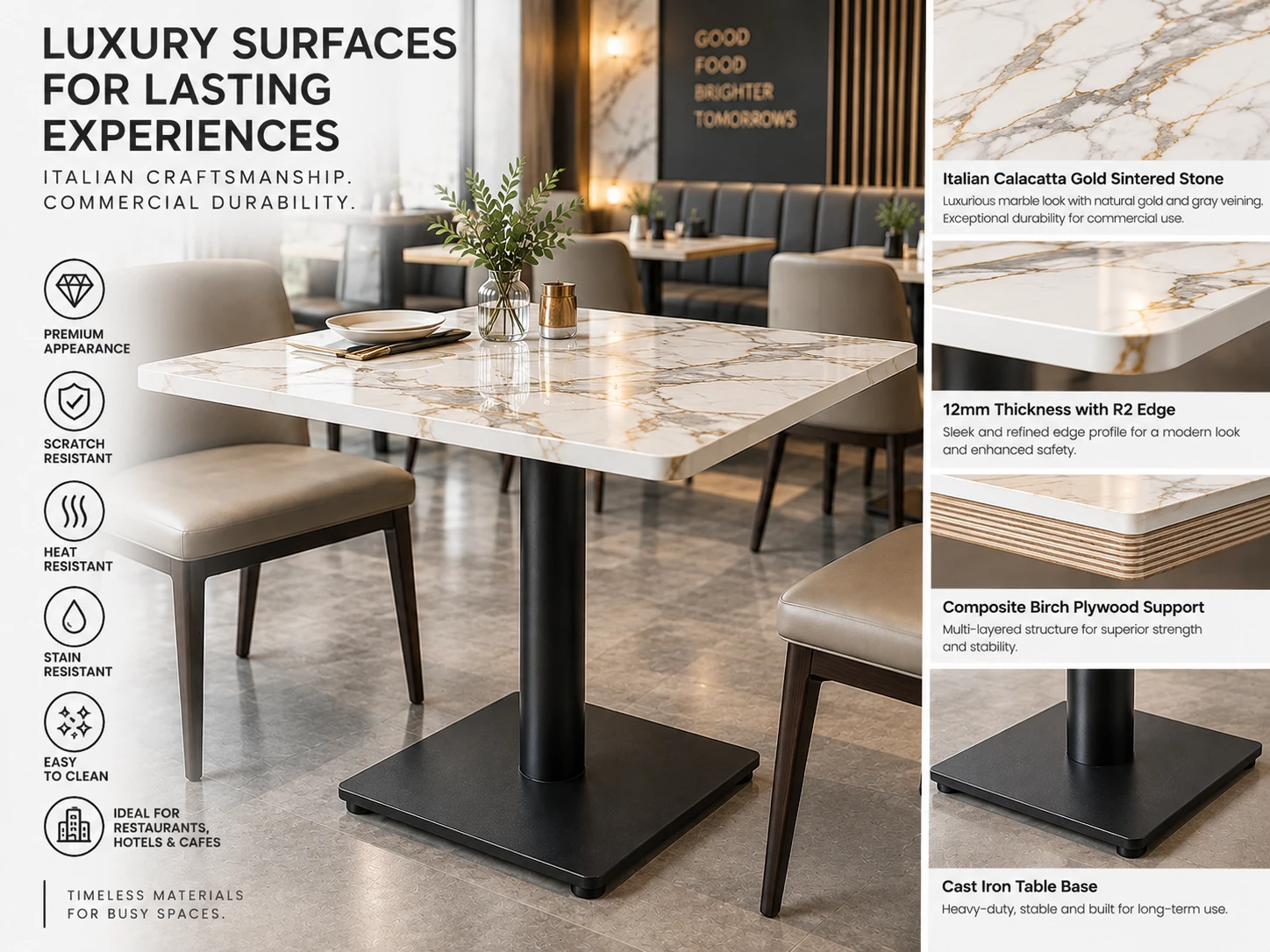
<0.05% absorption; highly resistant to red wine, food acids, and standard commercial sanitizers | Thin unbacked ceramic slabs mounted directly on metal spider frames can crack under corner impact. | 12mm high-density slab bonded with structural elastomeric adhesive onto a chamfered multi-ply wood subtop for impact damping and screw retention. |
| 2. Solid Kiln-Dried Hardwood (Ash / Oak / Walnut) (Craft gastropubs, fine dining, steakhouse booths) |
Janka ~1,010–1,360 lbf 2K Catalyzed PU topcoat (trivets & coasters required for hot cookware) |
Moderate; requires indoor HVAC humidity control (35%–55% RH) & non-abrasive pH-neutral wipe-downs | Unconditioned timber (>14% MC) cups, crowns, or splits along glue lines in dry winter heating. | ~8%–12% EMC kiln conditioning + alternating stave joinery + optional recessed steel anti-warp C-channels on wide-span tops. |
| 3. High-Pressure Laminate (HPL) + Sealed ABS Edge (Fast-casual, QSR, high-volume family diners) |
NEMA LD-3 Wear Surface Intermittent warm plate resistance (trivets required for hot skillets) |
High surface resistance; edge seam integrity depends on core and adhesive tier | Low-density particleboard core + thin unsealed edging swells when moisture penetrates seams. | Configurable plywood or high-density core + 2mm impact-resistant ABS edge-banding (moisture-resistant PUR bond available for heavy-duty specs). |
| 4. Compact Phenolic (12mm–18mm Solid Core) (Covered patios, coastal cafés, high-humidity zones) |
Homogeneous kraft-resin core Good ambient heat & scratch resistance |
Water-resistant solid core; no separate edge band to peel in humid or covered outdoor zones | Ultra-thin (≤8mm) panels flex under span loads and offer shallow screw engagement. | 12mm–18mm structural compact phenolic with pre-tapped machine-thread inserts or underside mounting plates matched to base spans. |
2. Why Budget Tabletops Loosen on Their Bases: Screw Withdrawal Mechanics (Fpullout)
Walk into many casual restaurants after a couple of years of heavy service and press down on the corner of a two-top table. Frequently, you will feel the tabletop rock or tilt slightly against the central pedestal column.
Many operators blame uneven flooring alone. As analyzed in our technical dossier on restaurant table wobble & warping solutions, a major cause of recurring wobble occurs at the top-to-base interface: short self-tapping wood screws driven into low-density cores gradually loosen under repeated patron leaning loads.
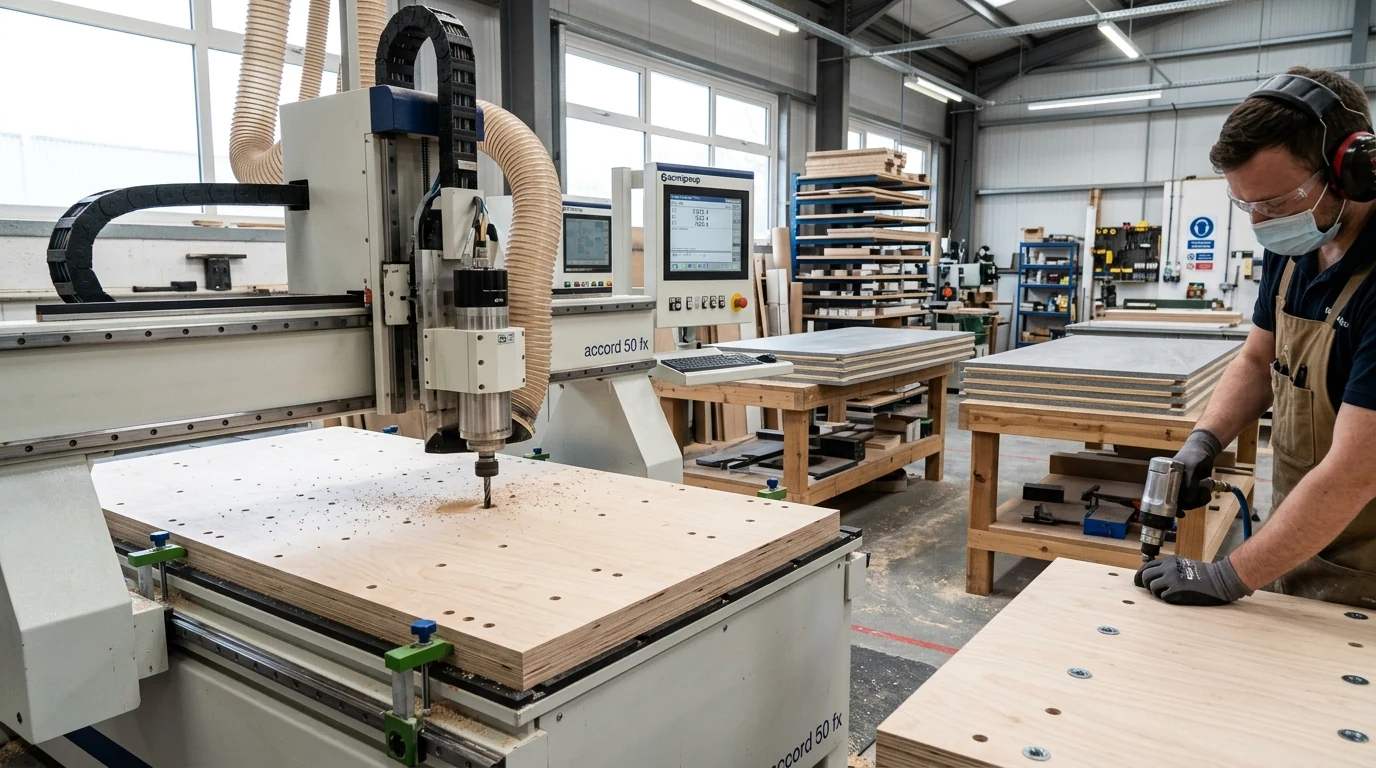
Below is an illustrative mechanical comparison between standard self-tapping wood screws in low-density particleboard and pre-embedded M8 threaded inserts in multi-ply hardwood—an engineering option available from our custom restaurant table manufacturer line when tops and bases are ordered as a matched system:
3. Managing Solid Wood Movement: Kiln Conditioning & Anti-Warp C-Channels
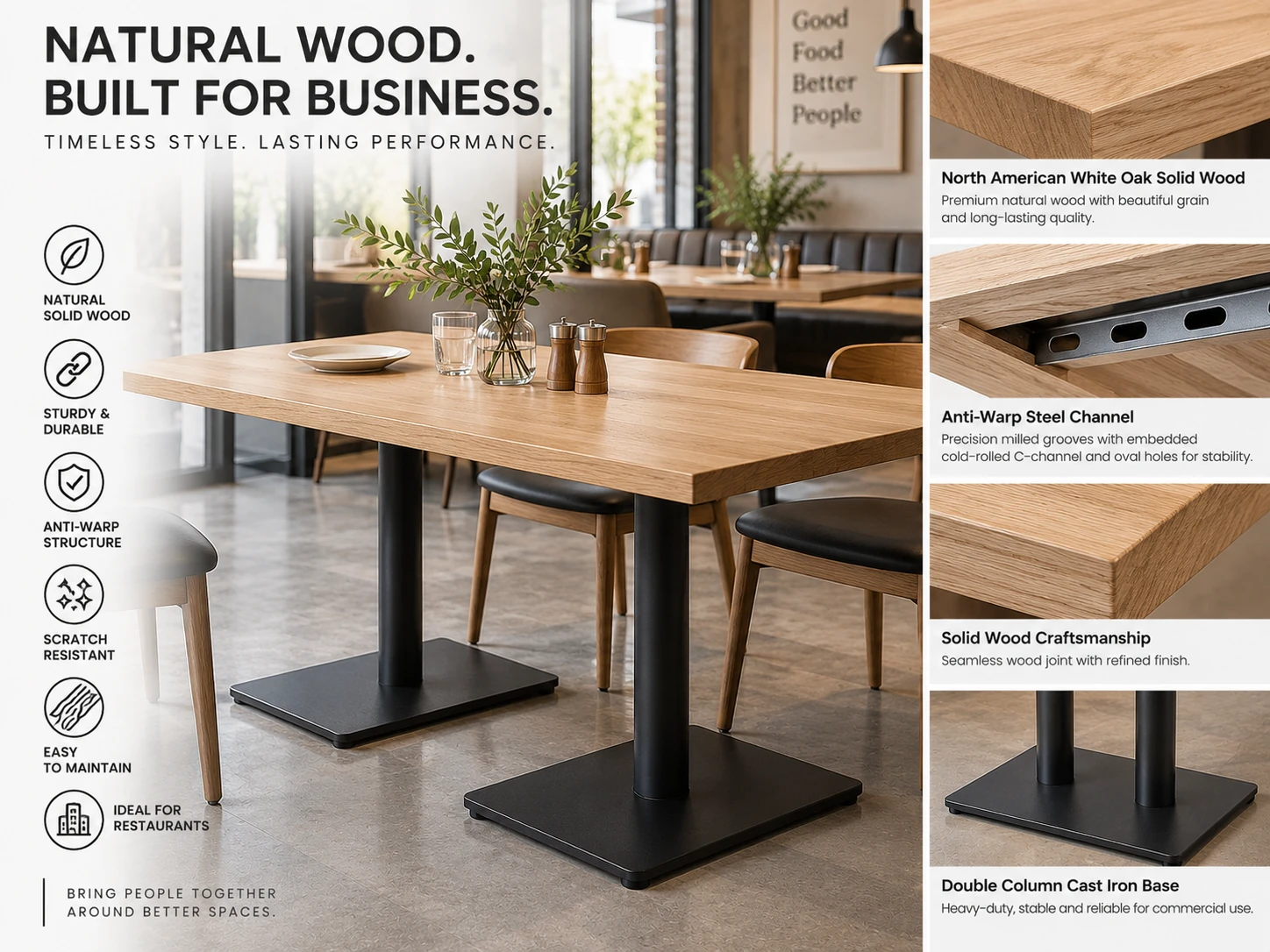
Few surfaces match the tactile warmth of a solid American White Oak, Ash, or Black Walnut tabletop in a craft steakhouse or bistro. However, solid wood is a natural, hygroscopic material—its fibers expand when absorbing high summer humidity and contract in dry winter heating environments.
When operators purchase unconditioned solid wood restaurant table tops wholesale cured only to ambient subtropical humidity (15% to 18% Moisture Content), moving those tops into a heated winter dining room (where indoor relative humidity can drop below 30%) causes rapid moisture loss, cross-grain shrinkage, cupping, or hairline glue-line checks.
At our Foshan timber workshop, we help mitigate seasonal solid wood movement through three manufacturing controls:
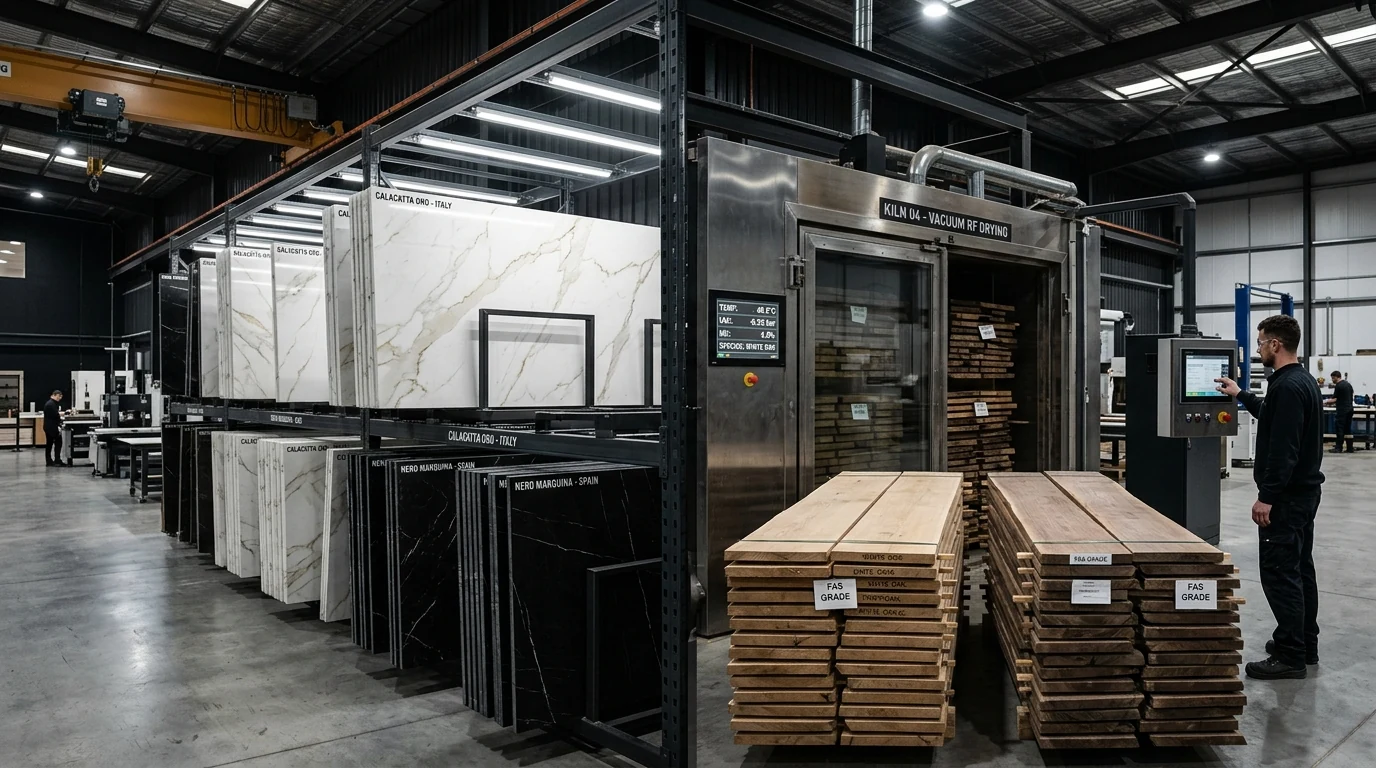
- Controlled ~8%–12% Equilibrium Moisture Content (EMC) Kiln Drying: Timber batches are kiln-conditioned prior to milling to better align with climate-controlled indoor commercial dining environments. (Note: Solid wood tabletops are designed for indoor climate-controlled venues maintaining ~35%–55% relative humidity and naturally exhibit organic grain, knot, and shade variations across boards.)
- Alternating Growth-Ring Stave Joinery: Rather than relying on single wide planks prone to severe cupping, our joiners alternate stave orientations across full-length or finger-jointed boards (as specified per budget tier) bonded under hydraulic clamping with moisture-resistant woodworking adhesive.
- Recessed Steel Anti-Warp C-Channels (For Wide-Span Solid Wood Tops): On solid wood tabletops where specified in the project technical drawing, we CNC-route underside channels and install recessed powder-coated steel C-bars with slotted bolt holes—allowing slight lateral seasonal wood movement while helping restrain vertical cross-grain cupping.
4. Edge-Profile Engineering, Base Pairing & Production Lead-Time Benchmarks
As detailed in our whitepaper on why commercial tabletop edges fail and our restaurant table sizing & seating clearance guide, ordering wholesale tabletops without coordinating the edge profile and commercial restaurant table bases can lead to chipped rims or top-heavy tipping risks.
- Chamfered & Bullnose Edge Profiles on Sintered Stone: Sharp 90-degree stone corners are vulnerable to chipping when servers clear heavy ceramic plates. Our waterjet and edge-polishing lines offer eased micro-chamfers, bullnose edges, or 45-degree shark-nose bevels (per model specification) to help deflect impact forces along the perimeter.
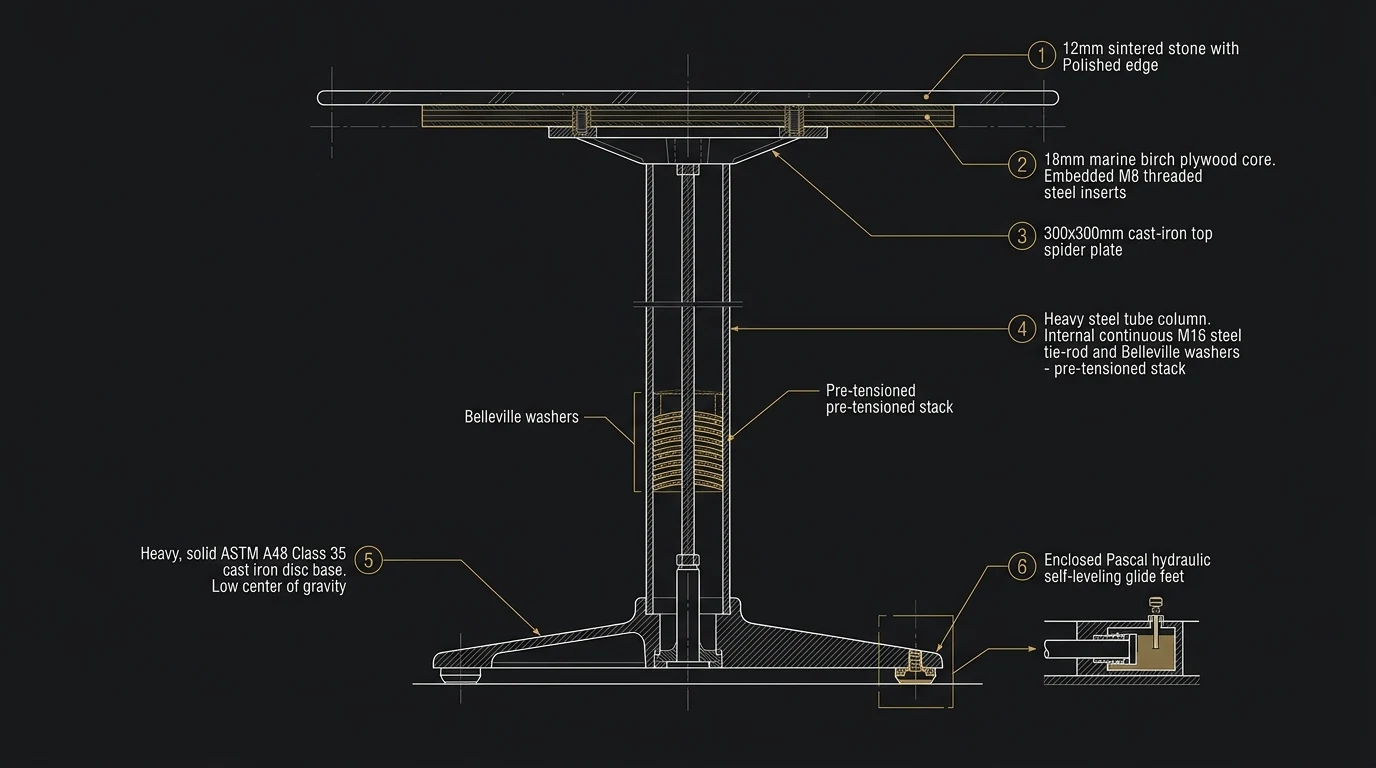
- Matched Cast-Iron Base Ballast: Heavy composite stone or thick solid wood 4-tops (750×1200 mm) require proper base weight and footprint span. Our commercial restaurant dining tables & bases catalog pairs each tabletop dimension with appropriately weighted cast-iron or brushed stainless steel bases featuring central steel tie-rods and adjustable leveling glides (with heavy-duty self-stabilizing glides available as an upgrade).
TECHNICAL NOTE // WHOLESALE PACKAGING, CUSTOM SPECS & LEAD-TIME BENCHMARKS
Factory-Direct Ordering & Indicative Lead Times: Tabletops are manufactured to order in standard or custom dimensions (2-tops, 4-tops, 6-tops, communal tables, and booth sizes). Under normal factory operating conditions, indicative production lead times range from ~20–30 working days for standard catalog tabletops to ~30–45+ working days for custom waterjet sintered stone or solid wood builds after final drawing, edge profile, finish swatch, and deposit confirmation (subject to order volume, slab availability, and seasonal production scheduling).
Contractual Scope: Subtop thickness, pre-drilled M8 insert patterns, recessed C-channels, and edge-banding adhesives are model-dependent options governed by the final signed Proforma Invoice (PI) and approved shop drawings.
5. Frequently Asked Questions (FAQ): Wholesale & Custom Restaurant Tabletops
1. Does a 12mm sintered stone tabletop sound loud or cold when guests set down glasses and silverware?
Bare 12mm stone mounted directly onto hollow metal frames can produce a sharp ringing sound when ceramic plates and wine glasses contact the surface. To improve dining room acoustics on composite builds, Ron Group can bond the 12mm sintered stone slab onto a multi-ply wood subtop using an elastomeric adhesive layer. The underlying wood subtop helps dampen high-frequency impact vibrations while retaining sintered stone's high scratch, heat, and stain resistance.2. Can we order custom tabletop dimensions and corner radii to match existing or irregular booth layouts?
Yes. Because we operate in-house CNC waterjet cutters (for sintered stone) and CNC timber routers (for solid wood, HPL, and compact phenolic) in Foshan, we support custom tabletop dimensions and corner radii tailored to your floor plan—including 620×1150 mm banquette tops, R50 mm rounded corners, or wedge-shaped tables for curved booths. Custom sizing is quoted transparently based on material yield, slab nesting efficiency, and order quantity.3. What is the difference between entry-level melamine tops and heavy-duty commercial HPL tops?
Entry-level melamine tops use thin decorative paper fused onto standard particleboard with basic hot-melt edge glue—suitable only for light-duty, dry indoor use. For high-turn restaurants that wipe tables frequently with wet sanitizer cloths, Ron Group recommends upgrading to 0.8mm–1.0mm high-pressure phenolic laminate (HPL) pressed onto a multi-ply plywood or high-density core with 2mm impact-resistant ABS edge-banding (available with moisture-resistant PUR adhesive bonding per project specification) to significantly improve edge-seam durability.The Foshan Direct Engineering Advantage
At Ron Group, we help hospitality buyers reduce multi-vendor friction, middleman markups, and spatial coordination gaps. By sourcing your complete front-of-house package—custom modular banquettes, sintered stone and kiln-dried hardwood tabletops, cast-iron table bases, contract dining chairs, and commercial tableware—through our Foshan manufacturing and consolidation hub, you can coordinate finishes, align structural specifications, and streamline 40HQ container shipping to your venue.
Engineering & Contractual Scope Note: All structural models, material grades, tolerances, cost ratios, and indicative production lead-time ranges presented in this whitepaper serve as general B2B planning benchmarks under normal operating conditions. Specific hardware configurations (e.g., subtops, M8 inserts, C-channels, foam densities, and custom tooling), custom pricing, and binding delivery schedules are model-dependent and governed strictly by the final signed Proforma Invoice (PI), approved shop drawings, and confirmed physical sample swatches.
1:1 Custom CAD Floor Plan & BOM Review
Submit your architectural DWG/PDF floor plan, target seat count, and target opening window for a preliminary layout & clearance review, itemized factory-direct BOM quote, and material swatch options tailored to your project scope.
Foshan Project Engineering Desk
Need guidance on 40HQ container consolidation, custom OEM booth dimensions, or sintered stone and solid wood tabletop configurations? Connect directly with our project specialists.
Explore Related Hospitality FF&E Technical Dossiers
Wholesale Restaurant Furniture Manufacturer: 40HQ Consolidation Guide
Volumetric cube efficiency (η_cube), landed CapEx modeling, and FCL vs. LCL break-even economics for new restaurant buildouts.
WP-3818 // OEM & Franchise QCRestaurant Furniture OEM Manufacturer Protocol & Multi-Unit Rollout
CAD shop drawing value engineering, 5-axis CNC repeatability, master finish swatches, and repeat franchise production governance.
WP-3819 // Tabletop Substrate SpecRestaurant Table Tops Wholesale: Sintered Stone, Solid Wood & HPL Matrix
Comparing 12mm sintered stone on multi-ply subtops, kiln-dried hardwood with anti-warp C-channels, and optional M8 threaded inserts.
WP-3820 // Spatial ErgonomicsRestaurant Tables, Chairs & Booth Pairing Ergonomics Guide
Loaded cushion differential drop (ΔH_loaded), armrest-to-subtop tuck clearance, base footprint alignment, and ADA knee clearance.
Seating Engineering HubCommercial Booth Seating Hub (16 Models & CAD)
High-resilience commercial foam standards, modular banquette layouts, and interlocking Z-cleat installation mechanics.
Turnkey Procurement HubFoshan Restaurant Furniture Master Guide
Navigating the Shunde and Nanhai furniture industrial clusters, OEM contract prototyping, and 40HQ container consolidation.