Home / Commercial Tables & Bases / 7-Stage Manufacturing Process
PRECISION FOUNDRY & 5-AXIS WATERJET CNC TABLE ENGINEERING

7-Stage Commercial Restaurant Dining Table
& Base Manufacturing Process

Explore the rigorous industrial engineering behind RON GROUP's contract table assemblies: 60,000 PSI 5-axis CNC abrasive waterjet stone fabrication, multi-layer birch core backing with 3,200N barbed M8 inserts, ASTM A48 Class 35 heavy gray iron foundry casting, 1,000-hour salt spray cathodic E-coating, and ocean-ready reinforced A-frame crating.

60,000 PSI
5-Axis Abrasive Garnet Waterjet
1,380°C
HT200 Gray Iron Induction Foundry
≥ 3,200 N
M8 Barbed Insert Pull-Out Proof
1,000 Hrs
ASTM B117 Cathodic E-Coat Salt Spray
0% HAZ
Zero Thermal Stress Micro-Cracks
Production Flow & Stationed Quality Gates

From Raw Sintered Slabs & Molten Iron to Ocean-Ready FCL Shipping

Every commercial tabletop and heavy cast iron pedestal undergoes continuous QA auditing against ISO 9001:2015, ANSI/BIFMA X5.5, and ASTM A48 international contract standards.
01
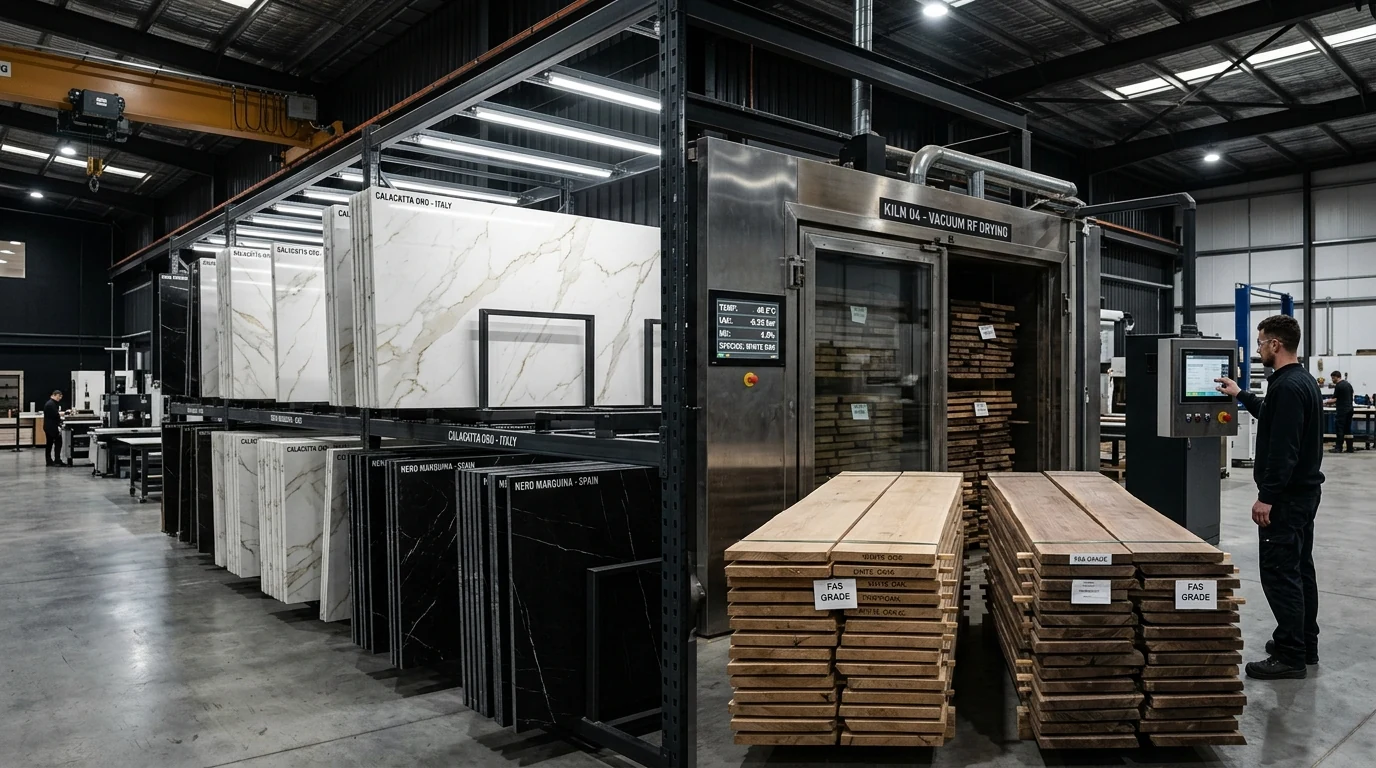
High-density sintered stone slabs and kiln-dried hardwood conditioning warehouse

Sintered Stone Slabs & Hardwood Timber Staging

Raw 12mm sintered stone slabs are inspected under polarized optical scanners for micro-fractures, color delta-E consistency (<0.5), and surface planarity (≤0.5mm over 2400mm). In parallel, FAS-grade American Walnut, White Oak, and Ash timbers undergo digital dehumidification vacuum RF kiln-drying to strictly stabilize Equilibrium Moisture Content at 6%–8% (EMC), preventing post-installation splitting or transverse cup warpage.
Stage 01 Critical Specs

  • Stone Mohs Hardness: Mohs 7 (Scratch Proof)
  • Water Absorption: <0.05% Ultra-Dense
  • Timber Moisture: 6% - 8% EMC Vacuum RF Kiln
  • Food Contact Safety: NSF/ANSI 51 Non-Porous
02
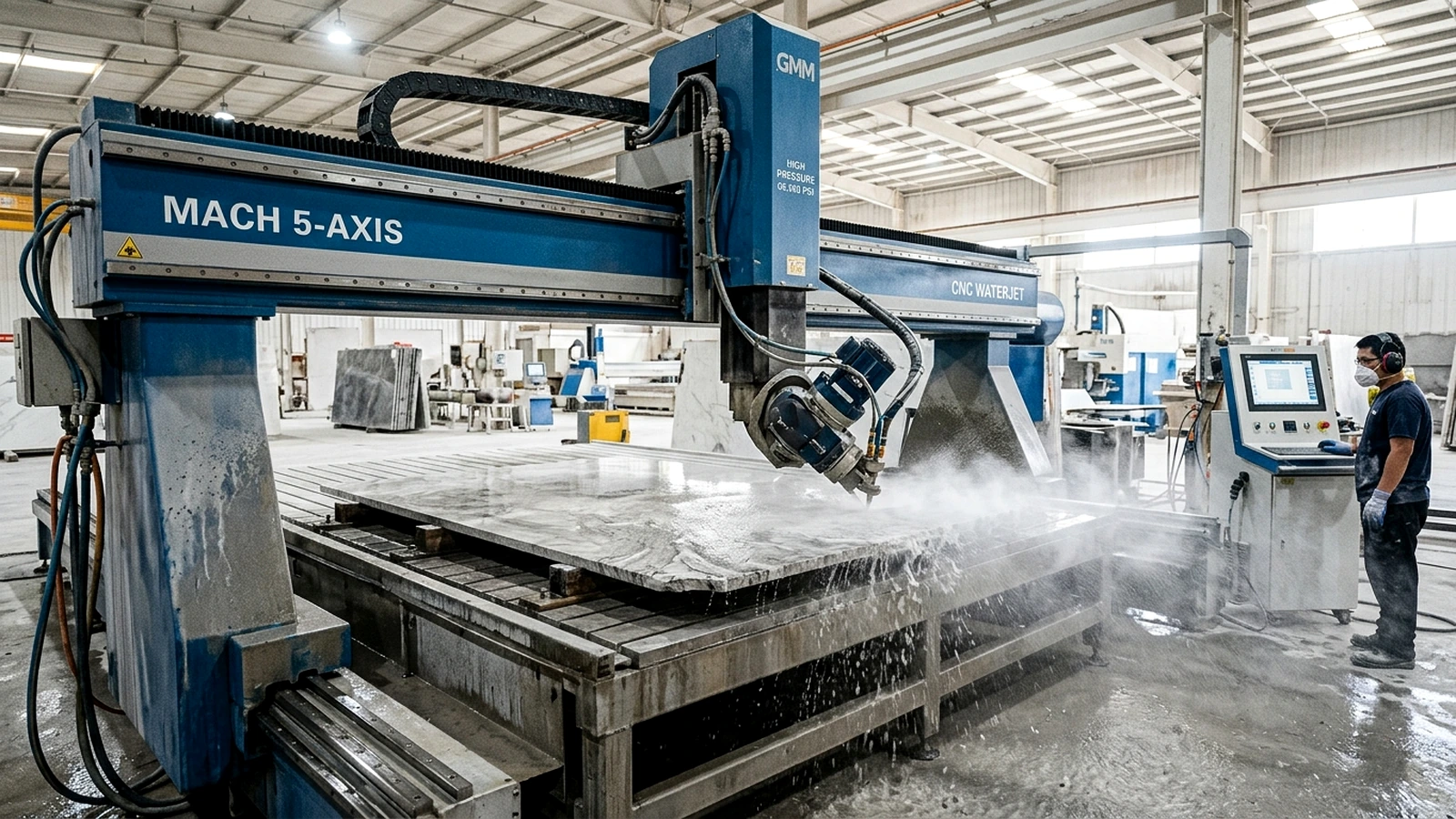
5-Axis CNC Waterjet Precision Stone Cutting and Edge Profiling

5-Axis CNC Abrasive Waterjet Profiling & Edge Honing

High-pressure 60,000 PSI abrasive waterjet cutting systems equipped with 80-mesh garnet abrasive cut intricate geometric shapes (circles, race-tracks, rounded squares) with ±0.3mm positional tolerance without thermal stress. Computer-controlled CNC bridge saws and multi-head diamond profiling wheels grind architectural edge treatments: 2mm Micro-Bevel, 5mm Radius, Half Bullnose, Shark Nose, and 45° seamless drop miter joints.
Stage 02 Critical Specs

  • Cutting Pressure: 60,000 PSI Garnet Waterjet
  • Positional Tolerance: ±0.3mm CNC Controlled
  • Edge Geometries: Micro-Bevel / Shark Nose
  • Thermal Stress: 0% Heat-Affected Zone (HAZ)
03
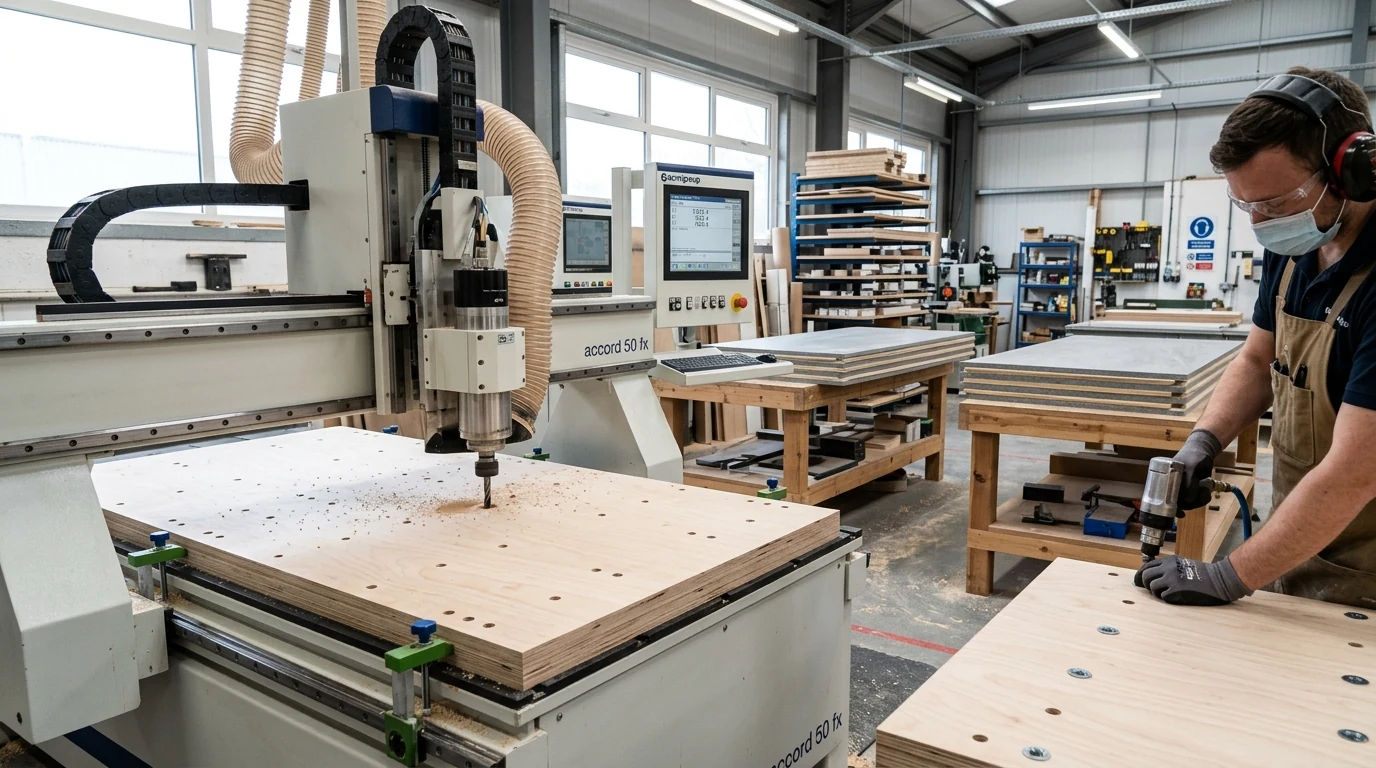
Birch Plywood Structural Sub-Base CNC Routing and Barbed M8 Steel Inserts

Structural Sub-Base Bonding & M8 Barbed Inserts Installation

Directly tapping fasteners into sintered stone causes instantaneous brittle fracture. RON GROUP laminates 15–18mm Russian Birch marine plywood to the stone underside using commercial two-component elastic polyurethane adhesive (Shore D 65), absorbing thermal shear differential. Automated CNC routing drills blind pilot holes into the wood core to embed flanged barbed steel M8 inserts, providing >3,200N anchor pull-out resistance.
Stage 03 Critical Specs

  • Sub-Base Material: 18mm E0 Marine Birch
  • Adhesive System: 2-Part Elastic PU (Shore D 65)
  • Insert Pull-Out Force: >3,200N Tensile Capacity
  • Solid Wood Bracing: Slotted C-Channel Steel Cleats
04
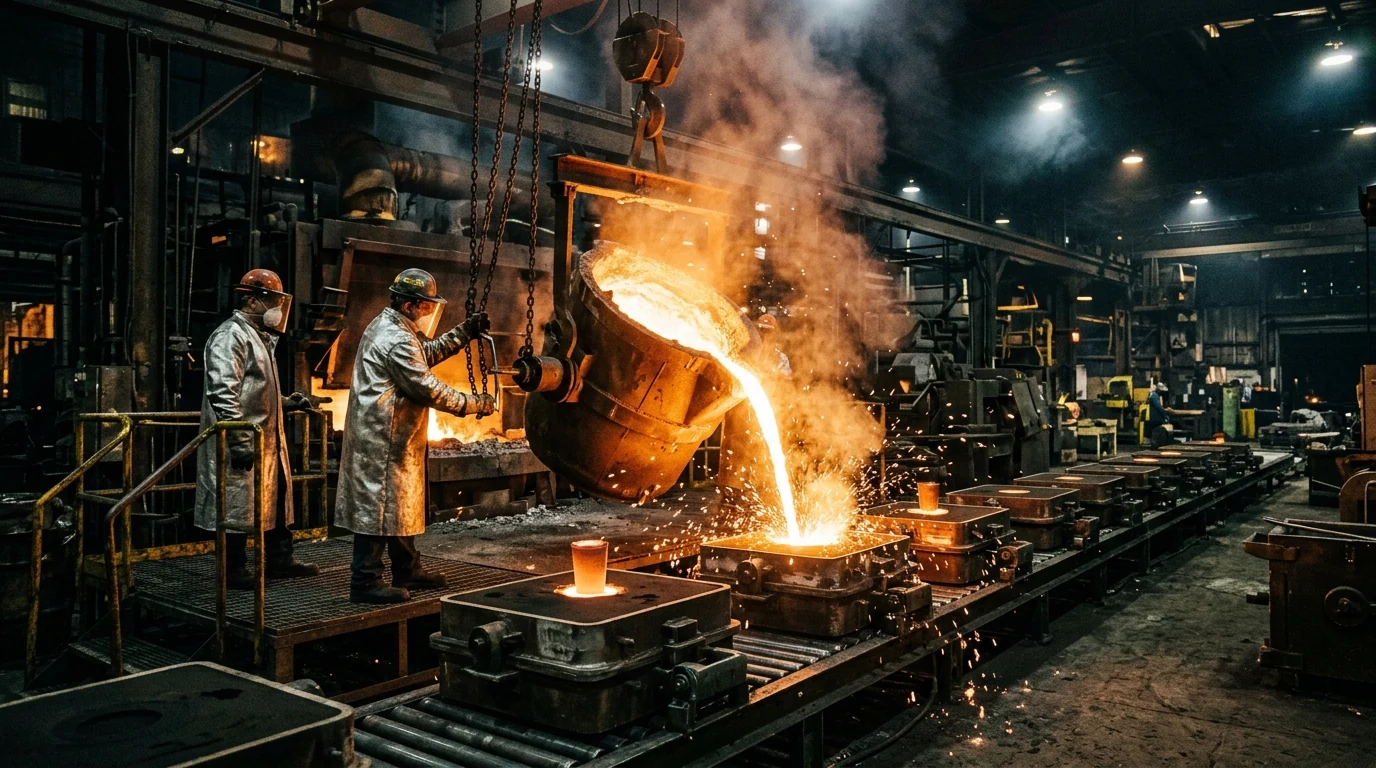
ASTM A48 Class 35 Gray Cast Iron Gravity Pouring Foundry

ASTM A48 Class 35 Gray Cast Iron Gravity Sand Pouring

In our specialized foundry lines, HT200 gray iron is melted in induction furnaces and poured at 1,380°C into precision automatic flask sand molds. The graphite flake microstructure inherently dissipates kinetic vibrations 300% more effectively than hollow fabricated steel. Base castings are produced with solid 16–26.5kg mass and calibrated to maintain a critical footprint ratio $D \ge 0.6W$, eliminating overturning hazards.
Stage 04 Critical Specs

  • Metallurgy Standard: ASTM A48 Class 35 (HT200)
  • Pouring Temperature: 1,380°C Induction Furnace
  • Vibration Damping: 3× Welded Tubular Steel
  • Anti-Topple Ratio: $D \ge 0.6 imes W_{table}$ (SF ≥ 2.2)
05
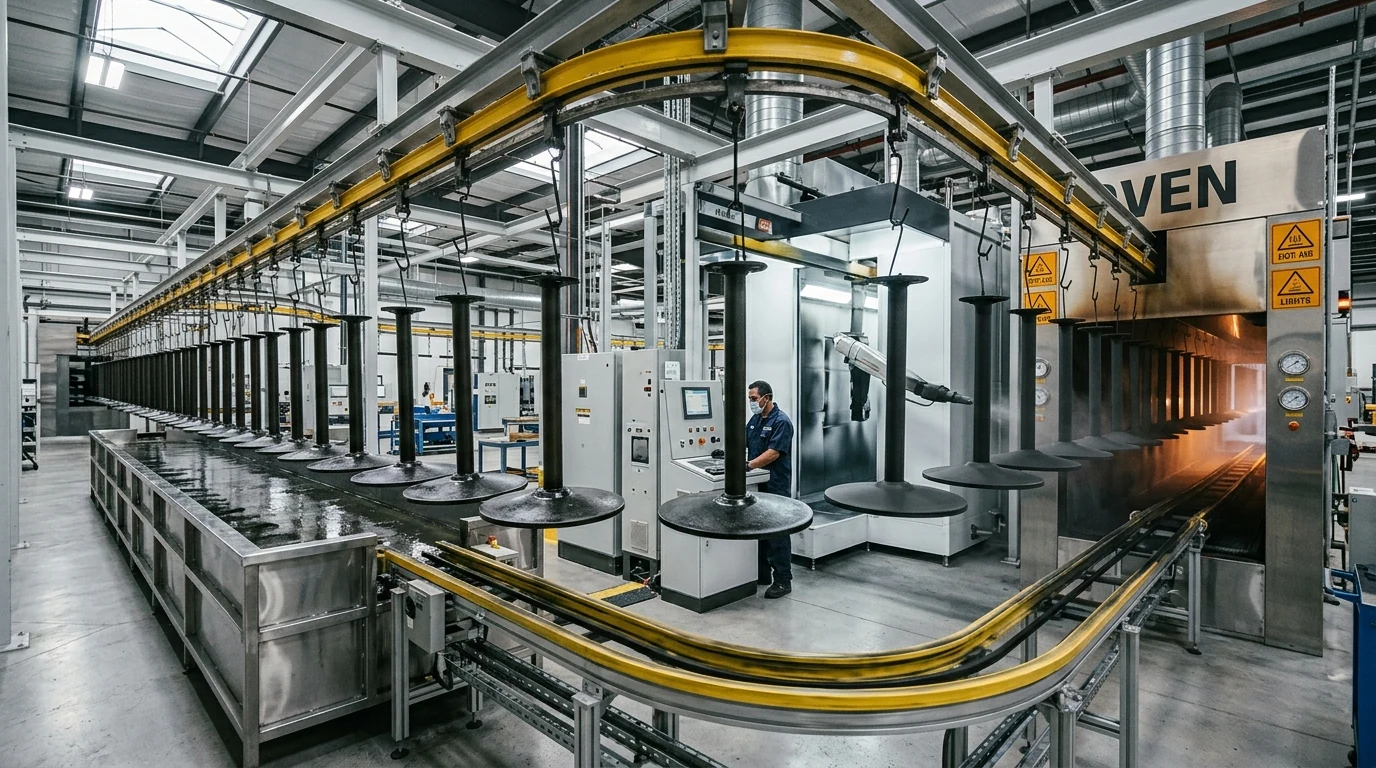
Automated Cathodic E-Coating and Architectural TGIC Powder Coating Line

7-Stage Immersion Pre-Treatment, Cathodic E-Coating & Powder Bake

Raw castings and steel columns undergo an automated 7-stage immersion process: hot alkaline degreasing, acid pickling, surface conditioning, and zinc phosphate conversion. Components are submerged in cathodic electrodeposition baths (E-coating) achieving a 20–25μm uniform corrosion shield inside tube cavities. Finished with architectural TGIC polyester powder baked at 200°C, certified for ASTM B117 1,000-hour salt spray.
Stage 05 Critical Specs

  • Pretreatment: 7-Stage Zinc Phosphate Dip
  • Electrophoretic Coat: 20 - 25μm Cathodic E-Coat
  • Exterior Finish: TGIC Outdoor Polyester Bake
  • Salt Spray Rating: ASTM B117 ≥1,000 Hours
06
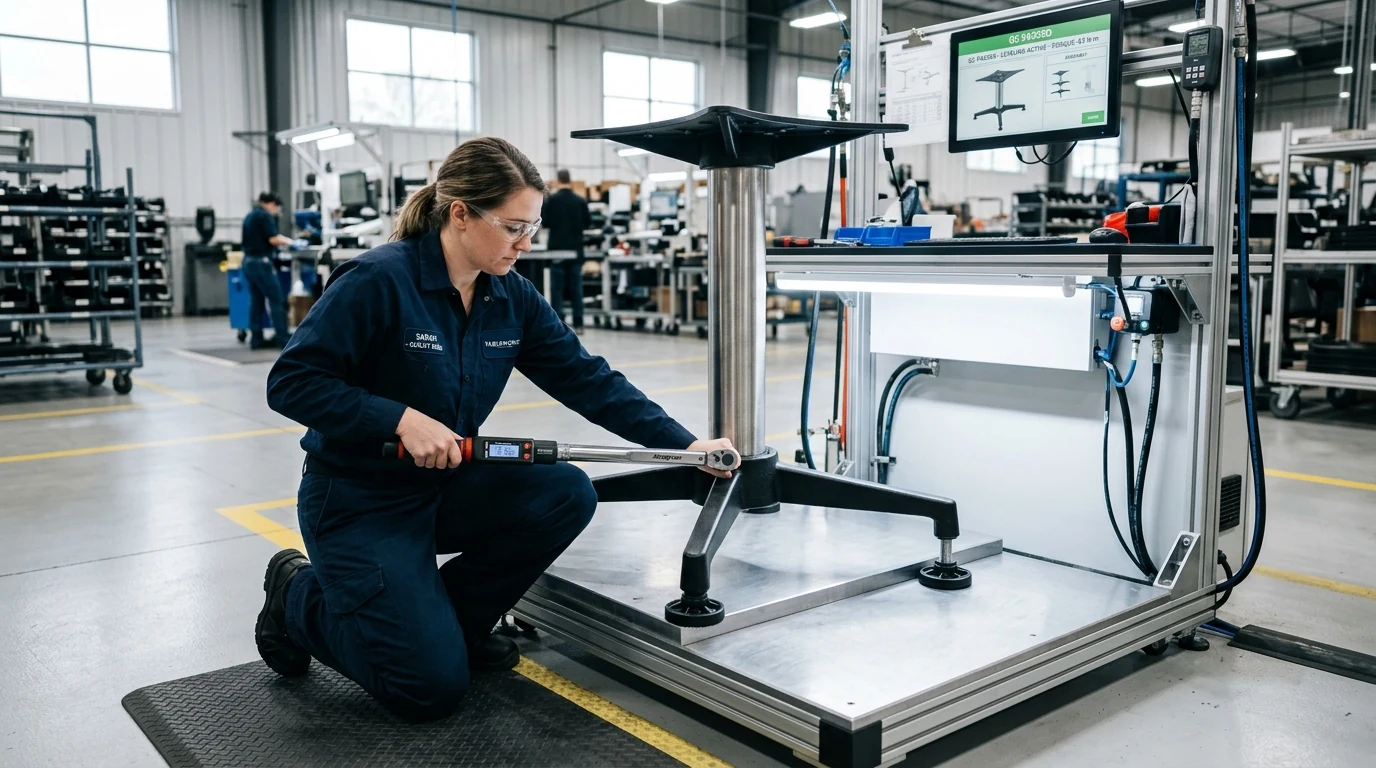
M16 High-Tensile Tie-Rod Pre-Assembly and Pascal Hydraulic Glides Testing Station

M16 High-Tensile Tie-Rod Pre-Assembly & Pascal Hydraulic Setup

The base plate, heavy-wall central column, and top spider plate (300×300mm cast ductile iron or 3.5mm laser steel) are unified by a continuous M12–M16 high-tensile threaded steel tie-rod torqued to 85 N·m with anti-loosening serrated Belleville spring washers. Integrated Pascal sealed hydraulic micro-piston feet are tested on 3.0mm stepped test fixtures to verify automatic fluid redistribution and instant lock in <0.3 seconds.
Stage 06 Critical Specs

  • Tie-Rod Hardware: M12 / M16 High-Tensile Steel
  • Torque Calibration: 85 N·m + Belleville Washers
  • Leveling Fluid: Pascal Closed-Loop System
  • Leveling Speed: <0.3s Automatic Lock
07
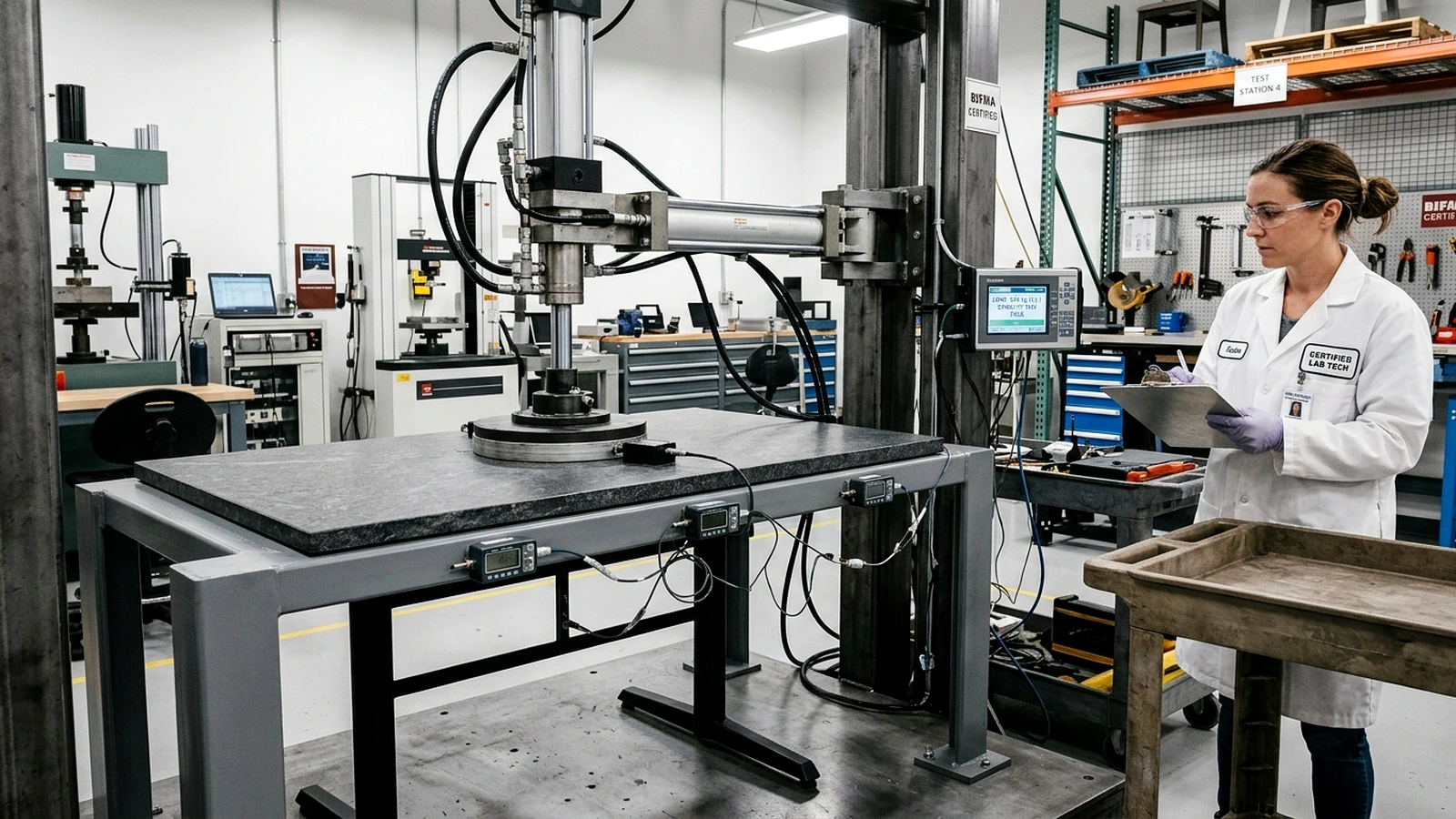
ANSI BIFMA X5.5 Structural Load Testing and Reinforced ISPM 15 A-Frame Export Crating

ANSI/BIFMA X5.5 Stress Proofing & Vertical A-Frame Crating

Finished tables pass rigorous ANSI/BIFMA X5.5 structural audits: 125 lbf cantilever edge load, 400 lbf center static load, and 20,000 horizontal racking cycles. For ocean shipping, sintered stone tops are packed vertically in heavy-duty A-frame solid timber crates with EVA corner protection and desiccants, compliant with ISPM 15 heat treatment standards to survive rough ocean transit without cracking.

Stage 07 Critical Specs

  • Durability Standard: ANSI/BIFMA X5.5 Compliance
  • Proof Test Loads: 125 lbf Edge / 400 lbf Center
  • Crate Architecture: Reinforced Vertical A-Frame
  • Phytosanitary: ISPM 15 Heat-Treated Stamp
Radical Engineering Transparency

Internal Architecture of a Commercial Dining Table & Base

A complete engineering cross-sectional breakdown of the precision components engineered into every RON GROUP table assembly, ensuring zero tipping, zero rock, and zero surface degradation over 10+ years of high-volume dining service.
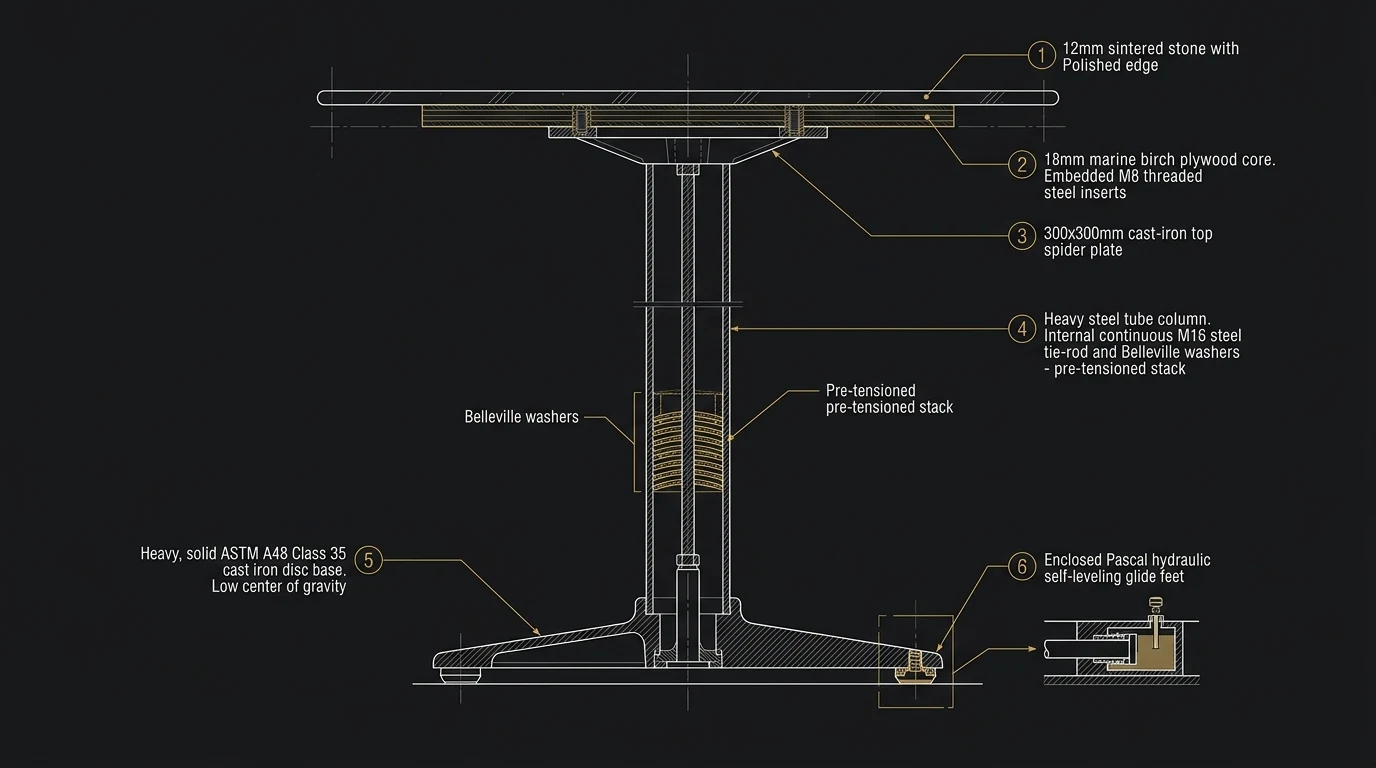
Full Engineering Cutaway Scheme Commercial Restaurant Dining Table Full Engineering Cutaway Blueprint
1

12mm High-Density Sintered Stone with Polished Edge

Mohs 7 surface impervious to knife cuts, hot skillet thermal shock (1200°C), red wine stains, and commercial sanitizers. Diamond-honed R2mm perimeter edge.

2

18mm Marine Birch Core with CNC Barbed M8 Inserts

Flexible polyurethane adhesive substrate buffers thermal expansion shear. Flanged M8 steel inserts provide >3,200N pull-out resistance without cracking stone.

3

300×300mm Heavy Cast Iron / 3.5mm Laser Steel Spider Plate

Distributes overturning cantilever moment arms across an expansive structural surface area, completely eliminating localized perimeter wobble.

4

Heavy-Wall Steel Column with Continuous M16 Tie-Rod

Continuous internal high-tensile steel rod torqued to 85 N·m with serrated Belleville spring washers, preventing base-column loosening under cyclic vibration.

5

ASTM A48 Class 35 Cast Iron Heavyweight Footprint Base

Solid 16–26.5kg gravity-cast gray iron anchor engineered to satisfy the critical footprint ratio $D \ge 0.6W$, creating an immovable center of gravity.

6

Pascal Hydraulic Closed-Loop Auto-Leveling Micro-Glides

Interconnected fluid chambers compensate for 1–6mm uneven floor grout dips in <0.3s, locking rigidly when diner weight is applied without manual adjustments.

Manufacturing Footprint & Verification Labs

Dual-Engine Production Facilities & Testing Infrastructure

Our integrated manufacturing footprint combines automated CNC stone fabrication, heavy sand-casting foundry, and contract stress testing rigs in Foshan, China.

CNC Waterjet Lab

60,000 PSI Waterjet Lines

Dual-head 5-axis abrasive waterjets capable of processing 250+ custom-profiled sintered stone tops daily with ±0.3mm tolerance and zero edge chipping.

Foundry & Casting

Automated Sand Molding

Specialized foundry pouring ASTM A48 Class 35 (HT200) gray iron pedestals and custom architectural cantilever wall brackets with over 5,000 base units monthly capacity.

Finishing & Coating

Cathodic E-Coating & Powder Line

Full immersion zinc phosphating, 25μm automated electro-coating, and dual-curing TGIC powder bake ovens certified for 1,000-hour ASTM B117 salt spray exposure.

Quality Lab

ANSI/BIFMA X5.5 Test Bench

Pneumatic cyclic testing rigs performing 20,000-cycle horizontal racking, 400 lbf static center loading, and digital torque calibration before every export container dispatch.

Packaging Facility

ISPM 15 A-Frame Crating

Dedicated export timber workshop fabricating custom vertical A-frame crating with high-density EVA shock padding, desiccant barriers, and heat-treatment stamps.

Global Delivery

10,000+ Delivered Projects

Outfitting major restaurant chains, 5-star hotel dining rooms, food halls, and airport concessions across 108 countries since 2005 with consolidated 40HQ container logistics.
Article 2118 Engineering Sizing and Base Selection Whitepaper
B2B Engineering Intelligence · Whitepaper 2118

Commercial Restaurant Table Sizing & Base Selection Guide

Read our companion engineering whitepaper covering tipping moment mechanics (\(M_{tip} = F_{edge} \cdot L_{cantilever}\)), cast iron vs aluminum weight ratios, and the Cornell RevPASH capacity matrix.

Read Whitepaper →
Direct Factory Sourcing & Container Consolidation

Request a 7–10 Day 1:1 Pre-Production Physical Table Sample

Verify sintered stone edge profiling, sub-base screw retention, cast iron base weighting, and hydraulic leveling action with a full 1:1 physical sample before releasing full container production runs. Shipped via air express directly to your project office.

Apply for Table Mockup & Factory RFQ → Browse 16 Table Styles
✓ 100% Foshan Foundry Direct Pricing ✓ Zero Multi-Factory Destination LCL Markup ✓ AQL 2.5 Quality Inspection & 1:1 Pre-Assembly Guaranteed

Explore the Complete Commercial Hospitality Engineering Ecosystem

Compare our 16 North American benchmarked table models, review 5 major client pain points and mathematical solutions, or inspect our matching commercial booth seating collection.

16-Model Catalog → Pain Points & Solutions → Commercial Booths Hub → Sourcing Portal →
Technical FAQ

Frequently Asked Questions by Hospitality Buyers

Direct technical answers addressing commercial table engineering, stone fabrication, and international logistics.

Why can't wood screws be installed directly into sintered stone tabletops?
Sintered stone has zero elasticity and high internal surface tension. Driving standard self-tapping screws directly into drilled pilot holes generates concentrated hoop stresses that cause instant radial cracking. RON GROUP laminates an 18mm Russian birch plywood core with flexible polyurethane epoxy and embeds threaded M8 barbed inserts, distributing screw forces evenly across a wood substrate.
Why does RON GROUP prioritize ASTM A48 Class 35 cast iron over welded tubular steel?
HT200 gray cast iron possesses internal graphite flakes that absorb impact and vibration frequencies 300% faster than hollow steel tube fabrications. Additionally, its concentrated weight (16–26.5kg per base) lowers the table assembly center of gravity, satisfying the critical tipping criterion \(D \ge 0.6W\) with a much smaller floor footprint, leaving generous legroom for seated diners.
How does the cathodic E-coating finish prevent rust in high-turnover restaurants?
Floor mop water contains harsh acidic or alkaline detergents that quickly rust standard wet-sprayed metal bases. Our cathodic electrodeposition process (E-coating) immerses the entire casting into an electrically charged resin tank, forming a continuous 20–25μm hydrophobic barrier inside and outside the casting. Top-coated with baked TGIC powder, our bases exceed 1,000 hours in ASTM B117 salt spray chambers without peeling or corrosion.
How do you package sintered stone tops to guarantee zero transit breakage?
Shipping stone tops flat in horizontal cartons leads to catastrophic mid-span flex fracture during ocean transit. RON GROUP packs all stone tops vertically in heavy-duty solid timber A-frame crates compliant with ISPM 15 heat treatment standards. Tops are separated with 5mm high-density foam, capped with heavy EVA corners, vacuum shrink-wrapped, and strapped to the frame with steel banding.
What is the minimum order quantity (MOQ) and production lead time?
Our standard production MOQ is 10 tables (or mixed container assortments with chairs and booths). Typical manufacturing lead time is 25–35 days from approved shop drawings and sample sign-off. Expedited 1:1 physical sample mockups can be fabricated and dispatched via air courier within 7–10 working days.