
Five Core Engineering Failure Modes & Factory Countermeasures
Hospitality operations across the globe battle the same five commercial dining table liabilities. Select your operating domain below to review our mathematical stress analysis and factory-tested countermeasures.
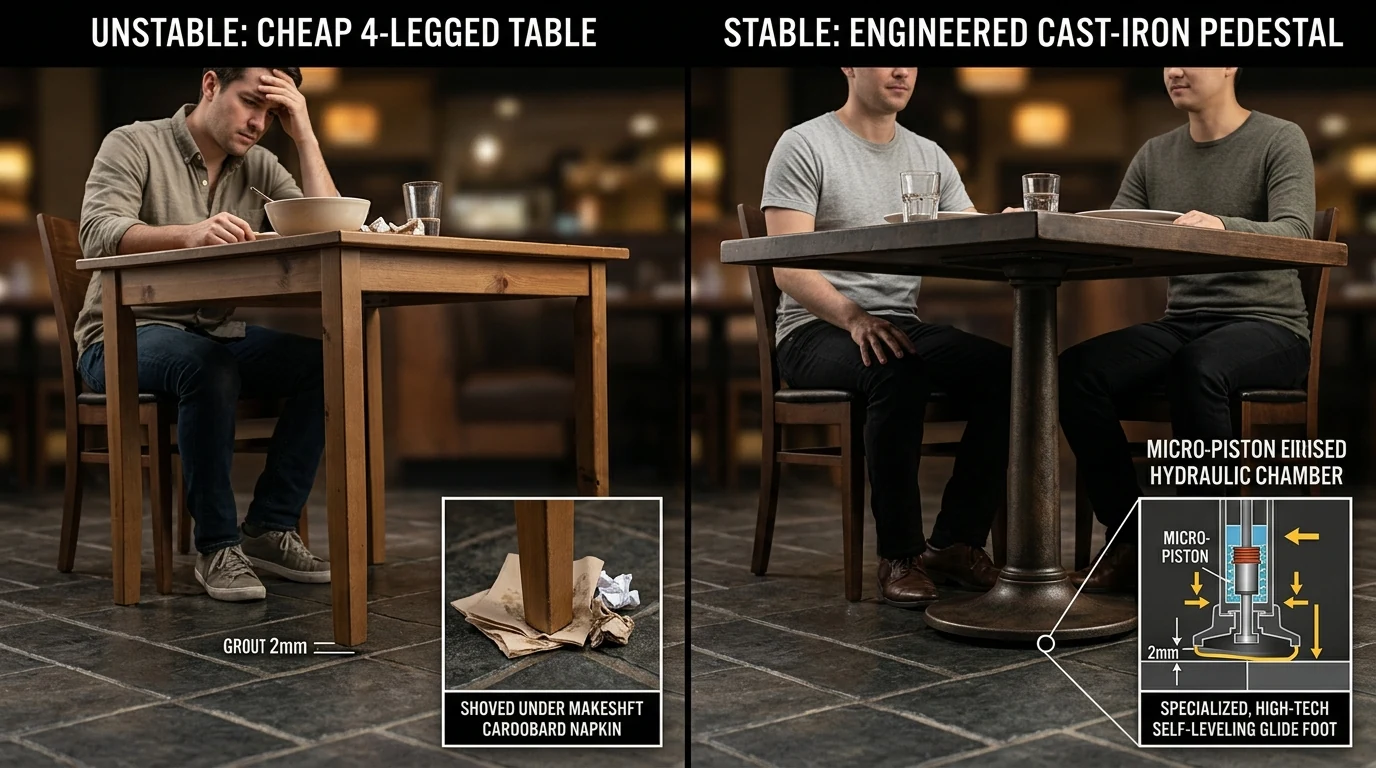
Wobbly Tables on Commercial Tile & The André Martin Theorem Fallacy
“Our bussers waste 20 minutes before every dinner service jamming folded drink coasters and napkins under wobbly table feet. The second a guest pulls the table back, the coasters slide out, wine glasses spill, and our Yelp reviews get hammered.” — Director of Operations, 14-Location Steakhouse Chain, Dallas, TX.
Industry Liability: The Napkin Humiliation
- Spatial Over-Constraint: According to the Kutzbach-Grübler mobility criterion, exactly 3 points define a geometric plane ($M = 0$). Adding a fourth rigid leg produces an over-constrained system ($DOF = -1$).
- The 1–3mm Tile Grout Cliff: Commercial ceramic and slate tile floors contain 1.0mm to 3.0mm grout line step discontinuities. The fourth foot hovers in midair, rocking diagonally under every forearm load.
- Why André Martin's Theorem Fails: Physicists cite the intermediate value theorem (rotating a 4-legged table $\le 90^\circ$ finds a level point). In dense commercial dining rooms, rotating a square table by $45^\circ$ blocks 900mm ADA service aisles and crashes into neighboring chairs!
RON GROUP Counter-Specification: Pascal Hydraulic Leveling
- Pascal Closed-Loop Fluid Circuit: We integrate sealed hydraulic micro-piston feet utilizing Pascal's Law ($\Delta P = F_i / A_i$). When placed on an uneven floor, fluid redistributes across 4 interconnected chambers in <0.3 seconds.
- Automatic 1–6mm Elevation Stroke: Absorbs deep grout dips and floor heave without requiring staff to bend over or adjust manual screw threads that inevitably loosen.
- Zero-Compliance Dynamic Lock: The moment a diner leans downward, internal micro-valves close, locking the table into a rigid static assembly rated for 1,334N (300 lbf) static proof load.
Kinematic Mobility:
M = 6(N - 1 - J) + Σ f_i = -1 (Rigid 4-Leg Over-Constrained)Pascal Fluid Compensation:
Δh_4 = (V_fluid - (Δh_1·A_1 + Δh_2·A_2 + Δh_3·A_3)) / A_4 [Lock Time t < 0.28s]
Pedestal Overturning Accidents & Shigley Center-of-Gravity Ballast
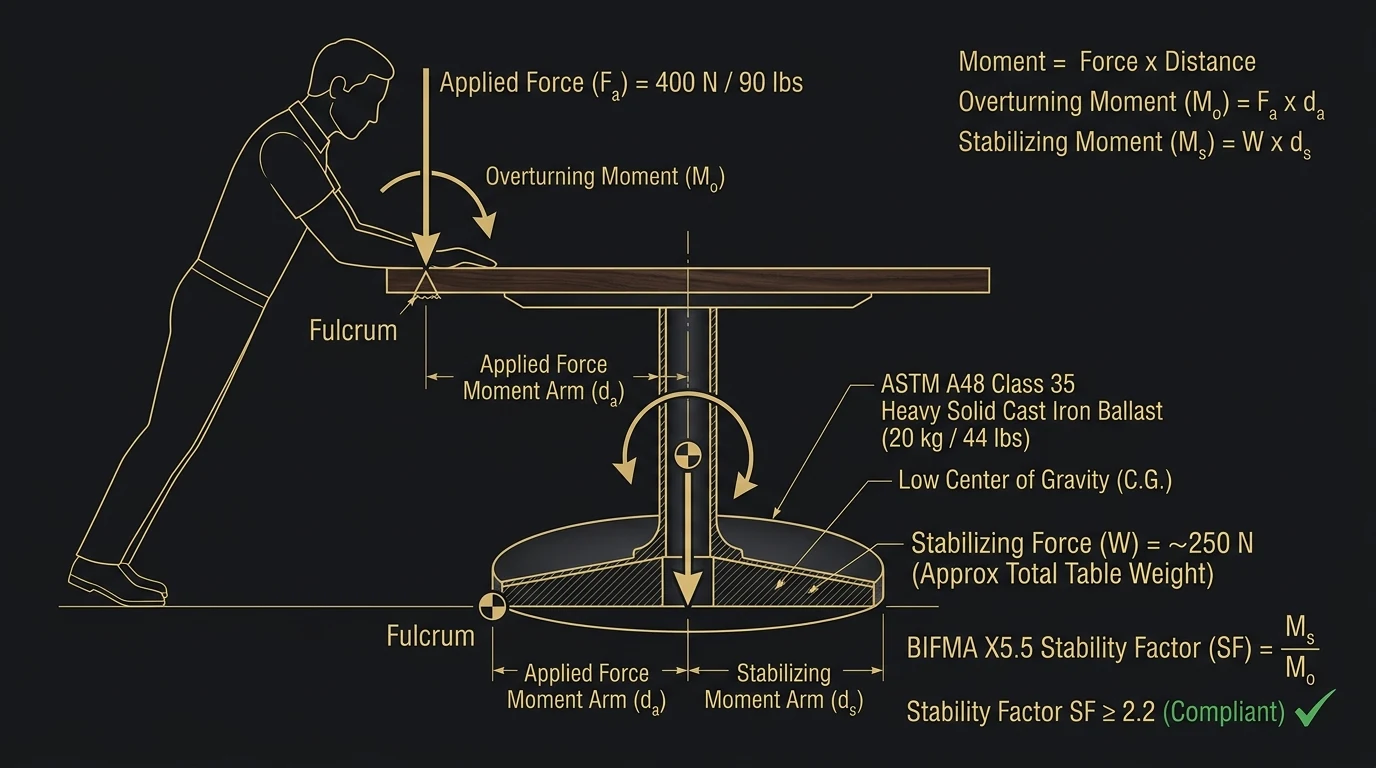
“An elderly patron leaned hard on the outer corner of a round cocktail table to stand up. The table flipped, spilling boiling clam chowder into her lap. We faced a $120,000 personal injury liability suit due to an undersized aluminum base.” — Corporate Risk Manager, Resort Hotel Group, Gold Coast, Australia.
Industry Liability: Dangerous Undersized Bases
- Inadequate Base Footprint: Low-cost importers pair large 900mm (36″) tabletops with tiny 350mm bases to cut ocean freight weight, severely violating moment arm equilibrium.
- Lightweight Stamped Sheet Metal: 2.0mm hollow steel bases weigh only 6–8 kg. The table's center of gravity resides near the tabletop, creating high rotational inertia when leaned upon.
- Tip-Over Catastrophe: A downward vertical force of just 180N (40 lbs) on the outer perimeter exceeds the restoring moment, flipping the table and scalding diners.
RON GROUP Counter-Specification: D ≥ 0.6W Cast Iron Ballast
- Strict Shigley Base Ratio: Base effective diameter $D$ must satisfy $D \ge 0.6W$. A 750×750mm tabletop mandates a minimum 450mm base spread; a 900mm top mandates 540mm+.
- ASTM A48 Class 35 (HT200) Gray Iron: Solid gravity-molded cast iron ballast (16.0–26.5 kg) concentrates 75% of assembly mass within 40mm of the floor.
- Safety Factor SF ≥ 2.2: Guarantees the restoring moment $M_{stab} = W_{base} \cdot (D/2)$ exceeds extreme patron leaning loads ($M_{tip} = F_{guest} \cdot (W/2)$).
Restoring Moment:
M_s = W_base · (D / 2) + W_top · (W / 2)Tipping Threshold:
F_tip = (W_base · D/2) / (W/2) ≥ 400 N (90 lbf) [Safety Factor SF ≥ 2.2 Compliant]
Solid Wood Tabletop Cupping & The Hoadley 1:10:20 Shrinkage Law
“We ordered solid American walnut tables for our waterfront bistro. After four months of ocean humidity, half the tops cupped upward like canoes, cracking the center glue joints. The supplier claimed it was 'natural wood behavior' and refused warranty.” — General Manager, Waterfront Dining, Sydney, Australia.
Industry Liability: Rigid Fastening & Green Timber
- High Equilibrium Moisture Content: Air-dried timber shipped at 14–18% EMC rapidly shrinks when entering climate-controlled indoor restaurant environments (50% RH).
- Hoadley Anisotropy Ignored: Timber shrinks in a 1:10:20 ratio (Longitudinal : Radial : Tangential). Tangential shrinkage across flat-sawn boards induces severe transverse stresses.
- Rigid Screw Fastening: Screwing a solid wood top directly to a stamped steel spider without expansion relief tears the grain apart, causing catastrophic longitudinal splits.
RON GROUP Counter-Specification: Slotted C-Channels & Vacuum Kiln Dry
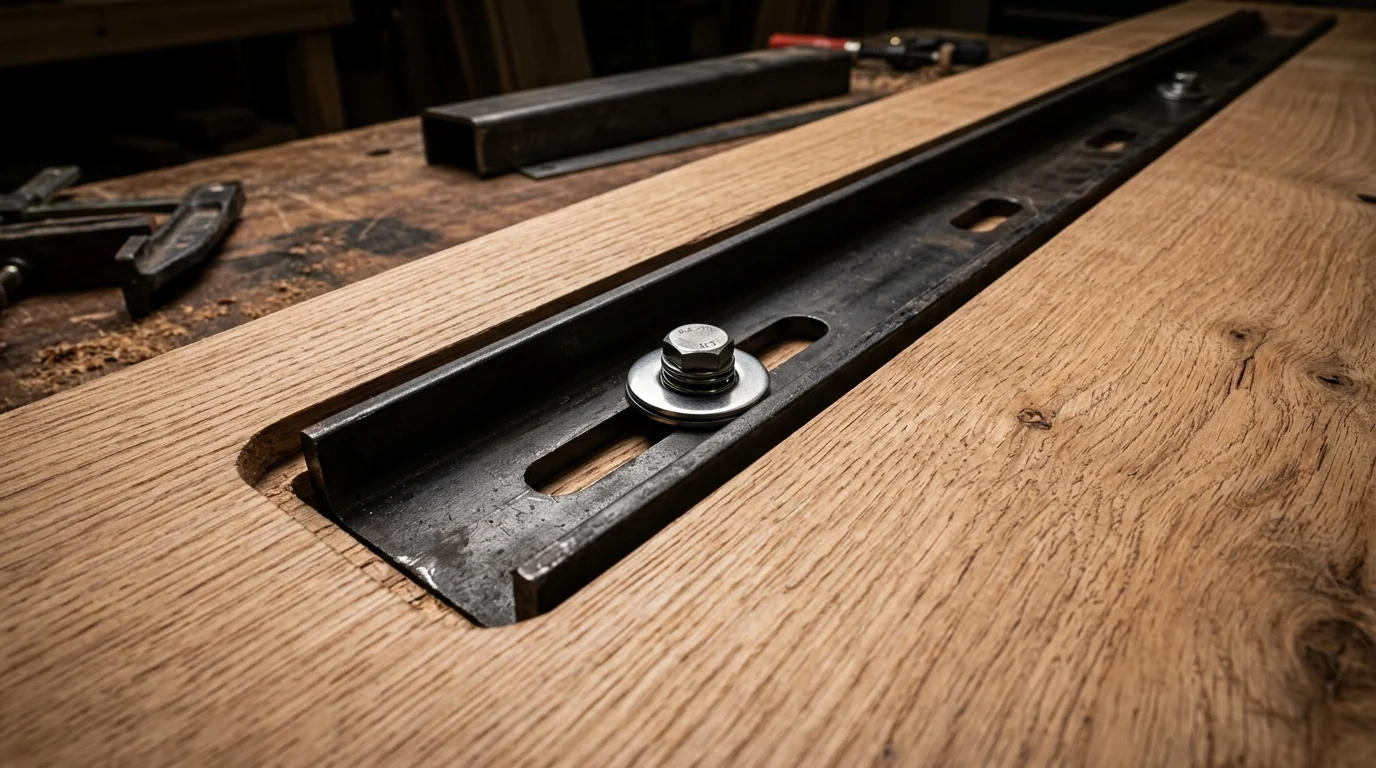
- Vacuum Kiln-Drying to 6%–8% EMC: Solid FAS White Oak and Ash conditioned in digital kilns to exact hospitality equilibrium, preventing post-install shrinkage.
- Dual Underside Steel C-Channels: CNC back-routed into the bottom face with 8mm elongated expansion slots and spring-loaded stainless washers.
- Free Lateral Breathing: The wood expands and contracts naturally across seasonal humidity swings while the rigid steel channel prevents transverse cupping.
Tangential Shrinkage:
ΔS_T = S_0 · C_T · (EMC_initial - EMC_final)Slotted Expansion Clearance:
Slot_length ≥ ΔS_T + 4.0mm [Zero Cupping Stress Relief]
Sintered Stone Edge Chipping & Fastener Pull-Out Failure
“We loved the look of marble-pattern sintered stone, but after 3 months, dinner plates chipped the sharp edges, and when a busser dragged a table, the mounting screws ripped right out of the stone, shattering a $400 top.” — Director of Purchasing, Boutique Hotel Collection, Chicago, IL.
Industry Liability: Direct Tapping & Sharp 90° Edges
- Brittle Tension Mechanics: Sintered stone possesses extreme compressive strength (Mohs 7) but low tensile elasticity. Direct wood screws drilled into stone act as destructive wedge splitters.
- Razor Sharp 90° Edges: Budget suppliers leave waterjet-cut slabs with raw 90° square edges. Any heavy stainless flatware or beer mug impact causes immediate micro-spalling.
- Delaminating Honeycomb Backers: Using cheap aluminum honeycomb backer plates with water-soluble glue leads to moisture failure under daily restaurant mopping.
RON GROUP Counter-Specification: 18mm Birch Sub-Top & M8 Helicoils
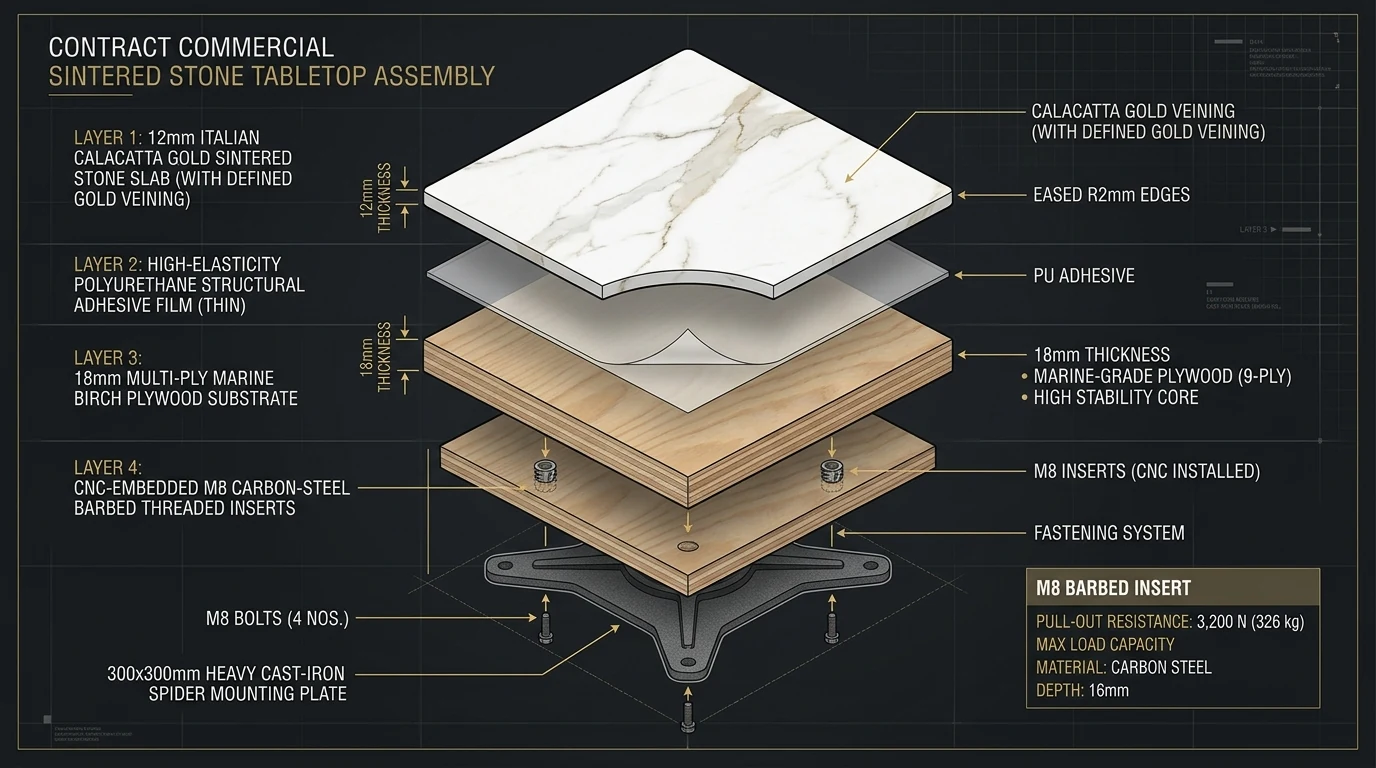
- 18mm Marine Birch Sub-Plate: 12mm sintered stone is permanently bonded to CARB P2 multi-ply birch with high-modulus elastic polyurethane structural adhesive.
- CNC Barbed M8 Helicoil Inserts: Base spider bolts fasten exclusively into high-tensile steel threaded inserts embedded in the birch backing, resisting ≥3,200N direct pull-out force.
- Eased R2mm & Chamfered Profiles: Sintered stone edges are diamond hand-polished to an eased R2mm pencil radius or wrapped in protective solid brass perimeter rims.
Pull-Out Resistance:
F_pull = π · d_eff · L_embed · τ_allow ≥ 3,200 N (326 kg)Substrate Interface:
High-Modulus Elastic PU Adhesive Layer absorbs 100% mechanical point stresses
Bruised Shins & Trap Doors in Deep Restaurant Booth Seating
“Guests constantly bang their knees and shins against table base prongs when sliding into our deep booth seating. Servers can't clean the floor under the tables without kneeling down with hand brooms.” — Franchise Operations VP, Fast Casual Dining, London, UK.
Industry Liability: Standard Pedestals in Booth Benches
- The Floor Prong Shin-Trap: Placing standard 22×22″ cross bases or 450mm round discs inside booth banquettes forces diners to twist their knees awkwardly around metal obstacles.
- Mopping Nightmare: Staff cannot run standard commercial mop heads beneath booth tables because base columns block floor clearance, creating accumulated grime zones.
- Tabletop Instability from Uneven Pulling: Guests yank on pedestal tables to pull themselves out of deep booths, loosening column tie-rods over time.
RON GROUP Counter-Specification: Cantilever Wall Mount & Inset T-Bases
- Heavy 3.5mm Steel Cantilever Wall Truss: Bolts directly into wall structural studs, suspending the tabletop with zero floor legs for 100% legroom freedom.
- Recessed Dual T-Bases (250mm Inset): When free-standing tables are required, T-bases are inset 250mm from perimeter edges, keeping floor columns far away from diner entry paths.
- Integrated Booth Coordination: Engineered to align perfectly with RON GROUP Commercial Booth Seating Systems with 0–25mm standard cushion overhang.
Cantilever Load Capacity:
M_b = P · L_span ≤ σ_allow · Z_steel [Proof Load Rating: 850 lbs (3,780 N)]Floor Obstruction =
0.0mm (100% Clean Pass for Maintenance Staff)
Commercial Table Engineering Benchmark Matrix
Side-by-side engineering comparison between generic trading company tables and RON GROUP direct factory specifications.
| Engineering Parameter | Generic Trading Company Table | RON GROUP Contract Table System | Operational Impact / ROI |
|---|---|---|---|
| Leveling Mechanism | Manual plastic screw glides (falls off) | Closed-loop hydraulic auto-leveling (1–6mm) | Eradicates napkins; saves 20 min/day busser prep time |
| Base Ballast & Metal | Stamped hollow sheet steel (6–9 kg) | ASTM A48 Class 35 HT200 Cast Iron (16–26.5 kg) | Guarantees D ≥ 0.6W tipping safety factor SF ≥ 2.2 |
| Sintered Stone Sub-Top | Raw stone direct tapped or hollow metal | 18mm Marine Birch Backer + M8 Helicoils | Resists 3,200N pull-out force; zero cracked stone slabs |
| Solid Wood Anti-Warp | Rigid screws into flat steel plate | Slotted C-Channels + 6%–8% Vacuum Kiln EMC | Absorbs Hoadley shrinkage; zero top cupping or splits |
| Corrosion Protection | Single spray paint coat (rusts in 90 days) | Cathodic E-Coating + 200°C Polyester Powder | ASTM B117 1,000-hour salt spray; mop chemical immune |
| Booth Seating Clearance | Generic 22x22" cross base (shin collider) | Cantilever Wall Truss / 250mm Inset T-Base | 100% legroom clearance; 70% faster floor cleaning |
100% Anti-Wobble
Hydraulic micro-pistons instantly absorb tile step drops up to 6mm under Pascal's fluid law.
Anti-Tipping Stability
Base footprint strictly satisfies D ≥ 0.6W with solid HT200 cast iron low-profile ballast.
Zero-Crack Mounting
18mm marine birch sub-plates with CNC barbed M8 inserts withstand 3,200N direct pull-out tension.
Direct Factory Control
Manufactured in Foshan foundries with 5-axis waterjet cutting and turnkey container freight consolidation.
Frequently Answered Engineering Inquiries
Critical specifications regarding tile step tolerances, pull-out forces, and commercial tipping compliance.
Get Your Custom Table BOM Breakdown & Landed Cost Analysis
Upload your restaurant floor plan CAD, table schedule, or seat count. Receive a transparent factory-direct BOM breakdown, ASTM A48 / BIFMA X5.5 stability test dossier, and centralized container consolidation savings model within 24 hours.