
When evaluating a wholesale restaurant furniture manufacturer or comparing the best restaurant supply companies for opening a new restaurant, the decisive financial variable is not the unit catalog price—it is Volumetric Cube Utilization (ηcube). Domestic furniture wholesalers import bulky, pre-assembled seating that wastes up to 55% of ocean container volume on empty air, passing compounding warehousing, LTL freight, and multi-tier broker markups onto the restaurant operator. By partnering directly with an integrated restaurant furniture manufacturer in Foshan utilizing Knock-Down (KD) nested chassis engineering and single-origin 40HQ container consolidation (68 m3 usable cube), operators compress total landed FF&E capital expenditure by 45% to 60% while upgrading to ANSI/BIFMA-certified commercial durability.
Imagine walking into a grocery store to buy a box of cereal, only to discover that the box is four feet tall, filled with 85 percent empty air, and the cashier charges you based on the size of the cardboard box rather than the weight of the oats inside.
You would walk out of the store immediately. Yet every single week, thousands of independent restaurant founders, hospitality procurement directors, and regional franchise developers sign purchase orders that commit that exact financial error on a massive industrial scale.
When preparing for a buildout, operators naturally search for the best restaurant supply companies for opening a new restaurant. They open domestic wholesale catalogs, request quotes from regional restaurant equipment dealers, and compare per-chair and per-table prices. What they never see on a domestic dealer's invoice is the invisible tax buried inside the unit price: the cost of shipping trapped ocean air and four layers of warehouse rent.
If you want to understand how multi-unit hospitality groups furnish a 90-seat dining room with heavy-duty sintered stone tables, solid hardwood chairs, and custom upholstered booths for nearly half the capital expenditure of a domestic catalog buyer, you have to stop thinking like a retail shopper and start thinking like a container logistics engineer.
1. The "Shipping Expensive Air" Trap: Why Domestic Wholesale Markups Exist
To see why domestic restaurant furniture wholesale prices are so inflated, let us use a simple Feynman mental model: The $4,800 Steel Shoebox.
Every piece of commercial furniture travelling across the ocean moves inside a standardized steel box—most commonly a 40-foot High-Cube (40HQ) container. Internally, that steel box measures 12.03 meters long, 2.35 meters wide, and 2.69 meters high. While its theoretical geometric volume is 76 cubic meters (m3), pallet clearances, corrugated wall corrugations, and ceiling header gaps leave exactly 68 m3 of real, usable loading volume.
Ocean carriers do not charge you by how many chairs you put inside that 40HQ box. Whether you put 10 chairs inside or 800 chairs inside, the ocean freight rate for the box remains fixed.
OPERATIONAL WARNING // THE DEAD-AIR SURCHARGE
Why Domestic Importers Charge 2.2x to 2.8x Factory Cost: A Fully Welded, Non-Stackable Dining Chair occupies roughly 0.32 m3 of bounding-box space—meaning 78% of the carton is empty air trapped between the four legs and the backrest. When a domestic middleman imports unoptimized furniture, stores it in a suburban distribution warehouse for six months, and ships it to your restaurant via domestic LTL pallet freight, you are paying for that empty air three separate times.
When you buy from a domestic "wholesale" website instead of a direct wholesale restaurant furniture manufacturer, your capital is bled across four compounding friction layers:
- Sourcing Broker & Trading Company Margin (18% – 25%): Most overseas vendors listed on generic B2B directories are trading intermediaries in office towers who outsource your tables to one workshop, your chairs to a second, and your booths to a third.
- Dead-Air Volumetric Penalty (20% – 35%): Unnested, poorly engineered frames cap container utilization at ηcube ≤ 48%, doubling the freight allocation per seat.
- Domestic Master Distributor Warehousing (30% – 45%): Importers must finance inventory holding costs, showroom leases, and regional sales commissions across slow-turning SKUs.
- Fragmented Domestic LTL Freight & Liftgate Fees (12% – 20%): As documented in our engineering audit on the 7-vendor fragmentation trap, splitting an order across multiple domestic warehouses triggers separate Less-Than-Truckload (LTL) minimum charges, residential delivery penalties, and liftgate surcharges.
2. The Physics of 40HQ Container Cube Utilization (ηcube)
In our Foshan Sourcing Engineering Lab, we treat the 68 m3 interior of a 40HQ container like a high-stakes game of three-dimensional Tetris. Every cubic centimeter of dead air we eliminate through structural industrial design translates directly into lower landed CapEx per seat for the restaurant operator.
Here is the exact mathematical model our logistics engineers use to audit container efficiency before a single piece of timber or steel is cut on the shop floor:
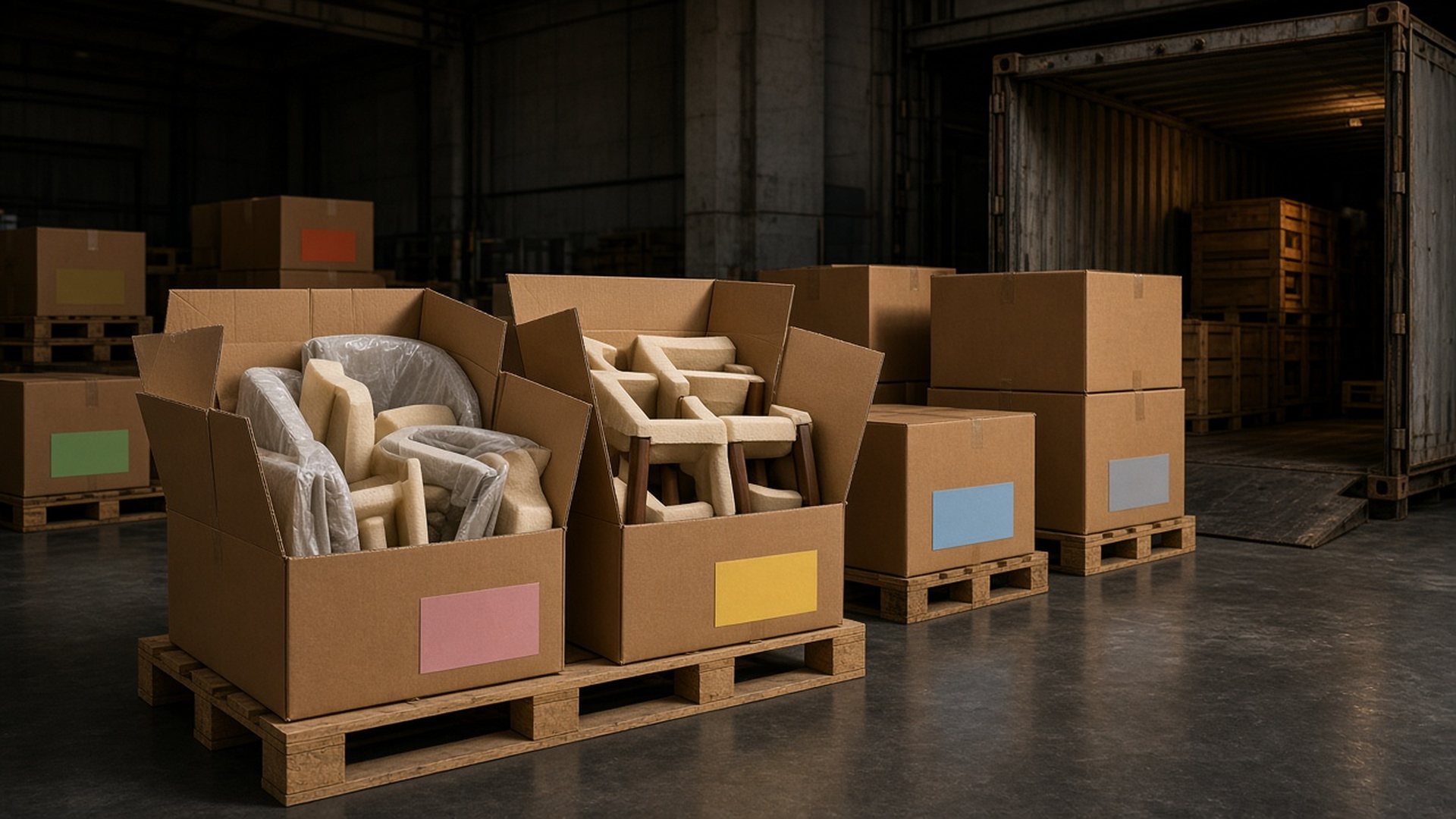
How do we optimize practical cube fill while protecting cargo integrity? Depending on the specific furniture silhouettes selected in your BOM, our logistics team applies Four Volumetric Packing Strategies:
L-Inverted Banquette Nesting (Where Geometry Permits)
For standard straight-back L-shaped booth modules without protruding decorative crowns, two units can be inverted 180 degrees face-to-face with EPE foam spacers—forming a compact rectangular block that reduces carton volume by up to 35%–42%.
3-Piece Knock-Down (KD) Table Architecture
Rather than shipping assembled tables (which are 85% empty air), standard pedestal tables ship in three decoupled sub-assemblies: flat-crated tabletops, boxed columns, and pallet-stacked cast-iron spider bases.
Saddle-Stacked Chair Cartons (Model-Dependent)
For qualifying stackable and saddle-compatible dining chair frames, up to two to four chairs interlock inside a single heavy-duty master carton (note: wide upholstered lounge armchairs ship 1-to-2 per carton based on frame profile).
Void-Filling Tableware & Smallwares Ballast
Because Ron Group is a one-stop commercial restaurant & hotel supplies manufacturer, remaining upper-tier container voids can be consolidated with cartons of porcelain dinnerware, cutlery, and barware—optimizing unused container space to significantly reduce incremental freight cost per unit.
3. Direct Factory MOQ vs. Multi-SKU Consolidation: Breaking the "100-Piece" Myth
One of the most common misconceptions preventing independent operators from approaching a wholesale restaurant furniture manufacturer is the fear of massive Minimum Order Quantities (MOQs).
Operators assume that factory-direct sourcing is reserved for 50-unit national chains ordering 2,000 identical chairs. That is true if you approach a single-category mono-factory that only stamps metal barstools. Because a mono-factory has to set up a dedicated tubing bender and powder-coat booth for one item, they demand a 200-piece MOQ per SKU.
Ron Group operates on a fundamentally different industrial model: Project-Level Container MOQ.
Instead of forcing you to buy 200 identical chairs, our Foshan manufacturing hub aggregates your entire restaurant floor plan as a single production batch:
- 28 to 40 Loose Dining Chairs across 2 complementary styles from our restaurant chair manufacturer for restaurants line;
- 14 to 22 Sintered Stone or Solid Wood Tabletops paired with anti-wobble cast-iron bases;
- 8 to 14 Custom Upholstered Booths & Banquettes tailored to your exact wall dimensions;
- 10 to 16 Barstools, Hostess Podiums, Waiter Stations, and Outdoor Patio Sets;
- Complete Commercial Tableware, Glassware, and Menu Covers.
| Procurement & Supply Chain Dimension | Domestic Catalog Wholesaler / E-Commerce | Mono-Category Trading Broker (Alibaba) | Ron Group Direct Factory Consolidation |
|---|---|---|---|
| Minimum Order Threshold (MOQ) | Low per-item MOQ, but penalized with retail list pricing & LTL freight fees. | Rigid 100–300 pcs per single SKU; rejects mixed small-batch restaurant floor plans. | Project-Based Consolidated MOQ (flexible per-SKU quantities when aggregated into a full buildout package, subject to specific model tooling and dye-lot minimums). |
| Customization & Dimensional Control | Zero customization; restricted to in-stock vinyl colors and standard 30x48 sizes. | High risk of spec drift; middleman subcontracts to unvetted workshops. | Tailored CAD Execution: Custom booth lengths, specified RAL powder coats, and COM fabrics manufactured within standard commercial tolerances. |
| Cross-Category Color & Finish Harmony | Clashing walnut stains and mismatched black metal sheens across 5 brands. | Severe batch variance; chair factory and table factory use different stain formulas. | Coordinated Master Swatch Alignment: Tables, chairs, booths, and millwork aligned against a unified project sample board. |
| Container Cube Utilization (ηcube) | 40% – 50% (shipped on domestic LTL pallets with heavy air volume). | Fragmented LCL shipments with punitive destination port CFS/devanning fees. | ~78% – 85% Practical Fill (Model-Dependent) inside a dedicated 20GP or 40HQ container with reinforced export crating. |
| Net Landed CapEx Impact (60–120 Seat Venue) | 100% Retail Baseline ($650 – $950 / seat) | 75% – 85% (Eroded by LCL fees & rework) | 45% – 60% Landed CapEx Reduction Range (Supports the $250–$340/seat planning benchmark) |
4. Why Foshan Direct Consolidation Ranks Among the Best Restaurant Supply Companies for Opening a New Restaurant
When founders evaluate the best restaurant supply companies for opening a new restaurant, they typically divide the market into two camps: domestic kitchen equipment giants (who excel at UL-listed refrigeration and gas ranges) and commercial hospitality manufacturers.
Here is the secret used by experienced multi-unit operators: Never buy Front-of-House FF&E and Tabletop OS&E from a domestic kitchen machinery dealer.
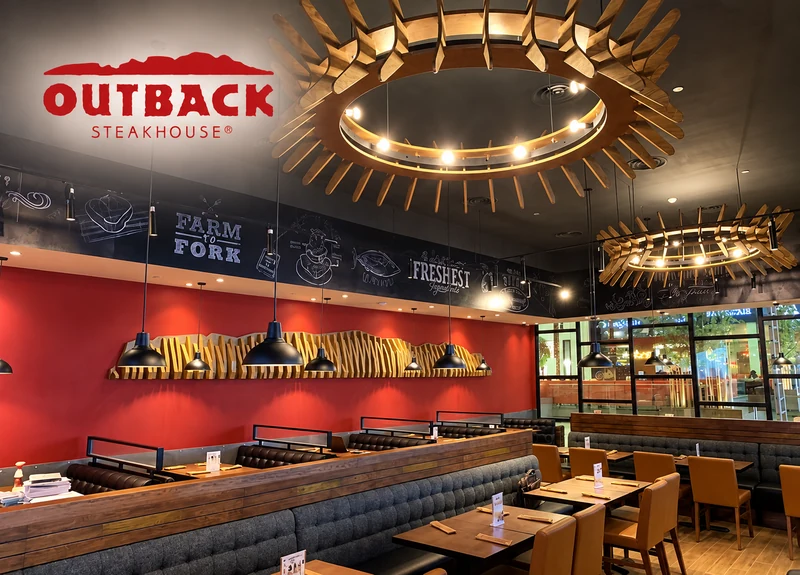
Domestic kitchen supply houses treat dining room furniture as an afterthought. Their catalogs carry entry-level imported tube chairs and particleboard laminate tops marked up 250 percent. Conversely, when you partner with Ron Group for your front-of-house furniture, custom millwork, and tabletop smallwares—as demonstrated in our Outback Steakhouse project case study and our Hot Rock Steakhouse project case study—you unlock a completely integrated engineering pipeline:
- 3D Spatial & Traffic Flow Engineering (For Qualifying Turnkey Packages): For full-store buildout packages, our architectural team can convert your 2D CAD floor plan into a 3D operational layout via our restaurant 3D design services, helping evaluate aisle clearances, seating capacity, and ambient lighting harmony before fabrication.
- Simultaneous Multi-Workshop Fabrication: Because timber joinery, stone fabrication, metal welding, and commercial upholstery operate in parallel across our Foshan facilities, typical production cycles are streamlined (indicatively ~20–30 working days for standard catalog configurations and ~30–50+ working days for custom/OEM builds after full drawing and swatch sign-off, subject to order volume and seasonal factory scheduling).
- Pre-Shipment Modular QC & Video Verification: Under our hospitality QC and export protocol, our QC team conducts batch sampling inspections, representative modular test-fitting, and photo/video verification prior to container loading (with full-zone floor staging available for specialized custom millwork programs upon contractual agreement).
5. Avoiding the LCL "Port Ransom" Trap: FCL vs. LCL Break-Even Math
A critical technical warning for first-time importers: Beware of cheap Less-Than-Container-Load (LCL) ocean quotes.
Unscrupulous trading brokers often lure restaurant buyers with a seemingly low "CIF Port $150 Ocean Freight" quote for a 15 m3 partial shipment. What they conceal is that LCL consolidators make their profit at the destination port through exorbitant Container Freight Station (CFS) devanning charges, chassis split fees, warehouse storage tiers, and doc turnover fees—often billing $2,200 to $3,800 at the destination warehouse before releasing your furniture.
TECHNICAL NOTE // MACRO PLANNING, LEAD TIMES & INCOTERMS COMPLIANCE
Macro Planning Baselines & Contractual Scope Disclaimer: Percentage savings, container seat counts, and per-seat planning benchmarks (such as our $250-per-seat FF&E CapEx model) represent indicative industry macro baselines under optimal KD/stackable SKU mixes. Actual container capacity, MOQs, production lead times, ocean transit durations, and landed costs vary by selected furniture silhouettes, custom material lead times, peak-season factory scheduling, carrier routing, and customs procedures. All specifications, packaging tiers, and delivery schedules are governed exclusively by your signed Proforma Invoice (PI) and itemized project BOM.
6. Frequently Asked Questions (FAQ): Wholesale Restaurant Furniture Sourcing
1. What is the minimum seat count required to justify importing directly from a wholesale restaurant furniture manufacturer in Foshan?
In practical container economics, the typical break-even threshold occurs around 40 to 45 dining seats (roughly 16 to 22 m3 of consolidated volume in a 20GP container, depending on selected chair and booth profiles). When you combine dining tables, chairs, custom booths, and commercial tableware into a single order, a 45-seat bistro can often achieve significant landed cost savings compared to domestic retail distributors. For venues with 75 to 130+ seats, a 40HQ container typically offers optimal volumetric efficiency.2. How long does factory-direct production and ocean shipping take for a new restaurant opening?
Production and shipping timelines depend on SKU customization complexity, material availability, and global vessel schedules. As an indicative planning benchmark under normal operating conditions: standard catalog configurations generally require ~20 to 30 working days of factory production, while custom millwork, booths, and OEM builds typically require ~30 to 50+ working days after final CAD shop drawing and physical swatch sign-off. Ocean transit and customs clearance generally range from ~25 to 40 days for North America West Coast / Australia and ~35 to 55 days for North America East Coast / Europe / UK (subject to carrier routing and port congestion). We recommend initiating floor plan planning 90 to 120+ days prior to your target soft opening.3. How does Ron Group help protect stone tabletops and upholstered booths during ocean transit?
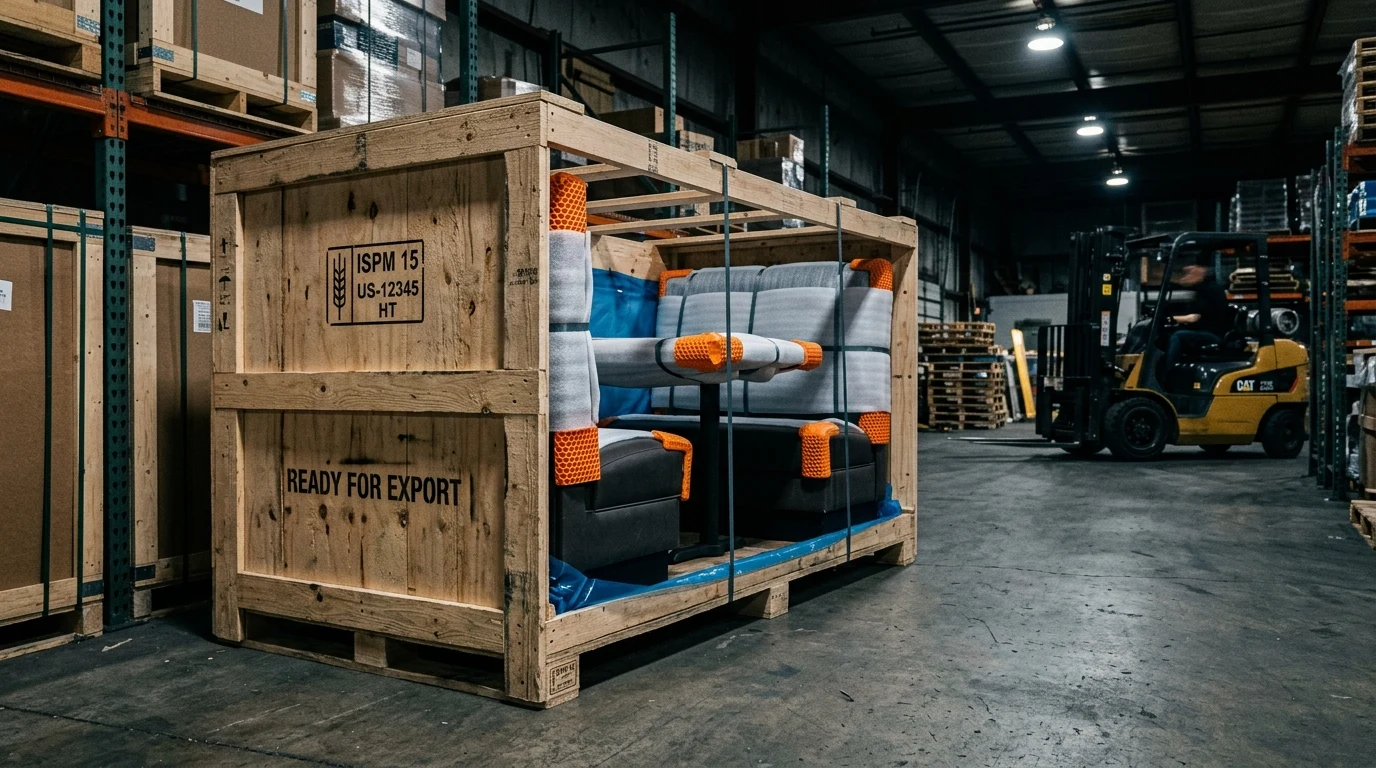
Export packaging is tailored to SKU fragility and shipping mode. Heavy sintered stone and solid wood tabletops are packed vertically inside ISPM-15 certified plywood A-frame crates with EPE closed-cell foam isolation; upholstered banquettes and chairs are wrapped in dust covers, moisture-barrier film with silica gel desiccant packs, and heavy-duty corrugated cartons with reinforced edge guards (specific crating and third-party drop-testing options can be specified in your project BOM).The Foshan Direct Engineering Advantage
At Ron Group, we help hospitality buyers reduce multi-vendor friction, middleman markups, and spatial coordination gaps. By sourcing your complete front-of-house package—custom modular banquettes, sintered stone and kiln-dried hardwood tabletops, cast-iron table bases, contract dining chairs, and commercial tableware—through our Foshan manufacturing and consolidation hub, you can coordinate finishes, align structural specifications, and streamline 40HQ container shipping to your venue.
Engineering & Contractual Scope Note: All structural models, material grades, tolerances, cost ratios, and indicative production lead-time ranges presented in this whitepaper serve as general B2B planning benchmarks under normal operating conditions. Specific hardware configurations (e.g., subtops, M8 inserts, C-channels, foam densities, and custom tooling), custom pricing, and binding delivery schedules are model-dependent and governed strictly by the final signed Proforma Invoice (PI), approved shop drawings, and confirmed physical sample swatches.
1:1 Custom CAD Floor Plan & BOM Review
Submit your architectural DWG/PDF floor plan, target seat count, and target opening window for a preliminary layout & clearance review, itemized factory-direct BOM quote, and material swatch options tailored to your project scope.
Foshan Project Engineering Desk
Need guidance on 40HQ container consolidation, custom OEM booth dimensions, or sintered stone and solid wood tabletop configurations? Connect directly with our project specialists.
Explore Related Hospitality FF&E Technical Dossiers
Wholesale Restaurant Furniture Manufacturer: 40HQ Consolidation Guide
Volumetric cube efficiency (η_cube), landed CapEx modeling, and FCL vs. LCL break-even economics for new restaurant buildouts.
WP-3818 // OEM & Franchise QCRestaurant Furniture OEM Manufacturer Protocol & Multi-Unit Rollout
CAD shop drawing value engineering, 5-axis CNC repeatability, master finish swatches, and repeat franchise production governance.
WP-3819 // Tabletop Substrate SpecRestaurant Table Tops Wholesale: Sintered Stone, Solid Wood & HPL Matrix
Comparing 12mm sintered stone on multi-ply subtops, kiln-dried hardwood with anti-warp C-channels, and optional M8 threaded inserts.
WP-3820 // Spatial ErgonomicsRestaurant Tables, Chairs & Booth Pairing Ergonomics Guide
Loaded cushion differential drop (ΔH_loaded), armrest-to-subtop tuck clearance, base footprint alignment, and ADA knee clearance.
Seating Engineering HubCommercial Booth Seating Hub (16 Models & CAD)
High-resilience commercial foam standards, modular banquette layouts, and interlocking Z-cleat installation mechanics.
Turnkey Procurement HubFoshan Restaurant Furniture Master Guide
Navigating the Shunde and Nanhai furniture industrial clusters, OEM contract prototyping, and 40HQ container consolidation.