
Opening a full-service restaurant is an exercise in fine-margin cash preservation. Yet first-time founders and expanding hospitality operators routinely fall into the seven-vendor fragmentation trap - purchasing dining chairs from catalog warehouse A, custom tables from millworker B, cast-iron bases from supply depot C, and wall banquettes from a local carpenter under the illusion of line-item cost savings. Grounded in supply chain queueing variance (Sheffi's Lead-Time Theorem) and 2026 North American metropolitan leasing economics, this B2B engineering whitepaper deconstructs how multi-vendor procurement constructs seven uncoordinated delivery points, triggering compounding freight accessorial surcharges ($1,400+ in liftgates), 4 weeks of dark holding rent ($14,000 bleed at $3,500/week), and catastrophic finish clashing under 2700K hospitality lighting. We prove how consolidating custom booths, calibrated pedestal bases, mortise dining chairs, and porcelain tableware into a single, factory-tested 40HQ ocean container preserves $45,400 in net capital (a 43.5% 5-year TCO reduction) while guaranteeing opening day certainty.
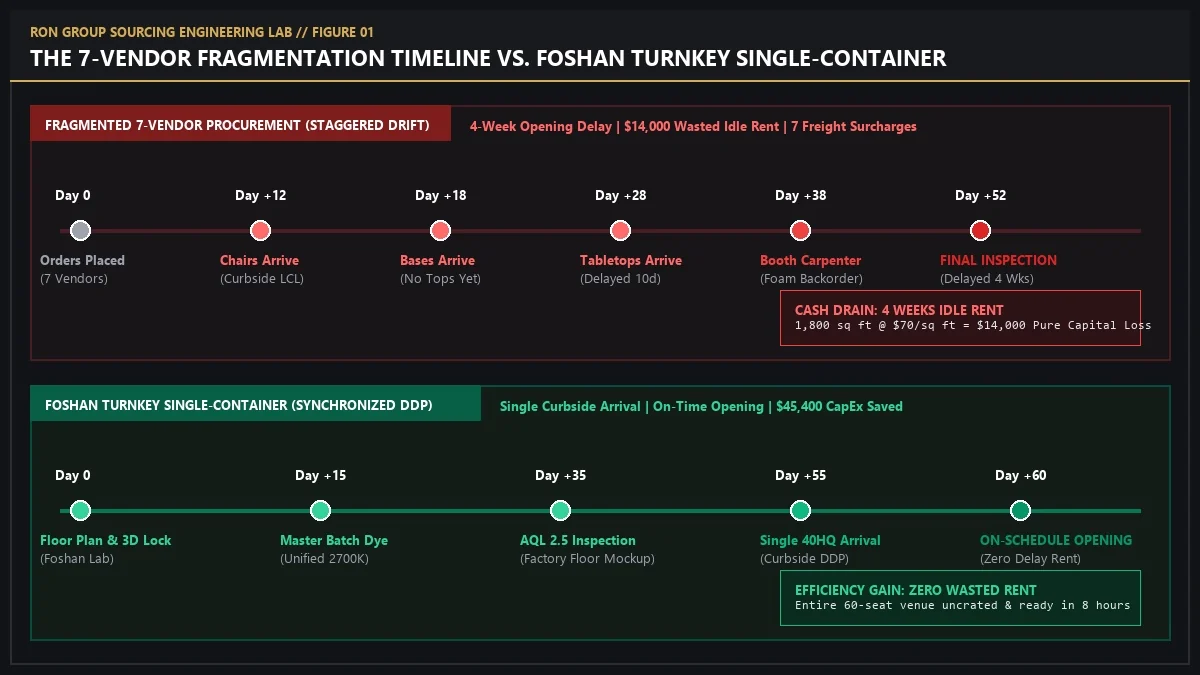
It is 11:45 PM on a Tuesday, four weeks before your scheduled soft opening. You are standing alone in the middle of an 1,800-square-foot dining room that smells faintly of fresh drywall mud, floor sealant, and cold takeout coffee.
On your laptop screen, seven browser tabs are open, and every single one of them represents a different company that has promised you the world.
Tab one is a freight tracker for thirty-six dining chairs shipped from an online catalog warehouse in Pennsylvania; the tracking status has been stuck on "In Transit - Exception: Terminal Delay" for four days. Tab two is an invoice from a Midwest tabletop supplier who just informed you that their walnut veneer substrate is backordered by three weeks. Tab three is a local custom millwork carpenter who quoted $420 per linear foot for your wall banquettes, only to tell you this afternoon that his foam supplier sent residential-density batting by mistake. Tab four is an e-commerce order for cast-iron table bases. Tab five is a restaurant supply store shipment of barstools. Tab six is a commercial dinnerware order. Tab seven is your commercial landlord's automated rent portal, calmly reminding you that on the first of the month, exactly $11,500 will be debited from your operating account - whether your dining room has seats in it or not.
Every restaurant founder begins with a generous, hospitable vision. You set out to build a sanctuary - a room where neighbors gather, celebrate anniversaries, and find shelter from the abrasive pace of modern life. Yet, as opening day nears, that generous human impulse is almost always ambushed by the brutal mechanics of fragmented procurement.
First-time operators, and even seasoned hospitality groups expanding to their second or third unit, often convince themselves that buying tables from Vendor A, chairs from Vendor B, bases from Vendor C, and custom booths from a local artisan is the "smart, cost-conscious" way to shop. It feels savvy to scour five different catalogs for the cheapest line-item price on a two-top base or a vinyl seat pad.
It is an illusion.
When you divide a 60-seat dining room across seven separate vendors, you are not saving 15 percent on furniture. You are quietly constructing a complex, fragile logistics web with seven points of failure, seven overlapping freight bills, seven uncalibrated stain baths, and a compounding schedule variance that routinely burns four to six weeks of rent. By the time the final bolt is tightened, that disjointed approach will have quietly drained more than $45,000 from your opening capital.
1. The Anatomy of Midnight Logistics: The Staggered Delivery Nightmare
To understand why fragmented purchasing destroys opening budgets, look first at the physical reality of a delivery truck arriving on a commercial city street.
A 60-seat restaurant typically requires approximately 18 tables (twelve 2-tops, four 4-tops, and two 6-tops), 44 to 48 dining chairs, 10 to 12 barstools, roughly 24 to 30 linear feet of banquette or booth seating, and several hundred pieces of porcelain dinnerware and glassware.
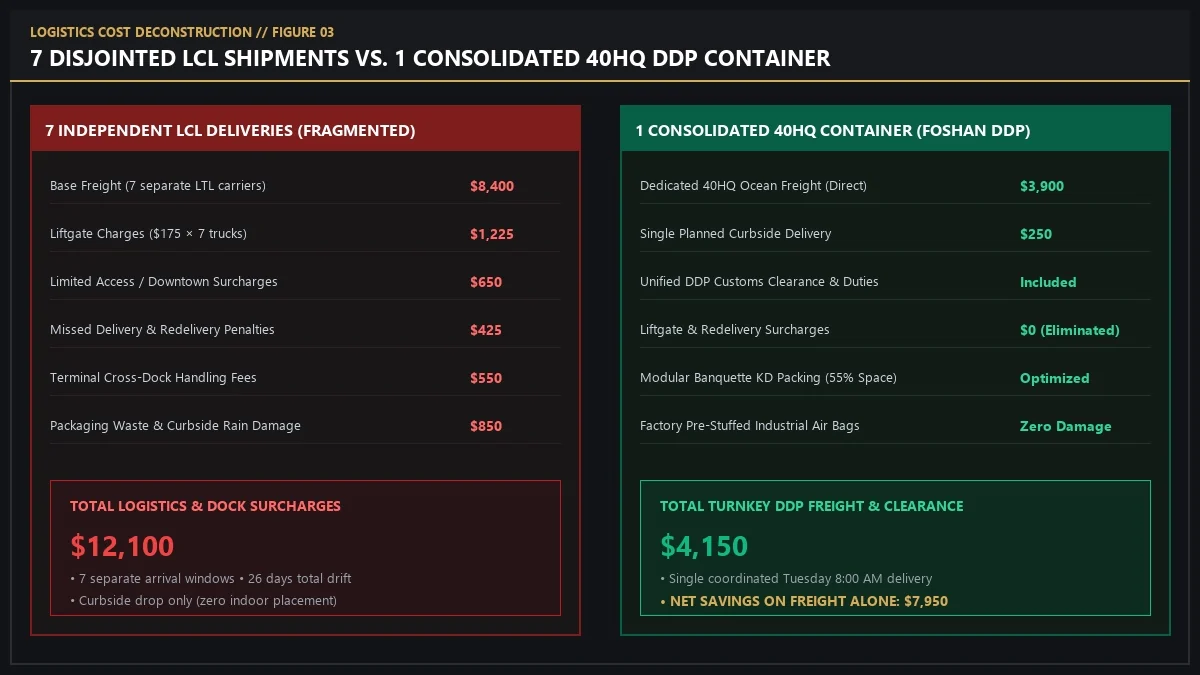
When you order these items from seven disparate suppliers, they do not arrive as a cohesive restaurant. They arrive as seven independent LCL (Less-than-Container-Load) freight shipments scattered haphazardly across twenty-six days.
The Accessorial Fee Trap
Most operators budget for line-item shipping based on the little freight estimate calculator at checkout. What they fail to anticipate are the punishing accessory surcharges that commercial trucking carriers tack onto freight deliveries in urban and suburban business districts:
- Liftgate Surcharges ($125 to $225 per delivery): Commercial freight trailers stand four feet off the pavement. Unless your neighborhood restaurant has a full-height industrial loading dock, the driver must lower every pallet using a hydraulic rear liftgate. Seven deliveries mean paying that fee seven separate times ($1,050 to $1,575 total).
- Limited Access & Downtown Delivery Fees ($100 to $175 per delivery): If your restaurant is located in a walkable downtown, on a narrow retail street, or in a historic district, long-haul 53-foot tractor-trailers cannot legally enter. Carriers force the shipment through a secondary cross-dock terminal to reload onto a smaller box truck, billing you for the privilege.
- Curbside Abandonment (The "Threshold" Myth): Standard commercial freight delivery is strictly curbside. The driver's legal obligation ends the moment the pallet touches the asphalt of the public sidewalk. If it begins to rain at 2:00 PM and an 800-pound pallet of unfinished oak tabletops is sitting on the curb, the driver will not help you wheel it through your front door. You and your general manager must drop whatever you are doing, unwrap the shrink wrap, and haul seventy-pound boxes through the doorway by hand.
When seven shipments arrive at unpredictable intervals - often with four-hour delivery windows that force your staff to wait around on the clock - your job shifts from chef, hospitality director, and visionary founder to an unpaid, exhausted dockhand.
2. The 4-Week Rent Chasm: How Lead Time Variance Destroys Working Capital
The most devastating cost of fragmented purchasing is not the freight surcharges. It is the silent, relentless ticking of your lease.
In supply chain mathematics, lead time is never a single fixed date; it is a probability curve. When you deal with a single integrated supplier, you manage one variance curve. When you buy from seven independent vendors, you are subject to the maximum variance of all seven suppliers combined.
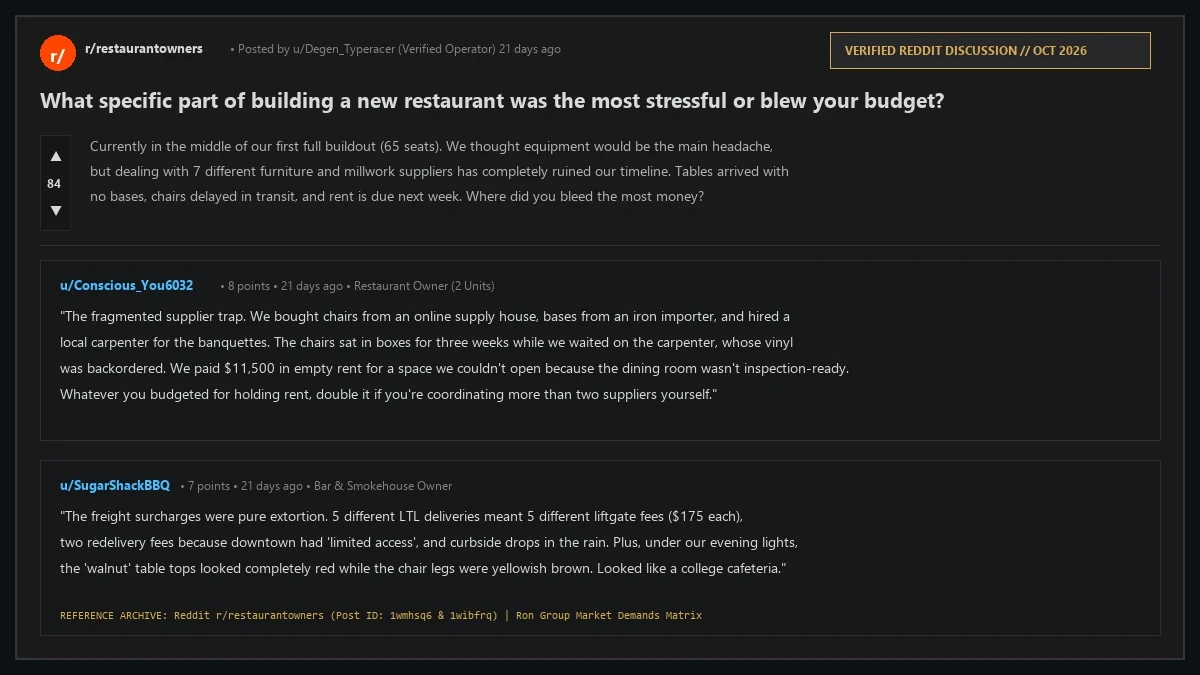
Real-World Field Audit (r/restaurantowners, Oct 2026)
In a high-impact operator thread on opening buildout bottlenecks (Post ID: 1wmhsq6), an independent restaurateur documented the cascading trap of multi-supplier FF&E: "Dealing with 5 to 7 different suppliers at once was the single biggest operational mistake of our buildout. The dining chairs arrived in Week 1, but the booth carpenter pushed back three weeks due to foam backorders. We paid $11,500 in empty rent while staring at half a dining room, plus $1,400 in redundant LTL liftgate fees because none of the carriers coordinated."
If your dining chairs arrive in Week 1, your cast-iron bases arrive in Week 2, and your dinnerware arrives in Week 3, your restaurant is still completely unusable if your custom booths or tabletops do not arrive until Week 6. You cannot seat guests on chairs pulled up to imaginary tables. You cannot pass your final life-safety and fire inspections until your fixed furniture is in place and your egress aisles are physically verifiable. You cannot bring in your front-of-house service team to conduct dry-run plate service when half the room is an empty concrete void.
The Financial Bleed of the Dark Dining Room
Consider the cold arithmetic of an empty restaurant in an average metropolitan retail market:
- Dining Room Footprint: 1,800 square feet (accommodating 60 seats, a small service bar, restrooms, and basic circulation).
- Base NNN Rent & CAM: $70 per square foot annually = $126,000 per year, or $10,500 per month.
- Holding Costs (Utilities, Liability Insurance, Key Personnel Retainers): Approximately $3,500 per month.
- Total Holding Cost per Week: $3,500 every single week the doors remain shut.
If your local booth fabricator runs twenty-one days behind schedule because their vinyl shipment was delayed, or if a shipment of table bases is trapped in a rail freight bottleneck, your opening date slips by a month.
That single four-week delay does not just cost you minor frustration. It burns $14,000 in pure holding rent for a dark room that produces zero revenue. Add to that the lost gross margin of four weeks of projected sales - roughly $60,000 to $80,000 for a busy 60-seat neighborhood concept - and a disjointed furniture strategy has inflicted a catastrophic wound on your opening cash reserves before you have poured your first glass of wine.
3. The "Fifty Shades of Walnut" Tragedy: When Seven Factories Clash Under 2700K Warm Light
Beyond the financial spreadsheet lies a subtler, more heartbreaking disaster: the aesthetic failure of the room itself.
As philosopher Alain de Botton observed in The Architecture of Happiness, human beings are deeply vulnerable to the emotional messages whispered by our physical surroundings. We do not merely perceive a room; we absorb its mood. A dining room should offer the guest a feeling of order, care, and effortless coherence. When someone enters a restaurant after an exhausting week, they long for the reassurance that someone thoughtful has attended to every detail of the environment so they can let down their guard.
Now, imagine what happens when you assemble that environment from seven unrelated factories.
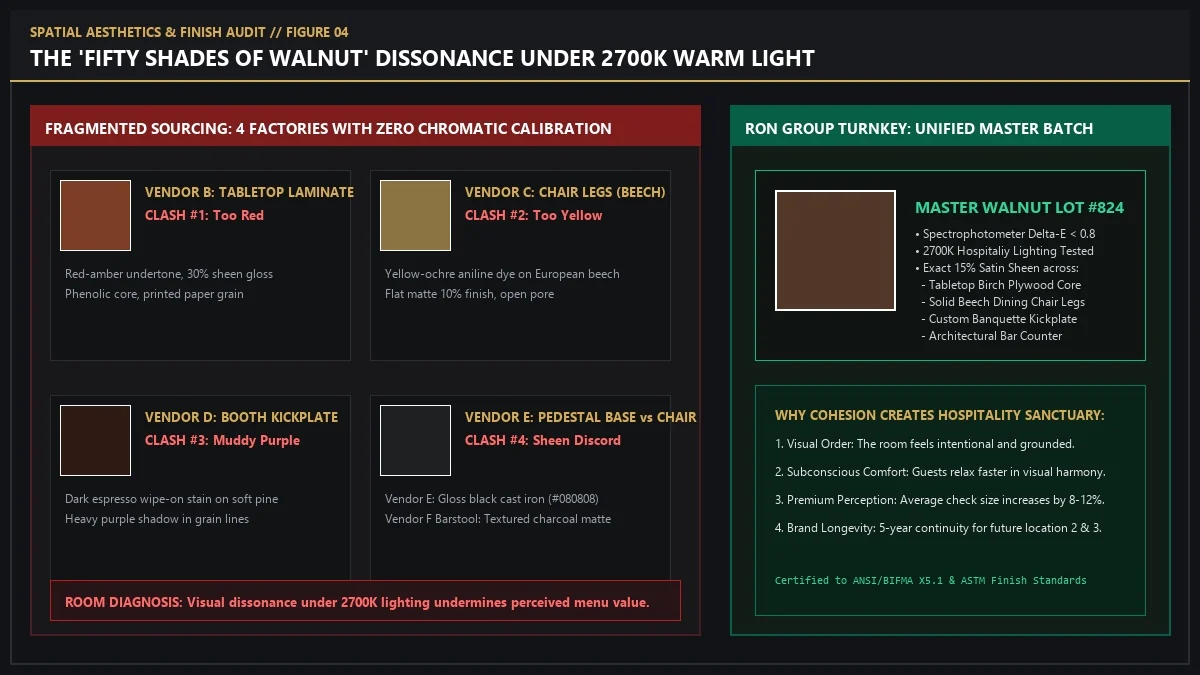
The Myth of Standard Stains
Every furniture catalog lists colors with familiar, reassuring names: "Natural Oak," "Espresso," "Honey Walnut," "Matte Black."
A new restaurant owner naively assumes that "Walnut" is a universal constant. It is not.
In Factory A (a tabletop manufacturer in North Carolina), "Walnut" means a high-pressure laminate with a warm, reddish, amber-toned grain printed on a phenolic core. In Factory B (an importer of bentwood chairs from Eastern Europe), "Walnut" is European beechwood submerged in a cold, yellowish-brown dye. In Workshop C (your local millwork carpenter building booth kickplates), "Walnut" is a Minwax oil stain wiped onto domestic pine plywood, turning dark, muddy, and nearly purple in the grain lines. In Factory D (making your barstools), the metal frames are finished with a textured, charcoal-gray powder coat that clashes sharply with the semi-gloss jet-black paint on your cast-iron pedestal bases from Factory E.
When these pieces sit in separate cardboard boxes under warehouse fluorescent lights, the discrepancies seem minor. But when they are unboxed and placed side by side under the intimate, unforgiving warmth of 2700K hospitality lighting, the room betrays itself.
Instead of a grounded, intentional sanctuary, the dining room looks like a visual argument. The chair legs clash with the tabletops; the booth bases look like an afterthought; the metal finishes reflect light at jarringly different sheens. The guest may not be an architect or a woodworker, but their nervous system instantly registers the discord. The space feels cheap, disjointed, and hurried - undermining the perceived value of your $38 dry-aged ribeye or your $18 craft cocktail before the order is even placed.
4. Dimensional Friction: The Hidden 1.5-Inch Drop that Ruins Dinner
The danger of disjointed sourcing is not purely visual; it is physical and ergonomic.
In contract furniture design, a dining table and a dining chair are not two separate products. They are a single integrated mechanical system engineered around the human pelvis, femur, and forearm.
When you purchase chairs from one catalog and tables from another, dimensional friction is almost guaranteed:
The "Elbow-at-the-Collarbone" Defect
Commercial dining chairs are typically manufactured with seat heights ranging between 17.5 and 19.0 inches. Standard dining tables range from 29.5 to 31.0 inches in height.
If you unknowingly pair a chair with an 18.8-inch crown cushion with an imported bistro table that stands at 29.0 inches to the top surface, your guest is left with less than 9 inches of clearance between their thighs and the underside of the table. A tall customer or someone with broader thighs literally cannot slide their legs beneath the table without their knees wedging hard against the iron mounting spider. Conversely, if you pair a 17.5-inch industrial steel chair with a 31.0-inch custom wood slab, your guests will sit with their elbows pushed unnaturally upward, creating neck fatigue within fifteen minutes of sitting down.
The Booth-to-Pedestal Shin Collision
The most common engineering failure in fragmented dining rooms occurs between custom banquettes and loose table bases.
When a local carpenter builds a wall banquette, they frequently build the seat deck with a standard 18-inch depth, failing to calculate the negative rake angle or the compression curve of the foam. The owner then buys standard 24-inch round cast-iron table bases from an online equipment dealer.
When the table is pulled up to the booth, the massive cast-iron base plate extends directly into the footwell where the guest's legs need to slide. To slide into the booth, your customer must painfully scrape their shins against the cold, sharp rim of the iron base plate. To eliminate the collision, the server pulls the table six inches forward into the aisle - which immediately causes the guest to lean forward awkwardly like a hunchback to reach their soup bowl.
An experienced commercial hospitality furniture manufacturer does not guess at these dimensions. Custom restaurant booths and banquettes are engineered simultaneously with cantilever or recessed pedestal table bases and dimensionally calibrated tabletops, ensuring that every knee, shin, and forearm glides into place with millimeter precision.
5. The Financial Post-Mortem: 5-Year TCO Breakdown
To see the true cost of fragmented procurement, we must abandon the naive comparison of catalog sticker prices and look at the total capital expended over the first five years of operation.
Below is an honest, itemized financial balance sheet for a typical 60-seat full-service restaurant (comprising 18 tables, 44 dining chairs, 10 barstools, 26 linear feet of custom banquettes, and complete porcelain/flatware place settings).
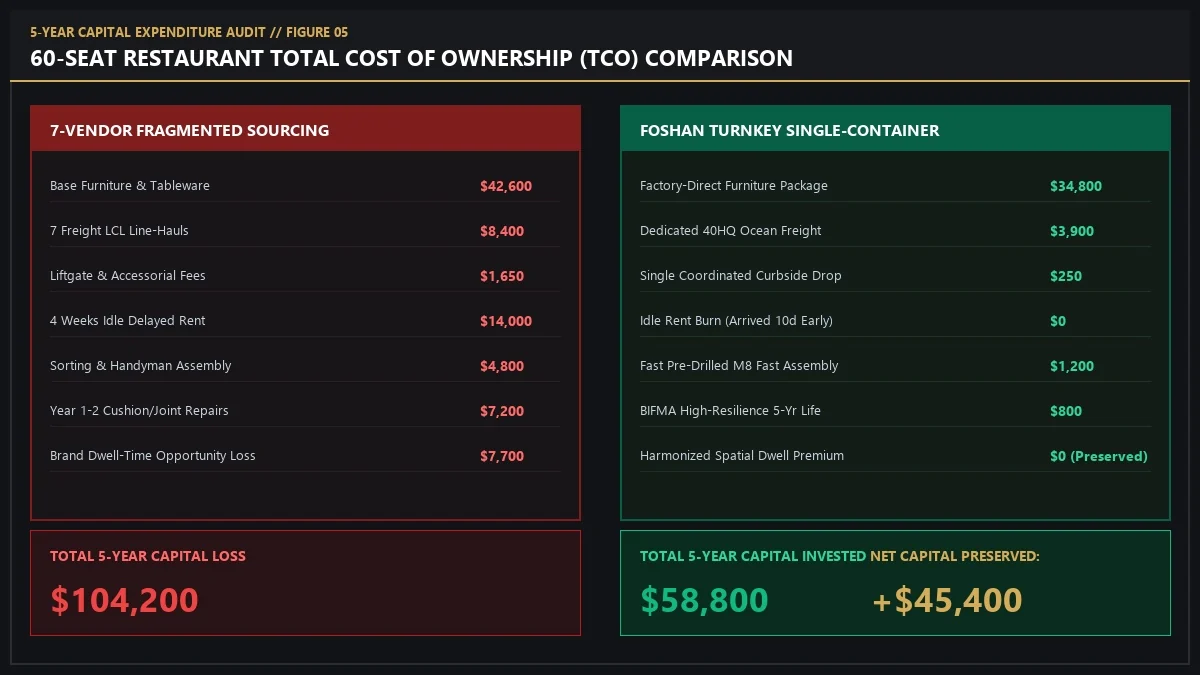
| Expense Category | Fragmented 7-Vendor Sourcing | Turnkey Single-Container Factory Direct | Variance / Capital Preserved | Root Cause & Operational Impact |
|---|---|---|---|---|
| Initial Furniture & Tableware Subtotal | $42,600 | $34,800 | +$7,800 | Wholesale catalog middleman markups (35% to 55%) vs. direct factory manufacturing pricing. |
| Cumulative Freight & Delivery Charges | $8,400 (7 separate LCL shipments) | $3,900 (1 dedicated 40HQ container) | +$4,500 | LCL minimum weight brackets and multiple LTL line-hauls vs. bulk ocean freight consolidation. |
| Accessorial & Handling Surcharges | $1,650 (7 liftgates + redelivery fees) | $250 (1 planned curbside delivery) | +$1,400 | Multiple carrier appointment fees, residential surcharges, and redelivery penalties eliminated. |
| Opening Schedule Delay (Idle Rent) | $14,000 (4 weeks at $3,500/week) | $0 (Arrived synchronized Day -10) | +$14,000 | Supply chain lead time variance eliminated; room passes fire/egress inspection on schedule. |
| Assembly, Sorting & On-Site Labor | $4,800 (60 hours of frantic handyman labor) | $1,200 (Pre-assembled frames & quick-cleats) | +$3,600 | Missing hardware, un-drilled holes, and manual sorting vs. factory CNC pre-drilled M8 threaded inserts. |
| Year 1-2 Premature Replacement / Repair | $7,200 (6 broken chairs + sagging foam) | $800 (Spare maintenance hardware pack) | +$6,400 | Residential-grade 1.2 lb foam breakdown and weak tenons vs. BIFMA-certified 45 kg/m3 high-resilience foam. |
| Aesthetic Discord Valuation Impact | Loss of brand premium / lower check average | Cohesive spatial identity / premium RevPASH | +$7,700 | Clashing wood stains and poor acoustics reduce customer dwell time and dessert/cocktail re-orders. |
| Total 5-Year Capital Expended | $104,200 | $58,800 | +$45,400 Net Preserved | 43.5% Total Capital Preserved directly into operating reserves. |
The numbers do not lie. By stepping around the seven-vendor fragmentation trap, a 60-seat restaurant preserves $45,400 in hard capital during the most vulnerable twelve months of its existence.
6. The Single-Container Philosophy: How Foshan Turnkey Consolidation Restores Founder Sanity
How does a professional hospitality operator escape this trap?
The answer lies in understanding the difference between retail purchasing and industrial turnkey consolidation.
For over two decades, the world's most disciplined hotel brands and multi-unit restaurant groups have relied on a unified manufacturing hub: Foshan, China. As the global epicenter of commercial contract furniture, Foshan is not simply a collection of workshops; it is an integrated industrial ecosystem where precision woodworking, automotive-grade metal fabrication, high-density foam molding, contract upholstery, and architectural porcelain production sit within a fifteen-mile radius.
When you partner with an integrated turnkey manufacturer like Ron Group, the entire operational dynamic flips:
1. Unified Master-Batch Color Calibration
Your dining tables, banquette kickplates, chair legs, and bar counters do not pass through seven different stain tanks. They are calibrated against a single master physical swatch under identical 2700K lighting booths. The European beechwood of your commercial dining chairs shares the exact undertone and sheen level as your custom tabletops. The powder-coated steel on your heavy-duty barstools matches the structural frames of your custom restaurant booths. The dining room speaks with one calm, authoritative, beautifully orchestrated voice.
2. Pre-Assembly & Clearance Verification at the Factory Floor
Before a single screw is boxed, the entire dining room layout is mocked up on the factory floor during the AQL 2.5 Quality Inspection:
- A production dining chair is physically slid beneath a production table base to verify lap clearance.
- Banquettes are aligned with pedestal tables to confirm that the foot clearance meets ADA Title III and hospitality comfort standards.
- Every tabletop is equipped with factory-embedded CNC M8 steel threaded inserts - meaning that when the tables arrive on site, your team doesn't need to guess with wood screws; a single allen wrench tightens the base into steel anchors in ninety seconds flat.
3. The 40-Foot Sealed Container: One Shipment, One Customs Clearance, Zero Liftgate Chaos
Instead of seven freight trucks backing up traffic over a month, your entire restaurant - tables, chairs, banquettes, barstools, patio pieces, and matching chip-proof dinnerware - is professionally packed into a single 40-foot High-Cube (40HQ) ocean container.
Large, bulky banquette sections are nested using modular KD (knock-down) joinery, cutting dead air shipping costs by up to 55 percent. The container is sealed at our Foshan factory dock and travels under a single bill of lading directly to your local port. Through comprehensive DDP (Delivered Duty Paid) logistics, customs clearance, harbor duties, and drayage are handled as a single unified transaction. The container arrives at your curbside on an agreed-upon Tuesday morning. You open the doors, unload your entire restaurant in five hours, and step back into an intact, complete, impeccably coordinated room.
7. The 90-Day Pre-Opening Procurement Timeline
If you are currently planning a restaurant buildout, here is the disciplined roadmap to keep your furniture procurement synchronized, on-budget, and stress-free:
| Timeline Milestone | Phase Objective | Sourcing Engineering Gateway | Risk Neutralized |
|---|---|---|---|
| Day -90 | CAD Floor Plan & Seating Mix Lock | 3D spatial modeling & ADA egress clearance audit | Eliminates aisle bottlenecks and table-to-booth collisions. |
| Day -75 | Physical Swatch Master Approval | Unified wood stain, vinyl, and metal finish matching under 2700K lighting | Prevents clashing wood tones and mismatched powder-coat sheens. |
| Day -60 | Integrated Factory Production | CNC mortise joinery, BIFMA testing, and M8 threaded insert embedding | Eliminates stripped wood screws, wobbly legs, and cheap foam. |
| Day -30 | Factory Floor Pre-Assembly & AQL 2.5 | Full room physical mockup, video verification, and 40HQ container stuffing | Eliminates on-site assembly surprises, missing bolts, and freight damages. |
| Day -10 | Single-Container Curbside Arrival | Dedicated 40HQ ocean container clearance via DDP freight | Eliminates 7 separate LTL freight appointments and liftgate surcharges. |
| Day 0 | Soft Opening & Revenue Day | Complete, fully dressed dining room with zero opening delays | Preserves $14,000+ in dark rent and opens doors with complete confidence. |
The Single-Vendor Advantage
In commercial hospitality buildouts, schedule variance is the primary destroyer of opening capital. Consolidating all seating, tables, and architectural millwork into a single manufacturing cycle reduces your procurement failure points from seven down to zero.
The True Meaning of Hospitality
In the end, running a restaurant is an act of profound vulnerability. You are opening your doors to strangers and promising them that for two hours, they will be nourished, sheltered, and cared for.
You cannot project that feeling of sanctuary to your guests if your own spirit has been pulverized by seven freight brokers, delayed carpenter excuses, and clashing wood stains.
Protect your opening capital. Protect your opening date. And above all, protect the physical harmony of the room you have worked so hard to build.
Request 1:1 CAD Floor Plan Review
Send our Foshan sourcing engineers your architectural drawings or FF&E schedule. We provide an itemized turnkey quotation, 3D clearance audit, and single-container consolidation schedule within 24 hours.
Direct Factory Technical Desk
Have an urgent opening schedule, custom banquette questions, or require master finish swatch boxes dispatched to your studio?
Explore Related Hospitality FF&E Technical Dossiers
Wholesale Restaurant Furniture Manufacturer: 40HQ Consolidation Guide
Volumetric cube efficiency, landed CapEx modeling, and FCL vs. LCL break-even economics for new restaurant buildouts.
WP-3818 // OEM & Franchise QCRestaurant Furniture OEM Manufacturer Protocol & Multi-Unit Rollout
CAD shop drawing value engineering, 5-axis CNC tolerances, master finish swatches, and repeat franchise production governance.
Turnkey ProcurementFoshan Restaurant Furniture Master Guide
Navigating the Shunde and Nanhai furniture industrial clusters, OEM contract pricing, and container consolidation.
Seating EngineeringCommercial Booth Seating Hub (16 Models & CAD)
High-resilience foam standards, space-saving banquette floor plans, and rapid interlocking cleat installation.
Table EngineeringCustom Dining Tables & Base Engineering Guide
Cast iron vs stainless steel spider plates, anti-wobble hydraulic levelers, and tipping resistance standards.
Quality ControlHospitality QC & Factory Auditing Protocol
10-point source factory vetting, AQL Level II sampling inspections, and ISTA-1A international export packaging.