
In high-volume commercial hospitality, restaurant tabletop failure rarely starts in the center of the surface; it starts along the outer two-millimeter perimeter. Black cast-iron pedestal bases survive decades of heavy foot traffic and mop buckets, while decorative top surfaces endure thousands of plates and glasses. Yet within 8 to 14 months of daily service, standard EVA hot-melt edge banding softens under hot skillets (140°F–150°F), chair bumps chip brittle PVC trims, and daily sanitizer wiping wicks moisture into compressed sawdust cores—causing irreversible 20% perimeter swelling and creating hazardous bacterial harborage zones under NSF/ANSI Standard 2. While operators frequently experiment with raw cut granite slabs as a seamless alternative, unbacked 55 lb stone introduces dangerous top-heavy tipping risks and catastrophic glue-joint detachment. Grounded in ASTM mechanical testing and commercial field audits, this engineering dossier demonstrates how pairing Reactive PUR zero-joint edge bonding over marine-grade birch plywood for indoor dining, and 12mm Ultra-Compact Sintered Stone vacuum-bonded to a threaded marine birch sub-top for indoor/patio crossover, eliminates edge failure entirely—reducing 5-year table ownership costs by 60.6% (saving $9,000 per 30 tables) while providing a unified, patio-ready aesthetic.
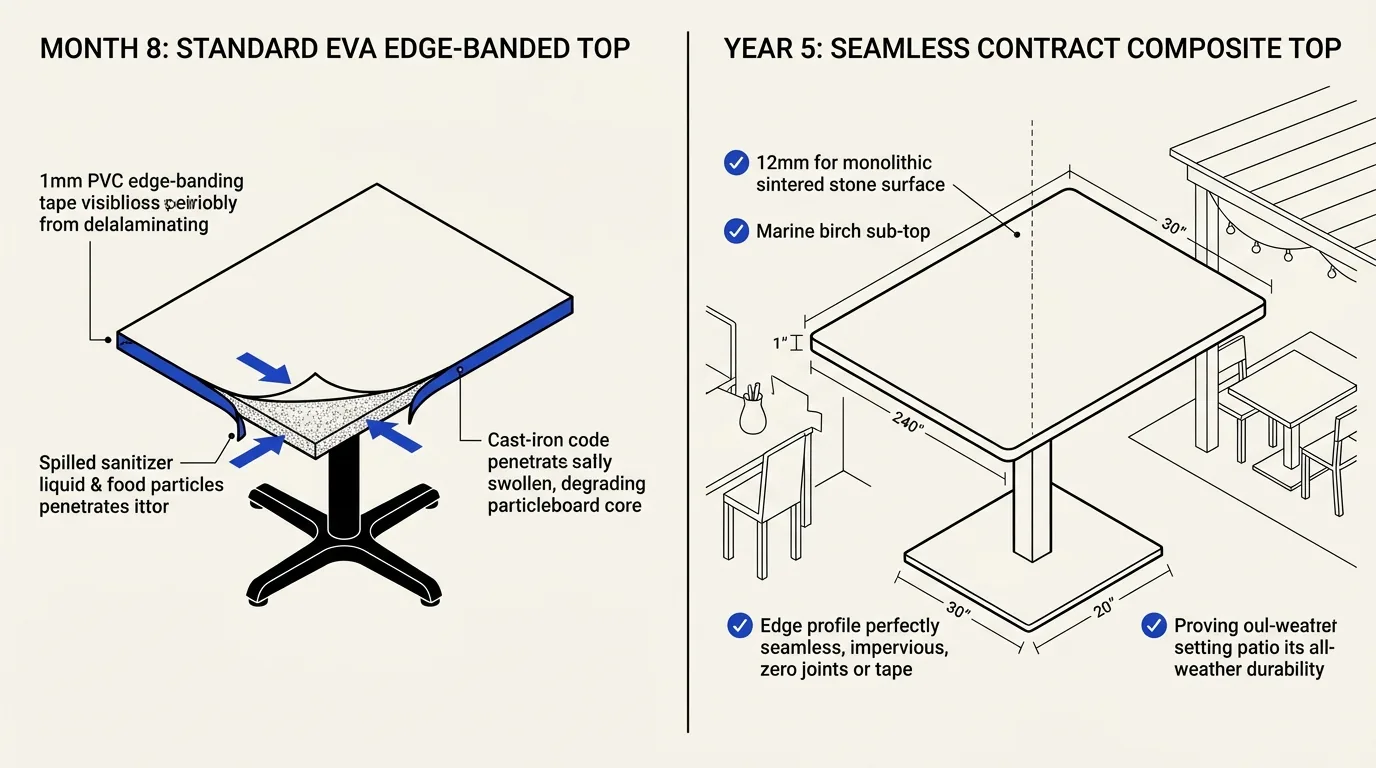
Walk through the dining room of almost any busy neighborhood bistro a year and a half after opening day, and you will spot a frustrating contradiction.
Look down at the floor first. The black cast-iron table bases look almost brand new. They have survived thousands of mop buckets, heavy work boots, and shifting weight, and they will easily last another decade. Now look thirty inches higher, right at the center of the tabletops. Where the plates and wine glasses sit, the laminate or wood-grain finish still looks completely fine.
Then run your thumb along the outer edge of the table.
Right along that narrow perimeter—where the flat top meets the side rim—the table is falling apart. The plastic edge trim is peeling away at the corners. Small chips have exposed raw, crumbly wood fiber underneath. Worse, after being wiped down fifty times a day with wet sanitizer rags, moisture has seeped into those tiny cracks and caused the outer rim to swell into a bumpy, spongy ridge that traps bread crumbs and grease.
In October 2026, a restaurant owner in the r/restaurateur community shared this exact frustration. They were facing the expense of replacing a dining room full of two-top tables where the flat surfaces were still usable and the iron bases were rock-solid, simply because the edges were chipping, separating, and soaking up water. Before buying another batch of tables that would fail the exact same way, the owner asked two questions that almost every operator eventually faces: what kind of tabletop edge actually survives constant wiping, hot plates, and chair bumps, and is there a single tabletop that works both indoors and out on a covered patio without managing two separate inventories?
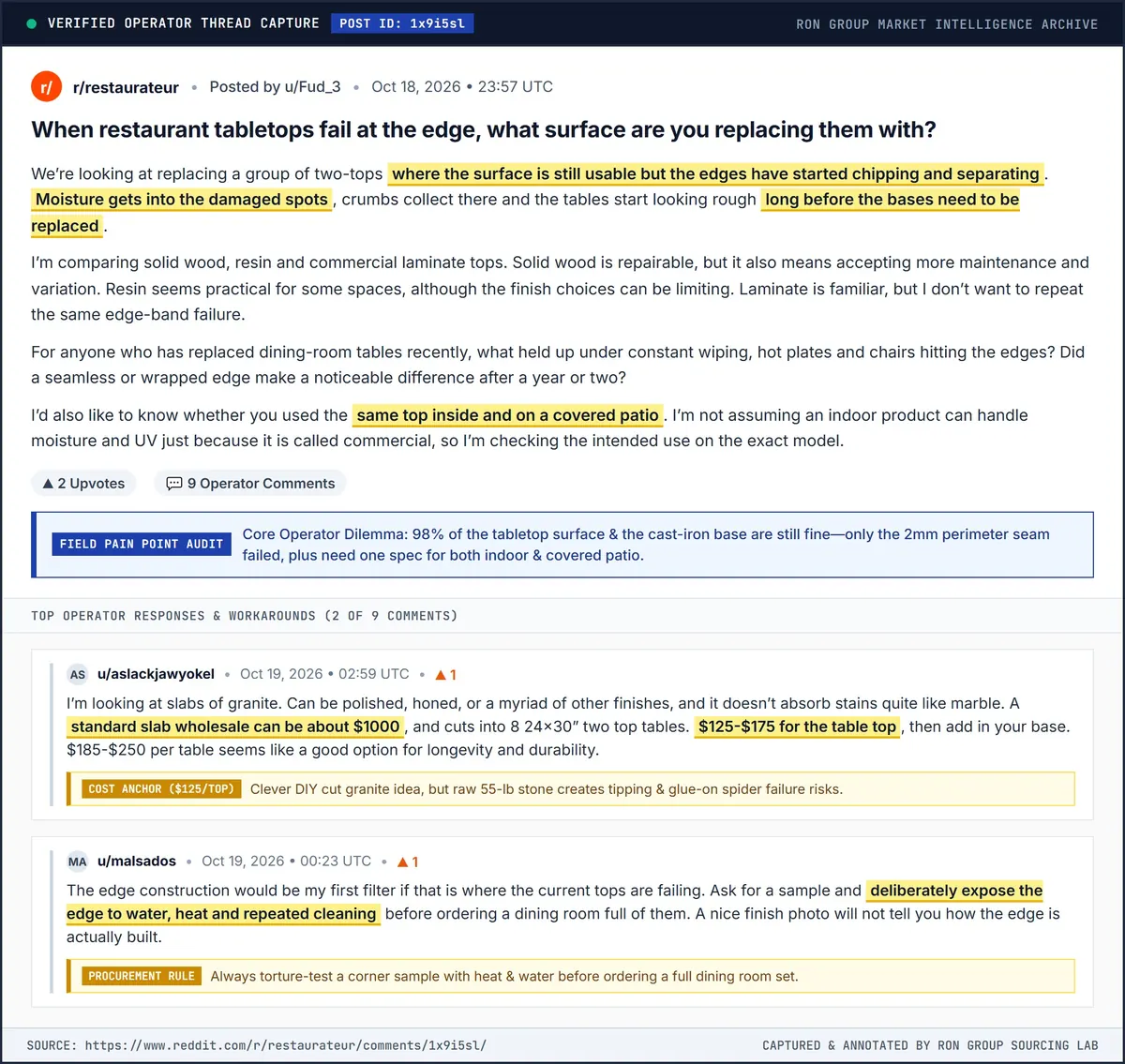
When you throw away a 24-by-30-inch tabletop because of a swollen rim, 98 percent of the table is still perfectly good. You are paying to replace the whole surface because the outer two millimeters lost a quiet war against heat, water, and daily wear.
Understanding why that narrow edge fails—and how to choose a surface that won't—is one of the simplest ways to stop bleeding money on replacement furniture.
1. Why Guests Notice the Edge Before They Notice Your Food
Before looking at how tabletops are glued together, think about how a customer actually uses a dining table.
Guests almost never touch the middle of a table. That space belongs to plates, water carafes, and shareable platters. Human contact happens entirely along the edge. Within ten seconds of sitting down, a guest pulls their chair in, opens the menu, and rests their bare forearms, wrists, and palms directly across the front rim of the tabletop.
Our fingertips and wrists are remarkably sensitive to texture. When a guest's arm brushes against a peeling plastic strip, a sharp chipped corner, or a slightly sticky, swollen seam darkened with yesterday's food residue, an immediate subconscious alarm goes off.
A customer cannot walk into your kitchen to check your walk-in cooler temperatures or inspect your dish pit. Instead, they judge your back-of-house hygiene by the physical surfaces they touch in the dining room. A swollen, crumb-trapping table edge quietly tells the guest that the restaurant is cutting corners on cleanliness—long before the first appetizer arrives. Health inspectors see it the exact same way. Under standard commercial food-code rules (NSF/ANSI Standard 2), any open seam or porous crevice on a dining surface is classified as a bacterial harborage zone because sanitizer rags simply wipe across the top while pushing dirty liquid deeper into the crack.
2. How Heat, Chairs, and Wet Rags Destroy Standard Tabletop Edges
If a tabletop is advertised as "commercial grade" in a restaurant supply catalog, why does the edge start peeling after eight to fourteen months? The problem is rarely the top laminate sheet itself. The failure happens inside the glue seam and the wood core underneath.
2.1 The Hot-Melt Glue Problem
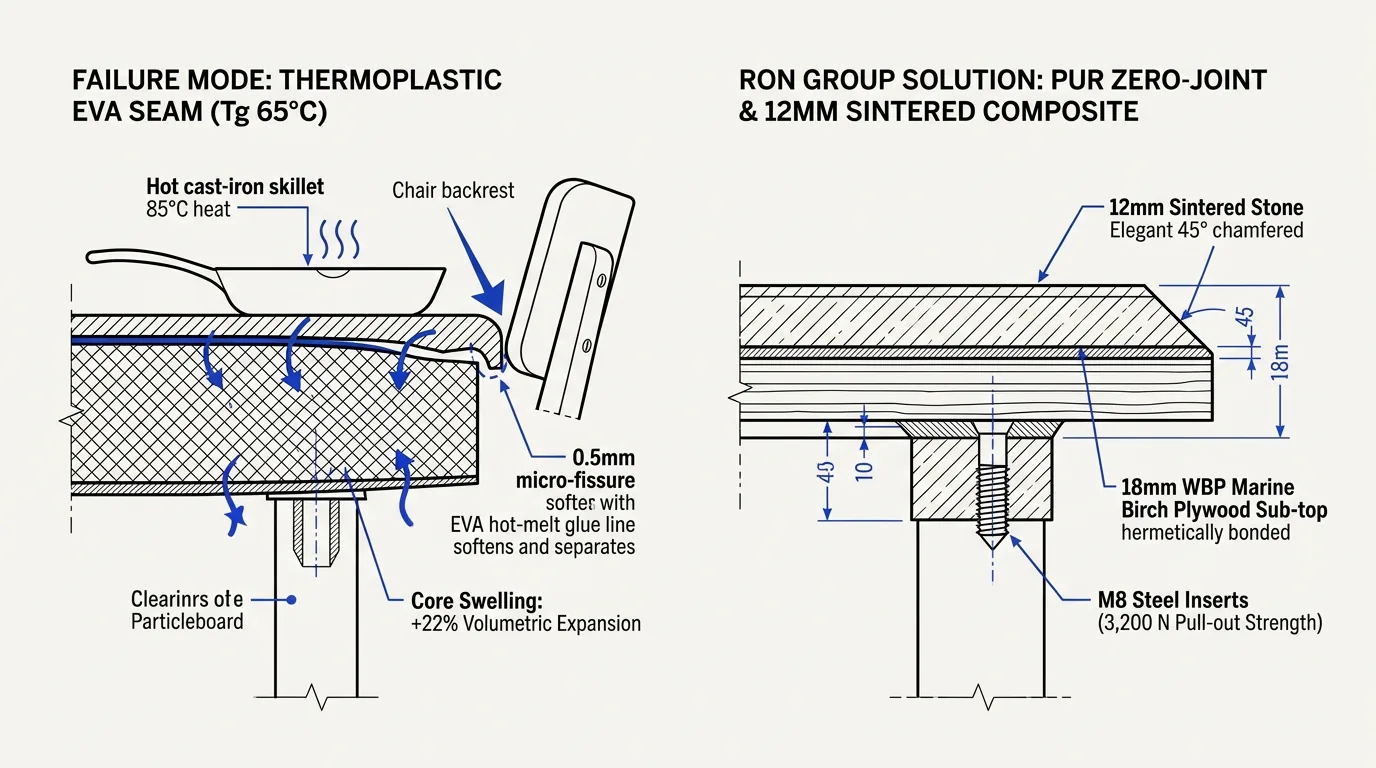
The vast majority of budget commercial laminate tables are finished by wrapping a thin strip of PVC plastic around the perimeter using standard EVA (Ethylene-Vinyl Acetate) hot-melt glue.
EVA is a thermoplastic adhesive—essentially the industrial cousin of the glue sticks used in a household craft glue gun. The defining trait of any thermoplastic glue is that its bond is reversible. It melts when heated, hardens when cooled, and softens up again every single time it gets warm.
In a laboratory at room temperature, that glue holds tight. A restaurant, however, is not a climate-controlled office. Think about what happens during a busy Friday dinner rush. A server brings out a sizzling cast-iron fajita skillet, a baked pasta dish fresh from the salamander, or a steaming bowl of soup, and sets it near the edge of a compact two-top. Or think about a covered patio where late-afternoon sunlight beats down on a dark walnut tabletop for three hours every day.
Standard EVA edge glue starts softening around 140°F to 150°F. Because the plastic edge strip was stretched tightly around the corners of the table at the factory, it is constantly pulling backward, trying to straighten itself out. The moment a hot plate or afternoon sun warms that seam, the glue turns soft and stretchy like warm taffy. Little by little, the corner of the plastic trim pulls away from the table, opening a hairline gap.
2.2 Chair Bumps and the Sponge Effect
Once heat loosens that glue line, the nightly closing shift finishes it off. Every time a table turns or the floor gets swept, servers and bussers slide dining chairs into the table. When a metal or wood chair back bumps squarely into a weakened corner, the thin plastic trim chips or cracks open.
Then comes the wet sanitizer rag.
Underneath the decorative top of most budget tables sits a core made of industrial particleboard or MDF—essentially sawdust and wood shavings pressed together with resin. As long as sawdust stays bone-dry, it stays flat. The moment sanitizer water wicks into a tiny gap at the edge, those compressed wood particles act like a dry kitchen sponge.
Even worse, unlike a kitchen sponge that shrinks back down when it dries, wet particleboard never returns to its original thickness. The wood fibers release the pressure from when they were manufactured, swelling upward by 20 percent or more along the rim. That swelling acts like a physical wedge driven under the edge of the tabletop, prying the rest of the trim loose and lifting the top surface into an ugly, permanent blister. At that point, no amount of wood glue or clamping can fix the table.
3. The "Cut Granite Slab" Workaround: Clever Math on Paper, Hidden Headaches on the Floor
Once a restaurant owner gets burned by peeling laminate edges, the natural instinct is to look for a solid material that has no edge strip at all.
In that same October 2026 discussion shown above, another restaurant operator shared a popular street-smart workaround: buying a whole slab of raw granite from a local stone wholesaler for $1,000, paying a fabricator to slice it into eight 24-by-30-inch tabletops (coming out to roughly $125 to $175 per top), and setting them onto standard $65 bases.
On paper, raw granite looks like the ultimate life hack. It is solid rock, it laughs at hot skillets, it doesn't stain as easily as marble, and there is zero edge tape to peel off. Yet when we inspect dining rooms that have put raw, unbacked stone slabs onto standard restaurant bases, three serious operational headaches almost always show up within the first year.
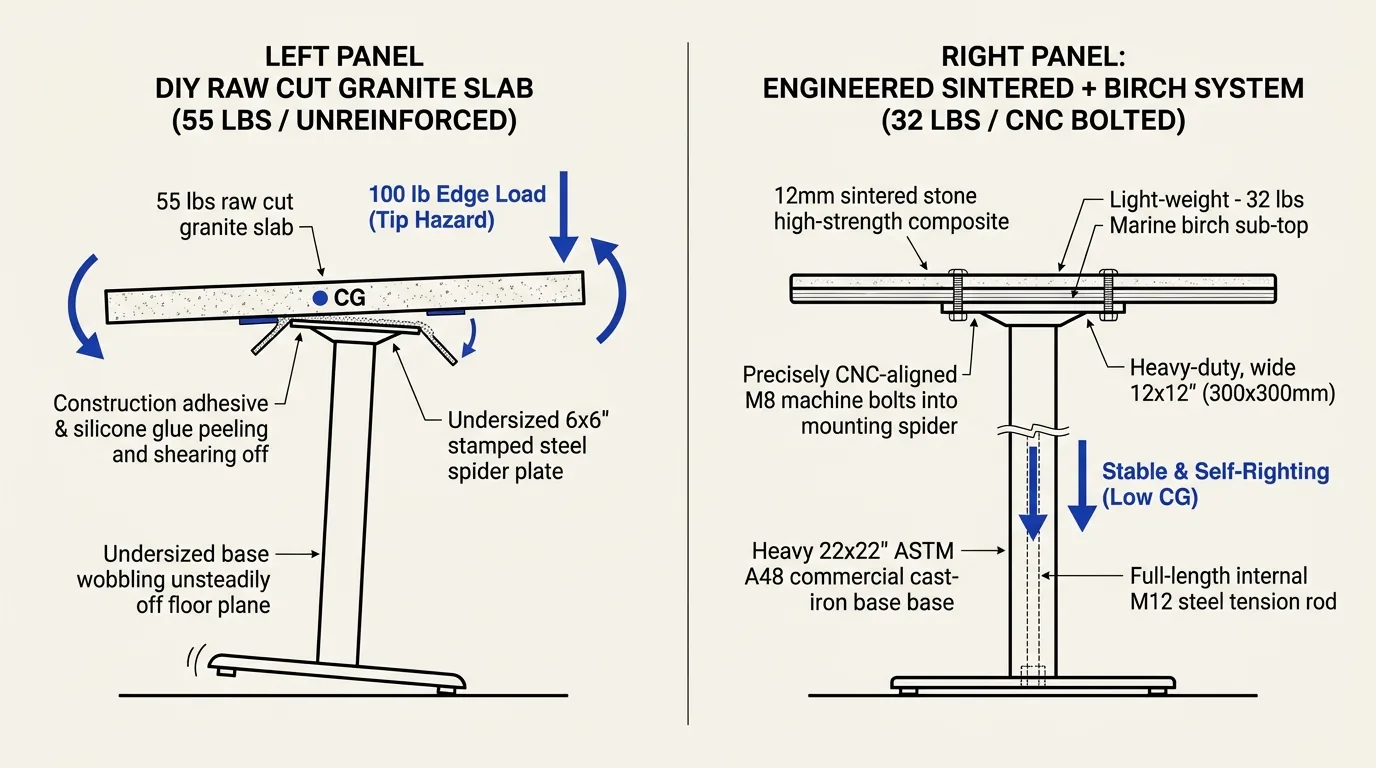
First, raw stone is dangerously top-heavy. A standard slab of natural granite cut to two-top size weighs well over 50 pounds by itself—more than double the weight of a normal tabletop. When you put a 55-pound slab of rock on top of a lightweight $65 pedestal base, almost all the weight of the table sits thirty inches in the air. If the table rests on an uneven patio paver and a guest presses their hands on the front edge to push themselves up from their chair, a top-heavy table can easily tip forward into their lap—bringing hot coffee, glassware, and 55 pounds of stone crashing down.
Second, you cannot drive wood screws into solid granite. When local installers mount a raw stone slab onto a table base, they usually squirt construction adhesive onto a small 6-inch metal mounting plate ("spider") and set the stone on top. That leaves a full foot of heavy, brittle rock hanging out past the metal plate on every side with nothing supporting it underneath. When two servers grab the ends of the table to slide two tables together for a party of six, or when a heavy guest leans on a corner, that glue bond on painted metal frequently snaps loose—or the granite cracks right along a natural mineral vein.
Third, bare stone mounted directly onto iron turns your dining room into an echo chamber. Without a wood layer underneath to absorb vibration, every ceramic plate, wine glass, and stainless-steel fork set down on bare granite rings out sharply, driving up dining room noise.
3.1 How the 5 Common Tabletop Options Actually Compare
To make the trade-offs clear at a glance, here is how the five most common tabletop builds hold up in real restaurant service:
| Tabletop Type | How Edge Is Built | Heat & Sanitizer Behavior | Chair Impact Resistance | Covered Patio Ready? | Real-World Lifespan |
|---|---|---|---|---|---|
| 1. Budget Commercial Laminate Particleboard + EVA Glue |
Thin PVC tape bonded with hot-melt glue | Hot plates soften glue; water swells sawdust core by 20% | Brittle plastic trim chips easily on square corners | No — Ambient humidity swells core in months | 8 – 14 Months |
| 2. Upgraded Birch + PUR Laminate Multi-Ply Birch + Reactive PUR |
2mm impact ABS edge with waterproof reactive bond | Chemical bond never re-melts; 100% waterproof barrier | Thick rounded bumper absorbs chair collisions | Indoor Only — Core is fine, but laminate fades in UV sun | 4 – 6 Years (Indoors) |
| 3. Poured Epoxy Resin Wood Core + Gloss Resin Coat |
Liquid resin poured seamlessly over radius edge | Impervious to water; hot skillets leave cloudy heat rings | Won't chip, but daily cutlery scratches dull high-gloss finish | No — UV sunlight turns resin yellow and chalky | 3 – 5 Years (Indoor Bars) |
| 4. DIY Cut Granite Slab Bare 30mm Natural Stone |
Solid quarry rock edge with no seam | Impervious to heat & water; requires yearly sealing against stains | Corners chip on hard metal contact; high glue-joint shear risk | Risky — Stone survives, but top-heavy tipping hazard | 5+ Years (High Tip Risk) |
| 5. Ron Group Sintered Stone + Marine Birch 12mm Mineral + 18mm Sub-Top |
Kiln-fired mineral slab with 45° shark-nose bevel over sealed birch | Impervious to boiling pans, bleach, and pooling water; zero edge tape | 45° bevel deflects chairs; wood sub-top quiets acoustics | Yes — 100% UV-proof, frost-proof, and humidity-proof | 8 – 10+ Years (Indoor/Patio) |
4. How We Engineer Tabletops That Outlast Their Cast-Iron Bases
At Ron Group's manufacturing hub in Foshan, we solve the edge-failure problem by getting rid of the two weak links that cause it: re-meltable glue and sawdust particleboard. Depending on whether your tables stay strictly indoors or need to move freely between your dining room and a covered patio, there are two proven ways to build them.
4.1 For Indoor Dining Rooms: Reactive PUR "Zero-Joint" Edge over Birch Plywood
If you love the warm look, light weight, and quiet feel of a wood-grain or matte laminate table indoors, you don't need to give up laminate. You just need to change the glue and the core.
Instead of standard EVA glue, our automated edge-banding lines use Reactive PUR (Polyurethane Reactive) adhesive paired with a thick, rounded 2-millimeter ABS bumper edge. Unlike ordinary hot-melt glue that softens whenever it gets warm, PUR undergoes a permanent chemical reaction as it cures, turning into a waterproof, heat-proof rubberized bond. Once cured, a sizzling skillet or a commercial heater can never re-melt it, and the seam is pressed so tight that neither crumbs nor bleach water can get past it.
Behind that sealed edge, we replace crumbly particleboard with a full 1-inch core of multi-layer marine-grade birch plywood bonded with waterproof phenolic resin. Cross-layered hardwood veneers don't puff up like a sponge even if a steak knife gouges the surface, and they hold mounting screws nearly three times tighter than particleboard.
4.2 For Indoor + Covered Patio Crossover: Sintered Stone Bonded to a Marine Birch Sub-Top
What if you want a single tabletop across your entire venue—something sleek enough for indoor dinner service, tough enough to live on a humid, sunlit covered patio, and light enough for two servers to push together without throwing their backs out?
For that setup, we combine a 12-millimeter (half-inch) Ultra-Compact Sintered Stone surface with a sealed 18-millimeter marine-grade birch plywood sub-top underneath.
Sintered stone is made by pressing natural quartz and mineral powders under immense pressure and firing them in a kiln at over 2,100°F—hotter than volcanic lava. Because it is solid mineral all the way through, there is no edge band to ever peel off. You can set a scorching cast-iron pan straight from the oven onto the edge, pour red wine or bleach on it, or leave it in afternoon patio sun for ten years without a trace of fading, staining, or swelling. To protect the perimeter from metal chairs, we shape the edge with a 45-degree sloped bevel ("shark-nose" profile) so chair backs glance harmlessly off the slope instead of striking a sharp square corner.
The real engineering magic, however, is the marine-sealed birch sub-top vacuum-bonded underneath the stone. That wood backing solves every single problem that plagues raw cut granite:
- Balanced 32 lb Weight: By pairing a 12mm sintered slab with a birch sub-top instead of a massive 30mm quarry rock, a 24-by-30-inch top weighs 32 pounds instead of 55 pounds. The table stays planted safely on its base without any top-heavy tipping hazard.
- Acoustic Vibration Absorption: The birch layer acts as a natural sound deadener, turning the loud, ringing clatter of ceramic plates on stone into a quiet, upscale thud.
- Factory CNC Threaded Inserts: Our CNC routers pre-install eight threaded steel M8 inserts directly into the birch underside, matched to a wide 300x300mm cast-iron spider plate. When your tables arrive, your team bolts the tops onto the bases in three minutes with an Allen wrench—no messy construction adhesive, no wood screws stripping out, and zero risk of the stone ever separating.
5. A Simple Back-of-House Test Before You Buy 30 Tables
As one veteran operator noted in the Reddit discussion above, the smartest move you can make is simple: never order a full dining room set from a catalog photo alone—get a sample corner first and try to ruin the edge in your own kitchen.
Before you wire a deposit for thirty or fifty tables, ask the supplier to ship you a small 12-by-12-inch corner sample that includes the finished factory edge. Take it into your back-of-house for two days and put it through three quick checks:
- The Hot-Skillet Heat Check: Set a heavy pan filled with boiling water right against the corner edge of the sample for fifteen minutes—or run the sample through two cycles in your high-temp commercial dish machine—and immediately try to pry the corner trim with your fingernail or a flathead screwdriver. If the glue feels soft or tacky, or if the corner lifts even a fraction of a millimeter, you are looking at cheap EVA hot-melt glue that will fail in your dining room. A true reactive PUR bond or solid sintered edge won't budge.
- The Overnight Bus-Tub Soak: Take a utility blade and make a small scratch right along the bottom seam where the edge trim meets the underside of the board. Stand that edge in a shallow bus tub of standard sanitizer water overnight. The next morning, feel the edge. If the core has puffed up into a spongy ridge, it is standard particleboard. If it stays flat and hard, you have genuine marine plywood or solid composite.
- The Chair-Bump Impact Test: Swing the back of a metal or wood dining chair into the sample edge ten times at normal bussing speed. Thin, brittle PVC tape will chip or show white stress cracks; a thick, rounded ABS bumper or a 45-degree beveled stone edge will shrug it off.
6. The Real 5-Year Math: Why $65 Tabletops Are the Most Expensive Option
It is easy to see why operators are tempted by $65 budget laminate tabletops. On opening day, when money is tight and unexpected plumbing bills are piling up, spending $1,950 for thirty tabletops feels much smarter than spending $5,850 for thirty contract-grade composite tops.
From six feet away, both tables look great during your soft opening. The difference shows up on your balance sheet over a five-year lease.
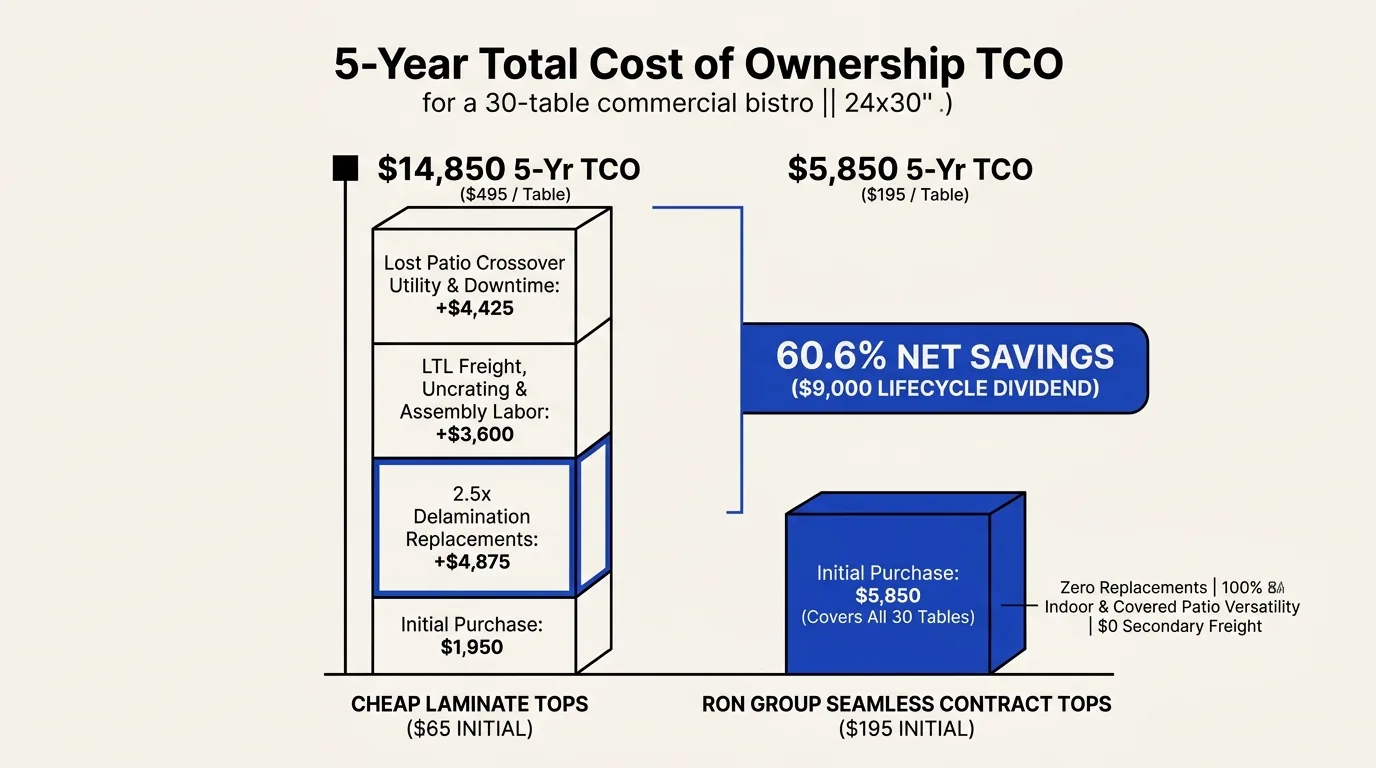
Let's look at the actual five-year numbers for a 60-seat neighborhood bistro running thirty 24-by-30-inch two-top tables (20 indoors and 10 on a covered patio), using its existing cast-iron bases:
| 5-Year Cost Breakdown (30 Two-Tops) | Option A: Budget Laminate ($65/top) | Option B: Cut Granite Slabs ($150/top) | Option C: Ron Group Sintered ($195/top) |
|---|---|---|---|
| Day-One Purchase (30 Tops) | $1,950 | $4,500 (4 raw slabs + cutting) | $5,850 (Factory-direct contract spec) |
| Lifespan Before Edge or Mount Fails | 12–18 mos indoors; 6 mos patio | Stone lasts, but light bases tip & glued spiders pop | 8 to 10+ years (Indoors & Covered Patio) |
| Replacements Needed Over 5 Years | 2.5 full replacements (75 tops bought) | 15 heavier bases + 5 cracked/detached tops | 0 replacements |
| Cost of Replacement Tops & Bases | $4,875 | $2,400 | $0 |
| Repeat Pallet Freight & Delivery Fees | $1,800 (3 separate LCL shipments) | $900 (Local stone flatbed transport) | $0 (Shipped once in master order) |
| Staff Labor (Unscrewing, Re-Mounting, Hauling) | $3,225 (75 swollen tops & dumpster runs) | $1,800 (Scraping old glue & re-leveling) | $0 (3-min initial bolt-on assembly) |
| Operational Drag & Patio Limitations | $3,000 (Can't move tables outside; chipped edges) | $1,500 (Staff hate moving 85-lb tables; noise) | $0 (Unified indoor/patio crossover) |
| True 5-Year Total Cost | $14,850 | $11,100 | $5,850 |
| 5-Year Bottom-Line Difference | +$9,000 Wasted | +$5,250 Wasted | Saves $9,000 (60.6% Lower TCO) |
When you look at the full five-year picture, the $65 tabletop is not a bargain—it is an expensive subscription plan. You end up buying the exact same thirty tabletops three and a half times, paying freight companies three separate times, and paying your staff overtime to unscrew swollen particleboard in the back alley.
7. How to Order Replacement Tops That Fit Your Existing Bases
Whether you are replacing peeled tabletops on cast-iron bases you already own, or outfitting a brand-new dining room and covered patio from scratch, getting the specification right upfront saves weeks of frustration at delivery.
When requesting quotes from a manufacturer, specify clearly that any indoor laminate top must use a multi-ply birch plywood core with Reactive PUR edge bonding (never particleboard or EVA glue), and any indoor-to-patio crossover top should use 12mm sintered stone bonded over an 18mm marine birch sub-top (or solid compact phenolic). Measure the top mounting plate ("spider") on your existing cast-iron bases—most standard commercial bases use either an 8-inch or 12-inch square bolt pattern—so our CNC routers can pre-install matching threaded steel inserts directly into the underside of your new tops at the factory.
For shipping, smaller replacement orders under 15 cubic meters (LCL) should always be quoted as transparent all-in DDP (Delivered Duty Paid) right to your door or EXW/FOB with your own forwarder—never accept vague LCL "CIF" quotes that hide surprise destination port fees. For full-container buildouts (20GP or 40HQ), we support standard FOB, CIF, DDU, or DDP terms with heavy plywood A-frame crating and reinforced corner armor. Standard commercial freight is curb or dock delivery, and because every tabletop arrives with pre-threaded metal inserts underneath, a two-person crew can unbox and bolt thirty new tops onto your existing bases in under ninety minutes.
Conclusion: Stop Throwing Away Good Tables Because of a Two-Millimeter Seam
A restaurant tabletop never dies from the middle out; it dies from the edge in.
When you choose tabletops based only on how the surface looks in a catalog photo, you are betting your furniture budget on a thin strip of hot-melt glue that gives up the first time it meets a hot skillet, a bumped chair, and a wet sanitizer rag.
By switching to waterproof Reactive PUR edge-bonded birch plywood for indoor dining—or stepping up to sintered stone over a threaded marine birch sub-top that works seamlessly indoors and out on the patio—you finally get a tabletop that lasts as long as the cast-iron base underneath it.
Summary Checklist: Commercial Tabletop Procurement Rules
- Rule 1 (Abolish EVA Hot-Melt): Never accept standard EVA hot-melt glue on laminate tables. Mandate Reactive PUR (Polyurethane Reactive) with a minimum 2mm rounded ABS bumper edge.
- Rule 2 (Banish Sawdust Particleboard): Specify multi-layer marine-grade birch plywood cores. Even if scratched, cross-laminated veneers resist water wicking and hold fasteners firmly.
- Rule 3 (Seamless Patio Crossover): For covered patios and sunlit perimeters, select 12mm Ultra-Compact Sintered Stone with a 45° shark-nose bevel vacuum-bonded to a sealed marine birch sub-top.
- Rule 4 (Mechanical Fasteners Over Glue): Reject glued spider mounts on stone. Mandate factory CNC pre-installed steel threaded inserts for secure machine-bolt assembly.
- Rule 5 (BOH Kitchen Stress Test): Test corner samples with a 15-minute boiling pan, overnight sanitizer bath, and 10 chair strikes before committing to volume procurement.
Complimentary Tabletop CAD Review & Sample Kit
Send us your floor plan or base spider dimensions. Our engineering lab will verify bolt-hole alignments, calculate tipping stability, and dispatch physical corner samples with factory-finished edges.
Request CAD Review & Swatches →Direct Factory Contract Desk (24/7 Hotline)
Direct communication with Foshan contract production specialists. Instant DDP ocean freight estimates, custom CNC sizing, and turnkey container consolidation.
Explore Related Hospitality FF&E Technical Dossiers
Restaurant Table Tops Wholesale: Sintered Stone, Solid Wood & HPL Matrix
Comparing 12mm sintered stone on multi-ply subtops, kiln-dried hardwood with anti-warp C-channels, and optional M8 threaded inserts.
WP-3820 // Spatial ErgonomicsRestaurant Tables, Chairs & Booth Pairing Ergonomics Guide
Loaded cushion differential drop, armrest-to-subtop tuck clearance, base footprint alignment, and ADA knee clearance.
Table EngineeringCustom Dining Tables & Base Engineering Guide
Cast iron vs stainless steel spider plates, anti-wobble hydraulic levelers, and tipping resistance standards.
Commercial SeatingCommercial Booth Seating Hub (16 Models & CAD)
High-resilience foam standards, space-saving banquette floor plans, and rapid interlocking cleat installation.
Procurement GuideFoshan Restaurant Furniture Master Guide
Navigating the Shunde and Nanhai furniture industrial clusters, OEM contract pricing, and container consolidation.
Quality ControlHospitality QC & Factory Auditing Protocol
10-point source factory vetting, AQL Level II sampling inspections, and ISTA-1A international export packaging.