
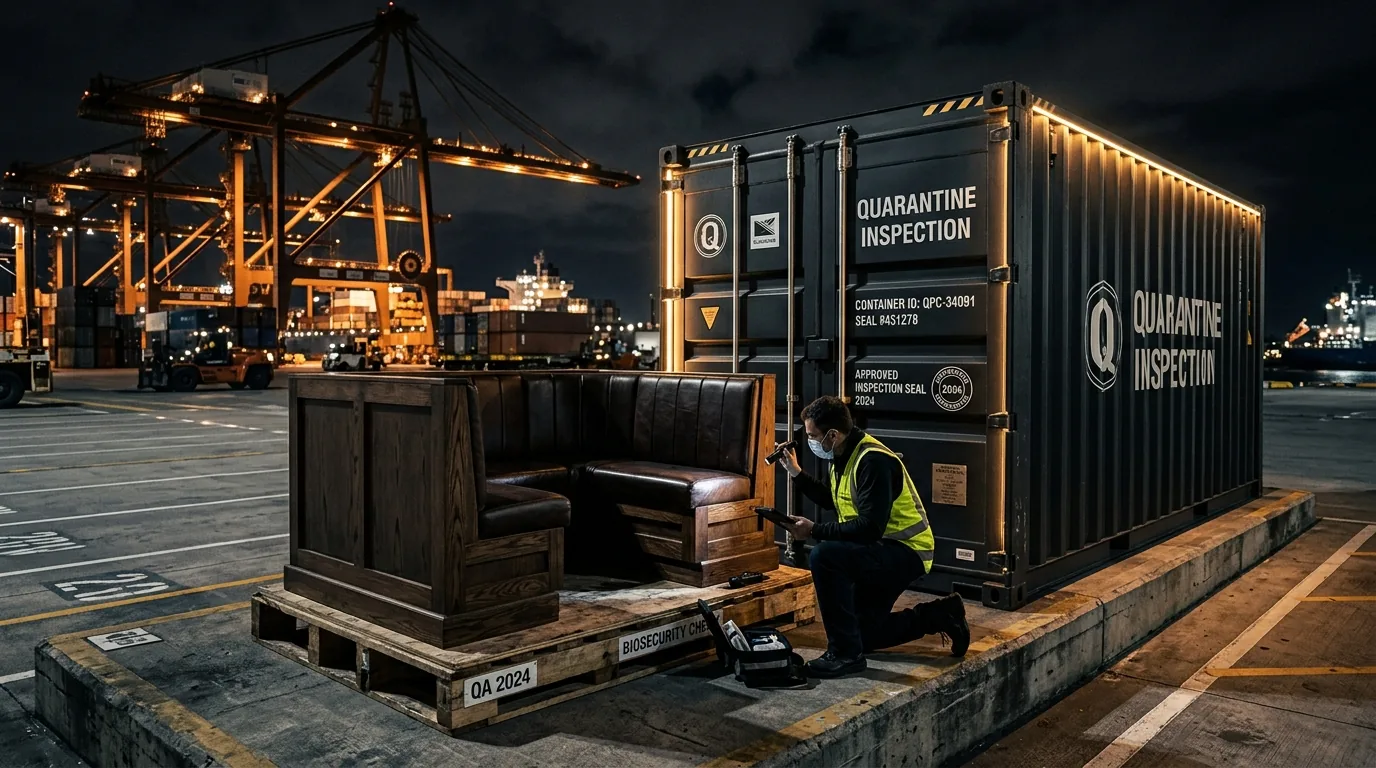
For international hospitality operators, Australian commercial developers, and contract procurement directors, shipping custom upholstered booth seating and architectural joinery into Australia represents one of the most punitive regulatory gauntlets in global logistics. Between September 1 and April 30 annually, the Australian Department of Agriculture, Fisheries and Forestry (DAFF) enforces mandatory seasonal biosecurity measures against the Brown Marmorated Stink Bug (Halyomorpha halys, BMSB) targeting all Chapter 94 furniture imports. Uninformed suppliers routinely trigger catastrophic multi-hundred-thousand-dollar losses through two fatal engineering errors: first, selecting cheap portside Methyl Bromide (CH3Br) fumigation, which reacts irreversibly with sulfur stabilizers in polyurethane foam to generate nauseating, permanent Methanethiol (CH3SH) "skunk odor" that renders luxury banquettes landfill waste; second, subjecting fully upholstered booths to 56°C / 30-minute core thermal kiln treatments, where low-end EVA glues melt at 55°C and cause severe structural frame delamination while thick foam insulates internal timber from reaching statutory core temperature. Simultaneously, Australian National Construction Code (NCC 2022 / BCA Spec C1.10) mandates rigorous fire testing under AS/NZS 3744 (butane match equivalent) and AS/NZS 1530.3. This whitepaper delivers the definitive technical protocol: decoding nucleophilic chemical reactions, establishing pre-assembly thermal kiln schedules with 120°C reactive PUR structural adhesives, auditing DAFF’s six mandatory certificate fields, analyzing micro-perforated packaging, and detailing Ron Group's Foshan offshore biosecurity engineering framework.
0. The Odor That Closed a Sydney Waterfront Bistro: The $180,000 Methyl Bromide Disaster
It was early October in Sydney, Australia. Along the bustling boardwalk of Barangaroo, overlooking the glistening waters of Sydney Harbour, a hospitality group was putting the final touches on a 180-seat premium Asian fusion restaurant and cocktail lounge. The grand opening was scheduled in eighteen days; local food critics had already published preview pieces, and the opening weekend reservations had been fully booked within forty-eight hours of going live.
The centerpiece of the interior architecture was eighty linear meters of custom curved booths and fluted velvet banquettes manufactured in Foshan and shipped across the Pacific in two 40-foot High Cube containers. The furniture had cost $112,000 AUD FOB, representing months of meticulous bespoke tailoring, deep emerald velvet upholstery, and fluted brass plinths.
Because the containers had been shipped in mid-September—during the official Australian BMSB seasonal window—the supplier’s local export freight forwarder arranged for mandatory offshore fumigation at the departure port. To minimize costs, the booking agent checked the lowest-cost treatment box: Methyl Bromide (CH3Br).
The treatment certificate was processed, customs cleared the goods through Port Botany without delay, and the two containers were trucked directly to the restaurant site for night-shift uncrating.
At 11:30 PM, the installation crew pried open the first heavy plywood crate inside the enclosed dining room.
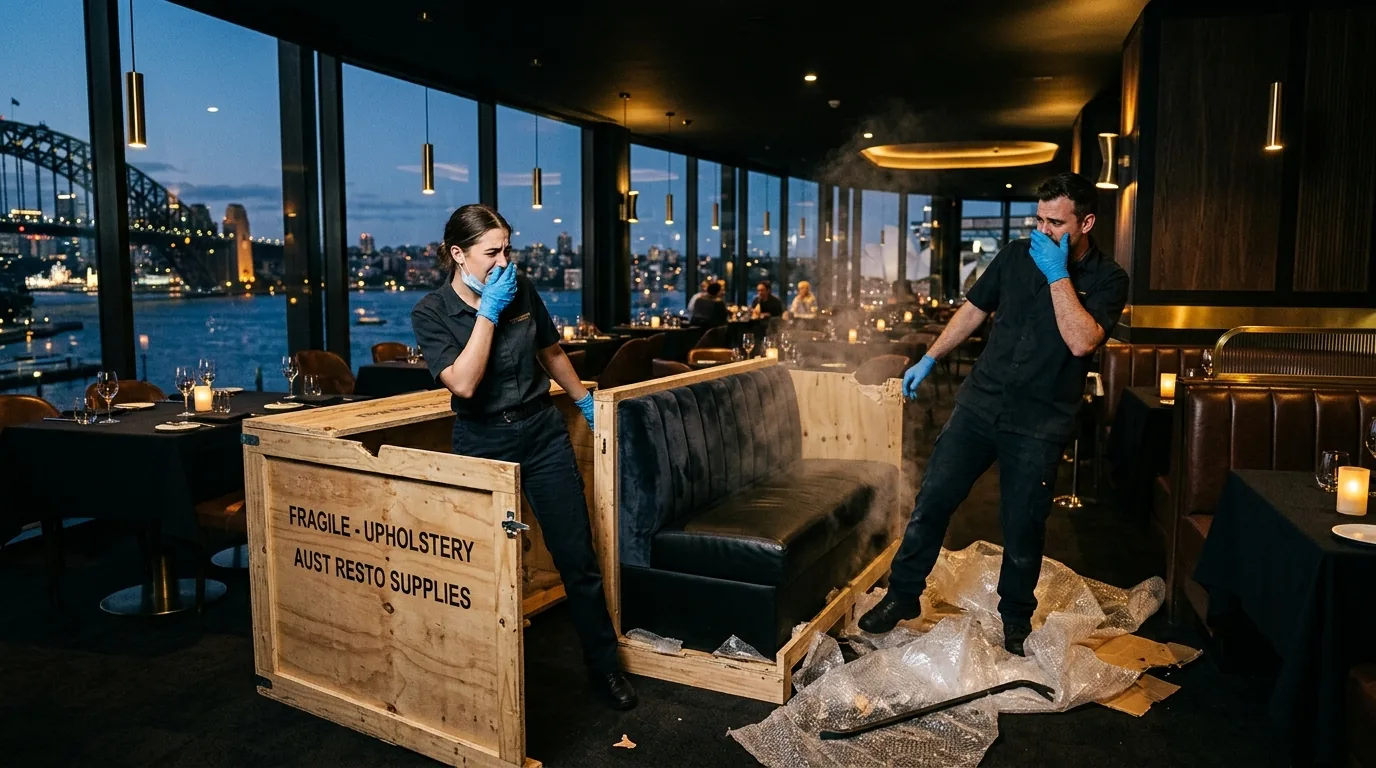
Within forty seconds, a wave of sickening, eye-watering stench swept through the two-story glass atrium. It did not smell like packaging dust or new furniture off-gassing. It was a suffocating, putrid stench reminiscent of rotting cabbage, burnt rubber, sulfur, and decomposing garlic.
Two carpentry apprentices began violently retching, dropped their pry bars, and fled onto the outdoor terrace. The site foreman ordered an immediate evacuation and called the general contractor, suspecting a ruptured sewer line or a municipal toxic gas leak beneath the foundation slab.
Emergency gas detection technicians arrived ninety minutes later. Testing confirmed the air was clear of methane and hydrogen sulfide. The lethal culprit was identified: Methanethiol (CH3SH) and dimethyl sulfide outgassing directly from the internal cellular matrix of the booth cushions.
Over the next twelve days, the desperate operator launched an aggressive remediation campaign:
- Four commercial-grade industrial ozone generators were run continuously for 96 hours inside the sealed dining room.
- Twelve HEPA-carbon scrubbing towers recirculated 8,000 cubic meters of air per hour.
- Specialized fabric restoration contractors saturated the velvet with enzyme deodorizers and heat-vapor extraction.
None of it worked.
The moment a human sat down on a booth cushion, their body heat and physical compression acted as a pneumatic pump, forcing concentrated micro-doses of sulfurous gas out of the foam cells and straight into their clothing. The stench was permanent, molecular, and indestructible.
With four days remaining before the opening, the municipal health inspector conducted a final occupancy inspection. The inspector spent less than ninety seconds inside the dining room before shutting his clipboard: "This venue is uninhabitable. The air quality violates basic commercial hospitality sanitation standards. No occupancy permit will be issued."
The financial consequences were total and irreversible:
- $112,000 AUD: All custom booths were removed under HAZMAT protocols, transported to an industrial waste facility, and incinerated.
- $38,000 AUD: Emergency commercial air freight and rush premiums for temporary freestanding tables and dining chairs.
- $32,400 AUD: Two weeks of delayed opening rent, staff holding wages, lost table turn revenue, and PR crisis management.
Total financial catastrophe: $182,400 AUD. The tragedy of this loss is that it was 100% preventable. It was caused by a complete ignorance of basic polymer chemistry and cross-border biosecurity engineering.
1. The Biosecurity Crossfire: Australia DAFF BMSB Seasonal Measures & Chapter 94 Mandate
To understand why commercial restaurant furniture is at the absolute center of Australian quarantine enforcement, one must understand the threat posed by the Brown Marmorated Stink Bug (Halyomorpha halys).
BMSB is an aggressive agricultural pest native to East Asia. It feeds on over 300 plant species, including grapes, apples, stone fruits, and grain crops. If established in Australia, DAFF biosecurity models estimate it would cause over $2.5 billion AUD in agricultural devastation within its first five years, annihilating the nation's wine, fruit, and grain export markets.
Unlike wood-boring termites or marine beetles, adult stink bugs do not feed on timber or foam. Instead, in late autumn, they seek out sheltered, dark, dry crevices in which to congregate by the thousands to enter overwintering diapause.
The hollow cavities of commercial booth seating—the voids beneath plywood seat boxes, the flutes inside tufted backrests, the spaces between zig-zag springs, and unsealed perimeter plinths—provide the ultimate artificial habitat for overwintering pests.
1.1 The Statutory Framework (DAFF Seasonal Measures)
Each year, from September 1 to April 30 (vessel departure date), DAFF enforces the BMSB Seasonal Measures:
- Target High Risk Countries: Includes over 40 nations, covering China, the United States, Japan, and most of Europe.
- Target High Risk Goods: Categorized strictly by Customs Harmonized System (HS) Tariff Codes:
- Chapter 94: All commercial seating (9401, including upholstered restaurant booths, dining chairs, barstools) and general furniture (9403, including dining tables, waiter stations, credenzas);
- Chapter 44: Plywood subframes, solid timber components, wooden crating, and engineered structural timber.
1.2 The Absolute Enforcement Doctrine (Zero Discharge)
Unlike standard customs tariff disputes, where an importer can pay a bond, hold goods in a bonded warehouse, or re-label packaging on-site, DAFF biosecurity enforcement is absolute:
- If high-risk Chapter 94 goods arrive in an Australian port from a Target Risk Country without valid offshore treatment documentation, the shipping line is legally prohibited from discharging the container onto Australian soil.
- The vessel must keep the container aboard or discharge it in a designated transshipment port for offshore re-export at the importer’s sole expense.
- There is no option for "let’s just fumigate it at the dock in Sydney" unless the container was shipped under a pre-approved, highly restricted safeguarding arrangement.
2. The Molecular Physics of the "Skunk Odor": Methyl Bromide (CH3Br) vs. Sulfuryl Fluoride (SO2F2)
Why did the Barangaroo bistro’s booths smell so vile? The answer is an unyielding law of organic chemistry.
For decades, Methyl Bromide (CH3Br) has been the workhorse fumigant of global agricultural trade. It is a dense, highly toxic alkylating haloalkane that rapidly kills insects, nematodes, and rodents. It is cheap, universally available, and effective against pests.
However, in contract commercial furniture manufacturing, Methyl Bromide is an unmitigated disaster when exposed to polyurethane foam, rubberized hair, or sulfur-tanned leather.
2.1 The Chemistry of Cellular Contamination
Flexible polyurethane foam is synthesized through the polymerization of polyether polyols and diisocyanates (TDI or MDI). To stabilize the reaction, regulate bubble nucleation, and accelerate curing, foam manufacturers incorporate trace chemical additives:
- Organotin catalysts and amine blowing agents;
- Alkyl mercaptan chain transfer agents and sulfur-containing antioxidant stabilizers;
- In natural leather, cysteine and methionine amino acid residues contain free thiol (—SH) functional groups.
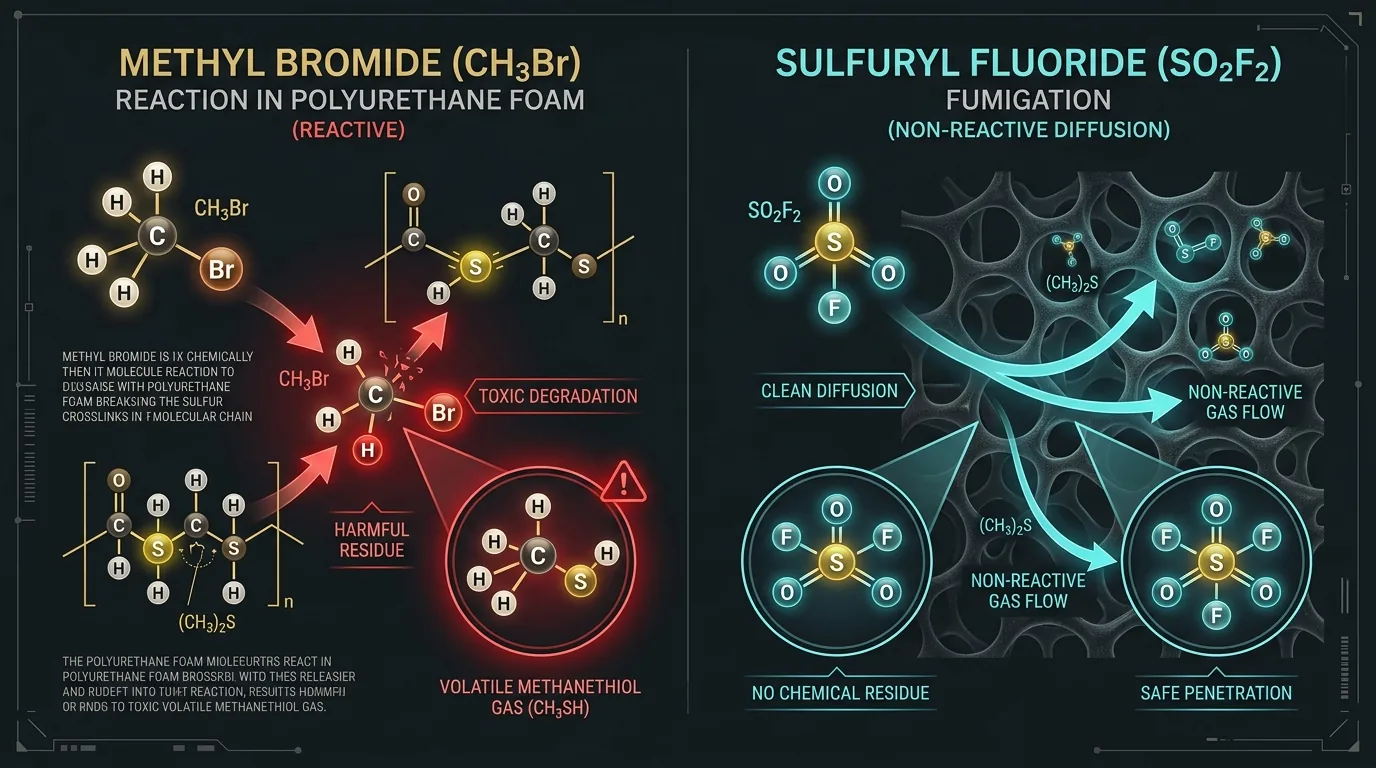
When Methyl Bromide gas is pumped into a shipping container, the volatile CH3Br molecules diffuse through protective wrappings and penetrate deep into the microscopic open-cell matrix of the booth cushions.
Step 1: R—S—H + CH3Br → R—S—CH3 + HBrStep 2: R—S—CH3 + CH3Br → [R—S+(CH3)2]Br− → CH3—S—CH3↑ (Dimethyl Sulfide) + CH3—SH↑ (Methanethiol)Olfactory Impact: Methanethiol carries an intolerable rotten cabbage / skunk odor with a human olfactory threshold of just 0.002 ppm (2 ppb). Because flexible foam possesses over 3.5 square meters of internal cell surface area per gram, this reaction binds permanently into the polymer lattice.
2.2 The Chemical Comparison Matrix
| Chemical Property | Methyl Bromide (CH3Br) | Sulfuryl Fluoride (SO2F2) | Hospitality Engineering Impact |
|---|---|---|---|
| Chemical Nature | Organic haloalkane (Alkylating agent) | Inorganic acid fluoride | SO2F2 is chemically inert toward polymers |
| Reaction with Polyurethane | Violent SN2 substitution with sulfur | Zero chemical reaction; pure physical diffusion | Eliminates all foul sulfur outgassing |
| Odor Profile | Permanent putrid skunk / cabbage stench | 100% Odorless | Zero olfactory disruption in luxury dining |
| Upholstery Impact | Degrades leather finishes & corrodes brass | Zero staining, non-corrosive to hardware | Pristine fabric and metal finishes |
| Aeration & Clearance Speed | Slow clearance (72+ hours retained in foam) | Rapid clearance (under 4 hours desorption) | Quick turnaround into shipping container |
| DAFF AEI Accreditation | Approved for BMSB | Approved for BMSB (Higher dosage required) | Fully recognized on official certificates |
3. The Thermal Penetration Paradox: 56°C / 30min Heat Treatment vs. Structural Wood Delamination
While chemical fumigation with Sulfuryl Fluoride is effective, many luxury hotel operators prefer a non-chemical approach: Heat Treatment (HT).
DAFF BMSB standards officially endorse Heat Treatment: the geometric core temperature of the thickest component must reach not less than 56.0°C (132.8°F) and be maintained continuously for not less than 30 consecutive minutes.
On paper, heating wood to 56°C sounds simple. In reality, attempting to heat-treat fully assembled commercial upholstered booths inside an industrial thermal chamber triggers the Thermal Penetration Paradox.
3.1 The Insulation Barrier of Upholstered Seating
Polyurethane foam is one of the most effective thermal insulation materials on earth, possessing an exceptionally low thermal conductivity (k ≈ 0.032 to 0.038 W/(m·K)). In contrast, solid timber has a conductivity of k ≈ 0.12 to 0.15 W/(m·K).
When a factory places a completed, fully assembled booth into a 65°C thermal kiln:
- The circulating hot air quickly heats the outer fabric and foam surfaces to 65°C.
- However, the thick foam acts as a thermal shield, choking heat transfer to the internal wooden frame.
- According to transient Fourier heat conduction equations, it requires between four and six hours of continuous kiln heating before the central timber joint beneath a 120mm foam deck reaches 56.0°C.
3.2 Adhesive Creep & The Ron Group 120°C PUR Solution
While the kiln operator waits six hours for the internal timber core to hit 56°C, catastrophe strikes standard furniture joints:
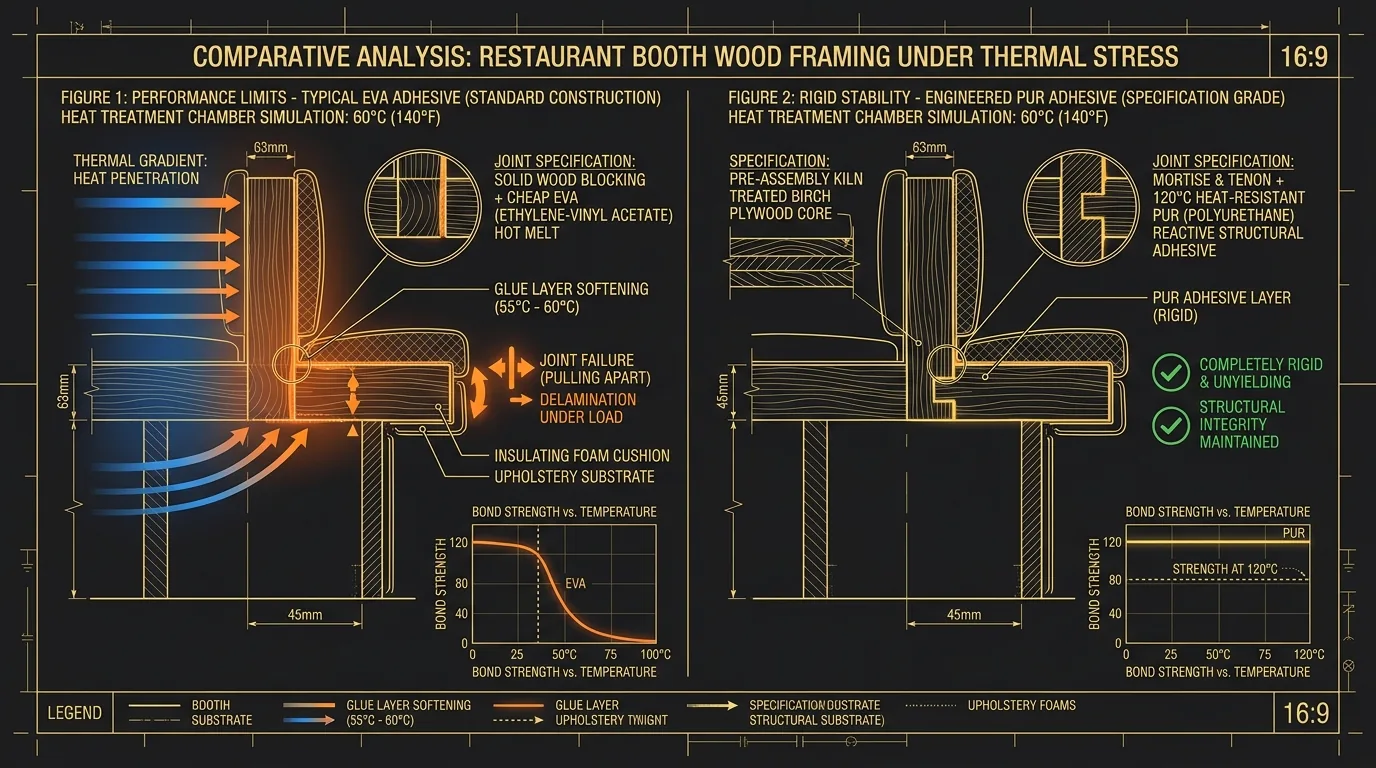
- The Low-End Glue Trap: Standard commercial workshops assemble plywood frames using inexpensive Ethylene-Vinyl Acetate (EVA) hot melt or basic PVAc white glue, which begins softening at 55°C to 60°C.
- Structural Warping: As the kiln temperature exceeds 65°C, internal zig-zag springs pulling with over 300 Newtons of lateral tension cause the softened glue joints to pull apart, destroying the subdeck.
- The Ron Group Solution:
- Pre-Assembly Kiln Conditioning: Bare Baltic birch timber frames undergo 56°C / 30-minute thermal conditioning in controlled kilns before any foam or upholstery is mounted, reaching core temperature in under 45 minutes without thermal barrier resistance.
- 120°C Reactive Polyurethane Adhesives (PUR): All mortise joints and frame dowels are bonded using moisture-curing reactive PUR structural adhesive (DIN EN 204 Class D4), retaining full joint shear strength (> 10 MPa) up to 120°C.
4. The 6 Statutory Pillars of a Fraud-Proof DAFF BMSB Treatment Certificate
When a container arrives in Melbourne, Sydney, or Brisbane, DAFF biosecurity officers do not inspect the furniture first. They inspect the paperwork.
Under DAFF’s Minimum Documentary and Import Declaration Requirements Policy, an offshore BMSB Treatment Certificate must contain six mandatory, non-negotiable field groups:
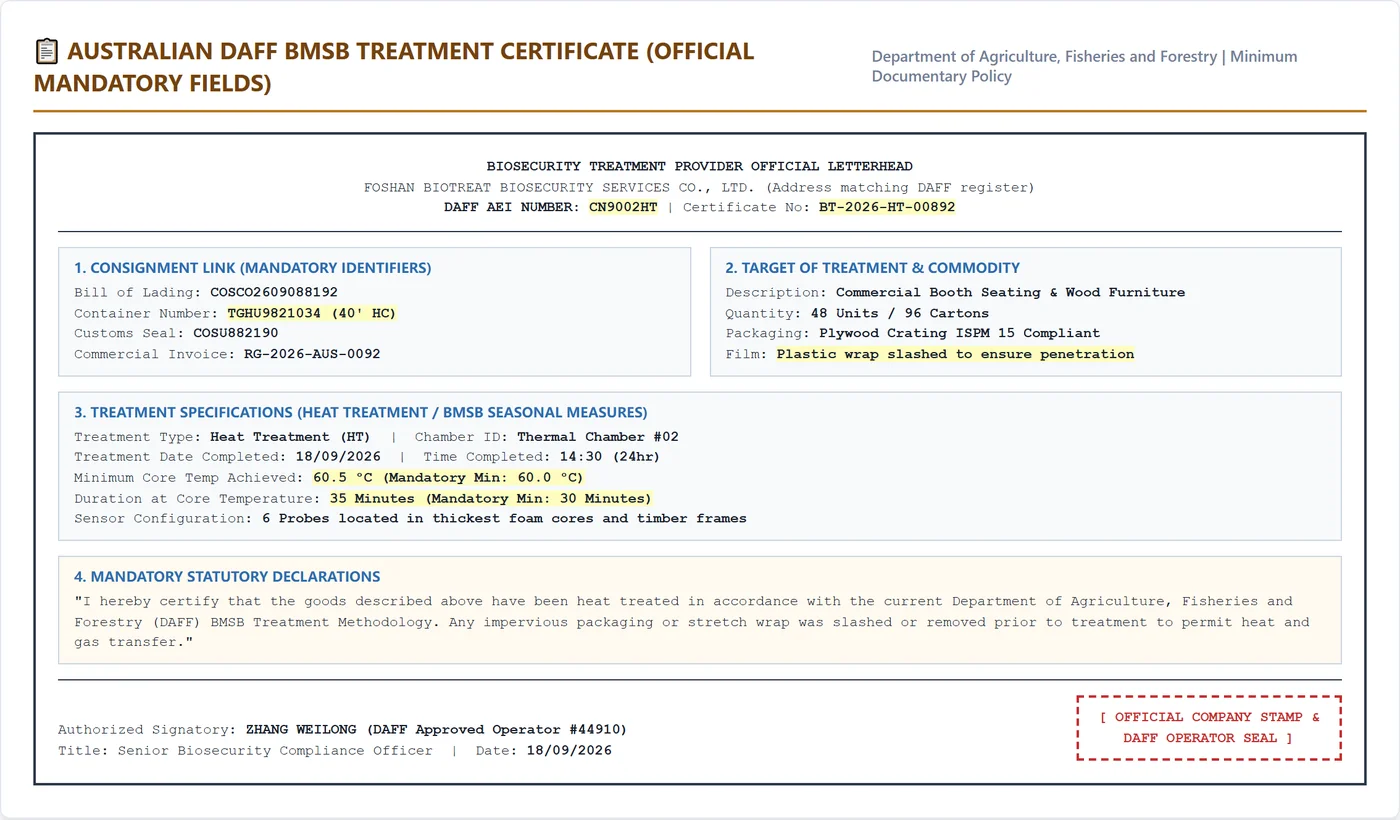
- 1. Treatment Provider Credentials: Company letterhead, physical address, unique certificate tracking number, and active DAFF Approved Entities Identifier (AEI Code).
- 2. Consignment Link Identifiers: Bill of Lading (B/L) number, container number, and customs seal number (FCL shipments).
- 3. Target of Treatment & Packaging Methodology: Accurate commodity description (e.g., Commercial Hospitality Upholstered Booth Seating), ISPM 15 packaging declaration, and explicit verification that protective plastic wrapping was slashed or perforated prior to treatment.
- 4. Treatment Specifications & Sensor Logs: Treatment type (Heat Treatment or Sulfuryl Fluoride), core temperature achieved (≥ 56.0°C / target 60.5°C) for ≥ 30 minutes, number of sensors, or chemical dosage (g/m3) with final gas clearance (< 5 ppm).
- 5. Statutory Legal Declarations: Formal legal declaration certifying adherence to official DAFF BMSB treatment methodologies and seasonal measures.
- 6. Authorized Signatory & Stamp: Name and accreditation ID of DAFF-registered operator, handwritten signature, date of issue, and official company embossed stamp.
All treated goods must be physically loaded aboard the export ocean vessel within 120 hours (5 calendar days) of treatment completion. If port congestion or vessel delays push loading past 120 hours, the certificate is legally void and goods must undergo secondary re-treatment.
5. Australian Fire Safety Synergy: NCC BCA Spec C1.10, AS/NZS 3744 & AS 1530.3
Importing commercial restaurant booths into Australia requires coordinating biosecurity clearance with domestic life-safety fire regulations under the National Construction Code (NCC 2022 / Building Code of Australia, BCA).
Under BCA Part C1.10 (Fire Hazard Properties), fixed built-in seating and wall banquettes installed in Class 6 buildings (commercial restaurants, cafes, bars) must meet stringent fire test benchmarks:
| Australian Fire Standard | Testing Methodology | Contract Pass Criteria | Ron Group Engineering Spec |
|---|---|---|---|
| AS/NZS 3744.1:1998 (Smouldering Cigarette) |
Smouldering cigarette placed in junction between booth seat deck and vertical backrest. | No progressive smouldering or flaming after 60 minutes; char < 50mm. | 100% Virgin CMHR high-resilience foam; self-extinguishing barrier. |
| AS/NZS 3744.2:1998 (Butane Flame / Match Equivalent) |
Butane burner flame applied to upholstery junction for 20 seconds. | Flaming must extinguish within 120 seconds; no smouldering past 15 min. | Fire-barrier interliner beneath velvet/vinyl; char self-terminates in < 15s. |
| AS/NZS 1530.3:1999 (Four-Index Fire Hazard) |
Radiometer panel exposed to vertical test specimen over 20-minute cycle. | Ignitability Index ≤ 12, Spread of Flame ≤ 5, Heat Evolved ≤ 5, Smoke Developed ≤ 5. | Low-smoke polyurethane formulation; Smoke Developed Index ≤ 3 to pass BCA egress. |
| BCA Spec C1.10 Clause 7 (Fixed Upholstered Seating) |
Fire hazard properties of materials in Class 6 commercial dining spaces. | Certified compliance with AS/NZS 3744 or approved fire-retarded assemblies. | Full ISO 17025 accredited laboratory test certificates supplied with shop drawings. |
6. The 5-Year Biosecurity & Compliance Risk Ledger: A Forensic Financial Audit
When contract procurement teams review furniture quotations for Australian projects, accounting departments often focus exclusively on the upfront Factory Gate Purchase Price (FOB). A bidding comparison for sixty meters of custom banquettes reveals an apparent cost difference:
- Vendor A (Unvetted Overseas Broker / Standard Export): $72,000 AUD
- Vendor B (Ron Group Contract Biosecurity & NCC Framework): $88,500 AUD
On paper, Vendor A appears to deliver an upfront "saving" of $16,500 AUD. Let us examine the five-year financial ledger of that decision under active Australian quarantine and building code enforcement.
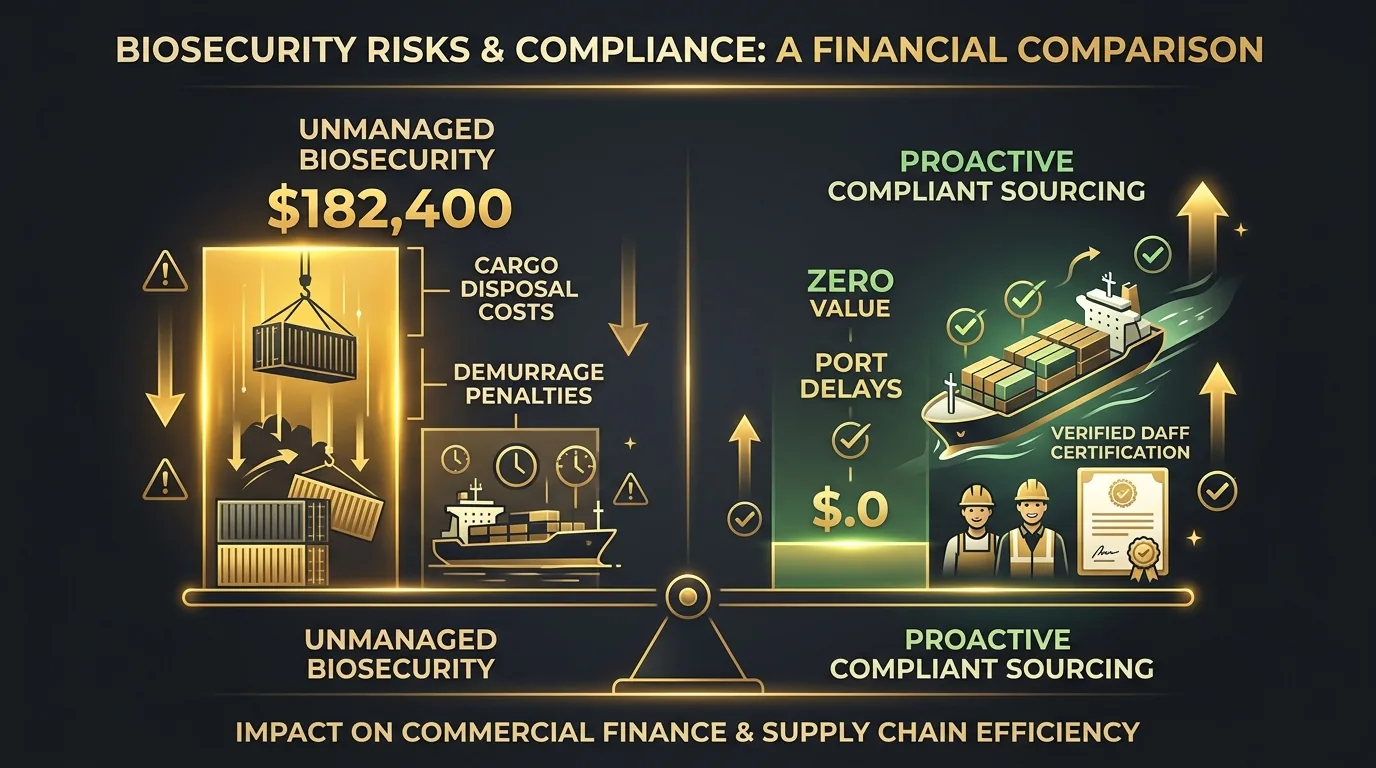
| Lifecycle Cost Component | Vendor A: Unmanaged Biosecurity | Vendor B: Ron Group Protocol | Net Variance (Delta) | Forensic Engineering Commentary |
|---|---|---|---|---|
| Initial Furniture Fabrication | $72,000 AUD | $88,500 AUD | +$16,500 AUD (Initial Premium) | Ron Group includes pre-assembly 56°C HT timber, 120°C PUR adhesives, CMHR foam, and micro-perforated packaging. |
| Ocean Freight (2x 40'HC) | $9,200 AUD | $9,200 AUD | $0 AUD | Identical container shipping slots from South China to Sydney / Melbourne. |
| BMSB Offshore Treatment Fee | $1,200 AUD (Cheap Methyl Bromide) | $2,800 AUD (Accredited Sulfuryl Fluoride) | +$1,600 AUD | Certified AEI treatment provider utilizing inert SO2F2 with continuous gas concentration data logging. |
| Methyl Bromide Skunk Stench Ruin | $72,000 AUD (Total loss of 60m custom banquettes) | $0 AUD (100% odorless, clean interior upon uncrating) | -$72,000 AUD | Methanethiol chemical bond irreversibly contaminated foam; booths unusable in dining service. |
| HAZMAT Disposal & Transport | $8,400 AUD (Tipping fees & hazardous transport in Sydney) | $0 AUD (Direct white-glove staging onto venue floor) | -$8,400 AUD | Specialized environmental disposal of sulfur-contaminated synthetic upholstery and foam. |
| Port Botany Demurrage Penalties | $11,600 AUD (8 days container detention from paper defects) | $0 AUD (Green-channel 4-hour electronic DAFF clearance) | -$11,600 AUD | Missing AEI registration code and lack of wrapping slash declaration held containers in port lock-up. |
| Emergency Temporary Furniture Lease | $18,500 AUD (6-week commercial rental of tables/chairs) | $0 AUD (Bespoke booths installed 14 days before opening) | -$18,500 AUD | Emergency replacement seating required to open doors for confirmed corporate event bookings. |
| Opening Delay & Revenue Loss | $34,000 AUD (Two weeks delayed sales & cover loss) | $0 AUD (Grand opening executed on original date with stellar reviews) | -$34,000 AUD | Lost operating revenue across 180 seats at $75 AUD average spend during remediation. |
| Emergency Foshan Rush Remanufacture | $78,000 AUD (Expedited air/sea split re-order) | $0 AUD (Original installation delivers 10+ year operating lifecycle) | -$78,000 AUD | Factory rushed replacement run; operator forced to pay 35% express fabrication overtime surcharge. |
| TOTAL 5-YEAR CASH EXPENDITURE | $304,900 AUD | $100,500 AUD | -$204,400 AUD NET LIFECYCLE SAVINGS | The "budget" supplier caused a 303% financial catastrophe through biosecurity negligence. |
7. The Specifier's 5-Step Anti-Detention Protocol for Australian Commercial Booth Procurement
To insulate hotel developers, hospitality franchisors, and design-build consultants from biosecurity seizures and destructive odors, Ron Group’s Global Logistics Lab mandates the 5-Step Anti-Detention Protocol:
Common Australian Sourcing Pitfalls
- Allowing export forwarders to select cheap Methyl Bromide fumigation.
- Heating assembled upholstered booths in kilns with 55°C EVA glues.
- Wrapping booths tightly in un-slashed, impermeable stretch film.
- Using unvetted fumigation vendors not listed on DAFF AEI scheme.
- Delaying container loading past the strict 120-hour window.
Ron Group Australian Contract Standards
- Mandating odorless Sulfuryl Fluoride (SO2F2) exclusively.
- Pre-assembly bare timber 56°C HT conditioning + 120°C reactive PUR adhesives.
- Industrial micro-perforated packaging (≥ 4 holes per 100×100mm).
- Partnering strictly with certified Tier-1 DAFF AEI registered providers.
- Tight export drayage scheduling guaranteeing vessel loading within 48 hours.
- Step 1: Explicitly Ban Methyl Bromide in Purchase Specifications
Insert a mandatory contract clause into all purchase orders: "Under no circumstances shall Methyl Bromide (CH3Br) be used for fumigation. All chemical treatments for Australian DAFF BMSB compliance must be performed exclusively using Sulfuryl Fluoride (SO2F2) by an approved DAFF Offshore Treatment Provider." - Step 2: Mandate 120°C Heat-Resistant PUR Adhesives
If heat treatment (HT) is specified, mandate that all timber framework joinery must be assembled with moisture-curing reactive polyurethane structural adhesive (PUR) meeting DIN EN 204 Class D4, completely forbidding standard PVAc white glues and EVA hot melts. - Step 3: Implement the Industrial Micro-Perforated Packaging Protocol
Require protective transit film to provide at least four ventilation holes of not less than 1.0mm diameter per 100×100mm of film surface (or documented cross-slashes every linear meter), ensuring treatment certificates carry the mandatory DAFF endorsement. - Step 4: Verify AEI Provider Status Prior to Container Gating
Confirm that the fumigation provider's Approved Entity Identifier (AEI Code) is currently listed as "Approved" on the official DAFF public online register before authorizing cargo to enter the export terminal. - Step 5: Enforce the 120-Hour Loading Buffer
Coordinate production and container stuffing so treatment occurs no more than 48 hours before scheduled vessel departure, maintaining a 72-hour safety buffer against port congestion.
8. The Ron Group Contract Engineering Solution
At Ron Group’s 20+ year manufacturing hub in Foshan, China, exporting commercial hospitality furniture to Australia is governed by a dedicated Australian Compliance Taskforce. We operate with full mastery of DAFF biosecurity mandates and NCC life-safety fire codes:
- 1. Component-Level Pre-Assembly Kiln Sterilization: All 18mm Baltic birch plywood and solid timber frame members undergo 56°C / 30-minute core thermal conditioning in our automated drying kilns before upholstery, ensuring 100% insect eradication with zero foam thermal aging.
- 2. Exclusive Sulfuryl Fluoride Partner Network: We partner exclusively with Tier-1 DAFF-accredited offshore treatment facilities (AEI Certified) utilizing high-purity Sulfuryl Fluoride with automated electronic concentration data-logging. Every shipment arrives 100% odorless and ready for immediate dining service.
- 3. Reaction-Injection CMHR Foam Matrix: We engineer all seat and backrest cushions with Combustion Modified High Resilience (CMHR) foam meeting both AS/NZS 3744.1/2 and AS/NZS 1530.3 fire indices, providing five-year anti-sag resilience combined with commercial fire protection.
- 4. Strict 120-Hour Departure Coordination: Our export logistics division directly manages container drayage, customs seals, and terminal loading, maintaining an unbroken chain of custody that guarantees loading well within the 120-hour window.
- 5. Audit-Ready Australian Documentation Package: Every container departs with an unassailable documentation bundle: official DAFF Treatment Certificate with matching container/seal numbers, verified packaging slash declarations, ISO 17025 fire test reports, and timber moisture declarations (8–12% MC).
By partnering with Ron Group, Australian hospitality operators, architects, and builders eliminate the catastrophic risk of port rejections, chemical stench destruction, and delayed liquor licensing—delivering stunning, compliant restaurant interiors on time, on budget, and without a whiff of risk.
Engineering Execution Summary
Never let a $1,200 port fumigation choice trigger a $180,000 toxic chemical destruction or an indefinite biosecurity hold at Port Botany. By specifying odorless Sulfuryl Fluoride, enforcing pre-assembly 56°C timber conditioning with 120°C PUR reactive adhesives, and executing strict DAFF 6-field certificate audits within the 120-hour window, hospitality developers can import bespoke Foshan luxury joinery into Australia with total regulatory confidence.
Australian DAFF & NCC Compliance Audit
Exporting hospitality joinery to Australia? Submit your furniture schedule and timber specifications. Ron Group’s Australian logistics desk will review your treatment protocols, packaging ventilation plans, and DAFF certificate workflows within 24 hours.
Request Biosecurity Audit →Foshan Factory Direct Australian Hotline
Have an urgent container booking during the September–April BMSB window, or need certified CMHR foam test data for Australian certifiers? Connect directly with our Foshan export engineering desk.
Global Sourcing Knowledge Mesh
Explore authoritative engineering whitepapers and manufacturing master guides from the Ron Group technical archive.
Commercial Booth Seating Hub (16 Models & CAD)
Explore 16 contract-grade restaurant booth models with full CAD blocks, BOM breakdowns, and American standard specs.
Foshan Restaurant Furniture Master Guide
The definitive guide to sourcing commercial dining tables, chairs, and custom millwork directly from Foshan factories.
Hospitality QC & Factory Auditing Protocol
Learn how to audit Chinese furniture factories, specify AQL Level II standards, and prevent export quality failures.
Custom Dining Tables & Base Engineering
Explore cantilever table frames, self-leveling bases, and anti-wobble structural joinery for heavy commercial use.