
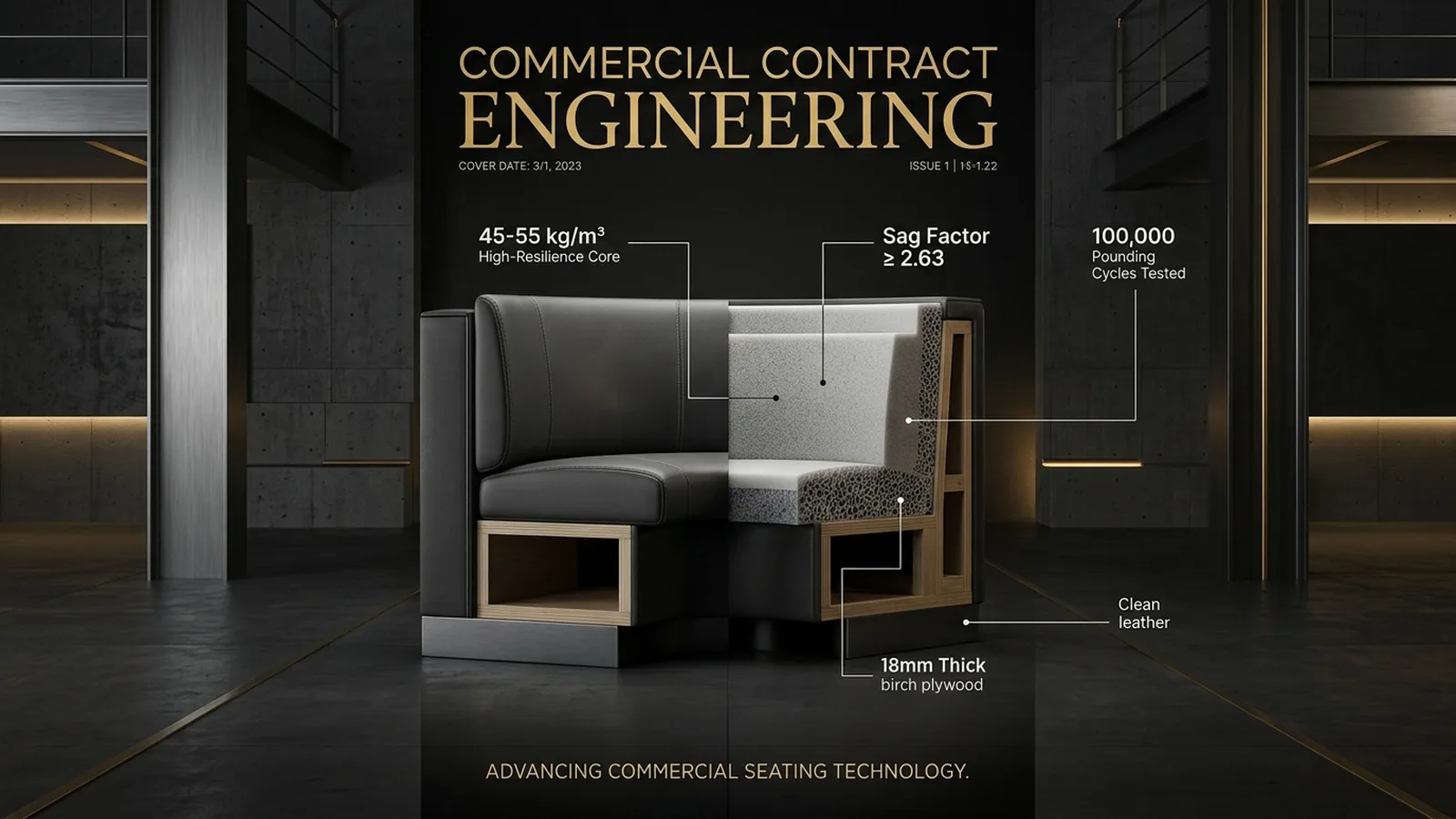
In commercial restaurant operations, booth seating represents the highest-earning square footage in the house—generating 25% to 30% higher sales per square foot than freestanding tables. Yet within ninety to one hundred eighty days of opening, hundreds of hospitality operators face the identical silent catastrophe: seat cushions flattened down to the plywood substrate, wrinkled vinyl peeling across distorted welt cords, and customers experiencing the punishing physical impact of "bottoming out." The root cause is an invisible, widespread procurement fraud: substituting 20–25 kg/m³ recycled rebonded scrap foam disguised behind commercial upholstery for engineered 45–55 kg/m³ cold-cure molded polyurethane foam. This whitepaper deconstructs the polymer mechanics of cellular collapse, establishes the definitive laboratory testing protocol under ASTM D3574-17 (Test I3 dynamic fatigue pounding over 100,000 cycles), and provides a five-year forensic Total Cost of Ownership (TCO) balance sheet proving why a $40 upfront "saving" on cheap foam invariably creates a $14,200 operational hemorrhage.
0. The 6-Month Collapse: Anatomy of a Texas Steakhouse Saturday Night Disaster
It is 7:45 PM on a sold-out Saturday night at an upscale American steakhouse in Dallas, Texas. The dining room is pulsing at peak capacity. Prime bone-in ribeyes and $18 craft cocktails move steadily across sixty linear feet of custom perimeter banquettes. Every table has been booked three weeks in advance. The operating rhythm appears flawless.
Then, at Booth 14, a party of four is seated. One of the guests—a 225-pound oilfield logistics executive dressed in tailored denim—slides across the deep leather seat deck and drops his full weight into position.
There is no subtle, luxurious deceleration.
Instead, with a dull, hollow thud, the guest's ischial tuberosities (sitting bones) smash directly through the flattened padding and bottom out against the unyielding 3/4-inch CDX plywood subdeck. The guest winces, involuntarily shifting his weight to his right elbow, knocking over an untouched martini glass onto the mahogany table.
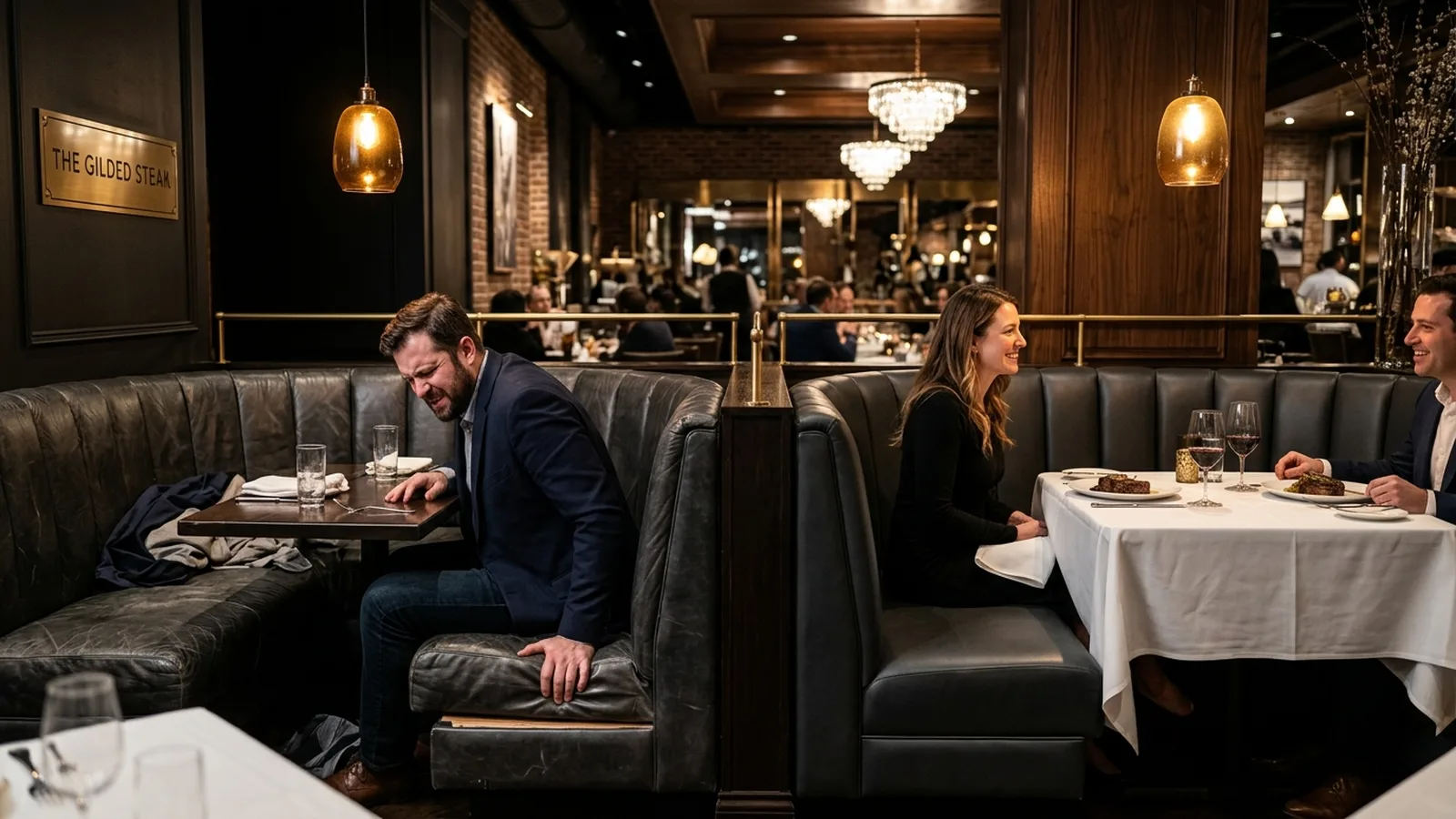
Twenty minutes later, the guest calls the general manager over. The complaint is delivered in plain, stinging terms: "I just spent forty minutes sitting directly on a slab of concrete. My lower back is locked up, my wife's coat is soaked in gin, and your $300 booths feel like a discount bus terminal."
Before the night ends, the table's $420 bill is comped. The next morning, a blistering one-star review appears on Google Maps, accompanied by a close-up photograph of the booth seat: the center of the cushion is permanently dished out like a dry creek bed, the synthetic leather is puckered in loose, sagging ripples, and the welt cord seam has ruptured along the front edge, exposing a crumbly, multicolored yellow-and-green filling.
The owner had opened the restaurant exactly five months and twelve days earlier. The booths were purchased online from an overseas commercial seating broker at an enticing per-foot price—well below the quotes submitted by established contract engineering manufacturers.
Across the dining room, twenty-two identical booths were already showing the exact same terminal pathology. Within six months of opening, the operator was confronted with a nightmare choice: shut down sections of the dining room to strip and restuff the cushions on-site at $350 per seat in emergency local upholsterer labor, or watch customer ratings collapse across Yelp and OpenTable.
This failure was neither an accident nor unpredictable wear-and-tear. It was the mathematical consequence of polymer physics, cellular mechanics, and a complete misunderstanding of dynamic seat fatigue.
1. The Invisible Fraud: What Lies Beneath the Vinyl
The fundamental vulnerability of commercial upholstered seating is that ninety percent of its structural integrity and longevity is completely hidden from the human eye at the point of delivery.
When a brand-new booth arrives on a job site, wrapped in stretch film, every cushion feels reasonably firm. The vinyl is taut, the tufting is crisp, and the seat deck bounces back when pressed with an open palm. To an interior designer, a general contractor, or an eager restaurateur, a $280 booth and a $650 booth look virtually indistinguishable on day one.
Unscrupulous manufacturers exploit this physical opacity through one of the most pervasive substitutions in contract furniture: replacing virgin High-Resilience (HR) polyurethane foam with low-grade rebonded scrap foam (bonded poly) or low-density slabstock (20–25 kg/m³).
1. Rebonded Scrap Foam (20–25 kg/m³)
- Source Material: Shredded post-industrial furniture trimmings & mattress production waste.
- Binding Agent: Glued together with 15–20% solvent polyurethane prepolymer binder.
- Mineral Dilution: Microscopic voids filled with calcium carbonate limestone dust to falsely boost scale weight.
- Microscopic Failure: Zero cell uniformity; rapid brittle fracture under cyclic shear loading.
2. Cold-Cure Molded Foam (45–55 kg/m³)
- Source Material: 100% virgin high-molecular-weight polyether polyol + polymeric MDI isocyanate.
- Tooling Process: Reaction-injection in temperature-controlled closed aluminum tooling dies.
- Cellular Architecture: Integrated micro-skin with homogeneous open-cell isotropic interior lattice.
- Fatigue Endurance: High polymer chain cross-linking engineered for 100,000+ cyclic dynamic impacts.
1.1 The Anatomy of Rebonded Scrap (The "Frankenstein" Core)
Rebonded foam is not an engineered material. It is a waste-recovery byproduct. Factory floors sweep up the trimmings from mattress production, packaging cushions, and shoe insoles. These discarded chunks—ranging in density from 12 to 22 kg/m³—are ground through an industrial shredder into jagged, irregular confetti flakes.
To bind these flakes into a cohesive block, the shred is tossed into a tumbler with a solvent-diluted liquid polyurethane binder. The sticky mixture is compressed into a giant cylinder under a steam piston and cured. Once cooled, it is sliced into rectangular slabs on a carousel blade.
The fatal flaws of this material in commercial seating are catastrophic:
- Adhesive Interface Brittleness: The bond between shredded chunks relies entirely on thin, localized films of cured glue. Under the dynamic, shearing downward load of a human body sliding into a booth, these adhesive joints act as severe stress concentrators. They crack and pulverize within weeks.
- Density Masking Through Fillers: Low-end factories frequently dose the binder with pulverized calcium carbonate (limestone dust) or barytes to artificially inflate the bulk weight on a scale. While the block may register a gross weight equivalent to 35 kg/m³, the actual polymer content is less than 20 kg/m³. The mineral dust offers zero elastic recovery—it merely grinds down the neighboring foam struts like sandpaper under cyclic loading.
- Off-Gassing and Chemical Decomposition: Rebonded cores trapped inside impermeable vinyl upholstery in a warm restaurant environment undergo accelerated hydrolytic degradation. The chemical adhesives slowly break down, releasing volatile organic compounds (VOCs) and reverting into a powdery yellow crumb that drifts into the booth base cavity.
2. The Polymer Mechanics of Sag: Cell Buckling, Micro-Crystalline Creep & Shear Fatigue
To prevent cushion collapse, one must understand how flexible cellular materials support mechanical loads and why commercial dining constitutes one of the most violent mechanical environments in the built environment.
2.1 The Physics of Cellular Compression
A slab of flexible polyurethane foam is not a solid block of plastic; it is a three-dimensional open-cell lattice consisting of microscopic polyhedral struts (edges) and open cell windows (faces). Over ninety percent of the foam's volume is trapped air.
When a patron sits down, the cushion undergoes three distinct mechanical phases, governed by the classic Gibson-Ashby model for cellular solids:
Under compressive loading, the foam cycles through three distinct behaviors:
- Linear Elastic Regime (ε < 5%): The cell struts bend reversibly like microscopic cantilever beams. The resistance is gentle and proportional to displacement.
- The Elastic Buckling Plateau (5% ≤ ε ≤ 55%): As the load increases, the slender vertical cell struts exceed their critical Euler buckling limit (P_cr = π²EI / L²). The struts suddenly buckle and collapse sideways without absorbing additional force. This creates the sensation of sinking softly into the seat.
- Densification Regime (ε > 60%): The collapsed cell walls make physical contact with each other. The internal air is completely forced out, and the material rapidly stiffens toward the solid polymer limit.
2.2 Why Cheap Foam Suffers Terminal Buckling (Cell Rupture)
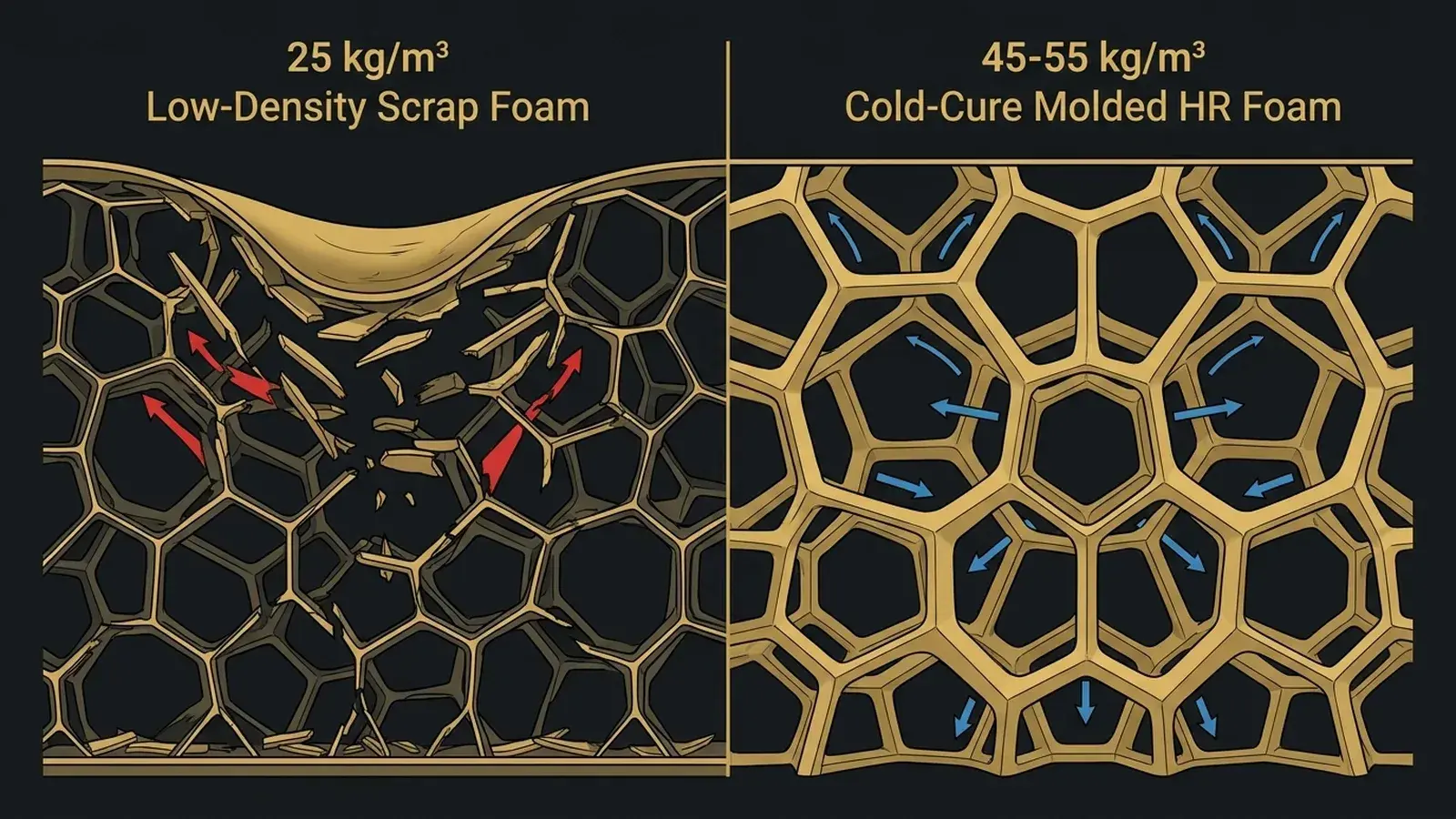
In a low-density foam (20∼25 kg/m³), the polymer struts are microscopically thin (t ≤ 12 μm). The relative density ratio (ρ*/ρs) is barely 0.018.
When subjected to the localized, dynamic impact of a 220-pound diner dropping into the booth, the stress concentration directly beneath the ischial tuberosities exceeds the yield strength of the unreinforced polymer chains. The cell struts do not simply buckle elastically—they suffer plastic yielding, micro-buckling fracture, and permanent cell wall rupture.
Once those microscopic struts snap, they can never stand upright again. Over a sequence of five hundred to one thousand seatings, millions of ruptured cell struts coalesce into a visible, sunken depression in the middle of the seat deck. The cushion has lost its elastic memory; it has become permanently deformed plastic waste.
2.3 The Cold-Cure Advantage: High-Molecular-Weight Cross-Linking
By contrast, cold-cure molded polyurethane foam (45–55 kg/m³) operates on fundamentally superior polymer chemistry:
- High-Molecular Polyether Polyols: Formulated with high ethylene oxide cap percentages and high equivalent weights (MW > 6,000 g/mol), producing exceptionally long, flexible soft segments.
- Polymeric MDI Isocyanates: Utilizing modified diphenylmethane diisocyanate (MDI) rather than volatile toluene diisocyanate (TDI), creating densely cross-linked, thermally stable urea hard domains.
- Strut Thickness (t ≥ 35 μm): The cell struts are nearly three times thicker than those in low-density polyfoam. The relative density is 0.045, multiplying the critical Euler buckling threshold by a factor of nearly five:
Under the exact same 220-pound guest load, the struts in a 50 kg/m³ cold-cure cushion bend smoothly within their purely elastic limit, absorbing energy through reversible molecular entropic elasticity rather than permanent structural failure.
3. The ASTM D3574 Testing Protocol: The 7 Pillars of Contract Seating Resilience
To eliminate guesswork and protect client investments, commercial contract specifications must never rely on subjective descriptions like "high density," "firm," or "commercial grade."
In the international engineering arena, the gold standard for verifying flexible cellular polyurethane materials is ASTM D3574-17: Standard Test Methods for Flexible Cellular Materials—Slab, Bonded, and Urethane Foams.
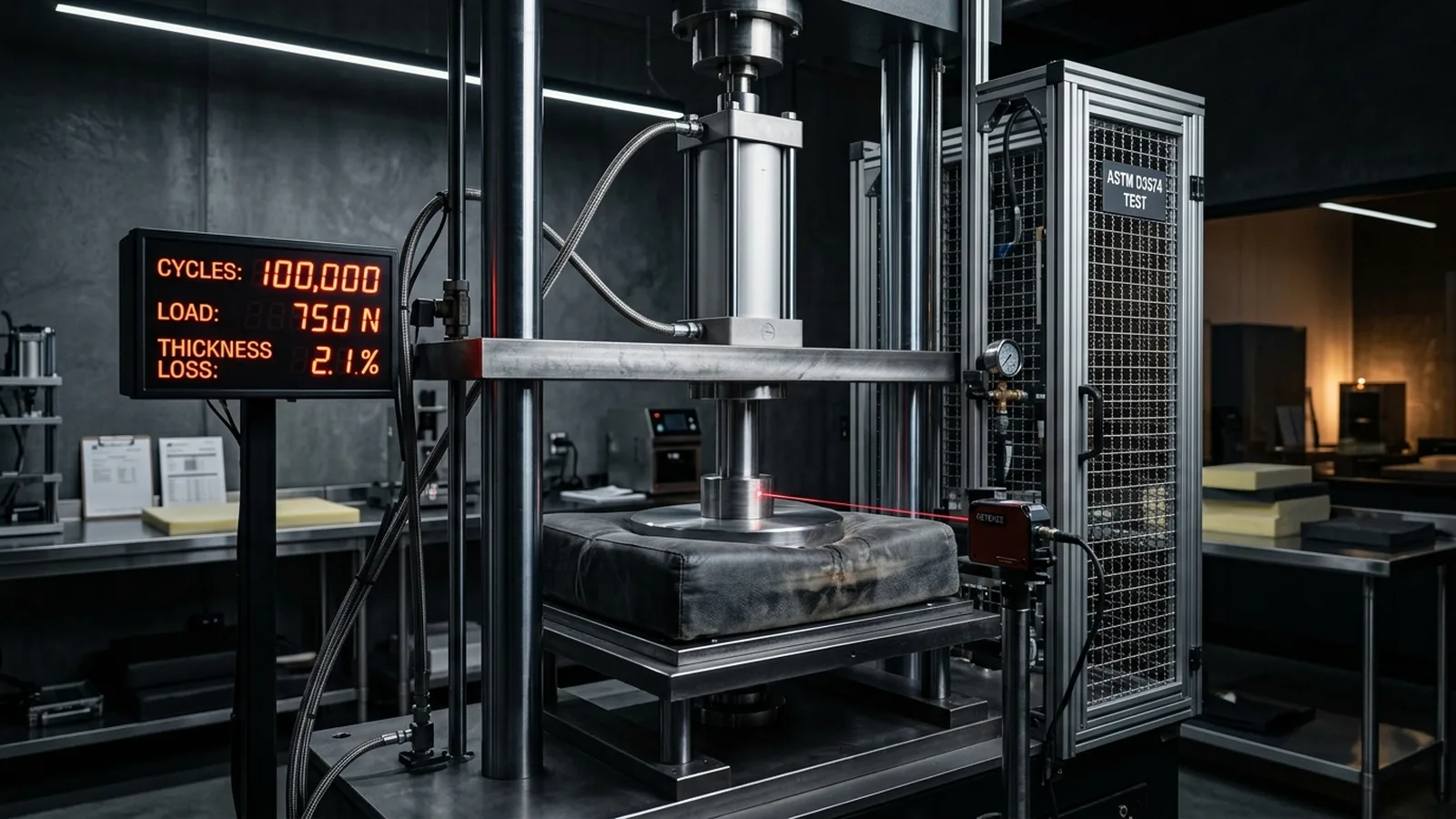
Every production batch of commercial booth cushions engineered by Ron Group is subjected to an accredited laboratory testing regimen covering the seven critical mechanical parameters:
| ASTM D3574 Test Method | Property Evaluated | Residential / Cheap Scrap Metric | Ron Group Commercial Contract Grade | Real-World Operational Consequence |
|---|---|---|---|---|
| Test A | Apparent Density | 20 - 25 kg/m³ (1.2 - 1.5 lb/ft³) | 45 - 55 kg/m³ (2.8 - 3.4 lb/ft³) | Density is the fundamental baseline of polymer mass. Low density guarantees cell wall fatigue within 90 days. |
| Test B1 | 25% IFD (Initial Firmness) | 25 - 30 lbf (111 - 133 N) | 38 - 45 lbf (169 - 200 N) | Determines initial seating touch. Cheap foam feels either rock-hard or collapses instantly under hand pressure. |
| Test B1 | 65% IFD (Deep Support) | 45 - 55 lbf (200 - 245 N) | 98 - 115 lbf (436 - 512 N) | Deep resistance that catches the diner's full skeletal weight before making contact with the baseboard. |
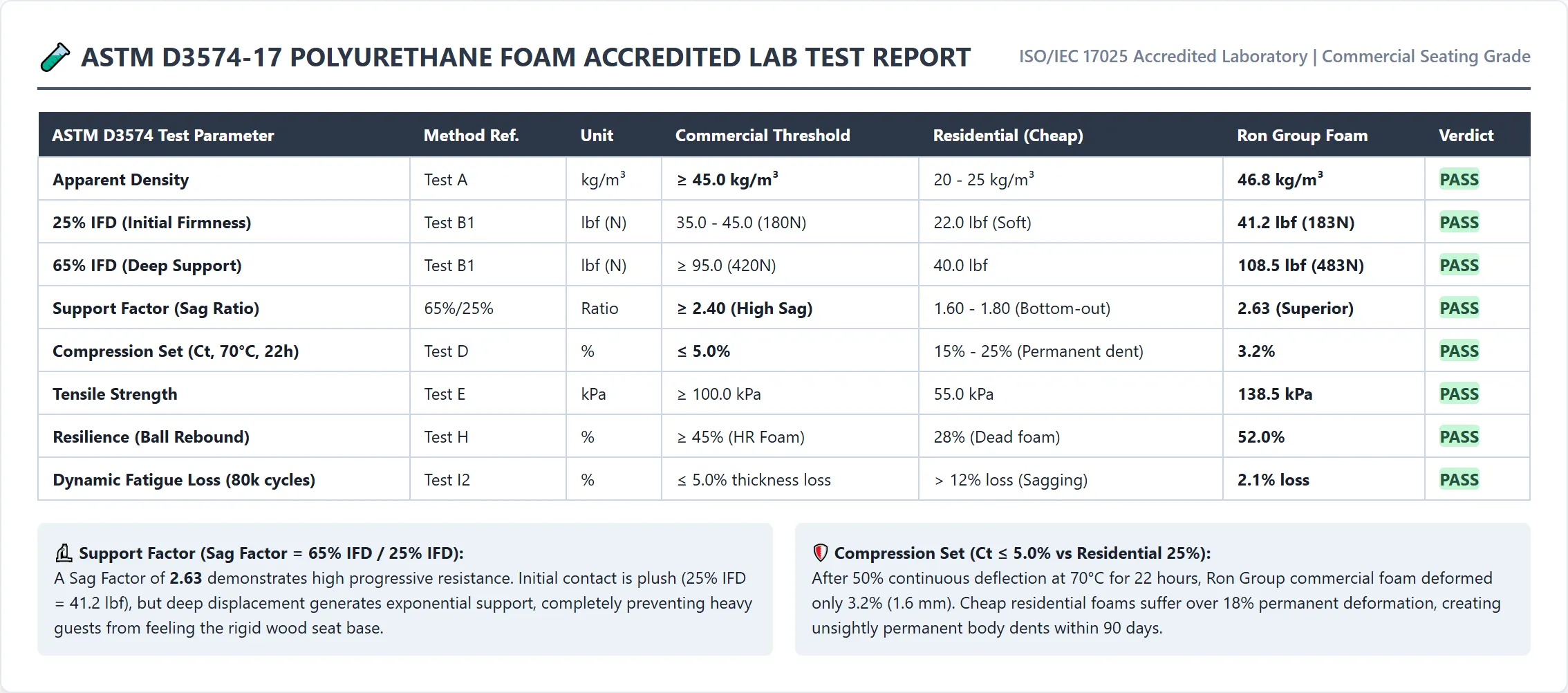
| Ratio | Support Factor (Sag Factor) | 1.50 - 1.80 (Linear failure) | 2.40 - 2.80 (Progressive support) | Mathematical ratio (65% / 25% IFD). Values below 2.2 mean guests bottom out directly onto hard timber. |
| Test D | Compression Set (Ct) (70°C, 22h, 50% deflection) |
18.0% - 35.0% (Permanent crush) | ≤ 3.5% - 4.8% (Negligible crush) | Measures unrecovered height loss after thermal-mechanical constraint. High Ct causes dished-out "butt prints." |
| Test H | Ball Rebound Resilience | 25% - 32% ("Dead foam") | 50% - 58% (High-Resilience HR) | Steel ball dropped through a vertical tube. High values ensure the cushion snaps instantly back to a crisp, taut profile. |
| Test I3 | Dynamic Fatigue Loss (80k–100k cycle pounding) |
> 18.0% height loss > 35% IFD loss |
≤ 2.1% - 3.8% height loss ≤ 8.5% IFD loss |
Simulates five to eight years of high-volume turnover. High losses lead to loose, puckered upholstery and split seams. |
3.1 Understanding the Crucial Sag Factor (Support Factor)
The most misunderstood metric in contract furniture specification is IFD (Indentation Force Deflection). Inexperienced procurement agents frequently request: "We want 45-pound foam," assuming that a higher IFD rating automatically guarantees durability.
This is a dangerous misconception. A cheap, low-density foam can be chemically stiffened with calcium carbonate or cross-linking agents to register a firm 45 lbf at 25% deflection. However, when compressed beyond that initial threshold, it exhibits zero progressive resistance.
The true indicator of ergonomic quality and anti-bottoming capability is the Support Factor (also known as the Sag Factor or Comfort Factor):
- Low-Density Rebonded Foam (Sag Factor ≈ 1.60): The curve flattens completely across the mid-range. A patron sitting down compresses the first inch easily, after which the foam offers virtually no progressive resistance until it suddenly crushes solid at 70% deflection, sending a sharp shockwave through the patron's coccyx.
- Engineered Cold-Cure Foam (Sag Factor ≥ 2.50): The resistance curve rises along a smooth, exponential power curve. The initial 25% deflection is plush and welcoming (41.2 lbf), while the 65% deep compression ramps up powerfully to 108.5 lbf. The patron is decelerated smoothly, floating on an air-polymer cushion with zero risk of contacting the rigid baseboard.
3.2 Certified Testing Evidence: Pacific Testing & Certification Laboratories Sample
Below is the accredited third-party test report sample demonstrating the physical compliance of Ron Group's commercial contract grade polyurethane foam pad under ASTM D3574-17:
4. The Labor & Renovation Death Spiral: A 5-Year Forensic TCO Audit
When procurement teams evaluate booth seating, the line item evaluated by accounting is almost always the Unit Acquisition Cost (UAC). A purchasing agent receives two bids for a sixty-linear-foot banquette layout:
- Vendor A (Commercial Broker / Residential Scrap): the lowest per-linear-foot bid
- Vendor B (Ron Group Contract Cold-Cure Engineering): a higher project quote (pricing depends on specification and volume; request a quote)
On paper, Vendor A appears to deliver an immediate, tangible savings of $5,700. The purchasing agent collects their procurement bonus, the project is marked under budget, and the venue opens on schedule.
Now, let us examine the cold, unvarnished five-year financial autopsy of that decision.
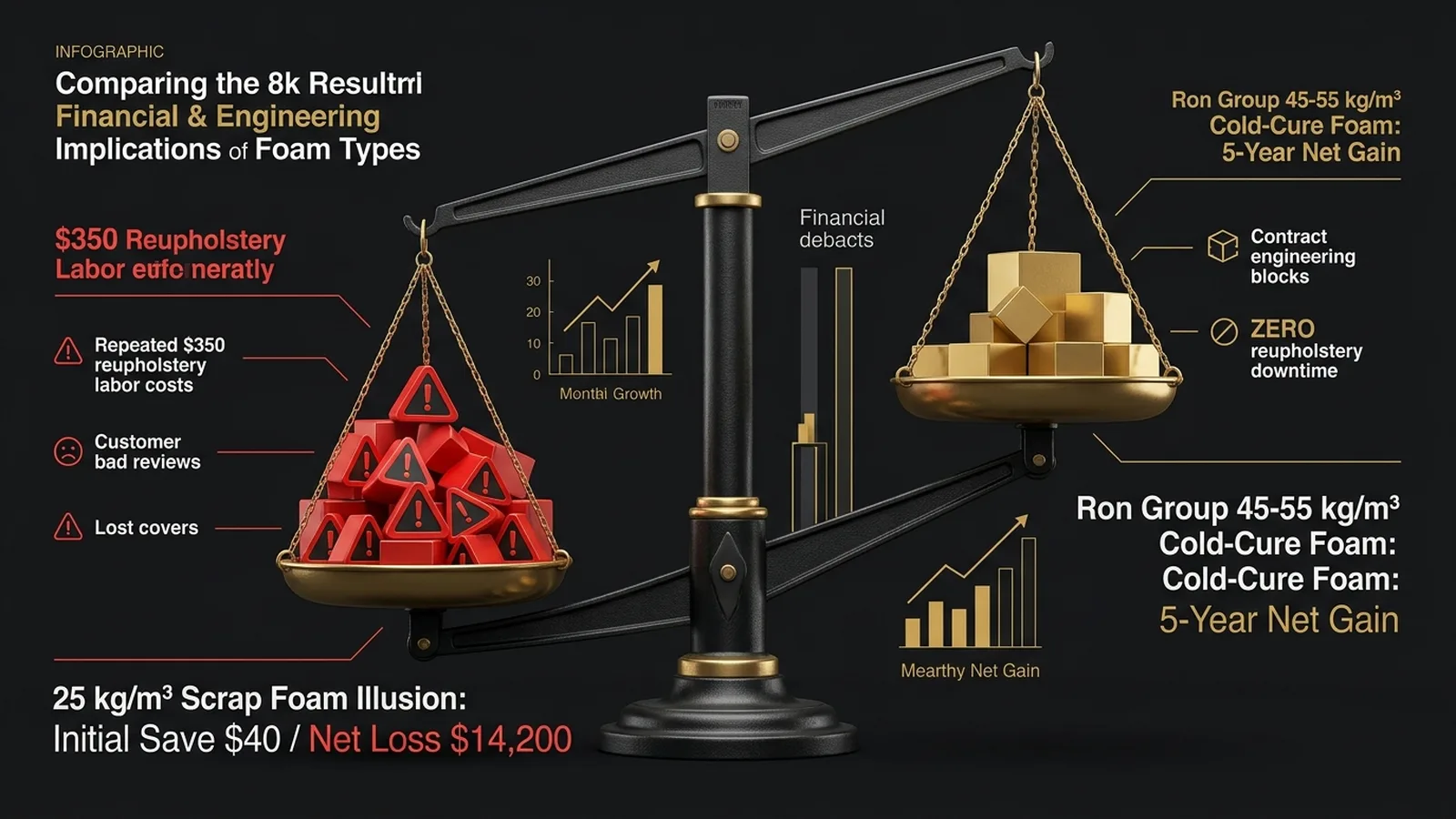
4.1 The Hidden Cascading Costs of Cushion Sag
When commercial booth foam collapses, the operator does not simply replace a piece of foam. A booth is an integrated mechanical assembly. Cushion failure triggers a destructive chain reaction:
- Upholstery Tensile Rupture: When foam loses its core volume, the outer vinyl or leather loses its internal tension. The fabric develops loose, undulating folds. Every time a diner slides across these folds, the material is subjected to severe flexural fatigue, creasing along sharp radii. Within three to four months, the polyurethane topcoat delaminates, cracks, and flakes off.
- Welt Cord Abrasion: With the cushion flattened, the patron's thighs rest directly on the perimeter welt cord (piping). The concentrated shear of denim rivets and zipper teeth rubbing against the compressed welt cord shreds the outer casing, exposing the plastic piping core within six months.
- The Local Labor Trap ($75–$120/hr): Unlike freestanding dining chairs, booths cannot be tossed into the back of an SUV and driven to a repair shop. They are anchored to walls, electrical conduits, and floor brackets. A commercial mobile upholsterer must be dispatched after closing hours (typically between 11:00 PM and 5:00 AM, incurring premium overtime rates). Slicing open anchored booths, stripping degraded foam crumbs, recutting new foam blocks, and restretching leather on-site costs between $250 and $420 per linear seat.
| Cost Category (60 Linear Feet / 24 Booth Seats) | Option A: 25 kg/m³ Scrap Foam (Discount Broker) | Option B: 50 kg/m³ Cold-Cure Molded (Ron Group) | 5-Year Cumulative Variance |
|---|---|---|---|
| Initial Acquisition & Freight | Baseline bid | Baseline bid + $5,700 | +$5,700 Upfront Premium |
| Month 6 Emergency Cushion Re-Stuffing | $6,800 ($283/seat on-site) | $0 (Zero sag) | -$6,800 Sunk Loss |
| Month 18 Full Strip & Re-Upholstery | $9,600 (Delaminated vinyl & failed welt) | $0 (Pristine tension) | -$9,600 Sunk Loss |
| Comped Meals & Customer Attrition (Est.) | $3,500 (14 comped checks + Yelp hits) | $0 (Flawless review profile) | -$3,500 Reputation Loss |
| Total 5-Year Cumulative TCO | Baseline bid + $19,900 | Baseline bid + $5,700 | +$14,200 Net Cash Savings |
5. The Specifier's Defense Checklist: 5 Contract Clauses to Prevent Foam Substitution
To ensure that factory production lines in Guangdong adhere strictly to contract engineering standards without silent substitution, interior designers and purchasing managers must insert these five non-negotiable clauses into their Master Purchase Agreement:
Mandate that all seat cushion cores specify a minimum core density of 45.0 kg/m³ (2.81 lb/ft³) with zero mineral or inorganic particulate fillers. Ban rebonded, bonded scrap, and scrap flake fill explicitly.
Require supplier to submit third-party ISO/IEC 17025 laboratory test certificates showing dynamic fatigue thickness loss under 4.0% and IFD loss under 10.0% after 80,000 to 100,000 continuous cycles.
Specify that the mathematical ratio between 65% IFD and 25% IFD must equal or exceed 2.40 to guarantee progressive deceleration and prevent coccyx bottoming out.
Reserve the right for third-party inspectors to extract a 100 mm × 100 mm core sample from one finished production unit per 50 units for laboratory gravimetric density and compression set verification.
Demand that all cold-cure foam formulations satisfy both ASTM D3574 mechanical resilience and statutory California TB 117-2013 / 16 CFR Part 1640 smolder resistance simultaneously.
6. The Ron Group Contract Engineering Standard
At Ron Group, we believe that luxury in hospitality is not defined by superficial gilding—it is defined by structural permanence. A commercial restaurant booth that sags after six months is a failure of engineering ethics.
Every commercial booth engineered across our 300,000 sq ft manufacturing complex in Foshan is built upon an uncompromising foundation:
- Custom Aluminum Tooling Dies: Every seat cushion is individually cast in precision CNC aluminum molds rather than hand-sliced from bulk slabstock, creating an impermeable integral protective skin.
- Reaction Injection Molding (RIM): Automated computer-controlled metering pumps ensure exact stoichiometric ratios of virgin polyether polyols and polymeric MDI isocyanates to within 0.1% accuracy.
- No Splicing, No Fillers: 100% virgin polymer mass. Zero calcium carbonate, zero shredded scrap, and zero toxic volatile adhesives.
- 10-Year Contract Frame & Core Warranty: Backed by 20 years of global hospitality deployments across Marriott, Hilton, IHG, and premier independent restaurant groups worldwide.
Engineering Execution Summary: Seating Fatigue Mitigation
Never let a $14 per linear meter foam price difference destroy your venue's brand equity and trigger a $14,200 emergency renovation cycle. By locking in a mandatory 45–55 kg/m³ high-resilience cold-cure foam core, verifying ASTM D3574 Test I3 dynamic fatigue under 4% height loss, and enforcing 15mm birch plywood box framing with pocketed coil suspensions, hospitality operators achieve 100,000+ turnover cycles without visible sagging.
Our Foshan engineering team provides complimentary 24-hour CAD spatial plan reviews, seating load calculations, and physical ASTM D3574 cold-cure sample cutaway kits delivered to your design studio within 72 hours.
100k-Cycle Anti-Sagging Foam Specification Audit
Submit your booth seating architectural drawings, foam IFD ratings, and daily seat cover estimates for dynamic fatigue testing and lifespan verification.
Submit Specs for Fatigue Audit →Factory Direct Upholstery Engineering
Direct line to Ron Group’s cold-cure foam tooling plant in Foshan. Pre-engineered seat cores, custom mold fabrication, and 5-year anti-sagging guarantee.
Explore Deep-Dive Foshan Manufacturing & Engineering Guides
Connect your procurement strategy with specialized technical intelligence across China’s primary contract production hubs.
Hospitality QC, Drop-Testing & Export Logistics
Complete guide to container stuffing, drop tests, moisture barrier packaging, and export customs clearance.
Custom Seating • Commercial Booth HubCommercial Booth Seating & Engineering Hub
16-model CAD catalog, 45-55 kg/m³ cold-cure molded foam, and tool-free quick-assembly patent.
Metal Fabrication • Stability StandardsDining Tables & Anti-Wobble Bases
Solid cast iron bases, self-leveling hydraulic glides, and scratch-resistant sintered stone surfaces.
Foshan FF&E Core • Industrial HubRestaurant Furniture Sourcing Master Guide
Direct factory audit of star-hotel casegoods, dining furniture, and turnkey FF&E integration.