
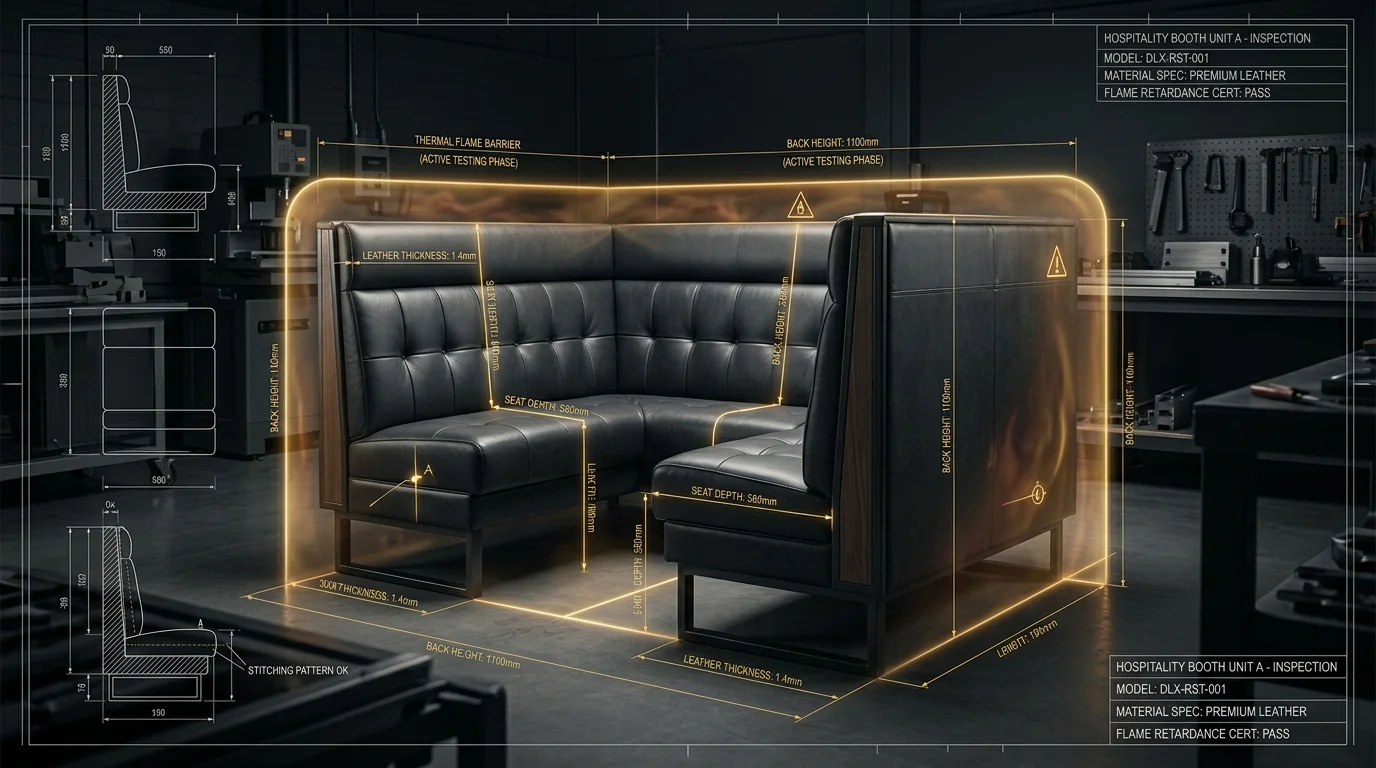
Executive Engineering Thesis
A dining room is an emotional sanctuary, but in the eyes of municipal fire officials, it is a dense thermodynamic fuel load. When commercial restaurant booths are imported without verifiable flammability engineering, a $1,200 discount on uncertified seating routinely transforms into a $38,500 disaster: red-tagged occupancy permits, emergency reupholstery, and weeks of hemorrhaging revenue. This whitepaper deconstructs the legal authority of 16 CFR Part 1640 (SOFFA), the critical engineering gulf between component-level smolder tests (TB 117-2013) and full-scale open flame calorimeter burns (CAL 133), and the exact physical anatomy required to pass municipal Fire Marshal field audits on day one.
0. The 72-Hour Knock: When Hospitality Dreams Meet the Propane Torch
There is a distinct, fragile silence in a newly completed restaurant seventy-two hours before its scheduled soft opening. The pendant lights are dimmed to a warm amber glow. The polished brass accents reflect the crisp glassware aligned along walnut tables. The kitchen staff is running prep, and the operator—having poured their life savings, six months of sleepless nights, and the collective hopes of their partners into these four walls—stands near the host stand, allowing themselves their first quiet exhale.
Then comes the sharp knock on the glass front door.
It is not a delivery driver or an enthusiastic neighbor. It is the municipal Fire Marshal, accompanied by a senior building inspector, carrying clipboards, measuring tapes, and a portable butane testing torch.
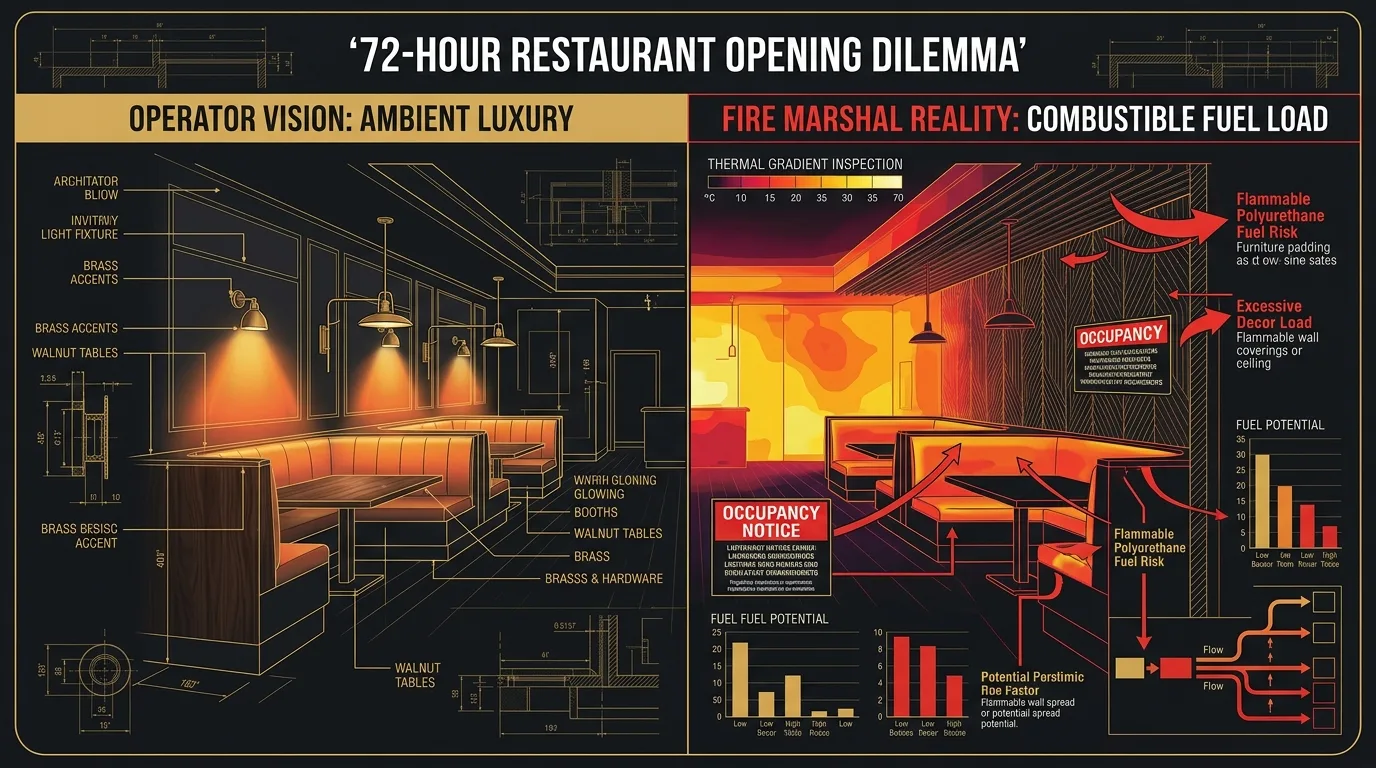
The Fire Marshal does not inspect the menu, admire the custom millwork, or care about the months spent perfecting the lighting design. Their eyes move straight past the dining room to the long row of upholstered banquettes and button-tufted booths anchored along the perimeter walls.
They walk to the corner booth, reach underneath the seat deck, and search for the statutory certification label. Finding only a flimsy, handwritten paper tag with an unverified factory stamp, the Fire Marshal frowns. They pull a utility knife from their belt, slice a small 2-inch incision along the underside of an unexposed seam, extract a sliver of yellow polyurethane foam, step outside onto the concrete curb, and hold a flame to it.
Within four seconds, the sample ignites into a spitting, dripping orange flame that releases a thick black plume of toxic hydrogen cyanide smoke.
The inspector walks back in, pulls a bright red adhesive label from their folder, and affixes it directly to the front entrance: OCCUPANCY CERTIFICATE DENIED. STOP WORK / NO OCCUPANCY PERMITTED.
In that single, four-second burn test, the operator's soft opening is incinerated. The landlord's rent clock of $14,000 a month does not pause. The executive chef and waitstaff, hired and scheduled, must either be paid to stand idle or risk walking to competing venues. The reservation book, filled two months in advance, is wiped clean.
This scenario is not theoretical fiction. It plays out monthly across major metropolitan jurisdictions—from Los Angeles, Las Vegas, and Chicago to Miami, New York, and Dallas. In the international contract furniture supply chain, flammability compliance is the single most dangerous, misunderstood, and poorly audited failure point in commercial hospitality procurement.
1. The Legal Architecture: SOFFA, 16 CFR Part 1640, and Federal Preemption
To understand why municipal authorities hold such unilateral authority over your dining booths, one must understand the federal statutory transformation that occurred in December 2020.
1.1 The Genesis of the SOFFA Act
For decades, the United States was a fractured patchwork of state flammability laws. California enforced its historic Technical Bulletin 117 (which originally mandated heavy, carcinogenic chemical flame retardants in polyurethane foam), while other states relied on vague building codes or NFPA guidelines.
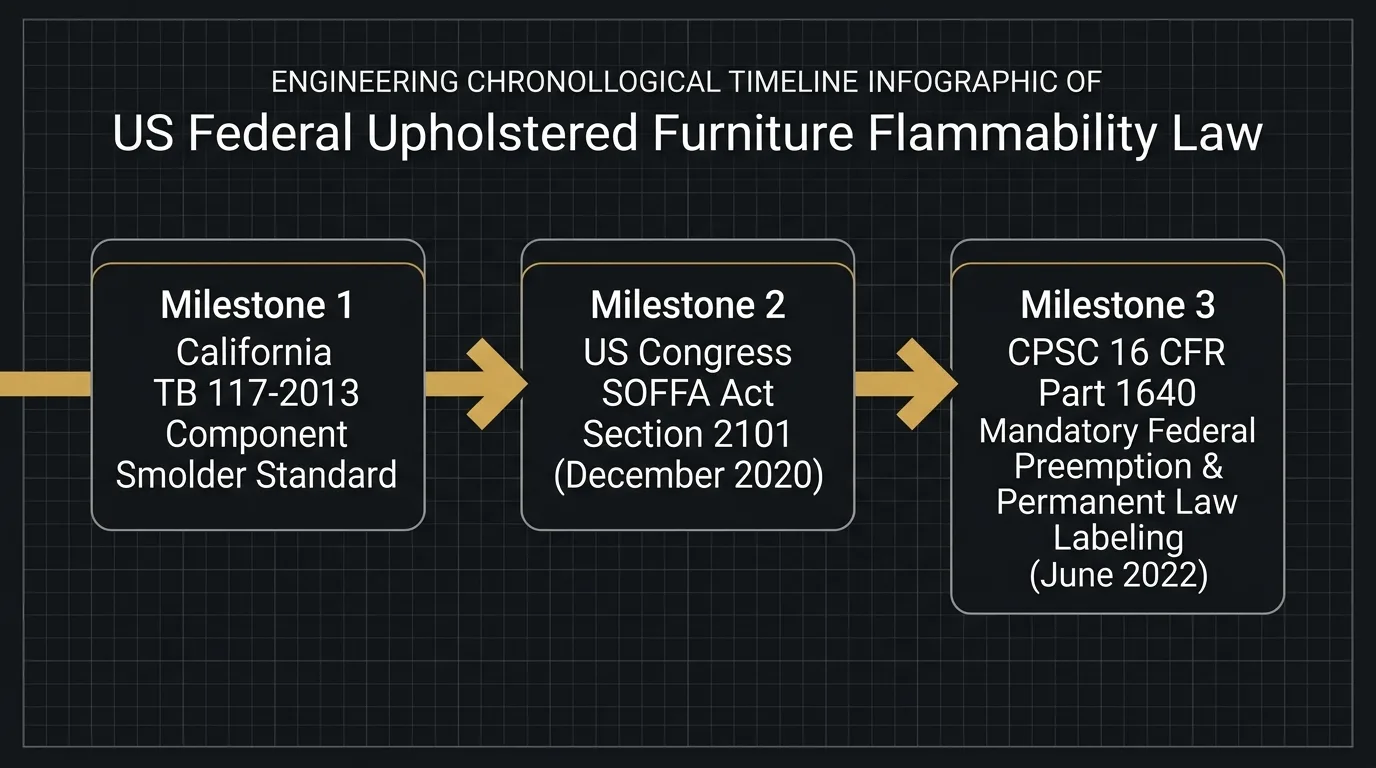
In December 2020, the United States Congress passed the COVID-19 Regulatory Relief and Work From Home Safety Act. Embedded within this omnibus legislation was Section 2101, formally designated as the Standard for the Flammability of Upholstered Furniture Act (SOFFA).
Key statutory milestones under SOFFA include:
- Federal Codification: The U.S. Consumer Product Safety Commission (CPSC) codified SOFFA into federal law under Title 16 of the Code of Federal Regulations, Part 1640 (16 CFR Part 1640).
- Direct Adoption of TB 117-2013: Rather than creating an entirely new testing apparatus from scratch, federal law adopted the testing methodologies of the State of California Department of Consumer Affairs Technical Bulletin 117-2013 (TB 117-2013) as the mandatory national flammability standard.
- Federal Preemption: 16 CFR Part 1640 explicitly preempts state and municipal laws regarding smolder resistance testing for upholstered furniture, creating a uniform nationwide performance baseline.
- Binding Timeline: Mandatory performance compliance took effect across all 50 states on June 25, 2021; mandatory permanent certification labeling on every manufactured or imported upholstered seating unit took effect on June 25, 2022.
1.2 Does 16 CFR Part 1640 Apply to Commercial Hospitality Booths?
A widespread and dangerous myth among inexperienced importers is that "16 CFR 1640 only applies to residential consumer furniture sold at retail."
This assumption is flatly incorrect.
Under 16 CFR § 1640.3, an upholstered furniture item is legally defined as:
"An article of seating furniture that (1) is intended for indoor use; (2) is movable or stationary; (3) is constructed with an upholstered seat, back, or arm; and (4) is made or provided with filling material, composite materials, or both."
Commercial restaurant booths, banquettes, barstools, and lounge seating meet every legal criterion of this definition. Whether a booth is manufactured as a standalone double unit or custom-anchored into the structural floor plate as a continuous banquette, federal customs officials (CBP) and local fire authorities classify it under the jurisdiction of upholstered commercial seating. Importing commercial booths without compliant SOFFA documentation is a direct violation of federal trade regulations.
2. The Fire Marshal's Field Audit: Anatomy of the 16 CFR § 1640.4(b) Law Label
When a municipal Fire Marshal steps into a restaurant, they are not reading a 40-page PDF laboratory report. They are inspecting the physical furniture for immediate, tangible, legal proof of compliance.
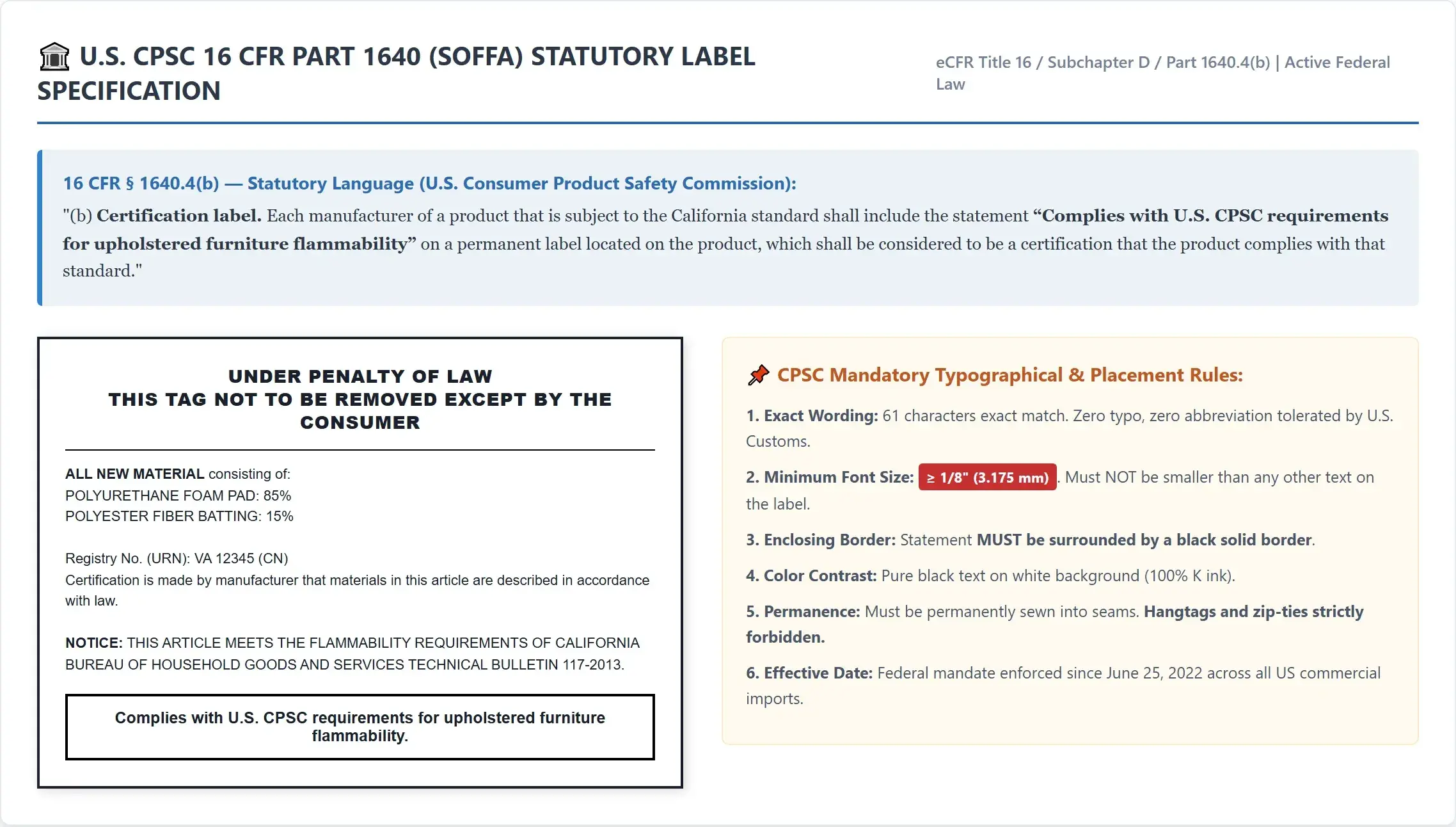
Under federal regulation 16 CFR § 1640.4(b), every upholstered seating unit manufactured or imported into the United States must carry a permanent certification label.
2.1 The Verbatim 61-Character Legal Statement
The statutory statement on the label is not open to creative copywriting. Under CPSC rules, it must state verbatim:
- Case and Punctuation: Every word, capital letter, and period must match the federal text exactly. Substituting "Meets CPSC standards" or "Complies with USA fire codes" immediately renders the label legally invalid.
- Font Size & Weight: The text must be printed in a clean, legible sans-serif typeface with a font size of at least 1/8 inch (3.175 mm). Furthermore, the font size cannot be smaller than any other explanatory text on the label.
- Color Contrast: The lettering must be 100% solid black ink printed on a pure white background. Faded gray, thermal dot-matrix print, or colored inks are grounds for rejection.
- Rectangular Enclosure: The statement must be enclosed within a solid, unbroken black rectangular border with a line thickness of at least 0.5 pt (0.2 mm), buffered by at least 2 mm of clear whitespace on all four sides.
2.2 Material Substrate and Attachment Permanence
Inspectors routinely fail imported furniture not because the foam inside is bad, but because the label itself fails the test of physical permanence:
| Critical Factor | CPSC & Municipal Requirement | Fatal Industry Violation | Ron Group Standard |
|---|---|---|---|
| Substrate Material | Tear-resistant, water-resistant synthetic stock (DuPont Tyvek or spunbonded polyester). | Plain wood-pulp paper or thermal sticker tape that disintegrates under damp mopping. | High-density 105gsm DuPont Tyvek with thermal-transfer resin print. |
| Attachment Method | Permanently sewn directly into a primary structural upholstery seam with double-lock stitching. | Fastened with a plastic zip-tie, staple, safety pin, or peel-and-stick pressure-sensitive adhesive. | Double-lock chain-stitched into the bottom seam tape between seat deck and frame. |
| Field Location | Accessible for inspection without requiring tools, located on the underside of the removable seat cushion or the bottom perimeter of the backrest. | Hidden deep inside sealed internal plywood cavities requiring power tools to reveal. | Positioned exactly 50 mm inboard from the rear dust cover edge on all booth modules. |
| Registry Identity | Must state the manufacturer's official Uniform Registry Number (URN), e.g., UT-XXXX (CN). | Missing URN or fictitious factory license codes, triggering immediate customs or municipal hold. | Pre-registered active URN matching factory audit certificates across all shipments. |
3. The Engineering Chasm: TB 117-2013 vs. CAL 133 / ASTM E1537
The single most disastrous technical mistake made by commercial interior designers and purchasing managers is treating TB 117-2013 and CAL 133 as interchangeable fire certifications. They are separated by a vast thermodynamic gulf.
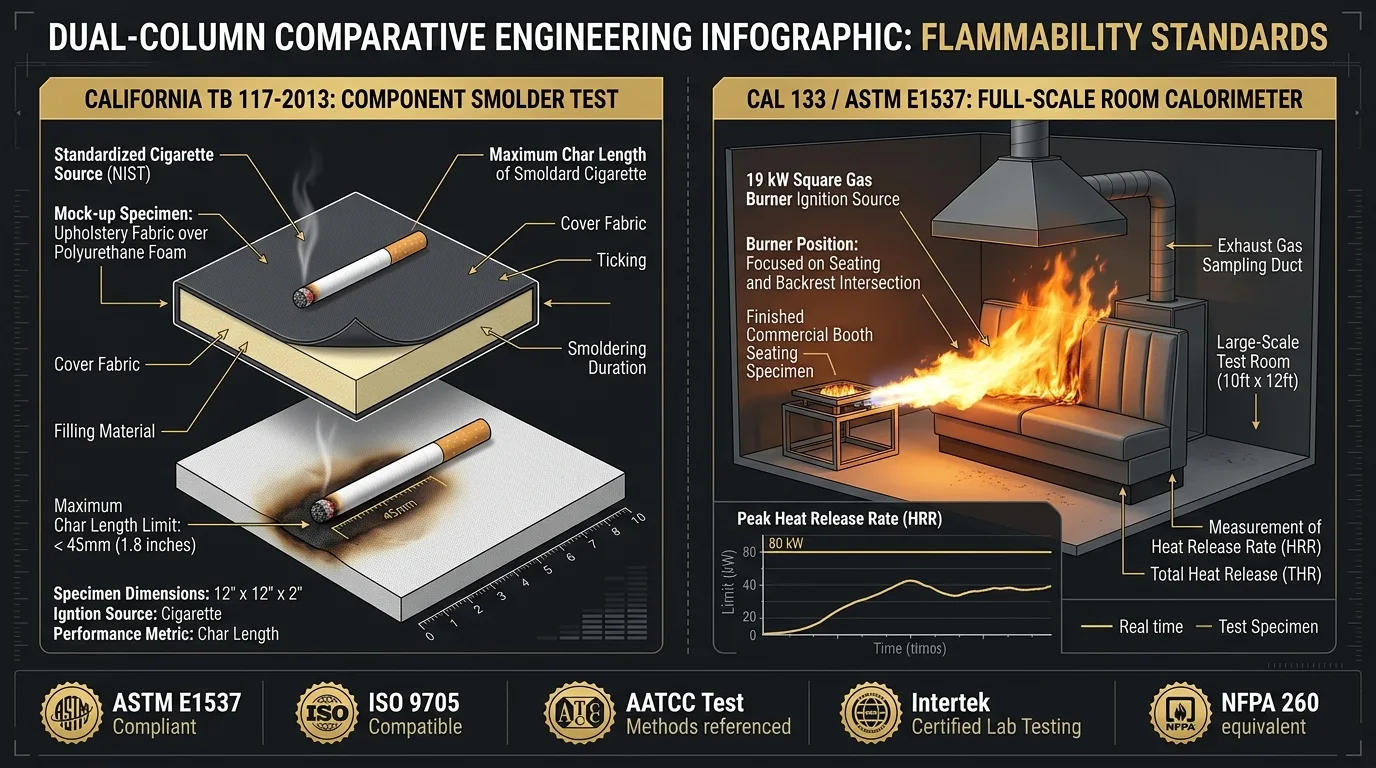
3.1 Understanding TB 117-2013 (Component Smolder Testing)
California Technical Bulletin 117-2013 was drafted specifically to address the leading cause of residential upholstered furniture fatalities: a dropped, smoldering cigarette on a sofa.
- Testing Methodology: TB 117-2013 is a component-level smolder test. Individual materials (cover fabric, barrier material, resilient filling foam, decking material) are placed into small metal test jigs. A standardized SRM 1196 smoldering cigarette is placed in the crevice between horizontal and vertical test panels and covered with a layer of cotton sheeting.
- Pass/Fail Criteria: (1) Vertical char length on the polyurethane foam must not exceed 1.8 inches (45 mm); (2) The specimen must not produce open flaming combustion; (3) The smoldering must self-extinguish without consuming the test substrate.
- The Critical Limit: TB 117-2013 does not test for open flames. It does not measure heat release, flame spread velocity, or smoke toxicity when subjected to an open fire source like a tipped candle, a lighter, or an electrical short.
3.2 Understanding CAL 133 / ASTM E1537 (Full-Scale Room Calorimeter Burn)
California Technical Bulletin 133 (also codified as ASTM E1537 and NFPA 261) is an extreme, destructive, full-scale calorimeter burn test designed for high-occupancy public spaces.
- Testing Methodology: A fully assembled, production-ready booth—complete with its actual internal hardwood framing, springs, adhesives, fasteners, and stitched upholstery—is wheeled into an instrumented burn room equipped with an exhaust collection hood and gas analysis sensors.
- The Heat Source: A massive 19 kW square gas burner (equivalent to an intense trash-can fire or a large pile of burning newspapers) is placed directly in the intersection between the booth seat and backrest. The burner blasts direct flames into the furniture for 80 continuous seconds.
- Thermodynamic Pass/Fail Thresholds:
- Peak Heat Release Rate (Peak HRR): Must remain below 80 kW. If the foam begins pooling and spikes above 80 kW, the test is an immediate failure.
- Total Heat Release (THR): Must not exceed 25 MJ within the first 10 minutes of the test.
- Smoke Opacity: Maximum total smoke release must remain under 25 m².
- Carbon Monoxide Concentration: Must not exceed 1,000 ppm at any point during the burn.
3.3 When Does CAL 133 Become Legally Mandatory?
While 16 CFR Part 1640 (TB 117-2013) is the mandatory federal floor, municipal jurisdictions frequently elevate the requirement to CAL 133 under the following regulatory conditions:
- High-Density Public Assembly: Any commercial dining venue, nightclub, or hotel banquet hall with an occupant load exceeding 100 persons (under IBC Section 805 and IFC Section 805).
- Non-Sprinklered Buildings: Historic buildings or legacy tenant spaces lacking a fully functional NFPA 13 automatic fire sprinkler system.
- High-Risk Institutional Environments: Healthcare dining facilities, senior living centers, airport terminals, and educational dining halls.
- Fire Marshal Discretion: Local fire codes grant municipal Fire Marshals unilateral authority to mandate CAL 133 compliance whenever furniture configuration creates an egress hazard along an exit corridor.
4. The Foshan Engineering Solution: Multi-Layer Fire Barrier Architecture
When polyurethane foam is exposed to an open flame, it does not merely burn—it undergoes rapid thermal depolymerization. It melts into a boiling, viscous liquid that behaves like liquid petroleum fuel, pooling beneath the furniture and creating an uncontrollable room flashover within 180 seconds.
To engineer commercial booth seating capable of surviving both the regulatory smolder tests of TB 117-2013 and the violent open flame exposure of CAL 133, the Ron Group engineering lab utilizes a synchronized, three-tier fire defense topology.
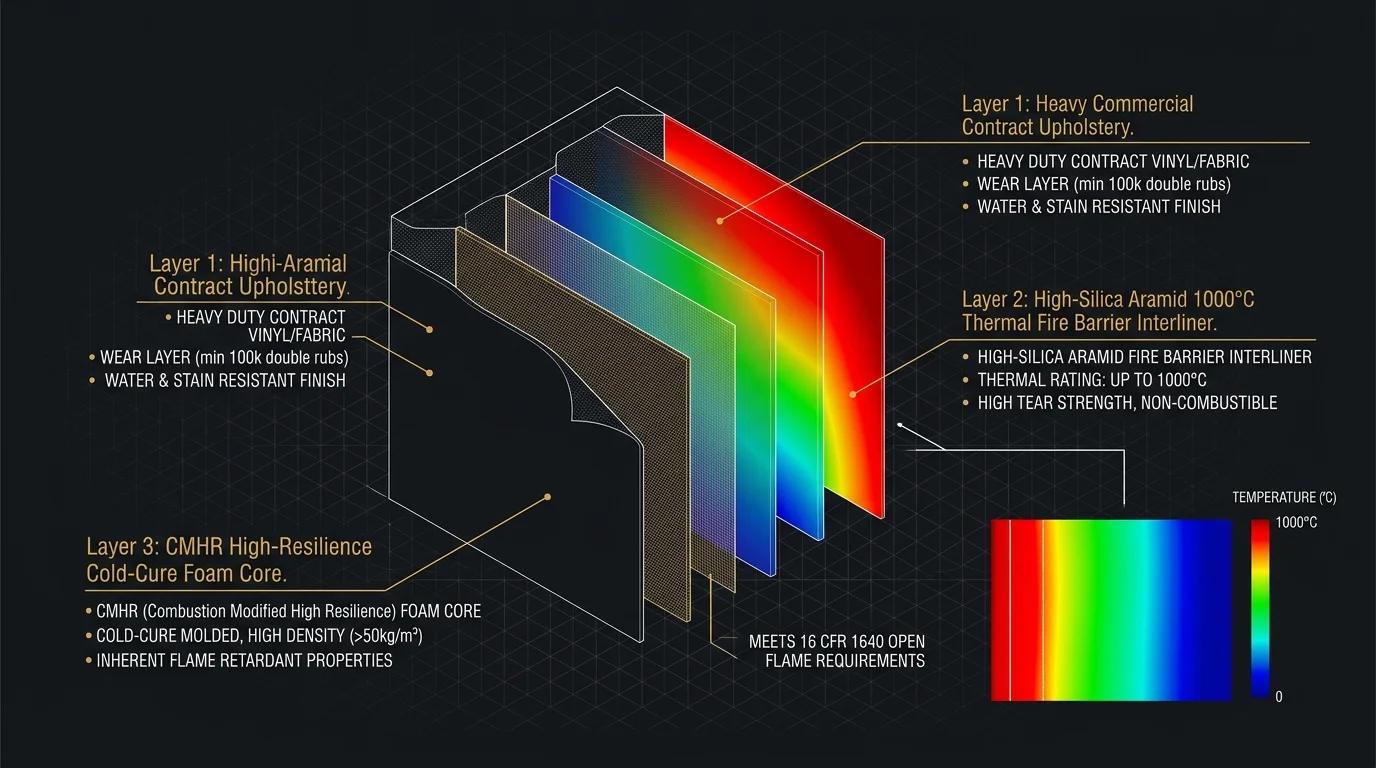
4.1 Layer 1: Commercial Contract Upholstery
The exterior facing layer must satisfy commercial wear and abrasion thresholds (exceeding 100,000 double rubs on the Wyzenbeek scale or 50,000 cycles on Martindale) while maintaining smolder resistance. We specify inherently flame-retardant (IFR) polyester fabrics or commercial-grade contract vinyls (PVC/PU blends) formulated with zinc borate and antimony trioxide synergistic flame retardants. Surface fabrics must pass NFPA 260 / UFAC Class 1 smolder resistance before being approved for production cutting.
4.2 Layer 2: The Invisible Shield (1000°C Aramid Interliner)
The true mechanical hero of a fire-rated commercial booth is the component the guest never sees: the Fire Barrier Interliner. Placed directly between the decorative upholstery fabric and the inner foam core, this is a flexible, woven non-woven technical textile engineered from meta-aramid (Nomex/Kevlar blends) and high-silica fiberglass fibers.
- Thermal Performance: The interliner remains structurally intact at temperatures exceeding 1000°C (1832°F).
- The Oxygen Starvation Mechanism: When an exterior flame burns through the outer vinyl or fabric, the flame impinges directly onto the aramid interliner. Rather than burning or melting, the aramid fibers carbonize and swell slightly, forming an airtight barrier. This cuts off oxygen to the underlying polyurethane foam and prevents molten polymer from seeping outward to feed the external flame.
4.3 Layer 3: CMHR High-Resilience Cold-Cure Foam
At the core of the seat cushion and backrest is Combustion Modified High Resilience (CMHR) polyurethane foam, engineered to a density of 45 to 55 kg/m³ (2.8 to 3.4 lbs/ft³).
- The Chemical Intumescent Action: During the foam formulation in our Foshan chemical mixing plant, microscopic flakes of expandable intercalated graphite and microencapsulated melamine are blended into the polyol stream.
- Physical Reaction Under Heat: When exposed to temperatures above 180°C, the intercalated acid within the graphite flakes vaporizes, causing the graphite to exfoliate and expand up to 200 times its original volume.
- This expansion creates a thick, spongy, non-combustible carbonaceous char layer (an intumescent crust) across the entire foam surface. The carbon crust insulates the virgin foam beneath, dropping the foam's thermal conductivity by over 70% and ensuring the Peak Heat Release Rate remains safely below the CAL 133 80 kW ceiling.
5. The Technical Compliance & Field Audit Defense Protocol
A successful opening requires more than compliant furniture in the workshop; it requires an airtight administrative defense that eliminates doubt before the Fire Marshal arrives on site.
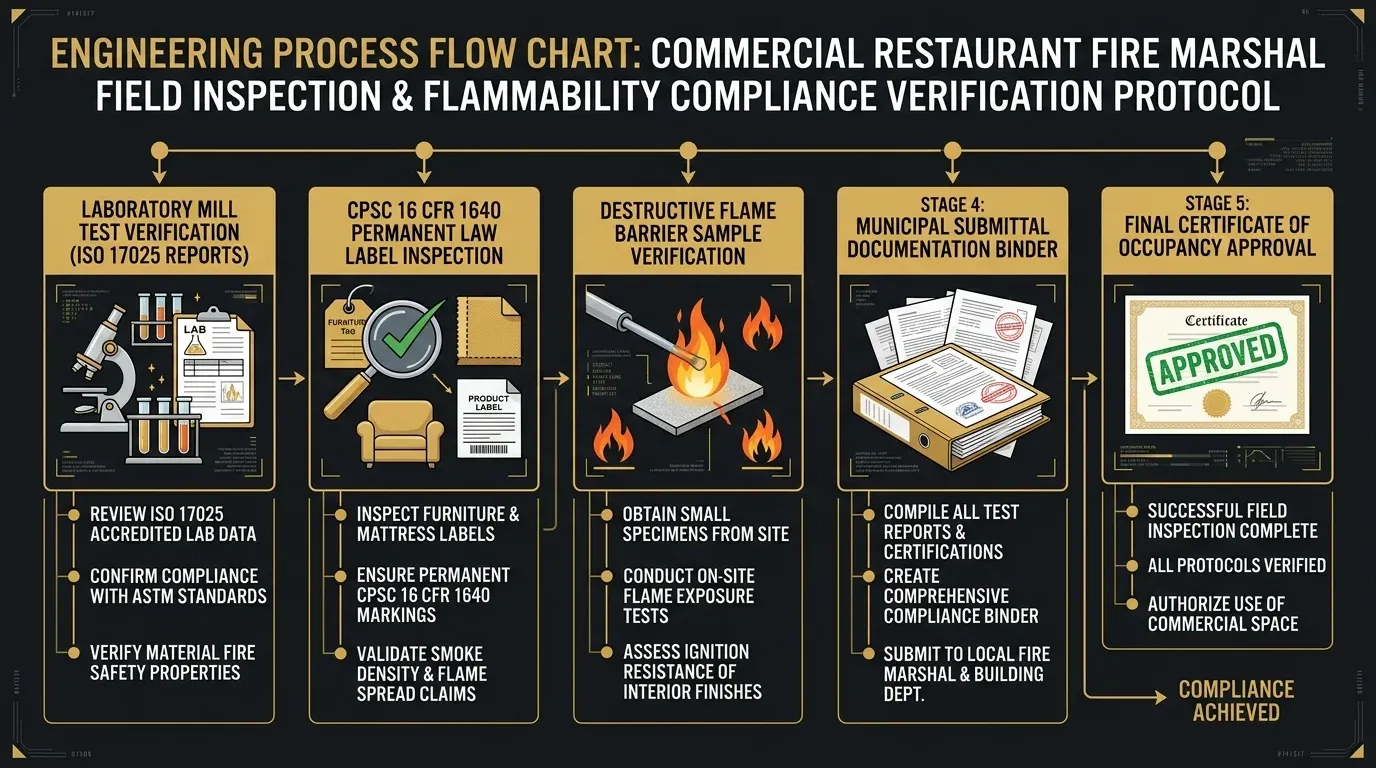
5.1 The 5-Stage Verification Protocol
- Stage 1: Laboratory Mill Test Verification — Before cutting raw materials, test reports from ISO/IEC 17025 accredited laboratories (SGS, Intertek, TÜV SÜD) are logged for fabric, foam, and flame barrier components.
- Stage 2: CPSC 16 CFR 1640 Law Label Verification — Sample labels are pulled and measured with digital calipers to confirm 1/8" font height, verbatim 61-character text, active URN, and double-lock seam stitching.
- Stage 3: Destructive Flame Barrier Swatch Archiving — For every project production run, our QC team archives a verified 300 mm × 300 mm (12" × 12") composite sandwich swatch taken from the exact same production lot. If an inspector insists on a live flame burn test on site, the contractor hands them the archive swatch, sparing the finished furniture from damage.
- Stage 4: The Compliance Documentation Package — A comprehensive technical package is assembled for the project architect and GC, containing ISO 17025 accredited laboratory test certificates, high-resolution photographs of attached Tyvek law labels, and certified material flammability specifications.
- Stage 5: The Final Walkthrough & Field Verification — The general contractor directs the inspector directly to the pre-positioned Tyvek label on the designated booth, presents the technical documentation package, and provides archive laboratory swatches upon request, removing flammability barriers to occupancy review.
6. Financial TCO Autopsy: The True Cost of Cheap Non-Compliance
Purchasing agents are frequently tempted by generic overseas trading companies offering restaurant booths at a $50 to $75 per-seat discount. When evaluated against the cold financial reality of commercial project risks, this upfront saving represents one of the worst risk-to-reward ratios in contract procurement.
| Cost / Risk Component | Generic Non-Compliant Import | Ron Group Certified Contract Engineering | Financial Variance & Business Impact |
|---|---|---|---|
| Initial Furniture Procurement (20 Custom Booths) |
Lowest bid (uncertified materials) |
Project quote (depends on spec & volume) |
+$1,600 Upfront Investment for certified CMHR foam, aramid barrier & Tyvek labels. |
| Compliance & Testing Documentation | $0 *(Generic vendor provides unverified copy)* | $0 *(ISO 17025 Lab Reports & Mill Certs Provided)* | Generic vendor cannot provide verifiable lab data; architect must scramble to order rush testing. |
| Flammability Field Audit Risk | HIGH RISK *(Red-tag citation for uncertified foam)* | DE-RISKED *(Standard-compliant label & certified barrier)* | Mitigates operational stop-work citations caused by uncertified upholstery fuel load. |
| Delayed Opening Costs (3 Weeks Postponed) |
$26,250 (Rent $1,500/wk + Staff $3,500/wk + Lost profit $3,750/wk) |
$0 *(No flammability remediation delay)* | +$26,250 Loss: Financial bleed while dining room stands idle awaiting foam remediation. |
| Emergency Field Remediation | $9,400 (Local upholstery contractor retrofitting barrier) |
$0 *(Pre-engineered at factory)* | +$9,400 Loss: Paying $95/hr for local labor to strip and reupholster booths under emergency conditions. |
| Municipal Re-Inspection Penalty | $1,250 | $0 | Administrative fee charged by municipal building department for repeat life-safety audits. |
| Total 5-Year Effective Cost | Bid + $36,900 remediation | Quote + $0 remediation | NET FINANCIAL PENALTY: +$35,300 |
The mathematical verdict is unmistakable: attempting to save $1,600 on uncertified commercial booth seating places over $35,000 of liquid capital and the entire reputation of the establishment at risk. In commercial restaurant hospitality, life-safety compliance is not a line-item expense—it is the foundational insurance policy of your entire enterprise.
7. Strategic Action Checklist for Commercial Hospitality Procurement
Before issuing final payment or signing off on a factory purchase order for commercial booth seating, mandate that your supplier provide verified, written confirmation of the following six checkpoints:
-
☑
1. Verbatim Statutory Statement: The law label includes the exact 61-character CPSC statement in ≥ 1/8" font within a solid black border.
-
☑
2. Permanent Tyvek Substrate: Labels are manufactured from synthetic Tyvek/polyester and double-lock sewn into primary seams—never stapled or glued.
-
☑
3. Active URN Registration: The Uniform Registry Number printed on the label is active and verified in state regulatory registries.
-
☑
4. Clear Test Boundary Definition: The specifications explicitly distinguish between TB 117-2013 (smolder) and CAL 133 (open flame), matching your local municipal code.
-
☑
5. Aramid Fire Barrier Interliner: For venues over 100 occupants or high-risk zones, ensure a high-silica aramid barrier interliner is specified beneath the upholstery fabric.
-
☑
6. Production Swatch Archive: A physical 12" × 12" composite production sample is packaged inside the shipment to serve as a sacrificial burn specimen for the Fire Marshal.
CAL 117 / 16 CFR 1640 Compliance Audit & Lab Review
Send your foam specifications, fabric technical data sheets, or municipal fire inspector citation. We audit flammability test packages within 24 hours.
Submit Specs for Fire Safety Review →Direct Booth Engineering Lab Desk
Connect directly with Ron Group’s certified upholstery engineers. Zero guesswork, authentic laboratory test reports, and factory-direct batch traceability.
Explore Deep-Dive Foshan Manufacturing & Engineering Guides
Connect your procurement strategy with specialized technical intelligence across China’s primary contract production hubs.
Hospitality QC, Drop-Testing & Export Logistics
Complete guide to container stuffing, drop tests, moisture barrier packaging, and export customs clearance.
Custom Seating • Commercial Booth HubCommercial Booth Seating & Engineering Hub
16-model CAD catalog, 45-55 kg/m³ cold-cure molded foam, and tool-free quick-assembly patent.
Metal Fabrication • Stability StandardsDining Tables & Anti-Wobble Bases
Solid cast iron bases, self-leveling hydraulic glides, and scratch-resistant sintered stone surfaces.
Foshan FF&E Core • Industrial HubRestaurant Furniture Sourcing Master Guide
Direct factory audit of star-hotel casegoods, dining furniture, and turnkey FF&E integration.