
When unexpected sub-slab plumbing trenching, make-up air unit code revocations, and $4,000-per-linear-foot kitchen hood overruns obliterate restaurant buildout contingencies, operators instinctively cannibalize front-of-house FF&E. This paper proves that sacrificing dining room furniture to absorb contractor inefficiency destroys customer lifetime value, triggers catastrophic 25% annual seat failure rates, and burns over $39,000 in net cash across a five-year operating lifecycle. By enforcing a disciplined 4-Bucket CapEx Framework, locking dining room capital at a $250-per-seat commercial durability benchmark, and decoupling custom seating as Tangible Personal Property under IRS Section 179 via non-destructive French cleats, hospitality founders eliminate middleman dealer markups, protect their opening cash buffer, and secure long-term enterprise balance sheet health through single-container Foshan factory direct consolidation.
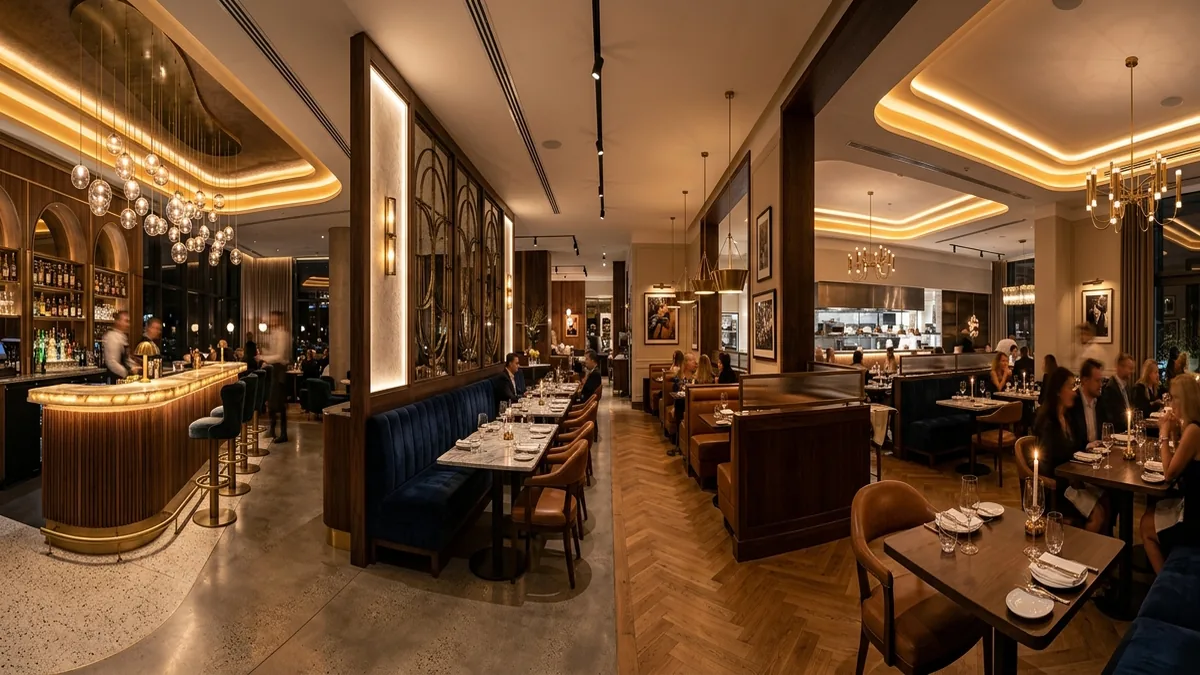
It is 11:30 PM on a Thursday, sixty days before your projected grand opening. You are sitting at a folding table in the middle of a raw construction site, staring at an Excel spreadsheet illuminated only by the harsh glare of a temporary halogen work light.
Around you, the space is a tangle of exposed ceiling joists, unpainted gypsum board, and coils of armored electrical cable. The concrete slab has just been core-drilled for a new grease trap. And on your laptop screen, your general contractor's latest change-order summary sits like a lead weight in your stomach.
The plumbing subcontractor had to trench through an unexpected four-inch sub-slab void to tie into the municipal sewer main: an unexpected $12,400. The mechanical engineer discovered that the municipal building department revoked the previous tenant's grandfathered status for the rooftop make-up air unit, requiring an emergency fan replacement and structural curb: another $16,800. And your commercial kitchen hood installer just informed you that running double-wall grease duct through the two-story chase will run $4,000 per linear foot instead of the $2,800 originally budgeted.
In a matter of three weeks, your $45,000 unforeseen contingency reserve has not merely been spent - it has been obliterated.
Now comes the moment of quiet panic that claims thousands of independent operators and regional franchise groups every year. You scan down the columns of your capital expenditure sheet looking for something - anything - that can be trimmed to balance the ledger. Real estate rent is locked by legal contract. Mechanical, electrical, and plumbing (MEP) work is dictated by city code inspectors who hold the keys to your certificate of occupancy. Heavy kitchen equipment is already on order with non-refundable 50 percent deposits.
That leaves only one unprotected line item on the entire spreadsheet: Front-of-House Dining Room Furniture, Fixtures, and Equipment (FF&E).
In your original business plan, you budgeted $68,000 to furnish your 90-seat dining room - roughly $755 per seat for custom contract banquettes, solid hardwood tables, cast-iron anti-wobble bases, and ANSI/BIFMA-rated dining chairs. But with the general contractor demanding $38,000 in cash to cover plumbing and ductwork overruns, the math turns brutal. You cross out $68,000. You write in $30,000.
You tell yourself that you will "upgrade the seating next year once revenue stabilizes." You open seven browser tabs on commercial closeout portals, e-commerce wholesale catalogs, and residential clearance sites, searching for $45 metal cafe chairs and flatpack laminate tables that can ship in two weeks.
It is the single most expensive mistake a restaurant operator can make.
1. The Anatomy of Budget Cannibalization: Why MEP Overruns Attack the Dining Room
To understand why so many commercial dining spaces fall apart within their first twelve months of operation, one must first examine the psychological trap of restaurant capital allocation.
In commercial construction, restaurant buildouts suffer from a structural vulnerability that few first-time founders anticipate: schedule-driven capital compression.
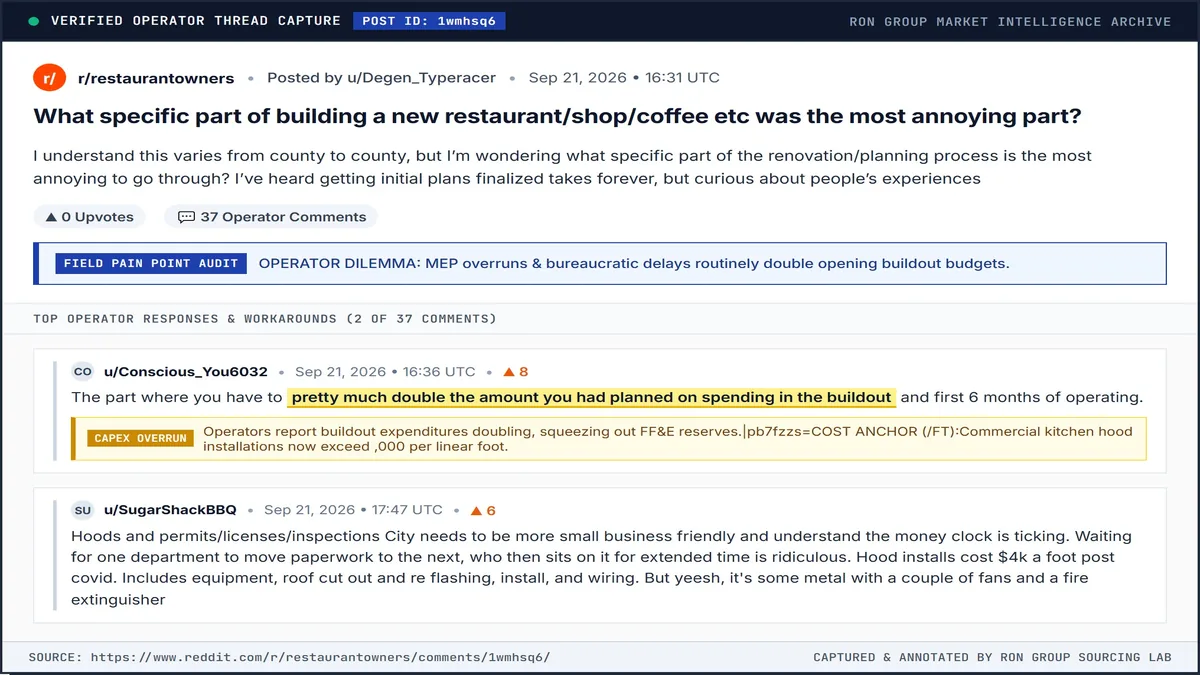
Recent operator field intelligence gathered across independent restaurant owners paints a remarkably consistent picture of this financial ambush. In community discussions on commercial buildout bottlenecks, operators repeatedly report that unbudgeted infrastructure mandates routinely double opening expenses. As one veteran operator frankly noted, the hardest reality of opening is "the part where you have to pretty much double the amount you had planned on spending in the buildout and first six months of operating."
Another operator documented that commercial kitchen hood installations routinely hit $4,000 per linear foot once roof curbs, fire suppression piping, make-up air fans, and electrical hookups are accounted for. When minor plumbing jobs that were quoted at $5,000 balloon into $10,000 invoices over a thirty-day delay, the contingency fund is gone before the dining room drywalls are even taped.
OPERATIONAL WARNING // SITE RISK ALERT
The Second-Generation "Zero Key Money" Mirage: Operators taking over existing second-generation restaurant spaces often assume they can bypass buildout costs entirely. But municipal health and fire departments routinely use the transfer of ownership to revoke historical code variances. Fire marshals mandate complete re-nozzling of hood fire suppression systems ($3,800 and up to nine weeks of permitting delays), while local building inspectors enforce ADA Title III corridor clearances that require gutting existing dining layouts.
When back-of-house infrastructure costs spiral out of control, founders treat front-of-house furniture as an elastic sponge. But dining room FF&E is not an elastic luxury; it is the primary physical interface between your customer and your brand.
When a guest walks into your restaurant, they do not touch your $35,000 grease trap. They do not run their fingers along the inside of your welded stainless exhaust duct. They touch the edge of your tabletop. They rest their forearms on your upholstered banquette. They shift their body weight onto the welded joints of your dining chair.
If that chair wobbles under a 230-pound diner, if the vinyl on the booth begins peeling after ninety days of commercial sanitizer wipe-downs, or if the tabletop chips down to raw particleboard, the guest does not think, "Well, the operator had to absorb unexpected plumbing costs." They think, "This place is cheap, sloppy, and poorly run."
Budget cannibalization sacrifices the long-term revenue engine of the business to pay for short-term contractor inefficiency.
2. The 4-Bucket CapEx Allocation Architecture
To prevent back-of-house infrastructure from swallowing your dining room, professional hospitality chief financial officers never manage restaurant buildouts as a single, pooled checking account. Instead, they implement a disciplined 4-Bucket CapEx Allocation Model.
| CapEx Allocation Tier | Target Share | Core Architectural Scope & Deliverables | Capital Ring-Fencing & Governance Mandate |
|---|---|---|---|
| Bucket 1: Leasehold Base & MEP | 45% - 50% | Structural demolition, concrete trenching, grease interceptor, electrical, plumbing, HVAC, fire suppression, ADA restrooms. | Contractually locked via Guaranteed Maximum Price (GMP); completely isolated from dining room funds. |
| Bucket 2: Kitchen Production Suite | 20% - 25% | Commercial cooking line, refrigeration, walk-in cold storage, custom stainless steel fabrication, dishwashing station. | Procured via commercial package specifications to eliminate retail distributor inflation. |
| Bucket 3: Front-of-House Dining FF&E | 15% - 18% | Contract seating, modular banquettes, dining tables, anti-wobble bases, architectural millwork, ambient lighting. | Strictly Protected. Ring-fenced at lease signing; zero crossover permitted into contractor change orders. |
| Bucket 4: Isolated Contingency Reserve | 10% - 12% | Unforeseen municipal code compliance, concealed slab remediation, utility tap fees, delayed landlord delivery credits. | Held in dedicated project escrow; drawn solely upon mutual executive and CFO sign-off. |
The fundamental rule of this architecture is contractual isolation. Bucket 3 (Dining Room FF&E) is ring-fenced. Under no circumstances is capital permitted to bleed from Bucket 3 to pay for change orders in Bucket 1. If Bucket 1 exceeds its budget, the overrun must be absorbed exclusively by Bucket 4 (Contingency) or resolved through value engineering within the contractor's scope - such as selecting exposed spiral ducting over concealed drywall chases, or opting for surface-mounted conduit over trenching.
By locking Bucket 3 at 15 to 18 percent of total capital expenditure, an operator planning an 80-to-120 seat dining room guarantees that the front-of-house experience remains pristine, durable, and commercially viable for five full years without emergency reinvestment.
3. The $250-per-Seat Benchmark: Sizing Investment by Dining Concept
Once the front-of-house budget is ring-fenced, how should that capital actually be spent across dining room furniture?
In commercial FF&E planning, allocating by lump sum leads to distorted buying decisions. An operator with $60,000 might overspend on ornate custom tables while being forced to buy flimsy $35 chairs to make the numbers work.
To achieve physical and financial balance, CFOs calculate dining room investment on a Per-Seat CapEx Benchmark. Every dining seat in a commercial restaurant is a revenue-generating productive asset. The required capital allocation per seat is directly proportional to two operational variables: Customer Dwell Time and Daily Seat Turns.
| Restaurant Concept Tier | Target Dwell Time & Turnover | Benchmark Dining Seat Mix | Factory-Direct Planning Target | Domestic Multi-Tier Dealer Cost | Structural Procurement Advantage |
|---|---|---|---|---|---|
| Tier 1: Fast-Casual & QSR (Fast-casual, counter service) |
35 to 45 mins 4 to 6 turns/day |
70% 2-top loose tables 20% high-top communal 10% wall perimeter rail |
$180 to $240 / seat | $450 to $600 / seat | ~55% - 60% Capital Compression (Preserves liquidity for operating cash flow) |
| Tier 2: Casual Dining & Modern Bistro (Full-service casual bistro, trattoria) |
65 to 80 mins 2.5 to 3.5 turns/day |
45% modular banquettes 40% 4-top & 2-top tables 15% barstools |
$250 to $340 / seat [Golden Industry Benchmark] |
$680 to $850 / seat | ~60% - 65% Capital Compression (Golden benchmark for full-service durability) |
| Tier 3: Upscale Dining & Polished Gastropub (High-turn craft gastropub) |
90 to 120 mins 1.5 to 2.2 turns/day |
55% deep-channel booths 30% plush armchairs 15% upholstered barstools |
$380 to $490 / seat | $950 to $1,280 / seat | ~60% Capital Compression (Luxury tactile finishes without retail markups) |
TECHNICAL NOTE // MACRO PLANNING BASELINES
Macro Planning Baselines: The per-seat expenditure ranges above serve as conceptual planning benchmarks for initial feasibility and capital allocation. Actual project investments vary dynamically based on floor plate geometry, custom COM upholstery selection, edge profiles, and real-time global freight indices. Ron Group's engineering lab prepares customized, itemized project BOMs based directly on your architectural CAD drawings.
Deconstructing the Benchmark: Engineering Depth Over Dealer Inflation
Why is $250 per seat established as the golden planning benchmark for casual dining and modern bistros?
Consider a standard four-seat booth configuration: two 2-person banquette benches facing a 24 × 42-inch dining table mounted on twin cast-iron pedestal bases.
Under traditional commercial distribution channels in North America or Europe, that single four-seat setup is weighed down by compounding domestic retail markups: custom on-site carpentry (typically billed at premium finish-carpenter hourly rates plus material markup); commercial laminate tabletops sourced through regional restaurant supply catalogs; and heavy cast-iron bases shipped via uncoordinated freight with redundant accessorial fees. Multi-tier distribution layers easily inflate the landed cost of a four-seat station to $800 to $900+ per seat, despite using standard commercial materials.
Now examine how Ron Group engineers the identical functional station through our factory-direct manufacturing hub in Foshan, deconstructed across Four Industrial Engineering Pillars:
Engineered Cold-Cure Foam & Birch Joinery
Rather than site-built framing padded with cut slab foam, banquettes utilize 45-55 kg/m³ high-resilience cold-cure molded polyurethane built around an 18mm CNC-milled Russian birch plywood chassis. The continuous core eliminates foam sag, while factory-integrated Z-cleat brackets ensure 15-minute precision mechanical mounting.
Ultra-Compact Sintered Stone Tabletops
In place of delamination-prone particleboard and commercial laminate, tabletops are fabricated from 12mm solid sintered stone (<0.02% water absorption, Mohs hardness 7, completely impervious to red wine, hot sizzle platters, and chemical sanitizers). Undersides feature CNC waterjet-drilled, factory-embedded M8 carbon-steel threaded anchors, guaranteeing over 3,200 N of pullout resistance.
HT200 Gray Iron Gravity Ballast
Pedestal bases are poured from heavy HT200 gray cast iron, engineered with a low center of mass to satisfy the strict D/W anti-tipping ratio, finished with ASTM B117 salt-spray electrostatic powder coating, and fitted with sealed hydraulic self-leveling glides.
Volumetric Nested Packaging
The entire station is engineered for knock-down (KD) nested packing, eliminating up to 55 percent of transit dead-air volume before loading into a dedicated ocean container, minimizing landed shipping costs per seating unit.
You are not compromising on material integrity. On the contrary, you are upgrading from failure-prone residential-grade components to certified industrial contract engineering. By bypassing regional import middlemen, wholesale brokers, stocking distributors, and showroom markups, direct factory consolidation strips out the compounding distribution tax - allowing operators to hit the disciplined $250-per-seat benchmark with uncompromised commercial durability.
Operators planning spatial layouts can review comprehensive restaurant and hotel furniture solutions to evaluate physical material specifications before finalizing budgets.
4. The Legal & Tax Arbitrage: IRS Section 179 vs. The Landlord Accession Trap
Beyond initial purchase price, the way your dining room furniture is engineered and installed has profound implications for your corporate balance sheet and tax liabilities.
The Landlord Accession Trap
In commercial real estate law, there is a dangerous doctrine known as the Doctrine of Accession.
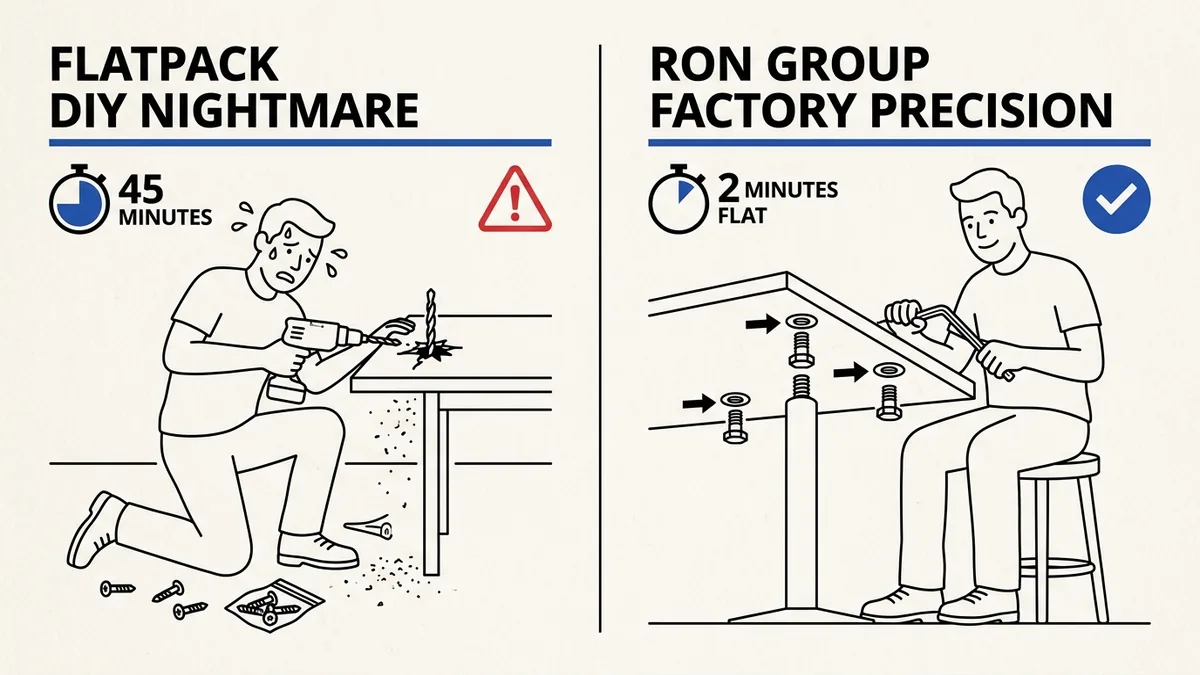
When a restaurant tenant hires a local finish carpenter to build custom banquettes on site, the carpenter typically anchors the wooden framing directly into the drywall studs with heavy wood screws, glues the baseboards to the floor slab, and applies perimeter caulking.
Under the standard terms of virtually every commercial triple-net (NNN) lease, any improvement that is permanently affixed to the structural fabric of the building legally becomes a Leasehold Improvement. The moment that carpenter drives the final screw, legal ownership of those booths transfers to the landlord. If your lease concludes in five years and you decide to relocate to a larger space, you cannot legally remove those booths. If you attempt to pry them off the walls, the landlord can withhold your security deposit and sue you for structural restoration damages. You have spent tens of thousands of dollars building a permanent asset for your landlord's real estate portfolio.
Furthermore, from a tax perspective, leasehold improvements are classified by the Internal Revenue Service as real property, requiring a grueling 15-year or 39-year straight-line depreciation schedule. Writing off a booth buildout over 15 to 39 years severely dilutes your annual tax recovery shield.
The IRS Section 179 Tax Shield
Now consider the financial mechanics of modular, cleat-mounted commercial FF&E.
When seating is manufactured with precision-stamped aluminum French cleat mounting brackets and self-weighted freestanding base chassis, the physical relationship between the furniture and the building changes completely:
- Classification as Tangible Personal Property: Because the seating can be unhooked and removed in fifteen minutes without damaging the drywall or concrete slab, it remains 100 percent Tangible Personal Property (7-Year MACRS Asset) owned exclusively by the tenant's operating LLC.
- Immediate 100% Expensing Under IRS Section 179: Under IRS Section 179 and current federal bonus depreciation guidelines, qualifying commercial business equipment and furniture can be 100 percent written off in Year 1.
| Governance & Asset Dimension | On-Site Carpenter Permanent Millwork | Ron Group Engineered Modular Seating | Strategic CFO & Audit Impact |
|---|---|---|---|
| Physical Fastening Mechanics | Screwed, glued, and caulked directly into drywall and structural floor slab. | Non-destructive interlocking aluminum French cleats and freestanding structural chassis. | Mechanical decoupling allows 100% damage-free disassembly. |
| Legal Property Classification | Inseparable Leasehold Improvement (Accession to landlord real property). | Tangible Personal Property (FF&E) owned exclusively by the operating tenant LLC. | Eliminates leasehold forfeiture; tenant retains complete asset ownership. |
| Statutory Cost Recovery Pathway | Extended real property amortization (typically 15 to 39 years straight-line). | Accelerated Cost Recovery (7-Year MACRS); eligible for first-year expensing under Section 179 / Bonus Depreciation frameworks. | Substantially accelerates capital recovery and protects operating cash flow. |
| Lease Expiration Residual Value | Zero liquidity; legally forfeited to landlord or penalized with demolition restoration costs. | 100% Asset Mobility; can be unclipped within hours, refurbished, relocated to a new venue, or liquidated. | Preserves balance sheet liquidity and long-term enterprise valuation. |
| Engineering & Tax Audit Defense | Generic contractor invoices with lumped labor and materials; high audit dispute risk. | Discrete CAD Shop Blueprints and unbundled FF&E specification schedules provided by Ron Group. | Furnishes your CPA and tax counsel with unequivocal physical substantiation. |
EXECUTIVE MANDATE // PROCUREMENT COMPLIANCE AUDIT
Tax Disclaimer & Professional Engineering Consultation: Specific tax treatments, bonus depreciation rates, and fiscal expensing eligibility vary across jurisdictions, corporate entity structures, and evolving tax regulations. Commercial operators should always consult their Certified Public Accountant (CPA) or corporate tax advisor for individual balance sheet determinations.
The Ron Group Engineering Advantage: What seasoned operators understand is that tax advantages cannot be retrofitted after construction is complete - they must be engineered into the physical architecture of the furniture from day one. This is why hospitality founders and multi-unit restaurant groups partner with Ron Group during the schematic design phase. Our engineering team designs all banquette, booth, and architectural millwork systems with non-destructive mechanical fasteners and provides stamped, decoupled CAD layouts alongside itemized FF&E schedules from our commercial restaurant booth seating engineering hub. We supply the rigorous technical documentation your legal and financial teams need to establish unequivocal tangible property status, safeguard your capital assets, and optimize your overall cost recovery strategy.
5. The Factory-Direct Sourcing Arbitrage: Single-Container Consolidation
Where does the massive price discrepancy between traditional commercial supply houses and factory-direct procurement come from? It is not inferior materials. It is the elimination of the middleman distribution tax.
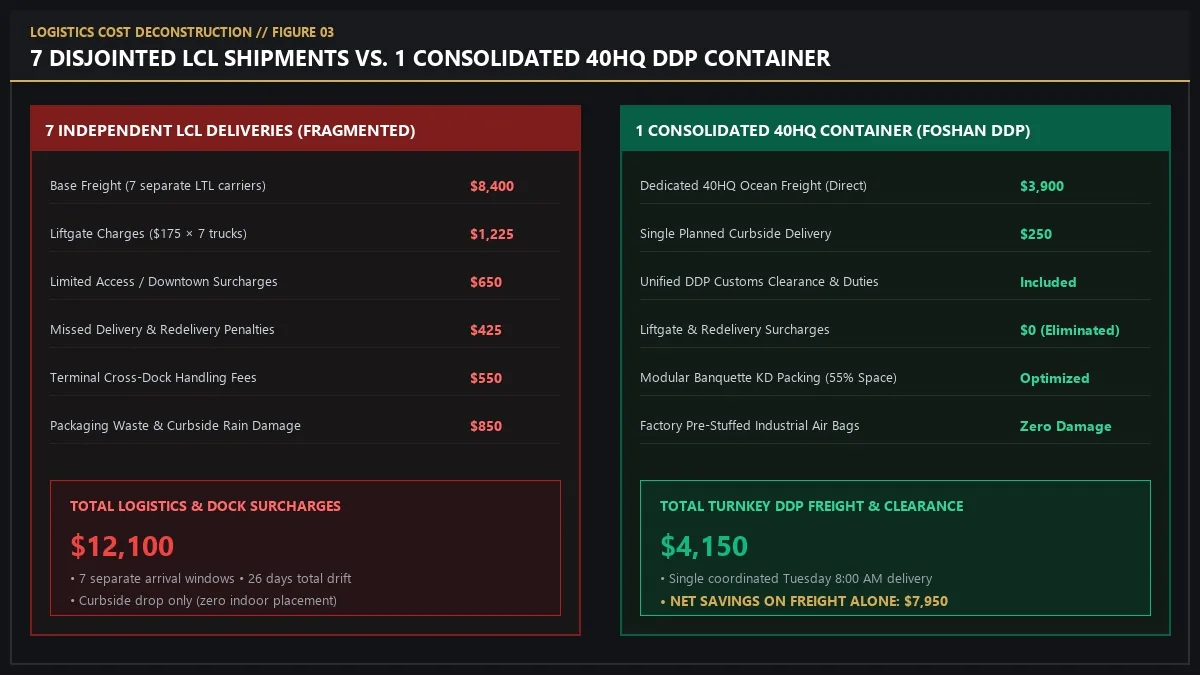
When an independent operator buys furniture through domestic catalogs or local restaurant supply dealers, their purchase passes through a fragmented chain of markups: an import trading house (20% to 30%); unoptimized partial container freight; master distributors (30% to 40%); and regional dealers (35% to 50%), topped off with unpredictable LTL residential liftgate fees.
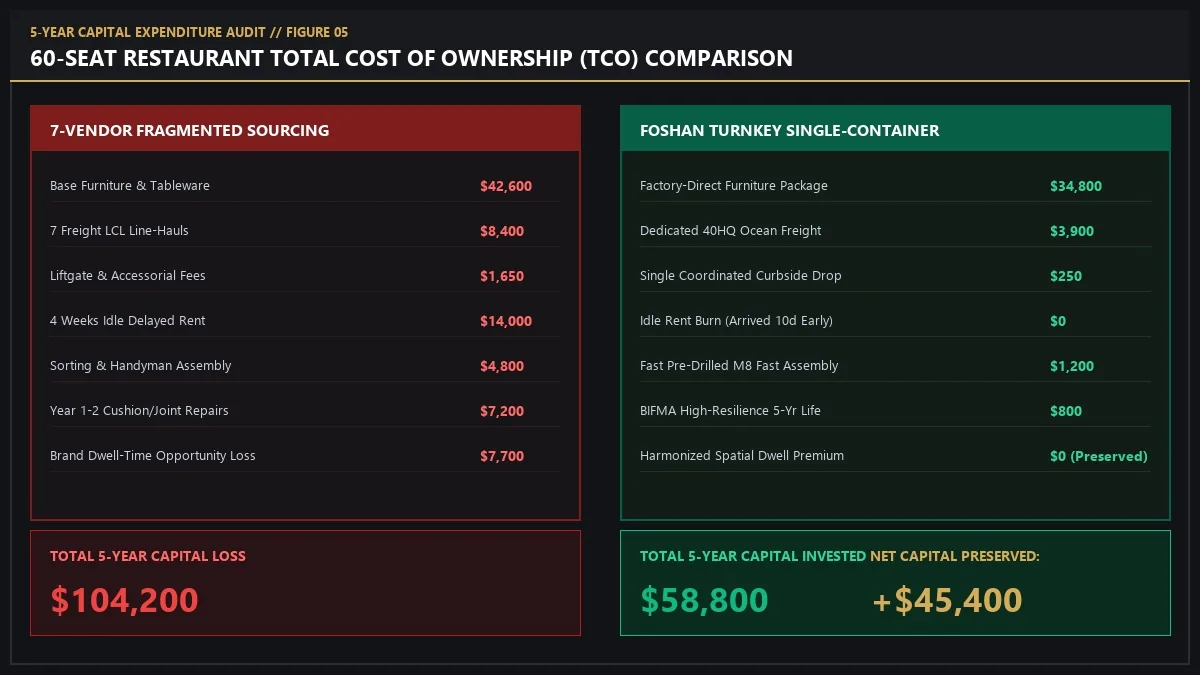
Furthermore, if you purchase tables from one vendor, chairs from another, and booths from a third, you pay separate crating and delivery fees for every shipment. As documented in our whitepaper on the 7-vendor fragmentation trap, managing multiple disjointed delivery appointments is the leading operational cause of missed soft-opening deadlines.
The modern CFO approach replaces this fragmented web with single-origin container consolidation:
- One Production Source: Dining chairs, sintered stone tables, cast-iron bases, upholstered banquettes, barstools, and exterior patio pieces are manufactured simultaneously under strict ISO 9001 quality controls at our manufacturing facility in Foshan.
- Volumetric Density Engineering: Bulky banquette modules are engineered as knock-down (KD) nested components. Table tops are packed flat in reinforced timber crates; bases are stacked in the bottom tier to establish a low center of gravity; chairs are nested four to a carton.
- One Bill of Lading, One Customs Clearance: An entire 80-to-120 seat dining package packs neatly into a single 40-foot High-Cube (40HQ) ocean container (68 cubic meters of usable volume).
- Delivered Duty Paid (DDP) Precision: The container moves directly from the factory floor across the ocean, clears customs under a single tariff classification, and arrives at your restaurant's curbside on a scheduled morning.
Instead of paying multiple uncoordinated LCL freight bills with unpredictable liftgate fees, consolidated ocean freight is streamlined into a single transparent shipment - saving thousands in raw transport while eliminating schedule variance.
6. The 5-Year Total Cost of Ownership (TCO) Balance Sheet
When capital is tight, the temptation to buy cheap residential-grade furniture from consumer e-commerce platforms is intense. An operator sees a metal cafe chair online for $55 that looks almost identical to an ANSI/BIFMA-rated commercial chair priced at $145.
They tell themselves, "I'm saving $90 a chair. Over 60 chairs, that's $5,400 back in my pocket."
Here is the cold financial autopsy of that decision over a five-year operating horizon.
A residential chair is engineered to support a 160-pound individual sitting quietly for thirty minutes, twice a day. In a busy commercial restaurant operating at three turns per day, that same chair is subjected to 1,095 seat cycles per year, dynamic load impacts from patrons weighing 220 to 280 pounds leaning back on the rear legs, and harsh daily cleanings with chemical sanitizers.
Under these industrial conditions, 0.8mm residential tubular steel buckles at the welded crossbars within four to six months. Cheap PU vinyl hydrolyzes and flakes off within ninety days. Screws driven into unreinforced particleboard strip out under table vibration.
| Financial & Operational Cost Factor | Scenario A: Cheap Consumer E-Commerce Seating | Scenario B: Ron Group Commercial Contract Seating | 5-Year Balance Sheet Delta |
|---|---|---|---|
| Initial Upfront CapEx (80 Seats) | $12,800 ($160/seat avg package) | $21,600 ($270/seat direct package) | +$8,800 upfront investment |
| Yearly Failure & Replacement Rate | 25% annual failure rate (20 seats replaced/yr) | <2% over 5 years (minor glide wear) | Dramatic reduction in capital churn |
| 5-Year Replacement Capital Expenditure | $16,000 (100 replacement seats over 5 yrs) | $450 (spare glides and minor touch-up) | -$15,550 saved on replacement |
| Emergency Maintenance & Handyman Labor | 120 hours over 5 yrs at $75/hr = $9,000 | 10 hours routine checks at $75/hr = $750 | -$8,250 saved on repair labor |
| RevPASH Drag from Out-of-Service Seats | 2 broken tables/month = $400 lost margin/mo = $24,000 | Zero downtime with commercial durability = $0 | -$24,000 revenue protected |
| Guest Injury Liability Insurance Risk | High risk of weld failure under dynamic patron load | Zero structural failures; BIFMA 400 lb proof | Significant risk mitigation |
| 5-Year Total Cost of Ownership (TCO) | $61,800 ($772.50 per seat) | $22,800 ($285.00 per seat) | -$39,000 NET CASH GAIN |
Scenario A did not save $8,800. Scenario A burned $39,000 in net cash, generated negative guest reviews, and drained dozens of management hours on patchwork repairs.
Investing in true contract-grade commercial furniture with 1.5mm (16-gauge) cold-rolled steel, high-density cold-cure foam, and 12mm sintered stone is not a luxury expense - it is a defensive capital strategy that pays a 340 percent return on investment over five years.
7. The 90-Day CFO Procurement Action Checklist
To execute your buildout on budget and protect your opening date, follow this disciplined 90-day procurement roadmap:
| Milestone | Operational Phase | Sourcing Engineering Gateway | Capital & Schedule Risk Neutralized |
|---|---|---|---|
| DAY -90 | Floor Plan Lock & Seating Mix Calibration | 3D space planning, party-size capacity modeling, and ADA egress clearance verification. | Eliminates spatial bottlenecks and table-to-booth dimensional collisions. |
| DAY -75 | Ring-Fence Bucket 3 & Material Sign-Off | Contractual ring-fencing of FF&E capital; physical master swatch matching under 2700K ambient light. | Prevents capital cannibalization by MEP trades; eliminates clashing wood and powder-coat tones. |
| DAY -60 | Integrated Factory Production | CNC timber joinery, cold-cure foam pouring, continuous bead welding, and M8 threaded insert embedding. | Eliminates wobbly legs, stripped wood screws, and premature foam degradation. |
| DAY -30 | Factory Floor Pre-Assembly & AQL 2.5 | 100% full-room physical mockup, high-resolution video sign-off, and volumetric container stuffing. | Eliminates on-site assembly surprises, missing hardware, and ocean transit damage. |
| DAY -10 | Single-Container Curbside Delivery | Point-to-point DDP ocean container clearance; synchronized dock-to-curbside drop. | Eliminates multiple fragmented LTL appointments and redundant liftgate surcharges. |
| DAY 0 | Grand Opening & Revenue Generation | Complete, fully dressed dining room ready for revenue service on schedule. | Preserves opening working capital and protects projected operating cash flow. |
Day -90: Floor Plan Lock & Seating Mix Calibration
- Finalize your architectural seating layout. Resist the urge to pack the room with oversized four-tops. Calibrate your seating mix based on projected party sizes: in casual urban dining, two-tops and flexible banquettes should represent 60 to 70 percent of your seating inventory.
- Engage our design engineering team to run comprehensive restaurant 3D design services to verify ADA corridor clearances and service traffic flow before placing orders.
Day -75: Ring-Fence Bucket 3 & Material Sign-Off
- Formally establish Bucket 3 in your project accounting. Require written executive consent before any funds from Bucket 3 can be altered.
- Request physical contract material boxes from your manufacturer: examine the density of the cold-cure foam, verify the Martindale rub count of the upholstery (>100,000 cycles), and review powder-coat metal finishes under your space's 2700K ambient lighting.
Day -60: Factory Production & Structural Precision
- Manufacturing commences. Frames are CNC cut, steel is robotically welded with continuous bead penetration, and tabletop substrates receive pre-installed M8 carbon-steel threaded inserts.
- Request factory in-line inspection photos showing frame joints and internal structural gussets.
Day -30: AQL 2.5 Inspection & Container Stuffing
- Prior to container loading, your complete dining room setup undergoes a physical floor mockup at the factory. High-resolution video confirms stain uniformity, upholstery tension, and table base leveling.
- The 40HQ container is loaded under strict volumetric packing protocols: heavy cast-iron table bases positioned low, nested banquettes secured mid-tier, and chairs boxed and cushioned with high-density air pillows.
Day -10: Single-Drop Curbside Delivery
- The container clears customs under DDP Incoterms and arrives at your restaurant on a scheduled morning.
- Because all banquettes utilize pre-aligned Z-cleats and all tabletops feature pre-drilled M8 threaded inserts, two general staff members can completely assemble and position an 80-seat dining room in less than six hours using simple Allen keys.
Day 0: Revenue Day
- You open your doors on schedule. Your dining room looks cohesive, solid, and inviting. Your contingency reserve remains intact in your operating bank account. And your cost per seat is locked in at an unassailable $250 benchmark.
The Strategic Capital Advantage
At Ron Group, we believe commercial dining spaces succeed through financial discipline and precision manufacturing. By manufacturing complete dining packages directly in Foshan - from high-density modular banquettes and sintered stone tables to cast-iron anti-wobble bases and contract seating - we help restaurant founders, CFOs, and multi-unit franchise operators bypass retail dealer markups, ring-fence capital, and deploy high-turn dining rooms at the disciplined $250-per-seat benchmark with guaranteed factory direct delivery.
1:1 Custom CapEx Budget & CAD Review
Submit your architectural floor plan, projected seat count, and opening timeline for an itemized factory-direct BOM cost model, CAD spatial analysis, and material swatch kit.
Direct Factory Technical Desk
Have an urgent grand opening timeline, custom millwork engineering inquiry, or require immediate container consolidation guidance?
Explore Related Hospitality FF&E Technical Dossiers
Wholesale Restaurant Furniture Manufacturer: 40HQ Consolidation Guide
Volumetric cube efficiency, landed CapEx modeling, and FCL vs. LCL break-even economics for new restaurant buildouts.
WP-3818 // OEM & Franchise QCRestaurant Furniture OEM Manufacturer Protocol & Multi-Unit Rollout
CAD shop drawing value engineering, 5-axis CNC tolerances, master finish swatches, and repeat franchise production governance.
Seating EngineeringCommercial Booth Seating Hub (16 Models & CAD)
High-resilience cold-cure foam standards, modular banquette layouts, and rapid interlocking Z-cleat installation mechanics.
Turnkey ProcurementFoshan Restaurant Furniture Master Guide
Navigating the Shunde and Nanhai furniture industrial clusters, OEM contract pricing, and 40HQ container consolidation.
Table EngineeringCustom Dining Tables & Base Engineering Guide
Cast iron vs stainless steel spider plates, hydraulic anti-wobble levelers, and tipping resistance standards.
Quality ControlHospitality QC & Factory Auditing Protocol
10-point source factory vetting, AQL Level II sampling inspections, and ISTA-1A international export packaging.