















































 3DREAL
Content
To compare suppliers in China fairly, a restaurant furniture RFQ template (request for quotation) should pair a revision-numbered project cover sheet with a line-by-line bill of quantities (BOQ), clear material and finish specifications, shop-drawing and sample approval gates, product-specific test evidence requests, and a landed quote-comparison worksheet. Define Incoterms® 2020 trade rules, named ports or delivery places, export packing, inspection terms, and site unloading boundaries up front so every bidder prices the exact same scope. The tables below are blank working worksheets, not a promise of price, certification, or production lead time.
When you request quotations for restaurant furniture, the lowest unit price rarely tells the full story. One supplier may price only a table top, while another includes the base, mounting hardware, finish sample, and export crating. Another assumes the buyer supplies final field dimensions rather than producing shop drawings for approval, leaving mismatches to surface only after samples ship or freight arrives on site.
When to Use This RFQ Template (and When Not To)
This cross-category RFQ and BOQ framework fits new restaurant openings, full dining-room refurbishments, multi-location rollouts, and custom dining seating or table orders sourced from China or regional workshops. Use it whenever two or more suppliers need to price identical specifications, materials, finishes, and shipping boundaries side by side.
Skip a multi-tab RFQ when you are buying a handful of off-the-shelf chairs or urgent replacement pieces that a local dealer can deliver from existing stock. If you are only comparing broad supplier capabilities before defining a room or table list, scope your supplier shortlist first rather than filling out a full BOQ prematurely.
1. Start With One Furniture Scope and a Revision Number
Create a separate RFQ package for each pricing revision so superseded floor plans never leak into factory quotes. Identify the project, venue type, destination country, target submission deadline, and the exact drawing revision bidders are allowed to price against. If your design team moves seating counts or banquette runs, increment the RFQ revision and log which rows changed.
Project-level RFQ cover sheet
| Field | Example / what to fill in |
|---|---|
| Project | [Restaurant name or internal project code] |
| Country and site | [City, country; delivery site or nearest destination port] |
| Venue and scope | [New restaurant / refurbishment / multi-site rollout] |
| RFQ revision | [R01, issue date, drawing set version] |
| Buyer contact | [Name, company, email, specification decision owner] |
| Target opening and required on-site date | [Calendar dates rather than "ASAP"] |
| Quotation currency, MOQ, and trade terms | [Currency, minimum order quantity rules, and requested Incoterms® 2020 alternatives] |
| Unloading and installation responsibility | [Local contractor / supplier / excluded from furniture quote] |
| Local compliance review owner | [Architect, project designer, or local code authority] |
Send a finish reference board or reference photographs if formal drawings are not finished yet. Mark unconfirmed dimensions as to be verified rather than letting each supplier assume a different size.
2. Build a BOQ Suppliers Can Price Consistently
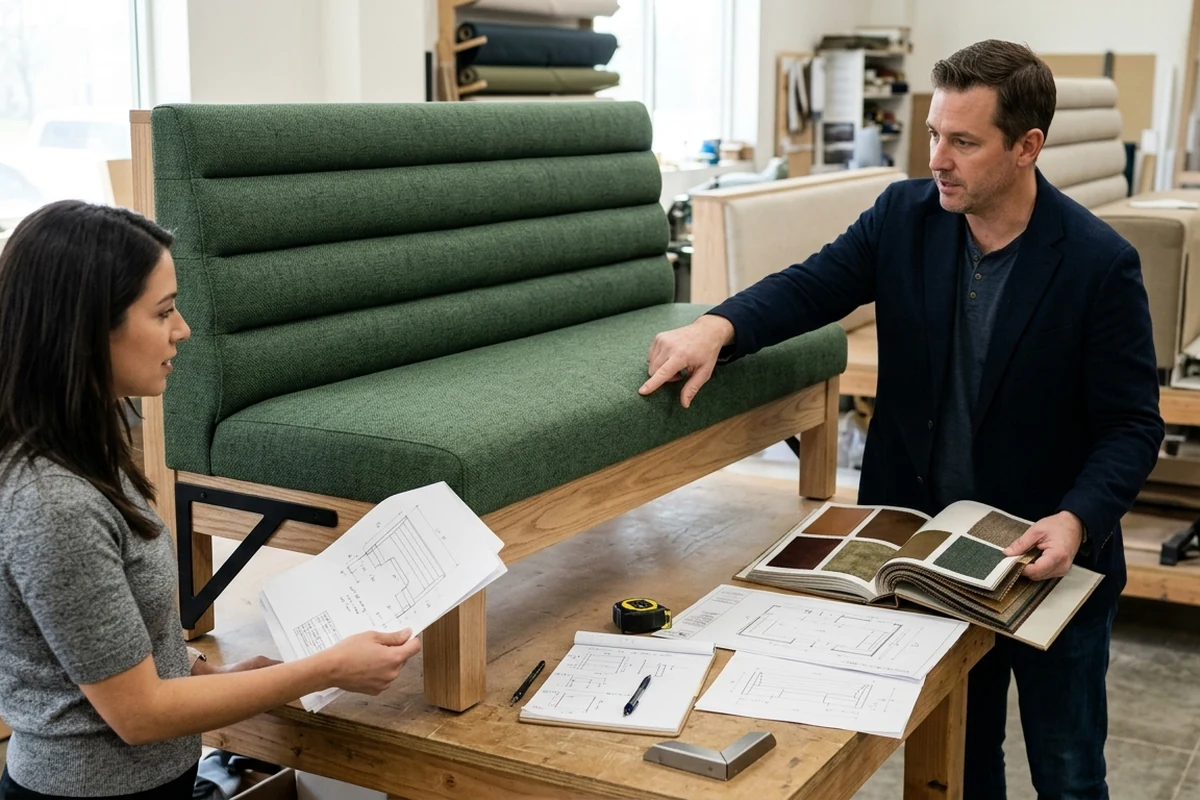
A usable BOQ assigns one row per identifiable deliverable rather than grouping inspiration images together. A custom wall banquette may require separate scope notes for corner modules, upholstery, plinth base, wall blocking, and site delivery, while a dining table line should state whether the quote covers the top, base, fasteners, and adjustable levelers.
Copyable restaurant furniture BOQ sample (illustrative rows only)
| Item code | Item and zone | Qty | Size or drawing (illustrative) | Material / finish | Included components | Sample / shop drawing gate | Open questions |
|---|---|---|---|---|---|---|---|
| F-01 | Dining chair / main hall | 48 | DWG-A12 / confirm seat height | Solid wood frame / buyer finish sample | Upholstery, glides, export carton | Finish swatch + frame sample before PO | Commercial upholstery rub rating to confirm |
| F-02 | 4-seat table / main hall | 12 | 1200 × 750 mm (approx. 47.2 × 29.5 in) example only | Selected top / powder-coated steel base | Top, base, mounting plate, levelers | Shop drawing + base stability check | Verify chair clearance and base weight |
| F-03 | Wall banquette / perimeter | 18 linear m (approx. 59 linear ft) example only | Site measure and shop drawing required | Commercial vinyl or fabric + agreed substrate | Modular frames, kick base, mounting cleats | Field measure + drawing sign-off | Access panels and local installer split |
| F-04 | Bar stool / counter | 10 | Counter elevation to confirm | Metal frame / approved powder coat | Footrest, protective glides | Frame sample after counter check | Match seat height to actual counter height |
The item codes, counts, and dimensions above are illustrative only, not a RON GROUP order or a code-compliant layout. For layout spacing and table-dimension planning, consult the restaurant table sizing guide and have local accessibility and egress rules verified by your design professional.
Request missing specifications before treating any quote as firm. Proportions read from 3D renderings are not automatically ready for fabrication, so define permitted dimensional tolerances and state which approved drawing governs production.
3. Ask Every Supplier the Same Technical and Commercial Questions
Standardize the evidence you ask every bidder to supply, without assuming every furniture category uses the same test report or compliance document. Different destination markets, substrates, and upholstery constructions require different documentation.
Include these eight questions in every restaurant furniture RFQ:
- Manufacturing role: Which legal entity builds each item—an in-house workshop, a subcontracted factory, or a sourcing and procurement partner coordinating specialist plants?
- Materials and COM: Which frame species, metal gauge, foam density, upholstery, coating, and hardware are included, and how is COM (customer's own material) handled if supplied separately?
- Shop drawings: Who prepares production shop drawings (detailed fabrication drawings showing joinery, hardware, and tolerances), who signs off, and how are revisions priced?
- Samples: Are finish swatches, prototype samples, and international courier fees included or billed separately, and who keeps the signed reference sample?
- Testing: Which product-specific test reports exist—showing exact model, accredited lab, issue date, and tested standard—and who checks destination suitability?
- Quantity and MOQ: Is quoted pricing valid at your exact project quantity, finish split, and delivery batch, and what minimum order quantity (MOQ) applies per SKU?
- Inspection: What in-line checks, assembly trials, and pre-shipment inspection (PSI, checking finished goods against approved samples before loading) apply under the purchase order?
- Warranty and exceptions: Which structural faults, replacement parts, labor, and freight expenses are covered or excluded, and for what period?
An "ISO-certified factory" claim usually refers to a management-system certificate, such as ISO 9001, issued to the organization by a certification body rather than by ISO itself, and not to any specific product. Ask for the certificate's scope, issuing body, and expiry date (accredited certificates can often be verified on IAF CertSearch or directly with the issuing body), and still require a product-specific test report and an approved item drawing. Record any undecided compliance requirement as a condition of quotation rather than implying suitability is already proven.
4. Compare Landed Scope, Not the Unit Price Alone
Put every quotation onto one comparison worksheet before shortlisting suppliers. Normalizing packing, export clearance, freight, and exclusions exposes whether a low unit price simply leaves major scope items out.
Supplier quote-comparison worksheet (blank template)
| Comparison line | Supplier A | Supplier B | Supplier C |
|---|---|---|---|
| RFQ revision and quote date | |||
| Identical item codes, specs, and quantities? | |||
| Unit price and quotation currency | |||
| Quote validity & price-adjustment conditions | |||
| Sample, swatch, and tooling charges | |||
| Inner packing, cartons, and pallet/crate charges | |||
| Carton / crate marking & BOQ code alignment | |||
| Export customs documentation and origin inland freight | |||
| Incoterms® 2020 rule and named port/place | |||
| Pre-shipment inspection or third-party testing | |||
| Estimated production time from what written approval date? | |||
| Ocean/air freight, import clearance, and local delivery scope | |||
| On-site unloading, uncrating, and installation included? | |||
| Warranty remedy and replacement lead-time terms | |||
| Outstanding technical or commercial exceptions |
Under Incoterms® 2020 rules, write both the specific rule (such as EXW, FCA, FOB, CIF, or DDP) and the exact named port or place of delivery, and state the edition in your purchase contract. Most furniture ships in containers; when containerized goods are handed to the carrier at a container terminal rather than loaded on board by the seller, the ICC advises considering FCA instead of FOB, and CIP instead of CIF. Because delivery terms allocate both transport cost and the point where risk transfers from seller to buyer, never compare an Ex Works (EXW) factory quote directly against a Delivered Duty Paid (DDP) site quote without normalizing freight, insurance, customs clearance, and destination duties. Confirm destination port charges and local import formalities with a licensed freight forwarder or customs broker.
Cost Drivers That Move Furniture Quotes (No Assumed Rates)
- Order volume and SKU consolidation: Splitting small quantities across many custom finishes raises setup and tooling costs per piece compared with standardized frames.
- Material grade and COM logistics: Commercial-grade solid timber, heavy-gauge steel bases, marine or contract upholstery, and buyer-supplied fabric handling change unit cost and waste allowances.
- Packaging method and container density: KD (knocked-down) flat packing versus fully assembled crating trades freight volume against local assembly labor at the restaurant site.
- Testing and customization depth: Dedicated prototypes, third-party lab testing, and custom millwork templates add upfront engineering and sampling fees that may amortize only at larger quantities.
5. Control Samples and Revisions Before Production
A commercial dining order moves through multiple approval gates: frame material, finish color, seating ergonomics, booth dimensions, table-base stability, and protective packaging. Replace vague "looks good" emails with a formal approval register tied back to item codes.
Sample, drawing, and revision approval register (illustrative rows only)
| Item | Reference / sample version | Decision | Conditions | Approved by | Reference retained by | Date |
|---|---|---|---|---|---|---|
| F-01 upholstery | SW-03 | Pending | Confirm commercial cleaning method | Buyer + Supplier | ||
| F-02 table base | DWG-A12-R2 | Conditional | Revise floor-plate thickness detail | Supplier (signed PDF + sample) | ||
| F-03 booth | MOCK-01 | Pending | Verified field dimensions still required | Project Manager + Factory |
Do not release mass production against unresolved critical specifications. For a dedicated checklist on material sign-off and pre-production evidence, follow our hospitality product sample approval workflow. Multi-unit restaurant groups should maintain one master specification plus a per-site variant sheet; this streamlines repeat orders, though suppliers cannot guarantee every third-party finish or dye lot remains active indefinitely.
6. Coordinate Quality Inspection, Packing, and Receiving
Define who inspects finished dimensions, quantities, surface finishes, carton marks, and protective crating before the balance payment or shipment release. Specify whether shipments move as LCL (less-than-container load, sharing container space with higher handling exposure) or FCL (full-container load), and link every carton label directly to BOQ item codes so site teams can sort rooms quickly.
Packing, inspection, and delivery boundary matrix
| Stage | Buyer / Customs Broker | Supplier / Sourcing Partner | Required record |
|---|---|---|---|
| Pre-shipment inspection (PSI) | Defines sampling level and pass criteria in PO | Coordinates finished-goods check against signed sample | Dated inspection report with photos by BOQ code |
| Export packing & carton marks | Supplies site zone labels and receiving sequence | Packs per agreed carton/crate spec with BOQ codes | Packing list showing carton count, net/gross weight, CBM |
| Customs & wood packaging | Confirms destination import rules and broker clearance | Supplies ISPM 15-marked solid wood packaging (or processed-wood/non-wood packing), commercial invoice, packing list, and origin documents | Broker-verified shipping and packaging documentation |
| Site receiving & punch list | Assigns on-site receiver, unloading, uncrating, assembly | Clarifies replacement claim evidence window in contract | Signed delivery receipt + timestamped shortage/damage log |
Treat the packaging and the furniture as two separate checks. Solid wood crates, pallets, and dunnage need phytosanitary treatment: the United States requires them to be ISPM 15 treated and marked, and Australia requires them to be treated and declared on the packing declaration, with ISPM 15-marked packaging the simplest way to comply. Write ISPM 15 packaging into the purchase order; packaging made wholly of processed wood, such as plywood or particleboard, falls outside these rules. The wooden furniture itself is assessed under the destination's own import conditions (in Australia, the BICON "Timber and timber products" case covers furniture), so ask your customs broker to confirm what applies to each shipment. For factory-side inspection and export consolidation practices, review RON GROUP's Foshan contract furniture sourcing overview and hospitality QC and export protocol; final inspection scope is confirmed per order.
Common Restaurant Furniture RFQ Risks and How to Reduce Them
- Quoting from concept renderings alone: Lock real structural thicknesses, joinery, and seat heights via shop drawings before accepting binding prices.
- Unpriced site access and unloading: Confirm early whether freight ends at the port, curbside, or inside the dining room, and who disposes of wooden crates.
- Comparing expired or mismatched quotes: Set one quote-validity window and freeze the RFQ revision before comparing Supplier A against Supplier B.
- Undocumented post-approval changes: Require a written revision entry whenever a factory proposes substituting hardware, veneer, foam, or upholstery due to stock shifts.
7. What to Send With Your First RFQ
You do not need a complete architectural tender set to start a productive quotation review. Assemble these seven practical inputs before reaching out:
- Latest floor plan or seating layout (even if marked preliminary)
- Estimated seating capacity and dining zones
- Furniture categories needed (chairs, tables, banquettes, bar stools)
- Finish references or mood-board images
- Destination country and city (plus nearest port if known)
- Target on-site and opening dates
- Decision owner authorized to confirm specifications and samples
If you have renderings without a formal BOQ, flag which designs are fixed brand standards and which items allow engineering alternatives. RON GROUP's restaurant 3D design services show how spatial layouts connect to product planning; exact deliverables and design scoping are confirmed with our team based on your project stage.
Next step: As a hospitality sourcing and procurement partner, RON GROUP helps restaurant groups and hospitality teams structure specifications, coordinate qualified manufacturers for each furniture category, and organize comparable quotations. Contact RON GROUP with your BOQ, floor plan, RFQ revision, quantities, and delivery location—we will flag missing specification fields and confirm item-by-item pricing, lead times, and available test documentation in writing.
Frequently Asked Questions About Restaurant Furniture RFQs
What is the difference between an RFQ and a BOQ?
A bill of quantities (BOQ) lists every furniture item, unit, quantity, dimension, and material specification needed for the project. A restaurant furniture RFQ packages that BOQ together with commercial terms, supplier qualification questions, submission deadlines, and shipping rules so bidders return directly comparable quotations.
Can a restaurant furniture supplier quote from a 3D rendering alone?
A rendering gives a helpful visual starting point, yet it rarely confirms structural framing, wall-blocking details, exact dimensions, or allowable material substitutions. Treat rendering-based figures as budgetary estimates only, and approve shop drawings and physical samples before releasing production.
Is one supplier always cheaper than several factories?
Not automatically. Working through one consolidated sourcing partner can simplify multi-category coordination, inspection, and container loading, while buying direct from specialized single-category workshops can suit high-volume standard items. Compare total landed cost, quality control responsibility, and delivery risk under identical assumptions.
Should every supplier have the same testing certificate?
No. Testing and compliance documents vary by product category, material composition, and destination country rules. Ask each bidder for product-specific reports tied to the exact model and standard, and have a qualified designer, engineer, or local compliance adviser verify applicability for your venue.
Get the week's latest industry information
-
Real-Life Professional Restaurant Case Studies
Explore Now
-
Create a unique restaurant with over 95,700+products
Explore Now
-
Protessional Free 3D Restaurant Design
Explore Now
-
Still Have Questions About Opening a Restaurant?
Explore Now

Sylvia
With 8 years in catering & hospitality industry, sales manager of Ron Group, specialise in providing one stop solutions to restaurants, hotels and weddings.
Discover Our Exclusive Products
Explore our extensive range of restaurant and hotel supplies designed to enhance your operations. Find the perfect solutions to meet your needs.
Browse Our ProductsFREE 3D DESIGN
Boost your restaurant's success with our free 3D design service. Start building the restaurant of your dreams today!
Explore 3D Design Case
RECOMMENDED CASES
-
La Rambla by Catalunya: Crafting Barcelona's Soul in Hong Kong - Custom Furniture Excellence
RON Group's custom Spanish-inspired furniture elevates La Rambla with artisanal aesthetics...
Learn More -

Cardinal Point: Elevating Outdoor Seating with Tailored Cushion Upgrades
Discover how Cardinal Point transformed its outdoor dining experience with custom cushions, achievin
Learn More
RECOMMENDED BLOGS
-

Bar Glassware 101: Types, Names, Uses, and How to Stock Your Bar
Learn the 10 core bar glassware types, names, and uses. Discover how to stock your bar with the right glasses for cocktails, beer,...
Sylvia2026-07-26 -

Commercial Bar Equipment List & Checklist for Opening a Bar
Commercial bar equipment checklist for new bars and restaurant bars: underbar stations, ice, refrigeration, draft, glassware and...
Sylvia2026-06-11 -

Low-Budget Restaurant Interior Design Ideas: Spend Where Guests and Staff Notice
Explore low-budget restaurant interior design ideas, practical material choices, layout priorities and phased upgrades without...
Sylvia2026-04-04
Subscribe to RON GROUP
Stay up-to-date with the latest industry insights and expert advice. Together, we'll create your ideal restaurant.