












Content
A hospitality sample can look ready and still be unsafe to approve. The chair is comfortable, the timber color is close to the finish board, and the hardware operates during the meeting. But the label does not identify the final factory, the drawing revision differs from the quotation, the fabric code is missing, and the supplier cannot show whether the production substrate, adhesive, coating, or packaging will match the item in front of you.

The sample has answered an appearance question. It has not yet answered the procurement question:
Is this exact configuration defined, evidenced, and controlled well enough to release the next step?
Establish the approval baseline before judging the sample
Give every submitted item a unique sample ID linked to the purchase package. The record should identify the product code, room or area, drawing revision, quotation revision, supplier, manufacturing site when relevant, material and finish references, hardware, upholstery, packaging assumption, submission date, and intended approval gate.
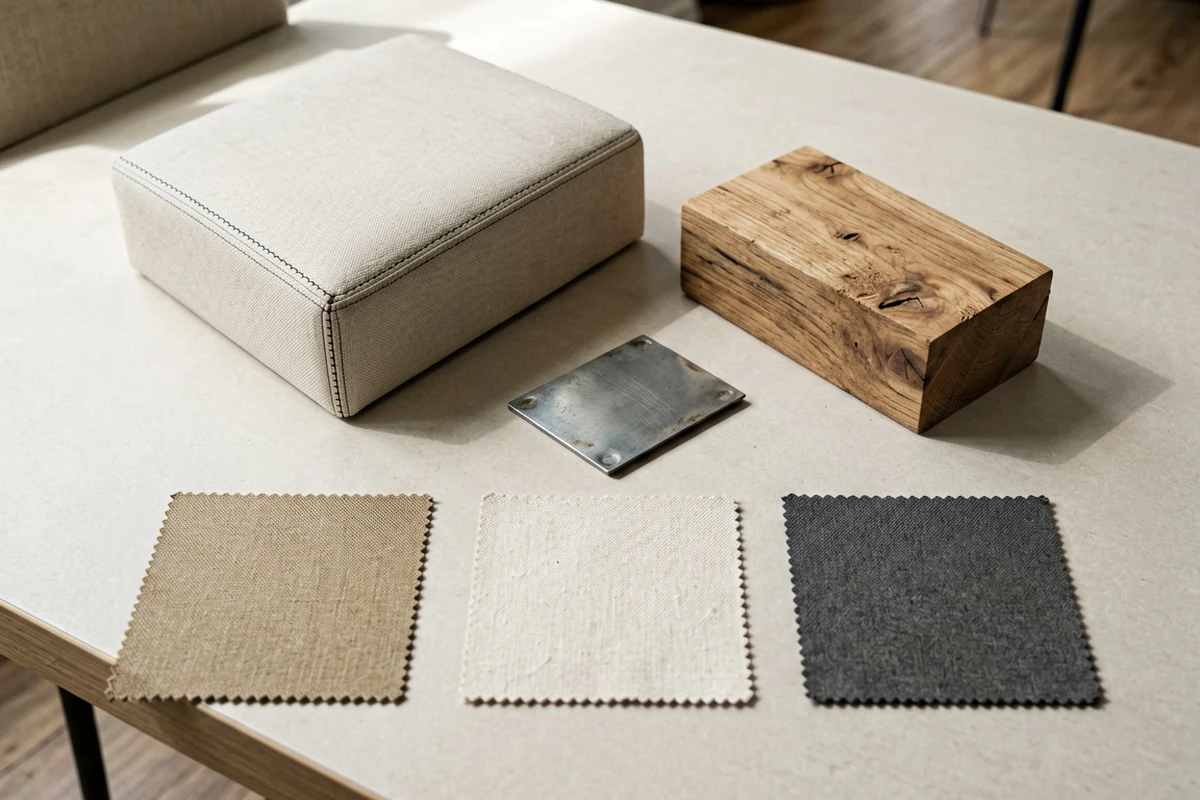
This baseline matters because "approved sample" is otherwise ambiguous. One person may mean color only; another may assume dimensions, construction, comfort, packaging, and regulatory evidence also passed. Write the scope on the approval sheet.
| Approval field | Evidence to attach | Decision question |
|---|---|---|
| Identity | Sample ID, item code, room or zone, supplier, factory where relevant | Can the physical item be matched to the order and production source? |
| Configuration | Approved drawing, bill of materials or component schedule, hardware and upholstery codes | Does the sample represent the configuration being quoted? |
| Finish | Control sample, color reference, sheen, grain direction, texture, approved variation | What visual range is accepted, and who owns the reference? |
| Interfaces | Overall dimensions, clearances, fixing assumptions, power or service interfaces | Does it fit the room, adjacent products, and installation condition? |
| Claims | Named standard, regulation, certificate, test report, declaration, or chain-of-custody record | Which claim is evidenced, for which product and market? |
| Change status | Deviation log and open-action list | What differs from the RFQ, and what must happen before release? |
The Architectural Woodwork Institute's public submittal guidance identifies shop drawings, material data, finish and core samples, sheet-product data, profiles, and hardware data as coordinated records. AWI applies to architectural woodwork within its scope, but its submittal categories provide a useful method for hospitality furniture and fixtures: approve an indexed package, not an object separated from its documents.
RON GROUP's furniture collection can help buyers define the relevant furniture category before item codes, materials, finishes, and sample requirements are frozen.
Verify the supplier and the evidence owner
Sample approval should not substitute for supplier due diligence. The U.S. International Trade Administration advises businesses to investigate markets and carefully select foreign partners, and it points to company background checks and screening resources as part of that work (Trade.gov due-diligence guidance).

For the sample file, confirm:
the legal contracting party and the entity receiving payment;
the manufacturer and production location when these affect the offer;
who owns the drawings, samples, test reports, certificates, and declarations;
whether the report holder, model, material, factory, and date match the offered product;
who may authorize substitutions or process changes;
who is responsible for corrective samples, production records, packing evidence, and final release.
A polished sample from a showroom or development workshop may not identify the mass-production source. Record that distinction instead of assuming equivalence. The related RON GROUP guide to furniture project supplier planning can support the wider supplier-selection task.
Separate five approval questions
1. Does it match the approved design?
Check dimensions, proportions, finish direction, upholstery code, seams, edges, hardware identity, component arrangement, branding, labels, and interfaces against the current drawing and schedule. Record measured values where the project has a defined tolerance. Do not invent tolerances during the meeting.
2. Does it work in the intended hospitality setting?
Review the sample in use: guest posture, table reach, drawer and door access, cleaning access, maintenance replacement, floor contact, wall relationship, service clearances, stability, and expected handling. These are project observations, not universal performance certifications.
3. Is the construction defined?
Ask the supplier to identify concealed as well as visible components. A finish chip does not define the substrate. A completed chair does not identify the foam, fasteners, adhesive, frame, coating preparation, or internal reinforcement. The approval package should state what production is expected to contain and which characteristics remain supplier-controlled.
4. Are regulated or commercial claims supported?
Do not approve a claim by looking at a sample. For relevant United States transactions, EPA's TSCA Title VI composite wood guidance addresses hardwood plywood, MDF, particleboard, and finished goods containing regulated composite wood products, with testing, certification, labeling, recordkeeping, and import provisions. Check product and transaction scope, applicable definitions and exemptions, supplier evidence, and current rule status rather than writing "compliant" on appearance alone.
The same discipline applies to responsible-sourcing and environmental language. FSC chain-of-custody certification relies on identifying and tracking certified material through manufacturing and distribution, with purchase, production, and sales records. A logo, timber swatch, or general supplier certificate does not prove that the offered finished product and transaction carry an eligible FSC claim.
Broad claims such as "eco-friendly," "green," or "sustainable" also need qualification. The U.S. Federal Trade Commission's Green Guides summary explains that environmental claims should be truthful, not misleading, and supported by competent and reliable evidence. Ask what attribute is claimed, what part of the product it covers, which evidence supports it, and which limitations must appear with the claim.
5. Can production be kept aligned with the approved baseline?
This is the question most sample forms miss. The buyer needs a change-control and production-evidence plan, not a promise that the factory will "make the same."
Do not let one sample stand in for production conformity
An approved sample is a reference for the attributes actually reviewed. It does not prove that later units, batches, components, or processes will conform.

The U.S. Consumer Product Safety Commission's general-use product testing guidance illustrates the distinction for products subject to applicable CPSC rules: certification may rely on testing or a reasonable testing program, while production variability, incoming materials, process controls, and material changes affect continuing assurance. CPSC also notes that changes to design, manufacturing process, paint, metal, fabric, or component sources can affect compliance and may require retesting. This is a United States regulatory example, not a rule for every hospitality product, but the procurement lesson is broadly useful: initial evidence and continuing production control are different things.
Before mass-production release, define:
the approved control sample and where it will be retained;
the frozen drawing, bill of materials, component codes, and finish references;
incoming-material and in-process checks relevant to the product;
first-production or pilot-unit review when project risk warrants it;
required lot, batch, or production records;
the inspection stage, sampling plan, acceptance criteria, and decision owner;
changes that require written notice, renewed evidence, a new sample, or retesting;
packaging approval and the evidence required before shipment.
The buyer does not need to prescribe the supplier's entire quality system in the sample meeting. The buyer does need to know which controls support the claims being relied upon and who is accountable when production changes.
Use an explicit release decision
| Decision | Use when | Supplier's permitted next step |
|---|---|---|
| Approve | The reviewed scope is identified, evidence is complete for that gate, and no open item could change the approved result | Proceed only to the named next gate |
| Approve with conditions | Limited open items have owners, due dates, evidence requirements, and a prohibited next step | Complete stated actions; do not treat conditions as waived |
| Revise and resubmit | The product direction may be acceptable, but drawings, materials, workmanship, interfaces, claims, or records need correction | Submit the revised package and sample evidence |
| Reject | The sample conflicts with the brief, has unacceptable defects, uses an unapproved configuration, or lacks credible correction logic | Stop the proposed configuration |
| Escalate | Regulatory scope, test applicability, structural safety, fire performance, accessibility, chemical claims, or contractual responsibility requires a qualified authority | Hold release pending specialist decision |
Write what passed. "Finish approved only" is valid. "Dimensions approved subject to revised drawing" may be valid. "Approved for mass production" is valid only when the form identifies the controlled configuration, required evidence, open conditions, decision owner, date, and next prohibited step.
For broader project coordination, RON GROUP's project page provides a relevant continuation path. To discuss a live approval package, send RON GROUP your sample status and project inputs: item list, drawings, quantities, destination market, finish schedule, material and hardware references, supplier submittal, required claims or standards, deviations, sample photos, packaging expectations, production status, and named approval owners.
The strongest sample approval does not claim that one item proves the whole order. It creates a clear baseline, states the limits of the decision, and defines the evidence needed to keep production aligned with what the buyer actually approved.
Get the week's latest industry information
-
Real-Life Professional Restaurant Case Studies
Explore Now
-
Create a unique restaurant with over 95,700+products
Explore Now
-
Protessional Free 3D Restaurant Design
Explore Now
-
Still Have Questions About Opening a Restaurant?
Explore Now

Sylvia
With 8 years in catering & hospitality industry, sales manager of Ron Group, specialise in providing one stop solutions to restaurants, hotels and weddings.
Discover Our Exclusive Products
Explore our extensive range of restaurant and hotel supplies designed to enhance your operations. Find the perfect solutions to meet your needs.
Browse Our ProductsFREE 3D DESIGN
Boost your restaurant's success with our free 3D design service. Start building the restaurant of your dreams today!
Explore 3D Design Case
RECOMMENDED CASES
-

La Rambla by Catalunya: Crafting Barcelona's Soul in Hong Kong - Custom Furniture Excellence
RON Group's custom Spanish-inspired furniture elevates La Rambla with artisanal aesthetics...
Learn More -

Cardinal Point: Elevating Outdoor Seating with Tailored Cushion Upgrades
Discover how Cardinal Point transformed its outdoor dining experience with custom cushions, achievin
Learn More
RECOMMENDED BLOGS
-

Bar Glassware 101: Types, Names, Uses, and How to Stock Your Bar
Learn the 10 core bar glassware types, names, and uses. Discover how to stock your bar with the right glasses for cocktails, beer,...
Sylvia2026-07-26 -

Complete Bar Equipment List for Opening a Bar
Use a complete bar equipment list with pictures, covering workstations, ice, refrigeration, glassware, utilities, sanitation and a...
Sylvia2026-06-11 -

Low-Budget Restaurant Interior Design Ideas: Spend Where Guests and Staff Notice
Explore low-budget restaurant interior design ideas, practical material choices, layout priorities and phased upgrades without...
Sylvia2026-04-04
Subscribe to RON GROUP
Stay up-to-date with the latest industry insights and expert advice. Together, we'll create your ideal restaurant.