

Content
Executive Overview:
In commercial hospitality, glassware is far more than a decorative serving vessel. It is a critical operational tool that governs liquid pour cost, aroma concentration, thermal retention, carbonation stability, and dishwashing survival rates. Choosing the wrong bar glassware types or underestimating your par stocking levels leads directly to service bottlenecks, high breakage attrition, and compromised beverage margins. This comprehensive commercial guide details the essential bar glass names and uses, breaks down material physics between crystal and tempered glass, provides mathematical per-seat stocking formulas, and outlines professional care standards for high-volume bars, craft cocktail lounges, and hotel operations.
Why Glassware Selection Matters in Commercial Bars
For commercial beverage operators, every glass on your backbar is an active financial asset. When an operator selects commercial bar glassware, they are making four intertwined operational decisions:
Pour Cost Control and Visual Fill Rate: An oversized glass tempts bartenders to over-pour spirits or top off with expensive mixers, directly eroding gross beverage margins. A properly specified glass creates a generous visual wash line with standard 1.5 oz to 2.0 oz spirit portions and precise ice displacement.
Sensory Delivery and Aroma Channeling: The geometry of the bowl, taper of the rim, and thickness of the lip dictate how aromatic compounds escape and where liquid makes initial contact on the palate. A wide-mouth coupe aerates differently than a narrow chimney Collins glass.
Thermal Mass and Heat Transfer: The thickness of the base (sham) and the presence of a stem determine whether human body heat warms a chilled cocktail. Stemmed glassware isolates chilled drinks served "up" from the 37 deg C (98.6 deg F) warmth of a guest's hand.
Mechanical Durability and Turnover Logistics: In a high-volume commercial bar, glassware cycles through commercial dishwashers operating at 150 deg F to 180 deg F (65 deg C to 82 deg C) dozens of times per shift. Glasses must withstand thermal shock, mechanical vibration in dish racks, and repeated bussing without chipping or cracking.
TECHNICAL NOTE // KEY ENGINEERING STANDARD
Commercial tabletop studies demonstrate that guests perceive cocktails served in heavy-base, laser-cut rim glassware as having 25% to 35% higher value than the identical drink served in generic rolled-rim tumblers. Investing in proper glassware directly supports premium drink pricing.
The 10 Essential Types of Bar Glasses
Understanding the core bar glass name list and their technical design parameters enables operators to build a versatile, cohesive tabletop program. Below are the 10 essential types of bar glasses used across international hospitality venues.
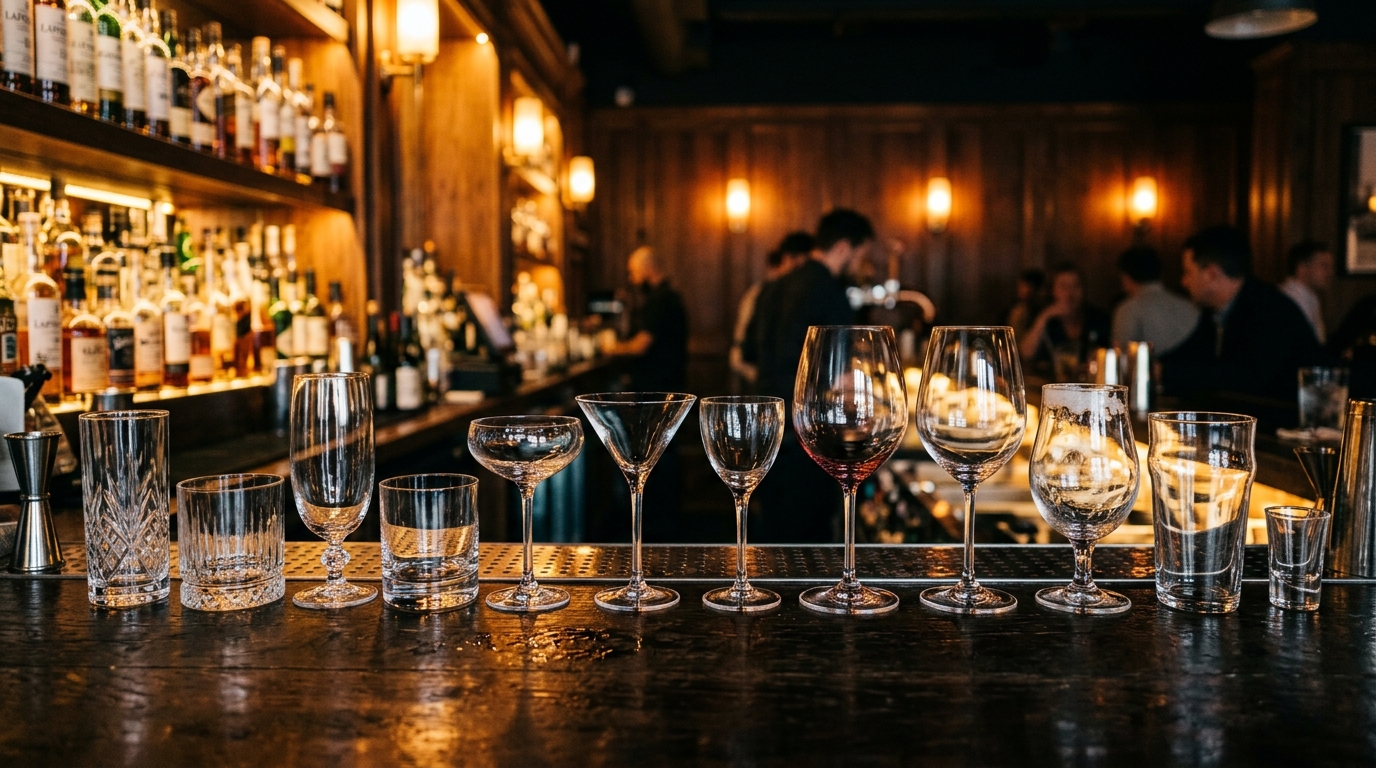
1. Highball Glass
Common Industry Names: Highball Tumbler, Tall Glass, Hi-Ball.
Standard Capacity Range: 8 to 12 fl oz (240 to 355 ml).
Signature Cocktails & Uses: Gin and Tonic, Whiskey Highball, Dark and Stormy, Paloma, Vodka Soda, Cuba Libre.
Engineering Anatomy & Commercial Function: The highball is a straight-sided or slightly tapered cylinder with a moderate-to-heavy base. Its vertical geometry is engineered specifically for effervescent, carbonated mixed drinks. By minimizing the exposed liquid surface area relative to total volume, the highball retards the escape of carbon dioxide bubbles, preserving crisp carbonation throughout service. The straight interior profile accommodates standard 1.25-inch ice cubes or full-length rectangular ice spears while leaving an exact 0.5-inch wash line for splash-free tray transport.
Standard Warewashing Rack: 25-compartment or 36-compartment full-height glass rack.
2. Rocks / Old Fashioned Glass
Common Industry Names: Lowball, Old Fashioned Glass, Single Rocks (6 to 8 oz), Double Old Fashioned / DOF (10 to 14 oz).
Standard Capacity Range: Single: 6 to 8 fl oz (180 to 240 ml); Double (DOF): 10 to 14 fl oz (300 to 415 ml).
Signature Cocktails & Uses: Old Fashioned, Negroni, Whiskey Sour, Penicillin, Sazerac, neat spirits, and premium spirits served on a single large ice cube or sphere.
Engineering Anatomy & Commercial Function: The rocks glass features a wide, straight or gently flared rim and an extra-heavy solid glass base (known as the sham), typically 12mm to 18mm thick. This dense sham serves two vital mechanical roles: it lowers the glass's center of gravity to prevent tipping on crowded tables, and it absorbs the downward mechanical shock of a muddler when a bartender crushes sugar cubes, herbs, or citrus wheels directly inside the glass. In modern craft cocktail programs, the Double Old Fashioned (DOF) is the undisputed workhorse, easily accommodating 2.0-inch to 2.5-inch artisanal ice spheres.
Standard Warewashing Rack: 25-compartment medium-height glass rack.
3. Coupe Glass
Common Industry Names: Champagne Coupe, Cocktail Saucer, Champagne Saucer.
Standard Capacity Range: 5 to 8 fl oz (150 to 240 ml).
Signature Cocktails & Uses: Daiquiri, Manhattan, Sidecar, Aviation, Gimlet, Espresso Martini, craft sparkling wine, vintage champagne cocktails.
Engineering Anatomy & Commercial Function: Originally created for sparkling wine in 18th-century Europe, the coupe has evolved into the universal standard for craft cocktails served "up" (shaken or stirred with ice and strained into a chilled stem without ice). The broad, shallow bowl showcases the cocktail's color and texture, while the slender stem and foot prevent hand warmth from elevating the drink's temperature. The rounded lip allows delicate foams (such as egg white or aquafaba in sours) to sit proudly above the rim without collapsing.
Standard Warewashing Rack: 16-compartment or 25-compartment stemmed glass rack with height extenders.
4. Martini Glass
Common Industry Names: Classic Cocktail Glass, V-Stem, Inverted Cone Stem.
Standard Capacity Range: 4 to 10 fl oz (120 to 300 ml; 5 to 7 oz is ideal for commercial drink balance).
Signature Cocktails & Uses: Classic Gin or Vodka Martini, Gibson, Cosmopolitan, Lemon Drop, Vesper.
Engineering Anatomy & Commercial Function: The martini glass features a sharp, 45-degree inverted conical bowl perched atop a long stem. The steep triangular walls serve a distinct sensory function: they maximize the surface area exposed to ambient air, allowing the aromatic botanicals of gin and dry vermouth to volatize and rise directly toward the drinker's nose. The conical angle also holds cocktail olives, cocktail onions, or citrus peel garnishes upright. Commercial Operational Note: Because the steep, uncurved rim makes liquids prone to sloshing during tray transit, many high-volume venues utilize 5 oz to 6 oz capacities or substitute rounded coupe glasses for floor service.
Standard Warewashing Rack: 16-compartment stemmed glass rack.
5. Wine Glass (Red & White)
Common Industry Names: Bordeaux Glass, Burgundy Glass, White Wine Goblet, Universal Restaurant Wine Glass.
Standard Capacity Range: Red Wine: 14 to 22 fl oz (415 to 650 ml); White Wine: 8 to 14 fl oz (240 to 415 ml); Universal: 12 to 16 fl oz (355 to 475 ml).
Signature Cocktails & Uses: Cabernet Sauvignon, Pinot Noir, Chardonnay, Sauvignon Blanc, Rose, wine spritzers, Sangria.
Engineering Anatomy & Commercial Function: Commercial red wine glasses feature a larger, rounder bowl with a broad surface area to promote aeration, soften firm grape tannins, and collect complex dark fruit aromas in the headspace. White wine glasses have a narrower, upright U-shaped bowl that limits surface exposure, preserving cool serving temperatures (45 deg F to 52 deg F / 7 deg C to 11 deg C) and concentrating delicate floral and citrus esters. High-turnover bistros and banquet operations frequently deploy a universal 14 oz wine glass to consolidate inventory and eliminate backbar confusion.
Standard Warewashing Rack: 16-compartment (for wide red bowls) or 25-compartment (for white and universal stems).
6. Champagne Flute
Common Industry Names: Sparkling Flute, Champagne Stem, Prosecco Glass.
Standard Capacity Range: 6 to 8 fl oz (180 to 240 ml).
Signature Cocktails & Uses: Champagne, Prosecco, Cava, Mimosa, Bellini, French 75.
Engineering Anatomy & Commercial Function: The champagne flute features a tall, narrow bowl with a small surface opening atop a medium stem. Its tall vertical column minimizes surface contact with warm air, preserving carbonation and effervescence. High-grade commercial flutes feature an engineered laser nucleation point at the bottom of the bowl. This micro-etched imperfection creates a steady release point for dissolved carbon dioxide, generating a continuous, visually appealing bead stream of bubbles rising through the center of the glass.
Standard Warewashing Rack: 36-compartment tall stemware rack.
7. Pint Glass
Common Industry Names: American Shaker Pint (16 oz), English Nonic Pint (20 oz), Conical Pint, Tulip Pint.
Standard Capacity Range: US Shaker: 16 fl oz (473 ml); Imperial Nonic: 20 fl oz (568 ml).
Signature Cocktails & Uses: Draught lagers, IPAs, stouts, ciders, shandies, soft drinks, and high-volume iced water service.
Engineering Anatomy & Commercial Function: While the conical American Shaker pint is common due to historical convenience, the English Nonic Pint is vastly superior for commercial operations. The Nonic pint features a distinct circumferential bulge roughly two inches below the rim. This bulge provides an ergonomic grip for servers with wet hands, prevents vacuum-locking when glasses are stacked, and protects the fragile rim from direct contact chipping when glasses bump inside warewashing racks or storage shelves.
Standard Warewashing Rack: 25-compartment full-height rack.
8. Shot Glass
Common Industry Names: Shooter, Single Shot (1.0 to 1.5 oz), Double Shot (2.0 to 3.0 oz), Fluted Shooter.
Standard Capacity Range: 1.0 to 2.5 fl oz (30 to 75 ml).
Signature Cocktails & Uses: Straight tequila, whiskey, vodka, layered shooters (B-52), boilermakers, and recipe portioning.
Engineering Anatomy & Commercial Function: Shot glasses are engineered with heavy wall profiles and thick, solid bases designed to survive repeated mechanical impacts when guests slam glasses onto wooden or stone bar surfaces. Many commercial shot glasses incorporate interior measurement rings or molded pour lines at 1.0 oz and 1.5 oz, allowing bartenders to visually verify portion accuracy during rapid-fire service.
Standard Warewashing Rack: 36-compartment or 49-compartment low-profile glass rack.
9. Snifter
Common Industry Names: Brandy Snifter, Cognac Balloon, Brandy Inhaler.
Standard Capacity Range: 6 to 18 fl oz (180 to 530 ml; standard spirit pour is 1.5 to 2.0 oz).
Signature Cocktails & Uses: Cognac, Armagnac, Aged Brandy, single malt Scotch, aged rum, barrel-aged stouts, Belgian quadrupels.
Engineering Anatomy & Commercial Function: The snifter is designed with a very short stem and an oversized, wide spherical bowl that tapers sharply toward the rim. The drinker naturally cradles the base of the bowl in the palm of their hand, using radiant body heat to gently warm the liquor. As warm ethanol vapors rise, volatile esters are captured inside the wide bowl chamber and concentrated at the narrow rim opening for optimal nosing and aroma evaluation.
Standard Warewashing Rack: 16-compartment or 25-compartment medium-height rack.
10. Collins Glass
Common Industry Names: Tall Cooler Glass, Slim Highball, Chimney Glass.
Standard Capacity Range: 10 to 14 fl oz (300 to 415 ml).
Signature Cocktails & Uses: Tom Collins, Mojito, Long Island Iced Tea, Singapore Sling, Ramos Gin Fizz.
Engineering Anatomy & Commercial Function: The Collins glass is narrower, taller, and more strictly cylindrical than a highball glass. Its slim vertical profile showcases layered drink presentations, long citrus ribbons, and fresh mint sprigs. The narrow diameter forces crushed or cracked ice into a tight vertical column, chilling the beverage rapidly while limiting overall surface air exposure to keep fizzy mixed drinks crisp and effervescent.
Standard Warewashing Rack: 36-compartment tall glass rack.
Quick-Reference: Glass Types at a Glance
The matrix table below summarizes the capacity, standard drink pairings, key engineering traits, and commercial warewashing specifications across all essential bar glassware types.
| Glass Name | Primary Uses & Cocktails | Standard Capacity | Key Engineering Feature | Commercial Dishwasher Rack Sizing |
|---|---|---|---|---|
| Highball Glass | G&T, Highballs, Long Drinks, Sodas | 8 - 12 oz (240 - 355 ml) | Narrow cylinder retains carbonation | 25 or 36 compartment, full height |
| Rocks / DOF | Old Fashioned, Negroni, Neat Spirits | 10 - 14 oz (300 - 415 ml) | Heavy 15mm sham absorbs muddler shock | 25 compartment, medium height |
| Coupe Glass | Daiquiri, Manhattan, Espresso Martini | 5 - 8 oz (150 - 240 ml) | Wide shallow bowl, stem prevents hand warmth | 16 or 25 compartment stemware rack |
| Martini Glass | Gin/Vodka Martinis, Cosmopolitans | 5 - 8 oz (150 - 240 ml) | 45-degree V-cone aerates botanicals | 16 compartment stemware rack |
| Red Wine Glass | Cabernet, Merlot, Pinot Noir | 14 - 22 oz (415 - 650 ml) | Oversized balloon bowl for tannin aeration | 16 compartment tall stemware rack |
| White Wine Glass | Chardonnay, Sauvignon Blanc, Rose | 8 - 14 oz (240 - 415 ml) | U-shaped bowl maintains cooler temperatures | 25 compartment stemware rack |
| Champagne Flute | Champagne, Prosecco, French 75 | 6 - 8 oz (180 - 240 ml) | Narrow chimney with laser nucleation bead | 36 compartment tall stemware rack |
| Pint Glass (Nonic) | Draught beer, ales, stouts, ciders | 16 - 20 oz (473 - 568 ml) | Anti-chip bulge, prevents stacking lock | 25 compartment full height |
| Shot Glass | Straight spirits, shooters, boilermakers | 1 - 2.5 oz (30 - 75 ml) | Thick reinforced walls survive counter slam | 36 or 49 compartment low-profile |
| Snifter | Cognac, Brandy, Barrel-Aged Stouts | 8 - 16 oz (240 - 475 ml) | Palm-cradled bowl warms liquor aromas | 16 or 25 compartment medium height |
| Collins Glass | Tom Collins, Mojitos, Long Island | 10 - 14 oz (300 - 415 ml) | Ultra-slim vertical column for crushed ice | 36 compartment tall glass rack |
| Nick & Nora | Clean stirred craft cocktails, Martinis | 5 - 6 oz (150 - 180 ml) | Curved sides prevent transit sloshing | 25 or 36 compartment stemware rack |
Material Options: Crystal vs. Tempered vs. Standard Soda-Lime Glass
Selecting the correct glass formulation is an essential engineering balance between optical brilliance, rim mouthfeel, and physical resilience. Commercial hospitality utilizes three distinct glass categories:
+---------------------------------------------------------------------------------------------------+
|                                 COMMERCIAL GLASS MATERIAL SPECTRUM                                |
|                                                                                                   |
|  [ STANDARD SODA-LIME ]       ======>   [ FULLY TEMPERED GLASS ]   ======>   [ LEAD-FREE CRYSTAL ] |
|  - Baseline economy                     - 3x to 5x impact strength           - Brilliant refraction|
|  - Thick rolled rim                     - Crumbles into blunt pebbles        - Ultra-thin cut rim  |
|  - General dining & banquets            - High-volume bars & patios          - Fine dining lounges |
+---------------------------------------------------------------------------------------------------+
1. Standard Soda-Lime Glass
Chemical Base: Silica sand (approx. 70%), soda ash (sodium carbonate), and limestone (calcium carbonate).
Physical Characteristics: The most common, economical glass formulation in the world. It features a moderate refractive index and requires a rounded, rolled bead at the rim to reinforce the glass against mechanical edge chipping.
Commercial Suitability: Ideal for budget-conscious family restaurants, catering operations, and general water tumblers. However, its lower thermal shock threshold (approx. 40 deg C to 50 deg C / 72 deg F to 90 deg F sudden variance) makes it susceptible to thermal fracture if exposed to sudden temperature shifts.
2. Fully Tempered (Toughened) Glass
Manufacturing Process: Soda-lime glass heated in specialized furnaces to approximately 600 deg C (1112 deg F) and then rapidly quenched with high-pressure jets of cold air. This process locks the outer surface into intense compressive stress while the inner core remains in tensile tension.
Physical Characteristics: Fully tempered glass offers 3x to 5x the mechanical impact resistance of untempered glass and withstands thermal shock differentials exceeding 130 deg C (266 deg F). When tempered glass does suffer a catastrophic failure, it does not form razor-sharp shards; instead, it fractures instantly into hundreds of small, relatively harmless granular pebbles.
Commercial Suitability: The gold standard for high-volume nightclubs, sports bars, poolside venues, rooftop terraces, and busy bistro dining rooms where staff and guest safety are paramount.
3. Lead-Free Crystal Glass
Chemical Base: Replaces traditional toxic lead oxide with safe minerals such as barium oxide, zinc oxide, or potassium oxide, often reinforced with titanium dioxide.
Physical Characteristics: Crystal possesses a significantly higher refractive index than soda-lime, giving stemware unmatched clarity, sparkle, and a clear musical ring when toasted. Crucially, the structural strength of the mineral matrix allows manufacturers to produce ultra-thin, cold-cut laser-sheared rims (under 1.0mm thick) without a bulky bead. This creates a superior mouthfeel that does not distract from wine or craft cocktail flavors.
Commercial Suitability: Essential for high-end hotel cocktail lounges, Michelin-starred dining rooms, and premium wine programs. Crystal requires gentler handling and dedicated stemware wash racks.
Low-Cost Untempered Glass Pitfall
Cheap untempered glassware features thick, beaded rims that distract from drink aromatics. Under rapid bar turnover, edge chipping occurs within 60 to 90 days. Untempered glasses shatter into lethal dagger shards, generating severe guest liability risks, high annual replacement costs, and frequent service halts.
Contract-Grade Tempered & Crystal Advantage
Commercial-grade tempered tumblers withstand high-temp commercial dishwashers and accidental bar impacts, cutting annual replacement expenses by up to 60%. Lead-free titanium crystal delivers luxury acoustic resonance and sub-millimeter mouthfeel while maintaining contract-level dishwasher durability.
| Material Parameter | Standard Soda-Lime Glass | Fully Tempered Glass | Lead-Free Crystal Glass |
|---|---|---|---|
| Mechanical Impact Resistance | Baseline (1.0x) | Superior (3.5x - 5.0x) | Moderate to High (1.5x - 2.5x with Titanium) |
| Thermal Shock Tolerance | 40 deg C - 50 deg C (72 deg F - 90 deg F) | 130 deg C - 150 deg C (266 deg F - 302 deg F) | 60 deg C - 80 deg C (108 deg F - 144 deg F) |
| Rim Construction | Rounded fire-rolled bead | Reinforced bead or polished edge | Laser-cut sheared rim (< 1.0mm) |
| Breakage Pattern | Dangerous, sharp dagger shards | Small, blunt granular pebbles | Clean fractures, minimal micro-shards |
| Optical Clarity | Slight green/blue tint | Clear with minimal tint | Ultra-brilliant, high refractive index |
| Optimal Venue Type | Buffets, diners, casual banquets | Nightclubs, pubs, high-volume bars | Craft cocktail bars, luxury hotels, fine dining |
How to Calculate Glassware Quantities Per Seat
Running out of clean glassware in the middle of a Friday night dinner rush is a catastrophic failure that instantly bottlenecks the bar, delays table service, and compromises revenue. To prevent this, commercial operations calculate orders using the Par Stocking System.
+---------------------------------------------------------------------------------------------------+
|                                  THE 3-PAR HOSPITALITY INVENTORY CYCLE                            |
|                                                                                                   |
|     [ PAR 1: FLOOR ]              [ PAR 2: DISH PIT ]              [ PAR 3: BACKROOM ]            |
|   Active on guest tables,     Bussed, racked, passing          Clean inventory stored in          |
|   bar counters, & trays.  ==> through wash cycle, drying.  ==> master cartons, absorbing peak     |
|   (In immediate service)      (15 - 30 minute lag)             surges & drop-breakage.            |
+---------------------------------------------------------------------------------------------------+
A "Par 1" represents the exact number of glasses needed to serve every seated guest in your venue at full capacity once. In commercial food and beverage operations, a minimum of 2.5 to 3.5 Par is required:
Par 1 (Active Service): Currently in the hands of guests, on dining tables, or positioned on the bartender's speed rail.
Par 2 (Washing & Transit Cycle): In bussing tubs, staged at the dish pit, cycling through the high-temperature warewasher, or cooling in drying racks.
Par 3 (Reserve & Breakage Buffer): Stored clean in back-of-house storage cabinets or master cartons, ready to absorb sudden customer rushes and replace daily breakage.
Ordering Factor by Glass Type
Not every glass type turns over at the same velocity. Highball and rocks glasses turn over 3x to 4x faster than dessert snifters. Use the ordering multipliers below to calculate initial procurement based on total venue seating capacity:
| Glass Type | Casual Pub / Sports Bar | Craft Cocktail Lounge | Hotel Dining & Lounge | Nightclub / High Volume |
|---|---|---|---|---|
| Rocks / DOF | 2.5x total seats | 3.5x total seats | 2.5x total seats | 3.0x total seats |
| Highball / Collins | 2.5x total seats | 3.0x total seats | 2.0x total seats | 3.5x total seats |
| Pint Glass (Beer) | 4.0x total seats | 1.5x total seats | 2.0x total seats | 3.0x total seats |
| Coupe / Cocktail Stem | 1.0x total seats | 3.5x total seats | 2.5x total seats | 1.5x total seats |
| Wine Glass (All-Purpose) | 2.0x total seats | 2.0x total seats | 3.5x total seats | 1.5x total seats |
| Champagne Flute | 0.5x total seats | 1.5x total seats | 2.0x total seats | 1.5x total seats |
| Shot Glass | 1.5x total seats | 1.0x total seats | 1.0x total seats | 3.0x total seats |
| Snifter / Specialty | 0.25x total seats | 0.75x total seats | 1.0x total seats | 0.25x total seats |
SOURCING AUDIT TIP // DIRECT PROCUREMENT SPECIFICATION
Practical Calculation Example for an 80-Seat Craft Cocktail Bar:
Rocks / DOF: 80 seats x 3.5 = 280 glasses (approx. 12 cases of 24)
Coupe Glass: 80 seats x 3.5 = 280 glasses (approx. 12 cases of 24)
Highball / Collins: 80 seats x 3.0 = 240 glasses (10 cases of 24)
All-Purpose Wine: 80 seats x 2.0 = 160 glasses (7 cases of 24)
Pint Glass: 80 seats x 1.5 = 120 glasses (5 cases of 24)
Champagne Flute: 80 seats x 1.5 = 120 glasses (5 cases of 24)
* Total Initial Stock: 1,200 glasses across all styles, providing total operational security during peak weekend turns.
Stocking Strategy by Venue Type
A successful glassware program reflects the specific operational rhythms, menu focus, and labor capabilities of your venue.
Casual Bar / Pub
Core Philosophy: Extreme mechanical durability, rapid turnover speed, and high stackability.
Core Assortment: English Nonic pints (20 oz), heavy-sham DOF rocks glasses (12 oz), durable highballs (10 oz), and a single universal 14 oz wine glass.
Recommended Material: Fully tempered soda-lime glass. Minimize delicate stemware to prevent bussing rack breakage.
Craft Cocktail Bar
Core Philosophy: Visual aesthetics, ice program integration, sensory aroma concentration, and tactile mouthfeel.
Core Assortment: Heavy-base Double Old Fashioned tumblers (with minimum 3-inch interior diameter for large ice spheres), vintage-cut or plain crystal coupes, 5 oz Nick & Nora stems, 12 oz cylindrical Collins glasses, and faceted crystal mixing beakers.
Recommended Material: Lead-free crystal glass with cold-cut laser rims for cocktail stems; heavyweight soda-lime or semi-tempered glass for rocks tumblers.
Hotel Bar / Fine Dining Lounge
Core Philosophy: Sophistication, varietal specificity, and luxurious presentation across diverse customer demographics.
Core Assortment: Dedicated Bordeaux and Burgundy red stems, tapered white wine stems, nucleated sparkling flutes, snifters, footed highballs, and elegant water goblets.
Recommended Material: High-clarity lead-free titanium crystal across all dining and lounge stemware. Ensure guestroom tumblers are fully tempered or sanitized using sealed single-use hygiene systems.
Nightclub / High-Volume Venue
Core Philosophy: Guest safety, rapid bussing turnover, maximum impact resistance, and low unit replacement cost.
Core Assortment: Tempered stackable rocks tumblers, tempered 12 oz highballs, heavy shot glasses, and specialized polycarbonate drinkware for outdoor patio or dancefloor zones.
Recommended Material: 100% fully tempered glass for indoor bars; commercial-grade shatterproof polycarbonate or Tritan for outdoor VIP pool decks and dancefloors.
Reducing Breakage: 5 Practical Steps
Commercial bar glassware breakage is not an unavoidable cost of doing business. It is usually the mechanical result of improper handling, thermal shock, and incorrect warewashing equipment. Implementing these five protocols reduces annual glassware replacement costs by 30% to 50%:
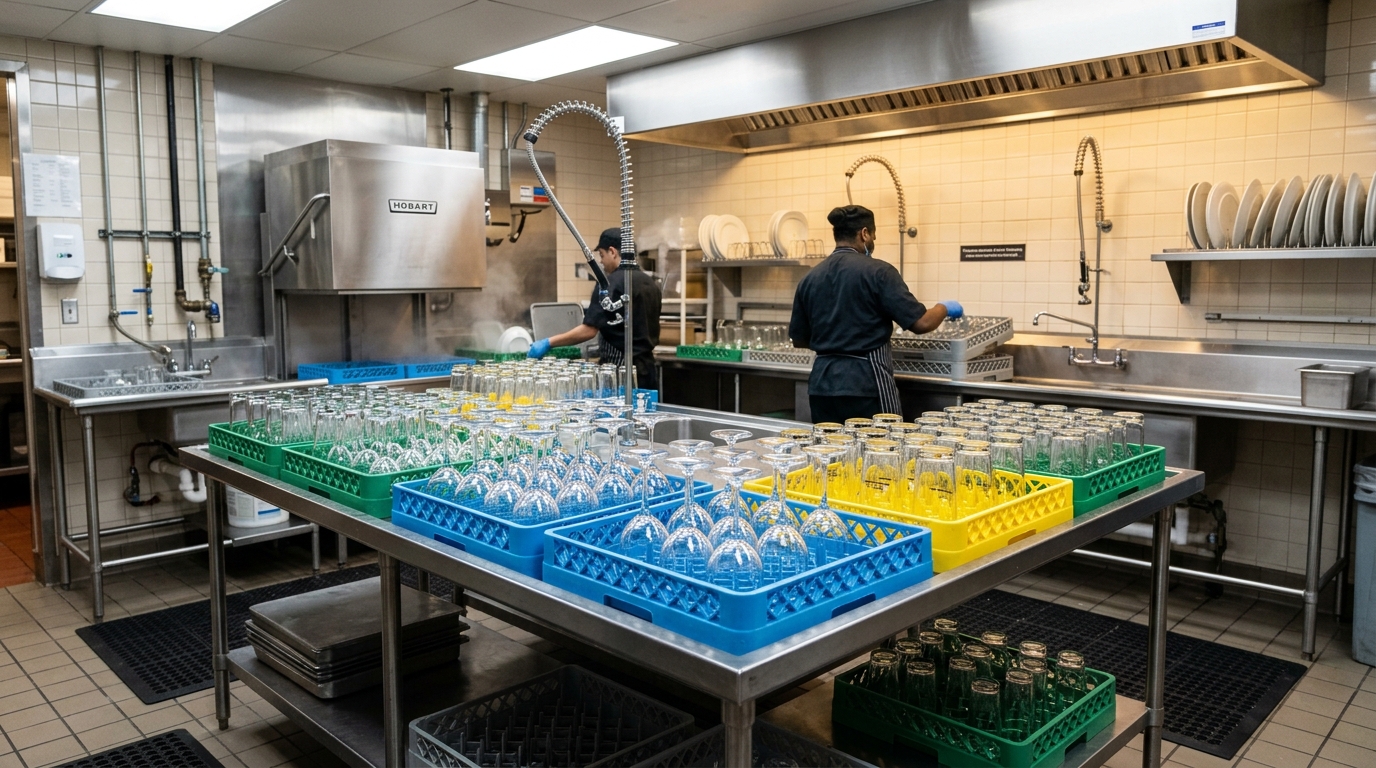
1. Eliminate Thermal Shock During Washing & Service
Glass expands when heated and contracts when cooled. Exposing hot glass to ice water creates localized stress that causes immediate or latent fracturing:
The 10-Minute Cool-Down Rule: Never transfer a hot glass directly from a 180 deg F (82 deg C) commercial warewasher to the bar rail for immediate cold beverage service. Glassware must sit in its wash rack for a minimum of 10 minutes to reach ambient room temperature.
Never Pour Hot Liquids into Cold Glass: When preparing hot toddies, Irish coffees, or mulled wine, preheat the glass with warm tap water before adding boiling liquids, or use tempered borosilicate footed mugs.
2. Match Glass Dimensions to Compartmented Warewashing Racks
Washing glassware in open, unpartitioned flat racks allows glasses to collide during high-pressure spray cycles, creating microscopic stress fractures along the rims and stems:
Use Dedicated Compartment Racks: Invest in color-coded, 16-, 25-, 36-, or 49-compartment racks (such as Camracks or Metro racks) where each glass is held in an isolated cell.
Install Snap-On Height Extenders: Ensure the top of the glass sits at least 0.5 inches below the upper edge of the rack divider so stacked racks rest on plastic frames rather than the glass rims.
3. Ban "Bouquet Carrying" and Hand-Nesting
Front-of-house staff often clear tables by inserting their fingers into multiple glasses or grasping four to five wine stems in a single hand (known as a "bouquet carry"):
High Torsional Shear Risk: Carrying stemmed glasses in bouquets forces stems against one another, applying lateral torque at the delicate bowl-to-stem weld point.
Mandatory Tray Clearing: Enforce a strict standard operating procedure: all glassware must be bussed on non-slip, rubber- or cork-lined service trays.
4. Never Use Glassware as an Ice Scoop
Bartenders working in fast-paced bars sometimes dip a rocks or highball glass directly into the ice well to save time:
The Chipping Hazard: The impact of cold, dense ice cubes against a glass rim can crack the glass or chip off microscopic slivers.
Burning the Ice Well: If a glass chips inside an ice well, bar operations must immediately halt. Staff must pour boiling water over 80 to 100 lbs of ice to melt it, thoroughly sanitize the stainless steel well, and inspect for glass shards before refilling, costing 20 to 30 minutes of peak service time. Always provide dedicated stainless steel or polycarbonate ice scoops.
5. Enforce Anti-Wedge Stacking Protocols
Never stack standard conical glasses unless they are specifically designed with internal stacking ledges or nonic bulges:
Mechanical Wedging: When two smooth glasses are stacked, the outer rim of the lower glass wedges against the inner wall of the upper glass. Thermal contraction locks them together, creating hoop stress that causes both glasses to shatter when someone forces them apart.
Budgeting for Your Glassware Program
A commercial glassware budget comprises two financial components: Initial Capital Expenditure (CapEx) and Ongoing Annual Operating Replacements (OpEx).
+---------------------------------------------------------------------------------------------------+
|                            3-YEAR TOTAL COST OF OWNERSHIP (TCO) COMPARISON                        |
|                                                                                                   |
|  [ CHEAP UNTEMPERED SODA-LIME ]                 [ CONTRACT-GRADE TEMPERED GLASSWARE ]             |
|  - Unit Cost: $1.20                             - Unit Cost: $2.40                                |
|  - Initial Order (1,000 units): $1,200          - Initial Order (1,000 units): $2,400             |
|  - Year 1 Breakage (40%): $480                  - Year 1 Breakage (12%): $288                     |
|  - Year 2 Breakage (40%): $480                  - Year 2 Breakage (12%): $288                     |
|  - Year 3 Breakage (40%): $480                  - Year 3 Breakage (12%): $288                     |
|  - Total 3-Year Spend: $2,640                   - Total 3-Year Spend: $3,264                     |
|  * PLUS: 280 extra shattered glasses on floor   * PLUS: 0 hazardous dagger shards on floor        |
|    and 6x more customer service interruptions!    and pristine customer review preservation!      |
+---------------------------------------------------------------------------------------------------+
CapEx Allocation
In a new restaurant or bar buildout, tabletop and smallwares typically represent 4% to 7% of the total interior FF&E budget. Glassware accounts for roughly 25% to 35% of that tabletop allocation. For a standard 100-seat full-service restaurant, initial glassware outlays typically range between $3,500 and $7,500, depending on the ratio of craft cocktail stemware to utility tumblers.
OpEx Breakage Reserve
Operators must establish a monthly or quarterly glassware replacement reserve. Typical annual breakage rates vary significantly by venue concept:
Fine Dining / Wine Lounge: 15% to 20% annual attrition.
Casual Full-Service Restaurant: 20% to 30% annual attrition.
High-Volume Craft Cocktail Bar: 25% to 40% annual attrition.
Nightclub / Busy Sports Bar: 35% to 50%+ annual attrition.
EXECUTIVE MANDATE // PROCUREMENT COMPLIANCE AUDIT
When evaluating initial supplier quotations, never evaluate unit purchase cost in isolation. A $1.20 untempered glass with a 40% annual attrition rate costs significantly more over three years than a $2.40 fully tempered glass with a 12% attrition rate, especially when accounting for staff cleanup labor and lost beverage sales.
Emerging Trends in Bar Glassware (2025-2026)
The hospitality tabletop landscape is witnessing a notable return to tactile textures, vintage styling, and mindful portion ergonomics.
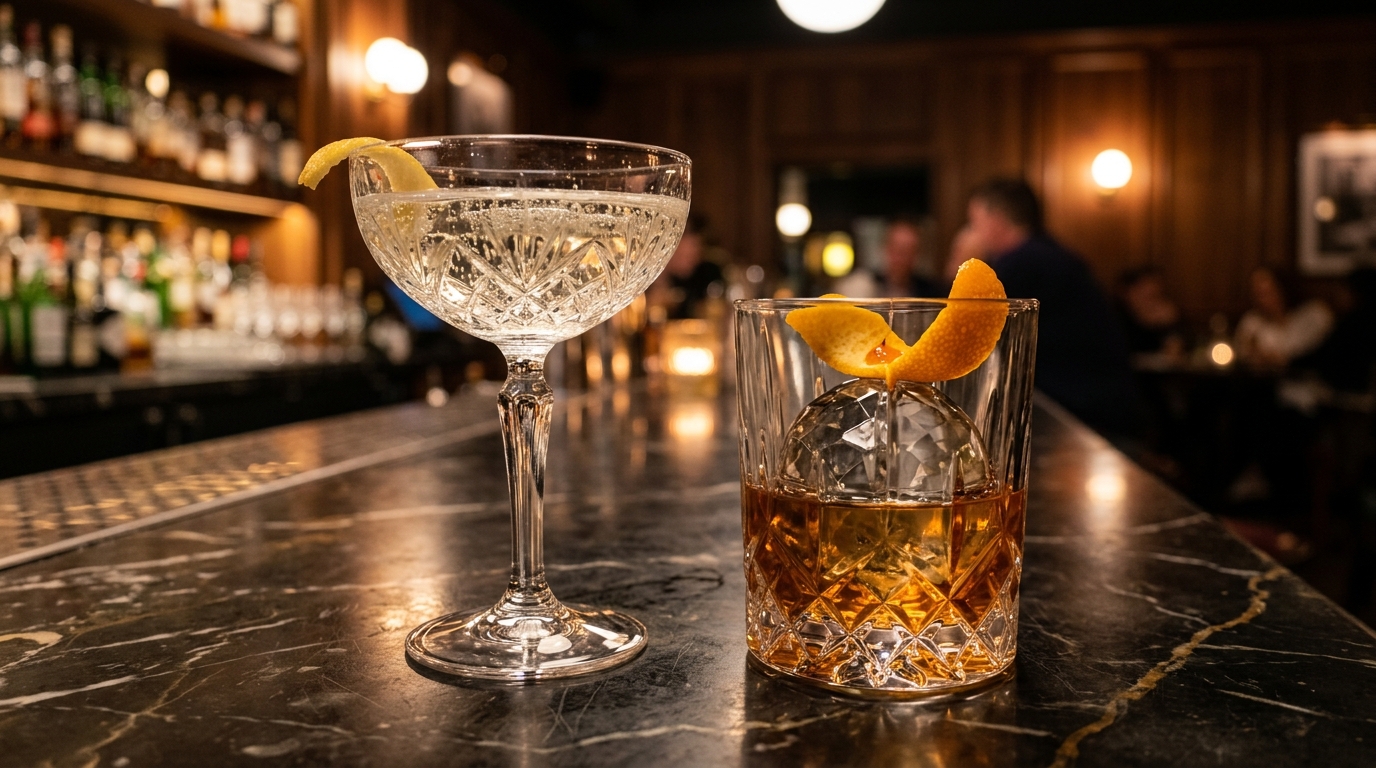
Faceted Crystal & Prohibition Cut-Glass Textures: Flat, smooth glass surfaces are increasingly being augmented by diamond-cut facets, fluted ridges, and vintage pressed patterns. These faceted surfaces refract backbar lighting, conceal minor water spots, and provide guests with an engaging, high-friction tactile grip.
The Ascendance of the Nick & Nora: Named after the fictional cocktail-sipping detectives Nick and Nora Charles, this 5 oz to 6 oz stemmed glass features a bell-shaped bowl with gently curved walls. It has rapidly replaced the oversized 8 oz V-shaped martini glass in forward-thinking craft cocktail bars. Its curved lip drastically reduces liquid spillage while delivering classic cocktail elegance.
Portion-Controlled Glassware for Low-ABV & Zero-Proof Programs: With the surging popularity of mindful drinking and non-alcoholic mocktails, operators are moving away from cavernous 16 oz tumblers. Compact 8 oz to 10 oz highballs allow zero-proof drinks crafted with non-alcoholic botanical distillates and artisanal tonics to maintain premium presentation and high carbonation without looking empty.
Smoked and Amber Tinted Glass Accents: Subtly tinted glassware-including smoky charcoal, honey amber, and olive green-is creating distinctive tabletop signatures. Operators use these colored vessels strategically for signature cocktails to create visual contrast against neutral marble and dark wood bar surfaces.
Glassware Care and Maintenance Best Practices
Even the finest commercial glassware deteriorates rapidly if subjected to incorrect dishwashing chemistry and aggressive handling.
Commercial Warewashing Parameters
Wash Temperature: Maintain commercial wash water between 150 deg F and 160 deg F (65 deg C to 71 deg C) with specialized commercial glass detergents formulated to break down dairy, egg whites, and citrus oils without leaving chemical fragrances.
Rinse Sanitization: Ensure high-temperature rinse cycles hit a minimum of 180 deg F (82 deg C) for thermal sanitization. If using low-temperature chemical sanitizers (chlorine or quat-based), monitor sanitizer concentration rigorously; excessive chlorine binds with glass silica, creating permanent cloudy etching over time.
Water Softening and Scale Prevention
White film, water spots, and cloudy haze on glassware are usually caused by dissolved calcium, magnesium, or silica in hard water. Installing a commercial Reverse Osmosis (RO) water filtration system or high-capacity water softener in your dish pit pays for itself by eliminating chemical film and reducing staff hand-polishing time by up to 70%.
The "Beer Clean" Glass Standard
Serving craft beer in a glass coated with microscopic soap residue or fat films instantly flattens carbonation, collapses foam head retention, and ruins the brewer's intended flavor profile:
The Water Sheet Test: Dip a clean glass in cold water. If clean, water will form a continuous, smooth sheet across the entire glass surface. If grease or detergent residues remain, the water will break into droplets and webs.
The Salt Test: Sprinkle table salt inside a wet glass. Salt adheres evenly to clean glass surfaces; it will not stick to areas covered in greasy oil residues.
The Lacing Test: As the guest drinks a properly served beer, a thick ring of foam ("Belgian lacing") should adhere to the glass wall at every sip.
+---------------------------------------------------------------------------------------------------+
|                                  THE DUAL-CLOTH POLISHING PROTOCOL                                |
|                                                                                                   |
|         [ WRONG METHOD: TWISTING ]                       [ CORRECT METHOD: DUAL-CLOTH ]           |
|   Holding base in left hand while twisting          Use two microfiber cloths simultaneously.    |
|   bowl with right hand snaps stems!                 Left cloth supports the bowl; right cloth     |
|   (Direct torsional weld failure)                   gently polishes inside & rim.                 |
+---------------------------------------------------------------------------------------------------+
The Proper Hand-Polishing Protocol
Always Use Dual Microfiber Cloths: Never polish glassware with linen napkins or paper towels, which leave lint and dust. Hold the glass bowl using one lint-free microfiber cloth while gently wiping with the second.
Never Twist the Stem Against the Base: The most common way staff break wine glasses during polishing is holding the foot in one hand while twisting the bowl with the other. This exerts tremendous torsional shear at the stem-to-bowl weld, snapping the stem instantly. Always cup the bowl directly in your hand while polishing.
Choosing the Right Supplier
When building an enterprise-grade glassware inventory, selecting the right manufacturing partner is as critical as choosing the glass shapes. A commercial bar supplier must meet four non-negotiable procurement standards:
Guaranteed Line Continuity (Open-Stock Availability): Glassware breaks continuously. Never purchase discontinued stock, clearance lots, or consumer-grade collections from retail department stores. Ensure your supplier guarantees line continuity for a minimum of 3 to 5 years, allowing you to reorder replacement cases without being forced to scrap your entire collection due to mismatched aesthetics.
Master Export Packaging & Drop-Test Certification: Glassware shipped internationally must be packaged in heavy-duty, double-wall corrugated master cartons featuring thick honeycomb cell dividers. Reputable commercial suppliers test their packaging according to ISTA 1A or ISTA 3A export drop-test standards, ensuring shipping attrition rates remain below 1.0% across container transit.
Heavy Metal Safety & Compliance Documentation: Ensure all glassware and decorated crystal comply with international food-contact safety standards, including US FDA 21 CFR 175.300, European LFGB, and EU Directive 84/500/EEC migration testing for lead, cadmium, and heavy metals.
Supply Chain Consolidation: Sourcing glassware from fragmented domestic distributors introduces hefty wholesale markups and piecemeal freight fees. Working with an integrated hospitality supply partner allows you to consolidate glassware alongside commercial bar counters, refrigeration, dining furniture, and tableware inside a single consolidated shipping container, dramatically reducing per-unit freight overhead.
For comprehensive operational checklists on outfitting your complete backbar and beverage stations, explore our detailed companion guide on commercial bar equipment checklists, or review specialized service drinkware in our analysis of commercial coffee shop mugs and cups.
Final Checklist: Stocking Your Bar Glassware Program
Before placing your opening purchase order, verify every stage of your glassware supply plan using this operational audit checklist:
[ ] Drink Menu Mapping: Every cocktail, draft beer, wine-by-the-glass, and mocktail on your opening menu has a designated glass type assigned.
[ ] Ice Compatibility Check: Rocks glasses and highballs accommodate your venue's specific ice shapes (standard cube, sphere, or collins spear) with proper displacement.
[ ] Par Ratio Verification: 3-Par inventory ordered for high-turnover tumblers; 2-Par ordered for specialty stemware.
[ ] Warewashing Rack Sizing: Exact compartment dimensions and snap-on height extenders ordered for every glass height and diameter.
[ ] Breakage Reserve Allocation: 20% to 35% annual replacement budget factored into your operating expense forecast.
[ ] Staff Training S.O.P.: Front-of-house staff trained on tray clearing, the 10-minute thermal cool-down rule, dual-cloth polishing, and strict prohibition of glass-in-ice scooping.
[ ] Supplier Continuity Guarantee: Supplier contract guarantees minimum 36-month pattern availability and certified export carton drop testing.
Ready to Build Your Glassware Program?
Outfitting a commercial bar, luxury hotel lounge, or high-volume restaurant requires a careful balance of aesthetic refinement, mechanical strength, and supply chain reliability. For over twenty years, Ron Group has served as the trusted one-stop hospitality procurement partner for hospitality operators, restaurant groups, and luxury resort brands across more than 100 countries.
Operating directly from Foshan, China-the global capital of commercial furniture, hospitality equipment, and architectural hardware manufacturing-Ron Group bridges the gap between factory-direct engineering and turnkey project delivery. Whether you require lead-free titanium crystal with custom laser-etched branding, fully tempered high-impact barware for a high-volume nightclub, or consolidated FCL container delivery combining your bar furniture, refrigeration, and tabletop, our dedicated engineering and logistics specialists ensure your venue opens on schedule and within budget.
Connect with Ron Group's hospitality specialists today to review your beverage menu, receive comprehensive glass specification sheets, and request a tailored, factory-direct quotation for your venue.
Get the week's latest industry information
-
Real-Life Professional Restaurant Case Studies
Explore Now
-
Create a unique restaurant with over 95,700+products
Explore Now
-
Protessional Free 3D Restaurant Design
Explore Now
-
Still Have Questions About Opening a Restaurant?
Explore Now

Sylvia
With 8 years in catering & hospitality industry, sales manager of Ron Group, specialise in providing one stop solutions to restaurants, hotels and weddings.
Discover Our Exclusive Products
Explore our extensive range of restaurant and hotel supplies designed to enhance your operations. Find the perfect solutions to meet your needs.
Browse Our ProductsFREE 3D DESIGN
Boost your restaurant's success with our free 3D design service. Start building the restaurant of your dreams today!
Explore 3D Design Case
RECOMMENDED CASES
-
La Rambla by Catalunya: Crafting Barcelona's Soul in Hong Kong - Custom Furniture Excellence
RON Group's custom Spanish-inspired furniture elevates La Rambla with artisanal aesthetics...
Learn More -

Cardinal Point: Elevating Outdoor Seating with Tailored Cushion Upgrades
Discover how Cardinal Point transformed its outdoor dining experience with custom cushions, achievin
Learn More
RECOMMENDED BLOGS
-

Bar Glassware 101: Types, Names, Uses, and How to Stock Your Bar
Learn the 10 core bar glassware types, names, and uses. Discover how to stock your bar with the right glasses for cocktails, beer,...
Sylvia2026-07-26 -
Complete Bar Equipment List for Opening a Bar
Plan a complete commercial bar equipment list by menu, service volume, refrigeration, ice, glassware, utilities, sanitation,...
Sylvia2026-06-11 -

Low Budget Restaurant Interior Design: 2026 Trends
Prioritize a low-budget restaurant interior by protecting code, operations, durability, accessibility, and phased design decisions...
Sylvia2026-04-04
Subscribe to RON GROUP
Stay up-to-date with the latest industry insights and expert advice. Together, we'll create your ideal restaurant.