





Content
Restaurant table sizes should be selected as part of a complete layout, not from a dimension chart alone. Place settings, menu format, chair width, table base, service style, usable dining area, accessible routes, and local requirements all affect whether a table works in a real project.
This guide provides planning inputs for comparing restaurant tables. It does not replace a project-specific review by the architect, accessibility specialist, building official, or fire authority.
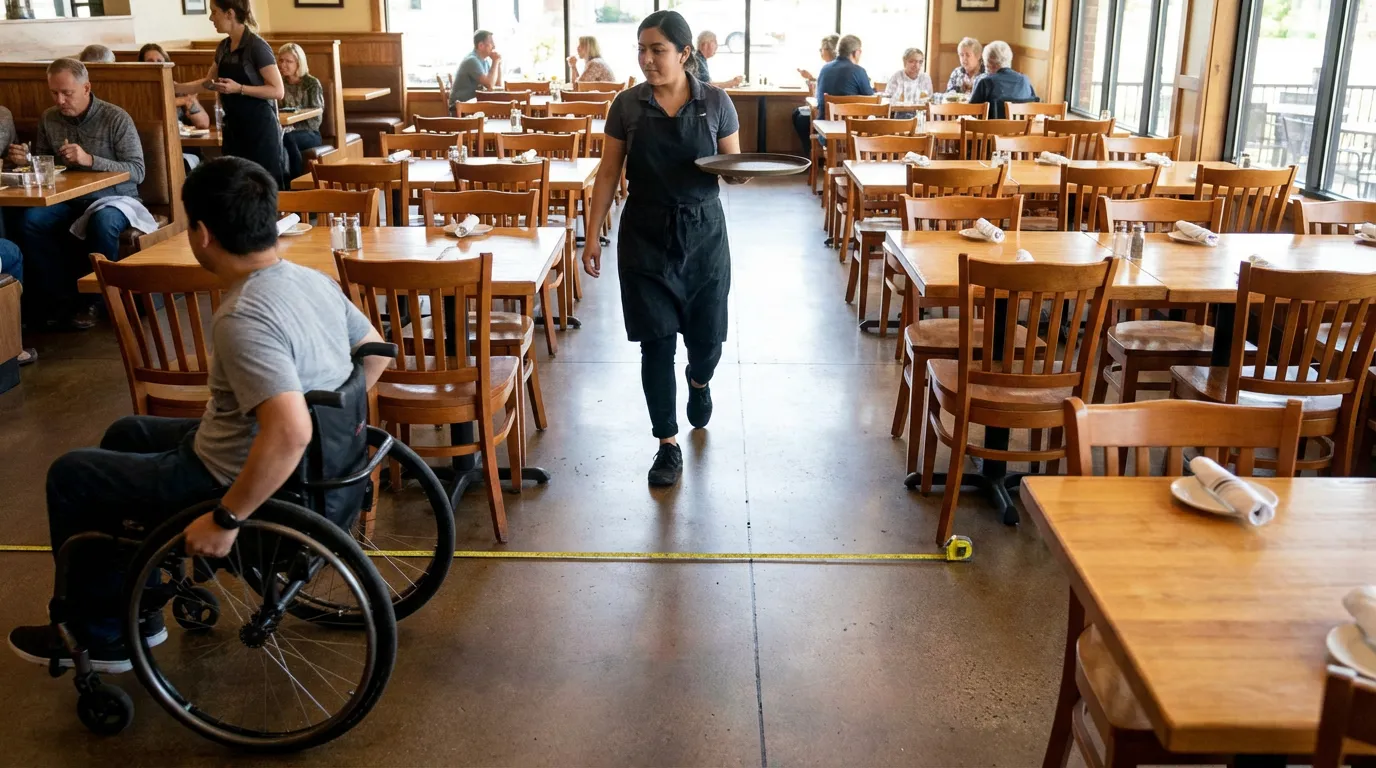
How to Read the Dimensions in This Guide
Each dimension belongs to one of four categories:
| Label | Meaning |
|---|---|
| Product dimension | A physical dimension of a selected table, base, or chair |
| Planning heuristic | A starting assumption for testing a layout |
| Federal accessibility requirement | A requirement cited from the applicable U.S. ADA standards |
| Local-code check | An item that must be confirmed under the adopted building, fire, and local accessibility rules |
Do not treat a planning heuristic as a legal minimum. When requirements overlap, the project team must identify and apply the controlling requirement.
Common Restaurant Table Sizes by Seating Capacity
The following ranges are common starting points. Verify them against the selected place setting, menu, chair, table base, and service method.
| Seats | Common square or rectangular starting range | Common round starting range | Verify before purchase |
|---|---|---|---|
| 2 | 24 x 30 in or 30 x 30 in | 24 to 36 in diameter | Place-setting width, chair envelope, wall condition |
| 4 | 30 x 48 in or about 34 x 34 in | 36 to 42 in diameter | Shared dishes, base position, ability to combine tables |
| 6 | 36 x 60 to 72 in | 48 to 54 in diameter | Chair width, service reach, centerpiece, circulation |
| 8 | 36 x 84 to 96 in | 60 to 72 in diameter | Table support, room geometry, service and access routes |
Allocating about 24 inches of table edge per diner is a common planning heuristic. It is not a universal code requirement. Concepts using large plates, shared dishes, tabletop cooking, extensive glassware, or service equipment may need more space.
Standard dining products are commonly around 29 to 30 inches high, while counter and bar products are taller. Accessible dining surfaces have a separate federal height and clearance framework discussed below. Review available commercial restaurant table tops only after the required footprint and base system are known.
Round, Square, or Rectangular Tables
Square Tables
Square tables are useful when two-tops need to combine into larger arrangements. Check whether adjacent tops align, whether bases interfere with knees and chairs, and whether combined tables remain stable.
Rectangular Tables
Rectangular tables work well along walls and in narrow rooms. They can provide efficient seating for larger parties, but long tops require suitable support and may reduce flexibility when party sizes change.
Round Tables
Round tables can support conversation and remove sharp corners from circulation paths. They may also require more room around the perimeter. Test a round option and a rectangular option in the same scaled layout using the actual chairs, table bases, and required clearances. Do not compare capacity from top dimensions alone.
Estimate Capacity from Usable Dining Area
Start with usable dining area, not total building area. Subtract fixed walls and columns, host and waiting areas, service stations, required circulation and accessible routes, door swings, and operational clearances before estimating seating capacity.
Usable dining area / selected planning allowance = preliminary seat estimate
The planning allowance is an operating assumption, not a guaranteed capacity. Test several scenarios and then draw the actual table, chair, booth, service, and circulation blocks. The final layout may produce fewer or more seats than the preliminary division because real furniture does not fill space evenly.
Table Spacing for Guests, Service, and Access
Test spacing with occupied chairs, not empty table tops.
Include:
Chair pull-out and occupied-chair envelope
Guest approach to the seat
Server carrying and clearing routes
Access to service stations
Wall, column, and booth conditions
Table-base and chair-leg conflicts
Cleaning access
Accessible routes where required
Door swings and emergency paths
Common service-spacing ranges may be useful as planning heuristics, but they should not be described as universal legal minimums. Create scaled blocks from the selected commercial dining chairs, tops, and bases, then test the layout with staff movements.
ADA Dining-Surface Requirements in the United States
Restaurants are public accommodations under the ADA. The U.S. Department of Justice Title III primer explains that guests with disabilities need access to dining areas, tables, food-service lines, counters, and other services. Required accessible dining surfaces must be dispersed rather than isolated in one location.
The U.S. Access Board ADA Chapter 9 includes scoping requirements for dining surfaces and technical requirements in Section 902. Accessible dining surfaces require applicable clear floor or ground space, knee and toe clearance, and a dining-surface height from 28 inches minimum to 34 inches maximum above the finish floor or ground.
Important distinctions:
The scoping requirement applies to dining surfaces, not simply a percentage of total seats.
Accessible dining surfaces must be connected by an applicable accessible route.
A narrow service gap is not automatically an accessible route.
Table bases, aprons, supports, and adjacent furniture must not obstruct required clearances.
Federal requirements do not eliminate state or local accessibility obligations.
Use the exact project conditions and current cited standards when documenting compliance.
Local Occupancy, Egress, and Fire Review
Do not use a single national square-feet-per-person or travel-distance figure for every restaurant.
The project team should confirm:
Adopted building and fire code editions
Occupancy classification
Fixed or movable seating condition
Sprinkler condition
Number and capacity of exits
Exit access and travel paths
Door swings
Local amendments
Outdoor or mezzanine dining conditions
The architect, building official, and fire authority should review the proposed occupant load and egress arrangement before furniture quantities are finalized.
Build a Table Mix from Party-Size Data
Generic table-mix percentages are less useful than the restaurant's own demand data.
Use:
POS party-size reports
Reservation records
Walk-in party sizes
Peak-period demand
No-show and cancellation behavior
Frequency of combined tables
Private dining and group bookings
For each party-size band, estimate how many parties must be seated at the same time. Then assign two-tops, four-tops, larger tables, booths, and communal tables. Record which tables can combine without blocking service or required routes.
Test the Table Mix in a Scaled Floor Plan
Several layout strategies can be tested:
Perimeter First
Place booths, banquettes, or wall-adjacent tables first, then test freestanding tables in the remaining area. Include table depth, seat depth, occupied-chair envelope, and aisle conditions.
Operational Zones
Group tables by service needs, noise, views, accessibility, family use, private dining, or proximity to the bar and kitchen.
Traffic Flows
Draw separate paths for:
Guests entering, reaching tables, and using restrooms
Servers delivering food and drinks
Bussing and used-dish return
Staff restocking service stations
Accessible routes
Emergency movement
Add columns, door swings, service stations, chair envelopes, and commercial table bases to the drawing. A top-only block is not sufficient.
Operational Checks Before Finalizing the Table Order
Review:
Fit between party sizes and available tables
Ability to combine and separate tables
Seat loss when two-person parties use larger tables
Service and bussing routes
Cleaning access
High-chair and wheelchair positions
Table and chair storage
Replacement availability
Floor fixing or leveling
Turnover targets based on the operator's own data
Do not assume that smaller tables or counter seating automatically increase revenue. Test commercial results using the restaurant's actual check average, turn time, party-size, and seat-utilization data.
Worked Example: From Usable Area to a Test Layout
Assume a project starts with a 1,500 square foot dining zone. After the team subtracts fixed walls and columns, host and waiting space, service stations, door swings, main circulation, and accessible routes, 1,280 square feet remains for preliminary seating tests.
1,280 usable square feet / 14 square feet per seat = about 91 preliminary seats
This is only a planning target. When the actual table tops, bases, chairs, service stations, and access routes are drawn at scale, the layout may support fewer seats. A furniture schedule showing 96 or 98 seats on paper should not be approved until the team confirms that guests, servers, mobility devices, cleaning access, and egress paths still work in the room.
Use the calculation to set the first test range, then use the scaled layout to decide the final order quantity.
Common Restaurant Table Sizing Mistakes
Before selecting tables:
Choosing top sizes before checking chair width, base position, and place-setting requirements.
Using gross dining area instead of usable dining area.
Filling the room with four-tops without reviewing party-size data.
During layout testing:
Testing empty table tops instead of occupied chairs.
Treating service-spacing heuristics as code requirements.
Clustering accessible dining surfaces instead of dispersing them.
Before ordering:
Forgetting high chairs, mobility devices, stroller conditions, and cleaning access.
Ordering the full quantity without a scaled mockup or field check.
Ignoring replacement availability for tops, bases, and chairs.
Who Should Review the Layout
The operator confirms menu, party-size data, service style, and operational targets.
The interior designer coordinates guest experience, furniture, materials, and circulation.
The architect coordinates building, occupancy, egress, and adopted-code requirements.
The accessibility reviewer checks applicable accessibility scope and technical criteria.
The fire authority reviews fire and egress conditions.
The furniture supplier confirms product dimensions, bases, finishes, lead times, and installation needs.
No single participant should approve every aspect of the layout in isolation.
Select Tables Only After the Layout Checks Pass
Before placing the order, confirm:
Top size and shape
Place-setting fit
Chair width and occupied depth
Table-base position and knee clearance
Accessible dining-surface requirements
Service and egress review
Finish and cleanability
Commercial durability
Floor condition and leveling
Delivery and installation access
Replacement and replenishment plan
RON GROUP can help coordinate restaurant tops, bases, and dining chairs against a project furniture schedule. Request a restaurant furniture layout using your floor plan, service concept, target seat count, and destination market.
Sources and further reading
Get the week's latest industry information
-
Real-Life Professional Restaurant Case Studies
Explore Now
-
Create a unique restaurant with over 95,700+products
Explore Now
-
Protessional Free 3D Restaurant Design
Explore Now
-
Still Have Questions About Opening a Restaurant?
Explore Now

Sylvia
With 8 years in catering & hospitality industry, sales manager of Ron Group, specialise in providing one stop solutions to restaurants, hotels and weddings.
Discover Our Exclusive Products
Explore our extensive range of restaurant and hotel supplies designed to enhance your operations. Find the perfect solutions to meet your needs.
Browse Our ProductsFREE 3D DESIGN
Boost your restaurant's success with our free 3D design service. Start building the restaurant of your dreams today!
Explore 3D Design Case
RECOMMENDED CASES
-
La Rambla by Catalunya: Crafting Barcelona's Soul in Hong Kong - Custom Furniture Excellence
RON Group's custom Spanish-inspired furniture elevates La Rambla with artisanal aesthetics...
Learn More -

Cardinal Point: Elevating Outdoor Seating with Tailored Cushion Upgrades
Discover how Cardinal Point transformed its outdoor dining experience with custom cushions, achievin
Learn More
RECOMMENDED BLOGS
-

Bar Glassware 101: Types, Names, Uses, and How to Stock Your Bar
Learn the 10 core bar glassware types, names, and uses. Discover how to stock your bar with the right glasses for cocktails, beer,...
Sylvia2026-07-26 -
Complete Bar Equipment List for Opening a Bar
Plan a complete commercial bar equipment list by menu, service volume, refrigeration, ice, glassware, utilities, sanitation,...
Sylvia2026-06-11 -
Low Budget Restaurant Interior Design: 2026 Trends
Prioritize a low-budget restaurant interior by protecting code, operations, durability, accessibility, and phased design decisions...
Sylvia2026-04-04
Subscribe to RON GROUP
Stay up-to-date with the latest industry insights and expert advice. Together, we'll create your ideal restaurant.