










Content
Commercial restaurant furniture undergoes extreme physical stress. In a high-volume 120-seat dining establishment operating at a 2.5x table turn rate, an individual chair accommodates between 300 and 400 unique patrons every week. Over a single year, that translates to more than 18,000 load cycles per seat, accompanied by continuous exposure to food acids, alcohol, caustic sanitizing chemicals, temperature swings, and industrial floor scrubbers.
Without an institutional maintenance strategy, commercial-grade furnishings experience premature structural failure, finish degradation, and upholstery delamination within 18 to 24 months. Conversely, implementing an engineering-backed preventive care schedule extends the operational lifespan of hospitality furniture from three years to eight or ten years, slashing total cost of ownership (TCO) by over 60 percent.
This technical guide details the maintenance protocols, chemical compatibility standards, joinery inspection methods, and replacement economics required to maintain front-of-house (FOH) furnishings at enterprise standards.
Why Restaurant Furniture Maintenance Protects Service and Replacement Cost
Neglecting hospitality furniture introduces severe operational liabilities, brand erosion, and unbudgeted capital expenditure (CapEx). A wobbly table instantly degrades guest perception regardless of culinary execution, while a compromised chair joint exposes the business to catastrophic failure, patron injury, and premises liability lawsuits under ANSI/BIFMA X5.1 and X5.4 commercial safety guidelines.
Total Furniture TCO Calculation:
TCO = Initial CapEx + Sum of (Annual Maintenance Labor + Chemical/Part Supplies) + Opportunity Cost of Downtime - Salvage Value
Consider the financial trajectory of a 150-seat independent casual-dining venue:
- Scenario A (Reactive Run-to-Failure): The operator purchases 150 commercial solid beech chairs at $110 per unit ($16,500 total). No routine joint tightening, glide replacement, or wood nourishment occurs. Sanitizer spray with high quat concentrations strips the conversion varnish within 14 months. Screws loosen, tenons crack under racking stress, and floor glides wear through, gouging expensive luxury vinyl tile (LVT) flooring. By month 36, 40 percent of the inventory is unusable, forcing an emergency reorder at inflated rush rates, freight surcharges, and mismatched dye lots.
- Scenario B (Engineered Preventive Maintenance): The same operator invests 2.5 labor hours per week across the service and utility crew for fastener torque checks, glide replacements, and pH-neutral wood care. Consumables cost roughly $450 annually. The chairs maintain structural rigidity and finish luster through year eight. The annualized capital asset cost drops from $5,500 per year to under $2,060 per year, yielding an operational savings exceeding $27,000 over eight years.
EXECUTIVE MANDATE // PROCUREMENT COMPLIANCE AUDIT
Commercial furniture failure is rarely instantaneous. Structural collapse is the final stage of long-term fastener elongation, glue-line fatigue, or finish breach. Routine inspection detects microscopic play at critical joint intersections before irreversible structural damage occurs.
Beyond direct asset costs, furniture condition directly governs labor velocity. Tables that wobble require emergency cardboard or wedge leveling mid-shift, disrupting server routes and irritating patrons. Chairs with worn glides emit high-decibel scraping noises during service turns, degrading the acoustic environment of the dining room.
Build a Daily, Weekly, Monthly, and Annual Maintenance Schedule
Systematic preventative maintenance requires dividing tasks into functional frequencies integrated directly into standard opening, transition, and closing side-work. Assign specific roles to specific assets to eliminate ambiguous accountability.
Preventative Maintenance Schedule Matrix
| Frequency | Target Component | Action Required | Verification Standard | Primary Responsible Role |
|---|---|---|---|---|
| Daily (Pre-Shift) | Dining Table Tops & Bases | Level verification, base-bolt stability check, surface inspection | Zero rock on level floor; dry surface free of sticky residue | Busser / Server Lead |
| Daily (Post-Shift) | Chair & Booth Upholstery | Organic debris removal, pH-neutral sanitization, dry wipe-down | Zero pooled moisture; vinyl supple; crevices vacuumed | Closing FOH Server |
| Daily (Post-Shift) | Bar Tops & Stools | Wipe down alcohol/citrus spills, footrest bracket check | Clear polyurethane barrier intact; no sticky foot rings | Bartender |
| Daily (Post-Shift) | Espresso Counter Seating | Steam residue wipe, milk protein degreasing | Zero lipid residue on timber or laminate edges | Barista |
| Weekly | Floor Glides & Casters | Visual audit for debris accumulation, hair wrap, wear | Glide pad intact (>2mm thickness remaining); zero exposed metal | Head Busser |
| Weekly | Booth Kick Plates & Legs | Heavy soil extraction, mop-water chemical neutralization | Zero corrosive cleaning chemical residue on metal/wood | Dishwasher / Utility Crew |
| Monthly | Structural Joinery & Bolts | Mechanical torque check of sub-frame fasteners, threadlock check | Fasteners torqued to spec; zero racking movement | Facilities Lead / Shift Mgr |
| Monthly | Wood Finishes | Wood nourishment, touch-up wax filling of minor scuffs | Moisture-shedding hydrophobic layer maintained | Assistant GM |
| Annual | Full Floor Inventory | Comprehensive ANSI/BIFMA load audit, structural teardown/re-glue | Re-certification of floor integrity, salvage/retire triage | GM / Ron Group Account Rep |
Maintenance by Furniture Material
Every material class utilized in commercial hospitality environments possesses distinct failure mechanisms driven by chemistry, environmental moisture, and mechanical loading.
Wood, Metal, Upholstery, Laminate, Polymer, and Outdoor Furniture
Material Failure Vector:
Wood      --> Moisture Imbalance (Swelling/Shrinkage) + Alcohol Stripping
Metal     --> Moisture/Salt Ingress (Corrosion) + Weld Shear Fatigue
Vinyl/PU  --> Plasticizer Extraction via Harsh Quats (Hardening & Cracking)
HPL/Edge  --> Core Infiltration via Standing Liquid (Edge Blistering)
Polymer   --> UV Photo-Oxidation + Environmental Stress Cracking (ESC)
Outdoor   --> Galvanic Corrosion + Reticulated Foam Mold Accumulation
1. Solid Hardwoods and Architectural Veneers
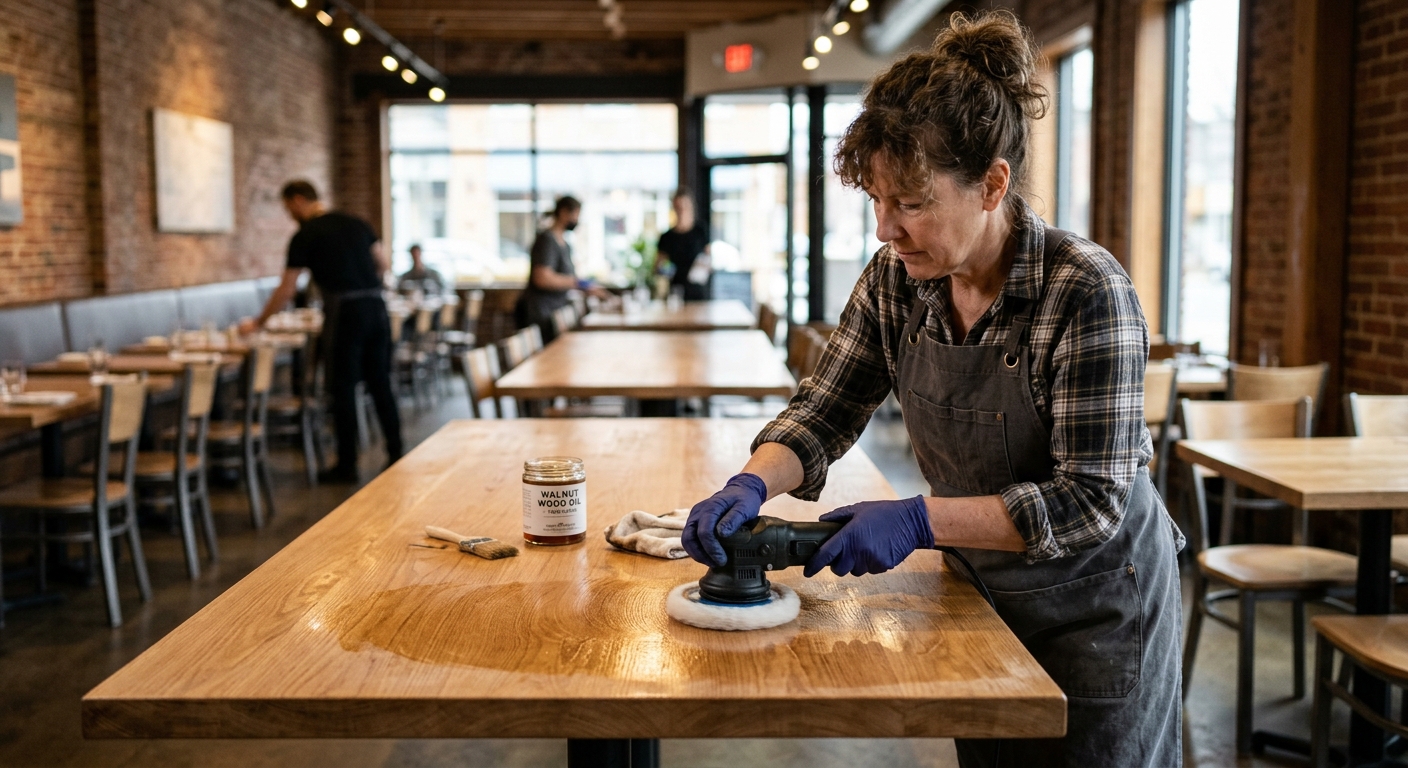
Solid beech, oak, ash, and walnut are the cornerstones of premium commercial dining chairs. Wood is hygroscopic; it absorbs and desorbs ambient moisture, fluctuating in dimension with restaurant humidity (which ideally sits between 40% and 55% RH).
- Finish Protection: High-grade commercial wood furniture utilizes catalyzed conversion varnish or polyurethane. Avoid silicone-based aerosol polishes; silicone penetrates micro-fissures in the finish, permanently contaminating the grain and rendering future sand-and-refinish operations impossible due to adhesion failure ("fish-eye" defects).
- The Chef Table Protocol: Chefs and back-of-house personnel managing heavy-duty chef tables or butcher-block dining stations must avoid bleaching agents. Clean raw butcher blocks daily with food-grade mineral oil mixed with natural beeswax (4:1 ratio) applied at 120 degrees Fahrenheit to penetrate end-grain capillaries. For lacquered dining surfaces adjacent to hot pass windows, thermal shock protection is mandatory; never rest sizzler platters or pans exceeding 140 degrees Fahrenheit directly on catalyzed varnish surfaces.
- Barista and Bartender Maintenance: Bar counter edges and cocktail communal tables face constant localized attacks. Citrus juices (citric acid, pH 2.0 to 2.6) and high-proof alcohol act as solvents on timber finishes. Bartenders must treat wood bar tops with a sacrificial carnuba or microcrystalline paste wax applied bi-weekly. If white heat rings or alcohol haze develop, perform a non-invasive rub-down with 0000-grade ultra-fine steel wool lubricated with light mineral oil, working strictly parallel to the wood grain, followed by hard-buffing.
For operators auditing their timber seating specifications, consult our detailed restaurant chairs procurement guide to understand structural joinery and timber kiln-drying standards.
Wood Maintenance Protocol:
1. Dust removal with dry microfiber
2. Damp wipe (water + pH 7.0 non-ionic surfactant)
3. Immediate dry buff with clean microfiber
4. Bi-weekly paste wax seal on high-wear contact zones
2. Powder-Coated and Polished Metals
Structural steel frames, extruded aluminum, and cast-iron table bases provide superior structural rigidity but are susceptible to oxidation and weld fatigue.
- Weld Seam Audits: Inspect the heat-affected zone (HAZ) adjacent to MIG and TIG welds quarterly. Look for hairline cracks in the powder coat, which signal structural deflection beneath.
- Corrosion Abatement: Steel bases exposed to damp mopping absorb floor cleaner chemicals, causing under-film corrosion where the powder coating debonds from the substrate. Neutralize rusted bases by wire-brushing the affected area down to bare steel, treating it with an orthophosphoric acid-based rust converter, applying a zinc-rich epoxy primer, and sealing it with an industrial-grade acrylic enamel topcoat.
- Stainless Steel (304 vs. 316): Polish polished stainless steel using non-chlorinated metal creams. Rub strictly along the directional grain lines. Never use carbon steel wire brushes or steel wool on stainless steel frames, as this embeds microscopic free-iron particles into the surface, triggering galvanic pitting.
3. Commercial Upholstery (Vinyl, Polyurethane, Performance Textiles)
Upholstery covers roughly 70 percent of dining room comfort assets, notably in banquettes and booths. For a deeper assessment of booth engineering, frame construction, and spring gauge ratings, refer to our analysis on how to choose a restaurant booth.
- The Plasticizer Extraction Trap: Most restaurant vinyl cracking is not caused by wear; it is caused by chemical extraction. Commercial polyvinyl chloride (PVC) relies on internal plasticizers for flexibility. Harsh quaternary ammonium compounds (quats) and alcohol-based surface disinfectants strip these plasticizers over time. The vinyl hardens, loses tensile elasticity, and cracks under compression along seam lines.
- Cleaning Protocol: Clean faux leather and vinyl using a mild Castile soap or dedicated pH-neutral upholstery cleaner (dilution ratio 1:20 with warm water). Agitate deep-grain textures using a soft-bristled horsehair brush.
- The Critical Dwell-Rinse Cycle: Sanitizers must sit for the contact time specified on the label to kill pathogens, but staff must never let sanitizer dry into a chemical film on upholstery. Wipe surfaces down with a clean, water-dampened cloth 3 minutes after application to remove residual surfactant salts, then wipe dry.
- Abrasion Rating Maintenance: Ensure that all specified fabrics maintain minimum ratings of 50,000 double rubs on the Wyzenbeek scale (ASTM D4157) or 40,000 cycles on the Martindale scale (ISO 12947). For high-pile velvets and woven textiles, vacuum weekly using an upholstery tool to remove sharp silica sand particles brought in on patron clothing, which saw through woven warp and weft fibers under the pressure of daily seating.
Vinyl Maintenance Cycle:
Clean (Castile Solution) -> Sanitize (Compliant Quat Dwell) -> Freshwater Wipe (Strip Salts) -> Microfiber Dry
4. High-Pressure Laminates (HPL) and Solid Surfaces
HPL table tops offer exceptional scratch and impact resistance, but their Achilles' heel is the edge-banding seam.
- Moisture Infiltration Prevention: When table tops are cleaned with dripping wet towels, capillary action draws water into the microscopic seam between the laminate face and the PVC or ABS edge banding. The interior medium-density fiberboard (MDF) or particleboard core absorbs moisture, swelling by up to 30 percent in thickness (edge blistering). Once swollen, core material cannot be compressed back into place.
- Remediation: Seal emerging micro-gaps at edge seams immediately using a water-clear cyanoacrylate adhesive (medium viscosity) or a low-odor moisture-curing polyurethane adhesive. Wipe away excess squeeze-out with acetone before it polymerizes.
5. Commercial Polymers and Composites
Polypropylene, polycarbonate, and fiberglass-reinforced nylon chairs are popular in fast-casual, outdoor, and cafeteria operations.
- Stress Whitening: When polypropylene flexes excessively, molecular chains realign, creating micro-voids that appear as white stress marks. Slow this process down by stabilizing the structural leg spreaders.
- Environmental Stress Cracking (ESC): Industrial cleaners containing aromatic hydrocarbons, esters, or concentrated ketones induce rapid stress cracking in polycarbonate. Clean polymer seating exclusively with anionic or non-ionic surfactant water solutions.
6. Outdoor Furniture (Teak, Rope, Synthetic Wicker, Aluminum)
Outdoor installations endure continuous UV radiation, rain, salt air, and thermal cycling.
- Grade-A Teak: Untreated teak naturally weathers to an oxidized silvery patina. If you prefer the golden honey color, scrub the wood annually with a soft bristle brush and an oxalic acid-based wood brightener, allow it to dry to below 12% moisture content, and apply a breathable penetrating tung-oil or marine teak-oil compound. Never apply polyurethane film finishes to exterior teak; moisture traps beneath the film, causing blistered peeling.
- Cushions and Reticulated Foam: Outdoor cushions must feature open-cell reticulated polyurethane foam wrapped in solution-dyed acrylic covers (e.g., Sunbrella). After heavy rain, store cushions vertically on edge to allow gravity to drain water out of the bottom mesh breather panels.
Cleaning Products, Methods, and Manufacturer Instructions
Using the wrong cleaning chemicals is the leading cause of premature furniture failure in commercial dining operations. Commercial-grade furnishings require cleaning methods matched to their chemical tolerances.
Chemical Resistance Thresholds:
Bleach (Sodium Hypochlorite)   --> Destroys Wood Finishes, Corrodes Metal, Degrades Fabric Dyes
Quats (Concentrated)           --> Hardens Vinyl, Extracts Plasticizers, Leaves Sticky Salt Film
Isopropyl Alcohol (>70%)       --> Melts Acrylic, Hazes Polyurethane, Dissolves Shellac
pH-Neutral Detergent (pH 6.5-7.5) --> Safe for 99% of Commercial Finishes and Substrates
TECHNICAL NOTE // KEY ENGINEERING STANDARD
Under United States OSHA Standard 29 CFR 1910.1200 (Hazard Communication), all dining room cleaning chemicals must have corresponding Safety Data Sheets (SDS) stored on-site. Train staff on precise dilution ratios using automated chemical dispensing units to prevent overly concentrated, finish-destroying cleaning solutions.
Step-by-Step Table Sanitization Standard Operating Procedure (SOP)
To maintain commercial tables without eroding the protective clear coat, busing staff must follow this two-stage protocol:
- Stage 1: Soil Extraction (Clean). Spray a clean microfiber cloth (not the tabletop directly) with a warm water and neutral detergent solution (dilution ratio 1:64). Wipe the table from the perimeter inward to collect crumbs, grease, and loose proteins.
- Stage 2: Pathogen Inactivation (Sanitize). Lightly mist an EPA-registered food-contact sanitizer (e.g., quaternary ammonium at 200-400 PPM or stabilized aqueous ozone) over the surface. Allow the liquid to remain wet for the verified dwell time (typically 60 seconds for commercial quats).
- Stage 3: Desiccation (Dry). Wipe the surface dry with a dedicated, clean microfiber cloth. Never allow sanitizer pools to evaporate naturally; evaporative drying concentrates chemical salts on the clear coat, creating a gummy film that attracts dirt and breaks down lacquer.
Inspect Joints, Glides, Upholstery, Finishes, and Fasteners
A consistent mechanical auditing protocol keeps small repairs from ballooning into complete furniture replacements.
Mechanical Inspection Priority Path:
Step 1: Inspect Floor Glides (Check for wear, exposed metal, or uneven leveling)
Step 2: Check Joint Racking (Apply 45-degree lateral load across backrest to seat)
Step 3: Audit Under-Seat Fasteners (Check torque on corner blocks and base plates)
Step 4: Audit Upholstery Substrates (Inspect welt cord friction, staples, and foam resilience)
       [Top Table Surface / Chair Back]
                       |
             [Structural Joinery]  <-- Check Mortise & Tenon / Welds Monthly
                       |
              [Fastener Cluster]   <-- Torque Bolts / Loctite 242 Semi-Annually
                       |
               [Leg / Pedestal]    <-- Inspect for Cracking / Deflection
                       |
              [Floor Glide Pad]    <-- Audit Wear Weekly; Replace at 2mm
                       |
                 [Floor Level]
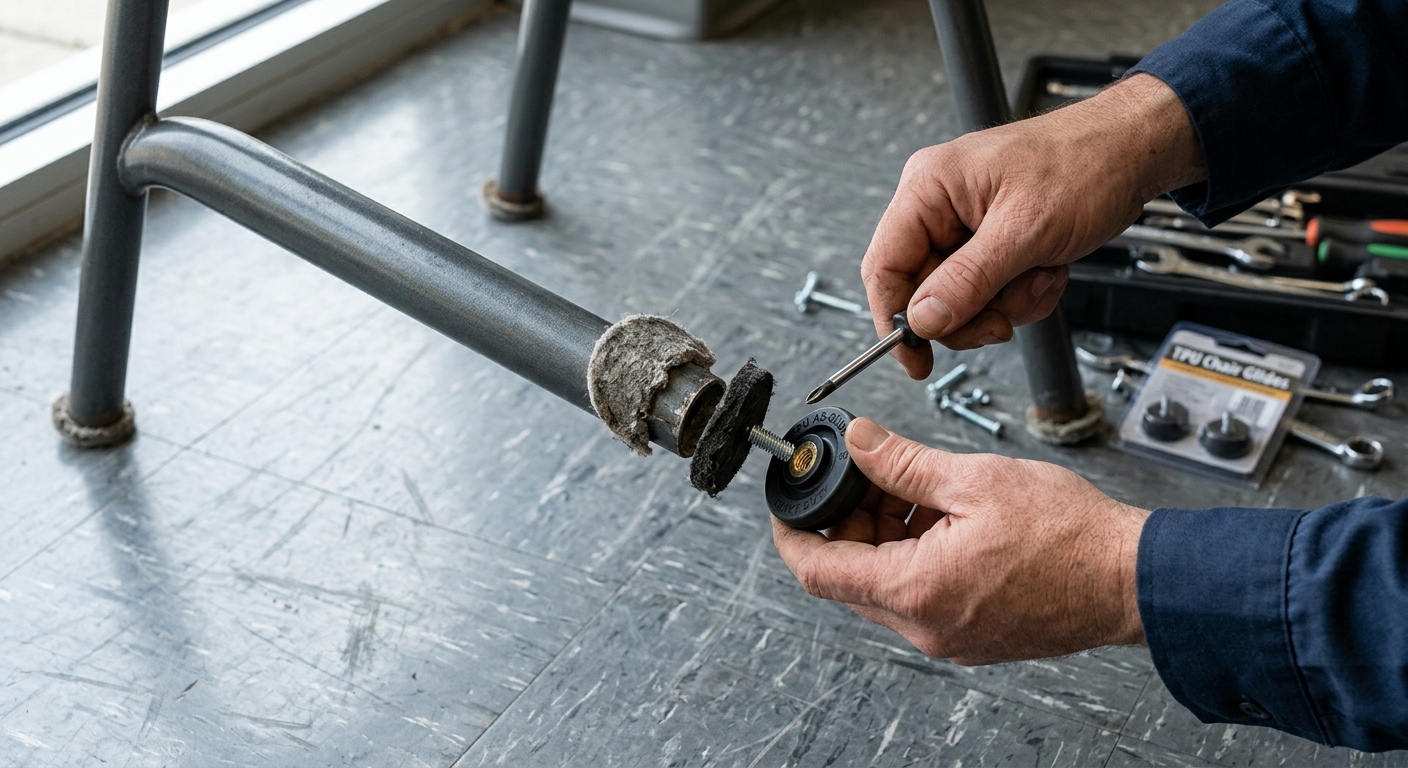
1. Floor Glides: The Frontline Asset Protectant
Floor glides absorb lateral shock when chairs are dragged, protect the chair frame from structural racking, and prevent floor damage.
- Felt Glides: Best for smooth solid hardwood and polished marble floors. Inspect weekly; felt traps abrasive quartz dust, transforming the glide into sandpaper if not brushed clean. Replace felt inserts every 90 to 120 days.
- Nylon Glides: Best for textured ceramic tile, quarry tile, and unpolished concrete. Replace when the nylon dome wears down within 2mm of the internal steel retention nail or screw head.
- Steel Glides: Best for commercial low-pile carpets. Check for burs or sharp edges that can snag and pull carpet loops.
2. Fastener Torque and Thread-Locking
Wood chairs and metal-to-wood table assemblies loosen because wood moves with humidity changes and metal components expand with temperature.
- The Threadlock Protocol: Factory assembly protocols mandate applying a removable anaerobic threadlocker (e.g., medium-strength blue Loctite 242) to the threads of all metal fasteners threaded into metal sub-frames, swivel plates, and cast-iron spider couplings. Do not use high-strength red threadlocker, which requires 500-degree Fahrenheit localized heating to disassemble, destroying upholstery and wood finishes.
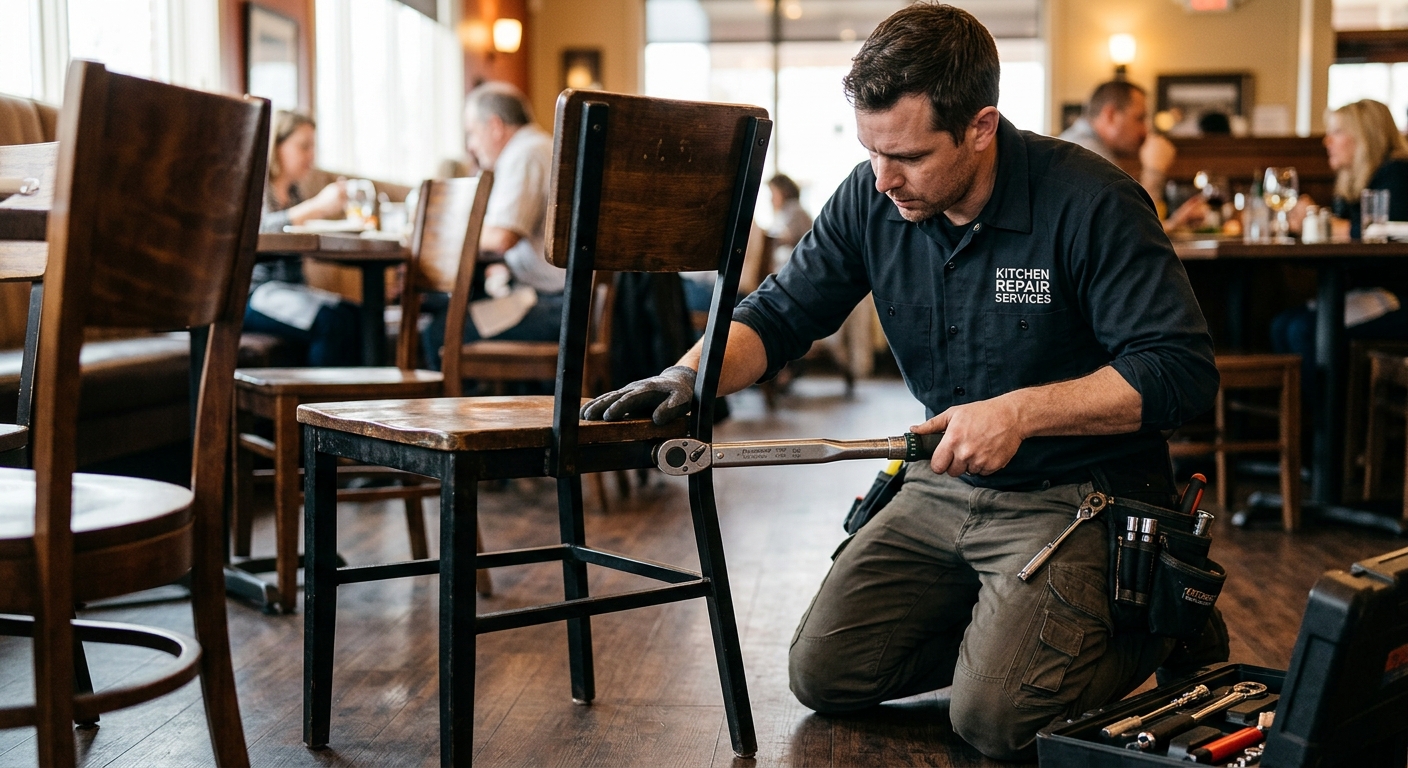
- Torque Limits: When tightening steel bolts into threaded steel inserts embedded in hardwood, limit torque to 8 to 10 foot-pounds (ft-lbs). Over-torquing strips the internal wood threads, ruining the structural integrity of the corner block.
3. Structural Joinery and Racking Tests
Perform an ANSI/BIFMA-style deflection field check:
- Grip the chair backrest with two hands.
- Apply a firm 40-pound lateral racking force back and forth along the diagonal axis.
- Observe the seat-to-leg joint interfaces. If you detect more than 2mm of play or hear a clicking noise, the joint has broken its glue line.
- Red-tag the chair and remove it from service immediately. Continued use with a compromised corner block will fracture the adjacent tenon, turning a minor re-gluing job into an expensive, irreparable structural failure.
Repair, Refinish, Reupholster, or Replace
When furniture degrades, operations managers face four remediation options. Deciding which path to take requires analyzing the unit's remaining lifecycle, original capital cost, and required repair labor.
Repair Decision Matrix:
If Repair Cost < 35% Replacement Cost AND Frame Structural Integrity >= 85% --> In-House Repair
If Repair Cost < 50% Replacement Cost AND High-Value Substrate (Hardwood/Bespoke) --> Refinish / Reupholster
If Repair Cost > 50% Replacement Cost OR Primary Weld/Tenon Shattered --> Retire & Replace
Repair vs. Refinish vs. Reupholster vs. Replace Decision Matrix
| Failure Mode | Diagnosis / Condition | Recommended Remediation | Estimated Cost / Unit (USD) | Downtime | Economic Lifespan Extension |
|---|---|---|---|---|---|
| Loose Spreader / Leg Racking | Frame sound; internal PVA glue bond fractured | Field repair: Clean old glue, apply industrial aliphatic resin or polyurethane glue, clamp at 100 PSI for 24h | $12 - $20 (Labor + Glue) | 24 Hours | + 3 to 5 Years |
| Stripped Floor Glide | Screw sheared off flush inside hardwood leg | Extraction: Drill out core with left-hand bit, plug with hardwood dowel + epoxy, re-drill pilot, insert threaded glide | $5 - $8 (Consumables + Glide) | 2 Hours | + 2 Years |
| Worn Table Top Finish | Conversion varnish scratched, stained; substrate dry and undamaged | Commercial refinish: Strip chemically, sand down to 180-grit, apply two-part catalyzed conversion varnish | $65 - $115 (Shop Refinish) | 5 to 7 Days | + 5 to 7 Years |
| Cracked Vinyl Seat Pad | Substrate board and foam sound; vinyl split along edge seam | In-house drop-in swap: Remove bottom screws, replace pre-cut upholstered vinyl seat assembly | $25 - $45 (Complete Pad Assembly) | 15 Minutes | + 3 Years |
| Severely Degraded Booth Foam | Foam bottoming out; vinyl abraded; frame solid | Commercial reupholstery: Strip to frame, install high-density combustion-modified 2.5 lb/cu.ft foam, re-cover | $180 - $290 (Per Booth Bench) | 3 to 5 Days | + 5 to 8 Years |
| Warped / Delaminated Core | Table core swollen from water penetration, laminate peeling | Replace: Discard top, retain cast-iron base, mount new commercial factory table top | $70 - $140 (Top Unit Only) | 30 Minutes | + 5 to 8 Years |
| Sheared Structural Weld | Main tubular frame weld fractured clean through | Retire & Replace: Field re-welding alters temper, scorches finish, and creates liability risks under ANSI/BIFMA | Full Replacement Cost | Immediate | New Asset Cycle |
SOURCING AUDIT TIP // DIRECT PROCUREMENT SPECIFICATION
Keep a modular seat pad pool. If your dining chairs use screw-on drop-in seat pads, order an extra 10 percent upholstered seat pads with your initial furniture order. When a seat is cut or stained during service, swap the entire pad out with four screws in under 3 minutes, then repair or clean the damaged pad off-shift without taking the chair frame out of service.
Train Staff and Record Maintenance
A well-designed maintenance schedule is only as effective as the staff executing it. Integrating furniture inspections into daily operations prevents systematic neglect.
Role-Specific Accountability Routines
Daily Operations Distribution:
FOH Servers    --> Chemical sanitation wipe-downs, table stability audits, vinyl drying
Bussers/Runners --> Visual glide checks, crumb crevice cleaning, stacking/handling care
Bartenders      --> Alcohol/acid neutralization, footrest rail checks, barstool swivel audits
Baristas        --> Steam and milk protein residue cleaning, laminate edge moisture protection
Facilities/GM   --> Mechanical bolt torque auditing, threadlock application, asset logs
- Bartenders: The bar environment is uniquely hazardous to furniture. Bartenders must treat bar stools and bar-front ledges as service equipment. End-of-night procedures must include wiping down stool footrests to remove salt and moisture brought in by patrons' shoes, which will otherwise pit chrome, strip powder coating, and rust steel supports within months.
- Baristas: Coffee service produces high ambient steam and aerosolized milk proteins. Baristas must wipe down espresso-counter seating rails, timber pick-up counters, and adjacent communal tables with a dedicated damp microfiber towel, followed by an immediate dry pass to keep heat rings and moisture swell from ruining the clear coat.
- Dining Room Bussers: Train bussers never to drag chairs sideways across floor surfaces, which applies high lateral torque to leg joints and shears floor glides. When moving chairs to sweep, staff must lift them clean off the floor. Do not invert chairs onto tabletop surfaces without protective felt pads, as metal or wood chair frames will quickly scratch catalyzed table varnishes.
Asset Tracking and Maintenance Logging
Implement a digital maintenance log to monitor warranty validity and track furniture lifecycles:
- Asset Tagging: Affix a high-durability polyester QR code or barcode asset sticker to the underside of every table top, booth frame, and chair seat rail.
- Incident Reporting: When a server notes a wobbly seat or peeling edge, they scan the QR code with their mobile phone and log a service ticket directly to the facilities or management dashboard.
- Audit Trail: Track every repair date, technician, chemical product applied, and component replacement. This documentation protects against premises liability claims by proving adherence to institutional commercial maintenance standards.
Plan Spare Parts and Supplier Support
Preventive maintenance requires having common replacement hardware on hand. Waiting six weeks for an overseas delivery of floor glides or custom connector bolts while a damaged chair sits out of service burns revenue and clutters back-of-house storage.
The Standard Hospitality Spare Parts Kit (Per 100 Seats)
Maintain the following components in a dedicated, labeled parts organizer:
Fastener & Glide Par Levels (Per 100 Seats):
* 50x Heavy-duty nylon base floor glides (matched to stem profile: threaded or push-in)
* 50x High-density felt-bottom screw-on glides (for wood legs)
* 24x Structural corner-bracket connector bolts (standard M6 or M8 socket-head cap screws)
* 24x Flat washers and split-lock washers (marine-grade zinc or stainless)
* 1x Bottle medium-strength removable blue threadlocker (Loctite 242 or equivalent)
* 1x Bottle premium industrial aliphatic resin wood glue (Type II water-resistant)
* 4x Heavy-duty bar clamps (minimum 24-inch spread capacity, non-marring jaw faces)
* 1x Set high-durability wax touch-up filler sticks (matched to dining room timber stains)
* 5x Complete pre-upholstered drop-in replacement seat pads
* 2x Universal replacement table-base leveling glides (1/4-20 or 3/8-16 standard threads)
Engineering and Sourcing Continuity with Ron Group
High-traffic hospitality environments inevitably require spare components that match original factory specifications. Ron Group supports global operators with complete supply chain transparency and sustained spare-parts continuity:
- Engineering Blueprints and CAD Retention: Ron Group retains architectural millwork drawings, custom metal mold profiles, and joinery specifications for a minimum of 7 years across all custom and catalog hospitality orders. When an operator needs 12 replacement leg assemblies or 20 matching upholstered back pads four years after a buildout, replacement components are precision-manufactured to match original tolerances and dye lots.
- Material Certification: Every upholstery textile, high-density foam core, and wood clear coat sourced through Ron Group includes standardized test documentation, including California Technical Bulletin 117-2013 (CAL 117), NFPA 260 flammability compliance, and ASTM D4157 Wyzenbeek abrasion certifications.
- B2B Logistics and Direct Supply Chain Control: Ron Group manages enterprise fulfillment through direct factory Full Container Load (FCL) container sealing, eliminating the component damage, transshipment delays, and cargo tampering risks typical of multi-stop freight consolidation. For partial orders, regional rollouts, and spare parts replenishment, transparent Less than Container Load (LCL) Delivered Duty Paid (DDP) shipping delivers components directly to your loading dock or staging warehouse without the unexpected fees and clearance delays common with standard CIF ocean terms.
Restaurant Furniture Maintenance Checklist
Print this operational checklist, place it in a moisture-resistant sleeve, and integrate it into standard shift side-work logs.
[ ] DAILY SERVICE CHECKS (FOH / Bussing / Bar Teams)
    [ ] Wipe all dining, bar, and counter surfaces using the two-stage clean/sanitize protocol.
    [ ] Dry upholstery completely; ensure zero pooled sanitizing chemistry in booth seams.
    [ ] Neutralize alcohol and citrus acid spills on wood bar tops with damp-then-dry cloth.
    [ ] Check table tops for wobbles; adjust threaded manual leveling glides (do not use cardboard).
    [ ] Lift chairs during floor cleaning; verify zero chairs are stacked improperly.

[ ] WEEKLY MECHANICAL AUDIT (Shift Supervisors / Maintenance)
    [ ] Inspect all leg glides on chairs and stools; confirm felt/nylon thickness is >2mm.
    [ ] Vacuum deep crevices of upholstered booths; inspect bottom seams for tensile splits.
    [ ] Check table-to-base connection screws; verify spider plate bolts are snug.
    [ ] Clean kick plates and stool footrest rings with neutral metal cleaner; dry thoroughly.
    [ ] Apply wax touch-up sticks to minor scuffs on high-traffic solid wood edges.

[ ] MONTHLY PREVENTIVE MAINTENANCE (Facilities Lead / GM)
    [ ] Apply lateral racking tests to 100% of dining chair frames; tag loose units for re-gluing.
    [ ] Audit under-seat corner blocks; torque loose bolts to 8-10 ft-lbs with blue Loctite.
    [ ] Deep-clean woven fabric upholstery using hot-water extraction (no harsh soaps).
    [ ] Check outdoor furniture for powder-coat chips, weld stress cracks, and footplate corrosion.
    [ ] Audit spare parts inventory; re-order glides, bolts, and pads when reaching 50% par.

[ ] ANNUAL COMPREHENSIVE ASSET REVIEW (Executive Leadership / Supplier Rep)
    [ ] Complete full-inventory safety audit under ANSI/BIFMA load and stability guidelines.
    [ ] Strip and apply two-part catalyzed refinishing coats to compromised solid timber surfaces.
    [ ] Triage damaged assets using the Repair vs. Replace 50% threshold formula.
    [ ] Review supplier CAD sheets with Ron Group rep to schedule batch replenishment.
Common Maintenance Mistakes
Even experienced operators often fall into habits that unknowingly compromise furniture integrity and void manufacturer warranties.
1. Inverting Chairs Directly onto Table Surfaces
Placing chairs upside down on dining tables to sweep and mop saves floor space, but resting bare metal or wood chair legs against catalyzed wood finishes or high-gloss laminates causes surface scratches. Mopping also kicks floor chemical vapors upward into the chair upholstery. Instead, move chairs into clustered rows on completed floor zones, or use padded, protective hanging bars specifically designed for table aprons.
2. Over-Tightening Fasteners into Wood Substrates
When a wood-framed chair develops play, the common reaction is to drive an impact driver into the corner-block wood screws. Impact drivers strip out the surrounding hardwood fibers, completely compromising the pilot hole. Use hand-operated torque wrenches or clutch-calibrated drivers, and repair stripped pilot holes with a hardwood dowel and aliphatic glue before re-seating the screw.
3. Using Abrasive Pads and High-Solvent Degreasers
Using green abrasive nylon scouring pads or melamine foam erasers on catalyzed lacquer or laminate table tops micro-abrades the protective clear barrier. While this strips grease quickly, it leaves an open, dull, unsealed surface that permanently absorbs future oil and water stains. Clean commercial furniture using split microfiber cloths and non-ionic detergents.
4. Spraying Cleaners Directly onto Furniture
Spraying chemical solutions directly onto table tops, booth backs, and chairs causes overspray to pool inside seams, joint crevices, and screw holes. Liquid pooling inside joint cavities breaks down PVA adhesive bonds and swells MDF cores. Always spray cleaning solutions onto a microfiber cloth first, and then wipe the furniture surface down.
5. Stacking Chairs Beyond Rated Capacities
Commercial chairs are precisely engineered for specific stacking configurations (typically four, six, or eight units high). Exceeding these stacking limits crushes the lower chair's upholstery, bends metal legs under excessive cantilevered weight, and chips the frame finish. Never stack chairs that were not explicitly designed to stack.
The True Return on Furniture Maintenance
Commercial furniture should be managed as an active income-producing operational asset, not an expendable supply expense. Systematically executing material-specific cleaning protocols, auditing joint fasteners on a schedule, and training your team on proper handling directly protects your bottom line.
By avoiding harsh chemicals, fixing joint play before it causes structural failures, and managing wear with spare parts, you preserve your dining room's aesthetic appeal, keep guests safe, and add years to the operational life of your furnishings. When you do need to expand, remodel, or replace key inventory, work with an integrated hospitality furniture partner like Ron Group that provides commercial-grade construction, comprehensive testing certifications, and reliable long-term supply chain support.
Commercial Procurement & Specification Benchmark
| Specification Category | Budget / Residential Grade | Heavy Commercial Grade (Ron Group Standard) | Compliance & Test Verification |
|---|---|---|---|
| Structural Material | Thin gauge 430 stainless / laminated particle board | 16-18 Gauge 304 Stainless Steel / Solid Hardwood Core | NSF/ANSI Standard 2 / ANSI/BIFMA X5.5 |
| Operational Duty Cycle | 2-4 hours intermittent | 18-24 hours continuous commercial turnover | UL Commercial / CE / ETL Sanitation Certified |
| Thermal / Mechanical Tolerance | Rapid fatigue after 6-12 months | 5-10 year commercial design lifespan | High thermal shock resistance (180 deg C delta) |
| 5-Year Total Cost of Ownership | High (frequent breakdown & replacement) | 35-45% lower net amortized TCO | Fully warrantied commercial supply chain |
Get the week's latest industry information
-
Real-Life Professional Restaurant Case Studies
Explore Now
-
Create a unique restaurant with over 95,700+products
Explore Now
-
Protessional Free 3D Restaurant Design
Explore Now
-
Still Have Questions About Opening a Restaurant?
Explore Now

Sylvia
With 8 years in catering & hospitality industry, sales manager of Ron Group, specialise in providing one stop solutions to restaurants, hotels and weddings.
Discover Our Exclusive Products
Explore our extensive range of restaurant and hotel supplies designed to enhance your operations. Find the perfect solutions to meet your needs.
Browse Our ProductsFREE 3D DESIGN
Boost your restaurant's success with our free 3D design service. Start building the restaurant of your dreams today!
Explore 3D Design Case
RECOMMENDED CASES
-

La Rambla by Catalunya: Crafting Barcelona's Soul in Hong Kong - Custom Furniture Excellence
RON Group's custom Spanish-inspired furniture elevates La Rambla with artisanal aesthetics...
Learn More -

Cardinal Point: Elevating Outdoor Seating with Tailored Cushion Upgrades
Discover how Cardinal Point transformed its outdoor dining experience with custom cushions, achievin
Learn More
RECOMMENDED BLOGS
-

Bar Glassware 101: Types, Names, Uses, and How to Stock Your Bar
Learn the 10 core bar glassware types, names, and uses. Discover how to stock your bar with the right glasses for cocktails, beer,...
Sylvia2026-07-26 -

Complete Bar Equipment List for Opening a Bar
Plan a complete commercial bar equipment list by menu, service volume, refrigeration, ice, glassware, utilities, sanitation,...
Sylvia2026-06-11 -

Low Budget Restaurant Interior Design: 2026 Trends
Prioritize a low-budget restaurant interior by protecting code, operations, durability, accessibility, and phased design decisions...
Sylvia2026-04-04
Subscribe to RON GROUP
Stay up-to-date with the latest industry insights and expert advice. Together, we'll create your ideal restaurant.