










Content
Introduction
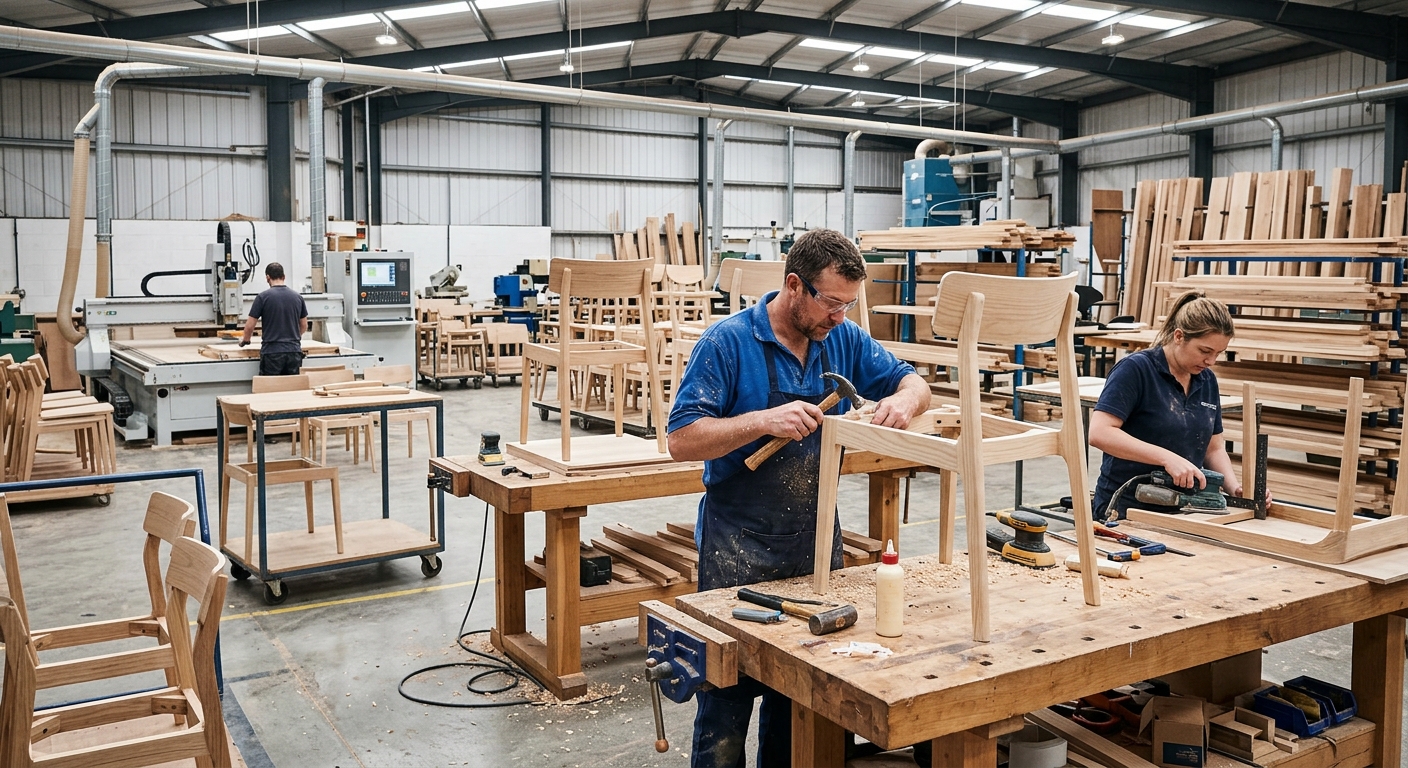
In high-traffic hospitality environments, commercial wooden furniture is an engineered structural asset rather than a decorative accessory. A restaurant dining chair must endure over 100,000 load cycles annually, survive aggressive chemical sanitizers, accommodate diners of varied body weights, and withstand fluctuating atmospheric humidity without structural failure. When a domestic chair loosens at the joints within twelve months, it is an annoyance; when a commercial dining chair fails under a guest, it represents a catastrophic liability risk, business interruption, and direct brand damage.
Understanding how commercial wooden furniture is manufactured provides hotel developers, restaurant operators, and procurement specialists with the technical criteria needed to evaluate structural integrity before issuing a purchase order. Commercial production is fundamentally different from artisanal carpentry. It requires rigid mechanical tolerances, precise lumber conditioning, multi-axis computerized machining, specialized polymer finishes, and industrial upholstery integration.
Every piece of contract-grade wooden furniture passes through a rigorous, sequenced manufacturing pipeline: raw timber grading and kiln drying, computer-numerical-control (CNC) cutting, specialized joinery drilling, multi-stage abrasive calibration, structural frame assembly, electrostatic surface finishing, and ergonomic upholstery application. This guide examines every engineering phase of commercial wood furniture production, detailing the exact specifications that differentiate fragile consumer furniture from contract-grade hospitality inventory.
Wood Classification
The performance of any commercial wooden chair, table, or banquette begins at the timber selection stage. In a factory environment, lumber is systematically classified across three primary axes: physical shape and cut, biological species, and geometric dimensions.
+-----------------------------------------------------------------------------+
|                     COMMERCIAL TIMBER SOURCING PIPELINE                     |
|                                                                             |
|  [Raw Sawn Logs]                                                            |
|         |                                                                   |
|         v                                                                   |
|  [Quarter-Sawn / Flat-Sawn Conversion]                                       |
|         |                                                                   |
|         v                                                                   |
|  [De-Humidification & High-Temp Kiln Drying (Target EMC: 8% to 10%)]        |
|         |                                                                   |
|         +-----------------------+-----------------------+                   |
|         |                       |                       |                   |
|         v                       v                       v                   |
|   [Solid Hardwood]     [Engineered Plywood]      [High-Density Fiber]       |
|    Chassis & Legs       Curved Shells / Seats      Substrates & Panels      |
+-----------------------------------------------------------------------------+
1. By Shape
Raw timber enters the initial processing plant in several structural profiles, each dictating its mechanical strength and grain behavior:
- Sawn Solid Lumber (Rough Cut): Unedged or square-edged timber boards cut directly from the log. Used primarily for structural subframes, chair legs, stretchers, and solid dining tabletops. Solid lumber exhibits distinct tangential, radial, and longitudinal movement profiles that require careful grain orientation during engineering.
- Engineered Hardwood & Plywood: Composed of cross-laminated rotary-peeled veneer sheets bonded with phenol-formaldehyde or melamine-urea-formaldehyde resins under high heat and pressure. Used extensively for molded seat pans, contoured restaurant chair backs, and internal structural cores. Multi-ply engineered wood provides superior dimensional stability across temperature swings and zero splitting risk along the grain axis.
- Veneer Sheets: Ultra-thin slices of high-grade architectural timber (typically 0.45 mm to 2.0 mm in commercial furniture manufacturing) bonded to engineered cores such as medium-density fiberboard (MDF) or multi-layer birch plywood. This shape allows luxury aesthetics (such as Crown American Walnut or Figured White Oak) while eliminating the warping, cupping, and seasonal expansion inherent to broad solid wood panels.
TECHNICAL NOTE // KEY ENGINEERING STANDARD
High-turnover hospitality environments rely on a hybrid material approach: solid hardwood for the load-bearing legs, rails, and structural frames where drop-impact and joint-stress occur, paired with high-density engineered veneered panels for deep tabletop surfaces to prevent seasonal splitting.
2. By Species
Wood species are biologically divided into softwoods (gymnosperms) and hardwoods (angiosperms). Contract hospitality furniture relies almost exclusively on temperate and tropical hardwoods due to their dense cellular structure, fibrous strength, and resistance to denting.
The density of a species directly correlates with its Janka hardness rating, modulus of rupture (MOR), and modulus of elasticity (MOE). The following table details the primary commercial timber species utilized in contract manufacturing:
| Species Common Name | Botanical Classification | Air-Dry Density (g/cm3) | Janka Hardness (lbf) | Modulus of Rupture (MPa) | Modulus of Elasticity (GPa) | Primary Hospitality Application |
|---|---|---|---|---|---|---|
| European Beech | Fagus sylvatica | 0.68 - 0.72 | 1,450 | 110.1 | 14.3 | Turned chair components, bentwood profiles, internal structural framing |
| North American White Oak | Quercus alba | 0.75 - 0.78 | 1,360 | 104.8 | 12.3 | Heavy-duty dining table tops, luxury restaurant seating, exposed grain millwork |
| North American White Ash | Fraxinus americana | 0.65 - 0.69 | 1,320 | 103.4 | 12.0 | Shock-resistant bar stools, high-traffic dining frames, bent components |
| American Black Walnut | Juglans nigra | 0.61 - 0.64 | 1,010 | 100.7 | 11.6 | High-end hospitality suites, fine dining accents, architectural credenzas |
| Rubberwood (Parawood) | Hevea brasiliensis | 0.58 - 0.62 | 960 | 73.5 | 9.1 | Mid-tier restaurant chair under-structures, casual dining tabletops |
| Birch (Baltic) | Betula pendula | 0.65 - 0.70 | 1,260 | 114.0 | 13.9 | Multi-ply curved seat shells, CNC-routed internal banquette skeletons |
European Beech and North American White Ash serve as the primary materials for high-volume commercial dining chairs due to their tight, uniform cell structures, exceptional bending strength, and uniform acceptance of stains and tinted topcoats. For further reading on selecting optimal chair frames for dining operations, consult our comprehensive guide on commercial restaurant chairs.
3. By Size and Thickness
Lumber is cataloged in the sawmill according to the quarter-inch measurement system, designating board thickness prior to commercial surfacing:
- 4/4 Lumber (Four-Quarter): 1.00 inch (25.4 mm) nominal thickness; yields roughly 0.75 to 0.81 inches (19 to 21 mm) after two-sided planing. Commonly assigned to chair back slats, corner support blocks, and small aprons.
- 5/4 Lumber (Five-Quarter): 1.25 inches (31.8 mm) nominal thickness; yields 1.00 to 1.06 inches (25.4 to 27 mm) finished thickness. Standard for heavy-duty dining table tops, upholstered seat outer frames, and sub-rails.
- 8/4 Lumber (Eight-Quarter): 2.00 inches (50.8 mm) nominal thickness; yields 1.68 to 1.75 inches (42.8 to 44.5 mm) finished thickness. The baseline standard for structural front and rear chair legs, heavy table trestles, and high-load cross-stretchers.
Kiln Drying and Equilibrium Moisture Content (EMC)
Raw lumber holds free water within its cell cavities and bound water within its cell walls. Before cutting, timber must undergo continuous computerized kiln drying to adjust its moisture content (MC) to an engineered baseline.
                                      Weight of Wet Wood Sample - Oven-Dry Weight
Moisture Content Percentage (MC%) = ---------------------------------------------  x  100
                                                   Oven-Dry Weight
For international hospitality export, moisture content is conditioned between 8% and 10%. If wood is processed at an uncontrolled moisture content of 14% to 18%, it will lose bound water when deployed inside climate-controlled restaurants (where indoor air maintains an EMC of 6% to 8%). This loss creates severe cellular shrinkage, leading to tabletop warping, perimeter checking, glue-line cleavage, and mortise-and-tenon joint failure.
EXECUTIVE MANDATE // PROCUREMENT COMPLIANCE AUDIT
A factory moisture verification protocol is mandatory. At Ron Group facilities, lumber moisture content is monitored using calibrated pinless electromagnetic and electrical-resistance pin meters across core and shell cross-sections before release into primary production.
Wood Cutting
The transformation of graded, kiln-dried timber into finished components is divided into two distinct manufacturing operations: primary rough dimensioning and secondary CNC precision cutting.
+-----------------------------------------------------------------------------+
|                           WOOD MACHINING WORKFLOW                           |
|                                                                             |
|  [Rough S2S / S4S Kiln-Dried Planks]                                        |
|         |                                                                   |
|         v                                                                   |
|  [Optimizing Multi-Rip Saw] ---> Removes Wane, Knots, & Splits              |
|         |                                                                   |
|         v                                                                   |
|  [Computer-Controlled Cross-Cut Saw] ---> Sets Rough Component Lengths      |
|         |                                                                   |
|         v                                                                   |
|  [Industrial 4-Sided Planer/Moulder] ---> Surfaces to +/- 0.1 mm Gauge      |
|         |                                                                   |
|         v                                                                   |
|  [5-Axis CNC Machining Center] ---> Mortising, Tenoning, Contouring         |
+-----------------------------------------------------------------------------+
1. Primary Cutting and Sizing
Primary cutting converts irregular rough boards into calibrated dimensional blanks (known as rough blanks) with surfaced reference planes:
- Gang Rip-Sawing: Planks pass through multi-blade ripping machines equipped with computer-vision defect-optimization scanners. The system detects knots, structural fissures, wane, and grain run-out, setting rip-blade spacing to maximize clear wood recovery.
- Cross-Cutting: High-speed automatic cut-off saws sever the long strips into specific component lengths, adding a 20 mm processing buffer for subsequent end-trimming operations.
- Four-Sided Planing (Moulding): The timber blanks pass through high-speed industrial four-sided planers (operating at spindle speeds between 6,000 and 8,000 RPM). This step squares all four faces, establishing flat reference surfaces (S4S - Surfaced Four Sides) with a dimensional tolerance within +/- 0.2 mm.
2. Precision Cutting
Once squared blanks are established, precision cutting cuts the exact angles, curves, and joinery foundations required for commercial furniture:
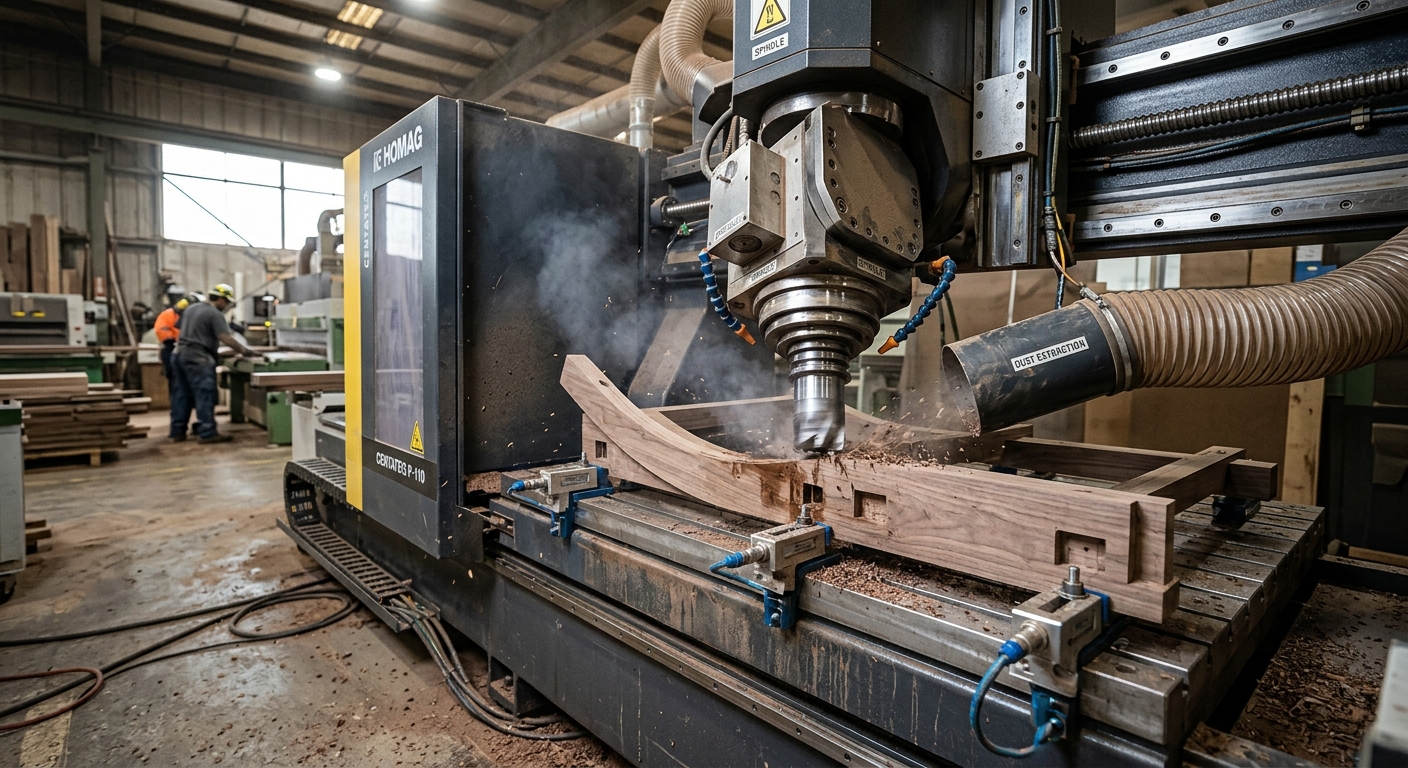
- 5-Axis CNC Machining: For complex chair rear legs, ergonomic curved armrests, and sculpted seat pans, 5-axis CNC machining centers run optimized toolpaths directly from 3D CAD/CAM models. The multi-axis head cuts complex compound curves and compound miters in a single clamping setup, preventing dimensional drift between production lots.
- Double-End Tenoning: For straight stretchers, table aprons, and rails, high-capacity double-end tenoning machines (DET) cut components to their exact finished length while simultaneously forming tenons or end-profiles on both extremities with zero variance.
- Tooling Specifications: High-volume contract factories use solid tungsten-carbide (HW) or polycrystalline diamond (PCD) tipped tooling. Tool sharpness is strictly monitored; dulled cutting edges induce micro-fissures in the wood cells and generate surface heat glaze, which prevents glue from penetrating during assembly.
Drilling
Industrial drilling forms the mechanical connections that join individual wooden parts together. In high-traffic environments, mechanical hardware and dowel arrays must resist massive torsional, lateral, and pull-out stresses.
+-----------------------------------------------------------------------------+
|                    STRUCTURAL DRILLING & JOINERY PROFILES                   |
|                                                                             |
|       Multi-Dowel Array                     Precision Mortise-and-Tenon     |
|   +-----------------------+                    +-----------------------+    |
|   |   (O)   (O)   (O)     |                    |    +---------------+  |    |
|   |    |     |     |      |                    |    | Tenon Tongue  |  |    |
|   |  Fluted Hardwood Pins |                    |    +---------------+  |    |
|   +-----------------------+                    +-----------------------+    |
|   Used for modular aprons & sub-frames         Used for critical leg-to-rail|
|   Rapid assembly, high shear resistance        Maximum glue area & flex life|
+-----------------------------------------------------------------------------+
Types of Drilled Holes
Drilling is divided into specific structural categories:
- Multi-Dowel Arrays: Parallel groupings of 8 mm, 10 mm, or 12 mm holes drilled into end-grain and edge-grain faces to accept spiral-fluted or pre-compressed compressed hardwood dowels.
- Pocket Holes and Counterbores: Stepped-diameter holes that house heavy-duty zinc-plated structural steel lag bolts or confirmat screws. These are commonly paired with solid hardwood corner blocks underneath commercial tabletops and seat perimeters.
- Through-Holes and Bushing Recesses: Drilled to receive steel tie-rods, threaded steel inserts (for knock-down hardware), or commercial levelers integrated into chair and table feet.
Drilling Process
Precision drilling is handled on multi-spindle boring machines and point-to-point CNC centers:
- Feed and Speed Optimization: Spindle speeds are calibrated between 3,000 and 4,500 RPM based on bit diameter (e.g., 10 mm brad-point bits) with controlled mechanical feed rates. This configuration prevents tear-out around the hole edge while keeping drilling temperatures low enough to avoid charring the wood fibers.
- Sacrificial Backing: Every through-hole is drilled against high-density phenolic or sacrificial MDF backer boards to eliminate bottom blowout (exit tear-out).
- Depth Control: CNC boring heads use digital stop-collars to keep depth tolerances within +/- 0.1 mm. This keeps dowel depths uniform across thousands of parts, preventing hydraulic lock during glue insertion.
The Role of Mortise-and-Tenon Joints
While multi-dowel systems are common in modular casework and flat-pack manufacturing, true mortise-and-tenon (M&T) joinery remains the gold standard for commercial restaurant and hotel chair production.
+-----------------------------------------------------------------------------+
|                         MORTISE-AND-TENON MECHANICS                         |
|                                                                             |
|           +-----------------------------------------+                       |
|           | Mortise Component (Leg / Post)          |                       |
|           |       +-------------------------+       |                       |
|           |       | Mortise Pocket (Cavity) |       |                       |
|           |       | Depth: 25 mm - 40 mm    |       |                       |
|           |       +-------------------------+       |                       |
|           +-----------------------------------------+                       |
|                                ^                                            |
|                                | 0.15 mm Engineered Adhesive Clearance      |
|                                v                                            |
|           +-----------------------------------------+                       |
|           | Tenon Tongue (Rail / Stretcher)         |                       |
|           | Length: 24.5 mm - 39.5 mm               |                       |
|           | Thickness: 1/3 of stock rail width      |                       |
|           +-----------------------------------------+                       |
+-----------------------------------------------------------------------------+
An engineered mortise-and-tenon joint provides massive surface area along the longitudinal grain, where structural adhesive bonding is most effective. When a diner leans back on the rear legs of a chair, extreme tensile and shear loads concentrate at the junction between the side seat rail and the rear leg. A mortise-and-tenon joint absorbs this racking force across its top and bottom shoulders, preserving the glue line.
Joinery Performance Comparison
The following engineering matrix compares standard joinery configurations used in contract furniture production:
| Joinery Typology | Static Load Capacity (kg) | Cyclic Fatigue Life (BIFMA X5.1 Cycles) | Torsional Shear Resistance | Long-Term Reliability in Dining Venues | Manufacturing Cost Index |
|---|---|---|---|---|---|
| Traditional Integral Mortise & Tenon | 380 - 450 | > 150,000 cycles | Exceptional (Superior face-grain adhesion) | Grade A: Ideal for severe-duty hospitality dining | Baseline (1.00) |
| Machined Loose Tenon (Floating Tenon) | 350 - 420 | > 120,000 cycles | Very High (Equal expansion properties) | Grade A: Excellent, used in modern 5-axis CNC lines | 0.90 |
| Multi-Fluted Hardwood Dowels (x3) | 220 - 280 | ~ 60,000 - 80,000 cycles | Moderate (Susceptible to glue-line fracture) | Grade B: Acceptable for light/medium dining, banquette frames | 0.65 |
| Pocket Screws with Corner Blocks | 180 - 220 | ~ 40,000 cycles | Poor (Mechanical reliance on fastener thread) | Grade C: Unacceptable alone; used only as secondary reinforcement | 0.40 |
| Knock-Down (KD) Cam & Dowel Fasteners | 120 - 160 | < 25,000 cycles | Low (Vibration causes structural backing-out) | Grade D: Prohibited in heavy commercial dining applications | 0.35 |
Sanding
Sanding directly impacts the quality and durability of the applied finish. Improper sanding causes clear topcoats to separate, creates blotchy and uneven stain absorption, and leaves circular swirl marks that become visible under direct restaurant spotlighting.
+-----------------------------------------------------------------------------+
|                          ABRASIVE PROGRESSION STAGES                        |
|                                                                             |
|  [Raw Machined Part: Visible Cutter Marks / Milling Tolerances]             |
|         |                                                                   |
|         v                                                                   |
|  [Stage 1: P80 - P100 Coarse Sanding]                                       |
|  Calibrates surface thickness, removes knife marks and surface burnish      |
|         |                                                                   |
|         v                                                                   |
|  [Stage 2: P120 - P150 Intermediate Leveling]                               |
|  Refines wood grain scratch pattern, levels pore transitions                |
|         |                                                                   |
|         v                                                                   |
|  [Stage 3: P180 - P220 Pre-Finish Polishing]                                |
|  Final preparation before stain; opens pores cleanly without fiber crush    |
|         |                                                                   |
|         v                                                                   |
|  [Stage 4: P320 - P400 Intercoat Denibbing] (Applied between finish coats)  |
|  Eliminates raised grain fibers, micro-bubbles, and dust nibs               |
+-----------------------------------------------------------------------------+
Why Sanding Matters
When wood is milled by planers, shapers, and CNC tooling, the cutting knives crush surface wood cells under high-speed impacts. If a stain or sealer is applied directly to an unsanded or poorly sanded component:
- Uneven Stain Absorption: Crushed cellular structures cannot absorb solvent-borne or waterborne pigments evenly, resulting in dark, blotchy patches adjacent to pale, under-saturated zones.
- Raised Wood Grain: Moisture from water-based stains or conversion coatings causes compressed cell walls to expand and spring back outward. This creates a rough, sandpaper-like surface texture across the product.
- Delamination Risk: Industrial lacquers and two-component polyurethanes require micro-mechanical anchor profiles to bond to the timber. Controlled abrasive scratch patterns provide the mechanical surface area necessary to anchor the finish.
Sandpaper Types
Industrial furniture facilities use high-performance abrasives manufactured to the European Federation of Abrasive Producers (FEPA) standard (designated by the prefix "P"):
- Aluminum Oxide (A/O): The standard abrasive for solid hardwoods and primary wide-belt sanding machines. It features friable, tough crystalline grains that micro-fracture during use, continually exposing sharp cutting edges.
- Silicon Carbide (S/C): An extremely sharp, hard, but brittle mineral. Used exclusively for fine finish sanding, intercoat sealer denibbing, and wet-sanding processes.
- Ceramic Alumina: Premium-performance abrasive deployed on high-pressure calibration wide-belt sanders for rapid, uniform stock removal on dense hardwoods like Oak and Beech without burning.
- Backing Weights: Calibration sanders use stiff, heavy "F-weight" and "E-weight" paper or heavy cloth backings (X-weight polyester/cotton). Fine orbital hand pads use flexible "A-weight" and "B-weight" paper to contour over complex chair radii.
The Sanding Process
A commercial wood sanding sequence follows strict mechanical progression rules:
Rule of Abrasive Progression: Never skip more than one grit stage in a sanding sequence.
Permitted:   P100 -> P150 -> P220
Prohibited:  P80  -> P220 (Leaves deep, unremovable scratches under the finish)
- Calibration Sanding (Wide-Belt Machine): Flat parts (table aprons, tabletops, leg blanks) pass through multi-head wide-belt sanding machines. The first drum uses a P80 or P100 grit steel-roller contact head to calibrate thickness. The second head uses a P120 or P150 grit segmented air-cushion pad to eliminate coarse scratch profiles.
- Contour Sanding: Curved chair backs, round legs, and transition joints are processed using pneumatic drum sanders, abrasive nylon brush heads, and custom-molded sanding blocks to refine shapes without altering edge geometry.
- Final Orbital Hand Sanding: Before entering the finish line, components undergo finish hand-sanding with dual-action (DA) random orbital pneumatic sanders using P180 or P220 grit disks.
- Dust Extraction and Air-Wash: Sanded components pass through high-velocity air-knife tunnels and anti-static de-ionizing extraction hoods to clear residual wood dust from the grain pores.
Preliminary Assembly
Once all individual components are machined, bored, and pre-sanded, they move to the preliminary assembly line. In commercial production, structural assembly is kept separate from cosmetic trim installation to ensure core joint integrity under clean factory conditions.
+-----------------------------------------------------------------------------+
|                        CHAIR FRAME ASSEMBLY SEQUENCE                        |
|                                                                             |
|  [Apply Polyvinyl Acetate D4 / 2K PU Adhesive to Mortise Cavity Walls]      |
|                                     |                                       |
|                                     v                                       |
|  [Mechanical Insertion of Tenons / Dowels with Precise Alignment]           |
|                                     |                                       |
|                                     v                                       |
|  [Pneumatic Clamping Table Engagement: 100 to 140 PSI Uniform Compression]  |
|                                     |                                       |
|                                     v                                       |
|  [Squeeze-Out Management: Mechanical Removal Prior to Chemical Gel Phase]   |
|                                     |                                       |
|                                     v                                       |
|  [Laser Squareness Verification: Corner-to-Corner Variance < 0.8 mm]        |
|                                     |                                       |
|                                     v                                       |
|  [Cure Tunnel Residence: Full Polymer Cross-Linking Before Finish Stage]    |
+-----------------------------------------------------------------------------+
1. Apply Glue
Industrial wood assembly relies on high-performance adhesives:
- Type I Water-Resistant PVAc (D4 Rating): Cross-linking polyvinyl acetate adhesives that satisfy the EN 204 D4 standard. They provide excellent water resistance and a bond line stronger than the shear strength of the wood itself.
- Two-Component Polyurethane (2K PU): Used on critical joints subject to continuous dynamic shock and thermal fluctuations. 2K adhesives cure via chemical reaction without releasing moisture into surrounding wood fibers.
Glue application must be precise. Adhesive is injected directly into mortise pockets and dowel cavities using pneumatic metering nozzles. Spreading adhesive exclusively on the tenon tongue is an assembly error; sliding the tenon into the mortise strips the glue off the tongue, leaving a dry joint that fails prematurely.
EXECUTIVE MANDATE // PROCUREMENT COMPLIANCE AUDIT
Squeeze-out management is critical. Adhesive that squeezes out of joints must be cleared immediately with a warm, damp microfiber cloth or scraped off at the rubbery "gel phase." Dried glue blocks surface pores, creating un-stainable pale halos around furniture joints.
2. Insert the Tenon into the Mortise
Assembly technicians mate the male tenon into the female mortise using dead-blow polyurethane mallets or automated assembly jigs.
The engineered clearance fit between tenon and mortise is kept between 0.1 mm and 0.2 mm. This micro-gap allows adhesive to coat the joint evenly. If the fit is forced, the tenon scrapes the mortise dry; if the gap exceeds 0.3 mm, the structural load shifts entirely to the glue line, reducing joint shear strength by more than 60%.
3. Secure with Rope or Clamps
Once mated, assemblies are compressed on multi-directional pneumatic clamping machines:
- Pneumatic Clamping Stations: Structural chair frames are secured in heavy steel clamping stations. Independent pneumatic pistons apply continuous pressure (100 to 140 psi for temperate hardwoods) along the X, Y, and Z axes. This distributes pressure evenly across all joint shoulders simultaneously.
- Traditional Strapping/Banding: For complex organic seating profiles and curved bentwood frames, ratcheting nylon load-straps and high-tensile elastic bands hold parts in alignment while cross-linking adhesives set.
- Pressure Duration: Clamping pressure is held for 15 to 30 minutes depending on adhesive chemistry, ambient humidity, and temperature. Subassemblies then cure for 24 hours in a climate-controlled queue before moving to surface finishing.
4. Check Alignment
Before glue cross-linking begins, the assembly team confirms alignment tolerances:
- Diagonal Measurement: Corner-to-corner diagonal spans are checked with digital calipers or laser alignment gauges. A variance greater than 0.8 mm across a 600 mm span causes dynamic rocking (chair wobble) that requires rejection.
- Coplanarity Surface Plate: Assembled chair sub-frames are placed on calibrated cast-iron surface plates. If any of the four leg tips lifts off the reference surface by more than 0.5 mm under zero load, the frame is re-squared in the pneumatic jig before the glue sets.
Painting and Finishing
Commercial surface finishing serves two roles: it protects the timber against environmental damage and highlights its natural wood grain. A residential dining table finish quickly deteriorates in a restaurant, where it faces daily spills of alcohol, hot oils, acidic citrus juices, and caustic sanitizing sprays.
+-----------------------------------------------------------------------------+
|                      MULTI-COAT FINISH APPLICATION SYSTEM                   |
|                                                                             |
|  [Raw Assembled Wooden Chassis: Final Dust Elimination & Inspection]        |
|                                     |                                       |
|                                     v                                       |
|  [Step 1: Penetrating Pigment / Dye Stain Application & Hand-Wipe]          |
|                                     |                                       |
|                                     v                                       |
|  [Step 2: Dual-Pass High-Solids Sealer Coat (2K Polyurethane / Conversion)] |
|                                     |                                       |
|                                     v                                       |
|  [Step 3: Convection Drying Tunnel & P320 Intermediate Denibbing Sanding]   |
|                                     |                                       |
|                                     v                                       |
|  [Step 4: Color Glaze / Tone Adjustment (Even Batch-to-Batch Chromaticity)] |
|                                     |                                       |
|                                     v                                       |
|  [Step 5: High-Performance Protective Clear Coat (Dual Cross-Linked Topcoat)]|
|                                     |                                       |
|                                     v                                       |
|  [Step 6: Controlled IR / Heated Air De-Volatilization & Final Curing]       |
+-----------------------------------------------------------------------------+
Types of Finishes
Contract furniture finishing relies on five primary chemical coatings, each with distinct durability profiles:
| Finishing System | Chemical Classification | VOC Profile | Taber Abrasion Resistance (Cycles to Failure) | Chemical & Solvent Resistance (SEFA 8) | Commercial Suitability Rating |
|---|---|---|---|---|---|
| Two-Component Polyurethane (2K PU) | Hydroxyl functional acrylic cross-linked with aliphatic isocyanate | High (Solvent-borne) | 1,200 - 1,500 | Outstanding: Impervious to alcohol, sanitizers, hot coffee | Recommended: Global standard for luxury and contract dining |
| Acid-Catalyzed Conversion Varnish (AC) | Amino-alkyd resin catalyzed with p-toluenesulfonic acid | Moderate-High | 900 - 1,100 | Superior: Resists household cleaners, boiling liquids | High: North American commercial standard for casegoods |
| UV-Curable Industrial Acrylic | Acrylated prepolymers cured via ultraviolet photoinitiators | Zero to Trace | 1,800 - 2,200 | Exceptional: Rock-hard surface cure, highly scratch-proof | Superior: Ideal for flat panel tables and high-volume chairs |
| Waterborne Polyurethane (1K/2K) | Polyurethane dispersion (PUD) with aziridine cross-linkers | Ultra-Low (< 100 g/L) | 800 - 1,000 | Good to Very Good: Modern formulations resist alcohol spills | High: Ideal for projects targeting LEED and WELL certification |
| Traditional Nitrocellulose Lacquer (NC) | Nitrated cellulose dissolved in volatile solvent carriers | Extreme (> 650 g/L) | 250 - 350 | Very Poor: Dissolves on contact with ethanol, water rings form | Unacceptable: Prohibited in commercial hospitality projects |
For long-term furniture maintenance strategies across diverse commercial finish types, see our operational restaurant furniture maintenance guide.
Number of Layers
A high-performance commercial finish is a composite structure built over multiple application and curing steps. The standard contract finish process includes:
- Stain/Equalizer Coat: Penetrating aniline dyes or solvent-borne pigment stains applied via automated reciprocator spray guns or hand-rubbed with lint-free rags. This step establishes the base color while keeping the wood grain open and visible.
- Sealer Coat 1 (Sanding Sealer): A high-solids, flexible primer formulated to penetrate deep into wood pores and build dry film thickness (DFT).
- Flash-Off and Intermediate Sanding: The component cures in an infrared (IR) or heated convection flash tunnel. Once dry, technicians hand-sand the surface with P320 or P400 abrasive paper to remove raised wood fibers, micro-bubbles, and dust nibs.
- Sealer Coat 2 (Barrier Coat): A secondary sealer application that locks in the base coat and provides a flat foundation for the final finish.
- Shading/Toning: Technicians mist tinted translucent lacquer over edges and transitional profiles to guarantee consistent color matching across individual lumber boards.
- Topcoat (Dual Pass): A final, dual-pass cross-linked protective coat (such as 2K Polyurethane or Conversion Varnish). Specifiers define the gloss sheen using a standardized 60-degree specular gloss-meter: Dead Flat:* 5 - 10% Sheen Matte:* 15 - 25% Sheen Satin (Contract Standard):* 30 - 40% Sheen Semi-Gloss:* 50 - 65% Sheen High Gloss (Piano Finish):* 85%+ Sheen
The completed dry film thickness (DFT) must measure between 3.5 and 5.0 mils (88.9 to 127 microns). Coatings applied below 3.5 mils leave the timber vulnerable to liquid ingress, while coatings exceeding 6.0 mils become brittle and risk micro-cracking under thermal shock.
Leather Upholstery Installation
Adding upholstery to a wooden frame turns a rigid timber chassis into a comfortable, ergonomic dining seat. This stage requires balancing structural strength, foam compression mechanics, and compliance with strict commercial flammability codes.
+-----------------------------------------------------------------------------+
|                      UPHOLSTERY INTEGRATION SEQUENCE                        |
|                                                                             |
|  [Plywood Base / Webbing Support Grid Attached to Hardwood Frame]           |
|                                     |                                       |
|                                     v                                       |
|  [Apply High-Resilience (HR) Cold-Cure Foam via Contact Adhesive]           |
|                                     |                                       |
|                                     v                                       |
|  [Thermal Polyester Dacron Wrap: Prevents Friction & Surface Creasing]      |
|                                     |                                       |
|                                     v                                       |
|  [Align Top-Grain Leather / Commercial Contract Vinyl Cover]                |
|                                     |                                       |
|                                     v                                       |
|  [Pneumatic Perimeter Stapling: 22-Gauge Crowns, Dynamic Cross-Tensioning]  |
|                                     |                                       |
|                                     v                                       |
|  [Seam Realignment, Fluffing, Steam-Ironing, Dust Cover (Cambric) Closure]  |
+-----------------------------------------------------------------------------+
Apply Foam and Glue
The structural foundation of commercial seating relies on high-resilience (HR) polyurethane foam rather than soft residential upholstery foam:
- Foam Density: Commercial seat cores require a minimum foam density of 2.8 to 3.5 lbs/cu ft (45 to 56 kg/m3). Residential grade foams (typically 1.2 to 1.8 lbs/cu ft) collapse within months of high-traffic use, leaving the frame unpadded.
- Indentation Force Deflection (IFD): Commercial chair seats use an IFD of 35 to 45 lbs (medium-firm core) wrapped in a 10 mm Dacron polyester fiber batten or a softer 20-IFD top wrap to provide plush initial contact backed by firm deep support.
- Adhesive Bonding: Foam layers are bonded to the curved plywood seat substrate using pressure-sensitive waterborne polychloroprene contact adhesives. The adhesive is applied via fine spray guns to prevent solvent pooling, which can degrade the cellular structure of the foam.
SOURCING AUDIT TIP // DIRECT PROCUREMENT SPECIFICATION
Always verify that the foam and fabric package complies with California Technical Bulletin 117-2013 (CAL 117) and NFPA 260 Class 1 fire safety standards. For high-risk hotel public spaces, specify combustion-modified high-resilience (CMHR) foam to satisfy British Standard BS 5852 Crib 5 flammability certifications.
Prepare and Align the Cover
Upholstery materials must endure dynamic stretch, spilled liquids, and abrasive contact:
- Material Selection: Specifiers use semi-aniline top-grain leather (thickness: 1.1 to 1.3 mm) or contract-grade performance vinyl/polyurethane textiles rated above 100,000 double rubs on the Wyzenbeek abrasion scale (ASTM D4157).
- Pattern Cutting: Upholstery covers are nested and cut on high-speed CNC reciprocating-knife tables or laser fabric-cutting systems. The digital nesting system cuts along the stretch axis of the hide or roll, ensuring uniform stretch resistance across all production seats.
Attach with Staples or Tacks
Upholstery technicians attach the material package to the wooden chassis using pneumatic staple guns:
- Fastener Specifications: Industrial attachment requires heavy-gauge steel staples (typically 20-gauge or 22-gauge galvanized wire, 71-series, with a 3/8-inch / 9 mm crown width and a 3/8 to 1/2-inch leg length).
- Dynamic Tensioning Sequence: Fastening begins using a four-point center-pull cross sequence (North, South, East, West). The technician tensions the leather evenly across its bias, driving staples at a 45-degree angle to the timber grain at a regular pitch of 12 to 18 mm. This balanced tensioning prevents diagonal puckering and visible pull marks along the frame profile.
Sew and Finish Seams
Exposed upholstery seams must resist bursting along the stitch line:
- Thread Integrity: Industrial sewing machines use bonded nylon or bonded continuous-filament polyester threads (ticket size Tex 70 to Tex 138). These heavy-gauge threads resist rot, UV degradation, and chemical breakdown from sanitizers.
- Stitch Engineering: Technicians use walking-foot industrial sewing machines set to a pitch of 5 to 6 stitches per inch (SPI). An overly tight pitch (such as 10 to 12 SPI) cuts through leather hide like a perforation line, causing the seam to tear under heavy load.
- Seam Typology: High-wear seating relies on double-needle topstitched seams or reinforced French seams, which spread dynamic loads across two parallel rows of interior structural stitching.
Check and Adjust
After stapling and sewing, the upholstery assembly undergoes final finishing adjustments:
- Heat Gun and Steam Smoothing: Technicians apply low-temperature industrial hot-air blowers and steam wands to leather upholstery to relax minor surface wrinkles and mold the hide to the foam contours.
- Cambric Dust Cover Installation: The underside of the wooden seat frame is sealed with a non-woven, breathable polypropylene dust cover (black cambric cloth). This panel conceals internal webbing, frame fasteners, and staple arrays, giving the underside of the piece a clean, finished look.
- Final Structural Inspection: The completed chair is placed under high-output inspection lamps to confirm that seam lines are straight, grain patterns align across adjacent chairs, and no glue or stain marks remain on the upholstery.
5-Year Total Cost of Ownership (TCO) Model
To understand why contract hospitality buyers avoid lower-priced retail furniture, consider this 5-year Total Cost of Ownership (TCO) model. The comparison evaluates a 120-seat high-traffic casual dining restaurant using Commercial-Grade Solid European Beech / 2K PU Seating versus Retail-Grade Solid Hardwood Seating.
5-Year Total Cost of Ownership = Initial Purchase + Logistics + (Annual Maintenance x 5) + Replacement Costs - Residual Asset Value
120-Seat Restaurant Seating Fleet (120 Dining Chairs)
| Cost Parameter / Milestone | Commercial-Grade (Ron Group Engineering) | Standard Retail-Grade Hardwood |
|---|---|---|
| Initial Unit Cost (FOB) | $125.00 | $65.00 |
| Total Initial Procurement (120 Units) | $15,000 | $7,800 |
| Ocean Freight & Land Logistics (Door-to-Door) | $2,400 (FCL Optimization) | $2,100 (Unoptimized Packaging) |
| Estimated Failure Rate (Years 1 to 2) | < 1.5% (Joints remain structurally rigid) | 35% (Dowels loosen, finish fails) |
| Year 2 Replacement / Re-Glaze Cost | $0 (Covered under commercial warranty) | $3,500 (Procurement, freight, downtime) |
| Estimated Failure Rate (Years 3 to 5) | < 4.0% (Minor edge wear, easily repaired) | 65% (Complete frame failure, safety risks) |
| Year 4 Complete Fleet Replacement | $0 (Not required; 8 to 10 year service life) | $11,200 (New units, inflation, freight) |
| Annual Cleaning & Touch-Up Maintenance | $600 / year ($3,000 over 5 years) | $1,400 / year ($7,000 over 5 years) |
| Guest Liability & Incident Reserves | $0 (Compliant with BIFMA X5.1) | $4,500 (Joint collapse insurance risk) |
| Total 5-Year Commercial Expenditure | $20,400 | $36,100 |
| Effective Cost Per Seat Per Operating Day | $0.093 / seat / day | $0.165 / seat / day |
Investing in contract-grade engineering cuts long-term operating costs by nearly half over five years. The initial savings of retail-grade furniture disappear once commercial dining operations subject residential frames to daily dynamic loading, frequent floor-mopping chemical contact, and constant turnover cycles.
Conclusion
The manufacture of commercial wooden furniture is a rigorous science where raw lumber conditioning, precision joinery, multi-layer chemical finishing, and ergonomic upholstery work together to produce a durable, contract-grade product. Every stage of the manufacturing sequence, from maintaining an 8% to 10% kiln-dried moisture equilibrium to cutting tenon joints with 0.15 mm tolerances, directly impacts the performance of the piece in high-traffic hospitality spaces.
When sourcing commercial furniture, restaurant owners and procurement managers must look past cosmetic surface treatments and evaluate the structural methods used on the factory floor. Specifying European Beech or White Ash frames, true mortise-and-tenon joints, two-component cross-linked polyurethane finishes, and high-density HR foam is essential to protecting your operational budget and brand reputation.
+-----------------------------------------------------------------------------+
|                     RON GROUP END-TO-END SUPPLY PIPELINE                    |
|                                                                             |
|  [Custom CAD/CAM 3D Engineering & Prototyping]                              |
|         |                                                                   |
|         v                                                                   |
|  [Kiln-Dried Hardwood Selection (MC: 8% - 10% Controlled)]                  |
|         |                                                                   |
|         v                                                                   |
|  [5-Axis CNC Precision Processing & Mortise-and-Tenon Assembly]             |
|         |                                                                   |
|         v                                                                   |
|  [2K Polyurethane Finishing & CAL-117 Compliant Upholstery]                 |
|         |                                                                   |
|         v                                                                   |
|  [BIFMA Dynamic Load Verification & Pre-Shipment Inspection]                |
|         |                                                                   |
|         v                                                                   |
|  [FCL Direct-Sealed Ocean Transit / Transparent DDP Curbside Logistics]     |
+-----------------------------------------------------------------------------+
Engineering Your Vision with Ron Group
At Ron Group, we bridge the gap between creative interior concepts and industrial-grade manufacturing. With over two decades of dedicated hospitality supply chain expertise, our integrated furniture manufacturing facilities produce contract-grade seating, custom restaurant tables, and architectural banquette millwork that balance high aesthetic appeal with long-term durability.
We operate under strict global quality control protocols. Every raw lumber batch is kiln-dried and monitored with electromagnetic sensors. Our factories run 5-axis CNC machining centers to ensure consistent joinery tolerances, and our automated spray lines apply durable 2K polyurethane finishes designed to withstand daily hospitality service.
Whether you are launching a boutique fine-dining restaurant, completing an international hotel property, or refreshing a nationwide multi-unit chain, Ron Group simplifies your procurement process. We offer end-to-end support: custom 3D shop drawings, physical material finish samples, clear pricing, and reliable global freight management. For full-container-load (FCL) shipments, containers are packed and sealed directly at our manufacturing facility. For less-than-container-load (LCL) shipments, we offer clear door-to-door delivery with customs clearance, or seamless coordination with your chosen freight forwarder under FOB or EXW terms.
Work with Ron Group to build commercial spaces that deliver long-term performance, lasting durability, and high return on investment.
Procurement Checklist: Factory Audit for Commercial Wood Furniture
Keep this operational checklist on hand when auditing factory samples or inspecting production runs for your next hospitality development:
- [ ] Moisture Content Verification: Timber is verified between 8% and 10% MC using an electrical-resistance pin meter at both the core and surface.
- [ ] Structural Joinery Standard: All primary load-bearing joints use true mortise-and-tenon or deep multi-fluted dowel joinery. Knock-down cam fittings and simple pocket screws are prohibited on structural frames.
- [ ] Corner Block Reinforcement: Seat corners feature solid hardwood blocks secured with both cross-linking glue and heavy-gauge screws to resist lateral racking forces.
- [ ] Adhesive Specification: All structural sub-frame connections use water-resistant D4-rated cross-linking PVAc or 2K polyurethane adhesives.
- [ ] Sanding Quality: Surfaces are sanded through a progressive sequence to P220 grit with no cross-grain scratches, tool marks, or burnished spots.
- [ ] Protective Coating: Surfaces are sealed with a multi-coat 2K Polyurethane or Acid-Catalyzed Conversion Varnish system (3.5 to 5.0 mils DFT) that passes SEFA 8 chemical and alcohol spot tests.
- [ ] Foam Specification: Upholstered seats use high-resilience (HR) polyurethane foam with a minimum density of 2.8 lbs/cu ft, fully compliant with CAL 117-2013 flammability codes.
- [ ] Seam Stitching: Leather and performance fabrics are assembled using high-tensile bonded nylon/poly thread (Tex 70+) at 5 to 6 stitches per inch with double-needle reinforcement along high-stress seams.
- [ ] Frame Alignment: Finished chairs sit flat on a precision cast-iron surface plate with a maximum corner wobble tolerance of less than 0.5 mm under zero load.
- [ ] Drop-Impact and Load Certification: Structural prototypes hold independent test certificates confirming compliance with ANSI/BIFMA X5.1 (General Purpose Office/Dining Chairs) or ANSI/BIFMA X5.4 (Lounge and Public Seating).
Commercial Procurement & Specification Benchmark
| Specification Category | Budget / Residential Grade | Heavy Commercial Grade (Ron Group Standard) | Compliance & Test Verification |
|---|---|---|---|
| Structural Material | Thin gauge 430 stainless / laminated particle board | 16-18 Gauge 304 Stainless Steel / Solid Hardwood Core | NSF/ANSI Standard 2 / ANSI/BIFMA X5.5 |
| Operational Duty Cycle | 2-4 hours intermittent | 18-24 hours continuous commercial turnover | UL Commercial / CE / ETL Sanitation Certified |
| Thermal / Mechanical Tolerance | Rapid fatigue after 6-12 months | 5-10 year commercial design lifespan | High thermal shock resistance (180 deg C delta) |
| 5-Year Total Cost of Ownership | High (frequent breakdown & replacement) | 35-45% lower net amortized TCO | Fully warrantied commercial supply chain |
Get the week's latest industry information
-
Real-Life Professional Restaurant Case Studies
Explore Now
-
Create a unique restaurant with over 95,700+products
Explore Now
-
Protessional Free 3D Restaurant Design
Explore Now
-
Still Have Questions About Opening a Restaurant?
Explore Now

Sylvia
With 8 years in catering & hospitality industry, sales manager of Ron Group, specialise in providing one stop solutions to restaurants, hotels and weddings.
Discover Our Exclusive Products
Explore our extensive range of restaurant and hotel supplies designed to enhance your operations. Find the perfect solutions to meet your needs.
Browse Our ProductsFREE 3D DESIGN
Boost your restaurant's success with our free 3D design service. Start building the restaurant of your dreams today!
Explore 3D Design Case
RECOMMENDED CASES
-
La Rambla by Catalunya: Crafting Barcelona's Soul in Hong Kong - Custom Furniture Excellence
RON Group's custom Spanish-inspired furniture elevates La Rambla with artisanal aesthetics...
Learn More -

Cardinal Point: Elevating Outdoor Seating with Tailored Cushion Upgrades
Discover how Cardinal Point transformed its outdoor dining experience with custom cushions, achievin
Learn More
RECOMMENDED BLOGS
-

Bar Glassware 101: Types, Names, Uses, and How to Stock Your Bar
Learn the 10 core bar glassware types, names, and uses. Discover how to stock your bar with the right glasses for cocktails, beer,...
Sylvia2026-07-26 -

Complete Bar Equipment List for Opening a Bar
Use a complete bar equipment list with pictures, covering workstations, ice, refrigeration, glassware, utilities, sanitation and a...
Sylvia2026-06-11 -

Low-Budget Restaurant Interior Design Ideas: Spend Where Guests and Staff Notice
Explore low-budget restaurant interior design ideas, practical material choices, layout priorities and phased upgrades without...
Sylvia2026-04-04
Subscribe to RON GROUP
Stay up-to-date with the latest industry insights and expert advice. Together, we'll create your ideal restaurant.