
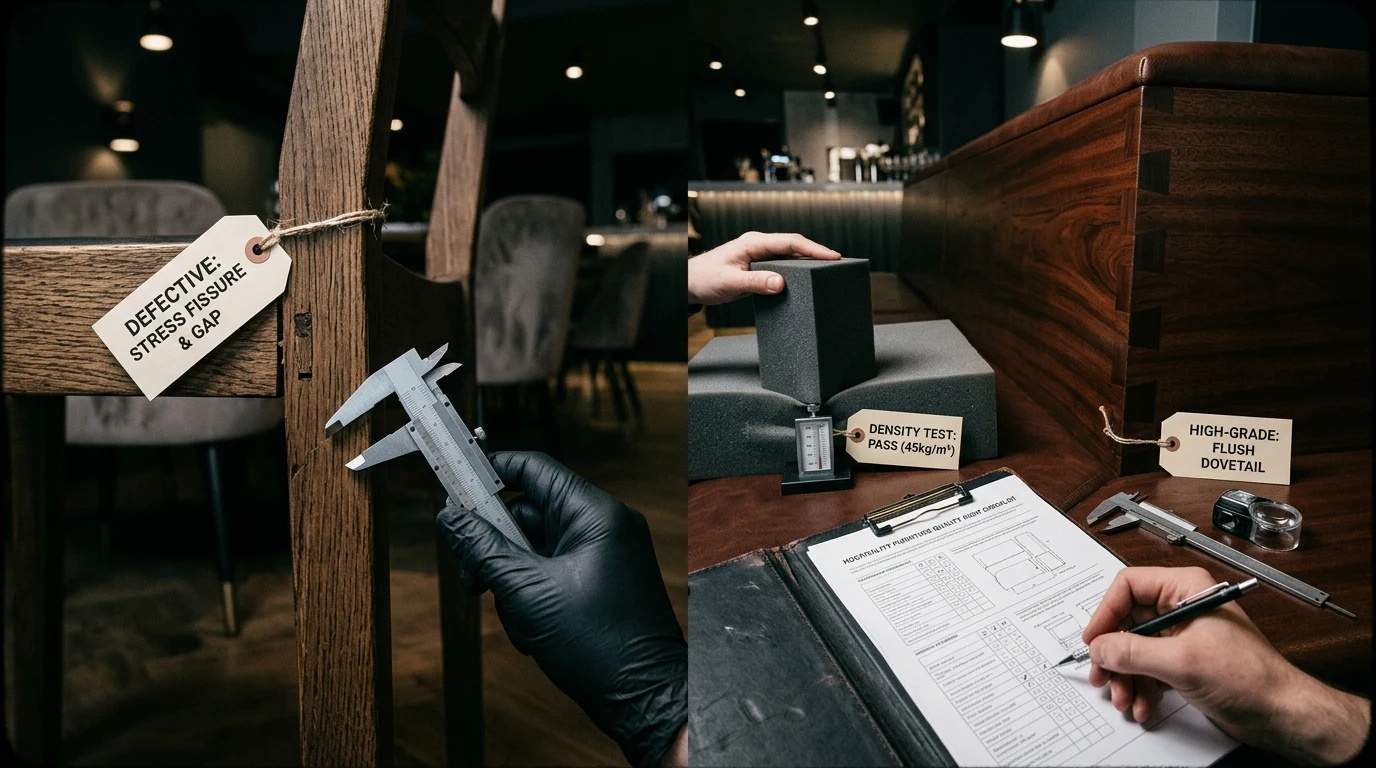
For hotel developers, restaurant group owners, and hospitality procurement directors, sourcing FF&E (Furniture, Fixtures, and Equipment) from overseas manufacturers represents one of the highest-leverage opportunities in capital expenditure (CapEx) management. Sourcing directly from China’s core contract furniture clusters can yield 45% to 65% cost savings compared to domestic distributors. However, it is also the single most unforgiving procurement channel if executed without rigorous engineering standards and on-site quality control.
In high-traffic commercial environments, furniture is not treated with domestic care. A dining chair in a 150-seat bistro undergoes more than 2,000 seating turnovers annually—subjected to continuous dynamic rocking, abrasive cleaning chemicals, spilled red wine, and concentrated guest loads. Sourcing decisions based purely on glossy catalogue photos and low unit costs invariably lead to premature structural collapse, wobbly tables that infuriate guests, failed fire audits, and catastrophic opening-day delays.
The 3 Golden Rules of Commercial Hospitality Sourcing
- Strict Contract-Grade Demarcation: Never allow domestic residential furniture into commercial projects. Commercial pieces require ANSI/BIFMA or EN 16139 Level 2 certified engineering.
- Uncompromising Destructive Standards: Mandate minimum 40–45 kg/m³ high-resilience foam, 50,000+ Martindale abrasion cycles, and kiln-dried timber conditioned to 8%–12% Equilibrium Moisture Content (EMC).
- Independent On-Site Gatekeeping: Never disburse balance payments against factory photos. Deploy ISO 2859-1 AQL 2.5 Major pre-shipment inspections and mandate industrial-grade container moisture control.
Below, we dissect the 8 fatal furniture procurement mistakes that commercial hospitality buyers make when sourcing from China, complete with technical failure mode analyses, engineering specifications, and actionable preventative protocols.
1. Specifying Residential Grade Furniture in Commercial Venues
The single most catastrophic error made by first-time restaurateurs and boutique hoteliers is purchasing items designed for retail homes to furnish commercial spaces. Residential furniture is engineered for gentle, intermittent usage by 2 to 4 family members. Its structural joinery relies on simple dowels, soft adhesives, and lightweight timber frames intended for static loads.
In contrast, commercial hospitality venues subject seating and casegoods to extreme operational abuse:
- Continuous Shear Stresses: Guests tilt back on chair legs, drag heavy banquettes across unlevel tile floors, and lean full body weight on armrests.
- Chemical & Sanitizer Exposure: Daily wiping with commercial quaternary ammonium compounds and bleach-based sanitizers strips domestic lacquers and causes wood veneers to delaminate within 90 days.
- Weight Capacities: Commercial furniture must support static loads of 300 to 500 lbs without deflection, meeting ANSI/BIFMA X5.1 or European EN 16139 Level 2 (Extreme Commercial Duty) standards.
Contractor Warning: Retail Warranties Are Void in Commercial Spaces
Virtually all retail furniture manufacturers explicitly exclude commercial use in their warranty terms. If a residential chair collapses beneath a patron, the venue owner bears full tort liability with zero manufacturer recourse. Always mandate certified contract-grade test reports.
2. Under-Specifying Foam Density Below 35 kg/m³ & Ignoring Fire Codes
Upholstered booths, banquettes, and lounge chairs live and die by the molecular density of their internal foam. To offer rock-bottom quotes, budget factories routinely substitute industrial high-resilience foam with cheap, low-density polyether foam (20 kg/m³ to 28 kg/m³) or reclaimed bonded foam scraps.
Low-density foam lacks structural memory. Under continuous 12-hour daily commercial seating, the microscopic air cells rupture within 3 to 6 months. The results are instantly recognizable: irreversible seat sagging, loose and wrinkled fabric covers, and painful “bottoming out” where guests can feel the timber subframe.
Furthermore, commercial public assembly spaces are legally bound by stringent municipal fire safety codes:
- North American Standard (CAL 117-2013): Mandates rigorous smolder-resistance testing of cover fabrics, barrier materials, and resilient filling cores under open-flame and cigarette ignition protocols.
- UK / Commonwealth Standard (BS 5852 Crib 5): Requires wooden crib flame source testing where foam and upholstery must self-extinguish within predetermined second thresholds without burning through.
For custom banquette seating, specify molded virgin High-Resilience (HR) polyurethane foam with a minimum density of 40–45 kg/m³ for seat decks and 30–35 kg/m³ for backrests. Review engineered seating standards in our dedicated custom booth seating manufacturing guide.
3. Neglecting Fabric Martindale Abrasion Below 40,000 Rubs
Fabric failure is immediately visible to every customer and directly degrades your venue’s perceived luxury. Residential upholstery fabrics are typically rated between 15,000 and 25,000 double rubs. In a bustling dining room or cocktail bar, this grade of fabric pills, thins, and splits along seam lines within 120 days of opening.
Commercial contract upholstery requires two non-negotiable engineering layers:
- Abrasion Fatigue Threshold: Heavy-duty commercial hospitality fabrics must test to a minimum of 50,000 to 100,000+ Martindale rubs (BS EN ISO 12947-2) or 50,000 double rubs on the Wyzenbeek cotton duck scale (ASTM D4157).
- Fluorocarbon-Free Nano Fluid Barrier: Spilled wine, hot coffee, and greasy condiments must bead on the surface without penetrating into the cushion core. Insist on factory-bonded polyurethane moisture barrier backings combined with permanent stain-release treatments (such as Crypton or Nanotex formulations).
- Colorfastness & Cropping: Mandate Grade 4 minimum on wet and dry crocking tests (AATCC 8) to prevent dark denim dye transfer from guests onto light-toned dining chairs.
4. Skipping Mortise-and-Tenon Joinery & Hardwood Corner Gussets
When dining chairs and barstools fail structurally, the breakdown almost always occurs at the critical 90-degree intersection between the leg and the seat apron. Budget workshops cut production time by utilizing butt joints fastened merely with wood dowels, staples, and standard PVA glue. Under the dynamic lateral shear caused by patrons sliding chairs across the floor, dowels snap and screws strip out of the grain.
High-integrity contract timber furniture relies on time-tested mechanical joinery:
- Precision CNC Mortise-and-Tenon (M&T): The tenon must be machined as an integral part of the rail, fitting into a matching mortise with tight 0.1mm tolerances, maximizing glue-surface bonding along long grain.
- Reinforced Hardwood Corner Blocks (Gussets): Every structural frame corner must feature a heavy triangular hardwood block. This block must be glued with polyurethane adhesive and secured with two heavy-gauge countersunk wood screws into each adjacent rail, creating a rigid structural triangle.
- Lumber Moisture Conditioning (8%–12% EMC): Timber harvested in humid southern climates will shrink and warp when exported to arid environments in Nevada or climate-controlled European interiors. Hardwood must be multi-stage kiln-dried to an Equilibrium Moisture Content (EMC) of 8% to 12% before 5-axis CNC machining.
5. Selecting Stamped Sheet-Metal Table Bases Over Solid Cast Iron
Few customer experiences are as aggravating as sitting down at a dining table that wobbles and sloshes drinks with every forearm movement. In 90% of cases, table instability is caused by buyers specifying cheap, stamped sheet-metal pedestal bases weighing less than 8 kg.
A standard 800mm × 800mm quartz, sintered stone, or solid hardwood tabletop weighs between 22 kg and 35 kg. Mounting this mass on top of a flimsy, hollow stamped steel base creates an inverted pendulum with a high center of gravity. Furthermore, 1.0mm thin stamped mounting spider plates flex under weight, transferring every vibration directly through the tabletop.
| Engineering Feature | Cheap Stamped Sheet Base | Commercial Cast Iron Base (Ron Group Standard) |
|---|---|---|
| Base Disc Weight | 6 kg – 9 kg (Hollow Stamped Steel) | 18 kg – 32 kg (Solid Foundry Cast Iron) |
| Center of Gravity | High (Prone to tipping & vibrations) | Ultra-Low (Anchors heavy stone and solid timber tops) |
| Top Spider Plate | 1.0mm stamped plate, 4 screw holes | 4.0mm heavy steel / cast aluminum spider, 8 fixing points |
| Floor Leveling Mechanism | Cheap plastic screw glides (strip easily) | Hydraulic self-leveling or heavy-duty M8 steel adjustable feet |
| Finish Durability | Single-coat flash paint (chips & rusts) | Commercial thermoset architectural epoxy powder coat |
To inspect precision metal fabrication, anti-wobble bases, and heavy-duty spiders, explore our specialized commercial dining tables and bases engineering guide.
6. Bypassing On-Site AQL 2.5 Pre-Shipment Quality Inspections
The cardinal sin of overseas FF&E procurement is paying the final 70% balance based exclusively on digital photographs or 30-second smartphone videos sent by the factory sales representative. In commercial manufacturing, what looks flawless under soft showroom lighting can conceal structural defects, incorrect timber species, mismatched stain finishes, or missing hardware packs.
Once containers are sealed and shipping lines issue the Bill of Lading, the buyer forfeits virtually all commercial leverage. Returning defective commercial goods across international waters is cost-prohibitive. Defect prevention must happen inside the factory before packing.
Mandate an independent, on-site inspection governed by ISO 2859-1 (ANSI/ASQ Z1.4) Sampling Standards with a threshold of AQL 2.5 Major / 4.0 Minor:
- Structural Stress Verification: Dynamic load testing of assembled chairs and casegood drawer slides.
- Digital Moisture Meter Testing: Random verification of 10+ timber components to guarantee moisture reading within 8%–12% EMC.
- Cross-Hatch Paint Adhesion (ASTM D3359): Lattice cutting and tape-pull test on lacquer and metal powder coating to verify zero flaking.
- Color Consistency & Sheen Level: Measured against approved master control samples under calibrated D65 light booths.
Read the comprehensive step-by-step audit framework in our hospitality export QC and inspection protocol.
7. Substandard Ocean Container Stowing & Moisture Shock Protection
Even perfectly manufactured furniture can arrive completely ruined if export packaging and container moisture dynamics are ignored. Ocean shipping across equatorial waters subjects cargo to extreme humidity and temperature differentials of up to 35°C between day and night. This triggers the destructive phenomenon known as “Container Rain”.
Trapped ambient moisture condenses on the container roof and drips continuously onto packaging cartons. Weak single-wall corrugated boxes absorb the moisture, lose 70% of their stacking strength, and collapse beneath upper tiers. Upholstered items grow fungal mold, and unsealed casegood veneers blister.
Professional export packaging requires rigorous defensive engineering:
- 5-Ply Heavy-Duty Export Cartons: Minimum bursting strength of 200 psi (14 kg/cm²) with full perimeter edge crush resistance.
- Molded High-Density EPS & EPE Corner Buffers: Minimum 25mm thickness on all eight corners to withstand rough drayage and container shifting.
- High-Absorption Calcium Chloride (CaCl2) Desiccant Poles: Suspended inside the vertical corrugations of container walls, each absorbing over 200% of its dry weight in water (far superior to cheap silica gel).
- Inflatable Dunnage Air Bags: Inserted between pallets and void walls to prevent lateral shifting during heavy swell at sea.
8. Unrealistic Production Lead Times & Missing Schedule Buffers
A recurring blunder in restaurant and hotel fit-outs is calculating procurement timelines purely around the factory’s quoted “assembly time” (e.g., “30 days”). Unprepared buyers fail to budget for shop drawing approvals, material procurement, mock-up room sign-offs, ocean transit, customs clearance, and final white-glove staging.
When unexpected supply chain frictions occur, the scheduled grand opening must be delayed—inflicting devastating losses in lease rent, pre-opening marketing, and operational revenue.
A battle-tested commercial procurement timeline requires a backward-scheduled 75 to 95-day operational runway:
- Phase 1: Shop Drawings & Finish Sample Sign-Off (10–14 Days): 3D CAD engineering, hardware schedules, fabric cuttings, and timber stain swatch approvals.
- Phase 2: Prototype & Mock-Up Room Fabrication (14–20 Days): Physical inspection of a full guestroom or dining set before volume green-light.
- Phase 3: Mass Batch Production & Upholstery (30–40 Days): Kiln drying, CNC joinery, lacquering, assembly, and drying cycles.
- Phase 4: AQL 2.5 Audit, Container Stuffing & Ocean Freight (18–35 Days): Dependent on port destination (14–18 days to US West Coast / Southeast Asia; 28–35 days to Europe / US East Coast / Middle East).
- Phase 5: Customs Clearance, Port Drayage & Staging (5–10 Days): ISF filings, terminal clearance, and final unboxing on site.
Comprehensive Engineering Specification Benchmark Matrix
Use the following technical comparison matrix as your contractual benchmark when reviewing factory quotations and issuing FF&E tender documents:
| Critical Quality Parameter | Residential / Budget Retail | Standard Commercial Grade | RON GROUP Hospitality Benchmark |
|---|---|---|---|
| Seat Foam Density | 20–28 kg/m³ Polyether | 35–40 kg/m³ High Resilient | 42–45 kg/m³ Virgin HR Molded Foam (0 Sagging) |
| Fire Safety Certification | Unrated / Non-compliant | Surface barrier wrap | CAL 117-2013 & BS 5852 Crib 5 Full-Core Certified |
| Fabric Abrasion Resistance | 15,000–25,000 Martindale | 35,000–50,000 Martindale | 60,000–100,000+ Rubs + Nano Hydrophobic Stain Barrier |
| Structural Timber Joinery | Butt joints, wood dowels, staples | Standard mortise & tenon | 5-Axis CNC M&T + 4 Glued & Screwed Hardwood Corner Gussets |
| Lumber Moisture Content | 14%–18% (Air dried, prone to warping) | 10%–14% (Basic kiln drying) | 8%–12% EMC Multi-Stage Vacuum Kiln Conditioned |
| Table Base Construction | <1.2mm stamped steel (<9kg) | 1.5mm steel / composite (12–16kg) | Solid Foundry Cast Iron (18–32kg) + Anti-Wobble Glides |
| Pre-Shipment Quality Gate | Factory internal self-review | Factory photographic report | ISO 2859-1 AQL 2.5 Major / 4.0 Minor Independent On-Site Audit |
| Export Packaging & Moisture | 3-ply carton, no desiccants | 5-ply carton, silica gel sachets | 5-Ply 200-psi Double-Wall + ISTA Drop Tested + CaCl2 Desiccant Poles |
Explore Deep-Dive Foshan Manufacturing & Engineering Guides
Connect your procurement strategy with specialized technical intelligence across China’s primary contract production hubs.
Hospitality QC, Drop-Testing & Export Logistics
Complete guide to container stuffing, drop tests, moisture barrier packaging, and export customs clearance.
Custom Seating • Upholstery EngineeringCommercial Booth & Banquette Seating
Spring suspension systems, 45 kg/m³ high-resilience foam, and heavy-duty contract upholstery standards.
Metal Fabrication • Stability StandardsDining Tables & Anti-Wobble Bases
Solid cast iron bases, self-leveling hydraulic glides, and scratch-resistant sintered stone surfaces.
Foshan FF&E Core • Industrial HubFoshan Manufacturing Sourcing Hub
Direct factory audit of star-hotel casegoods, dining furniture, and turnkey FF&E integration.
Closing Guidance: How to Structure a Defect-Free Hospitality RFQ
Preventing procurement disasters starts at the very first step of supplier engagement. When issuing your Request for Quotation (RFQ) to Chinese contract manufacturers, avoid generic renderings or non-annotated floorplans. Ensure your RFQ documentation incorporates the following technical controls:
- Itemized BOQ with Structural Callouts: Specify exact seat height, overall dimensions, timber species (e.g., FAS North American Ash or White Oak), and joinery requirements.
- Chemical & Fire Compliance Clauses: Explicitly state whether CAL 117-2013 or BS 5852 Crib 5 certification is mandatory for all internal foams and fabrics.
- Fixed Quality Hold Points: Require written approval gates for (a) 3D shop drawings, (b) physical finish swatch approvals, (c) full prototype mock-up room review, and (d) AQL 2.5 final inspection before balance release.
- Consolidated Logistics Integration: Consolidate casegoods, dining chairs, custom booths, lighting, and commercial tableware into unified full-container loads (FCL) to eliminate fragmented shipping markups and multi-vendor arrival delays.
Want to inspect factory protocols in Foshan?
Review our comprehensive cluster guide covering specialized contract workshops, drop tests, and export inspection procedures.
Visit Foshan QC Sourcing Hub →Have a live restaurant or hotel FF&E package?
Submit your architectural BOQ or floorplan for a free engineering defect review and factory-direct quote within 24 hours.
Request Fast BOQ Review →