







Content
Navigating the Commercial Tabletop Procurement Landscape
Effective hospitality tableware sourcing requires procurement teams to balance upfront capital expenditure against long-term operational continuity. The decision of where and how to procure plates, bowls, glassware, and flatware fundamentally shapes a restaurant's financial health and daily service efficiency. Commercial tabletop procurement differs from retail buying because the buyer must document service conditions, replacement continuity, order quantities, and commercial-use evidence instead of comparing appearance and shelf price alone.
Back-of-house kitchenware and front-of-house tableware may come from different specialists. Treat them as separate sourcing workstreams when their specifications, customization, testing evidence, replacement cadence, or supplier capabilities differ, then compare the actual quotations and lead-time commitments received for each workstream.
The core decision for any hospitality group ultimately comes down to choosing between a factory-direct manufacturing partnership and a local wholesale supplier. Both routes offer distinct advantages and carry specific risks. This guide provides a comprehensive sourcing-route decision matrix, a landed-cost worksheet, and an RFQ evidence checklist to help buyers make an informed, data-driven procurement decision.
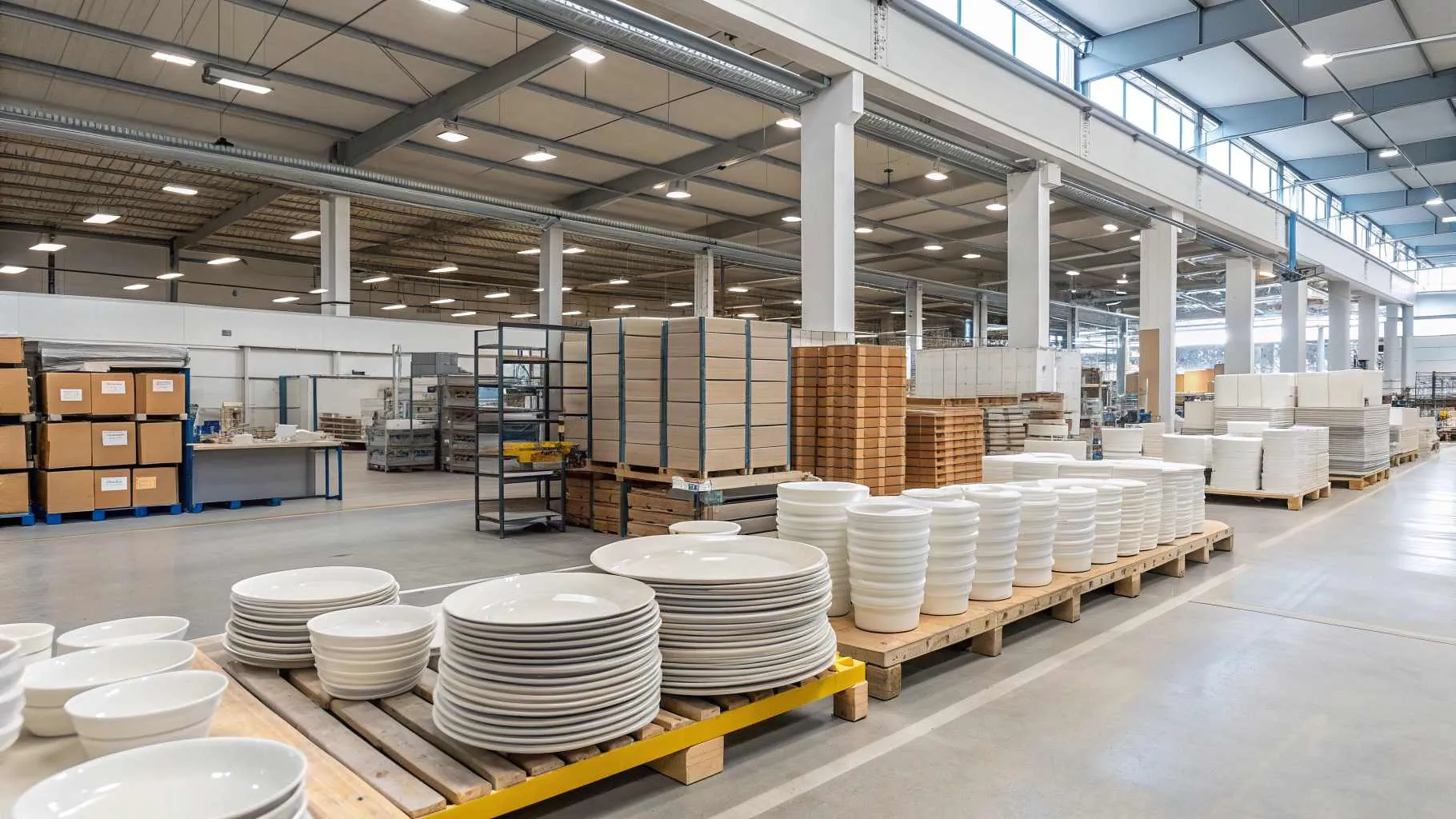
Factory-Direct Versus Local Supplier Decision Matrix
Choosing between a factory-direct route and a local supplier is not merely a question of unit price; it is a strategic decision regarding inventory management, cash flow, and customization requirements. An MOQ that exceeds usable storage or forecast demand creates avoidable inventory exposure. Record that exposure explicitly when comparing the two routes.
The Factory-Direct Route
Sourcing directly from overseas or domestic manufacturers allows hospitality groups to bypass distributor markups. This route is ideal for multi-unit operators, large hotel groups, or bespoke concepts requiring highly customized tabletop presentations. Direct discussions with the manufacturer can provide more control over agreed shapes, glazes, decoration, tolerances, and documentation, subject to the factory's actual capabilities and written quotation.
Advantages:
More scope to negotiate custom shapes, colors, and branding, subject to tooling and production constraints.
A base unit quote that may be lower at sufficient volume, before freight, duties, inspection, storage, and risk costs.
Direct communication regarding production standards and material specifications.
Challenges:
High Minimum Order Quantities (MOQs) dictated by the manufacturer's kiln capacity and production runs.
Extended lead times encompassing production, international freight, and customs clearance.
The burden of managing international logistics, quality assurance, and import compliance.
The Local Supplier Route
Local restaurant supply stores and national distributors maintain domestic warehouses stocked with standardized commercial tableware. This route serves independent restaurants, rapid-opening concepts, and venues with limited storage space.
Advantages:
Potentially shorter replenishment when the quoted item is confirmed in local stock.
Potentially lower order quantities, which must be confirmed for the exact SKU.
Simplified logistics with localized customer service and straightforward return policies.
Challenges:
Higher unit costs due to distributor markups, warehousing fees, and localized overhead.
Limited customization options; buyers are restricted to the distributor's existing catalog.
Risk of the distributor discontinuing a specific line, forcing the restaurant to mix and match tableware.
Sourcing Route Comparison Matrix
| Procurement Variable | Factory-Direct Sourcing | Local Supplier Sourcing |
|---|---|---|
| Ideal Buyer Profile | Multi-unit chains, large hotels, bespoke concepts with ample storage. | Independent restaurants, rapid openings, venues with strict storage limits. |
| Customization Capacity | Negotiable control over molds, glazes, and branding, subject to factory capability and tooling. | Limited to pre-existing catalog items; occasional custom decal options. |
| Lead Time Expectation | Extended (Production + International Transit + Customs). | Immediate to short-term (Domestic transit only). |
| Capital Tie-Up | High upfront investment for bulk orders and international freight. | Lower upfront investment; pay-as-you-go replenishment. |
| Storage Burden | Buyer must warehouse bulk inventory or pay a 3PL provider. | Supplier holds inventory; buyer stores only active stock. |
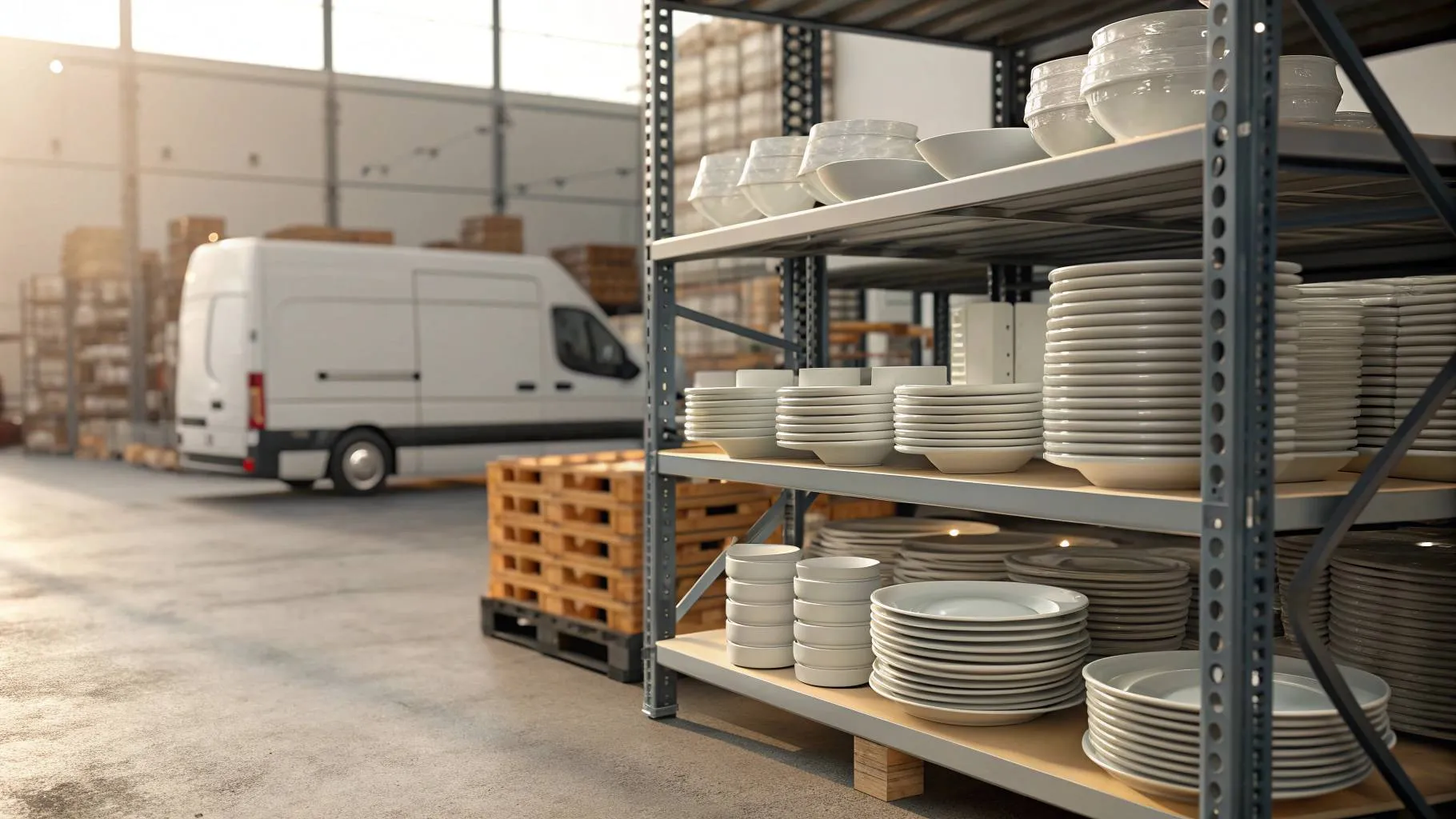
Comprehensive Landed-Cost Worksheet
Comparing a factory's base unit price directly against a local supplier's catalog price is a critical procurement error. The true financial impact of factory-direct sourcing can only be understood through a comprehensive landed-cost model. Buyers must calculate the total cost of moving the product from the factory floor to the restaurant's back door.
To accurately determine the total export price and subsequent landed cost, buyers must account for the product price, insurance, international freight, destination tariffs, local taxes, and other associated fees. Because these variables fluctuate based on the destination country and current trade policies, destination-specific verification is strictly required.
Understanding Incoterms and Customs Valuation
When negotiating with a factory, the quoted price is heavily dependent on the agreed-upon shipping terms. The Incoterms 2020 rules allocate delivery tasks, costs, and risks between the buyer and seller. For example, an FOB (Free On Board) quote means the factory covers costs up to the departure port, while a DDP (Delivered Duty Paid) quote means the factory handles all costs to your door. It is crucial to understand that the named Incoterms rule does not by itself calculate the total landed cost or replace the formal sales contract.
Furthermore, when calculating import duties, buyers must understand how their local customs authority values the shipment. The commercial invoice value and allowable additions (such as packing costs or assists) are jurisdiction-specific inputs that must be confirmed with a licensed customs broker or the importer of record. Never rely on a universal duty rate found online.
Landed-Cost Calculation Variables
Use the following worksheet structure to model the true cost of a factory-direct order. Replace the bracketed variables with actual quotes from your suppliers, freight forwarders, and customs brokers.
| Cost Component | Description & Input Variable | Verification Source |
|---|---|---|
| Base Product Cost | [Total Units] x [Unit Price based on specific Incoterm] | Factory Proforma Invoice |
| Tooling & Setup Fees | [Custom Mold Fees] + [Decal/Glaze Setup Fees] | Factory Quotation |
| Origin Logistics | [Inland Freight to Port] + [Origin Port Handling Charges] | Freight Forwarder Quote (if not included in Incoterm) |
| International Freight | [Ocean/Air Freight Rate per CBM or Container] | Freight Forwarder Quote |
| Cargo Insurance | [Insurance Premium based on Commercial Value] | Insurance Provider |
| Customs Duties | [Commercial Invoice Value] x [Destination-Specific HTS Duty Rate] | Licensed Customs Broker |
| Import Taxes & Fees | [Harbor Maintenance Fees] + [Merchandise Processing Fees] + [VAT/GST if applicable] | Licensed Customs Broker |
| Destination Logistics | [Destination Port Handling] + [Inland Freight to Warehouse] | Freight Forwarder / Domestic Carrier |
| Warehousing & Storage | [Monthly Pallet Storage Rate] x [Estimated Months of Inventory] | 3PL Provider / Internal Real Estate Cost |
By summing these components and dividing by the total number of usable units, procurement teams arrive at the True Landed Unit Cost. This is the only metric that should be compared against a local supplier's delivered price. For parallel procurement strategies regarding front-of-house assets, this methodology mirrors the approach detailed in our restaurant furniture sourcing guide.
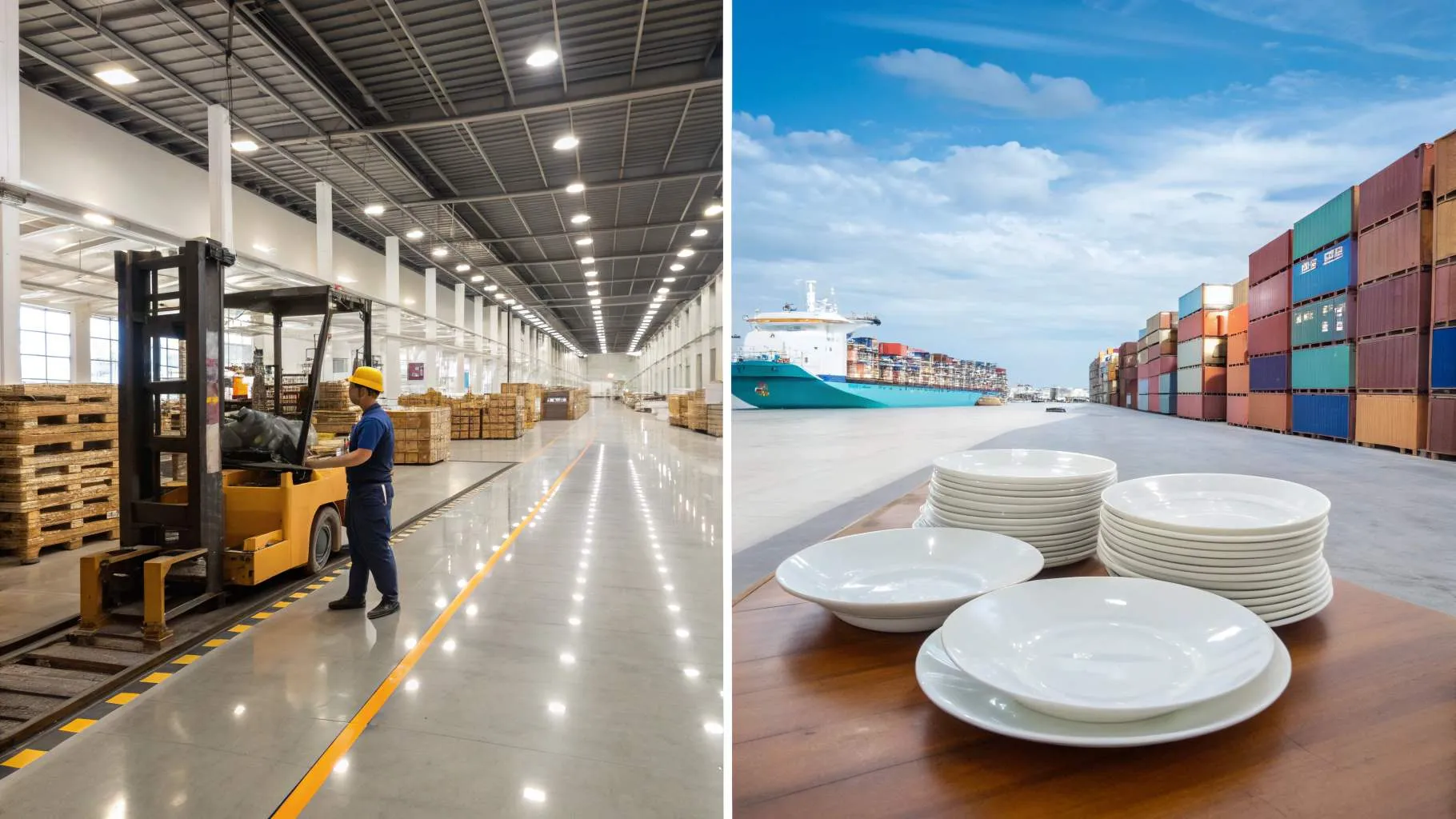
Sample and Lot-Approval Workflow
When sourcing factory-direct, approving mass production without a documented sample workflow creates avoidable fit and consistency risk. Record the dimensions and tolerances required for stacking, racks, pass-throughs, storage, and table use, then verify the approved sample against those project-specific constraints.
Phase 1: Digital Specification Review
Before any physical samples are produced, the buyer and factory must agree on digital specifications. This includes precise CAD drawings detailing diameter, height, well depth, foot ring dimensions, and weight tolerances. The digital review must also specify the exact material composition and the intended glaze finish.
Phase 2: Pre-Production Sample (PPS) Evaluation
The factory produces a small batch of Pre-Production Samples (PPS). These samples must be evaluated in the actual restaurant environment (or a test kitchen). Key evaluation metrics include:
Dimensional Accuracy: Do the plates stack evenly? Do they fit in the designated dishwasher racks?
Aesthetic Consistency: Does the glaze match the brand's color palette under the restaurant's specific lighting conditions?
Ergonomics: Are the items comfortable for servers to carry in multiples?
Phase 3: Performance and Stress Testing
Approved aesthetic samples must then undergo rigorous performance testing. While factories conduct their own tests, buyers should request independent verification or conduct in-house stress tests, including:
Thermal-use verification: Ask the manufacturer to identify validated temperature limits and applicable test evidence for the exact SKU; do not improvise extreme-temperature tests outside documented safe-use instructions.
Impact Resistance: Testing the edge chip resistance of the foot ring and rim, which are the most vulnerable points during bussing and washing.
Scratch Resistance: Simulating heavy cutlery use across the glaze to ensure the surface does not easily mar or degrade.
Phase 4: Mass Production Lot Approval
Once the PPS is approved, it becomes the "Golden Sample." This sample is signed, dated, and split between the buyer and the factory's quality control team. During mass production, the factory must pull random lots for inspection against the Golden Sample. Buyers should employ third-party inspection agencies to conduct a Final Random Inspection (FRI) before the container is sealed, ensuring the mass production lot matches the approved specifications.
Supplier Evidence Scorecard and Compliance
Procurement teams must ask: what should wholesale sourcing criteria include for event dinnerware sets including lead free materials and consistent glazing? Similarly, what criteria should i use to compare vendors' reusable dinnerware? The answer lies in an evidence-based scorecard that demands verifiable documentation rather than accepting marketing claims at face value.
Food-Contact Material Regulatory Status
Tableware is a food-contact material, meaning it is subject to strict health and safety regulations. In the United States, buyers must navigate the process of determining the regulatory status of components of a food contact material. Procurement officers must build a market-specific food-contact evidence request around the exact component identity, material specifications, authorization basis, manufacturer details, and intended conditions of use. Buyers must avoid accepting blanket "FDA-approved" claims from suppliers, as the FDA regulates specific substances and intended uses, not necessarily the finished plate as a generic category.
Traceability and International Standards
For venues operating in or importing to the European Union, compliance with Regulation (EC) No 1935/2004 is critical. This regulation mandates that food-contact materials must not transfer their constituents to food in quantities that could endanger human health. Furthermore, it requires strict traceability throughout the supply chain. For an EU-bound order, treat missing traceability documentation as an unresolved compliance gap and obtain market-specific advice before shipment. Buyers can use this regulation to support EU-market traceability and food-contact documentation checks without claiming universal global compliance.
The Evidence Scorecard Matrix
Use the following scorecard to evaluate potential factory partners or local suppliers. Record each requested document as received, verified, expired, mismatched, or missing; do not infer compliance from a supplier's assurance.
| Compliance Category | Required Evidence Document | Verification Method |
|---|---|---|
| Business Legitimacy | Valid Business License & Export License | Cross-reference with local chamber of commerce or trade registry. |
| Quality Management | ISO 9001 Certificate (or equivalent) | Verify certificate number with the issuing accreditation body. |
| Heavy Metal Leaching | Third-Party Lab Test Reports (Lead & Cadmium) | Ensure the test report matches the exact SKU and glaze formulation being purchased. |
| Food-Contact Safety (US) | Declaration of Compliance detailing specific substance authorization | Review against intended conditions of use (e.g., microwave, high-temp wash). |
| Traceability (EU) | Documentation supporting Regulation (EC) No 1935/2004 | Verify batch tracking capabilities and raw material sourcing records. |
For decisions regarding plate materials, thermal retention, and lifecycle analysis, consult our dedicated tableware material comparison.
Replenishment Continuity Scenario Modeling
The most significant hidden cost in restaurant tableware procurement is the cost of a stockout. Running out of specific plates forces a restaurant to serve signature dishes on incorrect tableware, degrading the brand experience and potentially impacting portion control. Before finalizing a contract, forecast each location's breakage, loss, and replacement demand from its own operating data rather than generic industry averages.
Calculating Safety Stock and Reorder Points
Whether using a factory-direct or local supplier route, buyers must establish a mathematical replenishment continuity scenario. This involves calculating the Reorder Point (ROP) and necessary Safety Stock.
Lead Time Demand: The number of units a restaurant will break or lose during the time it takes for a new order to arrive. (Daily Breakage Rate x Lead Time in Days).
Safety Stock: Buffer inventory held to protect against unexpected spikes in breakage or delays in the supply chain.
Reorder Point (ROP): The inventory level at which a new order must be placed. (Lead Time Demand + Safety Stock).
Scenario A: The Factory-Direct Replenishment Risk
For the factory-direct scenario, enter the supplier's quoted replenishment lead time, the venue's observed daily loss rate, and the quoted reorder MOQ. Calculate lead-time demand from those inputs, compare the result with usable storage and cash limits, and negotiate staged releases only if the supplier documents that arrangement.
Scenario B: The Local Supplier Replenishment Advantage
For the local-supplier scenario, use the distributor's written lead time and stock commitment rather than assuming immediate availability. Model the reorder point with the same observed loss data, then test the impact of a discontinued line or an out-of-stock period and record the agreed substitution or continuity plan.
Request for Quotation (RFQ) Evidence Checklist
A professional Request for Quotation (RFQ) separates serious buyers from casual inquiries and forces suppliers to provide actionable, verifiable data. Do not send a generic email asking for "your best price on white plates." Instead, submit a structured RFQ that demands specific evidence.
Essential RFQ Components
When drafting your RFQ for either a factory or a local distributor, ensure the following modules are included:
Exact Product Specifications: Detailed dimensions, weight tolerances, material composition, and required glaze finish.
Volume and Frequency Projections: Clear statements of the initial rollout volume and the projected annual replenishment volume.
Incoterms and Logistics Requirements: Specify the exact Incoterm required for the quote (e.g., FOB Shanghai, DDP New York) and the destination zip code for accurate freight modeling.
Compliance and Evidence Demands: A mandatory checklist requiring the submission of heavy metal testing reports, food-contact declarations, and quality management certificates alongside the pricing quote.
Sample Workflow Agreement: A request for the supplier's standard operating procedure regarding pre-production samples, revision timelines, and final random inspection protocols.
Packaging and Palletization Specs: Requirements for inner carton strength, master carton drop-test standards, and pallet dimensions to ensure safe transit and easy warehouse receiving.
Normalize Both Quotations Before Award
Before selecting a route, place both quotations on the same comparison sheet. Align the exact SKU specification, usable quantity, decoration and tooling scope, Incoterm, destination, inspection scope, packaging, delivery point, payment milestones, replacement terms, and quotation-validity date. Mark every blank field as unresolved rather than zero. Ask each bidder to confirm exclusions in writing, and separate one-time setup charges from repeat-order costs. Then test a base case, a delay case, and a replenishment case using supplier quotations and the restaurant's observed demand. This normalization prevents a low factory unit price or a convenient local delivered price from hiding a materially different scope.
By utilizing the decision matrices, landed-cost worksheets, and compliance scorecards detailed in this guide, procurement professionals can confidently navigate the complex tabletop market. Once your operational requirements, storage capacities, and compliance standards are fully defined, you are ready to explore commercial options. Review our complete restaurant tableware collection to see how these standards are applied in practice.
Ready to formalize your procurement strategy? send RON GROUP your tableware RFQ to begin the evidence-based sourcing process.
Get the week's latest industry information
-
Real-Life Professional Restaurant Case Studies
Explore Now
-
Create a unique restaurant with over 95,700+products
Explore Now
-
Protessional Free 3D Restaurant Design
Explore Now
-
Still Have Questions About Opening a Restaurant?
Explore Now

Sylvia
With 8 years in catering & hospitality industry, sales manager of Ron Group, specialise in providing one stop solutions to restaurants, hotels and weddings.
Discover Our Exclusive Products
Explore our extensive range of restaurant and hotel supplies designed to enhance your operations. Find the perfect solutions to meet your needs.
Browse Our ProductsFREE 3D DESIGN
Boost your restaurant's success with our free 3D design service. Start building the restaurant of your dreams today!
Explore 3D Design Case
RECOMMENDED CASES
-
La Rambla by Catalunya: Crafting Barcelona's Soul in Hong Kong - Custom Furniture Excellence
RON Group's custom Spanish-inspired furniture elevates La Rambla with artisanal aesthetics...
Learn More -

Cardinal Point: Elevating Outdoor Seating with Tailored Cushion Upgrades
Discover how Cardinal Point transformed its outdoor dining experience with custom cushions, achievin
Learn More
RECOMMENDED BLOGS
-

Bar Glassware 101: Types, Names, Uses, and How to Stock Your Bar
Learn the 10 core bar glassware types, names, and uses. Discover how to stock your bar with the right glasses for cocktails, beer,...
Sylvia2026-07-26 -

Complete Bar Equipment List for Opening a Bar
Plan a complete commercial bar equipment list by menu, service volume, refrigeration, ice, glassware, utilities, sanitation,...
Sylvia2026-06-11 -

Low Budget Restaurant Interior Design: 2026 Trends
Prioritize a low-budget restaurant interior by protecting code, operations, durability, accessibility, and phased design decisions...
Sylvia2026-04-04
Subscribe to RON GROUP
Stay up-to-date with the latest industry insights and expert advice. Together, we'll create your ideal restaurant.