



Content
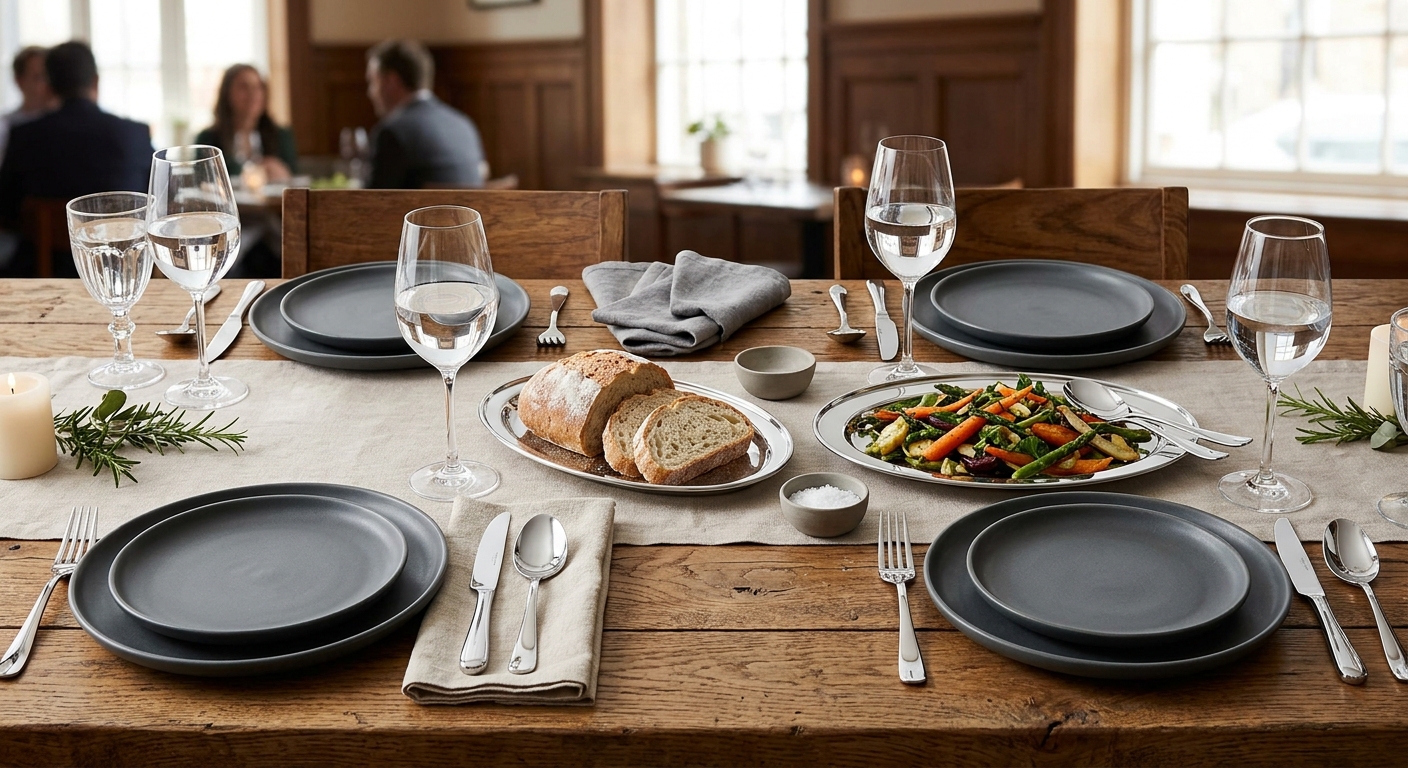
Procuring front-of-house dinnerware requires balancing culinary aesthetics, operational workflow, thermal dynamics, and lifecycle economics. For food and beverage directors, executive chefs, and procurement heads, the choice between commercial-grade ceramic and stainless steel tableware is rarely a matter of personal preference. It is an operational decision governed by menu mechanics, dining room acoustics, busing protocols, dishroom equipment, and capital expenditure budgets.
Both materials claim significant market share across distinct hospitality verticals. Vitrified ceramic dinnerware remains the default standard for traditional Western dining, fine dining, and upscale casual establishments. Stainless steel tableware-long standard in South Asian thali service, Korean barbecue concepts, and outdoor catering-is expanding into contemporary fast-casual, industrial-chic, and rooftop operations.
This guide provides a comprehensive engineering, operational, and financial comparison of stainless steel and ceramic tableware to assist hospitality operators in specifying the correct material asset for their operating model.
Direct Comparison: Stainless Steel vs Ceramic Tableware
A common point of confusion in commercial procurement is conflating generic consumer terms. "Ceramic" is an umbrella category spanning earthenware, stoneware, porcelain, and bone china. In commercial operations, fully vitrified porcelain and high-fired commercial stoneware are the primary ceramic formats specified.
Similarly, commercial stainless steel dinnerware must not be confused with porcelain-enameled steel (which coats carbon steel in glass frit) or low-grade ferritic decorative metal. Commercial stainless tableware is pressed or spun from austenitic (300-series) or ferritic (400-series) stainless steel alloys engineered for sanitation and corrosion resistance.
The table below establishes the baseline engineering and physical performance metrics for commercial-grade porcelain ceramics versus 304 austenitic stainless steel.
| Performance Metric | Commercial Vitrified Porcelain | Commercial 304 (18/8-18/10) Stainless Steel | Commercial Enamel-Coated Carbon Steel |
|---|---|---|---|
| Primary Material Composition | Kaolin, quartz, feldspar (fired at 1,250 deg C to 1,400 deg C) | Iron base alloy: 18% Cr, 8-10% Ni, 0.08% C | Carbon steel core coated with borosilicate glass enamel |
| Material Density | 2.30 - 2.50 g/cm3 | 7.90 - 8.00 g/cm3 | 7.50 - 7.85 g/cm3 (composite) |
| Mohs Hardness (Surface) | 6.5 - 7.0 (Glaze layer) | 5.0 - 5.5 (Uncoated metallic surface) | 5.5 - 6.0 (Vitreous enamel) |
| Thermal Conductivity | 1.3 - 1.7 W/(mK) | 15.0 - 16.2 W/(mK) | 45.0 - 55.0 W/(m*K) (steel core) |
| Water Absorption Rate | Less than 0.2% (Vitrified standard) | 0.00% (Non-porous metal) | 0.00% (Intact enamel surface) |
| Impact Failure Mode | Brittle fracture: edge chipping, cracking, shattering | Ductile deformation: rim denting, base warping | Brittle surface spalling (enamel chips, exposing raw steel) |
| Acoustic Noise Index (Cutlery contact) | 55 - 65 dB (Dampened clatter) | 75 - 90 dB (High-frequency metallic ring) | 60 - 70 dB (Moderate ring) |
| Microwave Compatibility | 100% Safe (assuming unmetallized glaze) | 0% Safe (Arcover / fire hazard) | 0% Safe (Arcover / fire hazard) |
| Salamander / Broiler Safe | Up to 250 deg C (Thermal shock limits apply) | Up to 600 deg C+ (Exceeds commercial ranges) | Up to 350 deg C (Chipping risk under thermal shock) |
| Average Initial Unit Cost (10.5 in Plate) | $4.50 - $14.00 (Standard commercial) | $3.80 - $9.50 (Standard gauge) | $5.00 - $11.00 (Specialty) |
| Typical Annual Breakage / Scrap Rate | 18% - 35% (Chipping / fractures) | 4% - 12% (Dents, bending, theft) | 15% - 28% (Glaze chipping exposes rust core) |
TECHNICAL NOTE // KEY ENGINEERING STANDARD
Enamel-coated steel is often mistakenly cross-shopped as "porcelain steel." While it offers a rustic aesthetic popular in barbecue and camping-themed venues, once the glass enamel layer chips from physical impact, moisture reaches the carbon steel core. This results in rapid oxidation (rusting) that violates health code standards (FDA Food Code Section 4-101.11), forcing immediate disposal.
Material Properties and Food-Service Fit
To understand why dinnerware performs differently under line stress, buyers must examine the microstructure of each material under applicable ASTM standards.
+-------------------------------------------------------------------------------+
|                       MATERIAL BEHAVIOR UNDER LINE STRESS                     |
+------------------------------------+------------------------------------------+
| VITRIFIED CERAMIC (PORCELAIN)      | AUSTENITIC STAINLESS STEEL (GRADE 304)   |
| - Microstructure: Glassy matrix    | - Microstructure: Face-centered cubic    |
|   interlocking mullite crystals    | - ASTM Standard: ASTM A240 / A480        |
| - ASTM Standard: ASTM C368         | - Non-brittle: absorbs kinetic energy    |
| - High compressive strength        |   via plastic deformation (dents)        |
| - Low tensile strength             | - Zero porosity; highly reactive heat    |
| - Risk: Surface micro-fissures     | - Risk: Chromium oxide layer breakdown   |
|   expand under mechanical shock    |   under prolonged high-chloride contact  |
+------------------------------------+------------------------------------------+
Ceramic and Porcelain Microstructure
Commercial porcelain is formed from kaolin, feldspar, and quartz, subjected to high-temperature bisquing and glost firing (1,250 deg C to 1,400 deg C). This process triggers complete vitrification, creating a non-porous body with a glassy matrix that bonds with the external glaze.
- ASTM C368 (Impact Resistance of Ceramic Tableware): High-fire commercial porcelain features high compressive strength but relatively low tensile strength. When dropped, the impact energy cannot be absorbed plastically; it concentrates at the point of impact, causing localized chipping or brittle catastrophic failure.
- Porosity and Hygiene: Under ASTM C373, commercial vitrified tableware must demonstrate water absorption below 0.5% (with premium porcelain falling below 0.1%). This prevents the absorption of grease, wash water, and pathogens into the ceramic core, preserving hygiene integrity even if surface glaze wear occurs.
Stainless Steel Metallurgy and Passivation
Commercial metal dinnerware is predominantly stamped from AISI Type 304 (18/8 or 18/10) or Type 430 (18/0) stainless steel.
- Alloy Composition: Type 304 contains 18% chromium and 8% to 10% nickel. The inclusion of nickel creates an austenitic crystalline structure, providing superior ductility, non-magnetic properties, and corrosion resistance against food acids. Type 430 contains no nickel; it is harder, magnetic, less ductile, and more prone to pitting corrosion in acidic dishwashing environments.
- Passivation Layer: Stainless steel relies on a microscopic, self-repairing passive film of chromium(III) oxide (Cr2O3) to prevent oxidation. Under standard conditions (ASTM A967), contact with oxygen maintains this barrier. However, prolonged exposure to high-chloride environments (such as table salt, acidic salad dressings, or un-rinsed tomato pures) can pit the steel, causing discoloration and metallic leaching if low-grade alloys are used.
Food Contact Chemistry and Acidity
- Acid Reactivity: Vitrified porcelain is virtually inert across the entire pH spectrum (pH 1.0 to pH 14.0). High-acid ingredients (citrus marinades, vinegar reductions, fermented dressings) will not degrade vitrified glaze or leach metallic ions. Lower-grade ceramic products with unstable decorative overglazes can pose heavy-metal leaching risks, which is why commercial operators must specify dinnerware certified under FDA Compliance Policy Guides Sec. 7117.06 and 7117.07 (Lead and Cadmium extractability).
- Metal Leaching: High-grade 304 stainless steel is inert under normal meal service conditions. However, cooking or holding food with high acidity (pH < 3.5) in un-passivated or 200-series low-nickel stainless vessels at elevated temperatures over prolonged periods can cause trace iron and nickel transfer. This can introduce a distinct metallic off-flavor to delicate sauces.
Appearance, Guest Experience, and Menu Presentation
Dinnerware is an extension of the kitchen's culinary intent. The weight, texture, acoustic profile, and color of a plate directly influence a guest's perception of food quality, portion size, and menu value.
+--------------------------------------------------------------------------+
|                      GUEST SENSORY PERCEPTION PROFILE                    |
+--------------------------+-----------------------------------------------+
| SENSORY DIMENSION        | OPERATIONAL IMPACT                            |
+--------------------------+-----------------------------------------------+
| Acoustic Signature       | Ceramic absorbs cutlery contact sound;        |
|                          | stainless steel rings at 75-90 dB.            |
+--------------------------+-----------------------------------------------+
| Thermal Hand-Feel        | Ceramic transitions heat gradually;           |
|                          | single-wall stainless steel transfers heat    |
|                          | instantly to hands and tabletop surfaces.     |
+--------------------------+-----------------------------------------------+
| Plating Visual Contrast  | White/earth-toned ceramic flatters diverse    |
|                          | foods; mirror/brushed steel reflects dining   |
|                          | room lighting and can wash out pale sauces.  |
+--------------------------+-----------------------------------------------+
| Tactile Weight Perception| Heavy vitrified ceramic correlates directly    |
|                          | with perceived luxury and higher menu prices. |
+--------------------------+-----------------------------------------------+
Visual Framing and Color Psychology
Vitrified porcelain is the global benchmark for visual food presentation. The availability of high-gloss white glazes, matte artisanal surfaces, reactive glazes, and textured rim details provides visual contrast that elevates culinary color palettes. A wide rim frames protein and sauce components cleanly, focusing the guest's eye inward.
Stainless steel reflects ambient lighting, ceiling fixtures, and surrounding room colors. In an industrial, outdoor, or cultural dining setting (such as traditional thali platters, tapas trays, or Korean banchan displays), metal tableware provides authenticity and visual punch.
However, in formal Western concepts, highly reflective mirror-finished stainless steel can produce harsh table glare under downlighting. Brushed, satin, or stonewashed stainless finishes soften these reflections, but can visually clash with fine sauces, emulsified dressings, and light-toned proteins.
For establishments focusing heavily on specialty beverage programs, selecting between ceramic, glass, and metal forms requires unique consideration. For an in-depth operational review of beverage service vessels, refer to our analysis on choosing coffee shop mugs and cups.
Acoustic Dynamics in the Dining Room
A critical operational factor frequently overlooked by design teams is the ambient noise floor created by cutlery contacting the plate.
- Ceramic Sound Attenuation: Vitrified porcelain and stoneware absorb acoustic energy. The contact between a 420-stainless steak knife or fork tine and a glazed ceramic plate produces a low-amplitude sound profile (55 to 65 dB). This acoustic profile maintains conversational intimacy in high-density dining rooms.
- Metal-on-Metal Resonance: Striking stainless steel tableware with stainless flatware generates high-frequency, non-damped acoustic rings (75 to 90 dB). In a 120-seat dining room operating at peak turnover, dozens of diners scraping flatware across stainless surfaces can push ambient noise levels to fatiguing thresholds. Operators utilizing stainless steel plates often transition to wood-handled flatware, chopsticks, or silicone-tipped tools to lower sound floor spikes.
Weight Perception and Value Correlation
Hospitality psychology studies consistently confirm that diners associate heavier service vessels with higher food quality and upscale pricing.
- A standard 10.5-inch commercial wide-rim porcelain dinner plate weighs between 750 and 950 grams. This weight communicates stability, craftsmanship, and luxury.
- A stamped 10.5-inch single-wall stainless steel plate weighs roughly 220 to 350 grams. If introduced into an upscale setting, guests may perceive the lighter weight as utilitarian, institutional, or temporary.
- Conversely, heavy dinnerware increases fatigue for service staff carrying loaded banqueting trays over extended shifts. This weight factor makes lighter metal ware attractive for high-volume pool decks, outdoor events, and off-premise catering.
Breakage, Denting, Scratching, and Replacement Risk
The operational lifespan of dinnerware is rarely cut short by natural wear. It is driven by terminal physical impacts on the line, in the dishroom, and during busing. The failure profiles of ceramic and stainless steel represent opposite ends of the structural mechanics spectrum.
+--------------------------------------------------------------------------+
|                        MECHANICAL FAILURE MODES                          |
+--------------------------+-----------------------------------------------+
| VITRIFIED CERAMIC        | STAINLESS STEEL                               |
+--------------------------+-----------------------------------------------+
| - Edge Chipping          | - Rim Deformation                             |
| - Stress Fractures       | - Base Warping / "Oil-Canning"                |
| - Glaze Knife Crazing    | - Micro-Scratches and Swirl Marks             |
| - Catastrophic Shatter   | - Loss of Specular Gloss                      |
+--------------------------+-----------------------------------------------+
Ceramic Failure Mechanics: Chipping and Shattering
Ceramic materials are inherently brittle. Under operational handling, failure takes three forms:
- Perimeter Edge Chipping: Occurs when plates bump inside bus tubs, hit stainless dishtables, or contact spray-nozzle heads. Plates with rolled edges offer significantly higher impact resistance than sharp, flat-rim profiles.
- Thermal Shock Cracking: Rapid temperature differentials (e.g., pulling a cold plate from a 4 deg C walk-in prep line and placing it directly into a 180 deg C holding salamander) induce uneven expansion between the outer glaze and inner core. This produces sudden structural fractures.
- Catastrophic Shatter: Dropping a ceramic plate onto quarry tile or concrete floors causes total structural failure. This creates an immediate safety hazard, operational disruption, and potential table-turn delay.
If alternative shatter-resistant composite materials are also under review for your venue, examine our technical breakdown comparing commercial porcelain vs. melamine and bone china dinnerware.
Stainless Steel Failure Mechanics: Denting, Warping, and Surface Wear
Stainless steel does not chip or shatter. When subjected to extreme impact, its ductile structure yields, resulting in:
- Rim Denting and Deformation: Dropping a metal plate onto a hard surface will deform the perimeter rim. A bent rim prevents uniform stacking, causing stacks to lean in dish storage and jamming automated pass-through dishwashing cassettes.
- Bottom Warping ("Oil-Canning"): Thin-gauge stainless steel plates (below 0.8 mm / 22 gauge) subjected to rapid thermal cycling can develop warped bases. When set on a flat table, the plate will rock or wobble under the pressure of the guest's flatware.
- Surface Micro-Abrasion and Scratching: Stainless steel has a Mohs hardness of 5.0 to 5.5, while commercial flatware blades (tempered 420 stainless steel) sit at 6.0 to 6.5. Consequently, steak knives and serrated cutlery will cut and scratch the surface of stainless plates over time. While polished stainless steel looks pristine out of the box, within 60 to 90 days of heavy service it develops a patina of micro-scratches. This reduces its reflective finish to a dull, matte grey.
EXECUTIVE MANDATE // PROCUREMENT COMPLIANCE AUDIT
Stainless steel dinnerware prevents catastrophic shattering and eliminates sharp glass hazards in the dining room. However, it is not immune to retirement. A dented, warped, or deeply scratched stainless steel plate degrades brand equity just as quickly as a chipped porcelain plate and must be pulled from rotation.
Heat Retention, Handling, and Service Safety
The thermal conductivity of the serving surface dictates kitchen plating speed, expediter heat lamp survival times, server safety, and the temperature curve of the meal at the guest table.
+--------------------------------------------------------------------------+
|                        THERMAL CONDUCTIVITY DYNAMICS                     |
+--------------------------------------------------------------------------+
| STAINLESS STEEL (15.0 - 16.2 W/m*K)                                      |
| Fast heat absorption  ====> Rapid heat dissipation to table              |
| High surface temp     ====> Server burn hazard; sauce skinning           |
|                                                                          |
| VITRIFIED CERAMIC (1.3 - 1.7 W/m*K)                                      |
| Slow heat absorption  ====> Gradual, sustained thermal release           |
| Moderate surface temp ====> Safe handling at rim; warm core              |
+--------------------------------------------------------------------------+
Thermal Conductivity Differences
Vitrified Ceramic (~1.5 W/mK): Acts as a thermal reservoir. When pre-heated in a commercial plate warmer to 55 deg C to 60 deg C, the dense clay core absorbs heat slowly and releases it steadily. Food plated on a warm ceramic base retains its core temperature over a standard 20-minute consumption window without scorching the bottom of delicate sauces. 304 Stainless Steel (~16 W/mK): Stainless steel conducts heat roughly 10 times faster than vitrified ceramic. A single-wall stainless steel plate placed under a 500-watt infrared heat lamp absorbs thermal energy almost instantaneously.
Server Safety and Table Surface Protection
Because single-wall stainless steel conducts heat so rapidly:
- The Entire Body Heats Instantly: While ceramic plates maintain a cooler perimeter rim for server thumbs, single-wall metal plates heat uniformly from center to edge. Food plated at 75 deg C heats the rim to unsafe handling temperatures within 45 seconds, requiring servers to carry plates using serviettes or underliners.
- Rapid Cooling Curve: Single-wall steel radiates its heat into the room and the tabletop just as quickly as it absorbs it. A hot steak or pasta dish plated on single-wall stainless steel drops to ambient temperature up to 40% faster than on a pre-heated ceramic plate, causing butter emulsions to break and gravies to skin.
- Tabletop Scorching: Setting a piping hot single-wall stainless dish directly onto a finished wood, resin, or lacquer tabletop without an underliner will blister or white-ring the wood finish.
+-------------------------------------------------------------------------------+
|                 PLATED DISH TEMPERATURE DROP-OFF OVER TIME                     |
|                      (Starting Food Temp: 80 deg C / 176 deg F)               |
+---------------------+------------------------+--------------------------------+
| Elapsed Time (Mins) | Pre-warmed Ceramic (C) | Single-Wall Stainless (C)      |
+---------------------+------------------------+--------------------------------+
| 0 min (Plating)     | 80 deg C (176 deg F)   | 80 deg C (176 deg F)           |
| 3 min (Expediter)   | 78 deg C (172 deg F)   | 74 deg C (165 deg F)           |
| 7 min (Delivered)   | 75 deg C (167 deg F)   | 66 deg C (151 deg F)           |
| 12 min (Mid-Meal)   | 69 deg C (156 deg F)   | 54 deg C (129 deg F)           |
| 18 min (Late-Meal)  | 62 deg C (144 deg F)   | 44 deg C (111 deg F)           |
+---------------------+------------------------+--------------------------------+
The Double-Wall Stainless Exception
To solve this thermal conductivity challenge, commercial manufacturers produce double-wall insulated stainless steel tableware.
By sealing an air or partial vacuum cavity between two stamped stainless steel shells, heat transfer via conduction is halted. Double-wall stainless bowls and platters keep hot soups boiling hot and chilled desserts ice-cold on the interior surface, while the exterior shell remains room temperature to the touch.
However, double-wall stainless pieces cannot be heated inside salamanders, ovens, or direct flame, as internal pressure expansion can rupture the sealed perimeter weld.
Cleaning, Warewashing, Staining, and Storage
Dishroom throughput directly dictates dining room turn capacity. Tableware must survive commercial flight-type or pass-through dishwashers running high-temperature sanitation cycles 12 to 18 hours per day.
+--------------------------------------------------------------------------+
|                         DISHROOM WORKFLOW DYNAMICS                       |
+-------------------+----------------------------+-------------------------+
| OPERATIONAL STEP  | CERAMIC TABLEWARE          | STAINLESS STEEL         |
+-------------------+----------------------------+-------------------------+
| Scraping / Raking | High resistance to rubber/ | Prone to surface gouges |
|                   | plastic scrapers; hard     | if metal scrapers are   |
|                   | glaze resists abrasion.    | used on soiled surface. |
+-------------------+----------------------------+-------------------------+
| Chemical Exposure | Inert to caustics and      | Vulnerable to pitting   |
|                   | chlorine sanitizers;       | from high-chlorine and  |
|                   | glaze dulls under scale.   | acidic delimers.        |
+-------------------+----------------------------+-------------------------+
| Racking / Washing | Peg racks required to stop | Can use open racks, but |
|                   | contact; risk of chipping  | light pieces can flip   |
|                   | against wash arm jets.     | under wash pump jet PSI.|
+-------------------+----------------------------+-------------------------+
| Storage Density   | Heavy stack footprint;     | Nest exceptionally thin;|
|                   | tall stacks risk base      | high shelf capacity;    |
|                   | blowout or toppling.       | low vertical profile.   |
+-------------------+----------------------------+-------------------------+
Commercial Dishwasher Chemistry and Corrosion
- Ceramic Glaze Wear: Vitrified ceramic holds up well against alkaline dishwashing chemicals (pH 10 to 12). However, poor water softening systems that let mineral scale accumulate will cause glaze dulling over 1,000+ cycles. Low-temperature dishwashers that use chlorine sanitizers will not chemically degrade commercial ceramic glaze, though unvitrified foot rings can absorb dirty wash water if drying cycles are cut short.
- Stainless Steel Pitting and Oxidation: Austenitic 304 stainless steel resists commercial alkaline detergents, but is vulnerable to halide-induced pitting. If chemical sanitizing dishwashers dose sodium hypochlorite (bleach) above 100 PPM, or if acidic wash-tank delimers (phosphoric acid) are not thoroughly neutralized, the protective chromium oxide film will pit. These micro-pits appear as tiny black pinholes that permanently harbor bacteria and rust.
Stacking Efficiency and Back-of-House Storage
Floor and shelf space in commercial kitchens carries a high real estate cost.
- Stacking Profile: Single-wall stainless steel plates feature ultra-thin material cross-sections (0.8 mm to 1.2 mm). A stack of 50 stainless steel plates measures approximately 15 to 20 cm in height. A stack of 50 wide-rim vitrified ceramic plates measures between 45 and 65 cm in height and weighs between 40 and 50 kg.
- Shelf Loading Limits: Loading wire shelving units (such as NSF-listed chrome or epoxy racks) with ceramic dinnerware demands strict adherence to maximum shelf ratings (typically 270 to 360 kg evenly distributed). Stainless steel plates reduce dead shelf weight by up to 60%, mitigating rack collapse risks and easing handling for dishmachine operators.
SOURCING AUDIT TIP // DIRECT PROCUREMENT SPECIFICATION
In high-turnover dishrooms, single-wall stainless steel plates can flip over inside open wash racks under the high-pressure water jets of a 3-horsepower commercial wash pump. To prevent wash water from pooling in flipped plates, always use pegged plate racks sized properly to the rim profile.
Lifecycle Cost Inputs Without Assuming One Universal Winner
A common pitfall in procurement analysis is assuming one material is automatically more cost-effective across every operational model.
Stainless steel is not universally cheaper over time; while it reduces catastrophic breakage, its aesthetic lifespan is bounded by scratching, denting, and visual wear. Ceramic dinnerware carries higher annual break-loss, but its glazed surface can remain optically brand-new until the day it chips or breaks.
To evaluate real Total Cost of Ownership (TCO) over a 5-year operating horizon, use the operational formula below:
$$\text{TCO}_{5\text{-Year}} = C_{\text{initial}} + \left( P_{\text{par}} \times C_{\text{unit}} \times R_{\text{loss}} \times 5 \right) + S_{\text{handling}} - V_{\text{salvage}}$$
Where:
- $C_{\text{initial}}$: Initial front-of-house table service inventory cost.
- $P_{\text{par}}$: Total inventory par level (typically 3x to 4x seating capacity).
- $C_{\text{unit}}$: Landed replacement cost per piece.
- $R_{\text{loss}}$: Annual attrition rate (combined breakage, chipping, denting, scratching, and guest/staff theft).
- $S_{\text{handling}}$: Handling overhead (labor to polish metal, transport weight costs, specialized wash rack tooling).
- $V_{\text{salvage}}$: Residual scrap value ($0 for ceramic; raw metal scrap value for high-grade stainless).
Five-Year TCO Simulation: 150-Seat High-Volume Urban Restaurant
The following simulation models a 150-seat high-volume casual-dining restaurant running 2.5 turns per day (375 covers/day, ~136,875 covers/year). Par stock is set at 3.5x seating (525 units of 10.5-inch dinner plates).
+-------------------------------------------------------------------------------+
|                       5-YEAR TCO MODEL: 150-SEAT OPERATION                    |
|                        (Initial Inventory: 525 Dinner Plates)                 |
+------------------------------------+------------------+-----------------------+
| Cost Component                     | Commercial       | Commercial 304        |
|                                    | Porcelain        | Stainless Steel       |
+------------------------------------+------------------+-----------------------+
| Unit Acquisition Cost (Landed)     | $8.50            | $6.50                 |
| Initial Procurement Capex          | $4,462.50        | $3,412.50             |
| Projected Annual Attrition Rate    | 24.0%            | 8.0%                  |
| - Annual Lost Units                | 126 units        | 42 units              |
| Annual Replacement Cost            | $1,071.00        | $273.00               |
| 5-Year Cumulative Replacement Cost | $5,355.00        | $1,365.00             |
| 5-Year Warewash Chemical Surcharge | $0.00            | $450.00 (Neutralizers)|
| Salvage Value at Year 5 (Metal)    | $0.00            | -$210.00 (Scrap value)|
+------------------------------------+------------------+-----------------------+
| TOTAL 5-YEAR ACCUMULATIVE COST     | $9,817.50        | $5,017.50             |
| Real Cost Per Guest Cover Served   | $0.0143          | $0.0073               |
+------------------------------------+------------------+-----------------------+
Interpreting the TCO Output
- The Pure Economic Winner: On pure balance-sheet metrics, stainless steel cuts 5-year dinnerware costs by nearly 49%. This reduction is driven by low replacement rates and durable metal construction.
- The Brand Equity Factor: The table above assumes the restaurant can operate with scratched, dull-patina stainless steel plates in Year 3 through Year 5. In a high-turnover, casual street-food or barbecue concept, this distressed aesthetic fits right in. But in an upscale urban bistro, surface scratches can look unhygienic, forcing operators to retire and replace scratched metal plates earlier than the 8% structural attrition figure suggests.
Decision Matrix by Restaurant and Hotel Use Case
To simplify specification across multi-unit hospitality groups and mixed-use hotel properties, use this environment-tested operational decision matrix.
+-------------------------------------------------------------------------------+
|                      HOSPITALITY VERTICAL DECISION MATRIX                     |
+--------------------------+---------------------+------------------------------+
| Operating Concept        | Recommended Choice  | Primary Operational Driver   |
+--------------------------+---------------------+------------------------------+
| Fine Dining & White-     | Vitrified Porcelain | Acoustic isolation; pristine |
| Tablecloth Venues        |                     | non-scratch glaze finish.    |
+--------------------------+---------------------+------------------------------+
| Rooftop, Poolside, Patio,| 304 Stainless Steel | Zero glass-shatter liability;|
| & Beach Club Operations  |                     | resists outdoor wind gusts.  |
+--------------------------+---------------------+------------------------------+
| High-Turnover Fast-      | Operator Preference | Fast bussing vs. comfort;    |
| Casual (Tray Service)    | (Hybrid Setup)      | depends on acoustic targets. |
+--------------------------+---------------------+------------------------------+
| Cultural Concepts        | 304 Stainless Steel | Authentic menu presentation; |
| (Thali, K-BBQ, Mezze)    | (Single/Double-Wall)| heat resistance to grills.   |
+--------------------------+---------------------+------------------------------+
| High-Volume Hotel        | Commercial Vitrified| Thermal reservoir holds food |
| Banqueting & Buffets     | Porcelain           | warm across large ballrooms. |
+--------------------------+---------------------+------------------------------+
| Institutional & Cruise   | 304 Stainless Steel | Max durability, compact      |
| Ship High-Density Lines  | (Heavy-Gauge)       | stacking, lower wash weight. |
+--------------------------+---------------------+------------------------------+
Deep Dive: Use Case Operational Nuances
Rooftop, Poolside, and Outdoor Dining
At outdoor, elevated, and poolside venues, liability is the primary selection criteria. A shattered porcelain plate on a pool deck demands pool closure, draining, filtering, and thorough cleanup, generating severe operational losses.
Stainless steel dinnerware is shatterproof, light enough for waitstaff to carry across long outdoor paths, and heavy enough not to blow off tables in sudden wind gusts (unlike disposable or lightweight melamine alternatives).
Fine Dining, Upscale Bistros, and Tasting Menus
In environments where average guest checks exceed $65, ceramic dinnerware remains essential. The tactile warmth, the muted sound of flatware on glazed surfaces, and the sheer framing power of white or artisan glazes cannot be replicated by stamped metal. Furthermore, fine dining back-of-house teams rely on pre-warmed plates to protect delicate food temperatures through detailed multi-step plating sequences.
Korean Barbecue, Asian Concepts, and Shared Dining
Stainless steel is deeply integrated into East and South Asian culinary traditions. In Korean barbecue concepts, metal tableware is essential: hot charcoal sparks, tabletop gas burners, and direct tabletop grill shears will chip, scorch, or break ceramic alternatives.
Furthermore, cold-service items (such as Korean cold noodles or naengmyeon) are elevated by double-wall stainless steel bowls, which sweat minimally and stay ice-cold throughout the meal.
Sample Test and Tableware RFQ Checklist
When issuing a Request for Quotation (RFQ) to international commercial tableware manufacturers, precision in the technical specifications protects operators from receiving domestic consumer-grade goods that fail within weeks.
+-------------------------------------------------------------------------------+
|                         PRE-SHIPMENT TESTING PROTOCOLS                        |
+-------------------------------------------------------------------------------+
| TEST A: THERMAL SHOCK TEST (ASTM C554)                                        |
| 1. Heat 10 sample plates in an oven to 175 deg C (350 deg F) for 30 minutes.  |
| 2. Plunge immediately into ice water at 4 deg C (40 deg F).                   |
| 3. Requirement: Zero crazing, cracking, or catastrophic spalling.             |
|                                                                               |
| TEST B: ACID RESISTANCE & PASSIVATION (ASTM A380 / ASTM C650)                 |
| 1. Submerge samples in a 5% citric acid & 10% sodium chloride solution at     |
|    60 deg C for 24 continuous hours.                                          |
| 2. Requirement: Stainless steel must exhibit zero micro-pitting or rust bloom.|
|    Ceramics must exhibit zero glaze dulling or pigment bleeding.              |
|                                                                               |
| TEST C: CUTLERY ABRASION SCRATCH TEST                                         |
| 1. Mount a 420-stainless serrated steak knife to a weighted mechanical arm    |
|    applying 2.5 kg of constant downward force.                                |
| 2. Draw across the plate surface through 100 continuous cycles.               |
| 3. Requirement: Ceramic glaze must show no gray pencil-line marking;          |
|    Stainless steel must exhibit uniform mechanical scratching with no burrs.  |
+-------------------------------------------------------------------------------+
Procurement Specifications Checklist: What to Write in Your RFQ
To ensure delivered goods match commercial-grade operational standards, incorporate the following explicit technical requirements into your purchasing orders:
If Specifying Ceramic / Porcelain Dinnerware
- Clay Body Formulation: High-aluminum vitrified porcelain body; alumina content equal to or exceeding 15% for enhanced edge strength.
- Firing Temperature: High-temperature glost firing at 1,280 deg C to 1,350 deg C minimum.
- Water Absorption Threshold: Must certify water absorption less than 0.2% tested in accordance with ASTM C373.
- Edge Profile: Specify reinforced, rolled edges on all circular plates to reduce chipping rates on high-contact points.
- Glaze Formulation: Lead and cadmium-free; guaranteed compliant with FDA CPG 7117.06/07. Must resist ASTM C650 chemical exposure without glaze clouding.
- Base Foot Ring: Fully polished or dry-foot wiped to prevent abrasive scratching when plates are stacked.
If Specifying Stainless Steel Tableware
- Alloy Grade: Explicitly mandate AISI Type 304 (18/8 or 18/10); ban 200-series (manganese-substituted) alloys and un-passivated 400-series alloys for food-contact bodies.
- Sheet Thickness (Gauge): Minimum 1.0 mm (19-20 gauge) for single-wall plates to prevent rim bending and oil-canning. Minimum 0.8 mm per wall for double-wall insulated bowls.
- Edge Finishing: 100% deburred and rolled smooth rims; zero sharp metal flash or shear burrs from stamping dies.
- Passivation Certification: Manufacturer must provide proof of chemical passivation (ASTM A967 nitric or citric acid treatment) to guarantee immediate corrosion resistance upon delivery.
- Surface Polish Spec: Specify fine mechanical satin/brushed finish (240 to 320 grit) rather than high-mirror polish to reduce the visual appearance of knife marks.
Global Hospitality Procurement and Supply Chain Delivery
Selecting the right tableware material is only half the battle. Delivering fragile porcelain or precisely finished stainless steel to a project site requires a dependable international supply chain.
Ron Group operates dedicated manufacturing networks and logistics consolidation hubs, delivering commercial hospitality products to operators worldwide. We support new restaurant openings, hotel renovations, and high-volume brand rollouts.
End-to-End Consolidation and Custom Manufacturing
Sourcing dinnerware across fragmented supplier catalogs introduces inventory risks, uneven quality, and uncoordinated delivery schedules. Ron Group provides an integrated procurement model:
- Custom Ceramic Production: From bespoke vitrified stoneware bodies to custom corporate-color reactive glazes and embossed rim details, our ceramic manufacturing facilities adhere to strict commercial hospitality standards.
- Precision Metal Fabrication: We engineer high-gauge, certified 304 and 316-grade stainless steel plates, platters, serving accessories, and double-wall insulated systems built to withstand the rigors of high-turnover dishrooms.
- One-Stop FFE/OS&E Consolidation: In addition to dinnerware, Ron Group coordinates your entire front-of-house and back-of-house package-spanning commercial kitchen equipment, bar supplies, glassware, custom lighting, and commercial dining furniture. This consolidation allows you to ship complete restaurant fit-outs inside unified container loads.
+-------------------------------------------------------------------------------+
|                       RON GROUP GLOBAL B2B SHIPPING FRAMEWORK                 |
+------------------------------------+------------------------------------------+
| FULL CONTAINER LOAD (FCL)          | LESS THAN CONTAINER LOAD (LCL)           |
+------------------------------------+------------------------------------------+
| - Direct factory container sealing | - Fully managed ocean consolidation      |
| - Minimized intermediate handling  | - Transparent DDP (Delivered Duty Paid)  |
| - Palletized, shrink-wrapped, and  |   or customer-appointed forwarder        |
|   drop-tested master cartons       |   (FOB / EXW terms)                      |
| - Ideal for complete new openings, | - Eliminates surprise port destination   |
|   hotel fit-outs, and brand resets |   fees common with unmanaged CIF terms   |
+------------------------------------+------------------------------------------+
Logistics Realities and Delivery Terms
Ron Group maintains transparent, commercial-grade delivery terms. Because commercial restaurant FF&E and OS&E shipments involve multi-ton palletized freight:
- Standard Commercial Delivery: All commercial shipments arrive via freight carriers arranged under direct international ocean terms. FCL shipments feature factory-sealed containers designed for commercial loading-dock offloading.
- No Residential or Inside-Carry Deliveries: As a standard B2B commercial supplier, our freight transit terminates at your venue's commercial curbside or loading dock. Drivers do not uncrate goods, carry products upstairs, or complete white-glove dining room setups. Operators must ensure facility teams or general contractors are on-site with pallet jacks and material handling gear.
- Damage-Free Export Crating: Ceramic dinnerware is packed in reinforced five-ply export cartons, fitted with customized honeycomb spacers, fully palletized, and shrink-wrapped with corner edge-protectors. This protects your shipment across every leg of international ocean transit.
Whether you are launching a fast-casual group, designing an outdoor rooftop lounge, or outfitting a luxury hotel dining room, Ron Group provides the engineering expertise, material transparency, and global supply chain capacity required to equip your operation with confidence.
Commercial Procurement & Specification Benchmark
| Specification Category | Budget / Residential Grade | Heavy Commercial Grade (Ron Group Standard) | Compliance & Test Verification |
|---|---|---|---|
| Structural Material | Thin gauge 430 stainless / laminated particle board | 16-18 Gauge 304 Stainless Steel / Solid Hardwood Core | NSF/ANSI Standard 2 / ANSI/BIFMA X5.5 |
| Operational Duty Cycle | 2-4 hours intermittent | 18-24 hours continuous commercial turnover | UL Commercial / CE / ETL Sanitation Certified |
| Thermal / Mechanical Tolerance | Rapid fatigue after 6-12 months | 5-10 year commercial design lifespan | High thermal shock resistance (180 deg C delta) |
| 5-Year Total Cost of Ownership | High (frequent breakdown & replacement) | 35-45% lower net amortized TCO | Fully warrantied commercial supply chain |
Get the week's latest industry information
-
Real-Life Professional Restaurant Case Studies
Explore Now
-
Create a unique restaurant with over 95,700+products
Explore Now
-
Protessional Free 3D Restaurant Design
Explore Now
-
Still Have Questions About Opening a Restaurant?
Explore Now

Sylvia
With 8 years in catering & hospitality industry, sales manager of Ron Group, specialise in providing one stop solutions to restaurants, hotels and weddings.
Discover Our Exclusive Products
Explore our extensive range of restaurant and hotel supplies designed to enhance your operations. Find the perfect solutions to meet your needs.
Browse Our ProductsFREE 3D DESIGN
Boost your restaurant's success with our free 3D design service. Start building the restaurant of your dreams today!
Explore 3D Design Case
RECOMMENDED CASES
-
La Rambla by Catalunya: Crafting Barcelona's Soul in Hong Kong - Custom Furniture Excellence
RON Group's custom Spanish-inspired furniture elevates La Rambla with artisanal aesthetics...
Learn More -

Cardinal Point: Elevating Outdoor Seating with Tailored Cushion Upgrades
Discover how Cardinal Point transformed its outdoor dining experience with custom cushions, achievin
Learn More
RECOMMENDED BLOGS
-

Bar Glassware 101: Types, Names, Uses, and How to Stock Your Bar
Learn the 10 core bar glassware types, names, and uses. Discover how to stock your bar with the right glasses for cocktails, beer,...
Sylvia2026-07-26 -
Complete Bar Equipment List for Opening a Bar
Plan a complete commercial bar equipment list by menu, service volume, refrigeration, ice, glassware, utilities, sanitation,...
Sylvia2026-06-11 -

Low Budget Restaurant Interior Design: 2026 Trends
Prioritize a low-budget restaurant interior by protecting code, operations, durability, accessibility, and phased design decisions...
Sylvia2026-04-04
Subscribe to RON GROUP
Stay up-to-date with the latest industry insights and expert advice. Together, we'll create your ideal restaurant.