










Content
To build a resilient supply chain for single-use items, restaurant operators must control disposable serviceware as an item master plus a replenishment loop, not as a loose shopping list. Haphazard purchasing of single-use items leads to mismatched inventory, storage bottlenecks, and unpredictable replenishment cycles. By structuring procurement through rigorous data models, defined units of measure, and controlled reorder workflows, multi-site restaurant teams can stabilize daily operations and eliminate stockouts.

Establishing Operational Control Over Disposable Serviceware
To build a resilient supply chain for single-use items, restaurant operators must control disposable serviceware as an item master plus a replenishment loop, not as a loose shopping list. Haphazard purchasing of single-use items leads to mismatched inventory, storage bottlenecks, and unpredictable replenishment cycles. By structuring procurement through rigorous data models, defined units of measure, and controlled reorder workflows, multi-site restaurant teams can stabilize their daily operations and prevent stockouts without relying on ad-hoc emergency orders. The sheer volume of eaches, inner packs, and cases moving through a restaurant requires strict data discipline to ensure that the right items arrive at the right time in the correct quantities.
It is critical to separate the transactional discovery of products from the operational control of inventory. The RON GROUP disposables collection acts as the commercial receiver for product discovery and supplier conversation; this article must not take its transactional promise. This guide owns only operational procurement controls, focusing strictly on the data architecture, receiving tolerances, and replenishment continuity required to manage disposable tableware at scale. Every operational field discussed here must stay bound to the exact supplier SKU, UOM, site, and buyer-approved record.
Furthermore, this guide maintains a strict operational boundary. For decisions regarding food-contact documentation, use-case selection, and packaging compliance, operators must consult the food-safe disposable packaging sourcing guide. For durable tableware material, sizing, and sourcing decisions, refer to the durable restaurant tableware material guide. This article does not recommend materials, takeout-container formats, durable tableware, or custom printed coffee-shop cups. It also makes no unsupported claims regarding pricing, ecological impact, material safety, structural integrity, or fixed inventory levels, nor does it rank suppliers or assert jurisdiction-specific regulatory approvals.
Disposable-Serviceware Assortment Mapping
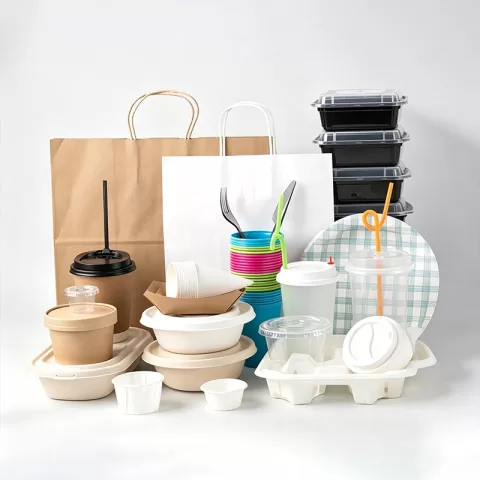
The foundation of a controlled replenishment loop is a strict assortment map. An assortment map defines exactly which disposable items are authorized for which service points within the restaurant. Without this map, locations may independently source unapproved variations, leading to SKU proliferation, fragmented purchasing power, and inconsistent guest experiences. The assortment map categorizes items by their operational function and service point, ensuring that procurement teams only manage data for authorized inventory.
By mapping the assortment to specific service points - such as the quick-service counter, the catering staging area, or the bar - procurement teams can align their data models with actual operational workflows. This mapping explicitly excludes forbidden categories, ensuring that the procurement data architecture remains focused solely on authorized disposable serviceware. If an item is not on the approved assortment map, it cannot be entered into the replenishment system, preventing rogue spending at the site level.
Table 1: Assortment Map by Service Point and Item Function
| Service Point | Item Function | Operational Category | Excluded Scope (Not Covered Here) |
|---|---|---|---|
| Quick-Service Counter | Single-use cutlery dispensing | Wrapped or bulk disposable utensils | Durable flatware, custom printed packaging |
| Catering Staging Area | Large-format disposable serving | Disposable serving tongs and spoons | Food-contact compliance certifications |
| Bar Service Station | Beverage stirring and garnishing | Disposable stirrers and picks | Custom printed coffee-shop drinkware |
| Drive-Thru Window | Condiment and napkin distribution | Dispenser napkins and portion cups | Takeout container use-case selection |
| Outdoor Patio | Casual dining single-use service | Disposable plates and bowls | Durable restaurant tableware materials |
SKU, GTIN, and Unit-of-Measure (UOM) Control
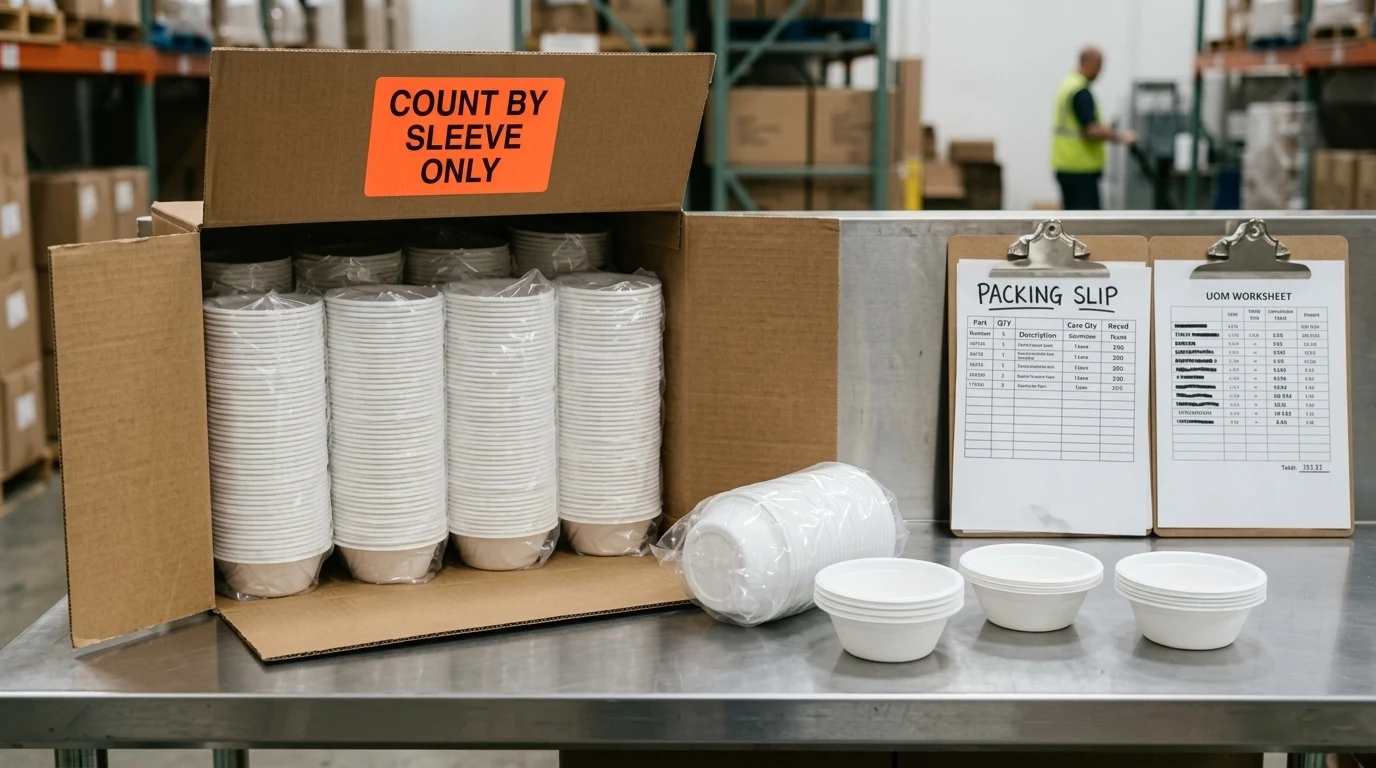
Once the assortment is mapped, every item must be defined within an SKU and Unit-of-Measure (UOM) crosswalk. Disposables are frequently purchased in complex packaging hierarchies: individual units (eaches) are packed into sleeves (inner packs), which are packed into cartons (cases), which are stacked on pallets. Failure to control these conversions leads to massive ordering errors, such as ordering five cases when five sleeves were intended, or receiving a pallet when a single carton was expected.
The GS1 Global Data Model Attribute Implementation Guideline provides a robust framework for this. GS1 models each, inner pack, case, and pallet as linked hierarchy levels with identifiers, contained-item counts, and orderable or shipping indicators. We use this to support an item-master crosswalk that keeps SKU, GTIN, hierarchy level, contained quantity, and orderable unit explicit. We use this for data-structure guidance only; do not imply that every supplier or market uses every GS1 field. The crosswalk ensures that the buyer's item ID translates perfectly to the supplier's SKU, and that the receiving dock knows exactly what unit to expect. The procurement data team must meticulously maintain these fields, as any discrepancy between the buyer's system and the supplier's catalog will result in rejected purchase orders or incorrect deliveries.
Table 2: SKU, GTIN, and UOM Crosswalk
| Buyer Item ID | Supplier SKU | GTIN (If Supplied) | Each Description | Inner Pack | Case Quantity | Pallet Quantity | Contained Qty (Base) | Orderable Unit | Invoice Unit | Receiving Unit |
|---|---|---|---|---|---|---|---|---|---|---|
| DISP-CUT-001 | SUP-FK-99 | 00012345678905 | 1 Fork | 100 per Sleeve | 10 Sleeves (1000) | 50 Cases | 1000 Eaches | Case | Case | Case |
| DISP-PLT-002 | SUP-PL-88 | 00012345678912 | 1 Plate | 50 per Shrink | 4 Shrinks (200) | 60 Cases | 200 Eaches | Case | Case | Case |
| DISP-NPK-003 | SUP-NP-77 | 00012345678929 | 1 Napkin | 250 per Band | 20 Bands (5000) | 30 Cases | 5000 Eaches | Case | Case | Case |
| DISP-CUP-004 | SUP-CP-66 | 00012345678936 | 1 Portion Cup | 200 per Tube | 12 Tubes (2400) | 40 Cases | 2400 Eaches | Case | Case | Case |
Case Pack, MOQ, and Mixed-Carton Rules
Procurement systems must normalize the commercial inputs returned by suppliers regarding case packs, Minimum Order Quantities (MOQs), and mixed-carton availability. These are not universal claims; they are specific, supplier-returned data points that dictate how and when an order can be placed. A supplier might require a minimum of five cases for a specific SKU, or they might allow mixed cartons only if ordered in full inner-pack increments. Understanding the difference between a supplier MOQ (the minimum total order allowed) and an order multiple (the increment in which the item must be purchased) is vital for accurate replenishment.
To manage this, operators can look to software data models. Oracle PeopleSoft: Defining Purchasing Item Attributes demonstrates that purchasing controls can bind supplier, location, unit of measure, order multiple, conversion rate, packing details, and quantity-received tolerance. We use this to support an SKU/UOM master and supplier-returned case-pack, order-multiple, conversion, and receiving-tolerance fields. We use this as an operational data-model example; buyers must set their own item-specific tolerances and system configuration. Normalizing these rules prevents purchase orders from being rejected by the supplier or causing receiving bottlenecks at the restaurant.
Table 3: Case-Pack, Order-Multiple, MOQ, and Mixed-Carton Normalization
| Buyer Item ID | Supplier SKU | Standard Case Pack | Supplier MOQ | Order Multiple | Mixed-Carton Allowed | Mixed-Carton Increment | Rule Normalization Owner |
|---|---|---|---|---|---|---|---|
| DISP-CUT-001 | SUP-FK-99 | 1000 Eaches | 5 Cases | 1 Case | No | N/A | Replenishment Buyer |
| DISP-PLT-002 | SUP-PL-88 | 200 Eaches | 10 Cases | 2 Cases | Yes | 1 Case | Replenishment Buyer |
| DISP-NPK-003 | SUP-NP-77 | 5000 Eaches | 1 Pallet Layer | 5 Cases | No | N/A | Replenishment Buyer |
| DISP-CUP-004 | SUP-CP-66 | 2400 Eaches | 1 Case | 1 Case | Yes | 1 Inner Pack (200) | Replenishment Buyer |
Concrete Risk Scenarios: UOM and MOQ Failures
A restaurant manager attempts to order 500 individual forks for a weekend event. Because the procurement system lacks strict UOM controls, the order is transmitted as "Quantity: 500" with the orderable unit defaulting to "Case." The supplier ships 500 cases (500,000 forks), resulting in a massive over-delivery that clogs the dry storage room, ties up operating capital, and creates a severe receiving exception on the dock.
A buyer attempts to build a mixed carton of portion cups and lids to save space in a small urban location. They order loose eaches, but the supplier's mixed-carton rule strictly requires full inner-pack increments. The supplier's automated system rounds the order up to the nearest full case for each item, bypassing the mixed-carton intent and blowing the location's weekly budget while overwhelming their limited storage capacity.
Samples and Lead Time Control
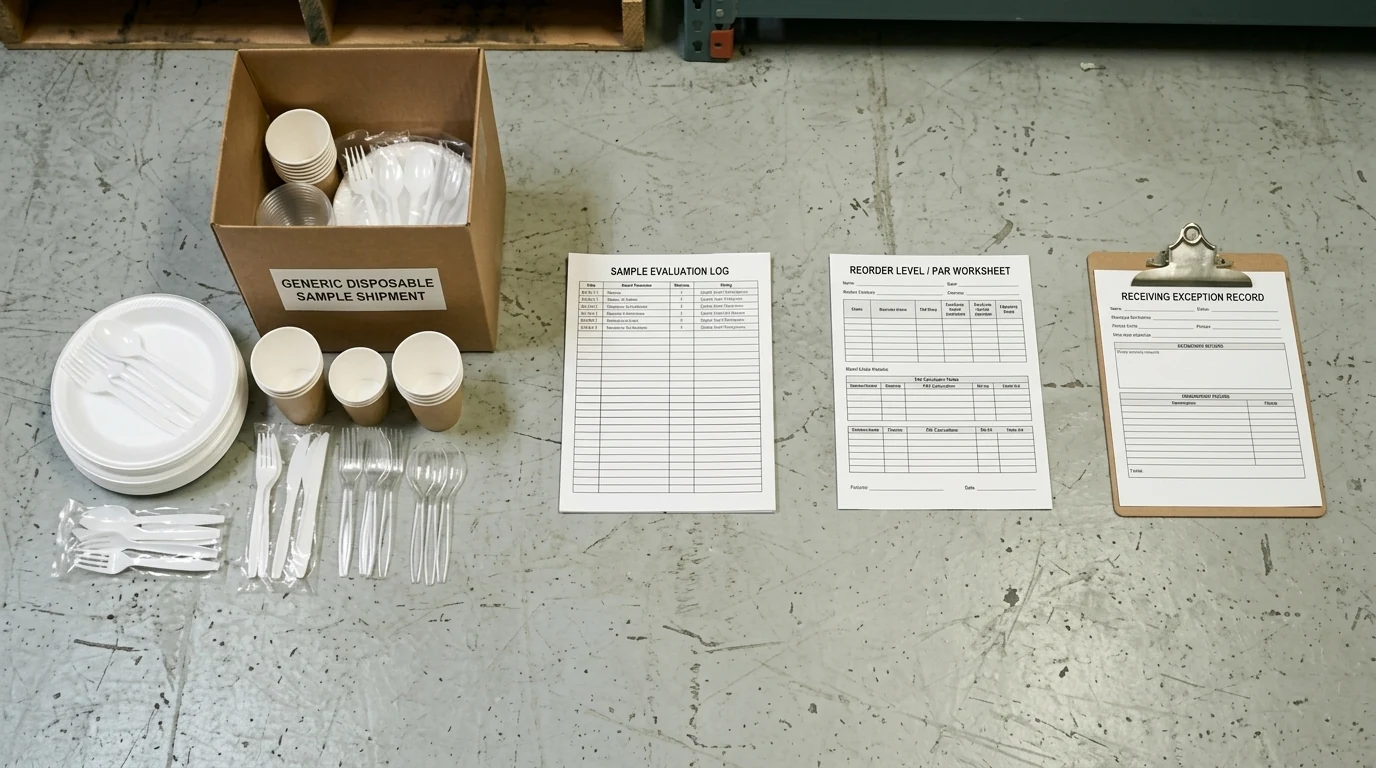
Before a new disposable item is added to the replenishment loop, it must undergo a controlled sample evaluation. This is not a casual review; it is a documented process where specific, observable characteristics are tested against operational requirements. Lead times must also be logged during this phase, tracking the days from request to dispatch, receipt, and final approval. Without a documented sample process, a buyer might approve an item that fails during peak service, requiring an emergency resourcing effort.
The Federal Acquisition Regulation 14.202-4: Bid Samples establishes that samples are appropriate when important product characteristics cannot be described adequately in a specification, and the evaluated characteristics must be stated. We use this to support a narrow sample plan with named observable characteristics, decision owners, and written acceptance or rejection. We use this as a procurement-control analogy only; do not represent federal rules as restaurant legal requirements. Documenting the production source during the sample phase is critical, as unauthorized changes in the manufacturing facility later on can alter the item's physical dimensions or stacking profile.
Table 4: Sample and Lead-Time Log
| Sample ID | Quoted SKU | Observable Characteristics | Approval Owner | Production Source | Req / Disp / Rec / Appr Dates | Observed Lead Time | Change Notice Req. |
|---|---|---|---|---|---|---|---|
| SMP-001 | SUP-FK-99 | Tine rigidity, wrapper seal integrity | Ops Director | Facility Alpha | 01-05 / 01-07 / 01-10 / 01-12 | 7 Days | Yes, prior to PO |
| SMP-002 | SUP-PL-88 | Stackability, rim uniformity | Ops Director | Facility Beta | 02-01 / 02-03 / 02-08 / 02-10 | 9 Days | Yes, prior to PO |
| SMP-003 | SUP-NP-77 | Dispenser fit, fold alignment | Ops Director | Facility Gamma | 03-10 / 03-12 / 03-15 / 03-18 | 8 Days | Yes, prior to PO |
| SMP-004 | SUP-CP-66 | Lid snap fit, base stability | Ops Director | Facility Delta | 04-05 / 04-06 / 04-09 / 04-11 | 6 Days | Yes, prior to PO |
A sample of a disposable portion cup is approved based on its precise lid fit, manufactured at Facility Alpha. Six months later, the supplier shifts production to Facility Beta without issuing a change notice. The new cups have a microscopic variance in the rim diameter. The lids no longer secure properly, causing widespread spills at the drive-thru window and disrupting service speed.
Buyer-Entered Forecast and Par Inputs
Replenishment of disposable serviceware relies on accurate forecasting and a precise par input for every item. However, there is no single fixed number that applies to all restaurants. Instead, operators must use a structured worksheet that calculates reorder triggers based on site-specific inputs: historical usage, review periods, on hand inventory, open receipts, known event demand, and observed lead times. A par input is not a static figure; it is a dynamic variable that must be updated as seasonal traffic patterns shift.
When a buyer enters a par input into the procurement system, they are establishing the baseline inventory required to survive the lead time plus the review period, along with a safety buffer. If the on hand inventory drops below this calculated threshold, the system flags the item for reorder. The accuracy of the on hand count is paramount; if the physical stock does not match the system's on hand record, the entire replenishment calculation will fail, leading to either severe stockouts or excessive over-ordering.
This methodology is supported by technical planning models. Oracle Inventory Help: Reorder Point Planning notes that reorder-point planning considers on-hand quantity, planned receipts, safety stock, forecast demand, and replenishment lead time. We use this to support a buyer-owned reorder worksheet based on site demand, stock position, receipts, buffer policy, and observed lead time. We describe the inputs as a planning framework, not a promise of stockout prevention. The buyer sets the buffer based on their specific risk tolerance and storage capacity. Every par input must be carefully validated against actual consumption.
Table 5: Forecast and Par Input Worksheet
| Buyer Item ID | Site Usage (Weekly Avg) | Review Period (Days) | Current On Hand | Open Receipts | Event Demand (Extra) | Observed Lead Time | Buyer-Set Buffer |
|---|---|---|---|---|---|---|---|
| DISP-CUT-001 | 3 Cases | 7 Days | 2 Cases | 1 Case | 0 Cases | 7 Days | 1 Case |
| DISP-PLT-002 | 5 Cases | 7 Days | 3 Cases | 0 Cases | 2 Cases | 9 Days | 2 Cases |
| DISP-NPK-003 | 2 Cases | 14 Days | 1 Case | 2 Cases | 0 Cases | 8 Days | 1 Case |
| DISP-CUP-004 | 4 Cases | 7 Days | 1 Case | 0 Cases | 1 Case | 6 Days | 1 Case |
A restaurant relies on a static, historical par level for disposable plates. A large catering event is booked for a Tuesday, right after the weekly Monday par review. Because the forecast worksheet did not include an input for "Event Demand," the standard buffer is entirely consumed by the catering order. The daily operations are left stocked out of plates before the next scheduled delivery arrives.
End-to-End Reorder Workflow
Translating the forecast inputs into a physical purchase order requires a disciplined reorder workflow. This workflow takes the data from the par input worksheet, applies the UOM and MOQ normalization rules, and generates a supplier-order increment. This process creates a systematic review trigger, though it does not promise absolute availability or fixed expenditure reductions. The workflow must be executed sequentially to ensure data integrity.
The replenishment system aggregates the weekly average usage and any specific event demand entered by the site manager for the upcoming review period.
The system calculates the net inventory position by taking the current on hand physical count and adding any open receipts (dispatched purchase orders).
The observed lead time is factored in, and the system subtracts the net inventory position from the total forecasted demand (including buffer) to identify the raw unit deficit.
The raw deficit is pushed through the UOM crosswalk and MOQ normalization table. If the deficit is 3 cases but MOQ is 5 cases, it rounds up to 5 cases.
The normalized order increment is transmitted to the supplier using the exact Supplier SKU and Orderable Unit defined in the item master crosswalk.
The transmitted order is logged as an open receipt to prevent duplicate orders, and the expected arrival date is scheduled on the receiving dock calendar.
Receiving Tolerances and Exceptions
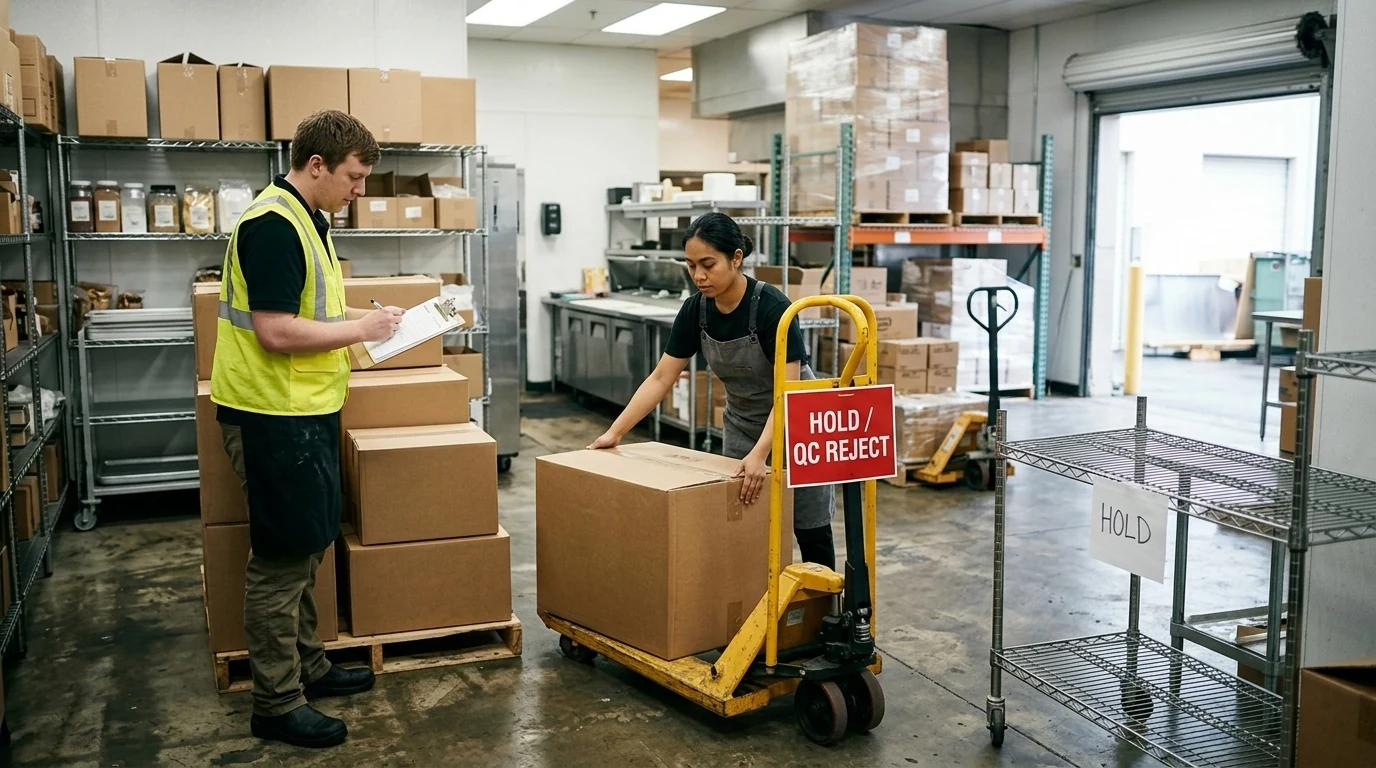
When the disposable serviceware arrives at the restaurant or distribution center, the receiving dock must execute a strict inspection protocol. When a delivery truck arrives, the receiving dock personnel must immediately verify the physical freight against the purchase order. This involves checking the supplier SKU, the unit of measure, and the total case count. This protocol separates the verification of carton identity, count, and visible condition from broader compliance checks. If discrepancies arise - such as shortages, over-deliveries, substitutions, or damage - the receiving team must follow a defined exception workflow.
The Federal Acquisition Regulation 8.406-2: Inspection and Acceptance demonstrates that destination receipt inspection can be limited to kind, count, and condition when prior source inspection has covered conformity. We use this to support a receiving checklist that separates carton identity, count, and visible condition from other evidence owners. Furthermore, Federal Acquisition Regulation 46.503: Place of Acceptance establishes that contracts identify where acceptance occurs, while destination checks can still cover quantity, transit damage, substitution, or fraud. We use these as process models and control concepts only; do not imply federal acceptance rules govern a restaurant purchase or assert legal applicability to a particular restaurant contract.
Practical receiving execution relies on clear documentation. The Idaho State University Inventory and Receiving Guidance calls for checking damage, matching products and quantities to the packing slip, and documenting discrepancies. We use this to support a receiving log that records PO, packing-list, SKU/UOM, quantity, condition, and exception owner, serving as a neutral receiving practice without importing institution-specific payment or storage rules. Additionally, Virginia Tech Procurement: Damaged Goods advises that prompt receipt inspection, detailed damage records, photographs, retained packaging, and documented supplier communication support discrepancy handling. We use this to support a receiving-exception packet and hold workflow for damage or shortage before stock is released, using the documentation practice only and not reproducing institution-specific claims, payment holds, or freight terms. The on hand inventory system must only be updated with the exact quantity physically received and accepted. Any damaged cases must be quarantined and excluded from the available on hand balance until a disposition decision is made by the procurement buyer.
Table 6: Receiving-Tolerance and Exception Table
| Exception Type | Item Identity / UOM Check | Case Count Tolerance | Condition Evidence | Quarantine Action | Disposition Owner | Substitution Rule | Shortage Action | Over-Delivery Action | Damage Evidence Req. |
|---|---|---|---|---|---|---|---|---|---|
| Identity Mismatch | Supplier SKU does not match PO | No unapproved variance | Visual check of carton label | Hold on dock, do not open | Procurement Buyer | Reject unless pre-approved | N/A | N/A | Photo of carton label |
| Shortage | Matches PO | Accept only within buyer-approved item tolerance | Clean cartons, missing units | Receive partial, log deficit | Inventory Manager | N/A | Log on packing slip | N/A | Annotated packing slip |
| Over-Delivery | Matches PO | Hold any amount above buyer-approved PO tolerance | Clean cartons, excess units | Hold excess on dock | Procurement Buyer | N/A | N/A | Request return authorization | Photo of excess pallets |
| Transit Damage | Matches PO | No unapproved variance for crushed cases | Crushed corners, torn shrink | Quarantine damaged cases | Receiving Supervisor | N/A | Treat as shortage | N/A | Photos, retained packaging |
| UOM Substitution | Different inner-pack config | No unapproved variance | Carton weight/size variance | Quarantine entire delivery | Procurement Data Team | Reject to prevent inventory error | N/A | N/A | Photo of inner pack label |
A supplier runs out of the standard 1000-count case of forks and substitutes two 500-count cases without notifying the buyer. The receiving dock, looking only at the total unit count, accepts the delivery and logs "1 case" received in the inventory system, assuming the standard UOM. The inventory system now believes 1000 units were added, but only 500 are physically present, leading to a phantom inventory stockout later in the week.
Continuity Controls for Replenishment
The procurement system must be resilient to changes. Suppliers frequently alter SKUs, pack hierarchies, case quantities, production sources, or lead times. Supplier-returned data is rarely static. A manufacturer might optimize their production line, changing a case pack from 1,000 eaches to 800 eaches. If the restaurant's procurement system is not updated to reflect this new supplier-returned data, the next automated order will create an inventory shortage equal to the pack-count difference. If these changes are not systematically managed through continuity controls, the replenishment loop will break. A change in case quantity, for example, requires an immediate update to the UOM crosswalk, the par input worksheet, and the receiving tolerances.
Continuity controls dictate exactly who is responsible for updating the data models when a change notice is received. This ensures that the next automated reorder trigger uses the correct math, preventing the cascading failures associated with outdated item masters. Continuity controls require a strict workflow where any change notice from a supplier triggers an immediate review of the SKU crosswalk, the par input variables, and the receiving tolerances. The procurement data team must own this update process, ensuring that every operational field stays bound to the exact supplier SKU, UOM, site, and buyer-approved record.
Table 7: Continuity Controls for Item Changes
| Change Trigger | Impacted Data Model | Required Action | Notification Routing | Control Owner |
|---|---|---|---|---|
| Changed Supplier SKU | SKU/UOM Crosswalk | Update Supplier SKU field, map to existing Buyer ID | Alert Receiving Dock of new label | Procurement Data Team |
| Changed Case Quantity | SKU/UOM Crosswalk & Par Worksheet | Update Contained Qty, recalculate Order Multiple | Alert Inventory Manager of new par math | Procurement Data Team |
| Changed Production Source | Sample and Lead-Time Log | Require new sample evaluation for observable characteristics | Alert Ops Director for re-approval | Procurement Buyer |
| Changed Lead Time | Forecast and Par Input Worksheet | Update Observed Lead Time, adjust Review Trigger | Alert Replenishment Buyer of new schedule | Inventory Manager |
| Changed MOQ Rule | Normalization Table | Update Supplier MOQ, adjust Buyer-Set Buffer if needed | Alert Replenishment Buyer of capital impact | Procurement Buyer |
Next Steps in Procurement Operations
Establishing strict controls over disposable serviceware transforms a chaotic purchasing environment into a predictable, data-driven replenishment loop. By maintaining rigorous assortment maps, UOM crosswalks, and receiving tolerances, restaurant operators can protect their inventory integrity and operational continuity.
To align your inventory data models and review a disposable-serviceware case-pack and reorder schedule, contact our procurement operations team.
Get the week's latest industry information
-
Real-Life Professional Restaurant Case Studies
Explore Now
-
Create a unique restaurant with over 95,700+products
Explore Now
-
Protessional Free 3D Restaurant Design
Explore Now
-
Still Have Questions About Opening a Restaurant?
Explore Now

Sylvia
With 8 years in catering & hospitality industry, sales manager of Ron Group, specialise in providing one stop solutions to restaurants, hotels and weddings.
Discover Our Exclusive Products
Explore our extensive range of restaurant and hotel supplies designed to enhance your operations. Find the perfect solutions to meet your needs.
Browse Our ProductsFREE 3D DESIGN
Boost your restaurant's success with our free 3D design service. Start building the restaurant of your dreams today!
Explore 3D Design Case
RECOMMENDED CASES
-

La Rambla by Catalunya: Crafting Barcelona's Soul in Hong Kong - Custom Furniture Excellence
RON Group's custom Spanish-inspired furniture elevates La Rambla with artisanal aesthetics...
Learn More -

Cardinal Point: Elevating Outdoor Seating with Tailored Cushion Upgrades
Discover how Cardinal Point transformed its outdoor dining experience with custom cushions, achievin
Learn More
RECOMMENDED BLOGS
-

Bar Glassware 101: Types, Names, Uses, and How to Stock Your Bar
Learn the 10 core bar glassware types, names, and uses. Discover how to stock your bar with the right glasses for cocktails, beer,...
Sylvia2026-07-26 -

Complete Bar Equipment List for Opening a Bar
Plan a complete commercial bar equipment list by menu, service volume, refrigeration, ice, glassware, utilities, sanitation,...
Sylvia2026-06-11 -

Low Budget Restaurant Interior Design: 2026 Trends
Prioritize a low-budget restaurant interior by protecting code, operations, durability, accessibility, and phased design decisions...
Sylvia2026-04-04
Subscribe to RON GROUP
Stay up-to-date with the latest industry insights and expert advice. Together, we'll create your ideal restaurant.