


Commercial Restaurant Dinnerware Guide: Selecting Plates, Bowls, and Chip-Proof Porcelain for High-Volume Hospitality
Content
Executive Overview: The True Function of Commercial Dinnerware
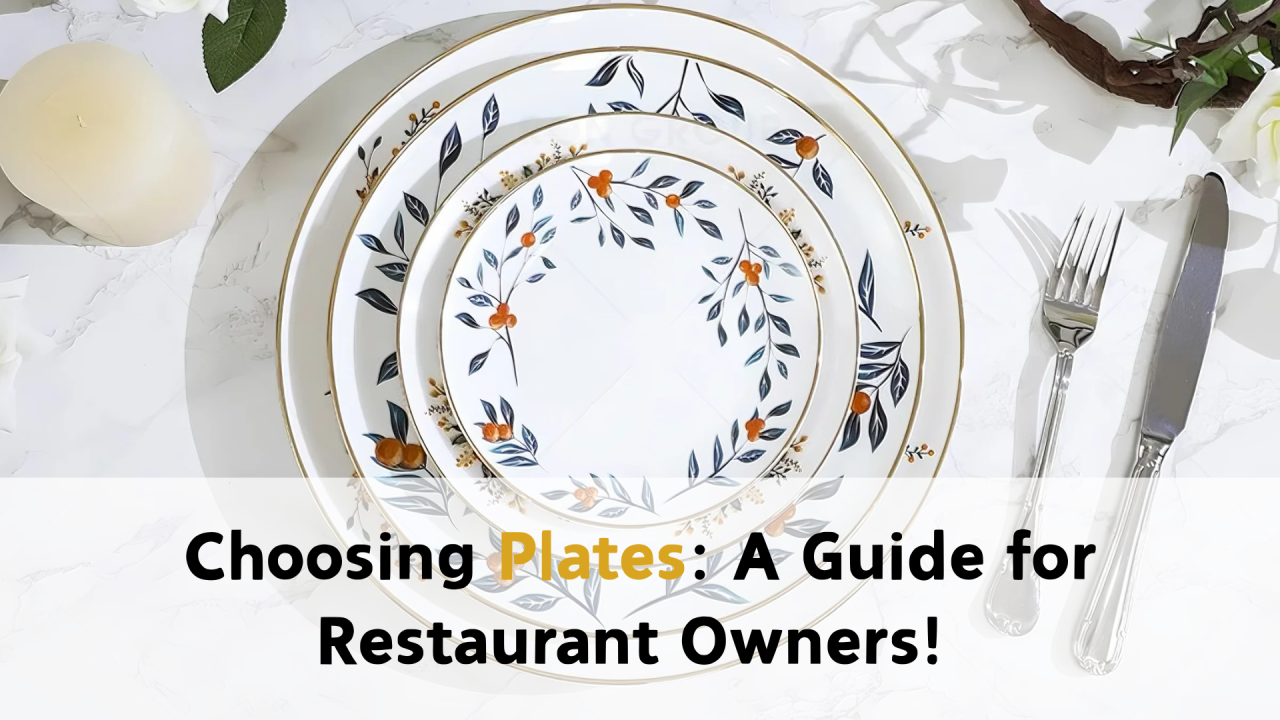
In professional hospitality operations, dinnerware is never merely a vehicle for food delivery. A plate is an active operational tool, an engineering substrate, and a core driver of guest perception. From the moment a server places an entree on the table, the tactile weight, thermal retention, acoustic response, and visual framing of the dinnerware directly influence how guests perceive food quality, freshness, and menu value.
Yet behind the dining room doors, commercial tableware undergoes relentless physical and chemical punishment. In a high-turnover casual restaurant, bistro, or luxury hotel banquet hall, an individual dinner plate is bussed, stacked, transported in heavy dish tubs, exposed to thermal shock under infrared pass heat lamps, washed in high-alkaline commercial dishmachines at 160 degrees Fahrenheit (71 degrees Celsius), and rinsed at 180 to 195 degrees Fahrenheit (82 to 90 degrees Celsius) up to four to six times every single day.
Independent operators and food and beverage directors often make a critical procurement mistake during opening phases: purchasing domestic retail dinnerware, everyday consumer ceramics, or budget unvitrified stoneware to cut initial capital expenditure (CapEx). Within 60 to 90 days, the consequences become catastrophic. Thin rims chip under standard busing collisions; soft decorative glazes develop unsightly gray cutlery scratches from 18/10 stainless flatware; and porous ceramic bodies absorb wash water, causing thermal cracking under heat lamps and creating serious food sanitation hazards.
[Domestic Everyday Ceramic Plate]
Porosity: 3.0% - 10.0% Water Absorption
Glaze Hardness: Mohs 4 - 5 (Easily scratched by cutlery)
Rim Design: Feathered / Sharp edge (Chips at < 0.15 Joules)
Thermal Shock Limit: Delta 100 deg C (Cracks under heat lamps)
Dishwasher Life: 150 - 300 cycles before glaze hazing
Result: 35% - 50% Annual Attrition Rate

VS.

[Ron Group Commercial High-Alumina Porcelain]
Porosity: Vitrified to < 0.10% Water Absorption
Glaze Hardness: Mohs 7 Diamond-Polished Silicate Glaze
Rim Design: Reinforced Rolled Rim (Withstands > 0.40 Joules)
Thermal Shock Limit: Delta 180 deg C (Freezer to 200 deg C oven safe)
Dishwasher Life: 2,500+ commercial wash cycles
Result: Under 10% - 12% Annual Attrition Rate
Selecting the right commercial dinnerware requires understanding the intersection of mineral material science, edge impact engineering, ergonomic server handling, menu-specific plating geometry, and multi-year lifecycle economics. This comprehensive technical guide breaks down the physical properties, plating categories, par level formulas, and factory-direct procurement strategies every restaurant owner and hospitality executive must master before issuing a commercial tableware purchase order.
Ceramic Science: What Makes Dinnerware Truly Commercial-Grade?
Not all white plates are created equal. Two plates of identical diameter, gloss, and weight can perform in completely opposite ways in a commercial kitchen depending on raw mineral formulation, pressing density, and vitrification firing temperature.
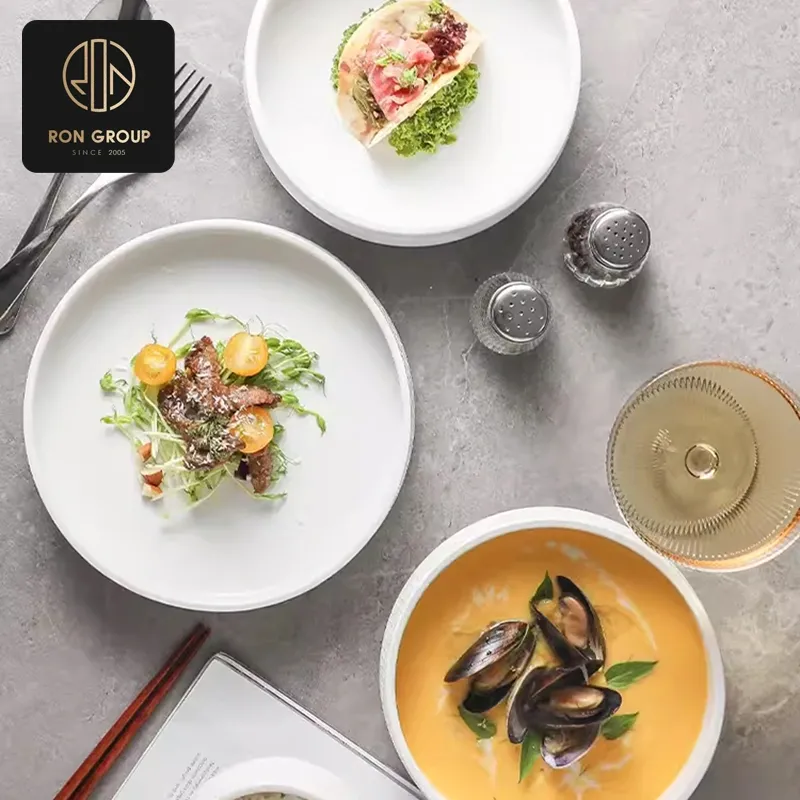
1. High-Temperature Vitrification (1320 deg C to 1380 deg C)
The primary dividing line in ceramic engineering is vitrification. Earthenware and low-grade domestic ceramics are fired at temperatures between 1000 and 1150 degrees Fahrenheit (1000 deg C to 1150 deg C), leaving a porous clay core.
Commercial hospitality porcelain produced by Ron Group is formulated with high-purity kaolin clay, feldspar, quartz, and an engineered 15% to 22% aluminum oxide (alumina) additive. The ware undergoes a preliminary bisque firing, followed by an intense glaze vitrification firing in high-efficiency tunnel kilns at temperatures ranging from 1320 to 1380 degrees Celsius (2408 to 2516 degrees Fahrenheit).
At these temperatures, the feldspar melts into liquid glass, filling microscopic pores between mullite and quartz crystals. This process fuses the clay body into a monolithic, non-porous vitreous structure with an industry-leading water absorption rate below 0.10% (conforming to BS 4034 and ASTM C373 standards).
Zero internal porosity provides three vital operational protections:
- Sanitary Compliance: Wash water, animal fats, and food pigments cannot penetrate the ceramic interior, eliminating bacterial colonization and rancid odors.
- Thermal Shock Immunity: Without trapped moisture that expands rapidly when heated, vitrified porcelain tolerates thermal swings up to Delta 180 degrees Celsius (Delta 356 degrees Fahrenheit). Plates can transfer safely from a cold staging walk-in directly under high-intensity infrared heat lamps or commercial salamander broilers without catastrophic micro-fractures.
- Microwave and Oven Safety: The absence of moisture pockets prevents uneven internal thermal stress that shatters consumer earthenware in commercial kitchens.
2. Mohs Scale 7 Scratch-Resistant Hard Glaze
Everyday plates frequently use low-temperature lead-bearing or soft borosilicate glazes that measure between 4 and 5 on the Mohs mineral hardness scale. When commercial waitstaff and guests cut meat or pasta using 18/10 stainless steel flatware (which contains hard martensitic blade alloys), the metal abrades the glaze surface. This leaves microscopic metallic deposits known as "gray cutlery marking" that cannot be removed by washing, permanently ruining table presentation.
Ron Group commercial porcelain features a high-density, lead-free feldspathic glaze engineered to Mohs Hardness 7 (equal to natural quartz). It is impervious to commercial cutlery abrasion, maintaining its pristine mirror gloss and brilliant surface reflection across thousands of covers.
3. Reinforced Rolled-Rim Impact Engineering
Over 85% of commercial dinnerware breakage occurs around the perimeter edge rather than the plate center. When busing personnel clear tables, stack plates into bus tubs, or load them into dishmachine wash pegs, plate edges collide under dynamic shock forces between 0.15 and 0.35 Joules.
Standard retail dinnerware features a tapered, sharp, or "feathered" rim that concentrates mechanical impact stresses on a razor-thin perimeter. Under minor contact, the edge flakes off, creating sharp jagged chips that instantly render the plate unusable and create severe guest safety liabilities.
Commercial vitrified tableware incorporates an engineered reinforced rolled rim. By rounding the edge profile and thickening the ceramic cross-section at the perimeter, impact kinetic energy is distributed across a broader arc. In standardized pendulum impact testing (ASTM C368), Ron Group rolled-edge porcelain absorbs impact energies exceeding 0.42 Joules without rim failure, reducing annual plate chipping rates by over 65%.
Commercial Performance Comparison Matrix
The table below outlines the core technical performance variances between domestic consumer dinnerware and Ron Group commercial-grade vitrified porcelain:
| Engineering Parameter | Domestic Retail Ceramic / Earthenware | Ron Group High-Alumina Vitrified Porcelain | Commercial Impact on Restaurant Operations |
|---|---|---|---|
| Vitrification Firing Temperature | 1,000 deg C - 1,150 deg C | 1,320 deg C - 1,380 deg C | Complete mineral fusion; zero internal micro-voids or moisture pockets. |
| Water Absorption Rate | 3.0% - 10.0% (Porous) | < 0.10% (BS 4034 Fully Vitrified) | Complete bacterial barrier; zero steam-induced cracking under heat lamps. |
| Glaze Surface Hardness | Mohs 4.0 - 5.0 | Mohs 7.0 (High-Alumina Fused) | Complete immunity to 18/10 stainless flatware scratching and gray marking. |
| Edge Impact Resistance | 0.10 - 0.18 Joules (ASTM C368) | > 0.42 Joules (Reinforced Rolled Rim) | Survives repeated collisions in bus tubs and commercial dish racks. |
| Thermal Shock Tolerance | Delta 80 deg C - 100 deg C | Delta 180 deg C (Delta 356 deg F) | Seamless transfer from cold preparation walk-ins to hot pass heat lamps. |
| Commercial Dishwasher Cycles | 150 - 300 cycles (Glaze etching) | 2,500+ cycles (Guaranteed gloss retention) | Resists high-alkaline (pH 11-13) chemicals and 85 deg C sanitizing rinses. |
| Stacking Base Engineering | Rough, unpolished abrasive foot ring | Precision diamond-ground smooth foot | Prevents foot rings from scratching the face glaze of nested plates. |
| 5-Year Annual Chipping Loss | 35.0% - 50.0% of active inventory | 8.0% - 12.0% of active inventory | Eliminates continuous reordering panic and reduces 5-year OpEx by 48%. |
Comprehensive Plating Taxonomy: Selecting the Right Profiles for Your Menu
A successful restaurant requires an intentional inventory of plate shapes, depths, and diameters tailored to specific culinary techniques, kitchen workflows, and presentation styles.
1. Flat Dinner Plates: Wide-Rim vs. Modern Coupe
The flat dinner plate is the flagship anchor of front-of-house table settings. Choosing between traditional wide-rim profiles and modern coupe silhouettes influences both culinary presentation and dining room ergonomics.
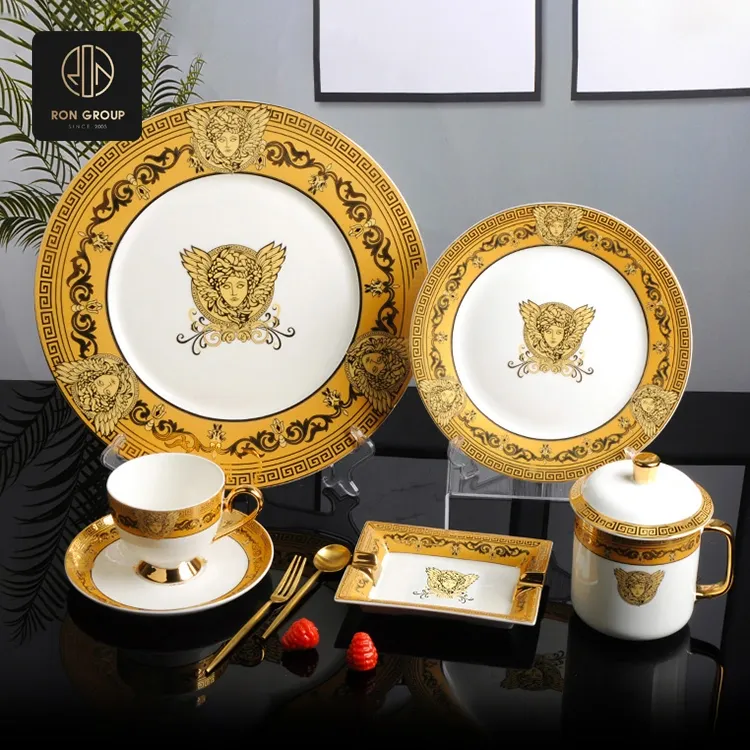
- Wide-Rim Dinner Plates (10.5 in to 11.5 in / 27 cm to 29 cm):
- Best For: Fine dining, classic French and Italian cuisine, formal banquets, and upscale steakhouses.
- Operational Advantage: The wide 1.5-inch to 2.0-inch rim provides an inviolable "clean zone" for waitstaff thumb placement during service, preventing food contact and fingerprint smudges. The raised rim acts as an architectural picture frame that directs the diner's eye to the center entree while containing au jus and pan reductions.
- Coupe Dinner Plates (10.0 in to 10.5 in / 25 cm to 27 cm):
- Best For: Contemporary bistros, farm-to-table dining, Asian fusion, and high-energy casual concepts.
- Operational Advantage: Coupe plates eliminate the distinct perimeter rim, maximizing the usable flat surface area. A 10.0-inch coupe offers the plating area of an 11.5-inch wide-rim plate while occupying 25% less tabletop surface. This space efficiency allows operators to deploy compact two-top tables without table crowding, increasing dining room seat density and total revenue per available seat hour (RevPASH).
2. Deep Soup and Pasta Plates: Containing Liquid Dynamics
Standard flat plates fail when presented with sauced courses, emulsified pasta, broths, or risotto. Deep plates prevent culinary spills and preserve critical food temperatures.
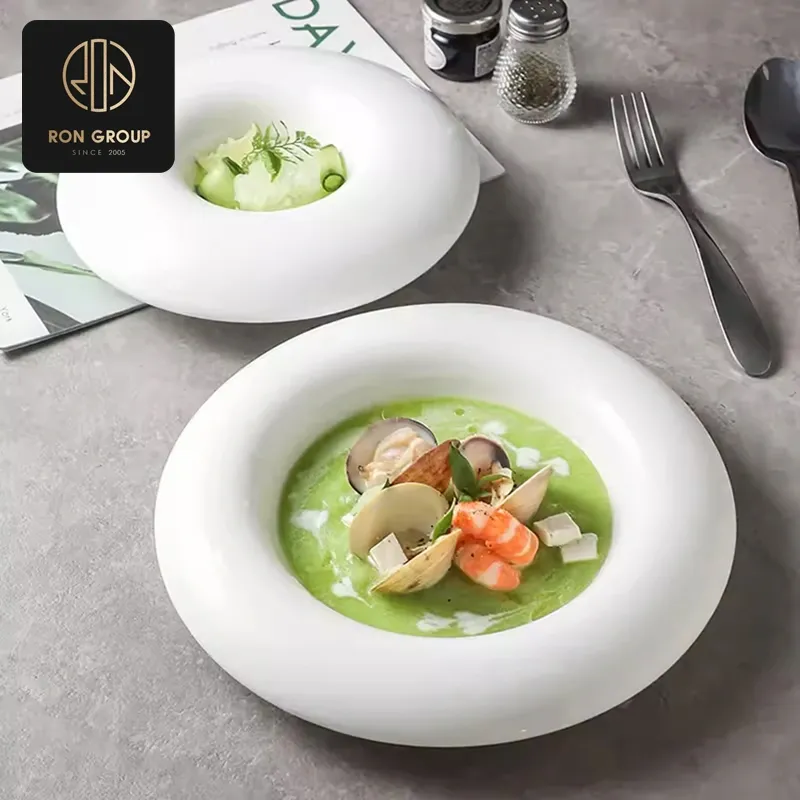
- Deep Rimmed Pasta Plates (9.5 in to 10.5 in / 24 cm to 27 cm, 18 oz to 24 oz):
- Best For: Handmade pastas, braised short ribs over polenta, bouillabaisse, and curries.
- Operational Advantage: The deep concave center well cradles food, keeping sauces pooled and retaining heat up to 40% longer than flat plates. The gentle slope allows diners to comfortably twirl pasta against the curve with a fork, while the broad flat rim catches accidental splashes before they soil tablecloths.
- Coupe Soup Bowls (8.0 in to 9.0 in / 20 cm to 23 cm):
- Best For: Hearty stews, ramen, poke bowls, and grain bowls.
- Operational Advantage: High vertical sidewalls prevent spillage during fast-paced server transit from the line pass to distant outdoor dining patios.
3. Dedicated Pizza Plates: Thermal Retention and Crisp Crust Preservation
Serving artisanal pizza on standard domestic plates or flat wooden boards introduces immediate quality degradation. Wood absorbs grease and retains sanitizing odors, while flat domestic ceramic plates trap rising steam underneath the hot dough, turning a crispy charred crust soggy within minutes.
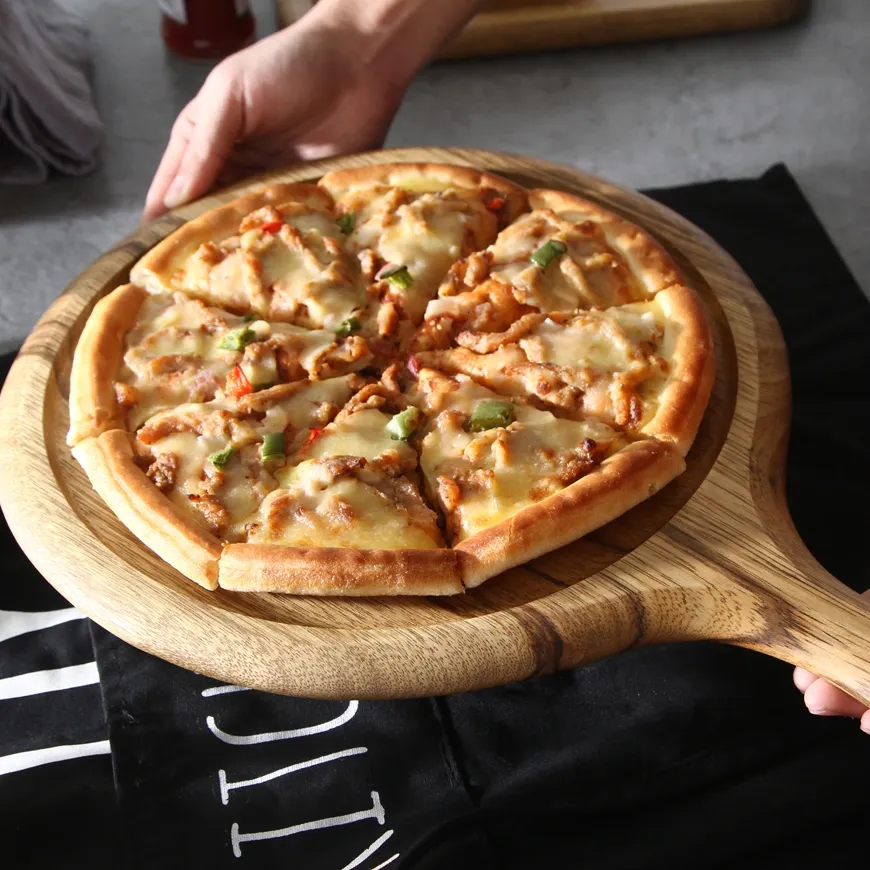
- Vitrified Ceramic Pizza Plates (12.0 in to 13.5 in / 30 cm to 34 cm):
- Best For: Neapolitan pizzerias, wood-fired casual bistros, and Italian trattorias.
- Operational Advantage: Commercial porcelain pizza plates feature a massive, dense ceramic body that pre-warms under line lamps, acting as a thermal heat battery that keeps thin crusts piping hot. The low-profile 0.5-inch perimeter lip prevents sliced pizza segments, olive oil, and melted burrata from sliding off the edge while permitting seamless pizza wheel cutting without rim interference.
4. Wide Pasta and Risotto Bowls: The Chef's Versatile Canvas
Modern gastronomy increasingly relies on multi-functional shallow bowls that bridge the gap between traditional plates and deep soup vessels.
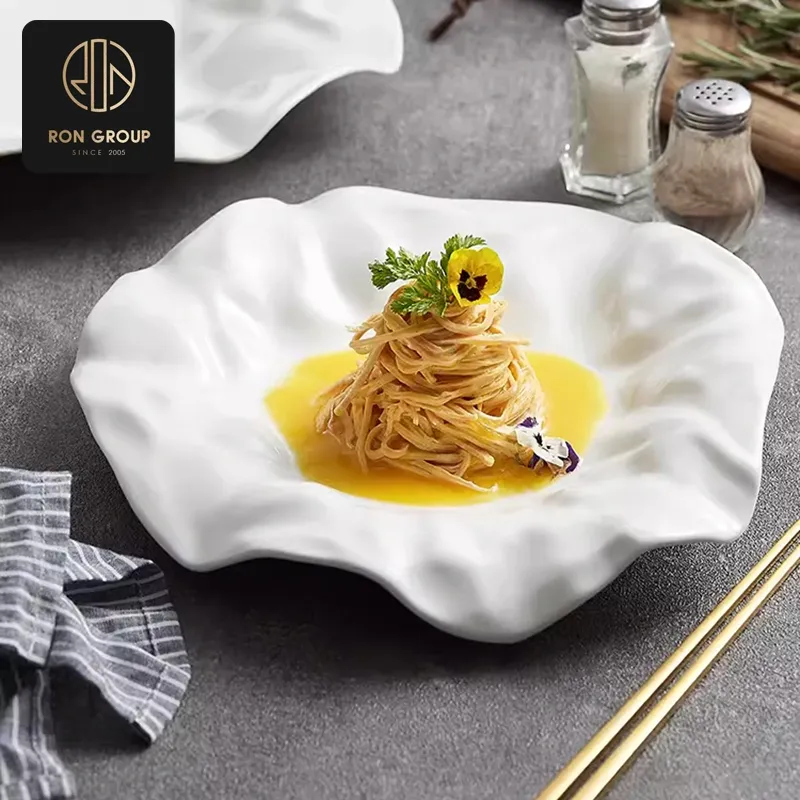
- Shallow Pasta Bowls / "Blates" (8.5 in to 9.5 in / 21 cm to 24 cm):
- Best For: Grain salads, gnocchi, stir-fries, sauced seafood, and shareable appetizers.
- Operational Advantage: The shallow coupe profile provides the dramatic visual spread of a flat plate while providing a 1.0-inch vertical perimeter wall that keeps sauces, vinaigrettes, and reductions safely contained. This single profile frequently replaces two separate skus in high-volume kitchens, streamlining prep line storage and dishroom sorting.
5. Heavyweight Oval Steak Platters: Heat Storage and Juice Channeling
Serving a 16-ounce bone-in ribeye or porterhouse steak on an undersized flat plate causes immediate operational issues: steak knives scrape against delicate rims, blood and pan juices overflow onto the table, and delicate sides are pushed off the edge.
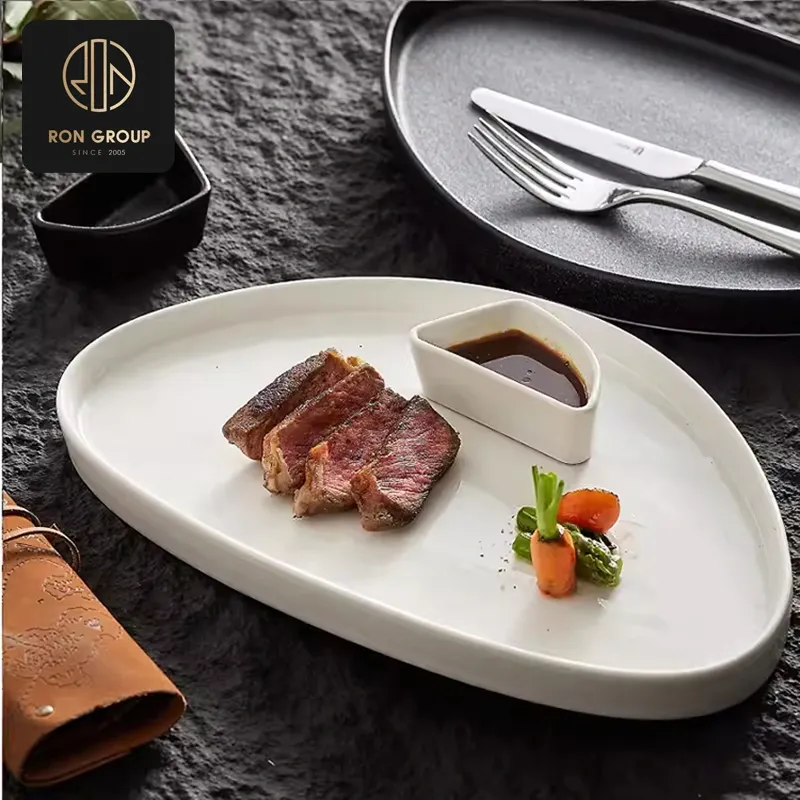
- Commercial Oval Steak Platters (11.0 in x 8.0 in to 13.0 in x 9.5 in):
- Best For: Classic steakhouses, chophouses, seafood grills, and family-style barbecue.
- Operational Advantage: Heavy commercial oval platters are pressed with substantial ceramic thickness (6.0 mm to 8.0 mm), giving them the thermal mass required to hold 140 deg F (60 deg C) surface temperatures through a 25-minute dining duration. The elongated oval geometry accommodates whole grilled fish or large cuts alongside compound butter and side starches, while recessed center wells prevent au jus overflow.
6. Rectangular and Square Gastronomy Platters: Casual Handheld Staging
Casual upscale dining, craft burger concepts, gastropubs, and sushi bars require modular plates that cleanly stage multiple culinary elements side by side.
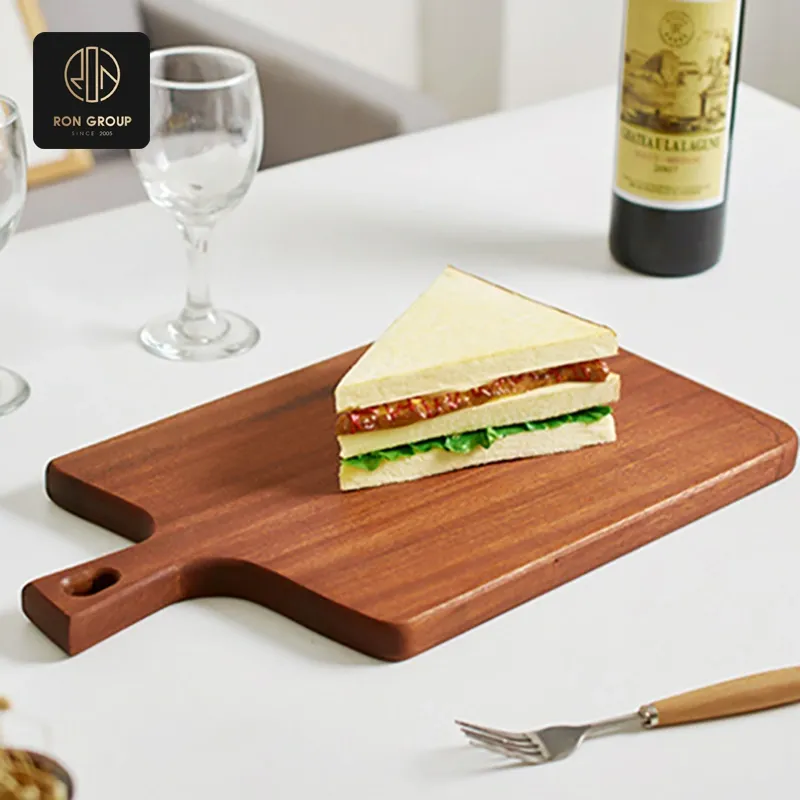
- Rectangular Gourmet Burger Platters (10.5 in x 6.5 in to 12.0 in x 7.5 in):
- Best For: Gourmet burgers, artisan sandwiches, flatbreads, sushi nigiri sets, and skewer presentations.
- Operational Advantage: Rectangular platters provide distinct geometric zones for a sandwich, a basket or stack of fries, and dipping ramekins without cross-contamination. Flat, precision-planed bases ensure zero platter wobble on wooden tabletops.
Executive Comparison: Residential vs. Commercial Tableware
+---------------------------------------------------------------------------------------------------+
|                                 EXECUTIVE SPECIFICATION AUDIT                                     |
+------------------------------------+----------------------------------+---------------------------+
| Operational Vector                 | Everyday Consumer Ceramic        | Ron Group Vitrified Ware  |
+------------------------------------+----------------------------------+---------------------------+
| Raw Composition                    | Soft red or white earthenware    | Refined Kaolin + 18%      |
|                                    | with 3%-10% porosity             | Alumina (<0.1% porosity)  |
+------------------------------------+----------------------------------+---------------------------+
| Mechanical Chipping Vulnerability  | Thin feathered edge chips        | Reinforced rolled rim     |
|                                    | at low 0.12 J collisions         | absorbs 0.42+ J impacts   |
+------------------------------------+----------------------------------+---------------------------+
| Dishwasher Detergent Resistance    | Glaze turns hazy & etched        | Fused silicate glaze      |
|                                    | after 200 wash cycles            | withstands 2,500+ cycles  |
+------------------------------------+----------------------------------+---------------------------+
| Cutlery Abrasion / Gray Marks      | Rapid surface gouging & metal    | Mohs Hardness 7 surface;  |
|                                    | transfer from 18/10 flatware     | zero cutlery marking      |
+------------------------------------+----------------------------------+---------------------------+
| Thermal Shock Stability            | Catastrophic cracking under      | Delta 180 deg C safe;     |
|                                    | line pass infrared heat lamps    | cold walk-in to hot pass  |
+------------------------------------+----------------------------------+---------------------------+
| 5-Year Financial Impact            | Uncontrolled 45% annual OpEx     | Amortized 10% attrition;  |
|                                    | replacement drain                | $8,000+ net savings       |
+------------------------------------+----------------------------------+---------------------------+
Ergonomics, Dishroom Stacking, and Acoustic Dynamics
Procurement specifications must extend beyond aesthetic dining room looks into back-of-house physics and dining room acoustics.
1. Weight Balance and Server Musculoskeletal Safety
A common misconception among non-technical buyers is that heavier dinnerware automatically translates to higher perceived luxury. While a lightweight, flimsy plate feels cheap to guests, an excessively heavy plate creates severe back-of-house physical strain.
A standard 10.5-inch commercial wide-rim porcelain plate engineered by Ron Group weighs between 750 and 850 grams (1.65 to 1.87 lbs). In contrast, unrefined domestic stoneware plates of identical size often exceed 1,150 grams (2.53 lbs) due to inefficient low-density clay bodies.
Consider a banquet server carrying an oval service tray loaded with five main course entrees. With Ron Group high-alumina dinnerware, the tare weight of the five plates equals 4.0 kg (8.8 lbs). With unrefined heavy stoneware, the plate tare weight jumps to 5.75 kg (12.7 lbs) - an extra 3.9 pounds of dead weight per carry. Over an eight-hour shift encompassing 40 tray runs, the server lifts an additional 156 pounds of dead ceramic mass. Specifying engineered commercial porcelain directly reduces server fatigue, accidental tray drops, and workplace compensation claims.
2. Nesting Tolerances and Diamond-Polished Foot Rings
Space inside high-volume commercial kitchens is at an extreme premium. Poorly engineered plates exhibit uneven warp during kiln firing, resulting in stacks that lean, rock, or jam together when stored on dish cart dollies or wire pass shelving.
Ron Group dinnerware is produced in precision hydraulic dust-press molds that ensure dimensional tolerances within +/- 1.0 mm. Stacks of 30 plates nest with zero lateral wobble, reducing vertical shelf space by 35% compared to uneven domestic ceramics.
Crucially, every Ron Group plate undergoes an automated foot ring diamond-polishing process after glaze firing. While residential plates feature rough, unglazed, sandpaper-like foot rings, Ron Group foot rings are ground to mirror smoothness. When 40 plates are stacked and subjected to vibration in mobile bus carts, the smooth foot ring glides over the glaze of the underlying plate without causing circular scratching rings.
3. Acoustic Damping and Dining Room Ambiance
In modern dining room design featuring polished concrete floors, exposed ductwork, glass facades, and hard plaster walls, ambient decibel levels can quickly become uncomfortably loud. The clatter of cutlery striking plates and the stacking noise of ceramic in wait stations contributes significantly to acoustic fatigue.
Dense, vitrified high-alumina porcelain exhibits a higher acoustic damping coefficient than unvitrified pottery or metal tableware. When an 18/10 stainless steel knife or fork makes contact with vitrified porcelain, the acoustic frequency is a crisp, muted click rather than the hollow, resonant, ear-piercing clatter produced by hollow ceramic or stainless steel platters. This subtle acoustic refinement enhances dining room speech intelligibility and luxury guest comfort.
Par Level Planning and 5-Year Total Cost of Ownership (TCO)
A critical failure in new hospitality launches is under-budgeting initial tableware par levels. Running out of clean plates during Friday night peak service forces dishmachine operators to rush wash cycles, resulting in wet, steaming plates being hurried to the line pass and thermal shock breakage.
1. The Commercial Tableware Par Level Formula
Tableware inventory requirements are determined by dining room seat count, anticipated peak table turns, and back-of-house wash turnover cycles:
$$\text{Required Plate Inventory} = \text{Seating Capacity} \times \text{Peak Turns per Service} \times \text{Safety Buffer Multiplier}$$
Recommended Par Level Benchmarks by Venue Vertical:
- High-Turnover Casual Dining / Bistros (1.5 to 2.5 hour table turns): 3.5x seating capacity per active entree plate shape. (Allows 1.0x on tables, 1.0x in bussing/dishroom transit, 1.0x clean on line pass, 0.5x storage reserve).
- Fine Dining / Upscale Casual (Single seating or 2-hour turns): 2.5x to 3.0x seating capacity.
- Hotel Banquet Facilities / Event Spaces: 1.5x to 2.0x maximum ballroom seating capacity (Accommodates simultaneous multi-course staging).
- High-Loss Small Items (Bread & Butter Plates, Espresso Saucers, Ramekins): 4.0x seating capacity (Higher loss due to bussing mishaps and trash chute discard).
2. Five-Year TCO Balance Sheet: Retail Ceramic vs. Ron Group Porcelain
The economic model below contrasts a 120-seat high-volume casual restaurant comparing domestic retail plates ($5.50 per unit) against Ron Group commercial high-alumina porcelain ($7.80 per unit) over a 5-year operating lifecycle.
Assumptions:
- Seating: 120 seats
- Entree Plate Inventory: 3.5x Par = 420 plates
- Daily Covers: 360 guests (3 full turns)
- Annual Operating Days: 360 days
| Financial Vector (120-Seat Restaurant) | Domestic Retail Ceramic ($5.50/unit) | Ron Group Commercial Porcelain ($7.80/unit) | Operational Variance & Savings |
|---|---|---|---|
| Initial Par Procurement (420 Units) | $2,310.00 | $3,276.00 | +$966.00 higher initial CapEx for Ron Group |
| Year 1 Chipping & Breakage Loss | 45.0% (189 plates replaced) = $1,039.50 | 10.0% (42 plates replaced) = $327.60 | Ron Group saves $711.90 in Year 1 OpEx |
| Year 2 Replacements & Freight | 45.0% (189 plates) = $1,039.50 | 10.0% (42 plates) = $327.60 | Ron Group saves $711.90 in Year 2 OpEx |
| Year 3 Pattern Discontinuation Restock | Pattern discontinued; full 420-unit re-buy required = $2,310.00 | 10.0% standard replenishment (42 plates) = $327.60 | Retail pattern discontinued; full replacement forced |
| Year 4 Replacements & Freight | 45.0% (189 plates) = $1,039.50 | 10.0% (42 plates) = $327.60 | Ron Group saves $711.90 in Year 4 OpEx |
| Year 5 Replacements & Freight | 45.0% (189 plates) = $1,039.50 | 10.0% (42 plates) = $327.60 | Ron Group saves $711.90 in Year 5 OpEx |
| 5-Year Accumulated Plate Spend | $8,778.00 | $4,914.00 | Ron Group Net Savings: $3,864.00 (-44.0%) |
| Labor & Admin Reordering Overhead | $1,250.00 (5 emergency small re-orders) | $200.00 (Scheduled annual maintenance) | Ron Group saves $1,050.00 in administrative time |
| TOTAL 5-YEAR DINNERWARE TCO | $10,028.00 | $5,114.00 | NET 5-YEAR CASH RETAINED: $4,914.00 |
The financial reality is incontrovertible: attempting to save $966 on opening day dinnerware costs results in $4,914 in wasted operational capital over five years. When multiplied across an entire tabletop program (soup plates, salad plates, pasta bowls, platters, and coffee ware), the loss frequently exceeds $18,000.
Global Sourcing and Damage-Free Logistics
One of the largest hidden risks in commercial dinnerware procurement is shipping damage during international transport. Unvetted suppliers pack heavy chinaware in thin 3-ply domestic cartons, resulting in crushed boxes, fractured rims, and catastrophic ocean container breakage rates exceeding 15%.
Ron Group operates from our global manufacturing and logistics headquarters in Foshan and Chaozhou, China - the historic world center of advanced ceramic engineering. We protect client investments through a rigorous quality control and export packaging protocol:
- Pre-Shipment Vitrification and Dimension Audits: Every production batch undergoes automated thermal shock tests (Delta 180 deg C), water absorption immersion testing, and rim impact pendulum verification prior to packaging approval.
- ISTA-Certified Heavy Export Packaging: All plates are packed in heavy-duty 5-ply double-wall corrugated cartons fitted with customized internal honeycomb dividers and non-abrasive micro-foam separators. No plate touches an adjacent plate without impact-absorbing cushioning.
- Heat-Treated Palletization and Edge Defense: Cartons are stacked on solid heat-treated four-way timber pallets, banded with high-tensile composite poly-strapping, shielded with heavy vertical corner-edge protectors, and fully encased in UV-stabilized moisture-barrier stretch wrap.
- Single-Port Container Consolidation (FFE + OS&E): Rather than ordering dinnerware from one vendor, dining chairs from a second, and kitchen refrigeration from a third, Ron Group consolidates your complete restaurant fit-out into unified FCL (Full Container Load) shipments. Porcelain tableware is safely staged in lower-tier pallet zones, buffered by custom commercial booths and solid furniture, eliminating transit vibration damage and saving up to 35% in ocean freight.
Executive Procurement Checklist for Restaurant Tableware
Before issuing a commercial dinnerware Request for Quotation (RFQ) or approving final purchase orders, verify the following technical parameters with your supplier:
- [ ] Material Specification: Certified fully vitrified high-alumina porcelain fired above 1320 deg C with water absorption tested under 0.10% (BS 4034 / ASTM C373).
- [ ] Glaze Rating: Lead-free and cadmium-free silicate glaze meeting FDA CPG 7117.06/07 with Mohs surface hardness 7 to eliminate cutlery marking.
- [ ] Edge Engineering: Reinforced rolled-rim profile on all high-turnover plates with pendulum impact resistance certified above 0.40 Joules.
- [ ] Thermal Stability: Guaranteed Delta 180 deg C thermal shock tolerance, safe for commercial dishwashers, microwave ovens, salamanders, and heat lamps.
- [ ] Foot Ring Polish: Diamond-ground polished foot ring on all plates to prevent circular face-glaze abrasion during vertical nesting.
- [ ] Guaranteed Replenishment Lifespan: Minimum 5-year pattern continuation guarantee to ensure replacement continuity without forced tableware redesigns.
- [ ] Complete Par Level Fulfillment: Inventory calculated at minimum 3.0x to 3.5x seating capacity for entree plates, with scheduled annual replenishment allocations.
- [ ] Export Crating Security: Verified 5-ply honeycomb carton packaging on heat-treated pallets with full container load consolidation insurance.
By demanding verified commercial-grade ceramic specifications, restaurant owners and hospitality operators protect their operational margins, safeguard brand presentation, and eliminate dinnerware chipping headaches for years to come.
Get the week's latest industry information
-
Real-Life Professional Restaurant Case Studies
Explore Now
-
Create a unique restaurant with over 95,700+products
Explore Now
-
Protessional Free 3D Restaurant Design
Explore Now
-
Still Have Questions About Opening a Restaurant?
Explore Now

Sylvia
With 8 years in catering & hospitality industry, sales manager of Ron Group, specialise in providing one stop solutions to restaurants, hotels and weddings.
Discover Our Exclusive Products
Explore our extensive range of restaurant and hotel supplies designed to enhance your operations. Find the perfect solutions to meet your needs.
Browse Our ProductsFREE 3D DESIGN
Boost your restaurant's success with our free 3D design service. Start building the restaurant of your dreams today!
Explore 3D Design Case
RECOMMENDED CASES
-
La Rambla by Catalunya: Crafting Barcelona's Soul in Hong Kong - Custom Furniture Excellence
RON Group's custom Spanish-inspired furniture elevates La Rambla with artisanal aesthetics...
Learn More -

Cardinal Point: Elevating Outdoor Seating with Tailored Cushion Upgrades
Discover how Cardinal Point transformed its outdoor dining experience with custom cushions, achievin
Learn More
RECOMMENDED BLOGS
-

Bar Glassware 101: Types, Names, Uses, and How to Stock Your Bar
Learn the 10 core bar glassware types, names, and uses. Discover how to stock your bar with the right glasses for cocktails, beer,...
Sylvia2026-07-26 -

Complete Bar Equipment List for Opening a Bar
Plan a complete commercial bar equipment list by menu, service volume, refrigeration, ice, glassware, utilities, sanitation,...
Sylvia2026-06-11 -

Low Budget Restaurant Interior Design: 2026 Trends
Prioritize a low-budget restaurant interior by protecting code, operations, durability, accessibility, and phased design decisions...
Sylvia2026-04-04
Subscribe to RON GROUP
Stay up-to-date with the latest industry insights and expert advice. Together, we'll create your ideal restaurant.