









The Flatpack Illusion: How "Missing Pre-Drilled Holes" and $300 Liftgate Fees Destroy Cheap Restaurant Furniture Budgets
Content
Executive Briefing & Strategic Positioning:
In the unforgiving arena of commercial restaurant openings, digital drop-shippers and online catalog portals sing an irresistible siren song: 30"x30" laminate table tops for $42 and cast-iron X-bases for $39. To an independent restaurateur or multi-unit operator bleeding cash in the final weeks of a buildout, this looks like an arbitrage miracle. It is not. It is an engineered transfer of manufacturing debt and logistics liability from a distant factory floor directly onto your curbside.
What appears on a purchase order as a "bargain" invariably transforms into a nightmare of stripped particle-board screws, exorbitant union handyman hours, and freight drivers holding your opening day hostage over undeclared liftgate fees. This whitepaper exposes the physics and supply chain reality behind cheap commercial dining tables - and maps the true 5-year ledger of contract-grade procurement.
Section Zero: The 48-Hour Opening Nightmare and the Loss of Human Dignity
1. The Voice of the Defrauded Operator (Reddit r/restaurateur Ground Truth)
In late August 2026, a thread erupted on Reddit's hospitality community (r/restaurateur), titled "Buyer beware of discount online restaurant furniture portals":
"Do not fall for these online 'wholesale' commercial furniture portals! Our shipment pulled up three days before our soft opening. The freight carrier driver stepped out of the cab and immediately refused to unload because our bistro is on a standard downtown street corner without a 48-inch concrete loading dock. He smirked, pulled out a rate sheet, and demanded $350 cash on the spot for a 'hydraulic liftgate service' - or threatened to drive off, charge us $200 a day in storage, and redeliver next week.
When we finally dragged the 24 heavy cartons inside ourselves, our stomachs dropped. Every single tabletop was a blank, raw board. Zero pre-drilled pilot holes. Zero alignment markings. Half the mounting machine bolts missing. We had to scramble two local handymen at $75 an hour with cordless drills for two full days. They accidentally drilled right through two laminate tops, stripped the screws on six others, and the tables wobbled on opening night anyway. We 'saved' $800 on the initial order and spent $2,400 cleaning up the disaster."
2. The Vulnerability of Creation (Alain de Botton on Spatial Dignity)
Opening a restaurant is one of the most generous, romantic, and deeply vulnerable acts a human being can undertake.
As Alain de Botton observes in The Architecture of Happiness, the objects we invite into our physical spaces possess a quiet psychological power: they speak to us of order, of benevolence, and of human dignity. When you set out to launch a dining room, your initial vision is poetic. You imagine the warm amber glow of pendant lights over polished glassware; the scent of wood-fired sourdough and roasting shallots; the gentle hum of laughter as evening falls and exhausted diners exhale into the sanctuary you have built for them. You are seeking to craft an island of grace in an indifferent world.
Yet flatpack commercial furniture - mass-market RTA (Ready-to-Assemble) junk masquerading as hospitality-grade fixtures - turns the 48 hours before opening into a scene of industrial degradation.
Instead of tasting sauces with your chef or training your front-of-house staff on table greeting protocols, you find yourself kneeling on a freezing concrete floor at two in the morning. Your knees are bruised purple. Your hands are covered in blistered skin from a cheap stamped-metal allen key. Toxic-smelling cardboard and static-cling styrofoam beads stick to your sweater. You are staring down at a blank slab of pressed wood chips with a flimsy 15mm wood screw in your hand, paralyzed by the realization that the system has betrayed you.
The cruelty of the modern digital dropship marketplace is that it disguises industrial abandonment as "e-commerce efficiency." The platform can sell you a tabletop for $42 only because they violently stripped away three essential manufacturing responsibilities:
- They eliminated CNC laser-guided pilot drilling (saving the factory 3 to 5 minutes of precision machine time per unit);
- They replaced high-tensile threaded steel inserts with 5-cent wood screws (pocketing the margin while transferring the mechanical risk to you);
- They offloaded final-mile logistics and crate-level protection (forcing you to negotiate with a freight driver on a rain-slicked curb).
This is not cost savings. It is a calculated transfer of manufacturing debt straight onto the shoulders of an exhausted small business owner.
Section One: The Micro-Mechanics of Failure: Why Self-Tapping Screws Are "Toothpicks in a Sponge Cake"
In a domestic dining room, a table experiences gentle, symmetrical use maybe three times a day. In a bustling commercial restaurant turning 150 covers an evening, that same surface is a dynamic battlefield of eccentric loads, lateral mop collisions, aggressive table-wiping, and heavy diners pushing off the rim to stand up.
1. Feynman's Schoolchild Analogy: The Playground Seesaw
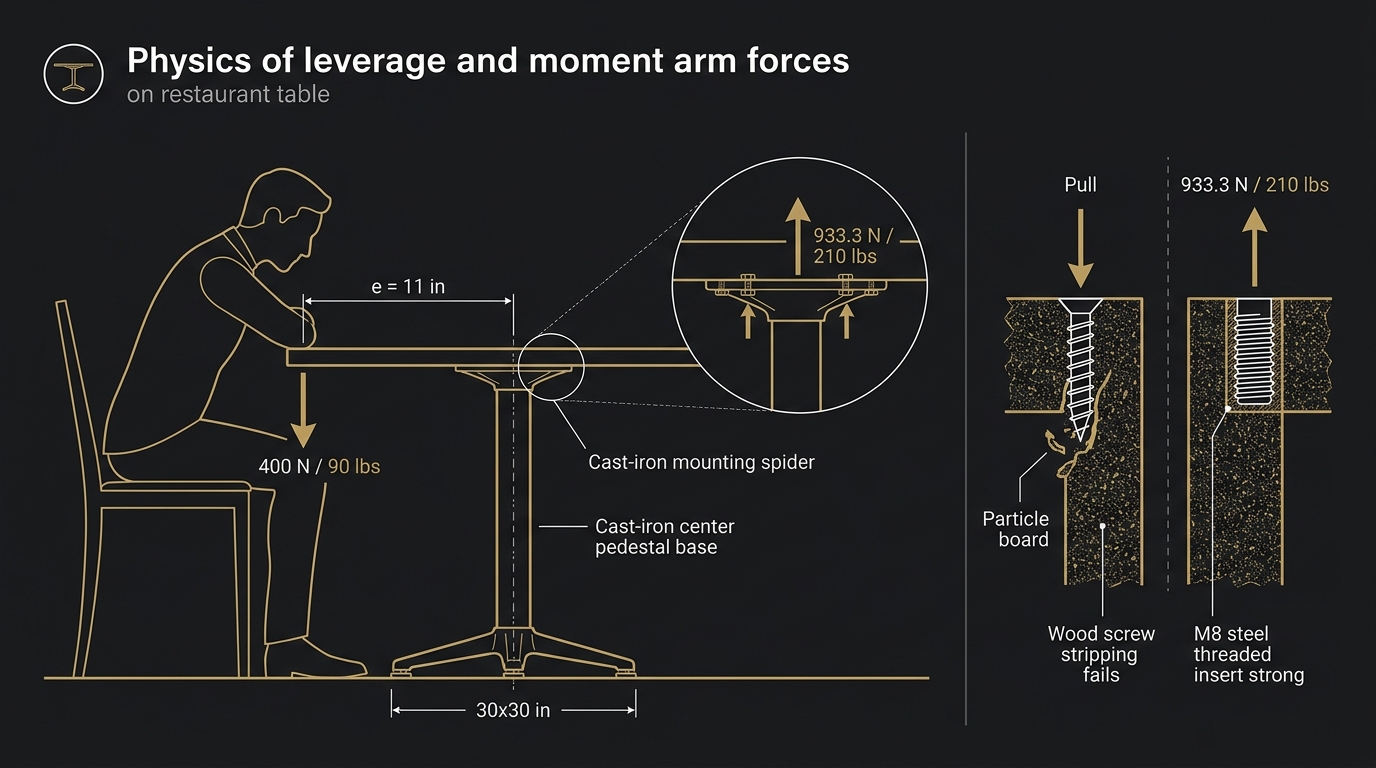
Think of a standard 30"x30" two-top table as a playground seesaw. The tabletop is the wooden plank, and the small cast-iron mounting bracket (the "spider") in the center is the pivot point.
Now, imagine an energetic adult diner, having enjoyed a hearty dinner, preparing to stand up from the table:
- The average adult diner weighs roughly 194 lbs (88 kg);
- When rising to use the restroom, they instinctively plant both palms on the outer perimeter of the table, exerting an instantaneous downward force of roughly 90 lbs (400 N);
- The distance from the table edge to the center mounting bracket (the lever arm) is 11 inches (0.28 m);
- Because the table acts as a lever, that downward push creates 82.6 lbf-ft (112 N-m) of rotational torque wrenching the center joint upward.
This rotational torque travels straight into the cast-iron spider bracket, whose mounting screw holes sit on a circle with a diameter of just 4.72 inches (0.12 m). While the screws on the diner's side are compressed downward, the screws on the far side are subjected to a violent, instantaneous upward pull-out force of 210 lbs (933 N).
MECHANICAL LEVERAGE DYNAMICS // THE SEESAW LEVER IN NUMBERS
Dynamic Downward Push (Rising Diner): 90 lbs (400 N) on the outer perimeter
Lever Moment Arm (Edge to Center): 11 inches (0.28 m)
Rotational Torque on Center Joint: 82.6 lbf-ft (112 N-m) wrenching upward
Instantaneous Pull-Out Force on Fasteners: 210 lbs (933 N) of vertical upward tension
Figure 1: Leverage and Moment Arm Dynamics. When a 90-lb diner leans on the perimeter of a 30"x30" two-top table, the 11-inch moment arm generates a violent 210 lbs (933 N) upward tensile pull on the opposing fasteners. Shallow wood screws in particle board fail catastrophically (Safety Factor = 0.37), whereas Ron Group M8 carbon-steel threaded inserts anchor solidly (Safety Factor = 3.43).
2. Pushing Toothpicks into Sponge Cake: The Particle Board Failure
What holds that 210-pound upward yank in a discount flatpack table? Four tiny #10 zinc wood screws (shank diameter 4.8 mm / 0.189 in), driven blindly into a core of pressed sawdust and resin.
Under standardized ASTM D1037 laboratory pull-out testing, a standard #10 wood screw driven 10 mm deep into commercial particleboard has an allowable holding capacity of just 76.8 lbs (341.6 N).
In mechanical engineering, the Safety Factor (SF) is calculated by dividing the holding strength by the applied load:
- Holding Capacity: 76.8 lbs (341.6 N)
- Applied Tensile Load: 210 lbs (933.3 N)
- Safety Factor: 76.8 / 210 = 0.37
Upward Lever Tension: 210.0 lbs (933.3 N)
Structural Safety Factor: 0.37 (Fails at 273% of capacity)
Upward Lever Tension: 210.0 lbs (933.3 N)
Structural Safety Factor: 3.43 (Exceeds BIFMA commercial margin)
FATAL FLAW CAUTION // STRUCTURAL CRITICAL LIMIT
The Brutal Physical Truth:
In engineering, a safety factor below 1.0 is not a mere risk; it is a mathematical guarantee of catastrophic structural failure. A safety factor of 0.37 means the joint is operating at nearly three times its physical breaking point.
It is literally identical to shoving a smooth wooden toothpick into a honey sponge cake and expecting it to suspend a 25-pound bowling ball. The shallow, fragile screw threads shear through the brittle sawdust core almost immediately. The first time a heavy diner leans forward to laugh, the wood fibers pulverize into powder, the screw pops free, and a full glass of Pinot Noir cascades across their lap.
3. The Craftsman's Answer: A Rock Climber's Expansion Bolt
In the automated workshops of Foshan, commercial table construction obeys an entirely different moral order.
No handheld electric drill is ever permitted near a commercial tabletop. Every tabletop in Ron Group's commercial restaurant table tops collection is vacuum-clamped onto a high-precision CNC multi-axis machining center. Water-cooled diamond router bits machine stepped blind holes with a tolerance tighter than +/- 0.15 mm (+/- 0.006 inches).
Next, heavy pneumatic press equipment cold-drives an industrial M8 barbed carbon-steel insert sleeve (Threaded Steel Inserts) deep into the high-density fiberboard core. Paired with contract-grade cast-iron anti-wobble table bases, the mechanical anchor transforms the entire joint structure:
- Instead of relying on micro-threads gripping loose sawdust, the M8 insert features exterior circumferential reverse barbs that lock mechanically into the solid core;
- The load area expands from a thin helical line into a solid cylindrical steel anchor;
- Single-point pull-out capacity jumps from 77 lbs to over 720 lbs (3,200 N)!
When the shipment arrives at your restaurant, assembly requires zero drilling, zero measuring, and zero guesswork. A busser armed with a simple hex key slides four heavy-duty M8 machine bolts into the pre-aligned steel sockets. Two minutes flat. Metal-to-metal machine threads. Rock-solid for a decade, even if disassembled and relocated twenty times.
Section Two: The Assembly Labor Black Hole: How $75/Hour Handymen Eat Up "Budget Savings"
Restaurateurs planning their opening budgets (Capex) frequently fall prey to a subtle accounting delusion: they treat their own physical labor and their team's frantic opening hours as free.
1. The Blind Drilling Geometric Nightmare
Mounting a cast-iron spider onto a blank tabletop is an agonizing exercise in geometry under pressure:
- A commercial cast-iron X-base weighs between 20 and 35 pounds. The mounting spider alone weighs 8 to 11 pounds;
- To prevent tipping, the mounting bracket must sit dead-center. If an installer is off by just 1/8 inch (3 mm), the table's tipping threshold shifts, causing it to wobble under regular place settings;
- A handyman must flip the board, stretch a tape measure across all four corners, mark chalk lines, center punch each hole, and apply tape to a drill bit as a crude depth stop. Push a fraction too hard, and the drill bit punctures the pristine wood veneer on the dining surface. Tilt the drill by three degrees, and the screw enters diagonally, splitting the edge of the particle core.
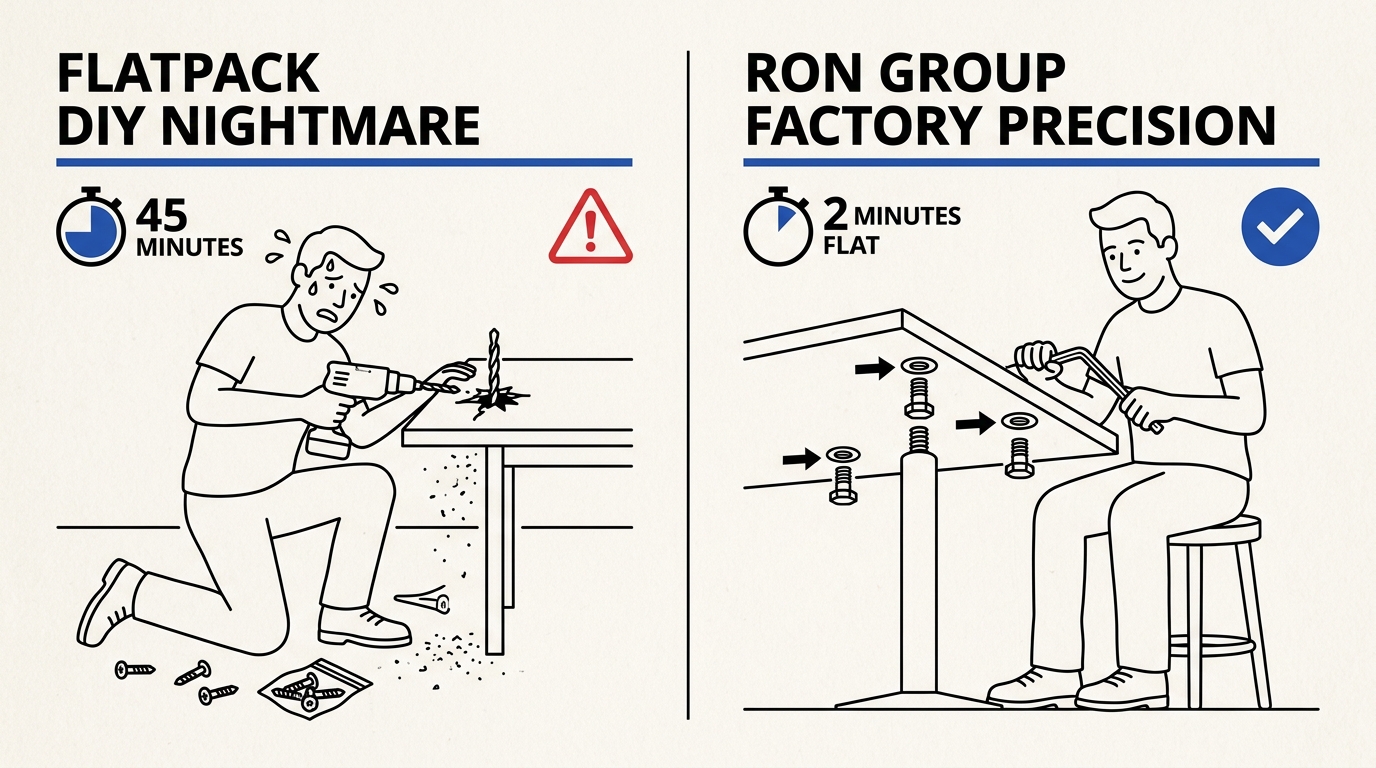
Figure 3: Assembly Labor Economics. Left: The Flatpack Nightmare - a sweaty handyman kneeling on the floor, measuring diagonals, accidentally drilling through laminates (45 minutes per table). Right: Ron Group Factory Precision - a clean 2-minute hex-key lock into CNC pre-installed metal inserts.
2. High-School Math: The Real Labor Invoice
Across metropolitan North America and Europe in 2026, the going commercial rate for a bonded handyman or tradesperson sits firmly between $65 and $85 per hour (averaging $75/hour).
Let us run the numbers for a standard 80-seat neighborhood restaurant requiring 25 dining tables (15 two-tops and 10 four-tops), paired with contract-grade commercial dining chairs:
- For an un-drilled flatpack top, the full sequence - unboxing, measuring, marking, pilot drilling, driving screws, sweeping sawdust, and leveling - takes two workers an average of 45 minutes (0.75 hours) per table;
- Across 25 tables, field assembly consumes 37.5 billable installer hours:
LABOR & ASSEMBLY COST BREAKDOWN // 25-TABLE FIELD INSTALLATION AUDIT
Field Assembly Hours: 25 tables x 0.75 hrs x 2 installers = 37.5 Billable Hours
Cash Invoice Paid to Handymen: 37.5 hrs x $75.00/hr = +$2,812.50 USD
Labor Penalty Per Table: $2,812.50 / 25 = +$112.50 per table
True Day-1 Landed Cost: $81.00 (Purchase Price) + $112.50 (Labor) = $193.50 per table
That adds an invisible $112.50 in assembly labor to every single "cheap" $81 table!
Your true Day-1 landed cost for that discount tabletop is not $81. It is $193.50 per table.
You did not save $34 compared to an engineered $115 commercial table. You paid an $78.50 penalty per seat - and you were left with a compromised, sawdust-filled tabletop that will start wobbling before your first monthly sales tax filing. Operators seeking predictable rollouts should compare this against Ron Group's complete turnkey restaurant furniture packages where all hardware arrives pre-tested and integrated.
Section Three: The Logistics Trap: The 48-Inch Loading Dock Cliff and Curbside Extortion
If shoddy fastener engineering is a slow, chronic bleed, the freight rules governing Less-Than-Truckload (LTL) shipping are a sudden mugging on the sidewalk.
1. The 48-Inch Chasm and the Charging Bull
Virtually all low-price online restaurant supply catalogs hide a fatal trapdoor in the checkout footer, printed in faint 8pt gray text: \"Standard freight delivery includes dock-to-dock curbside transit only. Customer is solely responsible for offloading from truck bed.\"
To an industrial logistics park with elevated concrete ramps, this is standard procedure. To an independent restaurateur on Main Street, it is a death sentence.
Standard interstate freight lines operate 53-foot semi-trailers. The floor of a standard dry van trailer sits exactly 48 inches (1.22 meters) above the street asphalt - roughly chest-height on an average adult.
Feynman would explain it like this: The freight company has just driven a 1,200-pound, crate-bound charging bull to your front door, balanced it on the edge of a balcony four feet in the air, and told you to catch it with your bare hands.
You have no forklift. You have no hydraulic pallet jack. You have no concrete ramp. You cannot safely slide 1,200 pounds of cast-iron bases down a ladder without crushing someone's foot.
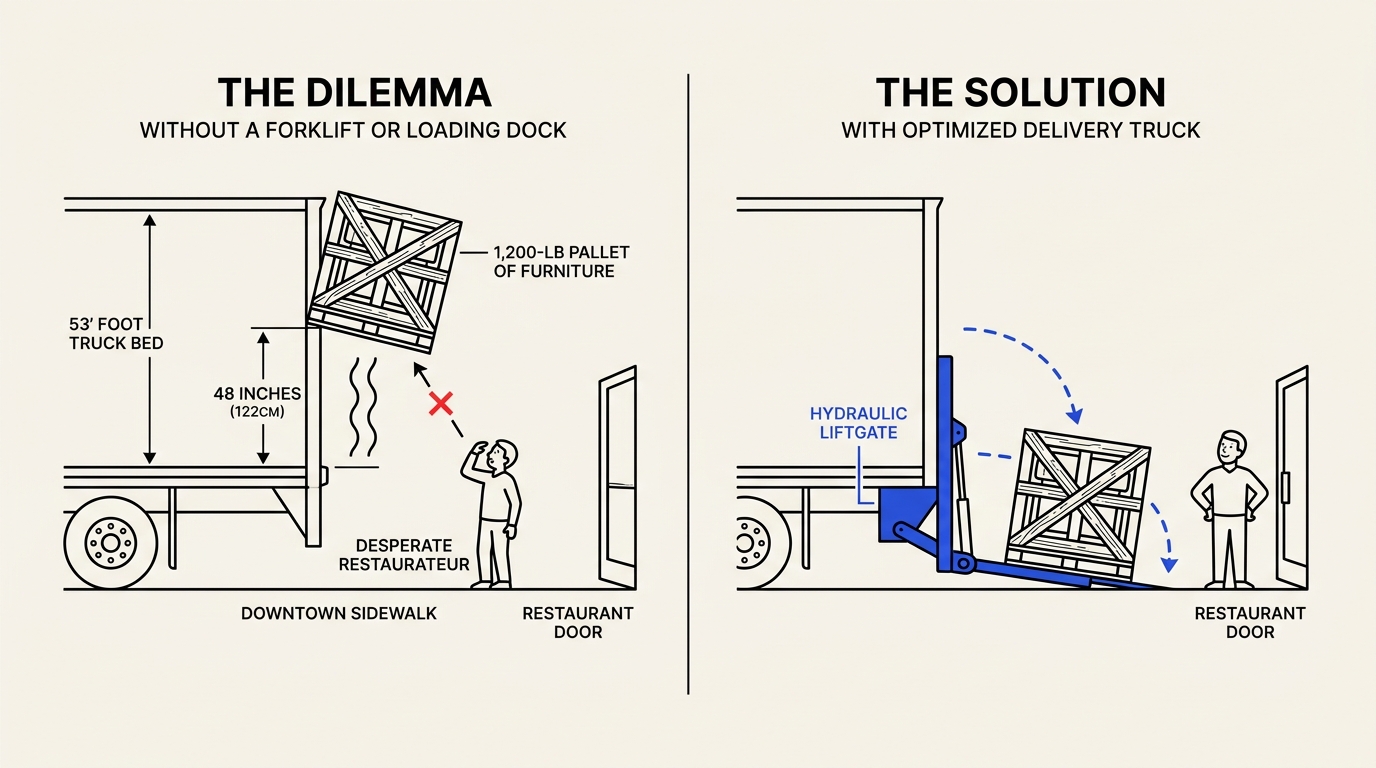
Figure 4: Logistics Comparison. Left: The Drop Trap - uncoordinated freight arriving on a 53-foot trailer with a 48-inch bed drop onto a public street. Right: Commercial Clarity - shipping terms and unloading specifications established prior to booking.
2. The Freight Carrier's Accessorial Extortion Matrix
This is the moment the freight driver shuts off the engine, climbs down with his clipboard, and points to the carrier's National Motor Freight Classification (NMFC) rulebook:
| Accessorial Freight Service | Online "Discount" Catalog Default | Street-Level Surprise Fee | Carrier Action if Unpaid |
|---|---|---|---|
| Hydraulic Liftgate Service | Excluded (Dock-to-Dock Only) | $150 - $350 | Refuses to unload. Closes trailer door and leaves with cargo. |
| Limited Access Surcharge | Excluded (Commercial Zone Only) | $75 - $150 | Assessed immediately because a restaurant street has parking meters and foot traffic. |
| Inside Delivery / Threshold | Excluded (Tailgate Drop Only) | $120 - $300 | If dropped, pallet is abandoned on the rain-soaked sidewalk gutter. Driver will not cross threshold. |
| Redelivery & Storage Fee | Buyer at Fault for Non-Receipt | $250 - $450 + $75/day | Assessed when shipment returns to regional terminal, delaying restaurant opening by 3-7 days. |
With opening day looming and inspectors scheduled, you have zero leverage. You pull out your corporate credit card with trembling fingers and sign for $400 in unplanned freight surcharges just to get your furniture off the street.
3. Clear Logistics Terms: Why Understanding Incoterms Protects Your Opening Day
When buying furniture from online catalogs, the most common trap is not understanding freight terms. Operators often assume "shipping" means goods will be delivered into their building, only to find a 53-foot semi-truck parked at the curb with a driver who cannot unload without a commercial dock.
In professional B2B procurement, managing logistics requires clear, realistic terms - not vague marketing promises:
- For Loose Cargo (LCL): In international logistics, an unrealistically cheap "CIF" quote on loose cargo is often a trap. When loose freight reaches the destination port, third-party deconsolidation warehouses frequently charge exorbitant, unregulated terminal and handling fees that can rival the cost of the furniture itself - sometimes leading buyers to abandon their goods. To prevent this, Ron Group does not ship LCL orders under CIF terms. Loose cargo is handled either through transparent DDP (Delivered Duty Paid) directly to your door with customs and duties managed, or by coordinating with your own nominated freight forwarder (EXW / FOB). Detailed protocols can be reviewed in our Foshan Quality Control & Export Protocol guide.
- For Full Container Loads (FCL): When outfitting a full restaurant where furniture, custom booths, and tableware consolidate into a dedicated container (20GP or 40HQ), standard trading terms apply cleanly: FOB, CIF, DDU, or DDP, based on what works best for your project. Because full containers are sealed directly at the factory, they avoid third-party deconsolidation fees altogether.
Section Four: The Brutal 5-Year Total Cost of Ownership (TCO) Financial Audit
Let us strip away the marketing fog and lay out the complete five-year financial ledger for an active 80-seat restaurant operating 25 commercial dining tables. For detailed per-table budgeting breakdowns, refer to the Restaurant Table Cost & Sizing Guide.
25-Table 5-Year Lifecycle TCO Matrix (Full Financial Breakdown)
| Expenditure Category | Discount Online Flatpack (RTA) | Ron Group Factory-Engineered Commercial |
|---|---|---|
| Initial Purchase Order (PO) | $2,025 ($81/set: $42 top + $39 base) | $2,875 ($115/set: complete contract assembly) |
| Ocean & Baseline Freight | $450 (unprotected LCL ocean transit) | $620 (full palletized containerized transit) |
| Unclear Freight Terms / Destination Surprises | +$350 (curbside surprise accessorials) | $0 (transparent Incoterms upfront) |
| Initial Assembly Handyman Labor | +$2,812.50 (37.5 hours @ $75/hr) | $0 (in-house staff locks bolts in 2 min/set) |
| Week-1 Drill Errors & Top Scrap | +$243 (3 tops drilled through/ruined) | $0 (CNC factory-drilled, zero installation scrap) |
| Month-6 Stripped Screw Repairs | +$600 (epoxy doweling & metal brackets) | $0 (M8 machine bolts never loosen or strip) |
| Year-2 Full Furniture Replacement | +$3,200 (pulverized cores force re-order) | $0 (original contract tables serving smoothly) |
| Diner Wine Spills & Bad Review Cost | +$450 (comped meals & dry cleaning bills) | $0 (cast-iron stability, zero customer accidents) |
| Total 5-Year Capital Outlay | $10,130.50 USD | $3,495.00 USD |
| Annual Amortized Cost Per Table | $81.04 / table / year | $27.96 / table / year |
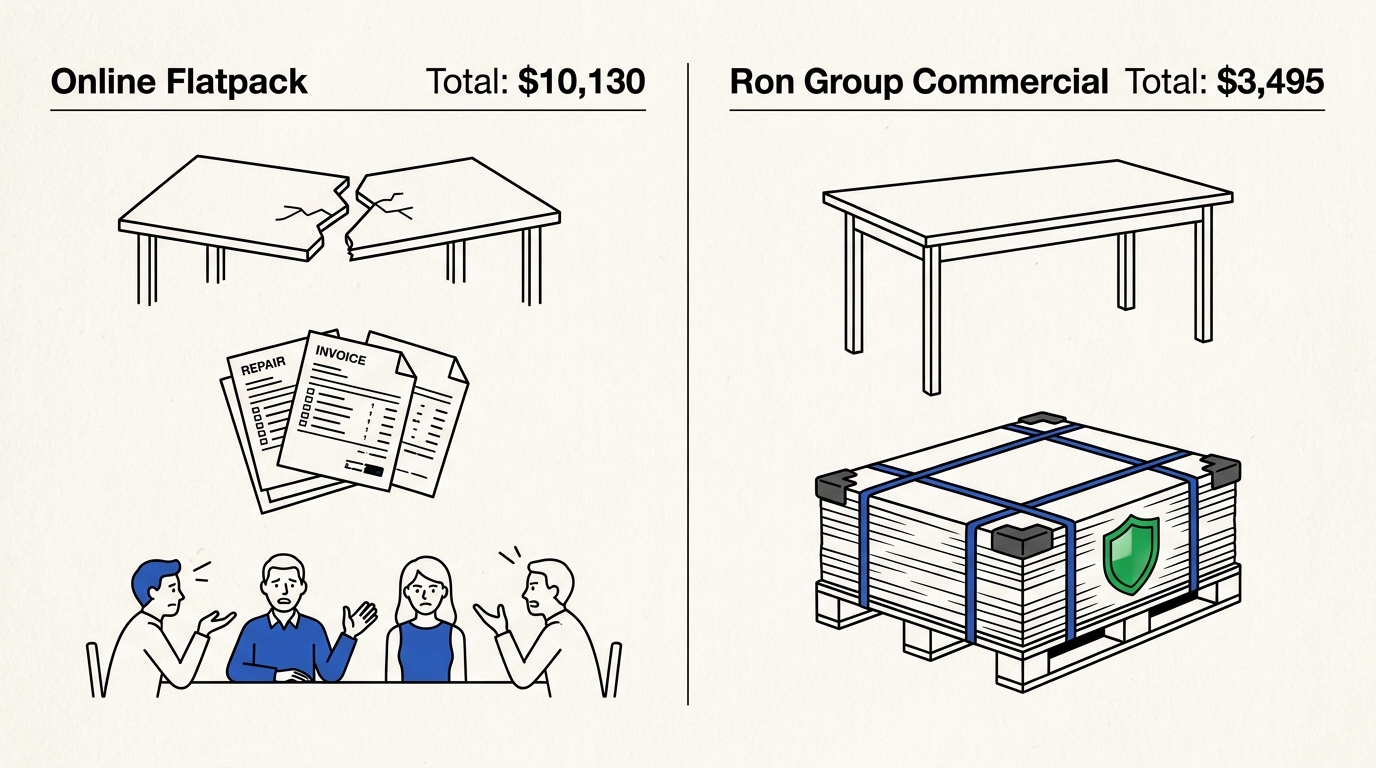
Figure 5: 5-Year True Cost of Ownership Balance Sheet. Left: The Flatpack Illusion ($10,130 total outlay across replacement tops, stripped screw repairs, and assembly labor). Right: Ron Group Commercial Standard ($3,495 total outlay, preserving 65.5% of restaurant capital).
TECHNICAL NOTE // KEY ENGINEERING STANDARD
The Financial Autopsy:
The operator who bought the discount flatpack tables believed they "saved $850" on Day One.
Over the next five years, they were forced to pay $6,635.50 in hidden taxes to local handymen, predatory freight carriers, and replacement suppliers.
That $6,635 is the exact difference between making payroll comfortably during slow winter months or falling behind on rent.
Section Five: The Restaurateur's 5-Point Self-Defense Technical Checklist
Before you transfer a deposit or sign a binding Purchase Order with any commercial furniture vendor, copy and paste these five non-negotiable engineering requirements directly into your inquiry:
EXECUTIVE MANDATE // PROCUREMENT COMPLIANCE AUDIT
Commercial Table Procurement Audit Checklist (Ron Group Sourcing Labs)
1. Fastening Methodology Audit: State in writing whether the underside of the tabletop features factory-installed CNC-drilled blind holes with pre-installed M8 carbon-steel threaded inserts. If blank boards and self-tapping wood screws are delivered, the order will be rejected with full freight chargeback.
2. Incoterms & Freight Delivery Clarity: Ensure shipping terms are established upfront. For loose cargo (LCL), request clear DDP terms or coordinate with your own forwarder, avoiding CIF terms with unregulated destination port fees. For FCL orders, confirm FOB/CIF/DDU/DDP based on project requirements.
3. Pull-Out Load Capacity Certification: Require manufacturer verification that tabletop fastener connections exceed 2,500 N (560 lbs) of vertical tensile resistance per ANSI/BIFMA X5.5 and ASTM D1037 standards.
4. Pre-Alignment Concentricity Tolerance: Verify that the cast-iron spider mounting plate is engineered with a concentricity tolerance within +/- 1.0 mm, allowing 2-minute tool-free alignment with a single hex key.
5. Export Packaging Integrity: Require delivery on unitized, heavy-duty wooden export pallets with corner armor, pneumatic steel banding, and moisture-barrier shrink-wrap protection.
Section Six: Epilogue: The Quiet Dignity of a Well-Anchored Bolt
Operating a restaurant is a relentless, beautiful, and punishing discipline.
Your head chef stands over an eight-burner range in 100-degree heat for twelve hours, adjusting the sear on an aged ribeye by seconds. Your head bartender calibrates bitter drops on an eyedropper to balance an amaro cocktail. Your general manager memorizes the names of sixty regulars and knows precisely which table in the corner a grieving widow prefers when she dines alone.
In an industry where margins are hard-won and human energy is consumed at a furious rate, you should not have to waste your emotional reserves on stripped particle board, bleeding knees, and truck drivers extorting you in the rain.
True craftsmanship and modern supply chain integrity do not announce themselves with flashy slogans.
They live in the Foshan workshop, in the extra three seconds a CNC diamond router takes to cut a flawless stepped hole into high-density fiberboard. They live in the dark, zinc-plated M8 insert pressed deep into the core, waiting silently to bear the weight of ten thousand convivial meals. And they live in the quiet confidence that when your tables are set in place, four machine bolts will hold your dining room steady for years to come.
Choosing engineered contract furniture is not an extravagance. It is an act of deep respect - for your capital, for your crew, and for every guest who will ever sit at your tables looking for an hour of human comfort.
Authorship & Sourcing Attribution
- Editor-in-Chief / Project Lead: Eden (Digital Operations Manager, Ron Group) Directing global digital operations, B2B restaurant sourcing infrastructure, and enterprise inquiry workflows connecting international hospitality groups with Foshan contract manufacturing.
- Content Research & Engineering Optimization: Philothea (Ron Group Sourcing Engineering Lab) Specializing in spatial aesthetics, commercial ergonomics, and human factors analysis.
- Publisher: Ron Group Foshan Sourcing Engineering Lab
- Enterprise Hospitality Inquiries & Custom Specifications: sales@rongroup.com | Foshan Commercial Hospitality Innovation Center
Get the week's latest industry information
-
Real-Life Professional Restaurant Case Studies
Explore Now
-
Create a unique restaurant with over 95,700+products
Explore Now
-
Protessional Free 3D Restaurant Design
Explore Now
-
Still Have Questions About Opening a Restaurant?
Explore Now

Sylvia
With 8 years in catering & hospitality industry, sales manager of Ron Group, specialise in providing one stop solutions to restaurants, hotels and weddings.
Discover Our Exclusive Products
Explore our extensive range of restaurant and hotel supplies designed to enhance your operations. Find the perfect solutions to meet your needs.
Browse Our ProductsFREE 3D DESIGN
Boost your restaurant's success with our free 3D design service. Start building the restaurant of your dreams today!
Explore 3D Design Case
RECOMMENDED CASES
-
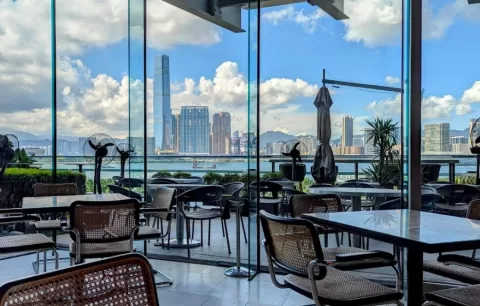
La Rambla by Catalunya: Crafting Barcelona's Soul in Hong Kong - Custom Furniture Excellence
RON Group's custom Spanish-inspired furniture elevates La Rambla with artisanal aesthetics...
Learn More -

Cardinal Point: Elevating Outdoor Seating with Tailored Cushion Upgrades
Discover how Cardinal Point transformed its outdoor dining experience with custom cushions, achievin
Learn More
RECOMMENDED BLOGS
-

Bar Glassware 101: Types, Names, Uses, and How to Stock Your Bar
Learn the 10 core bar glassware types, names, and uses. Discover how to stock your bar with the right glasses for cocktails, beer,...
Sylvia2026-07-26 -

Complete Bar Equipment List for Opening a Bar
Use a complete bar equipment list with pictures, covering workstations, ice, refrigeration, glassware, utilities, sanitation and a...
Sylvia2026-06-11 -

Low-Budget Restaurant Interior Design Ideas: Spend Where Guests and Staff Notice
Explore low-budget restaurant interior design ideas, practical material choices, layout priorities and phased upgrades without...
Sylvia2026-04-04
Subscribe to RON GROUP
Stay up-to-date with the latest industry insights and expert advice. Together, we'll create your ideal restaurant.