










Content

When evaluating a hotel room furniture manufacturer, the buyer is qualifying control of a repeatable room package, not selecting from a static product catalog. The practical question is whether the supplier can convert the room-type schedule into an approved sample-room package and then keep that approved reference identifiable through production, packing, receiving, installation, snagging, and handover.
This is a document-and-release problem as much as a product problem. Buyers should ask for evidence showing how the manufacturer manages item codes, room variations, submittals, finish references, revisions, packing labels, and replacement identity before awarding the package.
Translate the Room-Type Schedule into a Controlled Package
The room-type schedule is the foundation of the guest-room package. A hotel may include standard rooms, suites, accessible rooms, and unique layouts. Each project-defined room type can require furniture variations that must remain identifiable.
The buyer's input package commonly brings together FF&E specifications, architectural plans, interior elevations, a room matrix, and quantities. The room matrix should connect each room designation to a room type and the furniture items assigned to it. The supplier then needs to show how those inputs become an itemized quotation, drawing register, sample plan, and production schedule.
The first qualification test is traceability. Ask the supplier to demonstrate how a room type maps to item codes and how a variant remains separate from the standard item. For example, a standard desk and a project-defined variation may need distinct codes even if they share the same finish. Accessibility and other room variations remain project-specific review items; the manufacturer should not decide those requirements without the project's approved information.
The buyer can use the following illustrative matrix to test whether the supplier understands the package. The codes and review owners must be adapted to the actual project.
| Room Type | Illustrative Item Code | Variation to Lock | Evidence Required | Release Owner |
|---|---|---|---|---|
| Standard King | BD-01 | Headboard dimensions and service cutouts | Approved drawing and interface information | Designer / Project Manager |
| Double Queen | BD-02 | Nightstand position and fixing points | Room-plan overlay and approved drawing | Designer / Architect |
| Accessible Room | DSK-01 | Project-defined room variation | Drawing and sample-room measurement record | Project Team |
| Corner Suite | WR-01 | Wardrobe interface with surveyed conditions | Survey input and revised drawing | Project Manager |
| All Rooms | CH-01 | Upholstery orientation and seam reference | Signed physical sample reference | Designer / Buyer |
This matrix is useful during an RFQ because it exposes ambiguity early. A supplier that can only quote a total quantity without showing the connection between room types, items, and variations has not yet demonstrated package control.
Use Submittals to Prepare the Sample Room
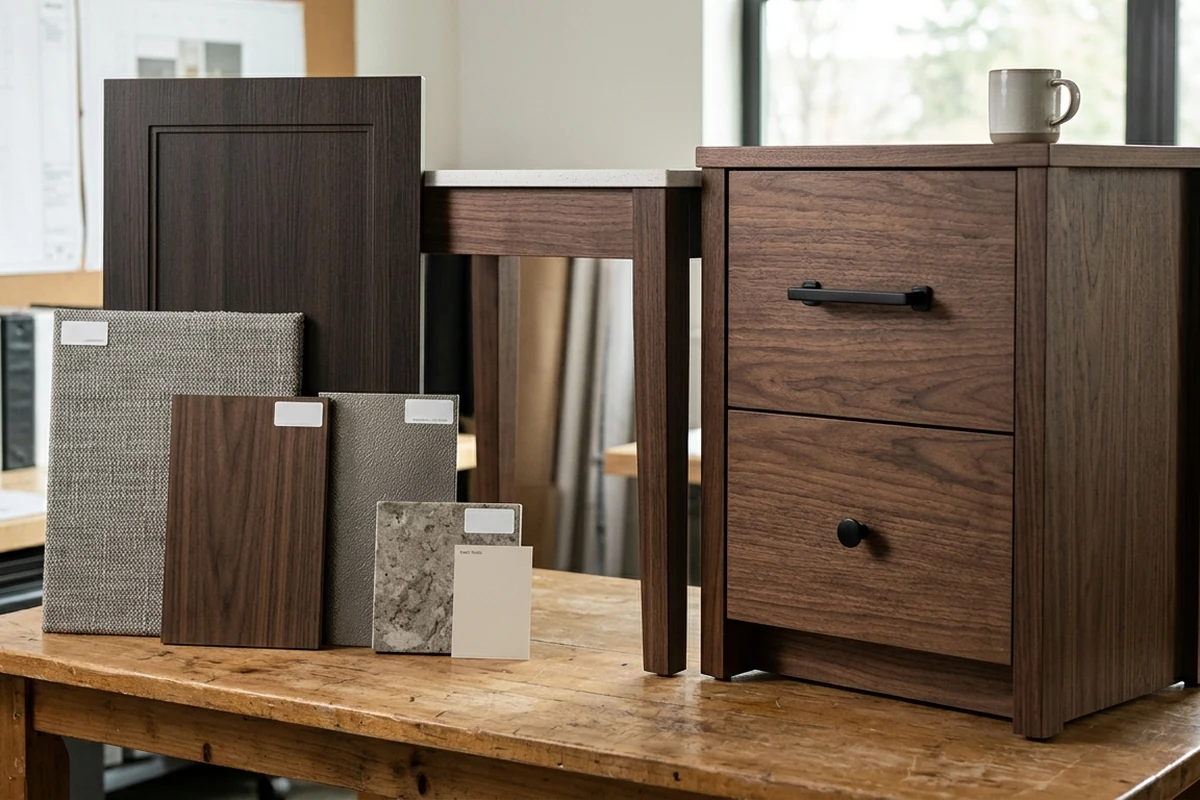
The AIA overview of construction submittals describes shop drawings, product data, samples, and mockups as distinct project-control submittal types. For a hotel furniture package, those categories give the buyer a practical way to organize review evidence. They do not replace the project's contract documents or define project-specific legal responsibilities.
Shop Drawings: Request drawings for each relevant item code, with the dimensions, materials, hardware, and construction details needed for review. Compare them with the design input and room conditions before authorizing the next stage.
Product Data: Request the available technical information for specified components such as drawer glides, hinges, wardrobe rails, or integrated power modules. Compare the submission with the project's stated requirements rather than infer performance from a product name alone.
Finish Samples: Identify which physical references the project requires, such as wood finishes, metal finishes, laminates, or upholstery fabrics. Signed references can support later visual comparison, but the approval record should state exactly what was accepted.
Sample Room: Use the sample room or mockup to compare a physical furniture set with the approved drawings, finishes, room dimensions, and interfaces with other specified items. Define what will be reviewed, who records comments, which documents are revised, and what approval is required before repeat production begins.
The distinction between a sample room and repeat production is essential. A sample room proves that one reviewed set can be assembled for a defined room condition. It does not, by itself, prove that the same document set, finishes, hardware, and variations will be controlled across the full package.
Freeze the Approved Reference and Control Revisions
After the sample-room comments are closed, the project can define a controlled reference for repeat production. The reference should identify the approved drawings, finish samples, component schedule, room type, and approval date. If the buyer uses the word "approved," the record should make clear what was approved and what remained open.
Ask how the supplier dates, retains, distributes, and supersedes controlled documents. A drawing revision should identify the affected item and change. A finish change should point to the updated physical or documented reference. A component substitution should not be treated as equivalent merely because it fits the same space.
If a site condition or design decision changes after approval, record the affected item code, room type, drawing, finish, quantity, and release decision. Revised documentation should be accepted before the affected work proceeds. When a deviation applies to only part of the order, the production and packing records need to keep it isolated from the standard package.
This control is the bridge from sample room to repeat production. The buyer is not asking for a general promise of consistency. The buyer is asking for a traceable relationship between the approved reference and the production information used for each affected item.
Evaluate Repeat-Production Evidence
Qualifying the manufacturer requires evidence of how the approved reference reaches production. Avoid unsupported claims about capacity, flawless execution, or universal quality. Instead, request examples of controlled documents and records that show how the supplier intends to repeat the reviewed package.
Useful questions include:
Which approved drawing and finish reference is released for each item code?
How are room-type variants distinguished from standard items?
Who can authorize a material, hardware, or dimensional change?
How is a change communicated to purchasing, production, packing, and the buyer?
Which inspection or comparison records will be supplied at agreed milestones?
The first-party furniture production context can help a buyer prepare questions about the production environment. It should not be used to infer exact capacity, certification, performance, or approval for a specific project. Those conclusions require project evidence.
Align Packing with Receiving and Installation
Furniture must reach the site in a form the receiver and installer can identify. Packing requirements should therefore be developed from the room schedule, delivery sequence, site access plan, and installation responsibilities rather than added after production.
Packing Method: Ask for a packing proposal that identifies how finished surfaces, corners, glass, loose components, and hardware will be handled for the planned transport and site conditions. The project team should review whether that method fits its actual route and handling plan.
Labels: Define the fields needed on each carton. These may include the project, purchase order, room type, item code, item description, destination zone, and box sequence. The exact taxonomy should match the buyer's room and installation records.
Receiving Sequence: If installation is planned by floor, wing, or room release, ask the supplier to show how packing lists and shipment groupings will support that sequence. Do not assume that production order and site receiving order are the same.
Installation Interface: Identify which party supplies assembly information, fixing information, loose hardware packs, and issue records. The hotel furniture collection provides product-family context, but the interfaces for a specific project must come from its drawings, specifications, and approved responsibilities.
Preserve Replacement Identity through Handover
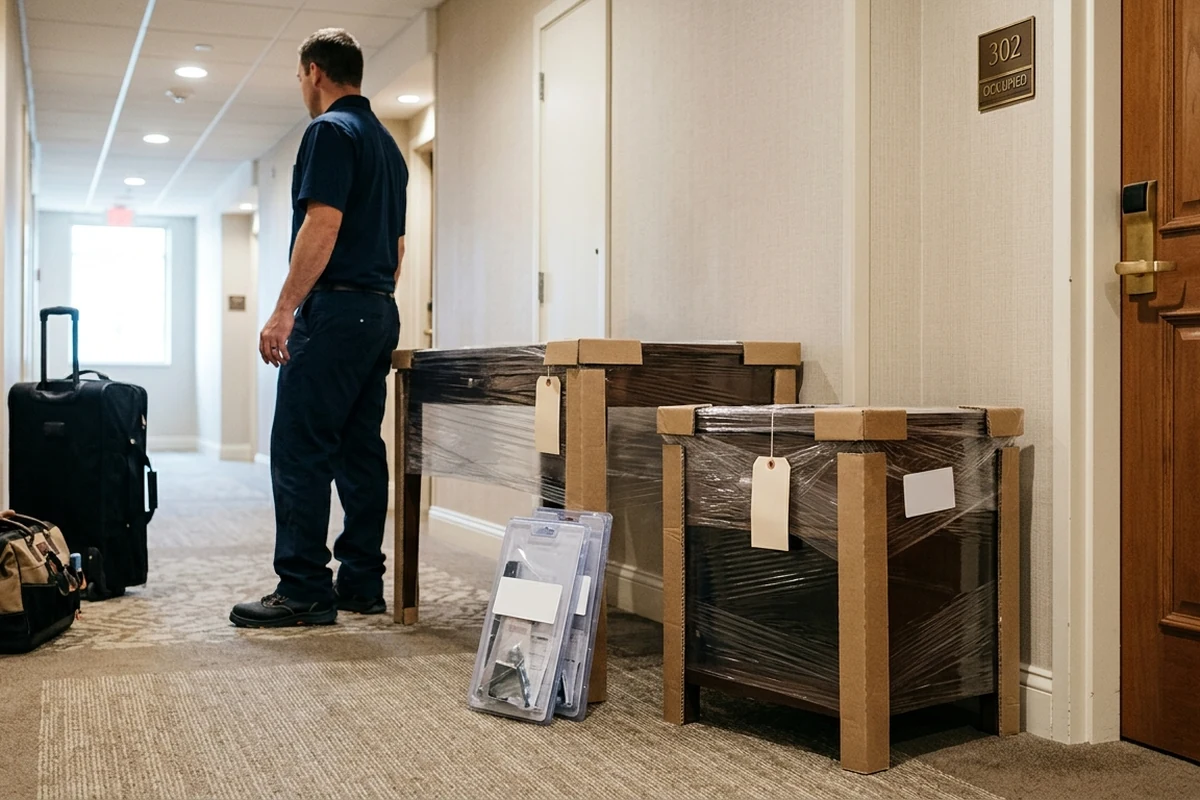
During installation, the site team may record damaged, missing, or nonconforming items. A useful snag record identifies the room, item code, issue, drawing or finish reference, responsible party, and disposition. That gives the supplier enough information to evaluate the affected item without relying on a generic description.
Replacement identity should be planned before handover. If a replacement is requested, the buyer should be able to identify the final item definition and the approved variation that applied to that room. The supplier should explain which records it can return and which information the hotel must retain.
The handover package should be defined in the contract scope. Depending on the project, it may include final approved drawings, finish and hardware schedules, care information, revision records, deviation records, packing lists, and open snag status. This article does not assume that every listed document is mandatory for every project; the buyer must select the records needed for its operations and contract.
Gate Each Phase with Evidence
The following table turns the package lifecycle into release decisions. It is a procurement framework, not a substitute for the project's contract administration process.
| Project Phase | Evidence to Request | Buyer Decision |
|---|---|---|
| Quoting and scheduling | Quotation mapped to room types, item codes, and stated variations | Confirm scope for submittal work |
| Submittal review | Drawings, product data, and required finish samples | Authorize sample-room work |
| Sample-room review | Comment record and updated controlled references | Release defined items for repeat production |
| Production control | Approved-reference register, change record, and agreed comparison evidence | Release defined goods for packing |
| Packing and logistics | Label proof, packing list, and planned shipment grouping | Release shipment under the site plan |
| Handover | Agreed final records and snag status | Close the furniture package under the contract |
Test the Supplier with Five Risk Scenarios
Unrecorded sample-room change: The team asks for a dimensional change but does not issue an updated drawing. The control question is whether production can identify the latest released information. Require a documented revision and release before proceeding.
Generic carton descriptions: Labels do not distinguish room types or variants. The control question is whether the receiver can route cartons using the approved schedule. Approve a label proof and packing-list structure before shipment.
Finish change applied to an undefined quantity: A finish is changed without identifying the affected items. The control question is whether purchasing, production, inspection, and packing share the same change boundary. Record the item codes, quantities, rooms, and new reference.
Component data omitted from review: The visible finish is approved, but a specified component has no reviewed product data. The control question is whether the supplied component can be compared with the project requirement. Add the missing submission to the review register.
Replacement requested without final identity: Operations knows the room and furniture description but not the final item definition. The control question is whether the handover records connect the installed item to its approved drawing and finish. Agree the replacement-identity fields before closeout.
These scenarios test the supplier's process without assuming a particular failure outcome. The buyer should compare the proposed controls with the project's actual risk allocation and site plan.
Bound Due Diligence and Destination Review
The U.S. International Trade Administration's supplier due-diligence guidance supports evaluating a potential foreign partner before making a commercial commitment. Use that guidance as a general counterparty-review frame. It does not approve a manufacturer or predict a furniture project's outcome.
Destination requirements need separate review. For a U.S. project involving composite wood, the EPA page on formaldehyde emission standards for composite wood products provides the appropriate starting context for product, labeling, certification, and record questions under the applicable U.S. scope. Do not treat a supplier or product as compliant without the exact project evidence.
No project-specific room schedule, drawings, sample-room signoff, hotel brand standard, installation method statement, or supplier production record was supplied for this article. Fire, accessibility, structural fixing, chemical, import, and hotel-brand requirements also remain project- and destination-specific review items.
Build the RFQ around Verifiable Package Controls
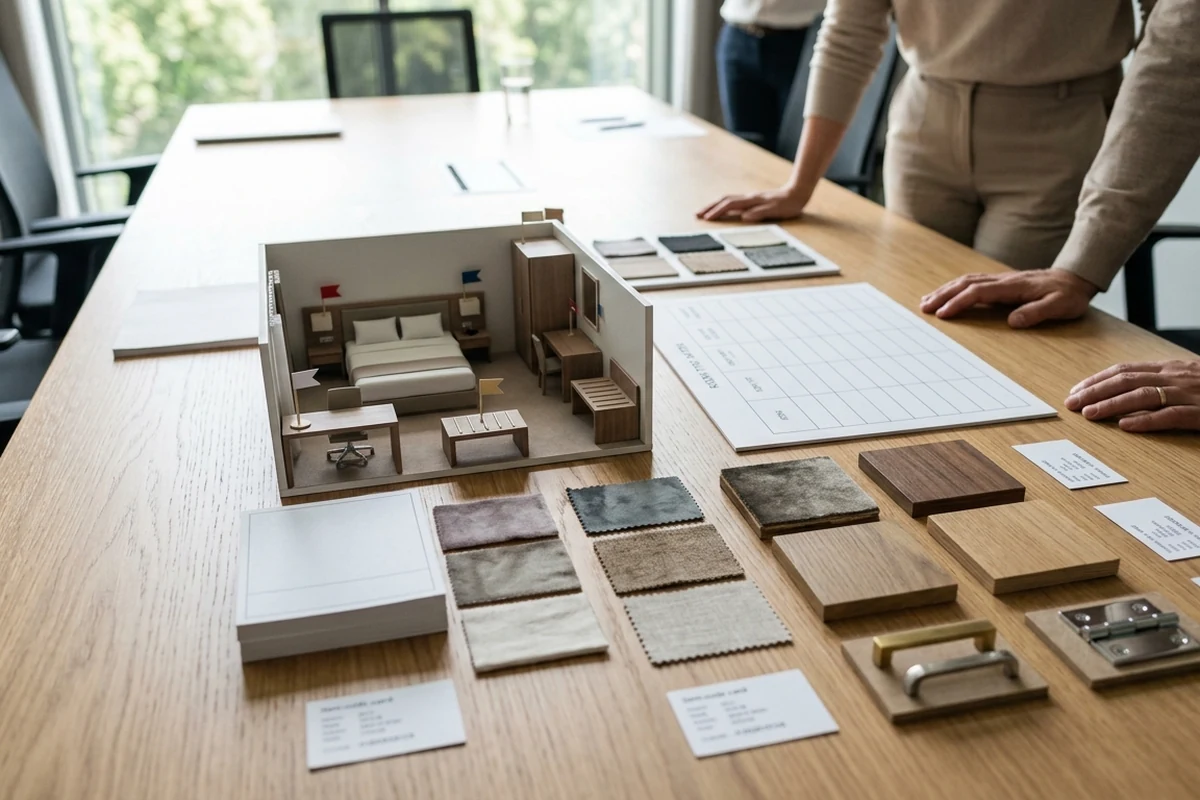
Before inviting a final quotation, ask the manufacturer to provide:
an example showing how room types, item codes, quantities, and variations are mapped;
a sample drawing and submittal register suitable for project review;
an explanation of revision, deviation, and release control;
a proposed sample-room comment and approval workflow;
a sample carton label and packing-list structure aligned with site receiving;
an outline of snag handling, replacement identity, and handover records.
Compare those submissions with the project's actual room matrix, drawings, specifications, delivery sequence, and responsibility schedule. If you have those inputs ready, you can send a guest-room package for review and use the response to evaluate whether the supplier can support the required document, sample-room, packing, and handover controls.
Get the week's latest industry information
-
Real-Life Professional Restaurant Case Studies
Explore Now
-
Create a unique restaurant with over 95,700+products
Explore Now
-
Protessional Free 3D Restaurant Design
Explore Now
-
Still Have Questions About Opening a Restaurant?
Explore Now

Sylvia
With 8 years in catering & hospitality industry, sales manager of Ron Group, specialise in providing one stop solutions to restaurants, hotels and weddings.
Discover Our Exclusive Products
Explore our extensive range of restaurant and hotel supplies designed to enhance your operations. Find the perfect solutions to meet your needs.
Browse Our ProductsFREE 3D DESIGN
Boost your restaurant's success with our free 3D design service. Start building the restaurant of your dreams today!
Explore 3D Design Case
RECOMMENDED CASES
-
La Rambla by Catalunya: Crafting Barcelona's Soul in Hong Kong - Custom Furniture Excellence
RON Group's custom Spanish-inspired furniture elevates La Rambla with artisanal aesthetics...
Learn More -

Cardinal Point: Elevating Outdoor Seating with Tailored Cushion Upgrades
Discover how Cardinal Point transformed its outdoor dining experience with custom cushions, achievin
Learn More
RECOMMENDED BLOGS
-

Bar Glassware 101: Types, Names, Uses, and How to Stock Your Bar
Learn the 10 core bar glassware types, names, and uses. Discover how to stock your bar with the right glasses for cocktails, beer,...
Sylvia2026-07-26 -

Complete Bar Equipment List for Opening a Bar
Use a complete bar equipment list with pictures, covering workstations, ice, refrigeration, glassware, utilities, sanitation and a...
Sylvia2026-06-11 -

Low-Budget Restaurant Interior Design Ideas: Spend Where Guests and Staff Notice
Explore low-budget restaurant interior design ideas, practical material choices, layout priorities and phased upgrades without...
Sylvia2026-04-04
Subscribe to RON GROUP
Stay up-to-date with the latest industry insights and expert advice. Together, we'll create your ideal restaurant.