





Content
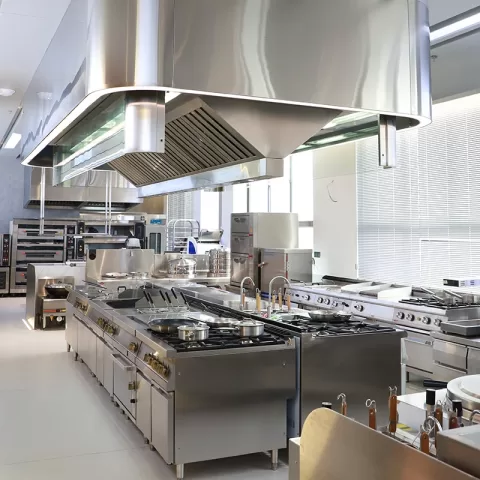
Most kitchen problems are designed in before the first pan is bought. A walk-in placed at the wrong end of the line, a dish return that crosses the pass, or a server station that sits in the cooks' path will slow service every night for years. The equipment list should follow the commercial kitchen workflow, not the other way round.
This guide sets out a practical order for planning a commercial kitchen layout: how food and people should move, the main layout types, the code and utility checks that come before any purchase order, and how the kitchen plan connects to front-of-house furniture planning.
Start with the flow, not the equipment
A restaurant kitchen workflow is a one-way route for food, with separate routes for dirty ware and waste. Map it before you choose a single piece of equipment:
- Receiving: deliveries arrive, are checked, and are weighed or counted.
- Storage: dry store, walk-in or reach-in refrigeration, and freezers.
- Preparation: separate prep for raw proteins, vegetables, and pastry where the menu needs it.
- Cooking: the hot line, grouped by the menu's main cooking methods.
- Plating and pass: where finished plates are checked and handed to servers.
- Service: servers carry food to the dining room.
- Return: dirty plates, glasses, and cutlery come back to the dish area.
- Washing and waste: dishwashing, then clean storage, with waste leaving by its own route.
The aim is that raw goods, finished food, and dirty ware never cross. Each crossing is a food safety risk and a collision point at peak hours.
Commercial kitchen material flow design
Material flow is where layouts usually go wrong. Check these points on the plan:
- Receiving should be close to storage, so deliveries don't travel through prep or cooking areas.
- Cold storage should be close to prep, and away from the heat of the hot line where possible.
- Prep should feed the hot line in the order the menu is cooked.
- The pass should be the only point where kitchen and front of house meet.
- Dirty ware should enter the dish area without crossing the pass or the cooks' line.
- Waste and recycling need a route to the back door that doesn't go through food areas.
Common kitchen layout types
| Layout | Works well for | Watch out for |
|---|---|---|
| Assembly line | Limited menus, high volume, fast casual | Long lines need enough pass width at the end |
| Zone layout | Broad menus with distinct stations | Needs clear routes between zones |
| Island | Larger kitchens with a central cooking suite | Ventilation and utilities must reach the island |
| Galley | Narrow sites, small teams | Two-way traffic in one aisle at peak hours |
| Open kitchen | Concepts that show cooking to guests | Noise, heat, and odor control in the dining room |
The right layout depends on the menu, the cover count, the site shape, and where the services (gas, water, drainage, power, and the exhaust route) can actually go.
Code and utility checks before you buy
Equipment choices are limited by the building and by local code. Confirm these with your kitchen designer, MEP engineer, and the local authority before ordering:
- Health department plan review. Many jurisdictions require approval of the kitchen plan, finishes, sinks, and equipment before construction.
- Food equipment certification and sanitation. In the US, many inspectors expect NSF/ANSI-listed food equipment. NSF/ANSI 2 also covers how floor-mounted equipment is installed, either sealed to a curb or raised on legs to leave clearance underneath for cleaning. Check the clearance and the sealing method your local authority requires, and design the floor plan around it.
- Ventilation and fire suppression. Hood size and location, the exhaust route, and the fire suppression system follow the local fire code (in many US jurisdictions this is based on NFPA 96).
- Electrical certification. Equipment usually needs a listing or certification recognized in the destination country (for example UL or ETL in North America, CE in Europe).
- Utilities. Gas, water, drainage, floor drains, grease interceptors, and electrical capacity all need to be in the right place before equipment is set.
- Clearances and aisles. Confirm aisle widths, door swings, and accessibility clearances with your designer and the code that applies.
Kitchen equipment plan: what to prepare before quoting
A clear kitchen equipment plan gets you comparable quotes. Prepare:
- ☐ A scaled layout with each item numbered and located
- ☐ An equipment schedule: item, size, utility type and connection, and certification needed
- ☐ The menu and expected covers per service, so suppliers can check capacity
- ☐ Utility drawings or at least the known positions of gas, water, drainage, and power
- ☐ Hood and exhaust information
- ☐ Required certifications for the destination market
- ☐ Delivery access: door widths, lift sizes, and the route from the street to the kitchen
Linking the kitchen to front-of-house furniture planning
The kitchen and the dining room are one system. Where the pass, the service door, and the dish return sit decides how the dining room furniture can be laid out. Plan them together.
Service routes and server stations
Servers need a direct route from the pass to every table, and a route back to the dish return that doesn't cross it. Put server stations along those routes, not in dead corners. Keep the area outside the kitchen doors clear of tables, so servers aren't weaving between seated guests with full trays.
Table and seating layout
The size and spacing of tables affects how quickly servers can move. Two-tops that combine into larger tables give flexibility, and booths along walls free up the central floor for service routes. Our restaurant table sizing guide covers table sizes and spacing by seat count.
Accessibility and clearances
Main service aisles often double as accessible routes. If booths and fixed seating line those aisles, check clearances against the accessibility rules on site. Our ADA booth and corridor compliance guide explains the US requirements for restaurant booths.
Open kitchens and noise
If the kitchen is visible from the dining room, the seats nearest the line get heat, noise, and light. Upholstered booths and softer finishes help with noise, and seating near the kitchen should use coverings that clean easily.
Timing
Kitchen equipment and dining furniture often come from different suppliers on different lead times. Fix the kitchen layout, the pass position, and the service routes before the furniture layout is final, and order custom booths and seating early enough to allow sample approval and production.
FAQ
What is a commercial kitchen workflow?
The order in which food moves through the kitchen, from receiving and storage through prep, cooking, and the pass, with separate routes for dirty ware and waste.
Should we buy kitchen equipment before the layout is final?
No. Fix the workflow and the layout first, then confirm utilities and code requirements, then order the equipment.
What is the most common kitchen layout mistake?
Routes that cross. Dirty ware crossing the pass, deliveries travelling through prep, or servers walking into the cooks' line all slow service and create food safety risks.
How does the kitchen layout affect dining room furniture?
The pass, service doors, and dish return set the service routes. Tables, booths, and server stations should be arranged around those routes.
Working with RON GROUP
RON GROUP has manufactured and sourced hospitality furniture in Foshan since 2005. We supply contract dining furniture and can consolidate it with kitchen equipment and tableware into one shipment. Browse our restaurant furniture collection, or send us your layout and equipment schedule for a quote.
To review a project or request a quote, email info@rongroup.co or call / WhatsApp +86 13380258855.
Get the week's latest industry information
-
Real-Life Professional Restaurant Case Studies
Explore Now
-
Create a unique restaurant with over 95,700+products
Explore Now
-
Protessional Free 3D Restaurant Design
Explore Now
-
Still Have Questions About Opening a Restaurant?
Explore Now

Sylvia
With 8 years in catering & hospitality industry, sales manager of Ron Group, specialise in providing one stop solutions to restaurants, hotels and weddings.
Discover Our Exclusive Products
Explore our extensive range of restaurant and hotel supplies designed to enhance your operations. Find the perfect solutions to meet your needs.
Browse Our ProductsFREE 3D DESIGN
Boost your restaurant's success with our free 3D design service. Start building the restaurant of your dreams today!
Explore 3D Design Case
RECOMMENDED CASES
-
La Rambla by Catalunya: Crafting Barcelona's Soul in Hong Kong - Custom Furniture Excellence
RON Group's custom Spanish-inspired furniture elevates La Rambla with artisanal aesthetics...
Learn More -

Cardinal Point: Elevating Outdoor Seating with Tailored Cushion Upgrades
Discover how Cardinal Point transformed its outdoor dining experience with custom cushions, achievin
Learn More
RECOMMENDED BLOGS
-
Bar Glassware 101: Types, Names, Uses, and How to Stock Your Bar
Learn the 10 core bar glassware types, names, and uses. Discover how to stock your bar with the right glasses for cocktails, beer,...
Sylvia2026-07-26 -
Complete Bar Equipment List for Opening a Bar
Use a complete bar equipment list with pictures, covering workstations, ice, refrigeration, glassware, utilities, sanitation and a...
Sylvia2026-06-11 -
Low-Budget Restaurant Interior Design Ideas: Spend Where Guests and Staff Notice
Explore low-budget restaurant interior design ideas, practical material choices, layout priorities and phased upgrades without...
Sylvia2026-04-04
Subscribe to RON GROUP
Stay up-to-date with the latest industry insights and expert advice. Together, we'll create your ideal restaurant.