










Content
Commercial dishwasher sizing must begin with the actual service load of the facility, rather than starting with a catalog category or a generic capacity label. A machine that appears large enough on a specification sheet can still cause operational failures if racks wait too long to be loaded, the dirty landing space is too small, utilities are inadequate, or the wash loop cannot return clean items before the next service period begins. Finding the right commercial dishwasher size requires analyzing the complete warewashing cycle.
This guide provides buyers, operators, and facility planners with a practical, verifiable methodology to estimate commercial dishwasher capacity before requesting formal quotes. It bridges the gap between theoretical machine ratings and real-world dishroom throughput. This methodology does not replace the mandatory review of the local health authority, building team, plumbing engineer, electrical engineer, or equipment manufacturer, but it ensures that the buyer is prepared to have those technical conversations.
For comprehensive facility projects, this dishwasher capacity check is normally reviewed alongside the broader kitchen equipment schedule, utility plan, and opening procurement timeline. This ensures the buying decision supports the whole operation instead of isolating one machine quote.
In This Guide
Establish the peak warewashing load and critical service periods.
Determine tested usable pieces-per-rack capacity.
Calculate the required racks-per-hour target using a core formula.
Select the machine type based on workflow and commercial dishwasher footprint.
Test the complete wash-loop bottleneck, including layout and landing zones.
Verify utilities, sanitation methods, and regulatory documentation.
Prepare a supplier-ready restaurant dishwasher checklist for RFQs.
Module 1: Peak Ware-Load Worksheet
The foundation of commercial dishwasher capacity planning is documenting exactly what must be washed during the busiest overlapping period. Relying solely on daily covers or total daily transactions is a common error, because daily volume often hides short, intense rushes—such as a concentrated dinner service, a rapid banquet changeover, or a high-turnover breakfast checkout period.
To accurately size the system, operators must isolate the peak hour of demand. This is the period where the highest volume of soiled wares arrives at the dishroom and must be processed to prevent a shortage of clean items on the service floor.
| Input Variable | What to Record and Measure |
|---|---|
| Service Period | Identify the specific shift (e.g., Breakfast, lunch, dinner, banquet, bar, room service, or mixed service). |
| Peak Covers or Transactions | The highest number of guests served or transactions processed during the busiest single hour. |
| Item Mix per Cover | The exact count of plates, bowls, trays, pans, glasses, flatware, and specialty items used per guest. |
| Total Peak Items | Peak covers multiplied by the item mix per cover, plus back-of-house prep wares generated during that hour. |
| Soil Level | Categorize as light beverage service, normal dining, baked-on food, or heavy kitchen production. |
| Return Timing | The rate at which dirty ware reaches the dish area (e.g., steady flow vs. sudden banquet drop). |
When calculating the item mix, include every piece of ware that requires washing. Item mix varies by menu and service format. Count the actual plates, bowls, glassware, flatware, trays, and back-of-house wares generated during a representative peak period instead of applying a generic pieces-per-cover figure.
Module 2: Tested Usable Pieces-Per-Rack Method
A critical step in determining commercial dishwasher size is translating the total peak items into the number of standard 20-inch by 20-inch dish racks required. Manufacturers often state theoretical maximums for rack capacity, but real-world loading is dictated by the shape of the wares, the need for safe spacing to ensure water penetration, and the speed at which staff can load the racks.
Do not assume a peg rack will hold its mathematical maximum. Instead, conduct a physical test or use conservative usable capacity estimates based on the specific wares being purchased.
Plates and Bowls: Load the proposed rack with the actual plate and bowl mix, follow the rack and machine instructions, and record the repeatable usable count without crowding or contact.
Glassware: Glassware capacity is strictly defined by the compartment rack used. A 25-compartment or 36-compartment rack yields exactly that many glasses, provided the glasses fit the compartment diameter.
Flatware: Use the rack system and loading method specified for the proposed machine, test the actual mixed flatware load, and record a repeatable usable count rather than applying a generic pieces-per-rack assumption.
Kitchen Prep Wares: Hotel pans, sheet pans, and large mixing bowls consume significant rack space. A single full-size sheet pan or large stock pot may occupy an entire rack on its own.
By dividing the total peak items by the tested usable pieces per rack for each category, the operator can determine the total number of racks generated during the peak hour.
Module 3: Required Racks-Per-Hour Calculation
Once the total number of racks generated during the peak hour is known, the buyer can apply the core sizing formula. This formula establishes the baseline required throughput, which must then be adjusted for operational realities.
Required Racks Per Hour = (Peak Items to Wash / Usable Items Per Rack) / Recovery Hours
Recovery Hours represents the time available to wash, unload, inspect, and return clean ware before the next demand peak or before the facility runs out of clean inventory. In high-turnover environments, the recovery time might be exactly one hour (meaning the machine must keep pace with the peak hour in real-time). In other scenarios, the dishroom might have a two-hour window to process a one-hour banquet drop.
Worked Example: High-Volume Restaurant Dinner Service
Assume a restaurant expects 200 dinner covers in its busiest one-hour window. The menu dictates that each cover generates 6 pieces of china (plates/bowls), 3 pieces of glassware, and 4 pieces of flatware. The kitchen generates an estimated equivalent of 10 racks of prep wares during this hour.
Step 1: Calculate Total Items
China: 200 covers * 6 pieces = 1,200 pieces
Glassware: 200 covers * 3 pieces = 600 pieces
Flatware: 200 covers * 4 pieces = 800 pieces
Step 2: Apply Usable Rack Capacity
China Racks: 1,200 pieces / 18 usable pieces per rack = 67 racks
Glassware Racks: 600 pieces / 25 glasses per compartment rack = 24 racks
Flatware Racks: 800 pieces / 150 pieces per open rack = 6 racks (rounded up)
Kitchen Wares: 10 racks
Step 3: Total Peak Racks
67 + 24 + 6 + 10 = 107 racks generated during the peak hour.
Step 4: Apply Practical Allowance
A machine rated for exactly 107 racks per hour will fail in this scenario. The formula is a planning tool, not a manufacturer guarantee. The buyer must add a practical allowance for sorting, scraping, rack staging, inspection, breakage, rewash cycles, and staff variation (time taken to push racks in and out). Use a documented utilization factor based on the operation's timed wash loop. If no reliable observation exists, model more than one scenario and state the assumption instead of presenting it as an industry benchmark.
For this hypothetical worksheet, divide the required 107-rack output by the operation's documented utilization factor and test the result against observed arrival surges. Treat the calculated rating as an RFQ input, then verify the complete wash loop and the exact model data rather than applying a universal allowance.
Module 4: Machine-Type Decision Table
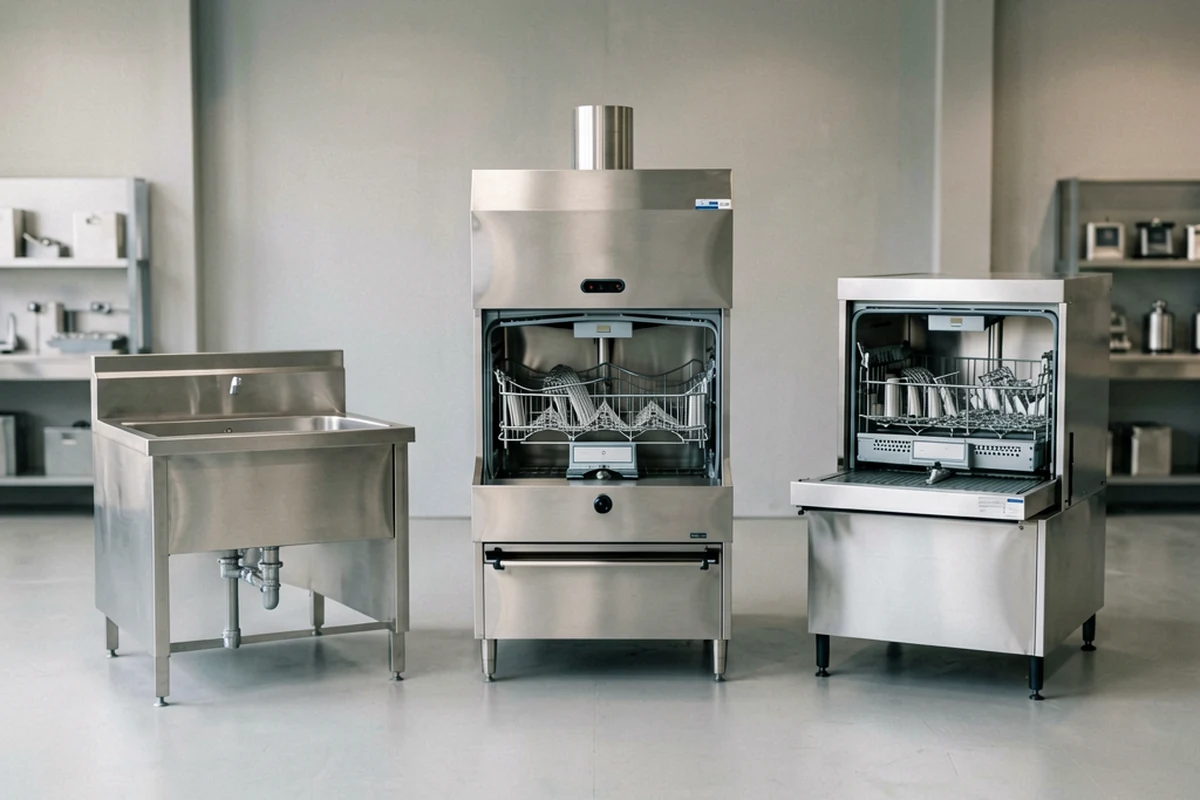
With a target racks-per-hour figure established, the buyer can evaluate machine types. Match the machine type to the workflow and the commercial dishwasher footprint, rather than just looking at the catalog name.
| Machine Type | Typical Throughput Range | Common Fit and Footprint Implications | Main Sizing Question |
|---|---|---|---|
| Undercounter | 20 - 30 racks per hour | Small cafes, bars, pantries, low-volume satellite stations. Fits under standard counters. | Can the operator wait for small batches without blocking service? |
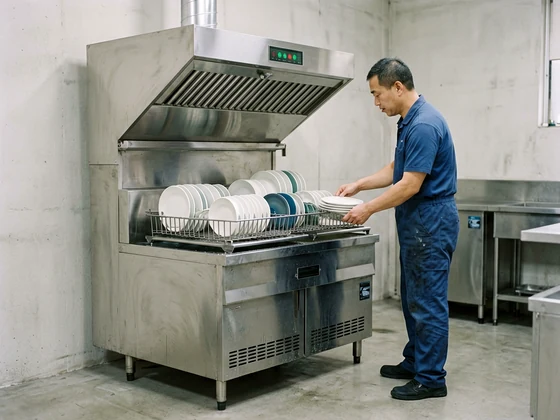
| Door-Type (Single or Double) | 50 - 120 racks per hour | Restaurant dish rooms, hotel breakfasts, medium-volume operations. Requires corner or straight-through tabling. | Can racks move through scrape, wash, landing, and storage without backing up? |
| Rack Conveyor (Single or Multi-Tank) | 150 - 300+ racks per hour | High-volume restaurants, hotel banquets, institutional service. Requires significant linear space. | Can the line, staffing, and landing space support continuous throughput? |
| Flight-Type | 4,000 - 10,000+ pieces per hour | Very high-volume tray or institutional operations. Large scale foodservice dishroom solutions. | Is the whole dish room designed around this machine and its massive utilities? |
When evaluating space-saving warewashing options, remember that reducing the machine footprint often requires increasing the frequency of wash cycles or expanding the clean storage areas to compensate for lower throughput.
Module 5: Complete Wash-Loop Bottleneck Check
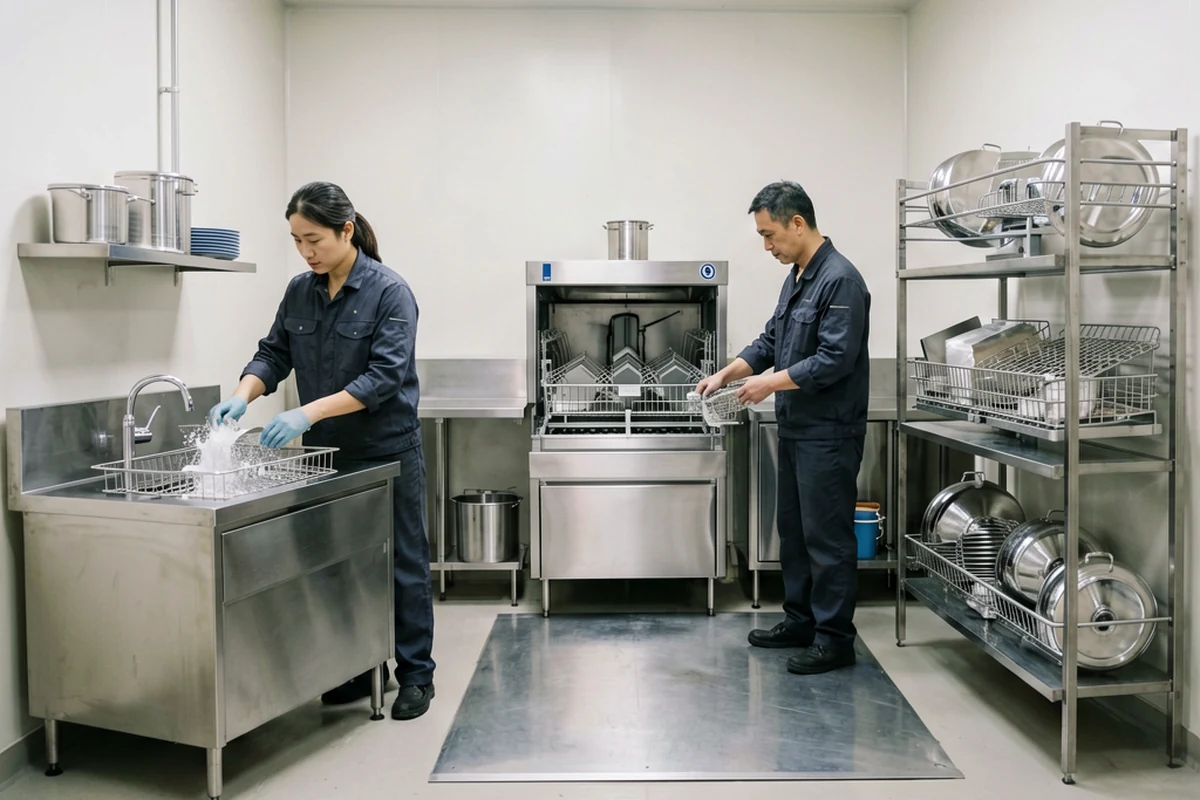
The machine cycle is only one part of the system. A common failure in commercial kitchen dishwasher layout is sizing the machine correctly but starving it of space on either end. Time and measure the full loop to identify bottlenecks.
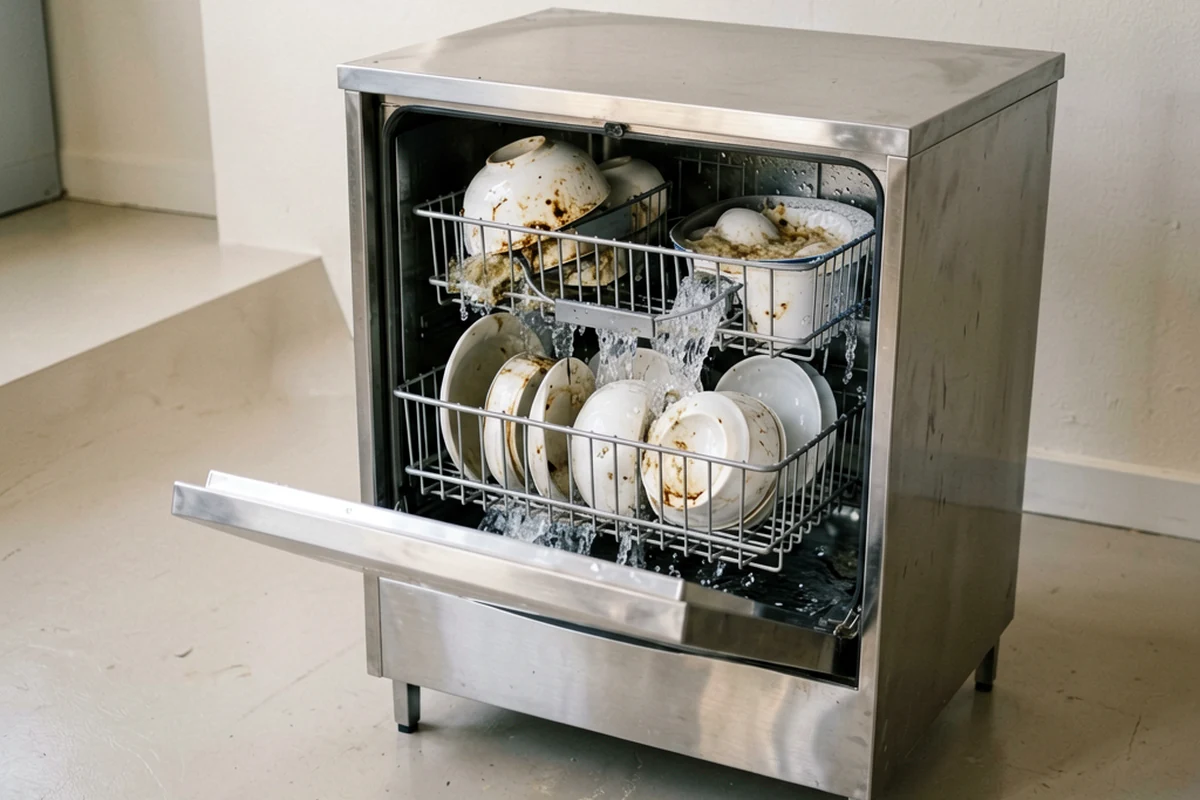
A functional commercial dishwashing layout must accommodate the following steps:
Arrival and Drop-off: Dirty ware leaves the table, bar, buffet, or kitchen and arrives at the soiled landing zone. Is there enough linear tabling to hold bus tubs without stacking them dangerously?
Scraping and Sorting: Staff scrape, sort, soak, or pre-rinse items where required. This requires a scraping trough, a pre-rinse spray valve, and dedicated space for trash and compost receptacles.
Rack Staging: Racks wait for a safe and complete load. If there is no room to stage a loaded rack before it enters the machine, the operator must wait for the machine to finish its current cycle before loading the next rack, destroying throughput efficiency.
Washing and Sanitizing: The machine executes its cycle.
Clean Landing and Drying: Staff unload, inspect, and separate rejected items. Size the clean landing area from the timed unload, inspection, air-drying, and removal steps for the proposed rack flow. If the clean landing space is too small, staff will stop the machine even when the wash chamber is available, creating an artificial bottleneck.
Storage and Return: Clean items return to storage, the line, the bar, or the dining room.
If the machine can wash faster than staff can load and unload, the rated capacity will not be achieved. The physical commercial dishwasher dimensions must be planned in conjunction with the soiled and clean tabling.
Module 6: Utility and Sanitation-Method Checklist
Capacity is not the only purchase criterion. A dishwasher also dictates water, sewer, energy, chemical use, heat rejection, and service reliability requirements. Understanding the commercial dishwasher reading on a specification sheet regarding utilities is critical before requesting a custom dishroom system quote.
Sanitation Methods: High-Temp vs. Low-Temp
Commercial dishwashers achieve sanitation through one of two primary methods, each with distinct utility impacts:
High-Temperature Sanitizing: Uses hot water (typically 180°F / 82°C at the manifold) to sanitize wares. This requires a booster heater (either built-in or external) to elevate the incoming water temperature. High-temp machines generally provide faster drying times and better removal of grease, but they consume more energy to heat the water and often require Type II ventilation hoods to manage steam and condensation.
Low-Temperature Sanitizing: Uses chemical sanitizers (like chlorine, iodine, or quaternary ammonium) combined with water at a lower temperature (typically 120°F to 140°F / 49°C to 60°C). These machines have different chemical, drying, ventilation, and operating implications; verify them for the exact model, chemistry, ware mix, and local code rather than assuming a category-wide outcome.
The FDA Food Code provides the model framework for warewashing and sanitizing requirements in retail and food-service operations. Operators must frame their sanitation choices against this model code and verify the specific edition and modifications adopted by their local health authority.
Utility Verification
Before finalizing a commercial dishwasher size, verify the facility can support the required utilities:
Electrical: Document the required voltage, phase (single-phase vs. three-phase), and total amperage. High-temp machines with electric booster heaters draw significant amperage and may require dedicated heavy-duty circuits.
Water Supply: Verify the incoming water line size, flow pressure (flow pressure is critical for proper rinsing), and incoming water temperature. Compare the measured incoming water temperature and recovery capacity with the exact model's installation requirements; have the engineer and manufacturer identify any required heating equipment.
Water Quality: Hard water causes scale buildup, reducing heating efficiency and leaving spots on glassware. Water treatment or softening may be required based on local water hardness levels.
Drainage: Confirm the floor sink or drain capacity can handle the rapid discharge of the machine's wash tank without overflowing.
Ventilation: Determine if local mechanical codes require a Type II exhaust hood for the selected machine, or if a machine with built-in ventless heat recovery is permitted and appropriate for the space.
To support measuring actual throughput and selecting an appropriately sized dishwasher that manages resources effectively, operators can reference the EPA WaterSense at Work Best Management Practices. Furthermore, the eCFR 10 CFR Part 431 Subpart T provides U.S. federal definitions and test-procedure context for commercial dishwashers, which helps buyers understand how manufacturers classify and test their equipment.
Module 7: Certification and Model Verification
Commercial warewashing decisions require a strict documentation trail to satisfy health inspectors and building officials. Where the destination authority requires a listing or certification, verify the exact model for its intended use.
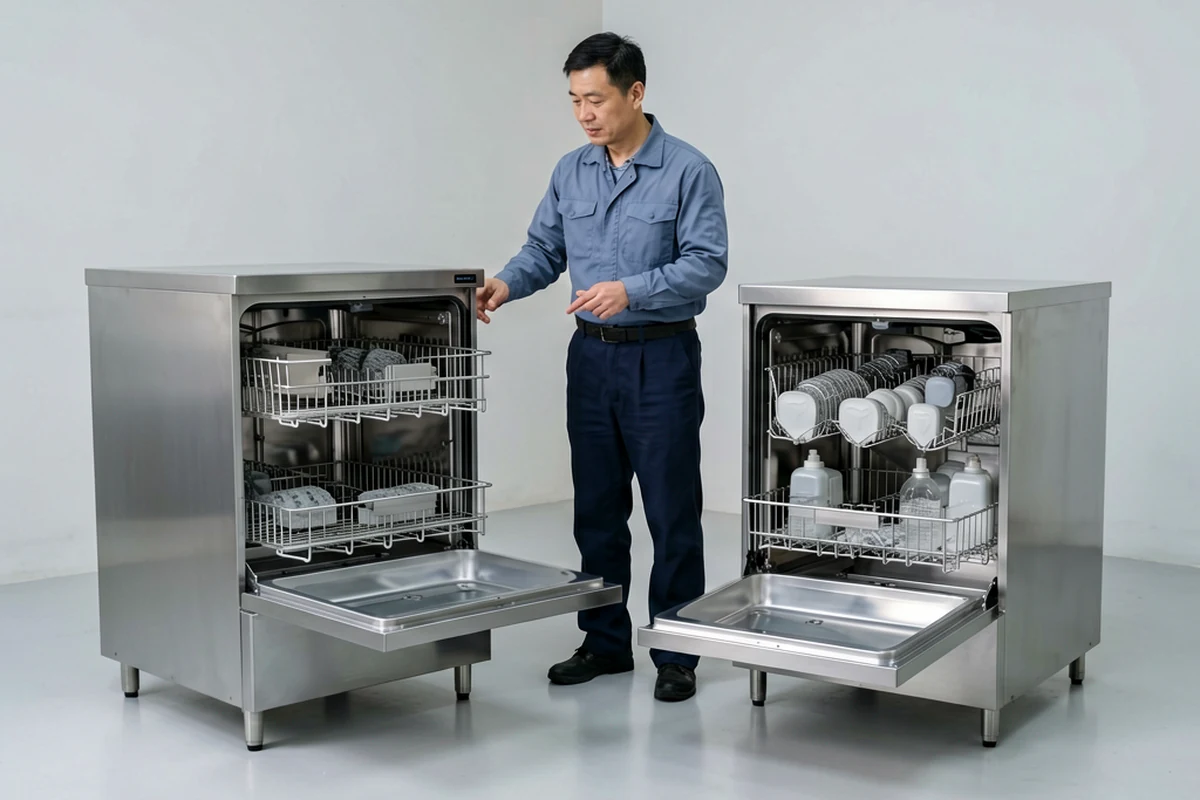
Buyers should use the NSF Official Listings — Standard 003 to verify the exact listed model identity and review listing capacity fields such as racks per hour, dishes per hour, and water-use calculations. This ensures the machine meets recognized sanitation standards for commercial food equipment.
For operators evaluating utility demands, the ENERGY STAR Commercial Dishwashers program provides guidance to support machine-type and sanitation-method screening. Buyers can use the ENERGY STAR Commercial Dishwasher Key Product Criteria to compare model efficiency fields by machine type and sanitation method. To verify specific models, consult the ENERGY STAR Certified Commercial Dishwashers Dataset, using it as the current model-level certification dataset to record model identity, sanitation method, rack capacity, and utility fields where available.
Module 8: Model-Comparison RFQ Table
Before requesting final quotations for custom dishroom equipment design, prepare a standardized schedule for every supplier. This ensures all bids are based on the same operational realities rather than theoretical maximums.
| Schedule Field | What the Buyer Must Provide to the Supplier |
|---|---|
| Operation Type | Specify if the facility is a restaurant, bar, hotel breakfast, banquet hall, cafe, or mixed-use venue. |
| Peak Period | The exact time window used for sizing (e.g., "Friday Dinner, 7:00 PM - 8:00 PM"). |
| Item Count | The total count of plates, bowls, trays, glasses, flatware, pans, and utensils generated during the peak period. |
| Rack Test Data | The tested usable items per rack by item type (e.g., "18 plates per rack, 25 glasses per rack"). |
| Recovery Target | The time available to return clean ware to service (e.g., "Must process peak load within 1.5 hours"). |
| Required Racks Per Hour | The calculated baseline throughput plus the required practical allowance. |
| Machine Type | The preferred format: Undercounter, door-type, conveyor, or flight-type. |
| Utility Constraints | Available voltage, phase, incoming water temperature, drainage capacity, and ventilation limits. |
| Certification Check | Required listings (e.g., NSF, UL), exact model numbers being considered, and local jurisdiction notes. |
| Service Plan | Requirements for warranty coverage, parts availability, technician access, and planned maintenance responsibility. |
Providing this detailed commercial dishwasher specifications checklist prevents suppliers from under-sizing the equipment to win a bid on price, which reduces the risk of an avoidable dishroom bottleneck during peak service.
Module 9: Connecting Dishwashing to the Broader Operation
The dishwasher does not operate in isolation. Its capacity and throughput directly impact other areas of the facility, particularly the bar and the overall kitchen workflow.
If the project includes a dedicated bar program, it is vital to coordinate the dishwashing strategy with the bar equipment checklist. Determine whether bar glassware will be washed in a dedicated undercounter glasswasher at the bar, or if it will be transported to the main dishroom. If transported, the main dishwasher must be sized to handle that additional peak load, and the transport carts must be factored into the dishroom layout.
Furthermore, the speed of the wash loop directly affects inventory requirements. Coordinate the dishwasher decision with the restaurant glassware par levels. If the dishwasher has a slow recovery time or if the clean landing space is too small to process racks quickly, the facility will require higher par levels of glassware and china to bridge the gap during peak service. A measured, reliable wash loop may support a different par-level decision, but the operator should validate that decision against breakage, drying, handling, and peak-service buffers.
Only after the required workflow, utilities, and capacity range are fully defined should the buyer move to select the final machine. Use the commercial kitchen equipment category as a commercial receiver only after these dishwasher capacity and utility parameters are locked in.
Common Commercial Dishwasher Sizing Mistakes to Avoid
Before selecting a machine:
Using total daily covers instead of isolating the peak dirty-ware arrival hour.
Comparing rated racks per hour without testing usable rack loads for the specific wares being purchased.
Selecting a machine before confirming electrical phase, incoming water temperature, drainage, and ventilation constraints.
During layout testing:
Ignoring the space required for scraping, sorting, rack staging, and clean landing.
Assuming the machine's wash cycle time equals the complete wash loop time.
Forgetting to allocate space for rewash racks, inspection, air drying, and staff movement.
Before ordering:
Treating a model code, certification, or efficiency label as a guarantee of local health department approval.
Omitting necessary accessories like chemical dispensers, specific rack types, booster heaters, installation, commissioning, and service access from the final quote.
Buying based solely on the opening menu without considering future banquets, seasonal volume spikes, or menu changes.
When to Request a Project-Specific Quote
Request a quote only after the project team has completed the peak-load estimate, conducted a rack test, established a recovery target, selected the machine type, verified utility constraints, and compiled local approval notes. A useful, actionable quote should identify the exact machine model, required options, rack packages, utility connections, installation scope, certification basis, warranty terms, service plan, lead time, and any exclusions.
RON GROUP can review the dish room workflow, peak load calculations, rack assumptions, utility limits, and the broader equipment schedule before you begin supplier comparison. To ensure your warewashing solution aligns with your facility's true demands, request a commercial kitchen equipment quote with your menu, service period, floor plan, destination market, and target opening date.
Get the week's latest industry information
-
Real-Life Professional Restaurant Case Studies
Explore Now
-
Create a unique restaurant with over 95,700+products
Explore Now
-
Protessional Free 3D Restaurant Design
Explore Now
-
Still Have Questions About Opening a Restaurant?
Explore Now

Sylvia
With 8 years in catering & hospitality industry, sales manager of Ron Group, specialise in providing one stop solutions to restaurants, hotels and weddings.
Discover Our Exclusive Products
Explore our extensive range of restaurant and hotel supplies designed to enhance your operations. Find the perfect solutions to meet your needs.
Browse Our ProductsFREE 3D DESIGN
Boost your restaurant's success with our free 3D design service. Start building the restaurant of your dreams today!
Explore 3D Design Case
RECOMMENDED CASES
-

La Rambla by Catalunya: Crafting Barcelona's Soul in Hong Kong - Custom Furniture Excellence
RON Group's custom Spanish-inspired furniture elevates La Rambla with artisanal aesthetics...
Learn More -

Cardinal Point: Elevating Outdoor Seating with Tailored Cushion Upgrades
Discover how Cardinal Point transformed its outdoor dining experience with custom cushions, achievin
Learn More
RECOMMENDED BLOGS
-

Bar Glassware 101: Types, Names, Uses, and How to Stock Your Bar
Learn the 10 core bar glassware types, names, and uses. Discover how to stock your bar with the right glasses for cocktails, beer,...
Sylvia2026-07-26 -
Complete Bar Equipment List for Opening a Bar
Plan a complete commercial bar equipment list by menu, service volume, refrigeration, ice, glassware, utilities, sanitation,...
Sylvia2026-06-11 -

Low Budget Restaurant Interior Design: 2026 Trends
Prioritize a low-budget restaurant interior by protecting code, operations, durability, accessibility, and phased design decisions...
Sylvia2026-04-04
Subscribe to RON GROUP
Stay up-to-date with the latest industry insights and expert advice. Together, we'll create your ideal restaurant.