












Content

Direct answer and ownership
The procurement team is responsible for converting approved uniform designs into a precise, executable order through strict size-run management. Once the visual and functional specifications are established, procurement must translate restaurant role requirements into sizes that fit the actual workforce. This process requires moving away from assumed retail sizing and implementing a controlled, data-driven approach to measurement, sample fitting, and record-keeping.
Ownership of the size run means that procurement controls the intake of wearer measurements, manages the physical sizing sets provided by the supplier, oversees the sample-fit approval process, and maintains the master record of all assigned sizes. By establishing a formal size matrix and requiring explicit sample-fit sign-offs, procurement prevents the costly cycle of incorrect orders, excessive returns, and operational delays caused by ill-fitting garments. Human approval is required at multiple stages of this process, ensuring that both the wearer and the department manager validate the fit before the final purchase order is generated.
Furthermore, procurement ownership extends beyond the initial rollout. The team must establish a systematic approach for handling out-of-range exceptions, tracking replacement sizes as personnel change, and defining evidence-based reorder triggers to maintain adequate stock levels without over-purchasing. This guide provides the operational framework and decision tools necessary to execute a controlled uniform size run from initial measurement to ongoing inventory replenishment.
Build the supplier-specific size matrix
A fundamental rule of uniform procurement is that garment sizes vary significantly between manufacturers, and relying on a wearer's assumed retail size will result in inaccurate orders. As noted by Grinnell College, body measurements provide a more reliable starting point than assumed labels alone. Therefore, procurement must build a supplier-specific size matrix that binds the manufacturer's exact size codes to measured body dimensions and tried-on samples.
The size matrix acts as the central translation tool between the wearer's physical measurements and the supplier's catalog. It is imperative to attach the size-run matrix after the restaurant uniform supplier selection brief is completed, as the matrix relies entirely on the chosen supplier's specific grading rules and technical specification sheets. Exact supplier/manufacturer records must be referenced to populate this matrix accurately.
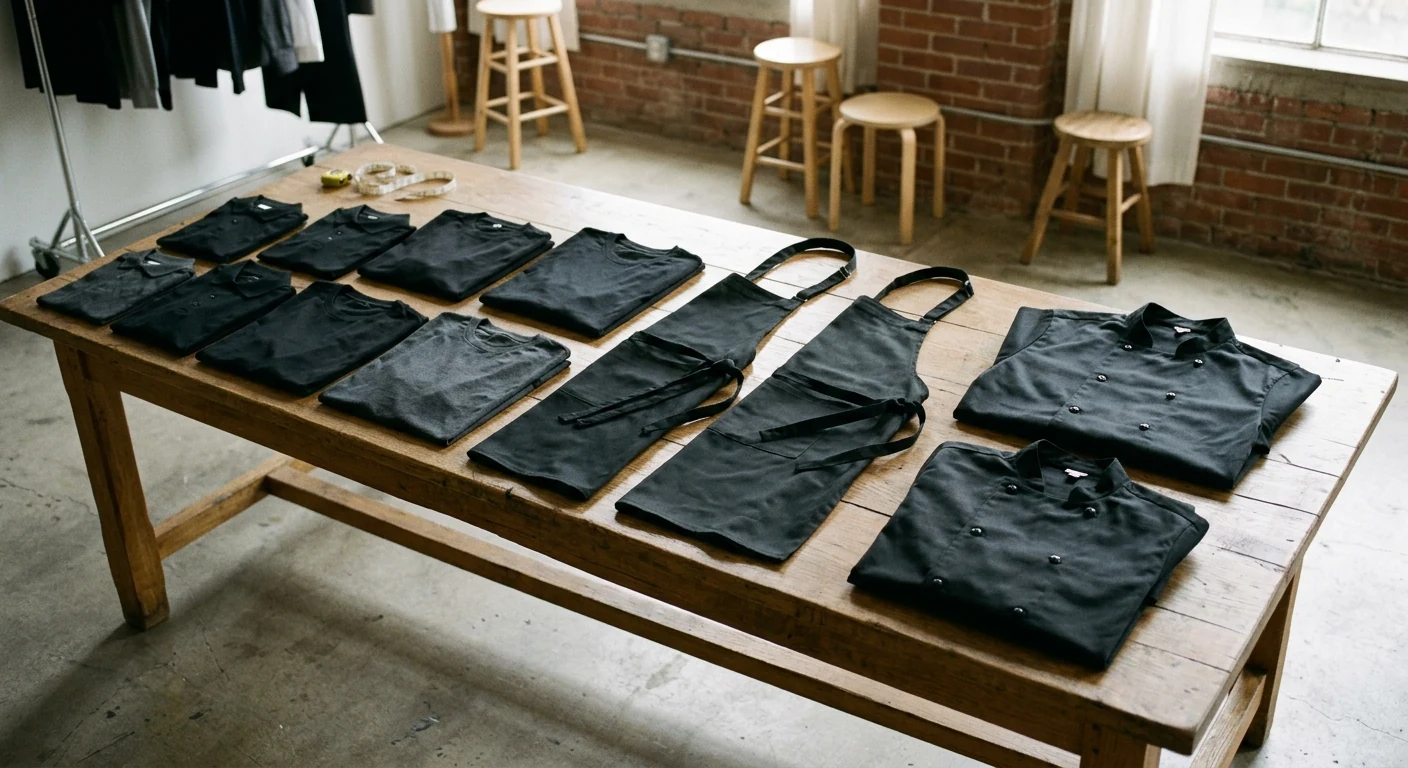
To construct the matrix, procurement must extract the measurement parameters for every garment type (e.g., chef coats, server aprons, host suiting) directly from the supplier. This includes critical dimensions such as chest/bust, waist, hips, inseam, outseam, and neck circumference. The matrix must clearly define the acceptable measurement range for each size code, eliminating ambiguity during the measurement intake process.
Decision Tool: size_matrix
| Garment Category | Supplier Size Code | Chest/Bust Range (Buyer-Entered) | Waist Range (Buyer-Entered) | Inseam/Length (Buyer-Entered) | Supplier Record Required |
|---|---|---|---|---|---|
| Server Shirt (F) | [Enter Code, e.g., M-Reg] | [Enter Range, e.g., 36-38 in] | [Enter Range, e.g., 29-31 in] | [Enter Length, e.g., 26 in] | Supplier Tech Pack Ref # |
| Chef Trouser (M) | [Enter Code, e.g., 34-Long] | [N/A] | [Enter Range, e.g., 33-35 in] | [Enter Length, e.g., 34 in] | Supplier Tech Pack Ref # |
| Host Blazer (U) | [Enter Code, e.g., 40R] | [Enter Range, e.g., 39-41 in] | [Enter Range, e.g., 34-36 in] | [Enter Length, e.g., 30 in] | Supplier Tech Pack Ref # |
Prepare the sizing set
Once the size matrix is established on paper, procurement must validate it in the physical environment. According to operational guidance from NHS Supply Chain, uniform ordering can utilize a physical sizing set or a detailed measurement guide to ensure accuracy. For restaurant environments where mobility and presentation are critical, a physical sizing set is highly recommended to support sizing-set trials and out-of-range exception handling.
Procurement must order a complete sizing set from the supplier, encompassing every size code listed in the size matrix for all core garments. When you review restaurant uniform options, ensure that the supplier can provide these sample garments specifically for fit-testing purposes. These garments are not for operational use; they are measurement tools. Upon receipt, procurement must inventory the sizing set, tag each garment clearly with its supplier size code, and secure the set in a designated fitting area.
The preparation phase also involves training the personnel who will conduct the sample-fit sessions. These individuals must understand how to use a soft measuring tape correctly, how to read the supplier's measurement guide, and how to instruct wearers on assessing the fit of the sample garments (e.g., checking shoulder seams, testing range of motion, verifying hem lengths). Human approval is required from the procurement manager to certify that the sizing set is complete and ready for deployment before any staff members are scheduled for fittings.
Run sample-fit sessions
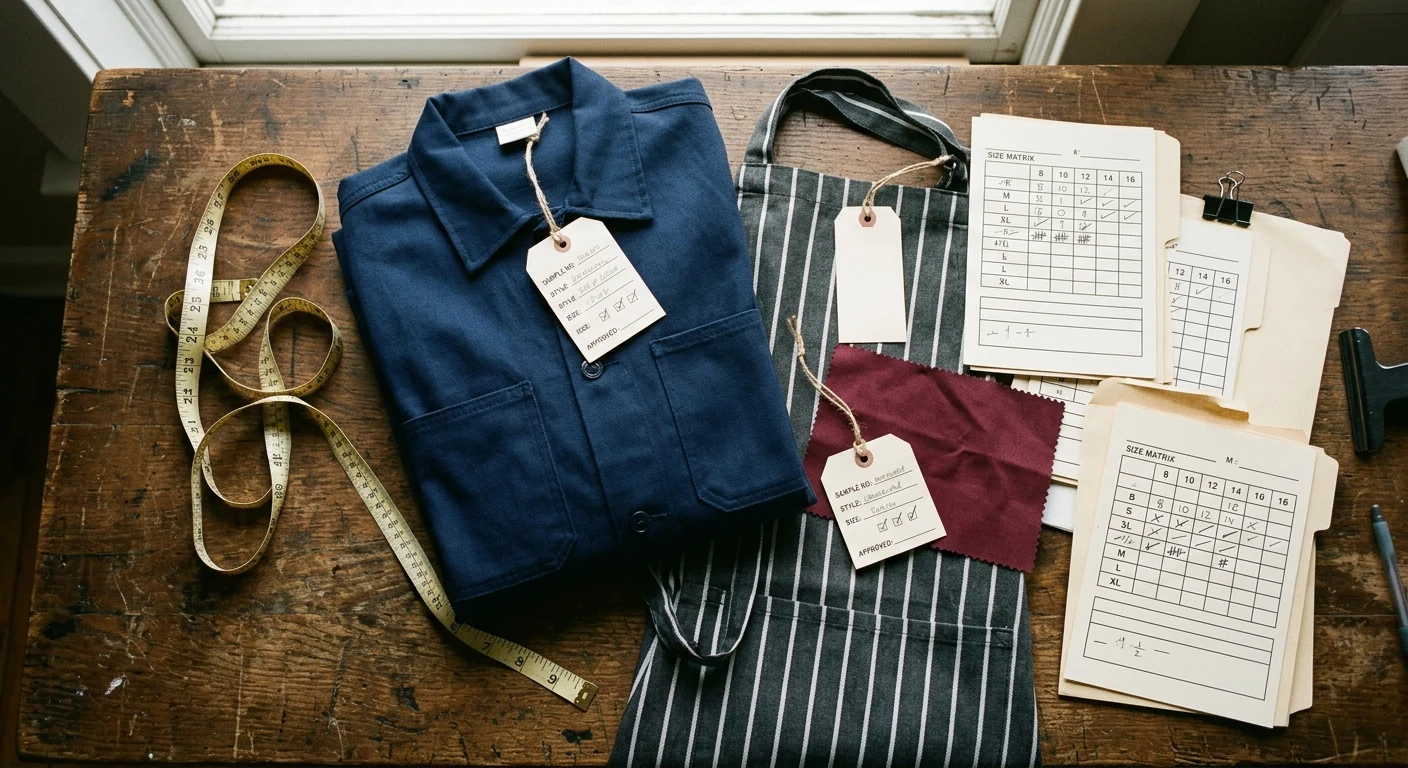
The sample-fit session is the critical event where theoretical measurements are tested against physical garments. As demonstrated by procedures at California Polytechnic State University, utilizing a uniform sizing form can standardize wearer measurements and cut preferences before ordering. This standardizes the intake record and prevents free-text size guesses that lead to procurement errors.
During the session, the wearer's baseline body measurements are taken and recorded on the standardized form. These measurements are then compared to the size matrix to select the initial sample garment for try-on. The wearer puts on the sample garment, and the fit is evaluated for both comfort and operational functionality. If the initial sample does not fit correctly, adjacent sizes are tested until the optimal fit is identified. The final selected size code must be recorded exactly as it appears in the supplier's catalog.
Procurement must enforce strict control over this environment. Wearers must not be permitted to simply state their preferred size without trying on the corresponding sample garment. The session must be documented meticulously, capturing the wearer's name, role, baseline measurements, the sample size tried, and the final size selected. This data forms the foundation of the final purchase order.
Decision Tool: sample_fit_workflow
| Workflow Step | Action Required | Data Captured (Buyer-Entered) | Human Approval Required |
|---|---|---|---|
| 1. Baseline Measurement | Measure wearer using soft tape per supplier guide. | [Enter Chest, Waist, Inseam] | Fit Session Facilitator |
| 2. Matrix Cross-Reference | Match measurements to size matrix to find starting size. | [Enter Target Size Code] | Fit Session Facilitator |
| 3. Physical Try-On | Wearer tests the physical sample garment for fit and mobility. | [Enter Fit Notes / Adjustments] | Wearer |
| 4. Final Size Selection | Determine the exact supplier SKU to be ordered. | [Enter Final Supplier SKU] | Fit Session Facilitator |
Record sign-off and exceptions
The conclusion of the sample-fit session requires formal documentation to lock in the data and transfer responsibility for the size selection. Drawing on principles from the State of Delaware Government Support Services, a uniform program must document selected sizes and alterations, validate measurements before production, and preserve records for reorders. This requires a formal sample-fit approval sign-off.
The sign-off document must clearly state the wearer's name, employee ID, department, and the exact supplier size codes selected for each required garment. Both the wearer and the department manager (or designated fit facilitator) must sign this document. This dual-signature requirement provides human approval that validates the data before it enters the procurement system, significantly reducing disputes over incorrect sizing upon delivery.
When measurements fall outside the standard size matrix, place the record in the exception queue. Use the selected supplier’s current special-order form and measurement fields; do not force the wearer into a standard size code.
Decision Tool: approval_signoff
| Employee ID | Garment Type | Selected Size Code (Buyer-Entered) | Wearer Signature Date | Manager Approval Date |
|---|---|---|---|---|
| [Enter ID] | [Enter Garment, e.g., Apron] | [Enter Code, e.g., OSFA] | [Enter Date: YYYY-MM-DD] | [Enter Date: YYYY-MM-DD] |
| [Enter ID] | [Enter Garment, e.g., Shirt] | [Enter Code, e.g., L-Tall] | [Enter Date: YYYY-MM-DD] | [Enter Date: YYYY-MM-DD] |
Decision Tool: exception_queue
| Employee ID | Garment Type | Out-of-Range Measurement (Buyer-Entered) | Supplier Custom Order Form Ref | Procurement Approval Date |
|---|---|---|---|---|
| [Enter ID] | [Enter Garment] | [Enter Variance, e.g., +4in Sleeve] | [Enter Supplier Form #] | [Enter Date: YYYY-MM-DD] |
| [Enter ID] | [Enter Garment] | [Enter Variance, e.g., 50in Waist] | [Enter Supplier Form #] | [Enter Date: YYYY-MM-DD] |
Convert approvals into the order size run
With all individual sample-fit sign-offs and exception forms collected, procurement must convert this wearer-centric data into a SKU-centric master order. This aggregation process translates hundreds of individual employee records into a consolidated purchase order that the supplier can process efficiently.
Procurement must tally the total quantity required for each specific supplier size code across all departments. This consolidated list becomes the official order size run. During this conversion, procurement must also factor in the initial safety stock required for immediate replacements and new hires anticipated during the rollout phase. The final master order must be cross-referenced against the individual sign-off sheets to ensure no data entry errors occurred during aggregation. Human approval from the procurement director is required to authorize the final release of the master purchase order to the supplier, confirming that the aggregated quantities match the approved budget and the documented sizing records.
Track exchanges and replacement sizes
Even with meticulous sample-fit sessions, some exchanges will be necessary upon final delivery due to minor manufacturing tolerances or changes in wearer preference. Procurement must establish a controlled replacement-size record to manage these events without losing track of inventory. The ordering team controls approval, returns, and made-to-order exceptions, ensuring that every garment moving in or out of the facility is documented.
When an exchange is requested, the wearer must return the original unworn garment to procurement. The returned garment is inspected, and if it meets the supplier's return conditions, it is either restocked into internal safety inventory or returned to the supplier for credit. The replacement size is then issued, and the master sizing record for that employee is updated to reflect the new size code. This continuous updating of sizing data ensures that future reorders for that specific employee are accurate, preserving the integrity of the procurement records when personnel changes occur.
Decision Tool: replacement_size_record
| Employee ID | Original Size Issued (Buyer-Entered) | Replacement Size Issued (Buyer-Entered) | Reason for Exchange | Inventory Action (Restock/Return) |
|---|---|---|---|---|
| [Enter ID] | [Enter Code, e.g., M] | [Enter Code, e.g., L] | [Enter Reason, e.g., Too tight in shoulders] | [Enter Action, e.g., Restock Internal] |
| [Enter ID] | [Enter Code, e.g., 32R] | [Enter Code, e.g., 34R] | [Enter Reason, e.g., Incorrect initial measurement] | [Enter Action, e.g., Return to Supplier] |
Define evidence-based reorder triggers
To maintain operational continuity after the initial rollout, procurement must define clear, evidence-based reorder triggers for the uniform program. Relying on visual checks of the stockroom is insufficient; procurement requires a data-driven approach based on historical replacement rates, employee turnover data, and exact supplier lead times.
The reorder trigger is the specific minimum inventory level at which a new purchase order must be generated to replenish safety stock before it is depleted. Procurement must calculate this trigger for each core size code. Common sizes (e.g., Medium and Large shirts) will require higher safety stock levels and more frequent reorders than outlier sizes. By analyzing the replacement-size records and turnover metrics, procurement can establish a reorder trigger table that automates the replenishment process, ensuring that new hires and replacement requests can be fulfilled immediately without waiting for standard supplier production cycles. Human approval is required to periodically review and adjust these triggers based on seasonal hiring fluctuations or changes in supplier delivery performance.
Decision Tool: reorder_trigger_table
| Garment SKU | Supplier Lead Time (Days) | Monthly Consumption Rate (Buyer-Entered) | Minimum Stock Trigger (Buyer-Entered) | Reorder Quantity (Buyer-Entered) |
|---|---|---|---|---|
| [Enter SKU, e.g., SHRT-WHT-M] | [Enter Days, e.g., 14] | [Enter Rate, e.g., 5 units/mo] | [Enter Trigger, e.g., 10 units] | [Enter Qty, e.g., 20 units] |
| [Enter SKU, e.g., APRN-BLK-OS] | [Enter Days, e.g., 7] | [Enter Rate, e.g., 15 units/mo] | [Enter Trigger, e.g., 25 units] | [Enter Qty, e.g., 50 units] |

Final purchase-control checklist
Executing a controlled uniform size run requires strict adherence to procurement protocols. Before finalizing any uniform program, procurement teams must verify that all steps have been completed and documented. The size matrix must be fully populated using exact supplier records. The physical sizing set must be utilized to conduct standardized sample-fit sessions. Every wearer must provide a signed approval for their selected size, and all out-of-range measurements must be processed through the formal exception queue. Finally, the replacement records and reorder triggers must be established in the inventory management system.
By maintaining this level of record control, procurement eliminates the guesswork from uniform ordering, reduces waste, and ensures that the restaurant staff is outfitted accurately and efficiently. To ensure your sizing protocols and inventory triggers are correctly calibrated for your specific operational requirements, request a size-run procurement review with our team.
Get the week's latest industry information
-
Real-Life Professional Restaurant Case Studies
Explore Now
-
Create a unique restaurant with over 95,700+products
Explore Now
-
Protessional Free 3D Restaurant Design
Explore Now
-
Still Have Questions About Opening a Restaurant?
Explore Now

Sylvia
With 8 years in catering & hospitality industry, sales manager of Ron Group, specialise in providing one stop solutions to restaurants, hotels and weddings.
Discover Our Exclusive Products
Explore our extensive range of restaurant and hotel supplies designed to enhance your operations. Find the perfect solutions to meet your needs.
Browse Our ProductsFREE 3D DESIGN
Boost your restaurant's success with our free 3D design service. Start building the restaurant of your dreams today!
Explore 3D Design Case
RECOMMENDED CASES
-

La Rambla by Catalunya: Crafting Barcelona's Soul in Hong Kong - Custom Furniture Excellence
RON Group's custom Spanish-inspired furniture elevates La Rambla with artisanal aesthetics...
Learn More -

Cardinal Point: Elevating Outdoor Seating with Tailored Cushion Upgrades
Discover how Cardinal Point transformed its outdoor dining experience with custom cushions, achievin
Learn More
RECOMMENDED BLOGS
-

Bar Glassware 101: Types, Names, Uses, and How to Stock Your Bar
Learn the 10 core bar glassware types, names, and uses. Discover how to stock your bar with the right glasses for cocktails, beer,...
Sylvia2026-07-26 -

Complete Bar Equipment List for Opening a Bar
Use a complete bar equipment list with pictures, covering workstations, ice, refrigeration, glassware, utilities, sanitation and a...
Sylvia2026-06-11 -

Low-Budget Restaurant Interior Design Ideas: Spend Where Guests and Staff Notice
Explore low-budget restaurant interior design ideas, practical material choices, layout priorities and phased upgrades without...
Sylvia2026-04-04
Subscribe to RON GROUP
Stay up-to-date with the latest industry insights and expert advice. Together, we'll create your ideal restaurant.