

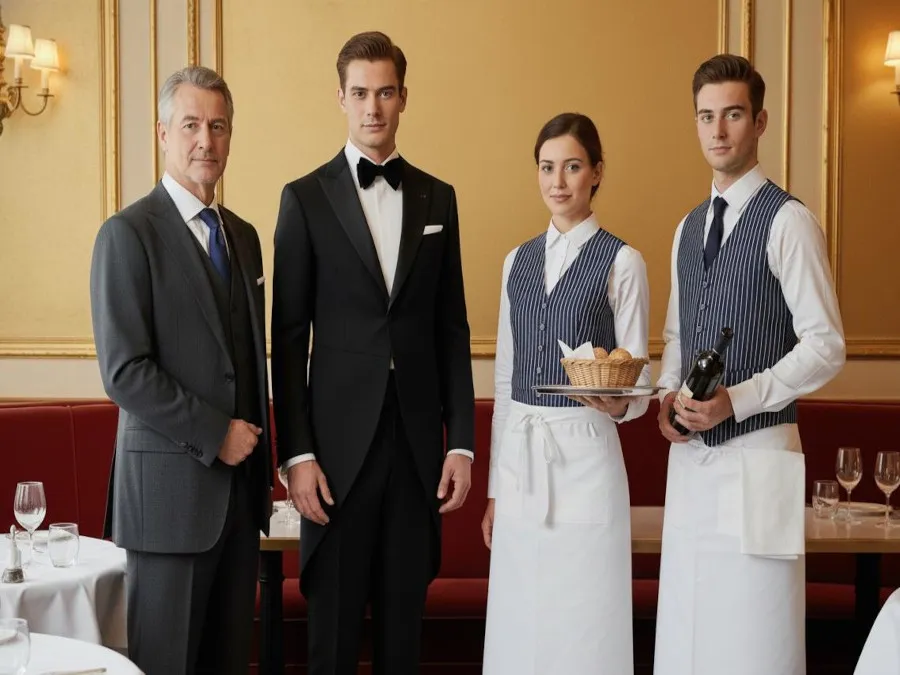
Fine Dining Restaurant Uniforms: Designing a Front-of-House Brigade That Communicates Hierarchy, Luxury, and Efficiency
Content
Direct Answer: In French fine-dining environments, the front-of-house uniform hierarchy visually maps service roles to specific operational duties, ensuring seamless guest communication and functional efficiency. A procurement-ready uniform specification must translate these roles—Restaurant Director, Maître d'Hôtel, Chef de Rang, Demi-Chef, Commis, and Sommelier—into bounded project inputs. This requires defining the silhouette, layering logic, and pocket configuration for each position based on their physical movement and table responsibilities. Furthermore, an approval-ready RFQ must mandate exact fitting checks, spare allocation logic based on local food code requirements, and documented evidence of industrial laundering compatibility using standardized test procedures.
Defining the Front-of-House Service Hierarchy
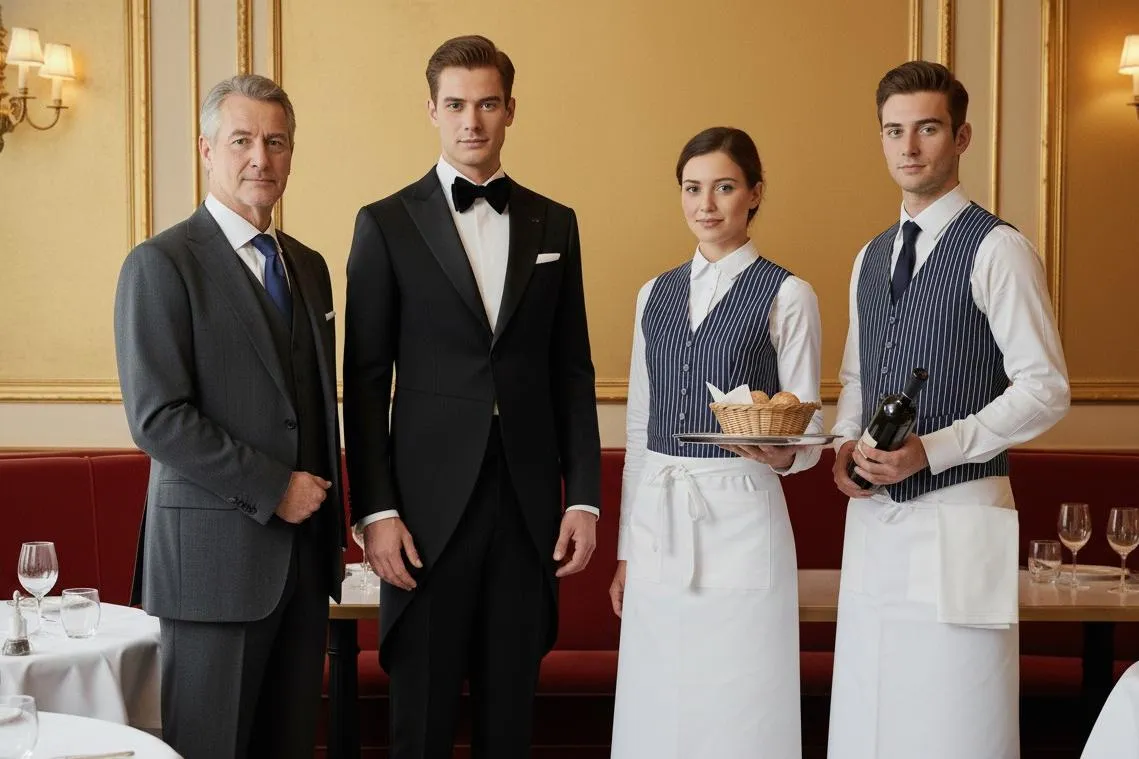
The architecture of a fine-dining dining room relies on a structured division of labor. When guests enter a high-end establishment, they subconsciously seek visual cues to understand who is managing their reservation, who is responsible for their table, and who is providing support. Translating this hierarchy into a uniform procurement strategy requires a precise understanding of the duties associated with each role.
According to France Travail's documentation on restaurant occupations, the relationships among the restaurant director, maître d'hôtel, chefs de rang, servers, and commis form the backbone of the service brigade. Each tier interacts with the guest and the physical environment differently, dictating strict requirements for garment construction, mobility, and durability.
The Restaurant Director and Maître d'Hôtel
The leadership tier of the dining room is responsible for the overarching orchestration of the service. As detailed by Onisep's career information for the Maître d'Hôtel, this role encompasses front-of-house leadership, supervision of the brigade, guest welcome, and the critical relationship to the chefs de rang and commis. Because their primary physical actions involve standing at a host stand, walking the dining room floor, and engaging in face-to-face guest communication, their uniform specifications prioritize structural tailoring and formal silhouettes over athletic mobility.
The property should define how the Restaurant Director and Maître d'Hôtel are distinguished from the brigade without assuming a universal color, lapel, or garment type. Record the approved silhouette, layering, pocket needs, movement requirements, and sample construction details in the role schedule. Ask the supplier to identify the proposed shell, lining, interlining, seam, and reinforcement choices so they can be checked against the property's service routine and care process.
The Chef de Rang and Demi-Chef
The Chef de Rang is the primary point of contact for the guest's dining experience. Onisep outlines the Chef de Rang duties as encompassing movement through service, direct table responsibility, and the supervision of junior service staff. This role requires a complex balance of formal presentation and high physical mobility. They must reach across wide tables to place plates, lean over to pour wine or water, and frequently pivot between the dining room and the service station.
Uniform specifications for the Chef de Rang and Demi-Chef must account for this constant articulation. Where the approved concept uses a waistcoat, jacket, or apron, the sample must demonstrate reach without riding up or binding. The RFQ should identify pocket contents, positions, opening dimensions, reinforcement details, and the staff movements to be performed during fitting rather than prescribing an unsupported universal fabric construction.
The Commis and Sommelier
The Commis (or runner/busser) performs the most physically demanding tasks in the dining room, including carrying heavy trays, clearing multiple plates, and rapidly navigating between the hot kitchen and the dining floor. Their uniform requires maximum breathability, minimal restriction, and high laundering frequency. Layering is typically reduced to a durable shirt and a shorter apron to allow for an unimpeded stride.
Conversely, the Sommelier requires a highly specialized uniform variant. While they share the formal requirements of the Maître d'Hôtel or Chef de Rang, their specific duties—presenting bottles, decanting, and utilizing specialized tools—demand unique pocket configurations. If a sommelier carries a wine key, tasting tool, or service cloth, record each actual item and its placement in the pocket schedule. Approve the pocket only after the wearer can reach, bend, present, and pour without snagging the tool or distorting the garment.

Translating Duties into Bounded Specification Inputs
Moving from conceptual roles to a tangible procurement document requires defining exact physical and environmental parameters. A successful RFQ does not ask for a "nice waiter uniform"; it requests a garment engineered for specific operational stresses.
Silhouette, Movement, and Pocket Logic
The silhouette of a fine-dining uniform must remain architectural, yet the garment must yield to movement. When specifying waistcoats and jackets, procurement managers must define the armhole depth. A lower armhole restricts arm lift, causing the entire garment to pull upward when a server reaches across a table. Armhole depth and sleeve geometry should therefore be evaluated on the fitted sample during the actual reach tasks defined for the role.
Pocket logic must be explicitly detailed in the RFQ. Do not accept standard patch pockets for service staff. Specify "bartacked, reinforced welt pockets" with exact dimensions required for the property's specific point-of-sale (POS) handheld devices. If a Chef de Rang carries a POS terminal, load the actual device during fitting and document any sagging, restricted movement, or seam stress. The supplier should then state the reinforcement method used for that approved pocket.
Heat Stress and Layering Considerations
The physical environment of a restaurant fluctuates dramatically between the climate-controlled dining room and the high-temperature kitchen pass. The NIOSH guidelines on heat stress explain that clothing, workload, and indoor heat can contribute significantly to occupational heat burden. For roles with high physical exertion, such as the Commis and Demi-Chef, heavy, multi-layered synthetic uniforms can trap body heat and moisture, leading to discomfort and reduced operational efficiency.
Procurement specifications must address this by defining the layering logic. If a waistcoat is required, the specification should request a breathable back panel (often a lighter lining material) rather than a full-fabric back. Shirts should specify a fabric weight and weave that promotes moisture management, avoiding heavy, densely woven polyesters for high-movement roles.
Laundering Evidence and Hygiene Standards
In hospitality, a uniform is only as viable as its ability to withstand constant cleaning. The FDA Food Code establishes the model context for the clean outer-clothing principle, mandating that food employees wear clean outer clothing to prevent contamination of food, equipment, and utensils. (Note: Locally adopted rules always control the exact enforcement of this principle). This requirement dictates a high frequency of washing, which in turn demands rigorous procurement standards for fabric durability.
When issuing an RFQ, procurement managers must not accept unsupported claims of "industrial wash durability." Instead, they must request exact test reports. The ISO 15797:2017 standard outlines specific industrial-laundering test procedures and the properties they can evaluate, such as dimensional stability (shrinkage), colorfastness, and seam puckering. The RFQ should require suppliers to provide test reports demonstrating how the proposed fabrics perform under these specific procedures.
Furthermore, garments intended for professional cleaning should be properly labeled. The ISO 30023:2021 standard defines the qualification symbols for workwear intended for professional industrial laundering. Requesting that garments carry these symbols, backed by the appropriate testing evidence, ensures that the property's laundry facility or third-party service can process the uniforms without causing premature degradation.
Sample Approval, Fitting Checks, and Spare Allocation Logic
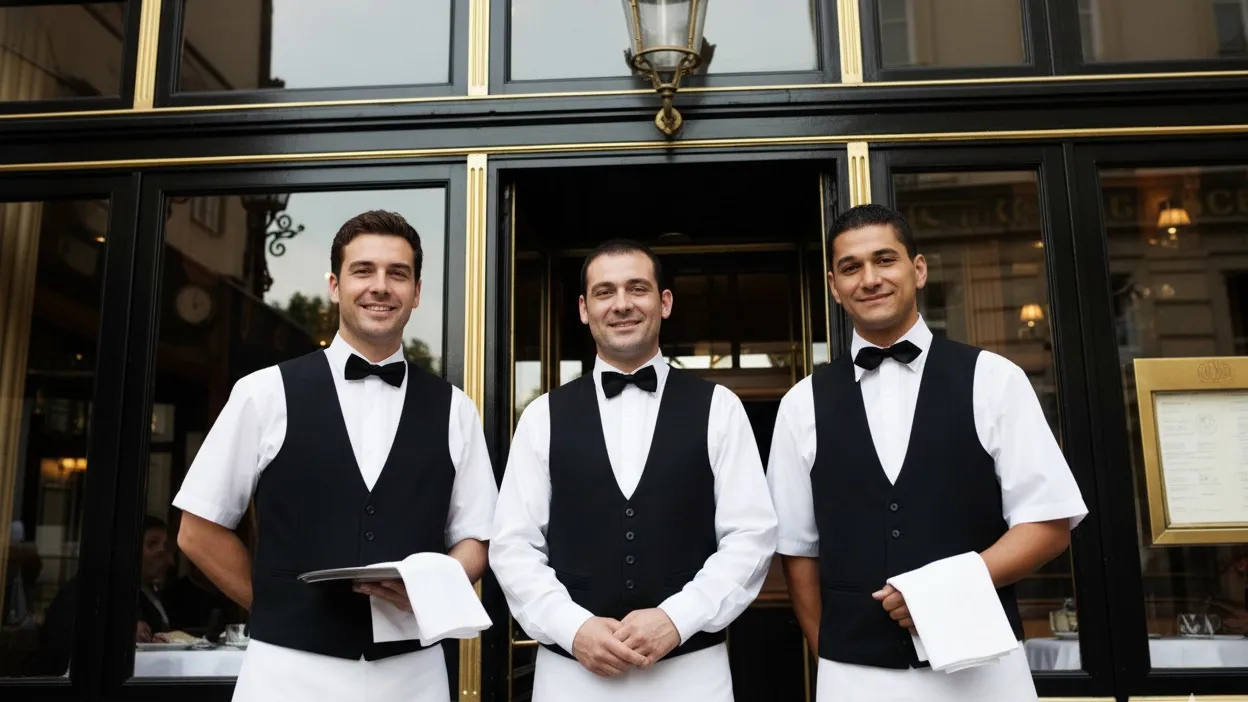
The transition from a paper specification to a deployed uniform program requires a rigorous physical evaluation phase. The sample approval process is the final barrier against procurement errors. When evaluating a sample, the focus must be on construction integrity and operational fit, not just aesthetics. Understanding these physical requirements is a core component of broader procurement strategy, similar to the principles discussed in 5 Mistakes to Avoid When Purchasing for Your Restaurant.
Conducting the Fitting Check
A fitting check must simulate actual service conditions. Do not evaluate a uniform sample on a static mannequin or a stationary staff member. Require the staff member to perform their specific role duties while wearing the sample:
The Reach Test: Have the Chef de Rang reach forward as if placing a plate at the center of a wide table. Check if the jacket or waistcoat rides up excessively, exposing the shirt beneath the belt line. Check for tension across the upper back (the yoke).
The Tray Carry: Have the Commis lift a weighted tray to shoulder height. Observe the shoulder seam and armhole for stress lines.
The Pocket Load: Place the actual POS terminal, a wine key, and a crumber into the designated pockets. Observe if the garment sags, if the pocket opening gapes, or if the tools restrict the wearer's ability to bend at the waist.
The Apron Stride: Ensure the apron length and tie placement do not restrict the natural walking stride or cause the apron to tangle around the legs during rapid movement.
Common Failure Mode Scenarios
Anticipating how a garment will fail allows you to write preventative requirements into the RFQ. Common failure modes in fine-dining uniforms include:
The Pocket Blowout: Occurs when servers repeatedly force hands or heavy tools into pockets lacking structural reinforcement. Prevention: Specify bartacking at all pocket corners and a reinforced internal lining.
The Lapel Distortion: A jacket front may ripple or separate after the intended care process. Approval response: ask the supplier to identify the interlining and attachment method, then include the complete sample in the agreed care trial.
The Seam Distortion: A trouser or skirt seam can open or distort under role-specific bending and movement. Approval response: inspect the worn sample, request relevant seam-performance evidence, and record the accepted seam construction.
The Collar Distortion: A service-shirt collar may lose its approved form during the intended care process. Approval response: include the complete shirt in the agreed laundry trial and record the collar construction shown on the approved sample.
Spare Allocation Logic
Determine uniform quantities from the property's issue policy, the locally required clean-clothing practice, work pattern, laundry collection and return cadence, emergency-change policy, seasonal staffing, and replacement lead time. Record these inputs rather than copying a generic par level.
Build the allocation by role because change frequency, care route, turnaround, and backup needs differ. Keep the reasoning visible in the schedule, and validate the final quantity against the actual roster and laundry calendar. The same input-led discipline used in our Restaurant Table Selection Guide helps keep assumptions reviewable without presenting a universal ratio.
Role-by-Role Schedule and RFQ Evidence Checklist
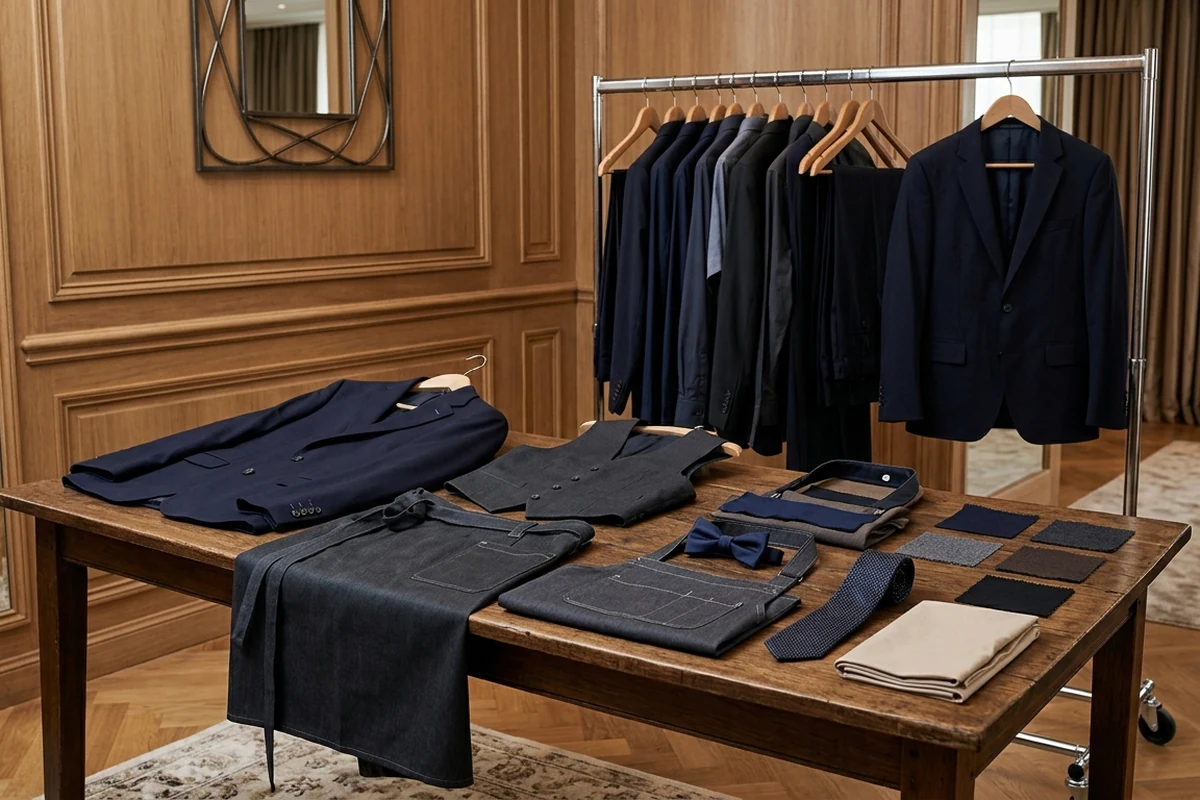
To execute a successful uniform procurement program, the requirements must be organized into clear, actionable schedules that suppliers can bid against accurately. The following tables provide a framework for structuring the RFQ.
Table 1: Role-by-Role Uniform Specification Schedule
| Role | Silhouette & Layering Logic | Mobility & Pocket Focus | Allocation Inputs to Confirm |
|---|---|---|---|
| Restaurant Director | Tailored 2-piece or 3-piece suit. Distinct color from brigade. High-grade interlining. | Low physical exertion. Standard internal jacket pockets for pens/cards. | Roster, issue policy, care turnaround, and contingency quantity. |
| Maître d'Hôtel | Formal dinner jacket/tuxedo. Reinforced shoulders for posture presentation. | Low physical exertion. Minimal pocketing to maintain clean lines. | Roster, issue policy, care turnaround, and contingency quantity. |
| Chef de Rang | Waistcoat with breathable back panel. Long service apron. High armholes. | High reach mobility. Reinforced welt pockets sized for POS terminal and crumber. | Separate quantities by component using actual change and care cadence. |
| Sommelier | Tailored jacket or specialized waistcoat. Distinct lapel or identifier. | Arm articulation for pouring. Specialized pockets for wine key, tastevin, and service napkin. | Role roster, care turnaround, fitting reserve, and contingency quantity. |
| Commis | Minimal layering. Durable shirt and short waist apron. Focus on heat mitigation. | Maximum mobility for tray carrying. Unrestricted leg movement for rapid walking. | Actual change frequency, laundry return time, and contingency quantity. |
Table 2: RFQ Evidence and Sample Verification Checklist
| Specification Requirement | Required RFQ Evidence | Physical Sample Check |
|---|---|---|
| Industrial Laundering Compatibility | Test reports referencing ISO 15797:2017 procedures for the specific fabric lot. | Run the documented care trial agreed with the supplier and laundry provider; record dimensions, color appearance, seams, closures, and pressing result before and after. |
| Professional Care Labeling | Documentation confirming application of ISO 30023:2021 qualification symbols. | Verify labels are securely attached, legible, and match the provided documentation. |
| Pocket Durability (Chef de Rang) | Technical drawing showing bartack locations and internal reinforcement materials. | Load pocket with actual POS device; perform "Reach Test" to check for sagging or seam stress. |
| Garment Construction (Tailoring) | Specification sheet detailing fusing type (e.g., half-canvas vs. full block fusing). | Pinch the lapel to feel for the floating canvas layer; check for stiffness or bubbling post-wash. |
| Mobility & Fit (Armholes) | Pattern grading chart showing armhole depth across all requested sizes. | Have staff perform the "Tray Carry" test; ensure the garment body does not lift excessively. |
Procurement Next Steps
Establishing a front-of-house uniform program that honors the traditions of French fine dining while meeting the rigorous demands of modern hospitality operations requires precise specification. By translating the distinct duties of the Maître d'Hôtel, Chef de Rang, and Commis into bounded requirements for mobility, pocketing, and laundering evidence, operators can eliminate procurement ambiguity and ensure their brigade is equipped for flawless service.
To explore how these technical specifications can be integrated into your next project, review our custom uniform solutions. When you are ready to define your role-by-role requirements, establish spare allocation logic, and request evidence-backed fabric proposals, Contact Ron Group’s FOH Style Consultants to initiate a structured RFQ process.
Get the week's latest industry information
-
Real-Life Professional Restaurant Case Studies
Explore Now
-
Create a unique restaurant with over 95,700+products
Explore Now
-
Protessional Free 3D Restaurant Design
Explore Now
-
Still Have Questions About Opening a Restaurant?
Explore Now

Sylvia
With 8 years in catering & hospitality industry, sales manager of Ron Group, specialise in providing one stop solutions to restaurants, hotels and weddings.
Discover Our Exclusive Products
Explore our extensive range of restaurant and hotel supplies designed to enhance your operations. Find the perfect solutions to meet your needs.
Browse Our ProductsFREE 3D DESIGN
Boost your restaurant's success with our free 3D design service. Start building the restaurant of your dreams today!
Explore 3D Design Case
RECOMMENDED CASES
-
La Rambla by Catalunya: Crafting Barcelona's Soul in Hong Kong - Custom Furniture Excellence
RON Group's custom Spanish-inspired furniture elevates La Rambla with artisanal aesthetics...
Learn More -

Cardinal Point: Elevating Outdoor Seating with Tailored Cushion Upgrades
Discover how Cardinal Point transformed its outdoor dining experience with custom cushions, achievin
Learn More
RECOMMENDED BLOGS
-

Bar Glassware 101: Types, Names, Uses, and How to Stock Your Bar
Learn the 10 core bar glassware types, names, and uses. Discover how to stock your bar with the right glasses for cocktails, beer,...
Sylvia2026-07-26 -

Complete Bar Equipment List for Opening a Bar
Plan a complete commercial bar equipment list by menu, service volume, refrigeration, ice, glassware, utilities, sanitation,...
Sylvia2026-06-11 -

Low Budget Restaurant Interior Design: 2026 Trends
Prioritize a low-budget restaurant interior by protecting code, operations, durability, accessibility, and phased design decisions...
Sylvia2026-04-04
Subscribe to RON GROUP
Stay up-to-date with the latest industry insights and expert advice. Together, we'll create your ideal restaurant.