

Content

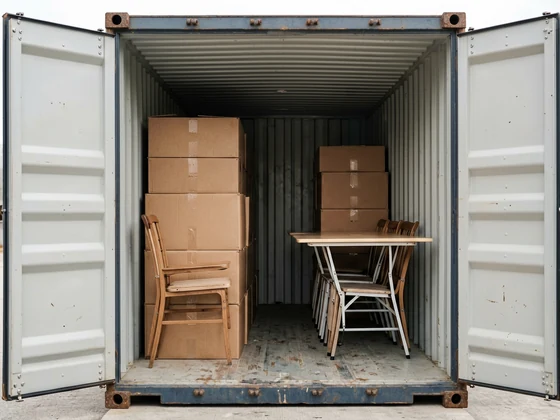
A restaurant furniture shipment can sit below nominal cubic capacity and still be unfit to load. A table-top crate may not pass the door, dense table bases may concentrate weight, chair cartons may not support the stack, or the destination team may face the wrong unloading order.
The buyer therefore needs an approval file, not a CBM promise: package data, transparent calculations, a scaled layout, a securing method, assigned responsibilities, loading evidence, and an unloading plan.
This is a planning and buyer-verification guide. Final equipment acceptance, route legality, cargo securing, verified gross mass (VGM), customs and phytosanitary compliance, and unloading safety remain with the qualified parties responsible for those decisions.
Start With Buyer-Controlled Inputs
Freeze the furniture schedule before approving calculations. Every package needs an identified destination. Buyers selecting restaurant furniture options should close SKU quantities before treating a container estimate as final.
The package list should contain at least:
| Required field | Why the buyer needs it |
|---|---|
| Package ID, furniture SKU, and quantity inside | Reconciles the shipment to the purchase schedule |
| Destination room, area, or installation zone | Supports staging and unloading order |
| Packed length, width, and height | Controls door entry, CBM, orientation, and layout |
| Gross mass | Supports payload, floor-loading, handling, and VGM inputs |
| Stack limit and required orientation | Prevents unsupported stacking assumptions |
| Fragile faces, finish risks, handling points, and centre-of-gravity marks | Directs handling controls |
| Packaging type and raw-wood content | Supports moisture and destination checks |
| Unloading priority | Connects the load plan to site operations |
Product dimensions are not packed dimensions. Protection, cartons, crates, skids, and hardware boxes change geometry and mass.
Pass Three Capacity Checks
1. Geometric Entry
Check the largest packed item first: dimensions, permitted orientation, turning clearance, handling method, and internal obstructions. The door can be smaller than the internal cross-section, so aggregate volume is irrelevant if the package cannot enter (Maersk equipment example; Hapag-Lloyd packing guide).
One Maersk specification lists a 20-foot standard dry container at approximately 5,896 x 2,350 x 2,393 mm internally, with a 2,350 x 2,274 mm door opening and 33 m3 nominal volume. Its 40-foot high-cube example is approximately 12,032 x 2,350 x 2,697 mm internally, with a 2,340 x 2,577 mm door opening and 76 m3 nominal volume. These are carrier examples, not universal dimensions. The booked unit, carrier confirmation, and CSC safety approval plate control.
2. Volume and Layout
Calculate package-level CBM:
Package CBM = packed length x packed width x packed height in metres
Then sum all packages and add explicit allowances:
Total CBM = sum(quantity x packed length x packed width x packed height) + explicit packing/securing allowance
Approval still depends on stack rules, package strength, voids, securing space, handling gaps, door access, and scaled plans.
3. Mass and Structure
Compare package mass with the actual unit's payload and permitted gross mass. Chassis, inland, lifting, handling, or route restrictions may impose lower limits. Heavy packages with small footprints may require load spreading. The floor plan should show mass, support points, heavy-item positions, and centre-of-gravity review. See the joint IMO/ILO/UNECE CTU Code.
Worked 40-Foot High-Cube Check
Assume the proposed shipment contains:
| Package group | Calculation | CBM | Mass |
|---|---|---|---|
| 80 chair cartons | 80 x 0.55 x 0.55 x 0.95 m | 22.99 m3 | 880 kg |
| 25 table-top crates | 25 x 1.25 x 0.85 x 0.12 m | 3.19 m3 | 550 kg |
| 25 table-base packages | 25 x 0.65 x 0.65 x 0.25 m | 2.64 m3 | 450 kg |
| Protection, dividers, dunnage, securing materials, and handling gaps | Explicit example allowance | 2.50 m3 | 500 kg |
| Planning total | 31.32 m3 | 2,380 kg |
The package subtotal is 28.82 m3; adding the 2.50 m3 allowance gives 31.32 m3. Mass is 880 + 550 + 450 + 500 = 2,380 kg.
Against the Maersk 40-foot high-cube example of 76 m3 nominal volume and 28,620 kg payload, the arithmetic shows substantial nominal headroom. The largest assumed crate, 1,250 x 850 x 120 mm, is smaller than the example door in at least one orientation.
That does not approve the load. It cannot prove turning clearance, stack geometry, package strength, concentrated-load acceptability, securing, or safe unloading. Those decisions require actual package drawings, stacking rules, a scaled layout, moisture controls, and competent securing review.
Assign Responsibility Before Loading
| Decision or activity | Accountable party | Evidence |
|---|---|---|
| Final schedule and installation priorities | Buyer or project manager | Approved item schedule and area codes |
| Packed dimensions, mass, stack limits, and package construction | Furniture supplier or packer | Final package list, drawings, and sample-pack evidence |
| Equipment selection and actual limits | Carrier or forwarder with the shipper | Booking, equipment specification, CSC plate, and tare marks |
| Blocking, bracing, lashing, and door restraint | Competent packer or cargo-securing professional | Method statement, load plan, and loading record |
| VGM submission | Legal shipper named in the transport document | Carrier-accepted VGM record |
| Destination wood-packaging and import checks | Importer, broker, and destination adviser | Current rule confirmation and applicable marks |
| Unloading method and sequence | Buyer, site logistics manager, and unloading contractor | Site-specific unloading plan |
Use restaurant furniture supplier checks to test whether the supplier can provide package-level evidence instead of a sales estimate.
Control Packing, Movement, and Moisture
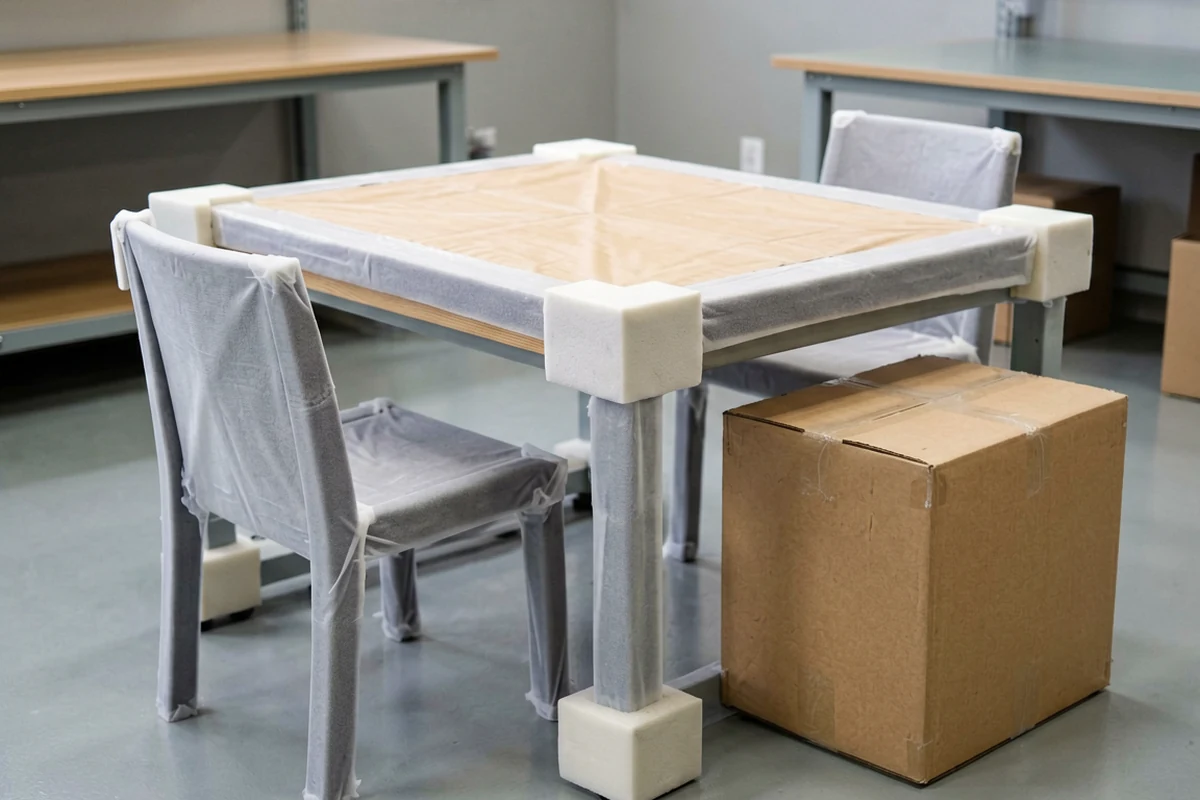
Review packing by failure mode. Visible finishes need compatible abrasion and edge protection. Cartons and crates need documented stack limits. Hardware and loose components need package IDs and retention. Internal cushioning controls movement within a package; blocking, bracing, lashing, and void treatment control movement between packages.
Humidity and condensation can damage packaging, finishes, metal components, and load stability. Use dry materials and inspect the container for cleanliness, dryness, weatherproof condition, and visible light leaks. Wet timber should not be loaded. Sheeting can trap moisture, and desiccant capacity should be calculated for the cargo and route (Hapag-Lloyd packing guide; CTU Code).
Raw-wood pallets, crates, blocks, bracing, and dunnage require a destination check. ISPM 15 addresses pest risk from raw-wood packaging material in international trade, including dunnage; processed wood such as plywood is outside the cited raw-wood scope. Implementation is destination-specific.
As a U.S. example checked on July 3, 2026, USDA APHIS requires regulated wood packaging to be pest-free, debarked, treated or fumigated as allowed, and properly marked; noncompliant material cannot enter (U.S. wood packaging guidance). Other destinations require local confirmation.

Apply an Approval Gate to the Load Plan
| Evidence required | Responsible party | Approve when | Reject or escalate when |
|---|---|---|---|
| Scaled floor and elevation plan | Supplier or packer | Package positions, orientations, footprints, heavy items, voids, and door zone are shown | Layout is only a CBM total or unscaled sketch |
| Mass and support review | Packer with carrier or freight input | Support points, distribution, actual limits, and load spreading are closed | Mass is missing or checked only against a generic payload |
| Securing method statement | Competent packer or securing professional | Voids, blocking, bracing, lashing, securing points, and doorway restraint are defined | The cargo-specific method is undocumented |
| Packing and moisture specification | Supplier or packer | Finish risks, stack strength, dry materials, barriers, and moisture basis are documented | One wrapping method is assumed adequate for every material |
| Loading photographs | Packer or loading supervisor | Package IDs, zones, supports, securing stages, final door area, and seal are visible | Images are incomplete or conflict with the approved revision |
The buyer should not calculate lashing capacity. The competent packer or cargo-securing professional owns the cargo-specific arrangement.
Separate Planning Mass From VGM
Planning mass evaluates the load. Container tare is the actual empty-unit mass. VGM is the packed container's verified gross mass.
Under SOLAS, the shipper is responsible for providing VGM in time for vessel stowage planning, and VGM is a condition for loading a packed container onto a ship. The IMO describes two high-level methods: weigh the packed container, or use an approved method that sums cargo, pallets, dunnage, securing materials, and container tare. A spreadsheet estimate is not VGM. Confirm the legal shipper, approved method, deadline, and submission route with the carrier and competent authority (IMO VGM guidance).
Load for Controlled Unloading
Before loading, confirm staging areas, installation priorities, access, labour, and equipment. Keep package IDs visible. Avoid unnecessary restacking, but do not let installation convenience override weight distribution or securing.
The unloading team should ventilate and assess the container before entry, control the first door because shifted cargo may fall outward, release securing materials without destabilizing the remaining load, use equipment matched to package dimensions and mass, and record damage as packages are removed (CTU Code).
Require a Loading-Day Evidence Pack
The release file should include:
container number, type, CSC plate, tare, and visible-condition record;
empty-container inspection photos covering cleanliness, dryness, structure, doors, seals, lashing points, odour, and light leaks;
final package list and approved load-plan revision;
applicable raw-wood packaging marks or records;
package-ID and zone photographs during loading;
securing, void-treatment, and door-restraint photographs;
final door-area photograph and seal number;
final packing list, actual mass inputs, and VGM handover record;
destination unloading instructions, equipment, access constraints, and contacts.

Approve, Revise, Reject, or Escalate
Approve loading when package data, actual equipment limits, scaled layout, securing method, moisture controls, destination wood-packaging checks, VGM responsibility, loading evidence plan, and unloading plan are closed.
Revise before loading when arithmetic fits but drawings, stack limits, package protection, floor layout, securing details, evidence responsibilities, or destination access remain incomplete.
Reject the proposed plan when a package cannot pass the door, actual limits are exceeded, dimensions or mass are unverified, wet or noncompliant packing materials are proposed, or loading differs materially from the approved revision.
Escalate to specialists for oversized packages, concentrated loads, special equipment, unclear route limits, dangerous goods, fumigation, destination compliance uncertainty, or securing work outside the supplier's competence.
To start with checkable inputs, send your furniture schedule and packing requirements: item quantities, available packed dimensions, gross weights, stack limits, destination country and port, delivery-site access, proposed container, opening or installation sequence, unloading equipment, raw-wood packaging plan, packing drawings, load-plan status, and sample-pack status. Final freight, compliance, VGM, securing, and unloading approvals remain with the responsible qualified parties.
Get the week's latest industry information
-
Real-Life Professional Restaurant Case Studies
Explore Now
-
Create a unique restaurant with over 95,700+products
Explore Now
-
Protessional Free 3D Restaurant Design
Explore Now
-
Still Have Questions About Opening a Restaurant?
Explore Now

Sylvia
With 8 years in catering & hospitality industry, sales manager of Ron Group, specialise in providing one stop solutions to restaurants, hotels and weddings.
Discover Our Exclusive Products
Explore our extensive range of restaurant and hotel supplies designed to enhance your operations. Find the perfect solutions to meet your needs.
Browse Our ProductsFREE 3D DESIGN
Boost your restaurant's success with our free 3D design service. Start building the restaurant of your dreams today!
Explore 3D Design Case
RECOMMENDED CASES
-

La Rambla by Catalunya: Crafting Barcelona's Soul in Hong Kong - Custom Furniture Excellence
RON Group's custom Spanish-inspired furniture elevates La Rambla with artisanal aesthetics...
Learn More -

Cardinal Point: Elevating Outdoor Seating with Tailored Cushion Upgrades
Discover how Cardinal Point transformed its outdoor dining experience with custom cushions, achievin
Learn More
RECOMMENDED BLOGS
-

Restaurant Table Spacing and Aisle Clearance: Supplier Drawing Checklist
Check restaurant table spacing, aisle clearance, chair pullout, service path, and supplier drawing proof before approving a...
Sylvia2026-07-20 -

5 Mistakes to Avoid When Buying Restaurant Furniture from China
Don't fall for costly oversights! Learn the 5 mistakes to avoid when buying restaurant furniture from China and ensure a...
 Ron2025-01-079 min read
 -

RON GROUP Launches VR Experience to Explore Our Dynamic Showroom
Discover RON GROUP's VR showroom! Explore dining furniture, tableware, and customized services virtually or visit us in person to...
Sylvia2024-12-163 min read
Subscribe to RON GROUP
Stay up-to-date with the latest industry insights and expert advice. Together, we'll create your ideal restaurant.