


Content
A commercial restaurant cutlery specification defines the exact material parameters, dimensional tolerances, weight requirements, surface finishes, and acceptance sampling criteria required for procurement Requests for Quotation (RFQs). This document establishes the strict boundary for dining table cutlery specification, supplier evidence requirements, and physical sample evaluation. For boundary context regarding procurement routing, consult the restaurant tableware sourcing guide. For separate ceramic specifications, refer to the ceramic selection guide. To view the visual catalog, visit the RON GROUP cutlery collection. This guide focuses strictly on the pre-RFQ specification, supplier evidence requirements, and sample acceptance protocols for dining forks, spoons, and table knives. A dining table knife may be discussed only through separately declared blade and handle evidence. By establishing a rigorous framework for these specific items, procurement teams can ensure that every supplier response is measured against an identical, unyielding standard.

1. RFQ Field Map for Commercial Cutlery
A structured Request for Quotation (RFQ) prevents ambiguity by forcing suppliers to respond to specific, measurable parameters rather than providing generic marketing descriptions. The RFQ field map categorizes requirements into distinct modules: material declaration, physical dimensions, surface and edge finish, sample evaluation criteria, defect tolerances, pack-out protocols, and repeat-order continuity. By utilizing a standardized field map, procurement teams ensure that all competing suppliers are evaluated against identical criteria, facilitating accurate bid leveling and establishing a clear contractual baseline for quality assurance. The buyer-set parameters establish the absolute minimum acceptable standard, while the supplier-returned evidence provides the contractual proof of capability. Without this dual-placeholder system, procurement teams risk receiving non-conforming goods that deviate from the intended specification.
The following table outlines the primary modules of a commercial cutlery RFQ, detailing the purpose of each section, the specific parameters the buyer must set, and the exact evidence or data the supplier is required to return. This structured approach ensures that every aspect of the cutlery, from the raw steel alloy to the final master carton labeling, is documented and agreed upon prior to the issuance of a purchase order. The rigorous application of this field map is the primary defense against specification drift during long-term procurement contracts.
| RFQ Module | Specification Purpose | Buyer-Set Parameter Placeholder | Supplier-Returned Evidence Placeholder |
|---|---|---|---|
| Material Declaration | Establish exact steel alloy composition | [Buyer-Set Grade Label] | [Supplier-Returned Mill Certificate] |
| Dimensions & Weight | Define physical size and mass tolerances | [Buyer-Set Target Weight (g) ± Tolerance] | [Supplier-Returned Production Weight (g)] |
| Surface Finish | Specify polishing and coating requirements | [Buyer-Set Finish Type] | [Supplier-Returned Finish Process] |
| Sample Approval | Define physical evaluation criteria | [Buyer-Set Sample Quantity and Date] | [Supplier-Returned Pre-Production Samples] |
| Defect Tolerances | Establish acceptable quality limits (AQL) | [Buyer-Set AQL for Critical/Major/Minor] | [Supplier-Returned Acceptance of AQL] |
| Pack-Out & Receiving | Define packaging and traceability | [Buyer-Set Inner Box/Master Carton Qty] | [Supplier-Returned Packaging Specifications] |
| Continuity | Ensure future replacement matching | [Buyer-Set Pattern Lock Period (Years)] | [Supplier-Returned Tooling Retention Policy] |
2. Material Declaration and Evidence
The foundation of a cutlery specification is the explicit declaration of the stainless-steel alloy. Procurement teams must require suppliers to provide documented material evidence of the composition rather than relying on generic commercial labels. The declared grade must match the formal designation recognized by international metallurgical standards. The British Stainless Steel Association — Cutlery stainless steel grades explains that 18/8 and 18/10 are commercial composition labels associated with 304/1.4301, while 18/0 is associated with ferritic 430/1.4016; knife blades may use hardenable martensitic grades rather than the handle, fork, or spoon grade. Procurement teams must treat these labels as claims that require supplier evidence and do not assume one grade is universally applicable or apply quality-ranking or lifespan language. A dining table knife may be discussed only through separately declared blade and handle evidence.
When specifying austenitic grades, buyers often reference standard datasheets for baseline composition. The Outokumpu Core range datasheet maps Core 304/4301 to EN 1.4301, Type 304, and UNS S30400 and provides typical composition plus available product forms and surface finishes. However, this is mill data for Outokumpu products, not evidence for an unnamed cutlery supplier; buyers must not transfer its composition or performance to another supplier without lot-bound documentation. Similarly, for ferritic grades, the Outokumpu Moda range datasheet maps Moda 430/4016 to EN 1.4016, Type 430, and UNS S43000 and identifies it as ferritic stainless steel with supplier-specific typical composition and product forms. Buyers must not turn the manufacturer’s environment descriptions into cutlery promises.
| Material Specification Field | Buyer Requirement Placeholder | Supplier Evidence Placeholder |
|---|---|---|
| Fork and Spoon Alloy | [Buyer-Set Grade (e.g., 1.4301)] | [Supplier-Returned Material Test Report (MTR)] |
| Table Knife Handle Alloy | [Buyer-Set Grade (e.g., 1.4301 or 1.4016)] | [Supplier-Returned MTR for Handle] |
| Table Knife Blade Alloy | [Buyer-Set Martensitic Grade] | [Supplier-Returned MTR for Blade] |
| Material Traceability | [Buyer-Set Lot Tracking Requirement] | [Supplier-Returned Heat Number Documentation] |
| Third-Party Verification | [Buyer-Set Independent Lab Test Requirement] | [Supplier-Returned Independent Lab Certificate] |

3. Piece Dimensions, Weight, and Balance
The physical dimensions and mass of commercial cutlery directly impact the operational handling within the restaurant environment. An RFQ must specify the exact piece length, the maximum gauge (thickness) of the steel stock used, and the target piece weight for each item in the collection. Because manufacturing processes such as stamping, forging, and polishing result in slight variations, the specification must include acceptable plus/minus tolerances for both dimensions and weight. A strict tolerance prevents suppliers from gradually reducing the thickness of the steel stock in subsequent production runs, a practice that alters the physical profile of the cutlery. The buyer-set parameters for piece length and piece weight must be explicitly matched by the supplier-returned confirmation data.
Balance is particularly critical for table knives, whether they are solid handle (stamped or forged from a single piece) or hollow handle (where the blade is cemented into a separate handle). A dining table knife may be discussed only through separately declared blade and handle evidence. The RFQ should define the acceptable center of gravity for the knife to ensure it rests securely on the edge of a resting surface without tipping. For forks and spoons, the gauge at the neck (the narrowest point between the handle and the bowl or tines) must be specified to prevent deformation during heavy commercial use and warewashing. By documenting these physical parameters, buyers establish a measurable baseline for incoming quality control inspections.
The verification of these dimensions requires precise measurement tools during the sample evaluation phase. Calipers must be used to verify the gauge at multiple points along the handle and neck, while calibrated scales must confirm the piece weight down to the specified decimal. Any deviation beyond the buyer-set tolerance must trigger a formal review and potential rejection of the supplier's bid.
| Dimension/Weight Field | Measurement Parameter | Buyer-Set Target & Tolerance Placeholder |
|---|---|---|
| Overall Piece Length | Millimeters (mm) from tip to handle end | [Buyer-Set Length (mm) ± Tolerance] |
| Maximum Gauge | Thickness (mm) at the thickest point of the handle | [Buyer-Set Gauge (mm) ± Tolerance] |
| Target Piece Weight | Grams (g) per individual piece | [Buyer-Set Weight (g) ± Tolerance] |
| Knife Balance Point | Distance (mm) from the bolster/neck | [Buyer-Set Balance Point (mm) ± Tolerance] |
| Neck Thickness | Thickness (mm) at the narrowest point | [Buyer-Set Neck Gauge (mm) ± Tolerance] |
4. Edge, Tine, and Surface Finish Requirements
The finish of commercial cutlery encompasses both the functional edges and the aesthetic surface treatment. The RFQ must explicitly detail the required finishing processes for the bowls of spoons, the tines of forks, and the serration patterns of table knives. Spoon bowls must feature a specified edge finish that is polished smooth on all perimeters. Fork specifications must detail the tine finish, ensuring polishing occurs not only on the front and back but also on the inside edges (the root of the tines) to prevent material entrapment and facilitate effective warewashing. Table knife blades require specific serration definitions, detailing the pitch and depth of the teeth, as well as the transition from the serrated edge to the smooth tip. A dining table knife may be discussed only through separately declared blade and handle evidence.
Surface finish specifications dictate the final visual appearance, such as high-polish mirror, brushed satin, matte, or Physical Vapor Deposition (PVD) color coatings. The ISO 8442-2:1997 — Requirements for stainless steel and silver-plated cutlery covers material and performance requirements and test methods for stainless-steel and silver-plated table cutlery; ISO confirmed it in 2025. The public ISO page establishes scope and current status only; buyers obtain licensed requirements. Procurement teams must not quote paywalled clauses, assert supplier conformity, or infer a grade-specific pass result from the title alone. The RFQ must require suppliers to detail their polishing compounds, tumbling media, and final buffing processes to ensure the specified surface finish is achieved consistently across the entire production lot.
The evaluation of the surface finish must be conducted under standardized lighting conditions to detect any inconsistencies, polishing burns, or incomplete buffing. The buyer-set parameters for the finish must be matched by a supplier-returned process document detailing the exact manufacturing steps taken to achieve the required aesthetic.
| Finish Specification Field | Requirement Focus | Buyer-Set Parameter Placeholder |
|---|---|---|
| Overall Surface Finish | Overall aesthetic appearance | [Buyer-Set Finish (e.g., Mirror, Satin, PVD)] |
| Fork Tine Finish | Inside edge polishing and root smoothness | [Buyer-Set Tine Polishing Standard] |
| Spoon Edge Finish | Smoothness and absence of burrs | [Buyer-Set Edge Radiusing Requirement] |
| Knife Serration Profile | Tooth pitch, depth, and grinding method | [Buyer-Set Serration Profile] |
| Handle Stamping Depth | Clarity and depth of backstamp/logo | [Buyer-Set Stamping Depth and Clarity] |
5. Sample Approval and Evaluation Criteria
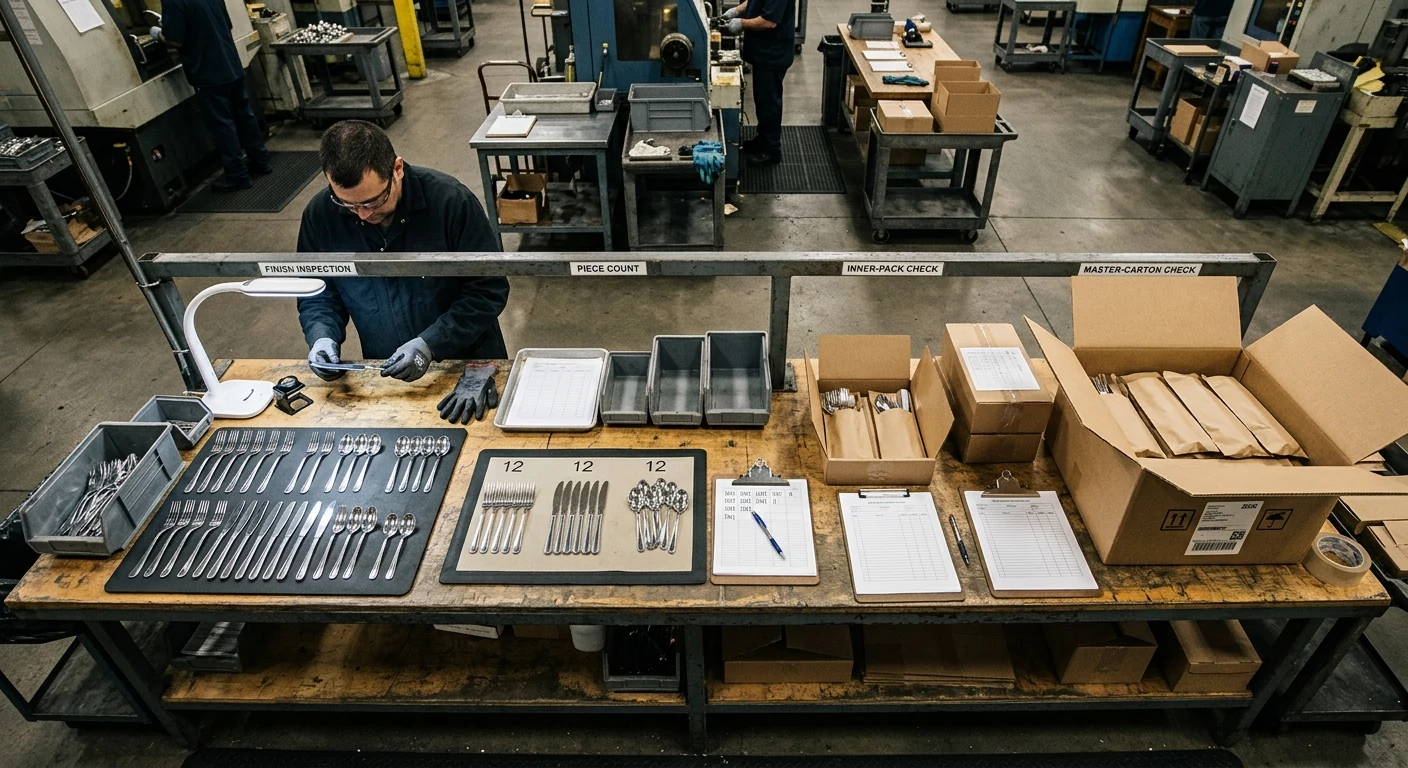
Before mass production commences, the procurement process requires the evaluation and formal approval of physical samples. The RFQ must outline the exact quantity of pre-production samples required, the timeline for their delivery, and the specific criteria against which they will be evaluated. Physical samples allow the buyer to verify the tactile qualities of the cutlery, such as the ergonomics of the handle, the actual weight distribution, and the visual consistency of the surface finish, which cannot be fully captured in written specifications or technical drawings. Each submitted item must be tagged with a unique sample ID for tracking purposes.
The Federal Acquisition Regulation 14.202-4 — Bid samples treats samples as appropriate when important characteristics such as balance, feel, color, or pattern cannot be described adequately and requires the evaluated characteristics to be listed. This is used as a procurement-control analogy only; buyers must not state that U.S. federal bidding rules govern a commercial restaurant or hotel purchase. In commercial practice, the buyer must document the evaluation of the RFQ sample against the RFQ parameters, noting any deviations. Approved samples are then signed, dated, and retained by the buyer as the master reference standards for all subsequent receiving inspections and quality control checks. The supplier-returned RFQ sample must perfectly align with the buyer-set specification document.
The retention of these master samples is a critical control mechanism. They serve as the undisputed physical baseline in the event of a quality dispute during mass production. The sample ID must be referenced in all subsequent purchase orders to ensure absolute clarity regarding the expected standard.
| Sample Evaluation Field | Evaluation Purpose | Buyer-Set Criteria Placeholder |
|---|---|---|
| Sample Quantity | Number of pieces required for review | [Buyer-Set Quantity per SKU] |
| Dimensional Verification | Checking against specified tolerances | [Buyer-Set Measurement vs. Spec] |
| Weight and Balance Check | Verifying mass and center of gravity | [Buyer-Set Weight/Balance vs. Spec] |
| Finish Inspection | Visual check for polishing consistency | [Buyer-Set Finish Acceptance] |
| Master Sample Retention | Establishing the production baseline | [Buyer-Set Retention Protocol and Sample ID] |
6. Defect Tolerances and Acceptance Sampling
No manufacturing process is entirely free of variation, making it essential for the RFQ to establish a clear defect tolerance and acceptance sampling plans. Defects in commercial cutlery are typically categorized into three levels: Critical defects (e.g., sharp metal burrs on a spoon bowl), Major defects (e.g., bent fork tines, deep scratches, or incorrect weight that affects usability), and Minor defects (e.g., slight polishing marks or minor variations in the backstamp that do not affect function). The RFQ must define the Acceptable Quality Limit (AQL) for each category, dictating the maximum number of defective units allowed in a sample size before the entire production lot is rejected.
The ISO 2859-1:2026 — Sampling procedures for inspection by attributes defines AQL-indexed single, double, and multiple acceptance-sampling schemes for lot-by-lot inspection and replaces the 1999 edition. Procurement guidelines dictate that buyers do not choose an AQL or sampling plan arbitrarily; rather, the buyer and qualified quality team must set contract-specific parameters from the licensed current standard. The supplier must formally agree to these AQL parameters in their RFQ response, acknowledging that the buyer will conduct incoming inspections based on these agreed-upon statistical sampling methods. The buyer-set AQL must be matched by a supplier-returned confirmation of acceptance.
The enforcement of the defect tolerance is non-negotiable. If a production lot exceeds the agreed-upon AQL during the receiving inspection, the buyer retains the right to reject the entire shipment, requiring the supplier to sort, rework, or replace the defective units at their own expense. This strict adherence to the AQL protects the buyer's operational standards.
| Defect Category | Definition and Examples | Buyer-Set AQL Placeholder |
|---|---|---|
| Critical Defects | Hazards (e.g., sharp edges on handles/bowls) | [Buyer-Set Critical AQL (e.g., 0.0)] |
| Major Defects | Functional issues (e.g., bent tines, deep gouges) | [Buyer-Set Major AQL (e.g., 1.5)] |
| Minor Defects | Aesthetic issues (e.g., light surface scratches) | [Buyer-Set Minor AQL (e.g., 4.0)] |
| Sampling Plan Level | Inspection level and sample size determination | [Buyer-Set Inspection Level (e.g., Level II)] |
| Lot Rejection Protocol | Actions taken if AQL is exceeded | [Buyer-Set Rework or Replacement Terms] |

7. Pack-Out, Traceability, and Receiving
The final physical stage of the cutlery specification involves the packaging, labeling, and receiving protocols. The RFQ must detail how the cutlery is to be packed to prevent transit damage, specifying the use of individual polybags, inner boxes (e.g., dozens), and master cartons. This pack-out process must be strictly controlled. Master cartons must be labeled with specific traceability information, including the purchase order number, SKU, material grade, gross weight, and production lot number. Traceability is a critical component of supply chain management and quality assurance.
The Consolidated Regulation (EC) No 1935/2004 on food-contact materials establishes general requirements and defines traceability across manufacture, processing, and distribution. Procurement teams must not present this as universal law, a declaration of conformity for any product, or proof that a named alloy is acceptable in every destination market. Furthermore, the EDQM Metals and Alloys Technical Guide, second edition addresses metal and alloy constituents, impurities, specific release limits where appropriate, and release-test sampling and measurement guidance for articles. Buyers must not invent release limits, test conditions, or compliance conclusions; buyers must use the applicable legal framework and qualified laboratory evidence. The FDA Food Code 2022 and current supplement multiuse-equipment provisions address materials, sufficient weight and thickness for repeated warewashing, and smooth cleanable surfaces. The Food Code is a model adopted differently by jurisdictions; buyers must not claim that a grade label alone is not compliance evidence and does not establish local legal acceptance.
Upon arrival, the receiving process must be clearly defined. The Federal Acquisition Regulation 46.503 — Place of acceptance distinguishes acceptance at source or destination and retains destination checks for quantity, transit damage, possible substitution, or fraud. This is used only as a control model; procurement teams must not import federal legal terms into a commercial purchase contract without qualified review. The RFQ must state whether final acceptance occurs at the factory (via third-party inspection) or at the buyer's destination warehouse.
| Pack-Out & Receiving Field | Specification Requirement | Buyer-Set Parameter Placeholder |
|---|---|---|
| Inner Packaging | Protection for individual pieces | [Buyer-Set Polybag/Sleeve Requirement] |
| Inner Box Quantity | Number of pieces per inner carton | [Buyer-Set Quantity (e.g., 12 pieces)] |
| Master Carton Labeling | Traceability and identification data | [Buyer-Set Label Data Requirements] |
| Gross Weight Limit | Maximum weight per master carton | [Buyer-Set Max Weight (kg)] |
| Place of Acceptance | Location of final quality inspection | [Buyer-Set Inspection Location] |
8. Replacement Matching, Change Control, and Repeat Orders
Commercial restaurants require cutlery patterns to remain consistent over many years to allow for the replacement matching of lost or damaged pieces without having to purchase entirely new sets. The RFQ must address pattern continuity and change control. Suppliers must be required to retain the specific tooling, stamping dies, and polishing jigs used for the buyer's approved samples. The specification should include a pattern lock clause, stipulating that the supplier cannot alter the material grade, dimensions, weight, or finish of the cutlery in future production runs without prior written authorization via a formal change notice and the submission of new samples for approval.
Furthermore, the RFQ should establish the protocol for a repeat order, ensuring that the original specification document and the retained master samples govern all future purchase orders. This prevents the common issue of specification drift, where subsequent batches of cutlery gradually deviate from the original approved quality due to uncommunicated manufacturing changes at the factory level. By locking in the specifications and requiring strict adherence to the master samples, buyers ensure long-term consistency in their dining presentation. The buyer-set retention period must be acknowledged by a supplier-returned guarantee.
The management of the change notice is a formal administrative process. If a supplier wishes to alter any aspect of the manufacturing process, they must submit the change notice detailing the proposed alteration, the reason for the change, and the expected impact on the final product. The buyer must then evaluate this notice and, if necessary, request a new RFQ sample before granting approval.
| Continuity Specification Field | Control Mechanism | Buyer-Set Parameter Placeholder |
|---|---|---|
| Tooling Retention | Preservation of manufacturing dies | [Buyer-Set Retention Period (Years)] |
| Change Notice Requirement | Requirement for prior approval of changes | [Buyer-Set Notice Period (Days)] |
| Repeat Order Baseline | Reference to original master samples | [Buyer-Set Reference PO/Sample ID] |
| Tolerance Drift Control | Verification against original specs | [Buyer-Set Re-verification Protocol] |
| Discontinuation Notice | Warning before a pattern is retired | [Buyer-Set End-of-Life Notice (Months)] |
9. End-to-End RFQ Workflow and Supplier-Answerable Wording
Specification Checklist Before RFQ Release
Material evidence: Request the supplier material declaration and separate table-knife blade and handle evidence.
Piece measurements: Record piece dimensions, gauge, weight, balance, and buyer-set tolerances.
Working finishes: State the required spoon edge, fork tine, knife serration, and surface finish.
Sample control: Assign sample IDs and record the approval attributes for each sample.
Defect and sampling terms: Define buyer-set defect categories and contract-specific acceptance sampling under qualified review.
Pack-out controls: Specify pack-out, labeling, and receiving controls.
Repeat-order control: Lock the repeat-order pattern and require change notice.
Supplier confirmations: Capture supplier-returned confirmations and master-sample references.
Executing a commercial cutlery specification requires a disciplined workflow that moves from initial drafting to final sample acceptance. Procurement teams must follow a structured path to ensure all technical requirements are communicated, understood, and legally bound before mass production begins. The following numbered workflow outlines the end-to-end process for issuing a cutlery RFQ and managing the supplier responses.
Draft the Technical Specification: The procurement team compiles the exact material grades, dimensional tolerances, piece length, piece weight, and finish requirements into the standardized RFQ field map.
Define Quality and Sampling Parameters: The quality assurance team establishes the AQLs for critical, major, and minor defects and selects the appropriate sampling plan based on the total order volume.
Issue the RFQ to Qualified Suppliers: The comprehensive RFQ, including the supplier-answerable wording modules, is distributed to the vendor pool.
Evaluate Supplier Declarations: Buyers review the returned RFQs, specifically checking the material evidence, confirmed tolerances, and acceptance of the AQL parameters.
Request and Receive Physical Samples: Shortlisted suppliers are required to submit pre-production samples that match their written declarations, each tagged with a unique sample ID.
Conduct Sample Evaluation: The buyer evaluates the physical RFQ sample against the RFQ specifications for weight, balance, dimensions, edge finish, tine finish, and surface finish quality.
Approve and Retain Master Samples: Acceptable samples are signed, dated, and securely stored as the definitive reference for all future production lots and replacement matching.
Issue the Purchase Order: The final PO is issued, explicitly referencing the approved RFQ document, the agreed-upon defect tolerance, and the retained master samples.
Execute Receiving Inspection: Upon delivery, the quality team conducts acceptance sampling on the master cartons during pack-out receiving, comparing the production units against the master samples and the written specification.
To ensure suppliers provide actionable data rather than vague assurances, the RFQ must include specific, answerable wording modules. Buyers should embed these placeholders into their procurement documents to force definitive responses. The table below illustrates how these modules should be structured to capture the necessary commitments.
| RFQ Module | Buyer-Set Wording Placeholder | Supplier-Returned Confirmation Placeholder |
|---|---|---|
| Material Declaration | [Buyer-Set Request for Exact Grade] | [Supplier-Returned Material Certificate] |
| Weight Confirmation | [Buyer-Set Target Weight (g)] | [Supplier-Returned Guaranteed Weight (g)] |
| AQL Acceptance | [Buyer-Set Major AQL Parameter] | [Supplier-Returned Signature of Acceptance] |
| Continuity Guarantee | [Buyer-Set Retention Period (Years)] | [Supplier-Returned Tooling Guarantee] |
| Change Control | [Buyer-Set Notice Period (Days)] | [Supplier-Returned Change Notice Agreement] |
10. Finalizing the Cutlery Specification Document
The finalization of the cutlery specification document represents the culmination of rigorous procurement planning and supplier vetting. By strictly adhering to the specification parameters and demanding documented material evidence, procurement teams can secure commercial cutlery that meets their exact operational requirements. The dual-placeholder system—relying on buyer-set targets and supplier-returned confirmations—eliminates ambiguity and establishes a legally binding framework for quality control. Every detail, from the formal designation of the steel alloy to the precise piece length and piece weight, must be locked into the final contract.
Furthermore, the management of the RFQ sample and its associated sample ID ensures that the physical reality of the product matches the written specification. This physical verification is crucial for assessing subjective elements like balance and surface finish, which cannot be entirely captured in text. The establishment of a strict defect tolerance and AQL provides the necessary statistical backing for lot rejection, protecting the buyer from substandard production runs. Finally, the protocols for pack-out, replacement matching, and repeat order continuity guarantee that the investment in a specific cutlery pattern yields long-term consistency. Any deviation from the established standard must be preceded by a formal change notice, ensuring the buyer remains in complete control of the supply chain. To discuss your specific requirements or to review a cutlery specification and sample-acceptance schedule, contact our procurement specialists.
Get the week's latest industry information
-
Real-Life Professional Restaurant Case Studies
Explore Now
-
Create a unique restaurant with over 95,700+products
Explore Now
-
Protessional Free 3D Restaurant Design
Explore Now
-
Still Have Questions About Opening a Restaurant?
Explore Now

Sylvia
With 8 years in catering & hospitality industry, sales manager of Ron Group, specialise in providing one stop solutions to restaurants, hotels and weddings.
Discover Our Exclusive Products
Explore our extensive range of restaurant and hotel supplies designed to enhance your operations. Find the perfect solutions to meet your needs.
Browse Our ProductsFREE 3D DESIGN
Boost your restaurant's success with our free 3D design service. Start building the restaurant of your dreams today!
Explore 3D Design Case
RECOMMENDED CASES
-

La Rambla by Catalunya: Crafting Barcelona's Soul in Hong Kong - Custom Furniture Excellence
RON Group's custom Spanish-inspired furniture elevates La Rambla with artisanal aesthetics...
Learn More -

Cardinal Point: Elevating Outdoor Seating with Tailored Cushion Upgrades
Discover how Cardinal Point transformed its outdoor dining experience with custom cushions, achievin
Learn More
RECOMMENDED BLOGS
-

Restaurant Table Spacing and Aisle Clearance: Supplier Drawing Checklist
Check restaurant table spacing, aisle clearance, chair pullout, service path, and supplier drawing proof before approving a...
Sylvia2026-07-20 -

5 Mistakes to Avoid When Buying Restaurant Furniture from China
Don't fall for costly oversights! Learn the 5 mistakes to avoid when buying restaurant furniture from China and ensure a...
 Ron2025-01-079 min read
 -

RON GROUP Launches VR Experience to Explore Our Dynamic Showroom
Discover RON GROUP's VR showroom! Explore dining furniture, tableware, and customized services virtually or visit us in person to...
Sylvia2024-12-163 min read
Subscribe to RON GROUP
Stay up-to-date with the latest industry insights and expert advice. Together, we'll create your ideal restaurant.