


Franchise Restaurant Equipment: Chain Procurement & Standardization Guide
Learn how to standardize restaurant equipment across multiple chain locations — from building a master spec list and consolidating suppliers to managing MOQs, rollout logistics, and ongoing replenishment.
Content
You've signed the franchise agreements. Site selection is done. The construction crews are in place across six cities. Now comes the question that will determine whether your rollout succeeds or turns into a procurement nightmare: how do you get the same chair, the same plate, the same commercial range hood into 50 locations, on time, at the right price, with every unit looking and performing identically?
This is the procurement challenge that separates chains from single-unit operators. The stakes are different. The systems required are different. And the supplier relationships that work for one restaurant rarely scale to 50.
This guide breaks down the full restaurant chain procurement architecture for multi-unit chains and franchise operators: from how to standardize restaurant equipment across multiple locations, to building your master specification list, to managing replenishment cycles three years after your last grand opening. The frameworks here reflect how established international chains actually operate their supply chains, not theory.
The Chain Restaurant Supply Challenge: Why Scale Creates Complexity
Counterintuitively, buying for 50 restaurants is harder than buying for one. Volume gives you negotiating power, but it also exposes every gap in your process. The core tension in franchise restaurant equipment procurement is this: brand standards demand uniformity, but local markets, regulations, and logistics don't cooperate.
Brand Standards vs. Local Compliance Variation
Every chain operates with a brand standards manual. Every piece of equipment, every uniform, every piece of furniture must conform to spec. But local regulations don't care about your standards manual.
A commercial fryer approved for your US locations may need different electrical specifications for Australia. Your preferred stainless steel prep tables may require NSF certification in North America but CE marking in Europe. Your dining chairs that pass California TB117-2013 flammability standards may need separate documentation for UK compliance. Managing these variations, without fragmenting your supply chain, requires a deliberate specification architecture from day one.
The Real Cost of Inconsistency
The most visible cost of procurement inconsistency is guest experience. A customer who visits your Chicago location and then your Miami location expects the same table height, the same plate weight, the same overall feel. When those differ, even slightly, it erodes brand perception in ways that marketing can't easily fix.
The less visible costs are often larger:
Training fragmentation: When equipment differs by location, your training materials can't be standardized. A line cook trained in Dallas needs retraining in Denver if the range model differs.
Maintenance complexity: Spare parts, service contracts, and technician certifications all multiply when equipment varies across locations. In one case we reviewed, a chain that allowed regional purchasing autonomy found itself managing 14 different commercial refrigerator brands across 80 locations, each with its own service vendor and parts inventory.
Warranty management: Consolidated purchasing lets you negotiate chain-wide service agreements. Fragmented purchasing leaves each location negotiating individually, at retail service rates.
The procurement investment in standardizing restaurant equipment across multiple locations pays back in operational simplicity for the full lifecycle of each site, typically 7 to 12 years before a major refresh cycle.
Building Your Master Equipment Specification List
The master spec list is the foundation of restaurant chain procurement. Get this right, and everything downstream, including supplier selection, volume pricing, and logistics planning, becomes executable. Get it wrong, and you'll spend the next three years managing exceptions.
Core vs. Market-Specific Variations
Not everything needs to be identical across all locations. A useful framework classifies every item into one of three tiers:
| Tier | Definition | Examples | Procurement Approach |
|---|---|---|---|
| Core (Mandatory) | Non-negotiable brand standards; identical across all locations | Logo tableware, uniforms, branded packaging, core cooking equipment | Single global supplier; no substitution allowed |
| Approved Variants | Same performance spec, regional compliance or supply chain variation allowed | Commercial refrigerators, HVAC, electrical fittings, seating for outdoor markets | Approved supplier list; 2 to 3 options per category |
| Local Discretion | Regional operators select within defined budget and spec parameters | Cleaning supplies, non-branded smallwares, office supplies | Category spec with budget cap; local sourcing permitted |
For a typical QSR chain, Core items represent roughly 60 to 70% of total equipment spend. Approved Variants cover 20 to 30%. Local Discretion items are typically low-value, high-frequency consumables that don't justify global procurement overhead.
Version Control for Rollout Phases
Specs change. Suppliers get discontinued. Regulations update. A chain that opened its first location in 2022 and its fiftieth in 2026 will have equipment generations in the field simultaneously.
Effective version control for your master spec requires:
Dated specification sheets: Every spec document carries a version number and effective date. Locations always know which spec generation applies to them.
Change notification protocol: When a spec changes, all pending orders are reviewed. Locations already under construction get a grace period to adopt the new spec.
Backward compatibility notes: When you update a spec, document what the previous version was and whether mixed generations create operational issues (for example, different plate sizes that affect plating templates).
Pilot validation before rollout: No spec change is deployed chain-wide without a 60 to 90 day pilot at 2 to 3 locations first.

Supplier Consolidation Strategy for Chain Restaurant Supply
Most chains begin with a fragmented supplier base inherited from their early growth phase: different vendors for furniture, kitchen equipment, tableware, uniforms. Consolidation is one of the highest-ROI procurement initiatives a growing chain can undertake.
Why Chains Shift to Preferred-Supplier Models
The math is straightforward. A chain managing 12 suppliers across its equipment categories spends roughly 3 to 4x more on procurement administration than one managing 3 to 4 preferred suppliers covering the same categories. More to the point, preferred suppliers develop institutional knowledge of your brand standards, your quality expectations, and your operational calendar. That knowledge can't be rebuilt every time you switch vendors.
RON Group has worked with international chains including Burger King, Outback Steakhouse, and Chili's Grill & Bar precisely because this model works. When a supplier understands your brand at an operational level, they can flag potential compliance issues before production starts, not after a container lands at your distribution center.
Vetting Criteria for Preferred Supplier Status
Not every supplier can handle chain-level procurement. The vetting process for preferred-supplier qualification should assess:
Financial stability: Request audited financials for the past 2 to 3 years. A supplier that can't survive a 90-day payment cycle shouldn't hold your chain's critical production capacity.
Production capacity documentation: Ask for a current capacity utilization report. A supplier running at 95% capacity has no ability to surge for emergency orders or absorb new location openings without compromising existing commitments.
Certification stack: Verify NSF, CE, UL, ISO, or market-specific certifications are current, not just claimed. Request certificate copies with expiry dates, and build re-verification into your annual supplier review.
Lead time SLA commitment: A preferred supplier should agree to contractual lead times, not just estimates. Standard production lead times for major equipment categories from China range from 25 to 45 days for standard items and 45 to 90 days for custom/OEM orders. Our China supplier MOQ and lead time guide covers detailed benchmarks by category.
Quality management system: Preferred suppliers should operate under documented QC procedures with pre-shipment inspection protocols. Third-party inspection compatibility is a minimum requirement. The quality inspection guide for China suppliers provides a full assessment framework.
Sample and prototype capability: For OEM and custom items, verify the supplier has in-house sampling capability and a track record of matching production to approved samples.
Negotiating Volume Pricing Tiers and Priority Capacity
Volume pricing is the visible benefit of consolidation. Priority capacity is the invisible one, and often more valuable.
Negotiate for both simultaneously. A typical multi-unit restaurant purchasing contract with a China-based preferred supplier covers:
Annual volume commitment tiers: Price reductions at defined annual purchase volumes (for example, 5% discount at $500K, 8% at $1M, 12% at $2M+)
Reserved production capacity: A defined percentage of the supplier's capacity is held for your orders during rollout windows, typically Q1 and Q3 of each calendar year for most chains
Expedited production SLA: Emergency replacement orders receive a contractually defined rush timeline, typically 15 to 20 days versus standard 35 to 45 days
Price stability period: A 12-month price lock on agreed SKUs, with commodity escalation clauses tied to verifiable indices (for example, LME nickel price for stainless steel)
MOQ, Staging, and Rollout Logistics
For a chain opening 10 to 15 locations per year, procurement logistics require as much planning as construction scheduling. The two timelines must be coordinated. Equipment that arrives before the building is ready costs money. Equipment that arrives after opening day costs revenue.
Phased Delivery vs. Consolidated Shipment
Two strategies exist, each with clear tradeoffs:
Consolidated shipment (all locations in a rollout phase ordered and shipped together) delivers the best per-unit pricing and allows full container optimization. The tradeoff is holding costs. Equipment for a location opening in Month 9 may be manufactured in Month 3 and warehoused for six months. For high-value items like commercial kitchen equipment, this holding cost can offset the price savings.
Phased delivery (orders placed location-by-location, roughly 8 to 12 weeks before each opening) minimizes holding costs but sacrifices volume pricing advantages and creates more procurement management overhead. It also means you're placing new orders in a rolling queue with your supplier, leaving less buffer for production delays.
Most chains use a hybrid approach: consolidated orders for Core high-value items (kitchen equipment, custom tableware, uniforms) and phased delivery for standard furniture and smallwares that carry lower per-unit risk.
Pilot Location Before Full Rollout
A pilot location isn't just a marketing event. It's your procurement testing environment. Before committing to chain-wide equipment specs, a pilot location should validate:
Equipment performance under real operational conditions (not just manufacturer specs)
Installation and fit-out compatibility with your standard construction spec
Staff usability, particularly for kitchen equipment that affects throughput
Durability under daily commercial use (6 to 8 weeks of operation minimum before sign-off)
Changes to equipment specs after a pilot are far cheaper than changes after 20 locations are already open.
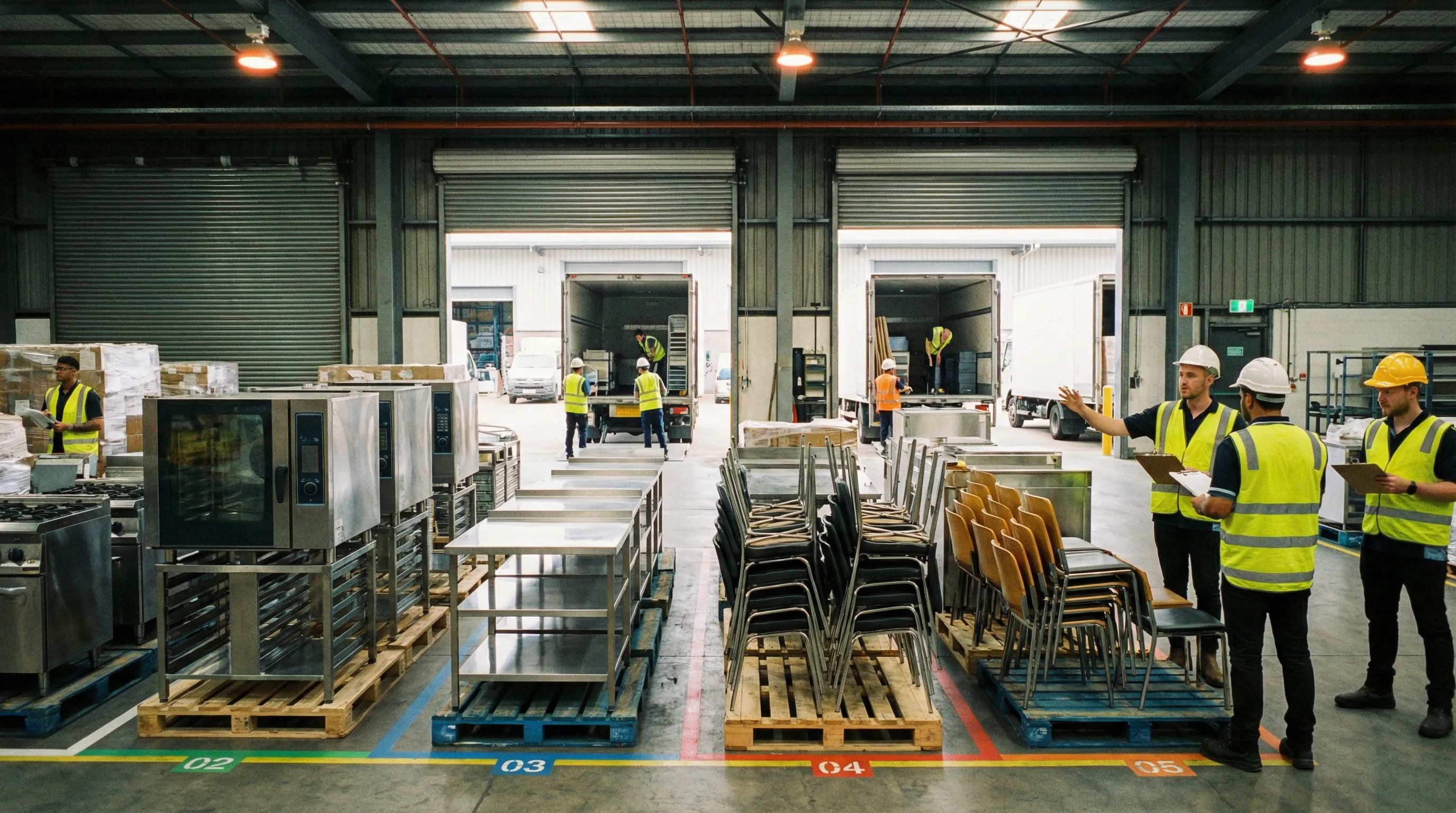
Buffer Stock for Emergency Replacements
No rollout runs perfectly. Equipment arrives damaged. A component fails in week three. A supplier production delay pushes delivery beyond opening day. Without buffer stock, any of these scenarios causes an opening delay or an operational shortfall.
Industry practice for chain rollouts is to maintain buffer stock equivalent to 5 to 8% of total unit count for high-frequency replacement items (tableware, smallwares, uniforms) and 2 to 3 critical units of high-value equipment per region. This inventory is typically held at a regional distribution center, not at individual locations.
Customization and Branding at Scale
One of the strongest arguments for sourcing franchise restaurant equipment from China is the OEM/ODM capability available at price points domestic manufacturing can't match. Customization at chain scale, though, requires a different set of supplier conversations than standard catalog purchasing.
Custom Logo on Tableware, Uniforms, and Packaging
Logo application methods vary significantly by product category, and the choice affects durability, cost, and lead time:
| Category | Recommended Method | Durability | MOQ for Custom |
|---|---|---|---|
| Ceramic / porcelain tableware | Underglaze decal firing | Dishwasher-proof, 1,000+ cycles | 500 to 1,000 pieces per design |
| Melamine tableware | Molded-in logo (mold cost required) | Permanent; excellent impact resistance | 1,000 to 2,000 pieces; mold cost $800 to $2,500 |
| Uniforms / aprons | Embroidery for primary logo; screen print for secondary graphics | Embroidery: 100+ wash cycles; screen print: 50+ wash cycles | 100 to 200 pieces per design/colorway |
| Metal smallwares | Laser engraving or etching | Permanent | 200 to 500 pieces |
| Packaging / disposables | Offset or flexographic printing | Single-use | 2,000 to 5,000 pieces (print plate cost applies) |
For chains sourcing custom tableware or branded uniforms at scale, a one-time tooling or mold investment in Year 1 typically generates cost savings in Year 2 and beyond versus purchasing unbranded stock items.
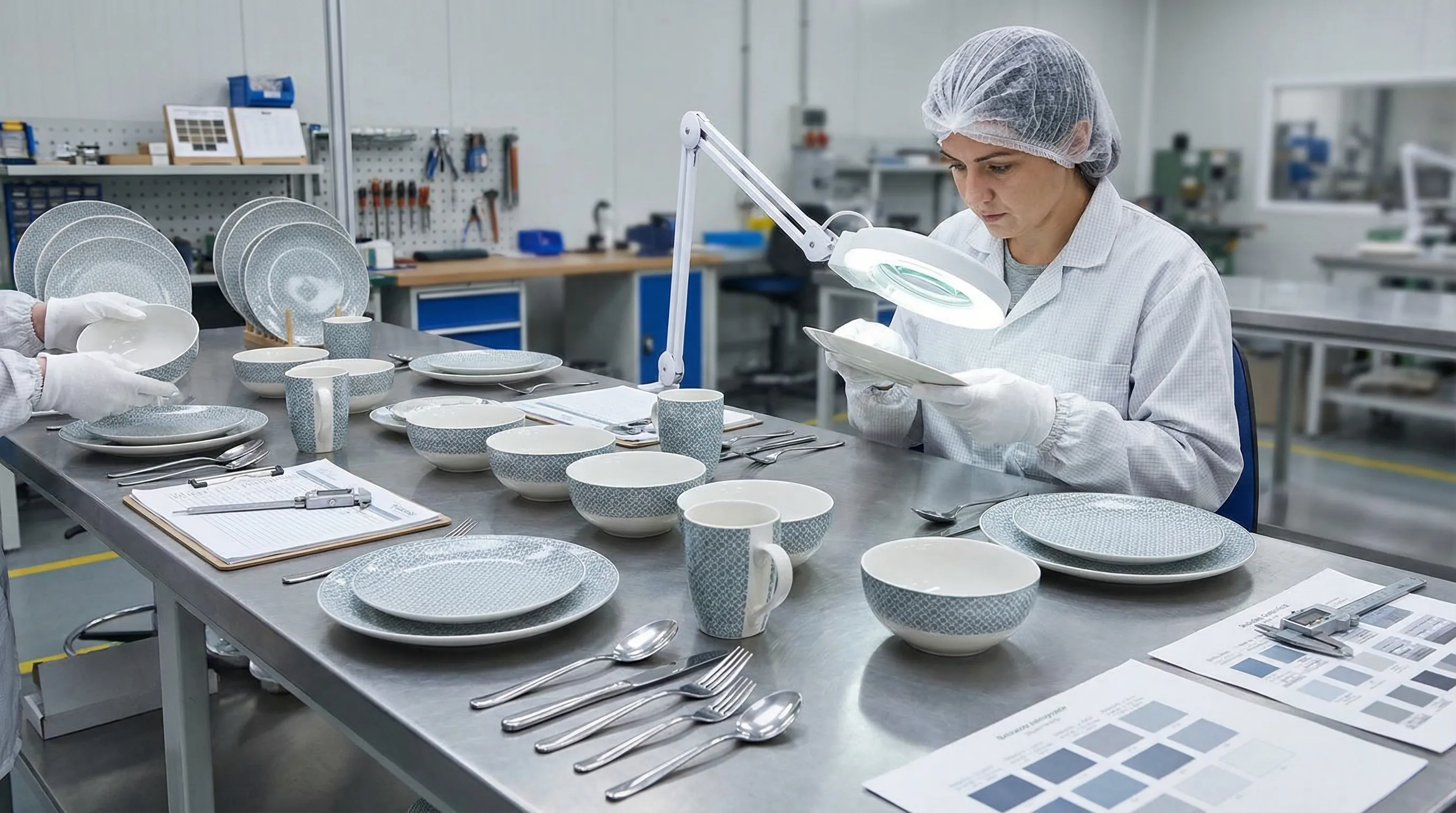
Color and Material Consistency Across Suppliers
Brand color consistency across multiple product categories (chairs, tableware, uniforms, packaging) is harder than it looks when different suppliers are involved. Each manufacturing process, whether textile dyeing, ceramic glazing, powder coating, or injection molding, handles color differently.
The solution is to establish a brand color standard with supplier-specific calibration references. Pantone matching is the baseline, but each category supplier needs to provide approved samples in the actual production material before any bulk order is placed. Annual re-calibration samples should be part of your preferred supplier contract.
OEM/ODM Capacity Requirements
For chain-scale OEM work, your supplier needs to demonstrate:
In-house design capability (2D/3D CAD) for minor modifications to standard SKUs
Tooling and mold production capacity or verified relationships with dedicated tooling vendors
Sample approval process with a defined turnaround, typically 15 to 25 days for first sample, 7 to 10 days for revisions
Production quality control that matches approved samples with defined tolerance ranges
Suppliers without these capabilities can still produce standard catalog items. They should not be used for OEM/branded production where consistency across a chain is non-negotiable.
Case Study Framework: Outfitting 50 Locations Over 24 Months
To make the procurement architecture concrete, consider a hypothetical QSR chain opening 50 locations over a 24-month rollout. This framework represents how a chain in the 40 to 80 location build-out phase typically structures franchise restaurant equipment procurement.
Phase Structure
A 24-month rollout typically runs in three phases:
Phase 1 (Months 1 to 3): Pilot location (1 site). Full procurement validation. Spec sign-off. Preferred supplier finalization.
Phase 2 (Months 4 to 15): Primary rollout (30 locations). Consolidated orders for Core items; phased delivery for furniture and smallwares.
Phase 3 (Months 16 to 24): Completion rollout (19 locations). Transition to steady-state replenishment model by Month 22.
Equipment Categories and Estimated Volumes
| Category | Items per Location | Total Volume (50 locations) | Estimated Unit Cost Range (FOB China) | Typical China Source |
|---|---|---|---|---|
| Commercial kitchen equipment | 8 to 15 major units | 400 to 750 units | $200 to $8,000/unit | Guangdong, Shandong manufacturers |
| Restaurant furniture (chairs + tables) | 60 to 120 pieces | 3,000 to 6,000 pieces | $35 to $280/piece | Foshan, Guangzhou manufacturers |
| Tableware (plates, bowls, cutlery) | 400 to 800 pieces (incl. operational stock ×3) | 20,000 to 40,000 pieces | $0.80 to $12/piece | Jingdezhen, Chaozhou ceramic districts |
| Uniforms (FOH + BOH staff) | 30 to 60 sets (4 to 6 staff per shift ×2 sets) | 1,500 to 3,000 sets | $18 to $65/set | Guangzhou, Zhejiang textile manufacturers |
| Smallwares & supplies | 200 to 400 items | 10,000 to 20,000 items | $1 to $45/item | Various Guangdong suppliers |
Cost Benchmarks and Savings Potential
A 50-location rollout sourced entirely from domestic suppliers in a developed market might carry total equipment and supply costs of $3.5M to $6M. The same spec sourced from established China manufacturers, with proper quality controls and logistics management, typically lands at $1.8M to $3.2M FOB, representing a 40 to 55% cost reduction before freight.
After landed cost (freight, duties, local delivery), the savings typically remain in the 30 to 45% range. For a chain where equipment represents 15 to 20% of total location buildout cost, this is a material difference in unit economics.
For a full breakdown of logistics costs and shipping options for large-volume restaurant equipment orders, our shipping guide for restaurant equipment from China covers FCL vs. LCL decisions, transit time benchmarks, and port-to-site delivery planning.
Managing Ongoing Replenishment
The rollout is the high-visibility phase. Replenishment is where chains often lose efficiency, and margin, over time. Getting the replenishment model right during the rollout phase sets up long-term operational cost control.
Replacement Cycles by Category
Equipment categories have very different replacement cycles, which should drive your chain restaurant supply inventory strategy:
| Category | Expected Lifespan | Replacement Trigger | Annual Replenishment Rate |
|---|---|---|---|
| Commercial kitchen equipment (heavy) | 8 to 12 years | End of life / major failure | 2 to 5% of installed base |
| Commercial kitchen equipment (small) | 3 to 5 years | Wear / compliance update | 10 to 15% of installed base |
| Restaurant furniture | 5 to 8 years | Brand refresh / damage threshold | 8 to 12% of installed base |
| Tableware (ceramic/porcelain) | 2 to 4 years (operational wear) | Breakage + brand standard refresh | 25 to 35% of installed base |
| Uniforms | 12 to 18 months per set | Wear / season change / staff turnover | 60 to 80% of installed base |
| Smallwares | 1 to 3 years | Loss / damage / replacement | 20 to 40% of installed base |
Spare Parts Inventory Strategy
For commercial kitchen equipment, spare parts availability is the hidden cost of procurement decisions. A chain that chose a lesser-known equipment supplier to save 15% on unit cost may face 6 to 8 week spare parts lead times when a critical component fails, versus 2 to 3 days for major brands with regional parts distribution.
Before finalizing any kitchen equipment supplier for chain use, verify:
Spare parts availability within your operating regions (stocked locally or via distributor)
Certified service technician availability within 150km of each location cluster
Parts availability commitment period (minimum 7 years post-purchase for commercial equipment)
Whether the supplier provides a recommended spare parts kit for each unit, and what it costs
Preferred Supplier Contracts vs. Spot Purchasing
Ongoing replenishment should run on preferred supplier contracts, not spot purchasing. The discipline matters for three reasons:
Spot purchasing opens the door to spec drift, where substitutions "work" but don't match brand standards
Spot purchasing forfeits volume pricing advantages
Spot purchasing creates supplier audit overhead with every new vendor
A well-structured preferred supplier contract for replenishment includes annual volume commitments (even if lower than rollout volumes), defined price review schedules, and first-right-of-refusal for new location projects. This gives suppliers enough forward visibility to hold pricing and capacity. And it gives chains the reliability needed to run lean replenishment inventories.
Why International Chains Source From China: The Three-Part Answer
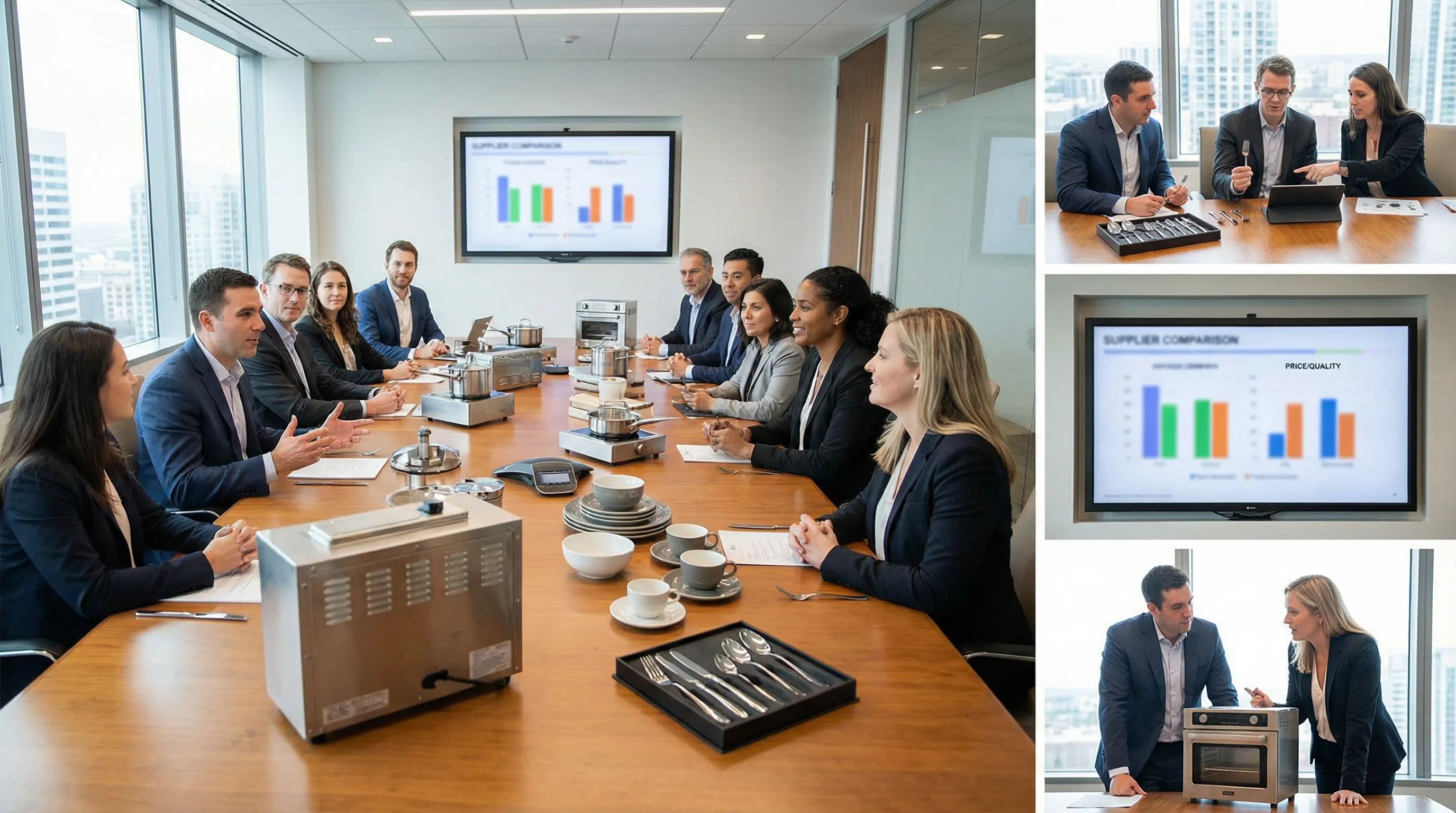
The decision to source restaurant chain equipment and supplies from China is often framed as a cost decision. It is. But cost alone is an incomplete explanation for why established chains like Burger King, Outback Steakhouse, and Chili's use China-based suppliers for significant portions of their global supply chains.
Cost Arbitrage at Scale
China's manufacturing cost advantage for hospitality equipment and supplies is structural, not cyclical. It derives from:
Mature, clustered supply chains (Foshan for furniture, Jingdezhen and Chaozhou for ceramics, Guangzhou for uniforms) that reduce raw material logistics costs
Labor costs that remain significantly below developed-market equivalents for manufacturing roles, despite substantial increases over the past decade
Economies of scale from serving global demand. Chinese manufacturers producing for domestic, European, and American markets simultaneously have utilization rates that domestic-market manufacturers can't match.
Customization Capability
Chain restaurants require customization at a scale that tests most suppliers: logo tableware in five colorways, uniform designs updated every two years, furniture with proprietary frame profiles. These requirements are standard workflow for established China manufacturers, not special projects that stress their operations.
The OEM/ODM ecosystem in China's hospitality supply sector is deep enough that a chain can move from approved concept to production-ready samples in 20 to 35 days and from sample approval to full container delivery in 60 to 90 days. That timeline is competitive with domestic custom manufacturing in most markets, often at half the cost.
Production Capacity for Global Rollouts
When a chain is opening 40 locations across three continents simultaneously, supplier capacity is the constraint that matters most. China's hospitality manufacturing sector, concentrated in Guangdong province but extending to Fujian, Zhejiang, and Shandong, has the capacity to supply global chain rollouts without the production constraints that single-country domestic manufacturers face.
This is the combination that keeps international chains returning to China-based suppliers: cost efficiency, customization capability, and the capacity to execute at global scale simultaneously. The RON Group project cases page documents how this plays out across real hospitality projects, from QSR chains to luxury hotel groups.
For chains at the evaluation stage of supplier selection, the right starting point is a structured supplier assessment, not a price quote. Understanding a supplier's capacity, certification stack, and quality management system before you negotiate pricing determines whether the relationship will hold through a 24-month rollout. Contact our procurement team to discuss your chain's specific rollout requirements.
The Chain Procurement Decision Framework: A Summary
Multi-unit restaurant purchasing is a system design problem, not a purchasing problem. The chains that execute rollouts successfully treat it that way, building the spec architecture, the supplier qualification criteria, and the replenishment model as infrastructure, not afterthoughts.
The key decisions, in sequence:
Classify your spec: Core / Approved Variants / Local Discretion. Don't over-standardize items that don't affect brand perception; don't under-standardize items that do.
Run a proper pilot: 60 to 90 days of real operation before committing chain-wide specs. Changes at pilot stage cost a fraction of changes at 20-location scale.
Consolidate your supplier base: A preferred supplier with institutional knowledge of your brand outperforms the lowest bidder at every point in a 10-year relationship.
Negotiate for capacity, not just price: A 5% price premium from a supplier with guaranteed capacity and a 15-day emergency SLA is worth more than the cheapest quote from a supplier who can't prioritize your orders.
Build replenishment into the rollout contract: The cost of replenishment over 5 years often exceeds the initial equipment order. Preferred supplier replenishment terms should be negotiated at the same time as rollout pricing.
The chains that get this right don't just save on unit costs. They build procurement infrastructure that makes every future location opening faster, cheaper, and more operationally consistent than the last.
Get the week's latest industry information
-
Real-Life Professional Restaurant Case Studies
Explore Now
-
Create a unique restaurant with over 95,700+products
Explore Now
-
Protessional Free 3D Restaurant Design
Explore Now
-
Still Have Questions About Opening a Restaurant?
Explore Now

Sylvia
With 8 years in catering & hospitality industry, sales manager of Ron Group, specialise in providing one stop solutions to restaurants, hotels and weddings.
Discover Our Exclusive Products
Explore our extensive range of restaurant and hotel supplies designed to enhance your operations. Find the perfect solutions to meet your needs.
Browse Our ProductsFREE 3D DESIGN
Boost your restaurant's success with our free 3D design service. Start building the restaurant of your dreams today!
Explore 3D Design Case
RECOMMENDED CASES
-

La Rambla by Catalunya: Crafting Barcelona's Soul in Hong Kong - Custom Furniture Excellence
RON Group's custom Spanish-inspired furniture elevates La Rambla with artisanal aesthetics...
Learn More -

Cardinal Point: Elevating Outdoor Seating with Tailored Cushion Upgrades
Discover how Cardinal Point transformed its outdoor dining experience with custom cushions, achievin
Learn More
RECOMMENDED BLOGS
-
Restaurant Table Spacing and Aisle Clearance: Supplier Drawing Checklist
Check restaurant table spacing, aisle clearance, chair pullout, service path, and supplier drawing proof before approving a...
Sylvia2026-07-20 -

5 Mistakes to Avoid When Buying Restaurant Furniture from China
Don't fall for costly oversights! Learn the 5 mistakes to avoid when buying restaurant furniture from China and ensure a...
 Ron2025-01-079 min read
 -

RON GROUP Launches VR Experience to Explore Our Dynamic Showroom
Discover RON GROUP's VR showroom! Explore dining furniture, tableware, and customized services virtually or visit us in person to...
Sylvia2024-12-163 min read
Subscribe to RON GROUP
Stay up-to-date with the latest industry insights and expert advice. Together, we'll create your ideal restaurant.