


Equipment Upgrade vs Equipment Replacement: Which Delivers Better ROI?
Replace aging equipment using 2025 EPA refrigerant rules, tax incentives, lifecycle economics, and TCO analysis to boost ROI, cut operating risk, and future‑proof your kitchen.
Content
The Asset Management Imperative in the Modern Hospitality Ecosystem
The global hospitality sector operates within a crucible of converging pressures. Operational efficiency, regulatory compliance, and financial sustainability have moved from being distinct departmental concerns to becoming an entangled strategic imperative. For entities ranging from boutique hotels to large-scale institutional caterers—typified by the diverse clientele serviced by RON Group Global, which spans destinations from the Gaylord Opryland Resort to international Radisson properties—the management of physical assets is no longer merely a maintenance function. It is a core driver of enterprise value.
In this environment, the decision to upgrade existing machinery or replace it entirely has evolved into a complex financial calculus. The historical tendency in facility management has been to view equipment through a “break-fix” lens, where the primary goal is maximizing the lifespan of the initial capital expenditure. However, this report posits that such an approach is increasingly obsolete. Modern financial models reveal that holding onto legacy equipment—even when it is technically functional—often constitutes a silent but massive hemorrhage of profitability.
The argument for a strategic pivot toward replacement is driven by a “polycrisis” of factors: the exponential rise in energy costs, the chronic unavailability of skilled labor, strict new environmental regulations taking effect in 2025 regarding refrigerants, and the availability of unprecedented tax incentives like the reinstatement of 100% bonus depreciation. This report provides an exhaustive analysis of these variables, offering a data-driven roadmap for hospitality leaders to navigate the upgrade-versus-replace dilemma.
1.1 The RON Group Portfolio Context
To understand the stakes of this decision, one must consider the operational diversity of the hospitality landscape. RON Group’s solutions portfolio encompasses a wide spectrum of venues, each with distinct asset utilization profiles.
High-Volume/Low-Margin (Fast Food, Cafeterias): For these entities, throughput is paramount. Equipment failure results in immediate revenue cessation. The ROI of replacement here is often driven by speed of service and reliability.
High-Touch/Experience-Driven (Luxury Hotels, Resorts): For properties like those under the Radisson or WorldHotels brands, the “product” is the guest experience. Noise pollution from aging compressors, inconsistent food quality from drifting oven thermostats, or HVAC failures are not just operational annoyances; they are brand-damaging events.
Institutional/Large Scale (Auditoriums, Convention Centers): These venues, such as the Gaylord Opryland, operate in bursts of extreme intensity. Equipment must handle massive loads intermittently. The risk here is “peak failure,” where systems collapse under the stress of a major event, creating liability and reputational catastrophe.
For all these sectors, the “Upgrade vs. Replace” question is not uniform. However, the overarching macroeconomic and regulatory trends create a strong gravitational pull toward modernization. The subsequent sections will deconstruct the financial, technical, and regulatory arguments that underpin this shift.

2. Deconstructing the Status Quo: The Fallacy of Legacy Maintenance Models
For decades, facility managers and CFOs have relied on heuristic models to make capital allocation decisions regarding equipment. The most pervasive of these is the “50% Rule,” a guideline suggesting that if a repair costs less than 50% of the replacement value, the asset should be repaired. While mathematically simple, this rule is dangerously reductive in the context of the 2024-2025 economic environment.
2.1 The Obsolescence of the “50% Rule”
The “50% Rule” fails because it treats the “New Unit” and the “Repaired Unit” as functionally equivalent outcomes, differing only in cost. This assumption ignores the rapid pace of technological advancement and operational inflation. A commercial fryer or combi-oven purchased ten years ago possesses significantly less thermal efficiency than a modern equivalent, yet the cost to repair it—a factor explored in recent troubleshooting analyses—continues to rise, driven by skilled labor shortages and parts scarcity.
When a manager spends 40% of the replacement value to restore an asset to its original condition, they are essentially investing in obsolescence. They capitalize a machine that is likely 30-50% less energy-efficient than the current market standard. Furthermore, this calculation often omits the “Zombie Asset” phenomenon, where a machine requires a sequence of repairs that individually fall below the 50% threshold but collectively exceed the cost of replacement over a 24-month period, a trend noted by foodservice equipment experts.
Table 1: The Modern Decision Matrix Variables
| Decision Variable | Upgrade/Repair Consideration (Status Quo) | Replacement Consideration (Strategic Asset Management) | Impact on ROI Analysis |
|---|---|---|---|
| Safety Integrity | Immediate cessation if unsafe (e.g., gas leaks, frayed wiring). | Mandatory replacement if safety features (e.g., sensors) cannot be retrofitted. | Critical: Safety failures yield negative infinite ROI due to liability and insurance premiums, a key point in equipment management guides. |
| Asset Age vs. Life Cycle | Viable only if asset age is <50% of its expected life cycle. | Strongly recommended if age >75% of life expectancy or approaching parts obsolescence. | Older units incur exponentially rising maintenance costs (“The Bathtub Curve”) that erode operating margins. |
| Technological Gap | Limited to adding digital controls or VFDs (Variable Frequency Drives). | Transformative: New tech like IoT offers labor/utility savings unavailable via retrofit, as seen in the rise of smart refrigeration. | The efficiency delta between generations drives massive OpEx savings. |
| Regulatory Status | Risky: Is the refrigerant legal? Is the burner NOx compliant? | Mandatory: As detailed in EPA guidance, 2025 HFC bans make many repairs illegal or practically impossible due to supply constraints. | Regulatory obsolescence destroys asset value overnight, turning equipment into “stranded assets”. |
| Tax Implications | Expensed as maintenance (Opex). | Capitalized with 100% Bonus Depreciation (Capex). | Tax shields in 2025 heavily favor replacement, subsidizing the acquisition cost. |
2.2 The Inflationary Pressure on Repairs
Another factor undermining the repair argument is the rising cost of the repair itself. The “repair vs. replace” equation is sensitive to the cost of skilled labor. In 2024, the maintenance sector reported a severe shortage of skilled technicians, leading to higher hourly rates and longer lead times for service calls.
When a piece of equipment fails, the “cost” is not just the invoice from the service provider. It includes the internal administrative burden of scheduling the repair, the opportunity cost of management attention, and the risk that the repair will fail due to the unavailability of OEM parts, necessitating a “band-aid” fix that degrades performance. Conversely, replacement equipment often comes with a manufacturer’s warranty, effectively insuring the operator against these costs for a defined period. This transfers the risk of failure from the operator back to the manufacturer, a value proposition vital for operational stability. For guidance on navigating these challenges, explore our Restaurant Cost-Cutting Guide.
3. The Regulatory Tsunami: Environmental Compliance as a Financial Risk
Perhaps the most significant variable shifting the ROI equation toward replacement is the global regulatory crackdown on environmental pollutants. Specifically, the phase-down of hydrofluorocarbons (HFCs) in commercial refrigeration and HVAC systems has created a “regulatory cliff” in 2025 that renders many existing assets financial liabilities.
3.1 The AIM Act and the HFC Phasedown (United States)
As of January 1, 2025, the American Innovation and Manufacturing (AIM) Act and the EPA’s Technology Transitions Rule have fundamentally altered the landscape for commercial refrigeration in the United States. The Act mandates a drastic reduction in the production and consumption of HFCs, targeting a reduction of 85% by 2036.
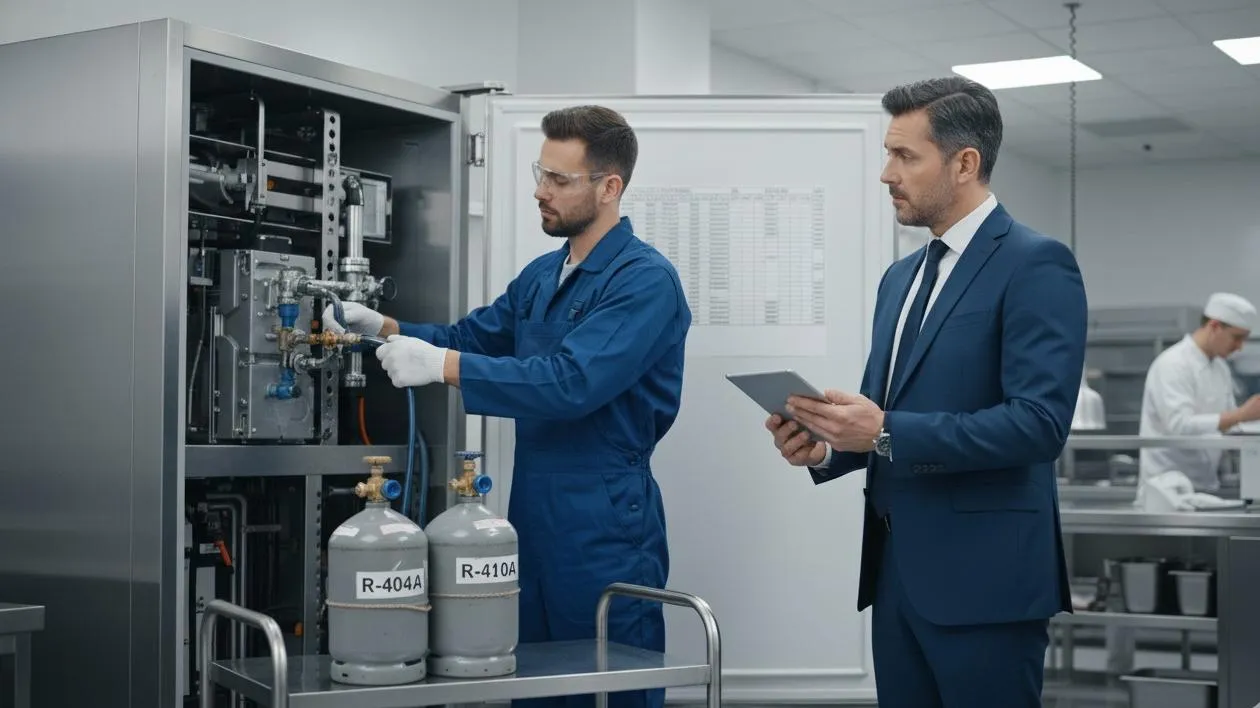
The Manufacturing Ban: The manufacturing and installation of new systems using high-Global Warming Potential (GWP) refrigerants (such as R-404A and R-410A) are severely restricted. New stand-alone units are generally limited to refrigerants with a GWP of 150 or less, forcing a shift to natural refrigerants.
The “Stranded Asset” Risk: While existing equipment is technically allowed to operate, the drastic reduction in the supply of legacy refrigerants will cause prices to skyrocket. Equipment running on these refrigerants will face maintenance costs that may exceed the value of the unit itself. If a major leak occurs in an R-404A system in 2026, the cost to recharge it could be prohibitive, effectively “stranding” the asset.
Leak Repair Mandates: For systems with a charge of 15 lbs or more, stringent leak repair requirements are now enforced. If a system exceeds a certain leak rate threshold, owners are legally mandated to repair the leak within 30 days or retire the asset. According to EPA regulations, chronic leakers must be mothballed, forcing unplanned replacement under duress.
Implication for ROI: “Upgrading” a 10-year-old walk-in cooler designed for R-404A is financially perilous. Retrofitting these units often results in capacity loss and potential seal failures. Replacement with natural refrigerant systems future-proofs the operation and eliminates the risk of unserviceability, delivering a superior risk-adjusted ROI.
3.2 The F-Gas Regulation (Europe/UK)
For RON Group’s European clients, the F-Gas Regulation imposes even stricter timelines and penalties, creating a parallel urgency for asset replacement.
2025 Market Bans: From January 1, 2025, new self-contained commercial refrigeration equipment using F-gases with a GWP of 150 or more is largely banned from being placed on the market. This means that if a breakdown occurs, purchasing an identical replacement unit is legally impossible. Operators must switch to new technology.
Service Bans (2032): By 2032, servicing stationary refrigeration equipment with high-GWP gases (GWP > 750) will be prohibited entirely, except for reclaimed gases which will be scarce and expensive, as outlined in recent F-Gas III revisions.
This creates a “hard stop” for the useful life of existing inventory. An attempt to extend the life of a 2018-era freezer through 2026 may succeed technically, but the asset value effectively hits zero as servicing options vanish. Replacement ensures compliance and avoids the operational risk of a breakdown that cannot be legally repaired.
4. Fiscal Architecture: Tax Incentives and Depreciation Strategies
In 2025, the fiscal environment in key markets like the United States and the United Kingdom provides a unique window where the government effectively subsidizes equipment replacement. These tax mechanisms dramatically improve the ROI of new acquisitions by reducing the effective purchase price through immediate tax savings.
4.1 100% Bonus Depreciation & Section 179 (USA)
The “One Big Beautiful Bill Act” (OBBBA), effective for tax years beginning in 2025, has reinstated 100% bonus depreciation, a provision that had previously been phasing out.
Mechanism: Businesses can immediately deduct 100% of the purchase price of eligible property (machinery, equipment, appliances) in the year it is placed in service, rather than depreciating it over several years.
Section 179 Expansion: For 2025, the Section 179 expensing limit has been raised significantly to $2.5 million, with a phase-out threshold starting at $4 million in total equipment purchases. This makes the deduction accessible to small and medium-sized hospitality businesses as well as larger enterprises.
ROI Impact Calculation: Consider a hotel purchasing a new $100,000 dishwasher system. Without Incentive: The hotel might depreciate this over 5 years. With 100% Bonus Depreciation: The hotel deducts the full $100,000 in Year 1. Cash Value: At a 21% corporate tax rate, this results in $21,000 in immediate cash savings in the first year. This effectively reduces the “real” cost of the equipment to $79,000, a point detailed in financial analyses of the new tax rules. Comparison: A repair costing $40,000 is also deductible, but it restores an old asset. The replacement provides a new asset with a lower effective cost basis and a reset lifecycle.
4.2 Full Expensing (United Kingdom)
Similarly, the UK government has made “Full Expensing” permanent, signaling a long-term commitment to encouraging capital investment.
The Policy: Companies can claim 100% first-year relief on qualifying main rate plant and machinery investments.
Applicability: This covers almost all hospitality equipment, including warehousing machinery, kitchen appliances, and HVAC systems (excluding cars).
Strategic Effect: This mirrors the US incentive, encouraging British hospitality operators to replace aging infrastructure immediately. It effectively allows companies to cut their corporation tax bill by up to 25p for every £1 they invest.
5. Total Cost of Ownership (TCO) Methodology
To accurately determine ROI, hospitality managers must move beyond sticker price and adopt a Total Cost of Ownership (TCO) methodology. TCO is a financial estimate that helps determine the direct and indirect costs of a product or system over its entire lifespan.
5.1 Defining the TCO Variables
In the context of commercial kitchen equipment, TCO comprises several critical inputs:
Where:
I (Initial Cost): Purchase price + Installation + Shipping - Tax Incentives.
O (Operating Cost): Utilities (Gas, Electric, Water) + Consumables (Oil, Chemicals).
M (Maintenance Cost): Planned Preventive Maintenance + Unplanned Repairs.
D (Downtime Cost): Lost Revenue + Brand Damage + Spoiled Inventory.
L (Labor Cost): Time spent cleaning and operating the machine.
R (Residual Value): Resale value at end of life (often negligible for old equipment).
Industry analysis suggests the purchase price accounts for a fraction of the total cost over a 10-year lifecycle. The remaining expenses are the “iceberg beneath the water”—energy consumption, water usage, chemical costs, labor, and unplanned downtime.
5.2 The Hidden Cost of Utilities
Energy efficiency is the most quantifiable differentiator between upgrade and replacement.
Refrigeration: Older motors and compressors are significantly less efficient. An ENERGY STAR-certified freezer can be over 20% more energy efficient than standard models, saving hundreds on utility bills over the product’s lifetime.
Cooking: Gas fryers are notoriously inefficient. A standard gas fryer may only transfer 35% of the heat to the oil, with the rest escaping up the flue. An ENERGY STAR replacement operates at >50% efficiency.
Water: In many municipalities, water and sewer costs are rising faster than energy. Equipment that consumes high volumes of water (like old steamers or dishwashers) has a TCO that escalates rapidly.
6. Deep Dive: The Refrigeration Asset Class
Refrigeration is the backbone of food safety and inventory preservation. It is also the asset class most impacted by the 2025 regulatory changes.
6.1 The Case for Replacement
Regulatory Obsolescence: As detailed in Section 3, units running on high-GWP refrigerants like R-404A are ticking time bombs. Retrofitting is technically difficult and often results in compromised performance.
Energy Density: New ENERGY STAR units are significantly more efficient due to better insulation materials and advanced ECM (Electronically Commutated Motor) technology for fans.
Smart Monitoring (IoT): Modern refrigeration units can be equipped with IoT sensors that monitor temperature fluctuations and power draw in real-time, a capability highlighted in analyses of AI’s role in sustainability. This is difficult and expensive to retroactively install on old units.
6.2 Preventing Inventory Loss
The ROI of smart refrigeration is often realized in a single avoided catastrophe.
Scenario: A walk-in cooler compressor fails at 2:00 AM. Legacy Unit: No alarm sounds. By 8:00 AM, the temperature has risen, and thousands of dollars of high-value inventory may be spoiled. Replacement Smart Unit: The system detects a temperature deviation and sends a push notification to the Chef’s smartphone. The inventory is saved.
ROI: The cost of a modern system is often less than the deductible of a single spoilage insurance claim, not to mention the operational chaos of losing stock.
7. Deep Dive: The Hot Side (Cooking Equipment)
For cooking equipment, the ROI argument shifts from regulatory compliance to operational efficiency and labor savings.
7.1 Fryers: The Oil Management ROI
Fryers are high-consumption devices.
Energy: An ENERGY STAR fryer can save thousands over its lifetime in energy alone compared to a standard model.
Consumables (Oil): Modern fryers feature automated filtration systems that extend the life of the cooking oil. Since oil is one of the most significant recurring costs in a kitchen, extending its life yields thousands of dollars in annual savings.
Verdict: REPLACE. The combination of energy rebates (often hundreds of dollars per unit) and oil savings can create a payback period of less than 3 years.
7.2 Combi-Ovens: The Labor Multiplier
Replacing a standard convection oven and a separate steamer with a modern combi-oven offers profound ROI.
Throughput: By combining steam and convection heat, combi-ovens cook faster and more evenly, increasing kitchen throughput during peak hours.
Yield: The precise humidity control reduces protein shrinkage, which directly improves food cost percentages.
Self-Cleaning: As discussed in Section 9, the self-cleaning feature saves massive amounts of labor.
Verdict: REPLACE. You cannot retrofit a standard oven to become a combi. Their versatility and efficiency are a core benefit.
7.3 Steamers: The Water Conservation ROI
Old boiler-based steamers are water hogs, often using 40 gallons of water per hour.
Efficiency: According to ENERGY STAR, connectionless steamers use as little as 3 gallons per hour.
Financials: This reduction can save over $6,200 over the product’s lifetime in water and sewer charges.
Verdict: REPLACE. The TCO of a legacy steamer is indefensible given modern water rates.
8. Deep Dive: Warewashing and Water Management
Dishwashing is typically the most energy and water-intensive process in a commercial kitchen. It represents a prime target for high-ROI replacement strategies.
8.1 The Heat Recovery Revolution
Legacy dishwashers operate on a simple principle: intake cold water, heat it with massive energy input, spray it, and drain it. The hot steam generated is vented out of the building—wasted energy.
Mechanism: Modern ENERGY STAR v3.0 machines with heat recovery capture the hot vapor from the wash cycle and use it to preheat the incoming cold water supply, according to academic studies on the technology.
Energy Savings: This process can reduce the energy required to heat the water by up to 50%.
Case Study: One notable case study showed a hotel saving over $23,000 annually in water, energy, and chemicals by replacing a standard machine with a heat-recovery unit.
8.2 Ventilation Capital Savings
A critical but often overlooked ROI factor is ventilation. Standard high-temperature dishwashers require a Type II ventilation hood to remove steam, which can be a significant installation expense.
Ventless Operation: Many heat recovery dishwashers condense the steam internally, eliminating the need for a hood.
Construction Savings: For new builds or renovations (a key market for RON Group), this capital saving alone can pay for the upgrade to a premium machine, a benefit highlighted by ENERGY STAR.
9. The Human Element: Labor, Safety, and Automation
While energy savings are easily quantified, the most profound ROI from replacement often comes from “soft” cost reductions: labor efficiency and safety.
9.1 The Labor Shortage Context
The hospitality industry faces a structural labor shortage. Equipment that substitutes for human labor or makes existing labor more efficient is highly valuable. Modern equipment is often designed with this “labor substitution” in mind.
9.2 Self-Cleaning Technology
Manual cleaning of equipment like rotisserie or combi-ovens is dirty, dangerous, and time-consuming.
Manual Process: Cleaning a commercial oven manually involves hazardous chemicals and significant scrubbing.
Automated Process: Self-cleaning units require only a button press and the insertion of a cleaning agent. This frees the staff member to perform other value-added tasks while the machine cleans itself.
Quantified Savings: If a self-cleaning feature saves 1 hour of labor per day at $20/hour (wage + burden), that is $7,300 in annual savings. Over a 10-year life, the labor savings alone can exceed the cost of the equipment.
Upgrade Limit: You cannot “upgrade” an old oven to be self-cleaning. This capability requires full replacement.
9.3 Safety and Retention
New equipment also improves safety. Automated oil filtration in fryers prevents burn injuries, and self-cleaning ovens reduce exposure to caustic chemicals. Improving the work environment helps retain staff, reducing the high cost of turnover.
10. The Cost of Inaction: Downtime and Operational Resilience
A strictly financial ROI analysis often overlooks the “Cost of Downtime,” which is rising dramatically. In 2024/2025, the cost of unplanned downtime has surged due to supply chain delays for parts and higher labor costs for emergency repairs.
10.1 Quantifying Hospitality Downtime
For a Quick Service Restaurant (QSR), a fryer going down during a Friday rush is not just the cost of the repair part.
Revenue Loss: If a QSR generates $5,000/hour during peak, a 4-hour outage could represent a $20,000 loss.
Reputation: Food quality and consistency are paramount for diners. A breakdown leading to long waits or unavailable menu items can drive negative reviews, which can deter a significant percentage of potential customers.
The Downtime Formula: The true cost of downtime includes lost revenue, idle labor, emergency repair premiums, and reputational damage.
10.2 Supply Chain Fragility
Reliance on old equipment exposes operators to supply chain risks. Parts for equipment older than 10-15 years are often no longer stocked locally. A breakdown that used to take 24 hours to fix might now take weeks while a part is sourced. Replacement equipment, backed by manufacturer warranties and modern supply chains, serves as an insurance policy against these extended outages.
11. Strategic Framework & Recommendations
11.1 The ROI Verdict
Based on the convergence of legislative pressure, tax incentives, and technological advancement, Equipment Replacement delivers a significantly better ROI than upgrading or repairing for core kitchen and refrigeration assets in the 2025-2030 window.
While “upgrading” remains viable for some structural assets, the rapid obsolescence of refrigerants and the high operational costs of legacy kitchen equipment make retention of old assets a financial liability. The combination of 100% bonus depreciation (USA) and Full Expensing (UK) creates a subsidized pathway to modernize, effectively lowering the barrier to entry for high-efficiency, labor-saving technologies. For a deeper dive into smart sourcing, see our guide on how to save 65% on restaurant setup.
Table 2: Strategic Decision Matrix for RON Group Clients
| Asset Category | Recommendation | Primary ROI Driver | 2025 Action Plan |
|---|---|---|---|
| Refrigeration (High-GWP) | REPLACE | Regulatory Compliance / Risk Avoidance | Audit all refrigerants. Replace high-GWP units to avoid “stranded asset” status. |
| High-Volume Cooking (Fryers) | REPLACE | Energy & Oil Savings | Utilize Energy Star rebates. Switch to auto-filtration units. |
| Ovens (Convection) | REPLACE | Labor Savings / Yield | Upgrade to Combi-ovens with self-cleaning. Factor labor savings into budget. |
| Dishwashing | REPLACE | Water/Energy / Ventilation | Move to heat recovery models. Eliminate hoods where possible. |
| HVAC (<10 Years Old) | UPGRADE | Life Extension | Retrofit VFDs and smart thermostats. |
| HVAC (>15 Years Old) | REPLACE | Efficiency / Refrigerant | Replace with modern high-SEER units before major failure. |
11.2 Recommendations for RON Group Clients
Conduct an Immediate Refrigerant Audit: Identify all units running on high-GWP refrigerants like R-404A. Schedule these for replacement in 2025 to utilize tax incentives and avoid the “stranded asset” trap.
Prioritize High-Consumption Assets: Target steamers, fryers, and dishwashers for replacement first. The utility savings on these units offer the fastest payback, often in under 3 years.
Leverage Labor-Saving Tech: When replacing ovens, mandate self-cleaning and programmable options. Factor the significant annual labor savings into the ROI model to justify the higher upfront capital.
Adopt Heat Recovery Warewashing: For hotel and large-scale catering clients, mandate heat recovery dishwashers. The removal of hood requirements and the potential 50% energy reduction provides an unbeatable TCO.
Utilize Tax Shields: Coordinate with financial controllers to ensure all 2025 acquisitions are captured under 100% bonus depreciation or UK Full Expensing rules to maximize cash flow.
The “Upgrade vs. Replace” debate is settled by the data. In 2025, replacement is not an expense; it is a strategic investment in the future viability of the hospitality enterprise. To begin planning your next equipment and restaurant furniture procurement, contact us today.
Get the week's latest industry information
-
Real-Life Professional Restaurant Case Studies
Explore Now
-
Create a unique restaurant with over 95,700+products
Explore Now
-
Protessional Free 3D Restaurant Design
Explore Now
-
Still Have Questions About Opening a Restaurant?
Explore Now

Sylvia
With 8 years in catering & hospitality industry, sales manager of Ron Group, specialise in providing one stop solutions to restaurants, hotels and weddings.
Discover Our Exclusive Products
Explore our extensive range of restaurant and hotel supplies designed to enhance your operations. Find the perfect solutions to meet your needs.
Browse Our ProductsFREE 3D DESIGN
Boost your restaurant's success with our free 3D design service. Start building the restaurant of your dreams today!
Explore 3D Design Case
RECOMMENDED CASES
-

La Rambla by Catalunya: Crafting Barcelona's Soul in Hong Kong - Custom Furniture Excellence
RON Group's custom Spanish-inspired furniture elevates La Rambla with artisanal aesthetics...
Learn More -

Cardinal Point: Elevating Outdoor Seating with Tailored Cushion Upgrades
Discover how Cardinal Point transformed its outdoor dining experience with custom cushions, achievin
Learn More
RECOMMENDED BLOGS
-

Restaurant Table Spacing and Aisle Clearance: Supplier Drawing Checklist
Check restaurant table spacing, aisle clearance, chair pullout, service path, and supplier drawing proof before approving a...
Sylvia2026-07-20 -

5 Mistakes to Avoid When Buying Restaurant Furniture from China
Don't fall for costly oversights! Learn the 5 mistakes to avoid when buying restaurant furniture from China and ensure a...
 Ron2025-01-079 min read
 -

RON GROUP Launches VR Experience to Explore Our Dynamic Showroom
Discover RON GROUP's VR showroom! Explore dining furniture, tableware, and customized services virtually or visit us in person to...
Sylvia2024-12-163 min read
Subscribe to RON GROUP
Stay up-to-date with the latest industry insights and expert advice. Together, we'll create your ideal restaurant.