


Content
To successfully procure custom branded drinkware for a coffee shop, buyers must qualify the exact cup or mug construction, the specific decoration system, the intended beverage and use conditions, the approved production sample, the lot controls, and the multi-site replenishment plan together as a single integrated requirement. Treating the blank vessel and the custom printing process as separate, unrelated procurement steps introduces significant risks regarding regulatory documentation, print consistency, and supply chain stability. A rigorous Request for Quotation (RFQ) and supplier qualification process tests whether the vendor can provide verifiable evidence for the exact final product under its intended use conditions, while making MOQ and lead-time assumptions visible across multiple cafe locations.

Custom coffee shop drinkware procurement requires strict alignment between the buyer and supplier on specifications, evidence, and replenishment.
Structuring the Request for Quotation (RFQ)
A comprehensive RFQ for custom coffee shop drinkware must capture every variable that affects the manufacturing, decoration, and deployment of the cups or mugs. Vague requests yield vague proposals, which complicate the supplier qualification process and obscure potential risks. Before finalizing these inputs, buyers should consult a coffee-shop mug and cup format guide to determine the baseline material, size, and service-fit selection. Once the baseline format is established, the RFQ must explicitly detail the customization and supply chain parameters.
The following RFQ input table outlines the critical data points that buyers must provide to suppliers, and the specific response formats required to evaluate vendor capabilities accurately.
| RFQ Input Category | Buyer Requirement Definition | Required Supplier Response Format |
|---|---|---|
| Item / Family Code | Internal SKU or project identifier for the specific custom drinkware line. | Confirmation of code mapping in supplier quotation and future invoicing. |
| Target Market | The geographic regions where the drinkware will be deployed and used. | Acknowledgment of market scope for regulatory documentation alignment. |
| Intended Use | Single-use disposable, multi-use dine-in, or retail merchandise. | Specification of manufacturing controls appropriate for the use case. |
| Beverage / Use Condition | Specific beverage types (e.g., acidic coffee, dairy), maximum fill temperatures, and washing conditions. | Submission of documentation matching these exact thermal and chemical exposures. |
| Decoration Area | Exact dimensions, placement, and wrap-around requirements for the custom artwork. | Technical drawing confirming printable area and margin tolerances. |
| Artwork Version | Specific file name, date, and revision number of the vector artwork provided. | Digital proof referencing the exact artwork version and file name. |
| Color Reference | Standardized color matching system codes (e.g., Pantone) for all printed elements. | Confirmation of ink mixing capabilities and color tolerance limits. |
| Pack / Lot Identification | Requirements for batch coding, date stamping, or carton labeling for traceability. | Description of the supplier's standard lot identification and tracking methodology. |
| Sample Stages | Requirement for digital proof, first-off-tool physical sample, and production reference sample. | Commitment to the sampling timeline and agreement not to proceed without sign-off. |
| Order Quantity | Total volume required for the initial rollout and subsequent replenishment cycles. | Tiered pricing structure based on exact volume breaks, not estimates. |
| Site Allocation | Number of delivery endpoints (e.g., central warehouse vs. individual cafe locations). | Logistics proposal detailing packaging, palletization, and multi-drop capabilities. |
| Lead-Time Inputs | Required delivery dates for samples, initial mass production, and ongoing replenishment. | Detailed critical path timeline separating blank production, decoration, and transit. |
| Evidence Requested | Specific declarations, test reports, and technical data sheets required for qualification. | Submission of verifiable documents matching the exact final construction. |
Market-Specific Food-Contact Evidence Matrix
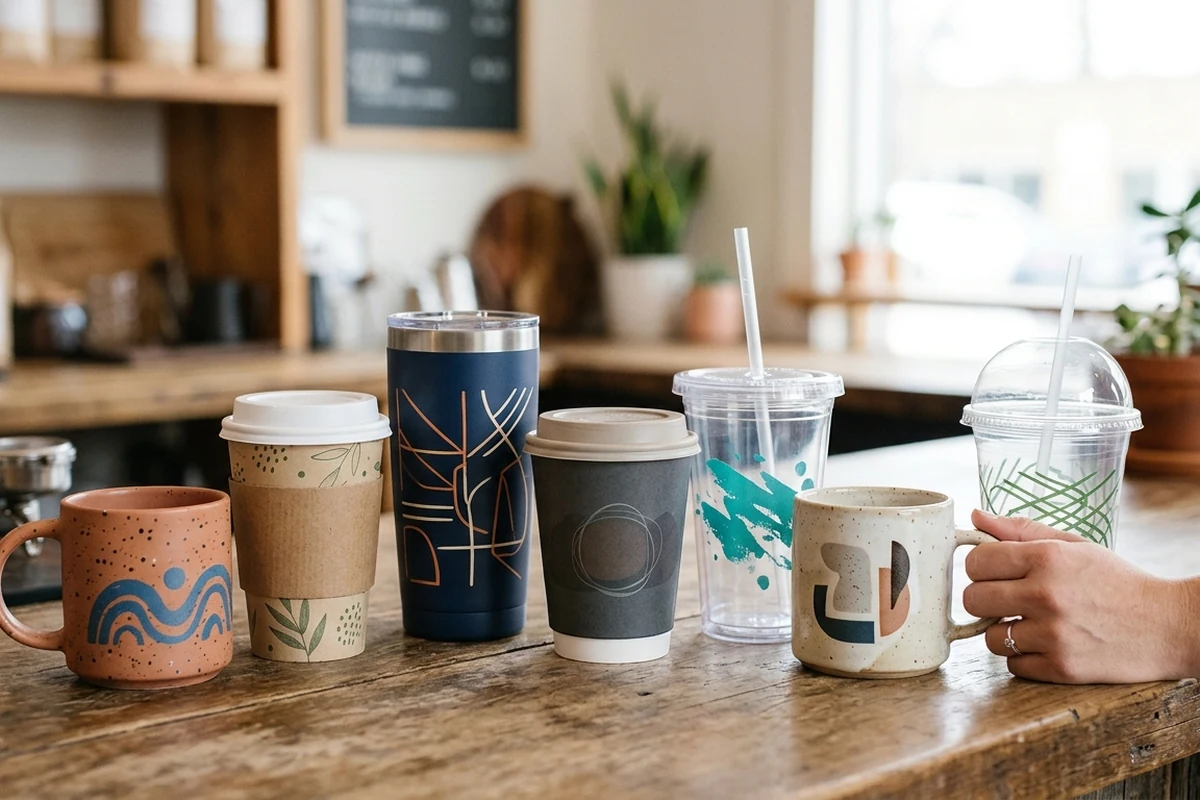
Supplier documentation serves as evidence to verify against the exact intended use conditions of the custom drinkware.
When sourcing custom drinkware, buyers must navigate complex regulatory frameworks governing materials that come into contact with beverages. It is a critical procurement principle that supplier documents act as evidence to verify, never as automatic proof of universal compliance. A supplier claiming a cup is broadly "approved" without referencing the specific use conditions introduces significant risk. Buyers must build a supplier evidence request around the regulatory basis for each food-contact component and its intended use.
In the United States, the framework for Determining the Regulatory Status of Components of a Food Contact Material requires buyers to verify that the specific materials used in the cup or mug—including substrates, coatings, and potentially inks if migration is a factor—are appropriate for the application. This evaluation is heavily dependent on the exact Food Types and Conditions of Use for Food Contact Substances. For example, a cup intended for a stated hot-beverage condition may require evidence scoped differently from a tumbler intended for a stated cold-beverage condition. The RFQ must explicitly state the beverage type, temperature, filling, and storage conditions so the supplier can provide documentation scoped to those exact parameters.
For the European market, buyers must frame their evidence requests around EU Regulation (EC) No 1935/2004, which establishes the general requirements for all food contact materials, emphasizing that they must not transfer their constituents to food in quantities that could endanger human health. Furthermore, the manufacturing process, including the application of custom branding, must adhere to Good Manufacturing Practice (GMP) as outlined in Commission Regulation (EC) No 2023/2006. This regulation is particularly relevant for supporting GMP, documentation, and printing-ink set-off or transfer controls for non-food-contact printing on the exterior of the drinkware.
Evidence Verification Matrix
Substrate Documentation: Request the market-specific declaration, authorization basis, or equivalent technical record applicable to the core material and exact construction. Verify that the document scope matches the intended beverage, temperature, contact time, and other stated use conditions.
Coating and Glaze Records: If the drinkware features an internal coating or glaze, ask the supplier to identify the applicable regulatory basis and provide any migration or composition evidence required for the target market. Cross-reference the documented test conditions, including simulants, time, and temperature where relevant, against the actual coffee-shop use case.
Decoration and Ink Data: For exterior custom printing, request technical data sheets for the ink system. Verify that the supplier has implemented GMP controls to prevent set-off (the transfer of ink from the outside of one cup to the inside of another during stacking).
Traceability Protocols: Request evidence of the supplier's lot tracking system to ensure that any future investigations can be traced back to specific production batches and raw material lots.
Print Trial and Approval Workflow
Customizing drinkware introduces variables related to artwork translation, color fidelity, and decoration stability. A structured print trial and approval workflow separates the evaluation into distinct stages, preventing mass production errors and establishing clear acceptance criteria.
Stage 1: Artwork Proofing
The workflow begins with a digital or physical flat proof. The buyer must verify the artwork version, dimensions, placement, and color references. This stage confirms that the supplier has correctly interpreted the design files before any physical decoration occurs.
Stage 2: Decorated Sample Production
The supplier produces a small batch of physical samples using the exact substrate, decoration method, and ink system intended for mass production. This is the first opportunity to evaluate how the custom branding interacts with the curvature and surface tension of the specific cup or mug.
Stage 3: Agreed Test Method Execution
Once the decorated sample is produced, it must be evaluated using an agreed test method to assess the stability of the decoration. For certain coated or printed surfaces, buyers and suppliers may agree to utilize ISO 2409:2020. It is critical to explicitly state that this standard offers a cross-cut coating separation classification method; it is not a direct measurement of adhesion and does not predict the service life of the drinkware. Its applicability must be agreed upon for the exact decoration and substrate combination to provide a standardized baseline for production consistency, not a guarantee of absolute durability.
Furthermore, when assessing the risks associated with custom printing, buyers should distinguish generic food-contact-material ink terminology from evidence for an exact direct-contact application, as clarified by the ECMA Statement on Direct Food Contact Inks. If the decoration system involves complex curing or potential migration risks, buyers may review original ink-manufacturer technical context, such as the INX Low Migration Brochure, strictly to inform their final-construction migration risk assessment and testing protocols, not as a vendor recommendation.
Stage 4: Production Reference Sample Approval
Following successful testing, the buyer approves a "golden sample." This physical unit serves as the definitive reference for color, placement, and finish for all subsequent mass production runs. Both the buyer and the supplier must retain identical approved samples.
Stage 5: Lot Inspection
During mass production, the supplier must implement lot inspection protocols. Buyers may choose to support an attribute-based lot sampling plan using frameworks like ISO 2859-1:2026. However, this is only effective when the buyer and supplier define the specific defect classes (e.g., critical, major, minor), the exact definition of a lot, the inspection level, the sampling plan, and the acceptance rules in advance. It must not be reduced to an arbitrary AQL number without these foundational agreements.
MOQ, Lead Time, and Replenishment Model
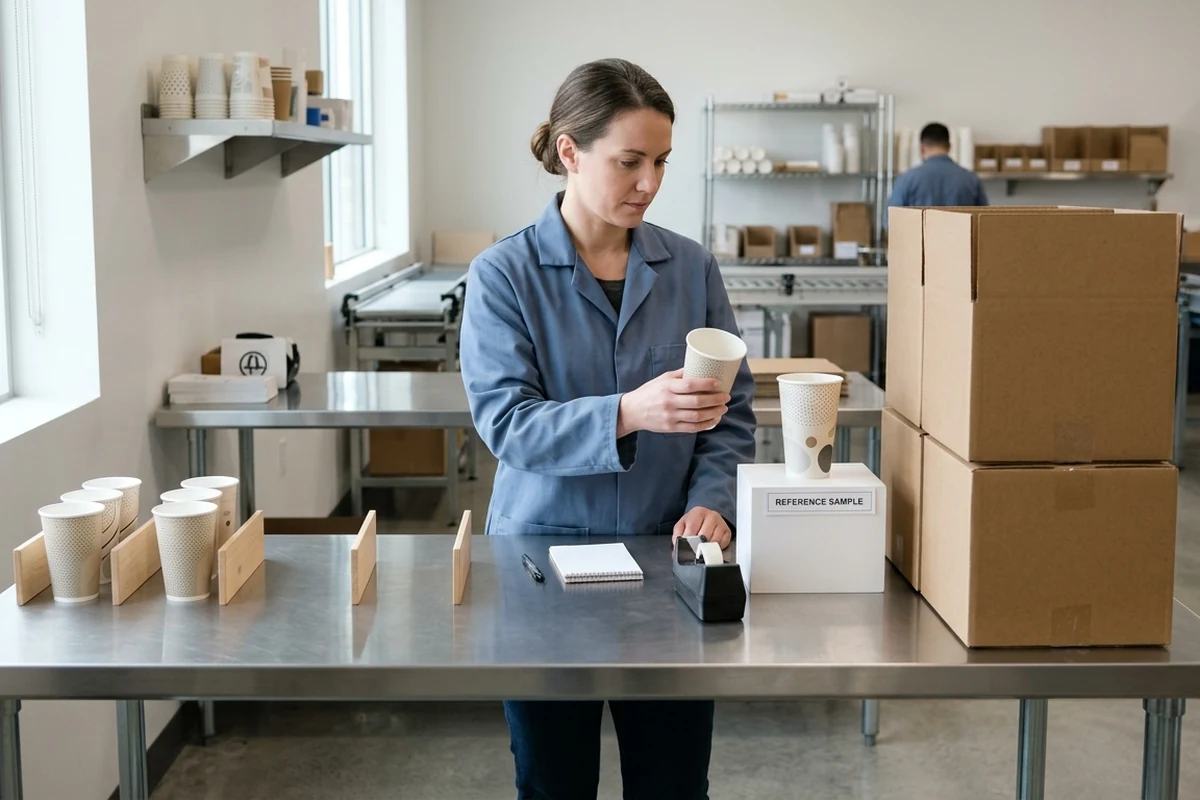
Separating blank-stock assumptions from decorated-stock assumptions allows for more controlled multi-site replenishment.
Managing the supply chain for custom drinkware across a coffee shop network requires a precise model for Minimum Order Quantities (MOQ), lead times, and replenishment. Buyers must avoid relying on invented numbers or generic industry averages and instead build a model based on their specific operational data and the supplier's verified capabilities. Once the supplier qualification inputs are defined, buyers can apply these controls to a reusable coffee mug collection or a disposable takeaway product range.
A critical strategy for managing custom drinkware is separating blank-stock assumptions from decorated-stock assumptions. Blank-production MOQ, decoration-run MOQ, and storage commitments can differ by supplier and construction. Ask the supplier to quote each constraint separately and, where it is operationally acceptable, evaluate a documented blank-stock buffer. This separation makes the lead-time and quantity assumptions for later decorated replenishment orders reviewable when demand or artwork changes.
Site allocation assumptions must also be explicitly defined in the replenishment model. For a multi-location coffee chain, the procurement team must determine whether the supplier will ship decorated stock to a central distribution center or perform multi-drop deliveries to individual cafes. Each route changes handling, pick-and-pack, freight, minimum-shipment, and allocation responsibilities. The RFQ must capture these logistical requirements so the supplier's quotation and lead-time commitments reflect the actual deployment strategy.
Failure Scenarios and Containment Actions
Even with rigorous qualification, deviations can occur during the lifecycle of custom drinkware procurement. Establishing predefined failure scenarios and containment actions ensures that the procurement and quality teams can respond rapidly to protect the brand and maintain operational continuity.
Scenario 1: Evidence is scoped to the wrong construction or use condition.
Issue: The supplier provides documentation for a cold-beverage cup, but the custom drinkware is intended for hot coffee.
Containment Action: Immediately quarantine the affected items. Halt further production and require the supplier to submit new, verifiable evidence matching the exact thermal and chemical exposure of the intended use before releasing the hold.Scenario 2: Artwork version drift occurs during a replenishment run.
Issue: A subsequent order is printed using an outdated or incorrect version of the logo or promotional artwork.
Containment Action: Isolate the non-conforming lot. Enforce strict version control on all Purchase Orders, requiring the supplier to reference the exact approved digital proof file name and date for every production run. Require visual inspection against the approved proof before shipment.Scenario 3: The approved sample differs from mass production.
Issue: The delivered drinkware exhibits color shifts, placement errors, or finish differences compared to the retained golden sample.
Containment Action: Halt deployment to cafe locations. Conduct a joint review with the supplier comparing the production units directly against the retained production reference sample to determine the scope of the deviation and negotiate replacement or rework.Scenario 4: A print transfer or scuff issue is identified in the field.
Issue: The custom decoration exhibits unexpected wear, or ink set-off occurs during stacking and transit.
Containment Action: Isolate the affected lot across all sites. Review the records of the agreed test method (e.g., cross-cut coating separation classification) from that specific production batch to determine if the process drifted out of control. Re-evaluate packaging and stacking protocols.Scenario 5: One site consumes stock significantly faster than projected.
Issue: A high-volume cafe location faces a stockout of custom drinkware before the next scheduled chain-wide replenishment.
Containment Action: Execute an emergency re-allocation from the central buffer or lower-volume sites. If utilizing a decoupled stock model, trigger an early decorated-stock run drawing from the supplier's held blank stock to expedite lead time.Scenario 6: A replacement order features an unannounced change in color or construction.
Issue: The supplier alters the base glaze color or the cup material without prior notification, affecting brand consistency.
Containment Action: Reject the non-conforming lot. Enforce strict change-notification clauses established during the RFQ phase, which mandate that any alteration to the qualified construction, material, or decoration system requires a new print trial and approval workflow.
Supplier Qualification Scorecard and Final RFQ Checklist
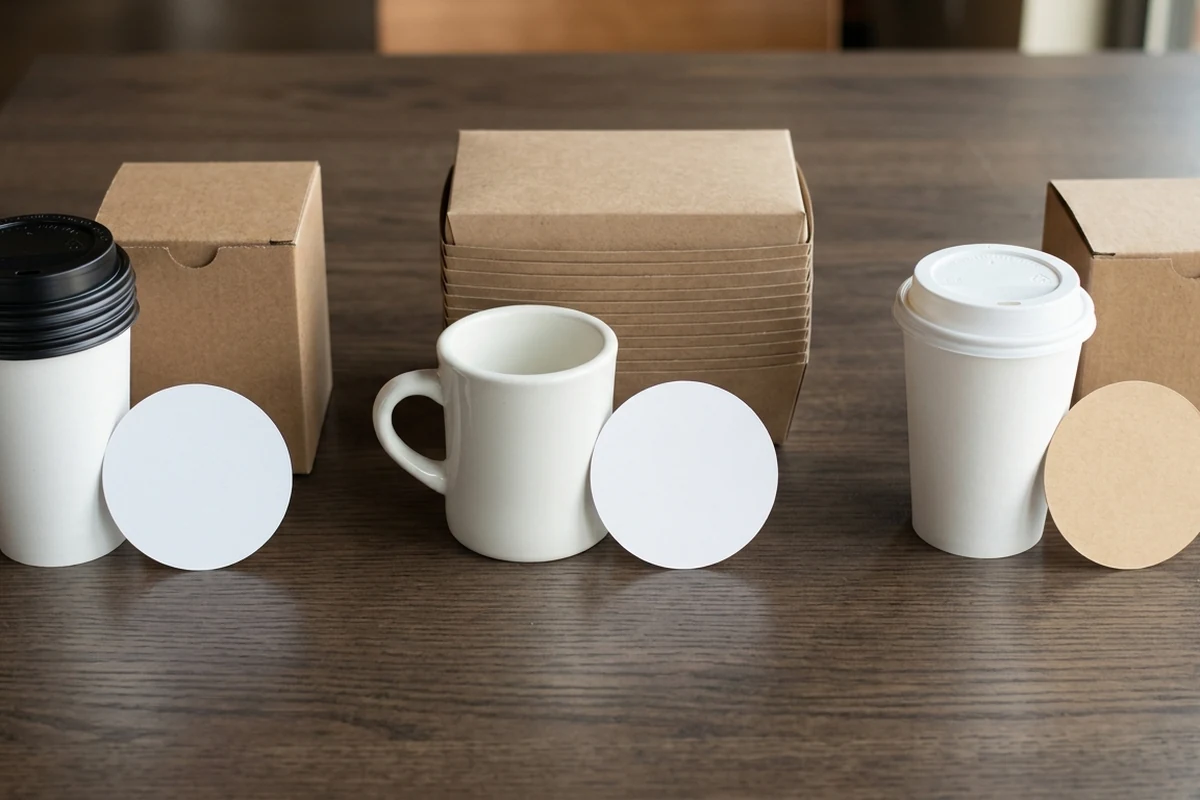
A structured supplier qualification scorecard evaluates the vendor's ability to meet exact construction, decoration, and lot control requirements.
To objectively evaluate potential vendors, procurement teams should utilize a supplier qualification scorecard that weights critical capabilities against the specific needs of the coffee shop network. This scorecard moves the decision-making process beyond simple unit price comparisons and focuses on total value, risk mitigation, and supply chain reliability.
| Qualification Criteria | Focus Area | Verification Method |
|---|---|---|
| Regulatory Documentation | Ability to provide evidence scoped to exact use conditions. | Review of submitted DoCs and test reports against RFQ parameters. |
| Decoration Capability | Precision, color matching, and consistency of the print system. | Evaluation of the physical decorated sample and agreed test method results. |
| Lot Control and Traceability | Systems for tracking batches and managing potential recalls. | Audit of the supplier's lot identification methodology and GMP records. |
| Replenishment Flexibility | Capacity to manage decoupled blank/decorated stock models. | Assessment of the proposed lead times and multi-site allocation logistics. |
| Change Management | Commitment to notifying the buyer of any material or process shifts. | Review of the supplier's quality manual and acceptance of RFQ terms. |
Before issuing the final RFQ, buyers must ensure all internal requirements are fully defined. The final checklist should confirm that the exact cup or mug construction is specified, the intended beverage and use conditions are documented, the artwork version and color references are locked, the required sample stages are scheduled, and the multi-site replenishment plan is clearly articulated. Requiring suppliers to respond to these specific, integrated parameters gives buyers a reviewable basis for qualification and replenishment decisions.
To begin formalizing your procurement requirements and establishing a rigorous qualification process, send RON GROUP your custom drinkware RFQ.
Get the week's latest industry information
-
Real-Life Professional Restaurant Case Studies
Explore Now
-
Create a unique restaurant with over 95,700+products
Explore Now
-
Protessional Free 3D Restaurant Design
Explore Now
-
Still Have Questions About Opening a Restaurant?
Explore Now

Sylvia
With 8 years in catering & hospitality industry, sales manager of Ron Group, specialise in providing one stop solutions to restaurants, hotels and weddings.
Discover Our Exclusive Products
Explore our extensive range of restaurant and hotel supplies designed to enhance your operations. Find the perfect solutions to meet your needs.
Browse Our ProductsFREE 3D DESIGN
Boost your restaurant's success with our free 3D design service. Start building the restaurant of your dreams today!
Explore 3D Design Case
RECOMMENDED CASES
-

La Rambla by Catalunya: Crafting Barcelona's Soul in Hong Kong - Custom Furniture Excellence
RON Group's custom Spanish-inspired furniture elevates La Rambla with artisanal aesthetics...
Learn More -

Cardinal Point: Elevating Outdoor Seating with Tailored Cushion Upgrades
Discover how Cardinal Point transformed its outdoor dining experience with custom cushions, achievin
Learn More
RECOMMENDED BLOGS
-
Restaurant Table Spacing and Aisle Clearance: Supplier Drawing Checklist
Check restaurant table spacing, aisle clearance, chair pullout, service path, and supplier drawing proof before approving a...
Sylvia2026-07-20 -

5 Mistakes to Avoid When Buying Restaurant Furniture from China
Don't fall for costly oversights! Learn the 5 mistakes to avoid when buying restaurant furniture from China and ensure a...
 Ron2025-01-079 min read
 -

RON GROUP Launches VR Experience to Explore Our Dynamic Showroom
Discover RON GROUP's VR showroom! Explore dining furniture, tableware, and customized services virtually or visit us in person to...
Sylvia2024-12-163 min read
Subscribe to RON GROUP
Stay up-to-date with the latest industry insights and expert advice. Together, we'll create your ideal restaurant.