
Restaurant Tabletop Material Selection: Core, Surface, Edge, and Base Compatibility Guide
Content
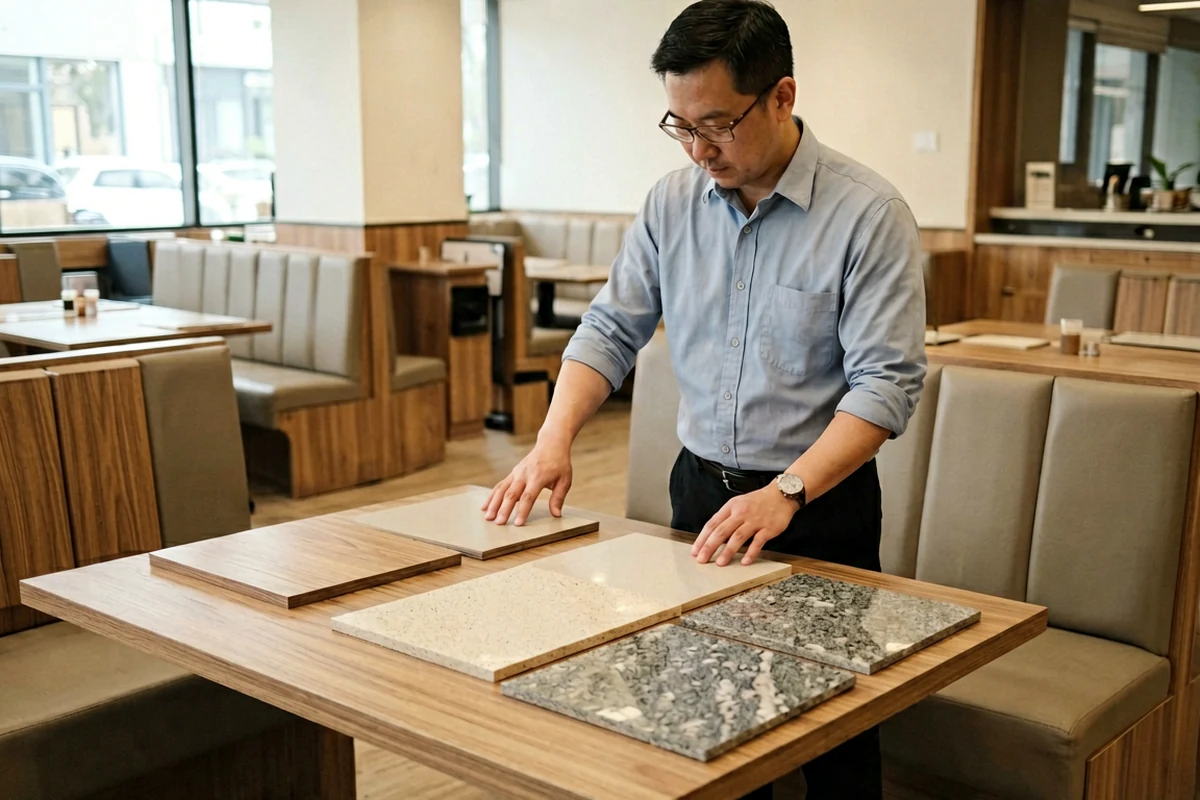
The procurement failure usually begins in the design presentation room. A buyer or designer approves a beautiful small finish swatch. Based on that surface aesthetic alone, the procurement team issues a purchase order for a bulk tabletop order. After installation, the venue may face a chain of problems: the unsealed edges are peeling from moisture ingress, the core material is swelling, and the screws connecting the tabletop to the metal base plate are stripping out because the fixing method was not reviewed against the selected core.
Furthermore, the maintenance team is degrading the surface finish with harsh chemical cleaners, and when the operator attempts to pull replacement tops from storage, they find blank, unlabeled cartons, making inventory management impossible. This scenario unfolds when buyers treat restaurant tabletop material selection as a surface-level aesthetic choice rather than the procurement of an engineered, multi-layer build-up.
Direct answer: Effective restaurant tabletop material selection requires specifying a complete build-up - core material, surface finish, edge profile, and underside backing - rather than just approving a decorative swatch. Procurement buyers should verify that the core and fixing method support the required base plate fasteners, the edge banding resists moisture and impact, and the surface is documented for the venue's cleaning method. Before issuing a purchase order, request a fully finished, edge-banded sample with pre-drilled base fixing points to confirm base compatibility, weight distribution, and maintenance requirements.
Differentiating Tabletop Procurement Scope
Procuring tabletops requires a different technical vocabulary than other front-of-house assets. For example, booth upholstery material selection is heavily influenced by the Association for Contract Textiles (ACT) performance guidelines, which provide context for textile abrasion, flammability, and colorfastness. However, ACT guidelines are strictly for upholstery and textile context; they cannot be used as proof of performance for hard tabletop surfaces.
Similarly, outdoor restaurant furniture procurement focuses on UV degradation, thermal expansion, and water drainage. Indoor restaurant tabletop material selection, by contrast, is an exercise in build-up coordination: balancing core stability, edge impact resistance, surface cleanability, and base plate fastener retention.
The Anatomy of a Tabletop Build-Up
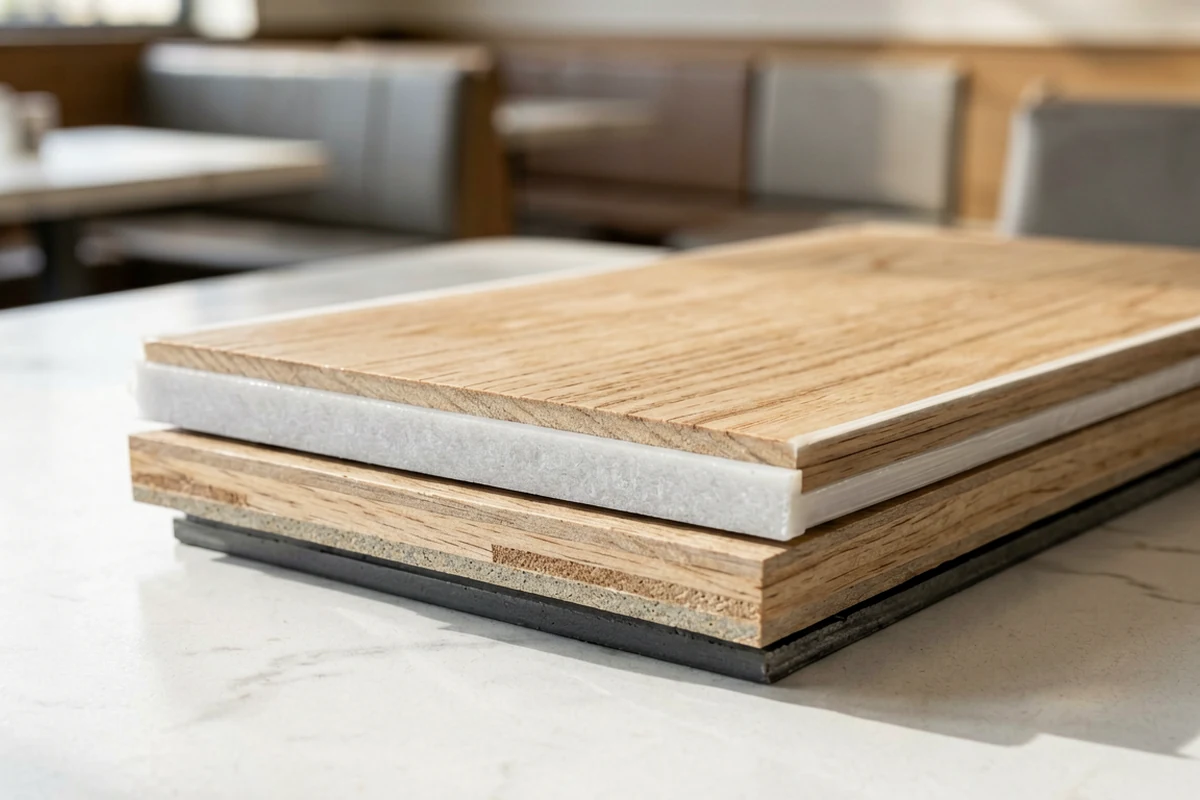
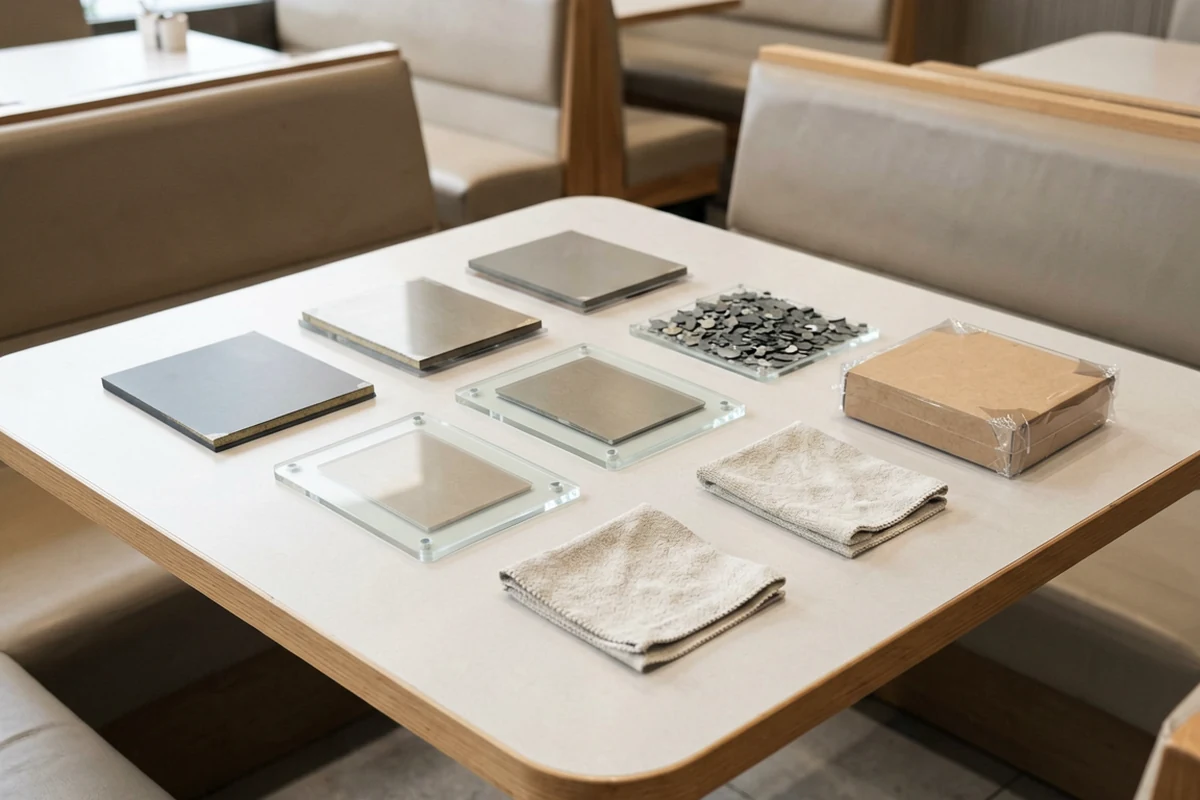
To execute a successful procurement cycle, buyers should specify the four distinct layers of a tabletop build-up.
1. The Core Material
The core dictates the structural integrity, weight, and fastener retention of the table. * Plywood or veneer-core proposal: Ask the supplier to document the core construction, fixing method, and base compatibility for the selected table base. * Composite core proposal: Ask for the core specification, underside detail, insert or fixing method, and the supplier's recommendation for the chosen base plate. * Particleboard or value core proposal: If proposed, ask how the supplier handles fasteners, inserts, edge protection, moisture exposure, and replacement risk for the project use case. * Solid Wood: Offers premium aesthetics but requires careful specification of moisture content and structural relief cuts on the underside to prevent warping. * Lightweight core proposal: If a lightweight build-up is proposed, ask where the base plate attaches and how the fixing area is reinforced or documented.
2. The Surface Finish
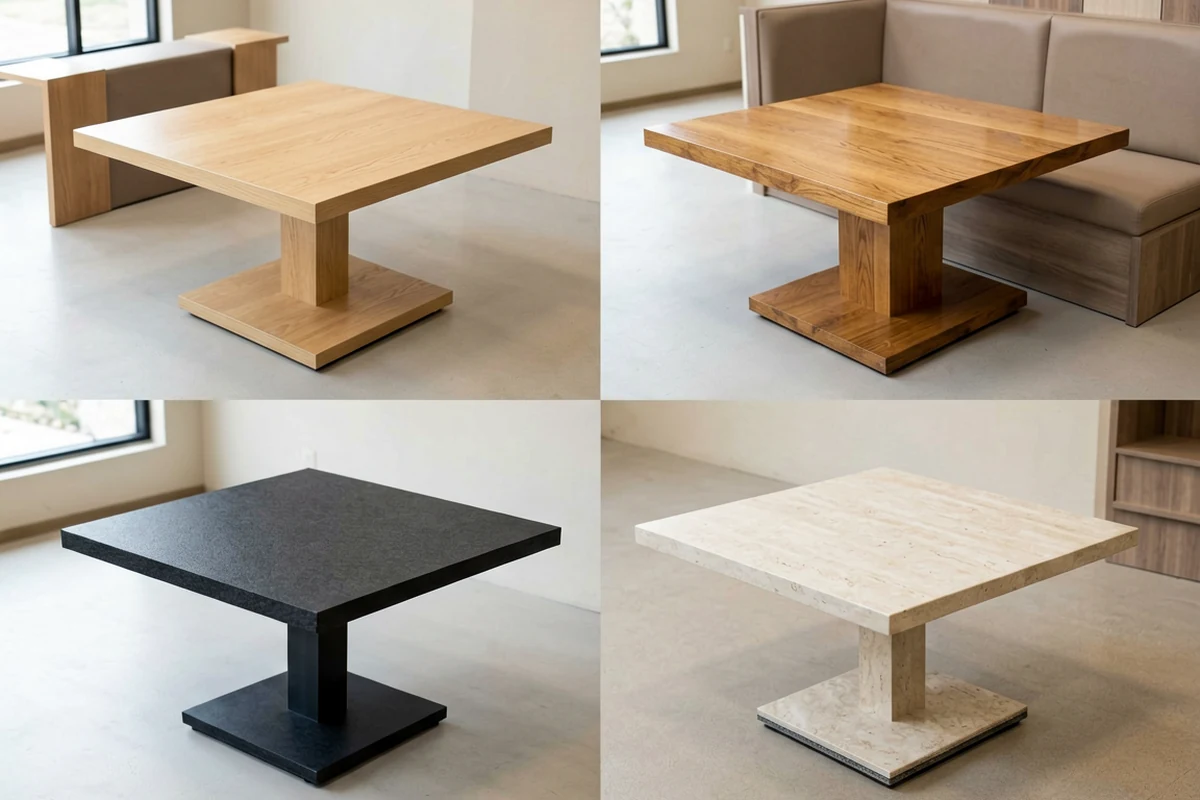
The surface is the primary interface for the guest and the maintenance team. * documented laminate or surface proposal: Often specified for repeat cleaning and consistent finishes. Procurement should specify the exact grade and thickness of the HPL. * Wood Veneer: Provides the look of solid wood with better dimensional stability. Buyers should specify the topcoat (e.g., polyurethane, catalyzed lacquer) and request supplier evidence of its chemical resistance. * Sintered Stone and Quartz: Extremely durable and non-porous. Procurement should verify the thickness and ensure the table base is rated for the significant weight of stone tops.
3. The Edge Treatment
The edge is the most vulnerable point of any restaurant table, absorbing impacts from chairs and exposure to liquid spills. * ABS or PVC Edge Banding: Applied to the perimeter of HPL or melamine tops. Procurement should request evidence of the adhesive used; the supplier should document the adhesive method and where it is suitable. * Solid Wood Lipping: A solid wood border applied to a veneer or laminate top, offering high impact resistance and the ability to be sanded and refinished if damaged. * Metal Edge Banding: Often used in retro or industrial designs; ask the supplier to document the fastening method and edge detail. * Self-Edge: Using the same surface material (like HPL) on the edge. This creates a sharp corner that is highly susceptible to chipping and should be reviewed carefully in high-contact dining areas.
4. The Underside Backer
If a tabletop features HPL or veneer on the top surface, ask whether it needs a balancing backer sheet (often phenolic) on the underside. Without this backer, the top may increase moisture or flatness risk.
Core, Surface, Edge, and Base Decision Matrix
Use the following decision matrix to align the tabletop build-up with the operational environment and base compatibility.
| Build-Up Type | Typical Core | Surface Material | Edge Treatment | Base Plate Compatibility | Best Application |
|---|---|---|---|---|---|
| Standard Laminate | documented core proposal | documented laminate or surface proposal | documented edge profile and adhesive method | Supplier to document fixing method and base compatibility. | High-turnover casual dining, food courts, cafes. |
| Premium Veneer | documented veneer-core or composite proposal | Hardwood Veneer with Catalyzed Topcoat | documented solid edge or lipping detail | Supplier to document fixing method for the selected core. | Fine dining, upscale steakhouses, private dining rooms. |
| Solid Wood Plank | Solid Hardwood (e.g., Oak, Walnut) | Stained and Sealed Wood | Routed/Eased Edge (Integral) | Requires slotted base plates to allow for natural wood expansion/contraction. | Farm-to-table concepts, rustic bistros, premium pubs. |
| Engineered Stone | Plywood Sub-top (Concealed) | Sintered Stone or Quartz (12mm - 20mm) | Polished or Mitered Edge | Base plate attaches to the plywood sub-top; requires heavy-duty base columns. | High-end lounges, modern luxury dining, patio transitions. |
Named Procurement Risk Scenarios
Procurement teams must actively manage the following risk scenarios during the sourcing and approval process.
Risk Scenario 1: The Surface-Only Approval Trap
A procurement buyer approves a tabletop based solely on a surface laminate swatch. The supplier manufactures the bulk order using a edge method that is not suitable for the cleaning exposure for the edge banding and omits the underside phenolic backer. Within weeks of deployment, daily wiping pushes moisture into the microscopic gap between the laminate and the edge band. The core absorbs the moisture, causing the edges to swell, split, and create hygiene and maintenance concerns that the project team must review. Mitigation: Always mandate a fully finished, edge-banded sample for approval, and request supplier evidence of the adhesive type and backer sheet application.
Risk Scenario 2: Base Instability and Fastener Pull-Out
A designer specifies a heavy heavy tabletop proposal. The procurement team orders standard cast-iron cross bases designed for lightweight laminate tops. If the base plate and column are not reviewed against the selected top, the tables are unstable in use and wobble continuously. Alternatively, a heavy base is screwed directly into a core that has not been reviewed for the fixing method; when staff drag the tables across the floor to accommodate large parties, the fixing points can fail during service.Mitigation: Ask suppliers for base plate, fixing, and load-support evidence for the selected tabletop build-up, then have the project team review base spread and handling assumptions.
Risk Scenario 3: Cleaning-Method Mismatch
Restaurant operators frequently use strong cleaning products to clean tables between seatings. If the procurement team does not communicate these specific cleaning protocols to the supplier, the factory may apply a standard residential-grade lacquer to a wood veneer top. The finish may respond poorly, creating maintenance complaints and supplier disputes. Buyers must reference NSF food equipment standards only as a reason to separate food-preparation sanitation claims from standard furniture claims; do not assume a furniture tabletop holds an NSF listing without product-specific supplier proof.Mitigation: Request supplier evidence of cleaning and maintenance protocol guidelines, ensuring the finish is documented for the operator's cleaning method.
Risk Scenario 4: Sample-to-Bulk Color Drift and Unlabeled Cartons
A beautiful solid oak tabletop sample is approved. However, the bulk production run utilizes wood from a different batch with drastically different grain patterns and moisture content. When the shipment arrives, the tops do not match the approved sample. Furthermore, the cartons lack clear labeling. When the operator needs to replace a damaged top a year later, they cannot identify the correct part number, size, or finish in their storage facility.Mitigation: Mandate sample-to-bulk quality control records and strict packaging and carton labeling specifications for all replacement inventory.
Service-Environment Checklist
Before finalizing restaurant tabletop material selection, evaluate the specific service environment using this checklist:
Cleaning Protocols: What cleaning products will be used? How often will the table be cleaned during service?
Heat and Moisture Exposure: Will the tables be exposed to condensation from iced beverages, hot plates straight from the salamander, or direct sunlight through adjacent windows?
Edge Impact: Will heavy dining chairs be pushed aggressively against the table edges?
Weight and Mobility: Does the floor plan require staff to frequently push tables together to accommodate large parties? If so, the build-up must be lightweight enough to move, but rigid enough to withstand the torque on the base plate.
Replacement Routing: How will replacement tops be ordered, identified, and installed by local maintenance teams?
Supplier Evidence Checklist
Do not rely on verbal assurances regarding tabletop durability. Require the following 10 items of supplier evidence before issuing a purchase order:
Core Material Technical Data Sheet: Request documentation showing the density, thickness, and moisture content of the core material (e.g., composite core, plywood, particleboard).
Surface Material Specification: Request the exact grade, thickness, and manufacturer of the HPL, veneer, or stone surface.
Edge Banding Application Method: Request proof of the application technique, specifically verifying if PUR adhesive, EVA hot-melt, or laser edge banding is utilized.
Underside Backer Sheet Specification: Request documentation confirming the presence and material of the balancing backer sheet to prevent core warping.
Base Plate Fastener Pull-Out Strength Data: Request supplier evidence demonstrating the core's ability to retain screws or threaded inserts under lateral stress.
Applicable BIFMA Standard Testing Reports: Reference the BIFMA standards page as a reason to ask suppliers which applicable furniture standards and testing documents are available for the complete table assembly (top and base combined).
NSF Food Equipment Standard Documentation: If the supplier makes specific sanitation or food-safety claims, request the exact NSF listing documentation, clearly separating these claims from ordinary furniture performance.
Cleaning and Maintenance Protocol Guidelines: Request the factory's official maintenance document detailing approved and prohibited cleaning chemicals for the specific surface finish.
Sample-to-Bulk Quality Control Records: Request documentation detailing how the factory helps show whether the bulk production run matches the approved finish sample in color, gloss level, and edge execution.
Packaging and Carton Labeling Specifications: Request evidence of the packaging standards, including drop-test compliance and carton labeling formats that support accurate inventory management for replacement tops.
RON GROUP Procurement Insights
Navigating the complexities of tabletop build-ups requires a supplier with deep manufacturing and project management expertise.
First, a tabletop is not a single piece of material; it is a manufactured assembly. RON GROUP uses the Factory Showcase as first-party production context, then keeps the buyer focused on sample code, edge detail, underside fixing, quality photos, carton labels, and project communication. The claim is not that every surface performs the same way; the value is keeping the approved build-up traceable through production review.
Second, controlled tabletop procurement maps the tabletop weight to the specific base spread and column thickness. The case page gives first-party project context, but the current order still needs its own base and fixing review. Selecting the right top is only half the equation; it must be paired with reviewed commercial restaurant tables/table bases to support stability review and replacement planning.
Finally, tabletop selection cannot happen in a vacuum. When sourcing a complete restaurant furniture package, procurement teams should check that tabletop edge profiles do not damage the armrests of adjacent seating. To reduce contact and finish conflicts, verify the clearance and material compatibility through careful adjacent chair coordination.
Tabletop Build-Up Release Checklist
Use this final decision tool to gate the release of your purchase order. Hold production release until the buyer, supplier, and project team agree on the open items.
| Verification Stage | Procurement Action | Acceptable Condition | Rejection Trigger |
|---|---|---|---|
| Sample Review | Inspect physical sample. | Fully finished, edge-banded sample provided with underside backer visible. | Supplier only provides a surface swatch or unbanded cut-off. |
| Core Verification | Review technical data sheet. | Core and fixing method are reviewed against base plate requirements (e.g., plywood or composite core). | Core proposal does not explain the fixing method. |
| Edge Inspection | Verify edge profile, adhesive method, and corner detail. | Supplier documents the method and where it is suitable. | Edge method is unspecified for the cleaning and spill exposure. |
| Base Integration | Confirm fixing pattern. | Underside features pre-drilled holes or inserts matching the approved base plate. | No fixing strategy defined; operator expected to drill into core on-site. |
| Packaging/Labeling | Review carton specifications. | Cartons feature clear part numbers, dimensions, and finish codes for inventory. | Blank or generic packaging proposed for the bulk shipment. |
Finalizing Your Tabletop Specification
Restaurant tabletop material selection is a critical procurement exercise that affects maintenance, base stability review, replacement planning, and the guest-facing dining room experience. By moving past surface-level aesthetics and rigorously specifying the core, surface, edge, and base compatibility, procurement buyers can reduce the risks of edge swelling, fastener pull-out, and finish degradation.
Request comprehensive supplier evidence, approve a fully finished sample, and confirm that table bases are reviewed against the weight and fixing method of the selected tops. To begin specifying your next project and confirm every layer of your build-up is ready for supplier comparison and sample approval, request a tabletop build-up review with our team.
Get the week's latest industry information
-
Real-Life Professional Restaurant Case Studies
Explore Now
-
Create a unique restaurant with over 95,700+products
Explore Now
-
Protessional Free 3D Restaurant Design
Explore Now
-
Still Have Questions About Opening a Restaurant?
Explore Now

Sylvia
With 8 years in catering & hospitality industry, sales manager of Ron Group, specialise in providing one stop solutions to restaurants, hotels and weddings.
Discover Our Exclusive Products
Explore our extensive range of restaurant and hotel supplies designed to enhance your operations. Find the perfect solutions to meet your needs.
Browse Our ProductsFREE 3D DESIGN
Boost your restaurant's success with our free 3D design service. Start building the restaurant of your dreams today!
Explore 3D Design Case
RECOMMENDED CASES
-

La Rambla by Catalunya: Crafting Barcelona's Soul in Hong Kong - Custom Furniture Excellence
RON Group's custom Spanish-inspired furniture elevates La Rambla with artisanal aesthetics...
Learn More -

Cardinal Point: Elevating Outdoor Seating with Tailored Cushion Upgrades
Discover how Cardinal Point transformed its outdoor dining experience with custom cushions, achievin
Learn More
RECOMMENDED BLOGS
-
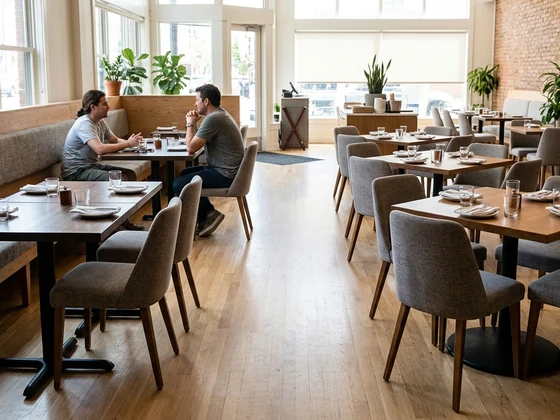
Restaurant Table Spacing and Aisle Clearance: Supplier Drawing Checklist
Check restaurant table spacing, aisle clearance, chair pullout, service path, and supplier drawing proof before approving a...
Sylvia2026-07-20 -

5 Mistakes to Avoid When Buying Restaurant Furniture from China
Don't fall for costly oversights! Learn the 5 mistakes to avoid when buying restaurant furniture from China and ensure a...
 Ron2025-01-079 min read
 -

RON GROUP Launches VR Experience to Explore Our Dynamic Showroom
Discover RON GROUP's VR showroom! Explore dining furniture, tableware, and customized services virtually or visit us in person to...
Sylvia2024-12-163 min read
Subscribe to RON GROUP
Stay up-to-date with the latest industry insights and expert advice. Together, we'll create your ideal restaurant.