









Content
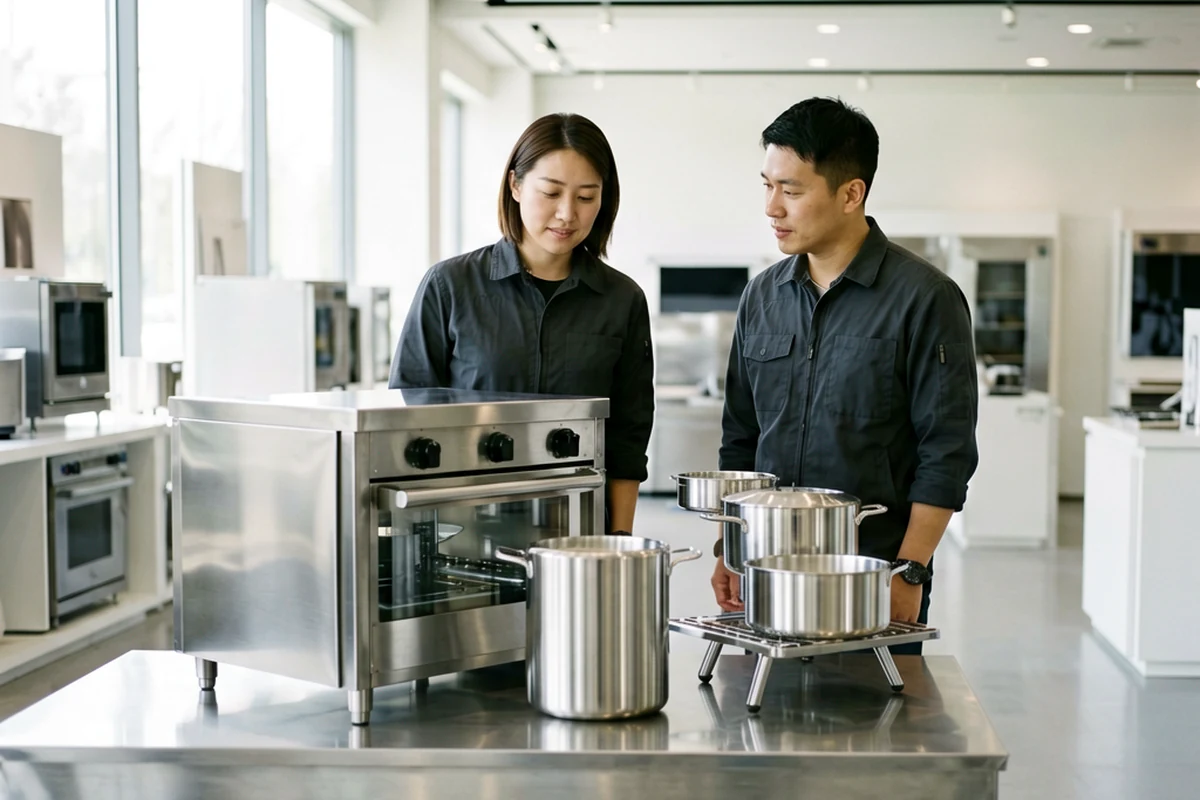
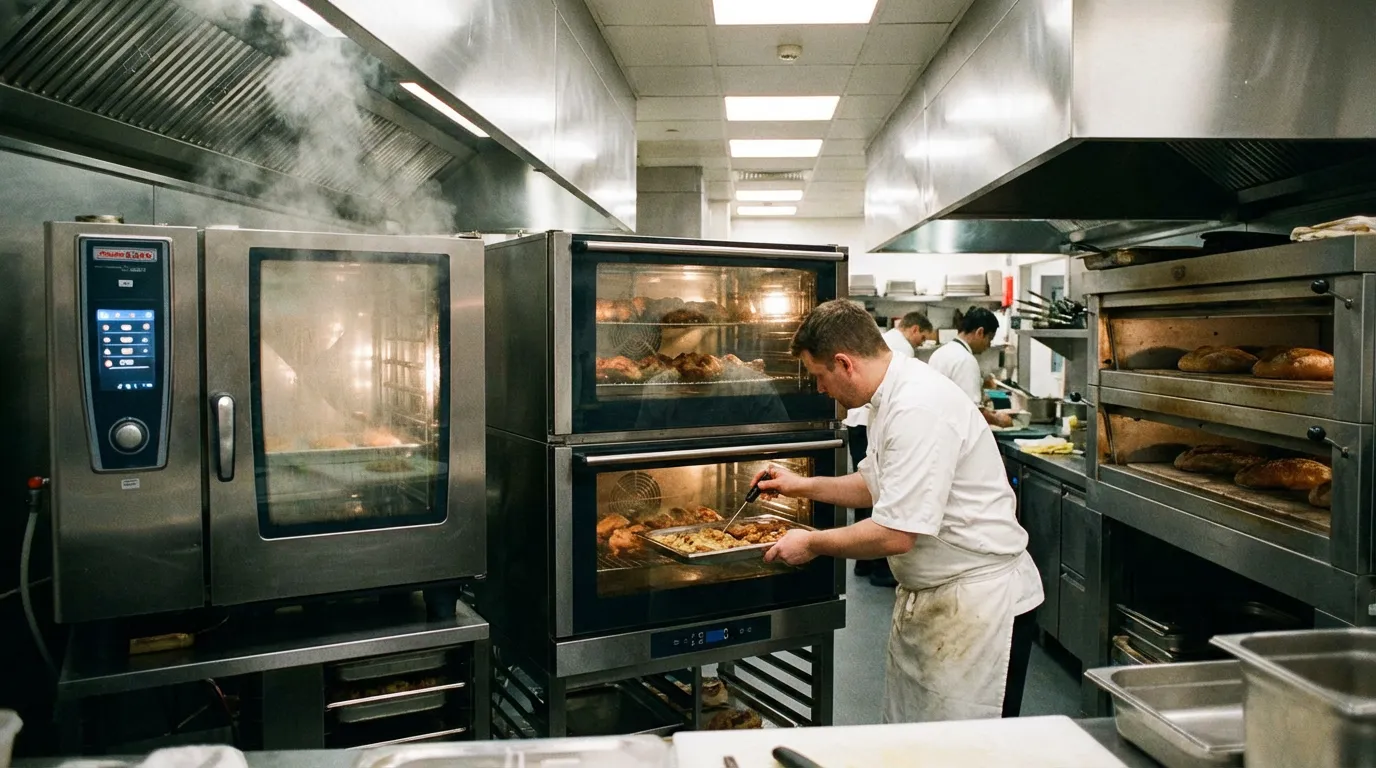
The oven is the defining piece of equipment in a commercial kitchen. It dictates what you can cook, how fast you can serve, and how much energy you consume during every shift. When operators ask what is a commercial oven, they are referring to the central thermal processing unit that anchors their hot line and production schedule. Yet choosing between the various types of commercial ovens remains one of the most complex equipment specification tasks in the foodservice industry. An incorrect selection can result in paying for excess capacity you never use, or under-investing and bottlenecking production within the first six months of operation.
Learning how to choose a commercial oven requires moving beyond basic brand preference. It demands a rigorous evaluation of your menu, your utility infrastructure, your maintenance capabilities, and your labor model. This guide breaks down each commercial oven category by operating principle, ideal use case, capacity verification, energy compliance, and total cost of ownership so you can match the right thermal platform to your operation based on verified technical data.
Understanding the Core Technologies
Every commercial oven applies heat to food, but the method of heat transfer determines cooking speed, moisture retention, texture, and the range of dishes you can produce. Understanding these mechanisms is the foundational step in procurement.
Convection Ovens: Forced Hot Air
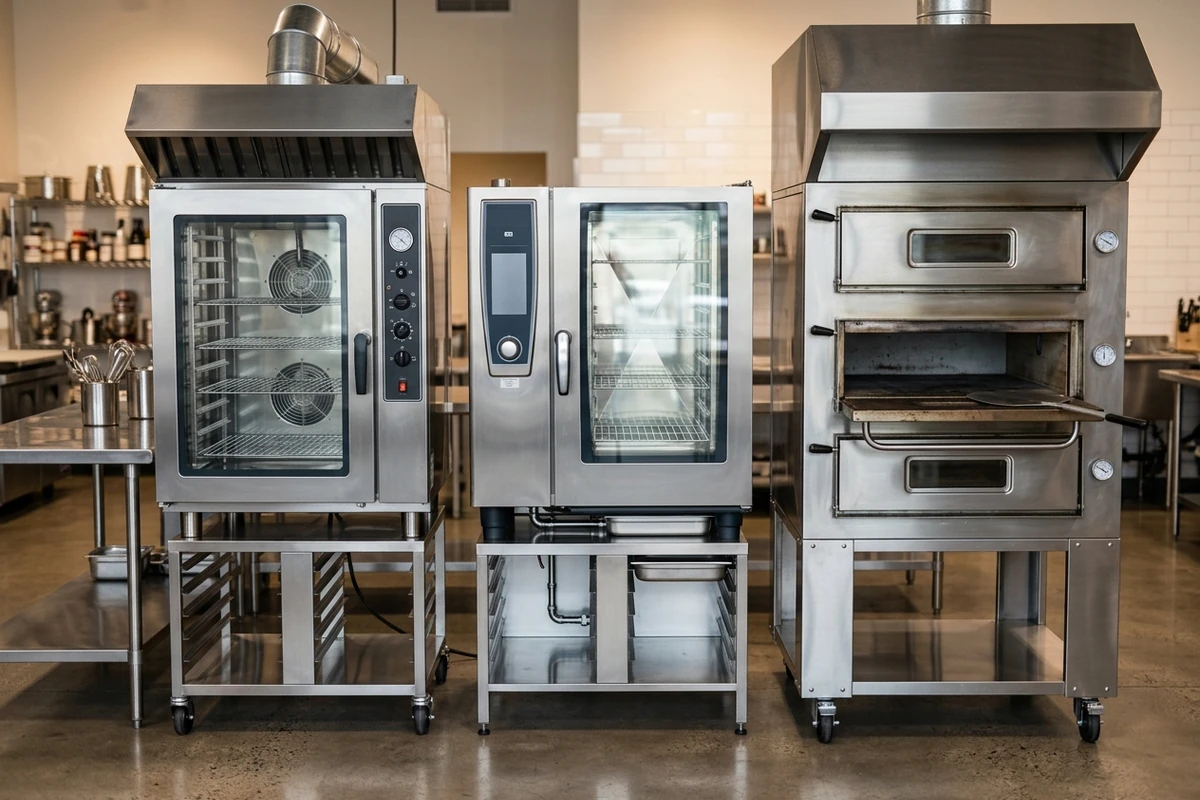
A convection oven uses one or more internal fans to circulate heated air throughout the cooking cavity. This forced circulation strips away the boundary layer of cool air that naturally surrounds food in a standard radiant oven, accelerating the cooking process and producing even browning. The result is consistent output whether you load the oven with a single sheet pan or a full rack. Convection technology is highly versatile, making it a staple for baking, roasting, and reheating across diverse foodservice segments. Modern units often feature reversing fans to further improve airflow distribution, ensuring that delicate baked goods receive uniform heat exposure without requiring operators to manually rotate pans halfway through the cycle.
Combi Ovens: Steam, Convection, and Combined Modes
To answer what is a commercial combi oven, one must look at its ability to control both temperature and humidity simultaneously. A combi oven integrates three distinct cooking modes into one unit: dry convection heat, pure steam injection, and a combination of both. In convection mode, it operates like a standard convection oven. In steam mode, it generates moist heat for poaching, steaming, and blanching. In combination mode, it balances dry and moist heat to keep proteins juicy while achieving surface browning. The commercial combi ovens market has expanded rapidly because this three-in-one capability allows kitchens to consolidate multiple appliances into a single footprint. For an overview of how advanced climate-control capabilities function at the category level, review the documentation for RATIONAL Combi Ovens, and always require exact model documentation to verify specific humidity control features, boiler versus boilerless steam generation, and programmable recipe capacities.
Deck Ovens: Conductive Stone Heat
For those wondering what is a deck oven, it is a specialized unit that cooks food through direct contact with a heated stone or steel surface. The strict deck oven definition involves a heating element beneath each deck that radiates intense bottom heat upward. The primary deck oven function relies on this conductive heat transfer and the thermal mass of the deck itself. Common deck oven uses include baking artisan breads, pizzas, and delicate pastries that require rapid bottom crust development. When specifying commercial deck-type ovens, buyers must account for the significant weight and recovery times associated with stone hearths. Choosing between a deck or cabinet oven ultimately depends on whether your menu requires this direct conductive heat or if ambient radiant heat is sufficient for your product specifications.
Conveyor and Rack Ovens: High-Volume Production
Conveyor ovens move food through a heated chamber on a continuous belt, applying heat via infrared elements, convection fans, or both. Because the belt speed and temperature are fixed, every item receives identical heat exposure, eliminating operator error and standardizing output. Rack ovens, conversely, allow operators to roll entire multi-tier pan racks directly into the cooking chamber, where they are often rotated for even baking. Both categories are designed for massive throughput, but they serve entirely different menu profiles: conveyor ovens excel at continuous linear production of flat items, while rack ovens are designed for high-volume batch processing of baked goods.
Direct Comparisons: Matching Equipment to Menu
Procurement decisions often come down to choosing between two competing technologies. The following comparisons highlight the operational trade-offs between the major oven categories, focusing on heat transfer physics and labor requirements.
Deck Oven vs Convection Oven
The debate of deck oven vs convection oven comes down to the physics of heat transfer. A convection oven vs deck oven comparison highlights that convection relies on moving air, which is excellent for roasting meats and baking cookies evenly across multiple racks. However, the forced air can dry out certain doughs and cannot produce a charred bottom crust. The main difference between deck and convection oven technologies is that the deck oven uses direct conductive heat from a stone hearth. In a deck vs convection oven scenario, artisan bakers and pizza operators will specify the deck oven for its ability to create a blistered crust through direct thermal contact. Conversely, a convection vs deck oven analysis shows that for general catering, roasting, and reheating, the convection oven offers faster recovery times, a smaller footprint, and greater versatility across a wider range of menu items.
Combi Oven vs Convection Oven
When comparing a combi oven vs convection oven, the primary differentiator is moisture control. A convection oven vs combi oven analysis shows that while both use forced air, the combi oven can inject precise amounts of steam. In the combi oven vs convection debate, the combi provides measurable advantages in protein yield; the added humidity prevents meats from shrinking and drying out during roasting, which can translate to more servable portions per roast. However, combi ovens require complex water filtration, drainage, and higher initial capital investment. If your menu consists entirely of dry-baked goods or simple reheating tasks, the premium for a combi oven may not be justified by your operational requirements.
Conveyor Pizza Oven vs Deck Oven
For pizzerias, the conveyor pizza oven vs deck oven choice dictates the entire labor model. A conveyor oven vs deck oven comparison reveals that conveyor units require minimal skill to operate—staff simply place the raw product on the belt. This ensures absolute consistency across shifts and locations, making it the standard for quick-service chains. However, a deck oven produces a traditional, hand-crafted crust that a conveyor cannot replicate. The trade-off is that deck ovens require skilled operators to manually load, rotate, and monitor the pizzas, increasing labor costs and training requirements.
Rack Oven vs Deck Oven
In high-volume bakeries, the rack oven vs deck oven decision centers on product type and labor efficiency. Rack ovens allow a single operator to load dozens of pans simultaneously, making them ideal for high-volume production of uniform items like buns, cookies, and standard loaves. Deck ovens require manual loading of individual loaves using a peel, which is highly labor-intensive but necessary for authentic hearth breads that require direct contact with a hot stone surface.
Comprehensive Decision Framework Matrix
Use this matrix to align your operational requirements with the correct oven category. Never assume a single oven type can perfectly execute every menu item; evaluate based on your primary production volume and facility constraints.
| Oven Category | Menu Result | Batch Pattern | Skill Level | Utilities | Ventilation | Cleaning | Service Access | Required Evidence |
|---|---|---|---|---|---|---|---|---|
| Convection | Even browning, dry roasting, consistent baking | Multi-pan batch loading | Low to Moderate | Gas or Electric | Type 1 or Type 2 Hood (Verify locally) | Manual wipe down, daily interior cleaning | Front and side panel access required | Spec sheet, utility load, warranty terms |
| Combi | High yield proteins, precise steaming, mixed loads | Continuous mixed loading or large batch | Moderate to High (Programming) | Gas/Electric, Water Supply, Floor Drain | Type 1 Hood (Verify locally) | Automated chemical wash cycles | Clearance for boiler/generator maintenance | Water quality spec, drainage requirements |
| Deck | Conductive bottom crust, hearth baking | Staggered manual loading | High (Manual peel operation) | Gas or Electric | Type 1 or Type 2 Hood (Verify locally) | Dry brushing only (No water on stone) | Element access beneath decks | Floor load capacity, recovery time data |
| Conveyor | Uniform toasting, melting, fixed-time baking | Continuous linear throughput | Low | Gas or Electric | Type 1 Hood (Verify locally) | Daily belt and crumb tray removal | Side access for belt motor and elements | Belt width/speed specs, clearance data |
Gas vs. Electric Verification
The decision between gas and electric models intersects with oven type, local utility rates, and existing kitchen infrastructure. This specification requires careful verification of your facility's capabilities.
Gas Ovens: Gas models generally offer faster initial heat-up times and can recover temperature quickly after door openings. They require a dedicated gas line, proper manifold pressure verification, and specific ventilation clearances. Operating costs depend heavily on local natural gas or propane rates. When specifying gas, you must verify the exact BTU requirements and ensure your facility's gas supply can handle the load without starving other equipment on the line.
Electric Ovens: Electric models offer precise temperature control, which is particularly critical for combi steam generation and delicate baking. They are increasingly specified in jurisdictions phasing out commercial gas hookups. However, they draw significant amperage. A full-size electric combi oven may require a dedicated 200-amp circuit. You must verify the exact voltage (e.g., 208V vs. 240V vs. 480V) and phase (single vs. three-phase) requirements with your electrical engineer before procurement.
Total Cost of Ownership (TCO) Input Categories
The initial oven price represents only a fraction of its total cost over a 7-to-10-year lifespan. To accurately compare quotes, you must calculate the Total Cost of Ownership (TCO) using verified input categories rather than assumed values. Request exact data from manufacturers for the following categories:
Capital Cost: The base purchase price of the oven, plus required accessories (stands, stacking kits, specialized racks, water filtration systems).
Installation Cost: Expenses for utility connections (electrical drops, gas plumbing, water lines, floor drains) and ventilation modifications. Combi ovens typically carry the highest installation costs due to plumbing requirements.
Energy Consumption: Annual utility costs based on the exact model's certified idle energy rate and cooking energy efficiency.
Maintenance and Consumables: Annual costs for preventive maintenance contracts, replacement gaskets, water filter cartridges, and proprietary cleaning chemicals (especially for combi ovens).
Labor and Yield Impact: The financial impact of labor savings (e.g., conveyor ovens reducing dedicated operator hours) or yield improvements (e.g., combi ovens reducing protein shrinkage).
For a detailed framework on evaluating equipment lifecycle costs, review our guide on total cost of ownership for commercial kitchen equipment.
Maintenance Best Practices by Oven Type
Preventive maintenance extends equipment life, prevents costly breakdowns during service, and maintains food safety compliance. Each oven type has specific maintenance requirements that must be factored into your operational procedures.
Convection Oven Maintenance
Clean fan blades and interior walls weekly to prevent grease buildup that reduces airflow efficiency and creates fire hazards.
Inspect and replace door gaskets every 12–18 months. Worn gaskets leak heat, increase energy consumption, and cause uneven baking near the front of the cavity.
Calibrate the thermostat quarterly using an independent, verified oven thermometer to ensure accurate temperature delivery.
Combi Oven Maintenance
Run the automatic cleaning cycle daily using only the manufacturer-recommended cleaning tablets or liquid chemicals. Using unapproved chemicals can damage the cavity and affect warranty coverage.
Descale the boiler or steam generator every 1–3 months depending on local water hardness. Monitor your water filtration system and replace cartridges exactly on schedule to extend descaling intervals.
Inspect the door seals and drain lines weekly to ensure there are no blockages that could cause water to back up into the cooking cavity.
Deck Oven Maintenance
Brush stone decks with a dry, stiff-bristled brush after each baking session. Never use water or wet mops on a hot stone deck, as the thermal shock will crack the hearth material.
Inspect heating elements (in electric models) or burner tubes (in gas models) every 6 months for uneven heating patterns or physical degradation.
Check steam injection nozzles (if equipped) monthly for mineral blockage, and clear them according to the manufacturer's service manual.
Conveyor Oven Maintenance
Clean the conveyor belt and crumb trays daily to prevent carbonized food debris from affecting product quality and creating a fire risk.
Lubricate belt rollers and chain drives monthly per the manufacturer's exact specifications, using only food-grade, high-temperature lubricants.
Inspect infrared elements or convection fingers quarterly for hot spots, blockages, or failed zones that could cause uneven cooking across the belt width.
Actual-Demand Sizing and Menu Test Worksheet
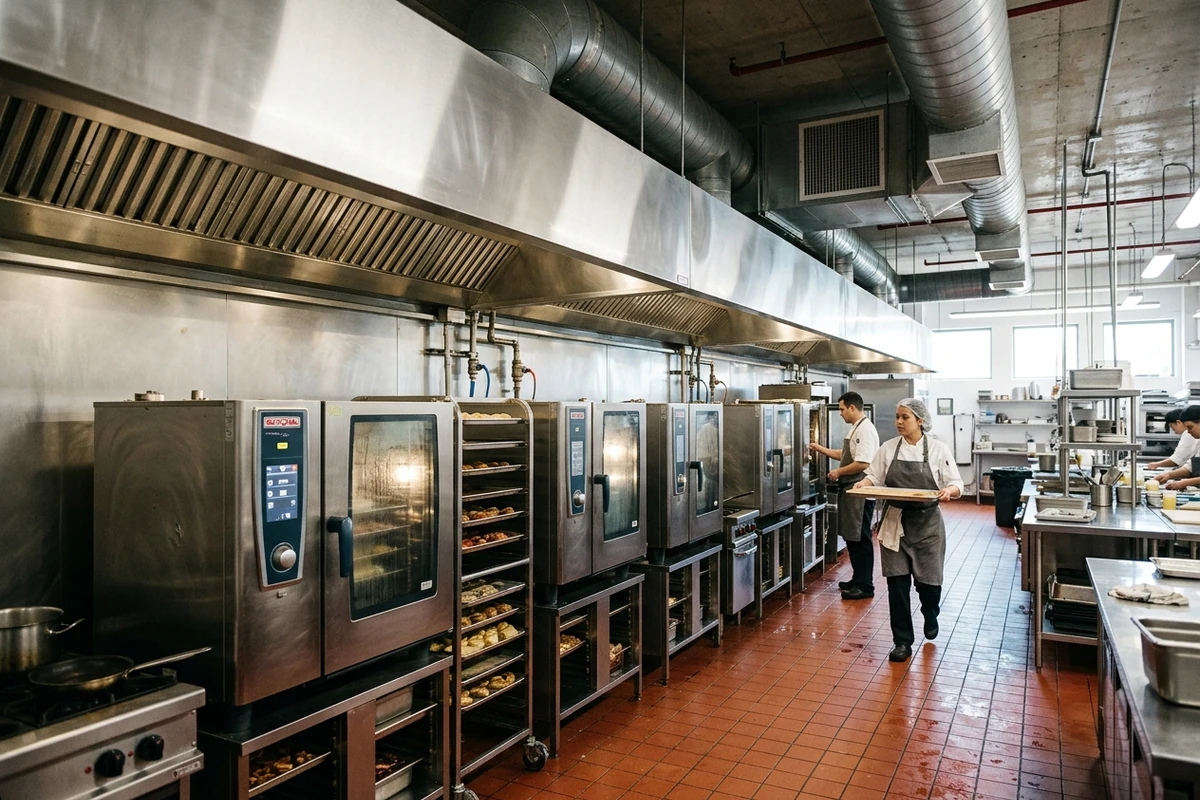
Oversizing wastes capital and energy, while undersizing creates severe production bottlenecks. Follow these steps to calculate your true capacity requirements before requesting quotes:
Define the Peak Production Window: Identify your absolute busiest 60-to-90-minute period of the week. Capacity must be planned for this peak, not the daily average.
Audit the Hot Menu: List every item that requires oven processing during the peak window. Group these items by their required cooking temperature and humidity profile.
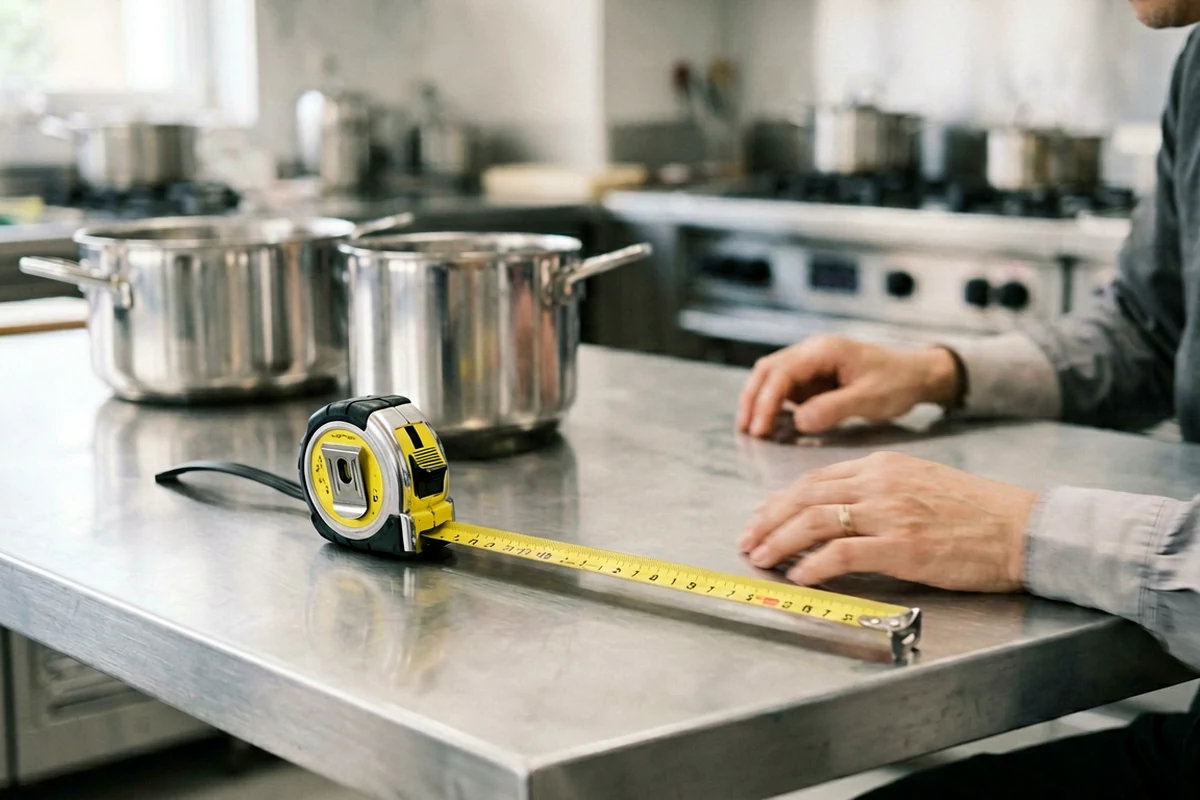
Calculate Pan/Deck Yield: Determine exactly how many portions fit on a standard full-size sheet pan, a GN pan, or a single oven deck. Do not estimate; physically measure the raw product on the pan.
Determine Cycle Times: Document the exact cook time for each item, plus the required recovery time for the oven to return to temperature after the doors are opened or the cold product is loaded.
Map the Batch Schedule: Calculate how many total pans or decks must be processed concurrently to meet the peak demand. If items require drastically different temperatures (e.g., roasting at high heat vs. delicate baking), you must plan for multiple oven cavities rather than one large unit.
Verify Manufacturer Capacity: Never assume a stated "10-pan" oven can cook 10 pans of dense, frozen product simultaneously without a substantial temperature reduction. Require the manufacturer to provide exact-model performance data for your specific product type.
If you need assistance calculating the right oven capacity for your specific operation, our operations consulting team can model production scenarios based on your menu and projected covers.
Installation and Service Checklist
The physical installation of a commercial oven dictates its long-term reliability. Failure to plan for utilities and clearances can invalidate warranty coverage and violate local codes. Use this checklist to verify site readiness:
Utility Verification: Confirm that your facility can supply the exact electrical voltage, phase, and amperage, or the exact gas pressure and BTU volume required by the specific model. Never invent or assume utility values; require exact-model documents.
Water Quality and Drainage (Combi Ovens): Combi ovens require strict water quality parameters to prevent boiler scale. Test your local water supply and verify the exact filtration requirements (e.g., reverse osmosis vs. carbon block) specified by the manufacturer. Ensure a compliant floor sink or drain is located within the specified distance.
Ventilation Compliance: Oven exhaust requirements vary by jurisdiction and oven type. Verify exact clearance and hood requirements in the manufacturer's installation manual and cross-reference them with your local mechanical inspector.
Sanitation and Safety Standards: Frame your cleaning protocols and local regulatory verification using the FDA Food Code as a baseline, but always defer to local health department rulings. Furthermore, require exact product safety certification evidence and installation instructions by referencing standards such as the UL Commercial Food Service Equipment guidelines.
Service Clearances: Ovens require physical space around them for airflow and maintenance access. Verify the exact side, rear, and top clearance requirements. Blocking service panels often results in denied warranty claims and overheating.
RFQ Evidence List and Final Decision Workflow
When sourcing ovens for the hotel trade, institutional kitchens, or independent restaurants, the Request for Quote (RFQ) must demand specific documentation. While the initial purchase price is a consideration, the total cost of ownership will ultimately determine the financial viability of the equipment. Require the following evidence from your suppliers to systematically evaluate your options:
Energy Efficiency Certification: Do not accept blanket claims of efficiency. Define covered oven categories and require exact model certification checks by consulting the ENERGY STAR Commercial Ovens registry.
Category Exclusions: Explain to your procurement team that eligible categories and exclusions differ significantly. For example, deck ovens are currently excluded from certain efficiency programs. Verify this by reviewing the key product criteria.
Specification Versioning: Anchor your current version and effective-date verification by referencing the ENERGY STAR Version 3.0 specification to ensure you are quoting against the most recent standards.
Technical Documentation: Require model-specific manuals, spec sheets, and service documents for convection and deck ovens before issuing a purchase order. For an example of the depth of documentation required, review the Blodgett Documentation Library.
Warranty and Service Network: Demand written confirmation of the warranty terms, specifically noting what conditions (e.g., improper water filtration, lack of ventilation) may affect coverage. Verify that authorized service agents are located within a reasonable radius of your facility.
Choosing the right commercial oven is a central equipment specification that impacts production capacity, utility costs, and menu execution. By utilizing the matrices, capacity worksheets, and strict RFQ guidelines outlined above, you can evaluate convection, combi, deck, and conveyor technologies based on verified data rather than assumptions. Browse our full range of commercial kitchen equipment to compare options. For specifications, bulk pricing, or help selecting the right model for your operation, explore the RON GROUP product catalog or contact our equipment specialists directly to ensure your next procurement decision is documented and aligned with your operational requirements.
Get the week's latest industry information
-
Real-Life Professional Restaurant Case Studies
Explore Now
-
Create a unique restaurant with over 95,700+products
Explore Now
-
Protessional Free 3D Restaurant Design
Explore Now
-
Still Have Questions About Opening a Restaurant?
Explore Now

Sylvia
With 8 years in catering & hospitality industry, sales manager of Ron Group, specialise in providing one stop solutions to restaurants, hotels and weddings.
Discover Our Exclusive Products
Explore our extensive range of restaurant and hotel supplies designed to enhance your operations. Find the perfect solutions to meet your needs.
Browse Our ProductsFREE 3D DESIGN
Boost your restaurant's success with our free 3D design service. Start building the restaurant of your dreams today!
Explore 3D Design Case
RECOMMENDED CASES
-

La Rambla by Catalunya: Crafting Barcelona's Soul in Hong Kong - Custom Furniture Excellence
RON Group's custom Spanish-inspired furniture elevates La Rambla with artisanal aesthetics...
Learn More -

Cardinal Point: Elevating Outdoor Seating with Tailored Cushion Upgrades
Discover how Cardinal Point transformed its outdoor dining experience with custom cushions, achievin
Learn More
RECOMMENDED BLOGS
-

Bar Glassware 101: Types, Names, Uses, and How to Stock Your Bar
Learn the 10 core bar glassware types, names, and uses. Discover how to stock your bar with the right glasses for cocktails, beer,...
Sylvia2026-07-26 -

Complete Bar Equipment List for Opening a Bar
Plan a complete commercial bar equipment list by menu, service volume, refrigeration, ice, glassware, utilities, sanitation,...
Sylvia2026-06-11 -

Low Budget Restaurant Interior Design: 2026 Trends
Prioritize a low-budget restaurant interior by protecting code, operations, durability, accessibility, and phased design decisions...
Sylvia2026-04-04
Subscribe to RON GROUP
Stay up-to-date with the latest industry insights and expert advice. Together, we'll create your ideal restaurant.