
Content
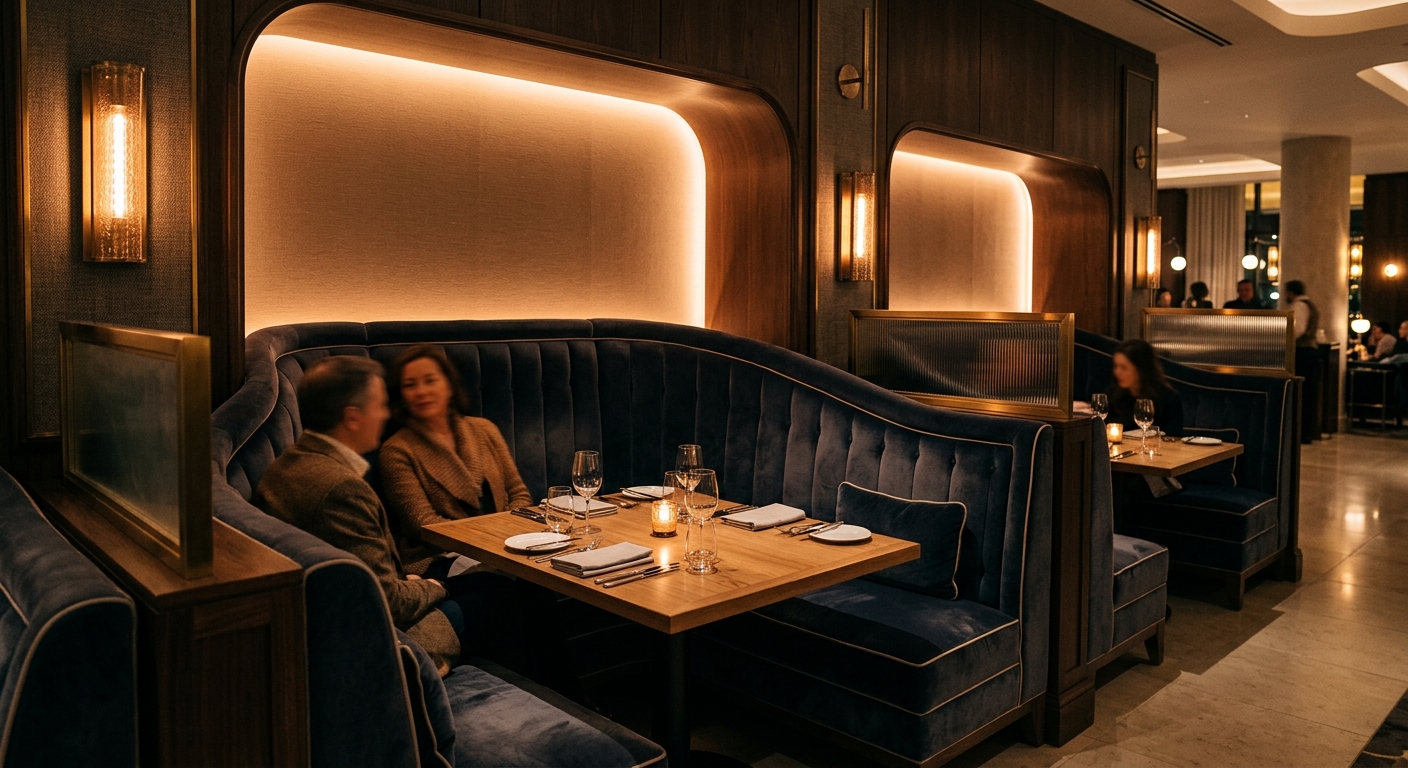
Lighting is the single most powerful architectural tool in commercial food service design. It dictates how patrons perceive interior textures, shapes emotional comfort, governs table turnover velocity, and directly influences how appetizing food appears on the plate. Yet, lighting is frequently treated as an afterthought in hospitality fit-outs, relegated to value-engineering cuts or compromised by decorative residential-grade fixtures that fail under commercial operational demands.
Executing an exceptional restaurant lighting plan on a disciplined capital expenditure budget requires moving past aesthetic intuition into rigorous photometric discipline. Whether outfitting an upscale moody bistro, a fast-casual dining concept, a high-volume cafeteria, or a traditional highway dhaba, achieving atmospheric balance demands a calculated integration of lighting layers, color science, beam angles, driver topologies, and control systems.
This technical guide breaks down how to balance lumens, Kelvins, and capital costs to create an elevated guest experience without ballooning procurement budgets.
Define the Restaurant Concept, Dayparts, and Lighting Goals
Every successful commercial lighting layout starts with the operational business model. Lighting directly guides patron behavior, appetite, and perception of value. Before selecting a single fixture housing or driver, an operator must define how light levels will adjust across different service dayparts to align with dining psychology.
Visual Pace by Sector:
QSR / Cafeteria:    [ High Illuminance (300-500 Lux) ] -> Fast Turnover, Maximum Alertness
Casual Dining:      [ Balanced Multi-Layer (150-250 Lux) ] -> Moderate Dwell Time (45-60 min)
Fine Dining / Bar:  [ Low Illuminance (30-80 Lux), High Contrast ] -> Extended Dwell, Intimacy
Daypart Programming and Revenue Dynamics
A venue operating across breakfast, lunch, and dinner transitions through conflicting psychological environments:
- Breakfast and Morning Rush: Requires higher illuminance (250 to 400 lux) and cooler, crisper white light (3000K to 3500K) to stimulate alertness, support quick reading of menus or devices, and drive fast customer turnover.
- Lunch Service: Demands moderate ambient levels (150 to 250 lux) with balanced contrast. Guests require clarity for business discussions, fast dining transactions, and clean visual orientation.
- Dinner Service: Demands low ambient levels (50 to 100 lux) combined with intimate table-top accentuation (100 to 150 lux) and warm color temperatures (2200K to 2700K). Contrast ratios must increase to create privacy pockets between tables, softening vocal volume and encouraging longer dwell times.
- Late-Night / Lounge Service: Relies on hyper-intimate lighting (20 to 50 lux), where general ambient light is dropped to near zero, shifting the focus to decorative elements, glowing perimeter coves, and illuminated back-bars to drive beverage profitability.
EXECUTIVE MANDATE // PROCUREMENT COMPLIANCE AUDIT
The human eye adapts logarithmically, not linearly, to changes in light. Dropping a dining room from 200 lux to 100 lux does not cut perceived brightness in half; it registers as a subtle mood shift. To create perceptible intimacy or dramatic focus, lighting levels between focal areas and circulation pathways must follow intentional contrast ratios, typically starting at 3:1 for casual dining and exceeding 8:1 for moody, high-end environments.
Operational Turnover vs. Dwell Times
Lighting levels serve as an invisible floor manager. High, uniform lighting levels (such as those in institutional cafeterias or quick-service restaurants) shorten dwell times to 20 to 30 minutes, keeping seats churning during peak volume.
Conversely, dim, low-contrast ambient fields paired with focused, warm accent downlights signal relaxation, extending dwell times beyond 90 minutes and increasing high-margin beverage, appetizer, and dessert sales. Specifying fixed-output, non-dimmable fixtures locks an operator out of these critical revenue levers.
Use Ambient, Task, and Accent Lighting Together
Relying on a single fixture type, such as a grid of recessed downlights, creates a flat, clinical, uninviting environment often referred to as the "office ceiling effect." High-performance hospitality spaces use a four-layer lighting strategy: ambient, task, accent, and decorative.
+-------------------------------------------------------------+
|                     CEILING PLANE                           |
|   [Recessed Downlight]               [Track Projector]      |
|    (Ambient Layer)                    (Accent Layer)        |
|           |                                  \              |
|           v                                   \             |
|   +---------------+                            v            |
|   | Circulation   |                     +---------------+   |
|   | Path (100 lx) |                     | Feature Wall  |   |
|   +---------------+                     | (400 lx)      |   |
|                                         +---------------+   |
|                 [Suspended Pendant]                         |
|                    (Task Layer)                             |
|                         |                                   |
|                         v                                   |
|                  +---------------+                          |
|                  | Dining Table  |                          |
|                  | (150 lx)      |                          |
|                  +---------------+                          |
|                                                             |
+-------------------------------------------------------------+
1. Ambient Lighting (The Foundation)
Ambient lighting provides the baseline illumination required for safe navigation, basic spatial comprehension, and overall comfort. In a restaurant, ambient lighting should never overpower the room. It sets the baseline visual floor. In moody dining environments, the ambient layer is intentionally subdued, allowing the eye to register contrast and depth.
2. Task Lighting (The Functional Layer)
Task lighting delivers directed light to surfaces where specific visual actions occur. Critical task zones include:
- The dining tabletop (reading menus, evaluating plating, viewing table companions).
- The bar counter and drink preparation wells (measuring, pouring, cash handling).
- Point-of-sale (POS) and host terminals.
- Kitchen pass counters and culinary plating stations.
Task lighting must be positioned to prevent the guest's or worker's own head and body from casting shadows directly over the working plane.
3. Accent Lighting (The Architectural Drama)
Accent lighting draws attention to focal points, architectural details, textures, artwork, wine displays, and floral arrangements. To register as an accent, the light delivered must be at least three to five times higher than the surrounding ambient baseline (a 3:1 to 5:1 contrast ratio).
Using adjustable narrow-beam track projectors (15 to 24 degrees) with cross-cube louvers allows precise beam shaping on a textured brick wall or an art piece without spilling stray photons into adjacent dining booths.
4. Decorative Lighting (The Visual Jewelry)
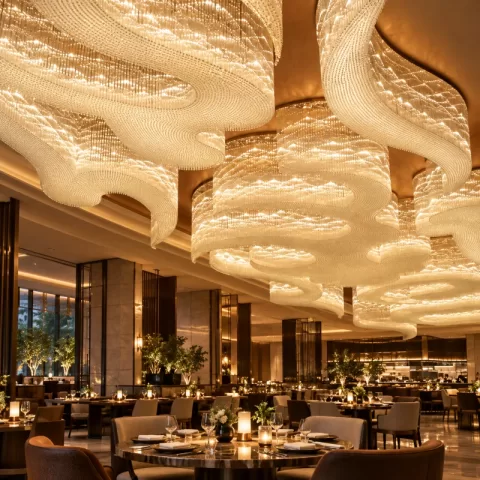
Decorative fixtures include statement chandeliers, custom cluster pendants, table lamps, and wall sconces. In modern restaurant design, decorative fixtures establish the design theme and provide warm, human-scale focal points. However, decorative fixtures should rarely be relied upon to provide primary ambient or task lumens.
When oversized, unshielded filament globes are cranked to high output to illuminate a dining table, they blind seated guests. Decorative fixtures should operate at low surface brightness, while hidden architectural downlights do the heavy photometric lifting.
Lighting Plan by Restaurant Zone
A restaurant is an interconnected system of functional micro-environments. Applying a blanket lighting specification across the entire floor leads to operational failure. Each zone requires specific illumination values, color metrics, and glare control parameters.
Restaurant Zoning Footprint:
[ Exterior Facade & Entry ] -> IP65, Transition Lighting (3000K)
     |
[ Host & Circulation ] -----> Safe Egress, UGR < 19 (2700K-3000K)
     +-----> [ Bar & Counter ] --------> Vertical Bottle Highlights, Low Bar Top (2200K-2700K)
     +-----> [ Main Dining Area ] -----> Direct Table Pools, Low Glare (2200K-2700K)
     +-----> [ Restrooms ] ------------> High CRI Vanity, Flattering Flank Lighting (2700K-3000K)
     |
[ Kitchen / Pass (BOH) ] ---> NSF/IP65, 500-750 Lux, 4000K, R9 > 50
Dining Tables, Bar, Counter, Circulation, Kitchen, and Exterior
Dining Tables
The table is the center of the guest experience. Light must pool cleanly across the horizontal surface (100 to 200 lux) while leaving the guests' faces softly and flatteringly illuminated without harsh vertical shadows.
Suspended pendants should be installed 30 to 36 inches above the table surface, shielding the light source from seated sightlines. For flexible dining configurations where tables shift frequently, ceiling-mounted adjustable accent fixtures with field-changeable beam optics (24 to 36 degrees) are far superior to fixed pendants.
For detailed criteria on deciding between overhead suspension styles, review our technical guide on pendant lights vs chandeliers for commercial restaurants.
Bar and Counter
The bar is both an entertainment stage and a high-speed production station.
- The Bar Top: Requires focused pools of light (100 to 150 lux) for drinks and payment processing, traditionally delivered via narrow mini-pendants or recessed pinholes.
- The Underbar / Wells: Bartenders require clean, shadowless task light (250 to 350 lux) to read labels, pour precise measurements, and clean bar tools. Waterproof IP65 linear LED extrusions mounted directly under the front bar lip pointing downward provide this without spilling light into the front face.
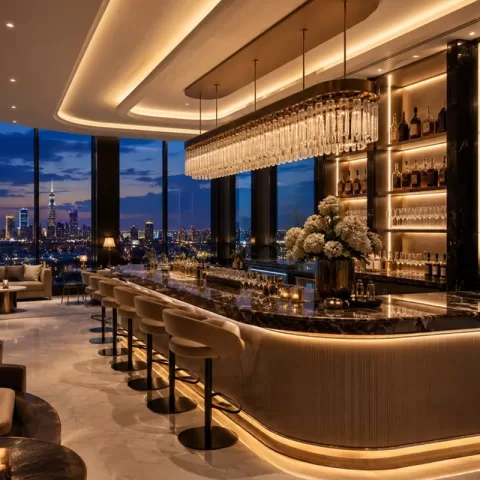
- The Back-Bar: Requires vertical illumination to highlight glassware and premium bottles. Concealed linear LED strips (2400K to 2700K) integrated into shelf channels, combined with narrow-beam framing projectors, create an illuminated backdrop that draws eyes across the room.
Service Counters and Cafeteria Display Lines
In cafeteria formats, quick-service counters, or high-volume roadside dhabas, visual speed and food cleanliness drive sales. Display cases, sneeze guards, and steam tables require 400 to 600 lux of high-CRI light to make pre-cooked proteins and vibrant vegetables look fresh and appealing.
Fixtures must feature specialized diffusers to eliminate visible diode reflections on glass counter shields.
Circulation Paths and Restrooms
- Corridors and Circulation: Circulation pathways should guide patrons naturally toward restrooms, exits, and dining areas using low-glare floor-level step lights or warm ceiling wash fixtures (50 to 100 lux). Per NFPA 101 Life Safety Code, commercial facilities must maintain an absolute minimum of 1 foot-candle (approximately 10.8 lux) along designated emergency egress paths at floor level at all times.
- Restrooms: Restroom lighting requires careful human-scale consideration. Avoid mounting overhead narrow downlights directly above mirrors, which cast harsh vertical shadows under eyes and noses. Instead, specify vertical wall sconces or integrated mirror LED backlights flanking the mirror at eye level (5 to 5.5 feet above finished floor) at 2700K to 3000K with a minimum CRI of 90.
Kitchen and Back-of-House (BOH)
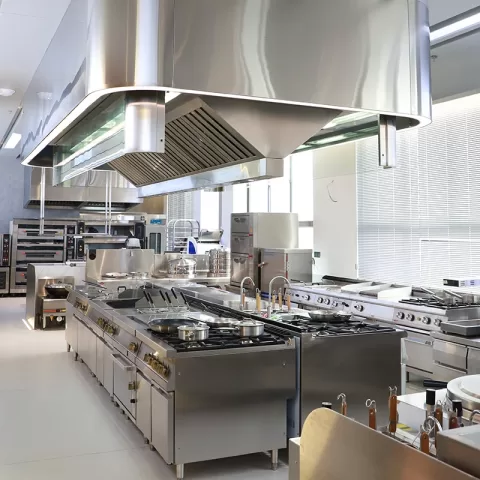
Kitchen lighting is governed by food safety, hygiene, and worker productivity codes. The US Food Code and NSF/ANSI Standard 2 generally require a minimum of 50 foot-candles (approx. 540 lux) on all food preparation, cutting, and cooking surfaces.
- CCT should be specified at 4000K to maintain alert staff and detect food contamination, spoilage, or scorch marks.
- Fixtures must be NSF-certified, vapor-tight, IP65 or higher, and fitted with shatterproof polycarbonate lenses to prevent broken glass contamination in food.
Exterior and Facade
Exterior lighting establishes the transition from the street into the hospitality environment. Use dark-sky compliant downlights to highlight architectural textures, signage, and entry pathways without causing blinding street-side glare. Exterior fixtures must carry an IP65 rating minimum (IP67 for low in-ground walk-over fixtures) to endure rain, power-washing, and temperature cycling.
Commercial Lighting Specifications by Operational Restaurant Zone
The following parameters serve as commercial baseline guidelines for professional lighting layouts:
| Zone / Area | Target Illuminance (Lux) | Main Layer Type | Recommended CCT (Kelvin) | Minimum Color Quality (CRI Ra / R9) | Glare Metric (Target UGR) | Ingress Protection (IP Rating) |
|---|---|---|---|---|---|---|
| Fine Dining Tables | 50 - 120 lx | Task / Accent | 2200K - 2400K | Ra >= 95, R9 >= 80 | UGR <= 10 | IP20 |
| Casual Dining / Bistro Tables | 150 - 250 lx | Ambient / Task | 2700K - 3000K | Ra >= 90, R9 >= 50 | UGR <= 13 | IP20 |
| QSR / Cafeteria Seating | 300 - 450 lx | General Ambient | 3000K - 4000K | Ra >= 85, R9 >= 20 | UGR <= 19 | IP20 |
| Bar Counter (Guest Surface) | 80 - 150 lx | Task / Decorative | 2200K - 2700K | Ra >= 90, R9 >= 50 | UGR <= 13 | IP20 |
| Bar Back-Display (Shelving) | 250 - 450 lx | Vertical Accent | 2400K - 2700K | Ra >= 92, R9 >= 60 | Non-Direct Visual | IP54 |
| Circulation / Egress Corridors | 50 - 100 lx | Ambient / Step | 2700K - 3000K | Ra >= 80, R9 >= 0 | UGR <= 16 | IP20 / IP44 |
| Restrooms (Vanity Area) | 200 - 300 lx | Task / Vertical Flank | 2700K - 3000K | Ra >= 90, R9 >= 60 | UGR <= 16 | IP44 (Zone 2/3) |
| Kitchen / Plating (BOH) | 500 - 750 lx | High-Output Task | 4000K | Ra >= 85, R9 >= 50 | UGR <= 22 | IP65 / NSF Spec |
| Exterior Facade / Entryway | 80 - 200 lx | Architectural Accent | 2700K - 3000K | Ra >= 80, R9 >= 10 | Shielded (Dark-Sky) | IP65 / IP67 |
Color Temperature, Color Rendering, Glare, and Shadow Control
Selecting an attractive fixture housing will not save a space if the photometric engine produces unflattering light. Hospitality spaces require strict control over four variables: correlated color temperature (CCT), color rendering fidelity, optical glare shielding, and beam distribution.
Color Temperature Scale in Hospitality Design:
[ 1800K - 2200K ] Candlelight / Flame  --> Intimate Bars, Fire Pits, Low Accent
[ 2400K - 2700K ] Warm Incandescent   --> Traditional Fine Dining, Lounges, Booths
[ 3000K - 3500K ] Crisp Warm White    --> Fast-Casual, Cafes, Daytime Bistros
[ 4000K +       ] Cool Neutral White  --> BOH Kitchens, Commercial Prep, Cold Pantries
The Kelvin Spectrum in Hospitality
Color temperature sets the psychological warmth of the interior.
- 2200K to 2400K (Candlelight Warmth): Emulates historic gaslight or heavily dimmed incandescent sources. Ideal for cocktail bars, moody dining enclaves, and low-level perimeter coves.
- 2700K (Warm White): The gold standard for casual and fine-dining interiors. Provides comfortable warmth while maintaining crispness on white table linens and tableware.
- 3000K (Crisp Neutral Warm): Best suited for modern quick-service restaurants, contemporary urban cafes, and fast-casual concepts where an energetic, clean atmosphere is desired.
- 3500K to 4000K (Neutral / Cool): Strictly reserved for back-of-house culinary prep, food displays, and service sculleries. Installing 4000K in a front-of-house dining room makes the space look institutional and uninviting.
CRI vs. TM-30 Metrics: Protecting Food Presentation
Never specify lighting fixtures based solely on standard Color Rendering Index (CRI Ra). Standard CRI is an average calculated from only eight pastel test color samples (R1 through R8), completely omitting saturated reds (R9).
Standard CRI (Ra) vs. Hospitality Color Demands:
[ R1-R8 Pastels (Ra Average) ] ---> Insufficient for food accuracy
[ R9 (Saturated Deep Red)    ] ---> Critical for steaks, tuna, berries, wood grain
Target: Ra >= 90, R9 >= 50 (Fine Dining: R9 >= 80)
In food service, R9 is critical: it governs how human eyes perceive rare steaks, seared tuna, wine, ripe produce, tomato sauces, and healthy human skin tones. A fixture with Ra 80 can have an R9 rating near zero, rendering food gray, dull, and unappealing.
For commercial hospitality procurement, demand ANSI/IES TM-30-20 metrics from fixture manufacturers:
- Fidelity Index (Rf): Target Rf >= 90 (measures how closely colors match an ideal reference source across 99 color samples).
- Gamut Index (Rg): Target 98 <= Rg <= 102 (measures color saturation; an Rg below 95 dulls food colors, while an Rg above 105 oversaturates them artificially).
Glare Control: Protecting Seated Patrons
Glare occurs when a light source within the field of view is significantly brighter than the surrounding interior adaptation level. There are two primary forms:
- Discomfort Glare: Causes eye fatigue, headaches, and an instinctual desire to look away.
- Disability Glare: Physically impairs vision through stray light scattering across the cornea.
To control glare, specify recessed architectural downlights with deep-set LED engines providing a physical shielding cut-off angle of at least 30 to 45 degrees. Fixtures should use specular or black micro-baffles, honeycomb louvers, or cross-cube accessories to conceal the diode matrix. In Europe and international projects, keep Unified Glare Rating (UGR) levels below 13 for intimate dining spaces and below 19 for general circulation.
Shielding Angle Engineering:
             [ Ceiling Surface ]
                 /         \
   Baffle Wall  /  Diode    \ Baffle Wall
               /   Engine    \
              /               \
             /--- Shield Angle --\ (>= 30-45 Degrees)
            /                     \
       [ Sightline of Seated Guest ]  <-- Blocked from raw diode emitter
Shadow Engineering
Harsh shadows under guests' brows, noses, and cheekbones (the "skull effect") happen when narrow-beam downlights are placed directly overhead in dining seats.
To eliminate this:
- Cross-aim two lower-intensity accent beams from opposing angles across the table surface.
- Pair overhead directional spots with vertical wall sconces or low-level diffuse lighting to soften directional facial shadows.
- Keep beam angles wider (36 to 50 degrees) over casual seating clusters to ensure consistent ambient overlaps.
Fixture Types and Mounting Decisions
Selecting the right balance between fixed architectural hardware and decorative luminaires directly affects maintenance budgets and floorplan flexibility.
Architectural vs Decorative Fixture Layering:
+-----------------------------------+-----------------------------------+
| Architectural Engine              | Decorative Expression             |
| - High-performance optical control| - Visual anchor and thematic cue  |
| - Deep recess, anti-glare louvers | - Warm secondary light source     |
| - Fixed, track, or linear slot    | - Pendants, sconces, chandeliers  |
+-----------------------------------+-----------------------------------+
Recessed Downlights (Fixed vs. Adjustable)
Recessed downlights are the workhorses of architectural lighting. In restaurant design, fixed downlights should be restricted to general circulation paths. Over dining tables and artwork, always specify adjustable recessed downlights (30-degree tilt, 360-degree rotation) with hot-aiming capabilities. This allows your team to redirect the beam precisely onto the center of the table without opening the ceiling housing.
Track Systems: Flexibility for Dynamic Floorplans
In leased commercial restaurant spaces, table layouts change frequently to accommodate private parties, holiday layouts, and floor plan revisions. Hardwired ceiling cutouts anchor tables to fixed points.
Surface-mounted or suspended architectural track systems (especially 48V low-voltage magnetic tracks) provide exceptional layout flexibility:
- Projectors, pendants, and linear wash modules can be clicked in, clicked out, and slid along the track by floor staff without calling an electrician.
- Fixtures can be re-aimed in minutes whenever table configurations shift.
Pendants and Chandeliers
Pendants create visual rooms within open layouts, establishing intimacy over booths and center banquettes.
- Mounting Height: The bottom lip of suspended dining pendants must hang 30 to 36 inches above the finished tabletop. In circulation walkways, the bottom of any suspended chandelier or fixture must maintain a minimum clear vertical headroom of 84 inches (7 feet) from the finished floor to comply with international building and accessibility codes.
- Diffuser Selection: Avoid fully clear glass pendants with standard LED bulbs; they create high surface luminance that blinds diners. Specify acid-etched, frosted, or shielded metal shades that drive light downward while hiding the diode source.
Linear Cove and Indirect Millwork Lighting
Linear LED extrusions run along banquette toe-kicks, drop ceiling perimeters, and bar facings to add visual depth without contributing to glare.
- Always mount LED flex tape inside rigid anodized aluminum extrusions with frosted PMMA diffusers. The aluminum acts as an essential heat sink, extending diode life, while the diffuser eliminates individual diode reflection spots on shiny flooring or stone counters.
- Specify high-density diode tape (minimum 120 to 240 LEDs per meter) or continuous Chip-on-Board (COB) strips to eliminate pixelation across shallow profiles.
SOURCING AUDIT TIP // DIRECT PROCUREMENT SPECIFICATION
Never install linear strip lighting pointing directly downward at high-gloss polished marble, resin, or granite bar counters. The polished surface acts as a mirror, exposing ugly diode arrays and bouncing direct glare straight into the eyes of seated guests. Always mount the strip aimed sideways against an internal angled reveal or bounce the light upward inside a perimeter cove.
Dimming, Scenes, Controls, and Daylight
A restaurant lighting plan without dynamic controls will fail operationally. An intimate dining scene cannot be set if the floor team can only flick standard on/off rocker switches.
Control Ecosystem Architecture:
[ Daypart Timeclock / Lux Sensor ]
                |
                v
[ Central Lighting Controller ]
    | (0-10V, DALI-2, or Phase Signal)
    +---> Scene 1: Morning Cleaning   (100% Output, 4000K / Bright)
    +---> Scene 2: Lunch Rush         (60% Output, Balanced Daylight)
    +---> Scene 3: Evening Dinner     (25% Output, Warm Accent Focus)
    +---> Scene 4: Late-Night Lounge  (8% Output, Hyper-Moody Intimate)
Control Protocols: DALI-2, 0-10V, Phase, and Wireless
Selecting the right commercial dimming protocol prevents catastrophic flicker, buzzing drivers, and mismatched dimming ranges across different fixture brands:
1. 0-10V Dimming
The dominant commercial protocol in North America. Simple to wire (requires two extra low-voltage control lines). However, most budget 0-10V drivers only dim down to 10% or 5% before abruptly turning off (the "pop-on/pop-off" issue), which is far too bright for an intimate dinner service. Look for "deep-dimming" commercial drivers rated to 0.1% or 1%.
2. DALI-2 (Digital Addressable Lighting Interface)
The global gold standard for complex hospitality spaces. Every fixture or small group carries an individual digital address over a two-wire bus. This allows an operator to re-zone and re-balance light levels via software without rewiring ceilings. DALI-2 delivers smooth logarithmic dimming down to 0.1%.
3. Phase Dimming (Forward/Reverse Phase / ELV)
Common in historic retrofit projects where pulling new control cables through finished plaster or concrete ceilings is cost-prohibitive. Use Reverse Phase (Electronic Low Voltage / ELV) dimming for LED drivers rather than older Forward Phase (TRIAC) dimmers to avoid audible buzzing and driver overheating.
4. Commercial Wireless Mesh (Bluetooth Mesh / Zigbee)
Ideal for historic buildings or low-budget remodels where opening ceiling walls is impossible. Reliable commercial wireless nodes eliminate thousands of dollars in copper cabling and conduit runs.
Dim-to-Warm Technology: Emulating Incandescent Dynamics
Traditional halogen and incandescent bulbs naturally drop down the Kelvin scale as they are dimmed, sliding from 2700K at full output down to 1800K at low output (producing that signature cozy, ember-like glow). Early commercial LEDs dimmed at a static color temperature, turning an unflattering, cold, ashy gray when dialed down to 10% output.
Always specify Dim-to-Warm LED drivers and engines for dining room downlights and decorative pendants. A high-quality dim-to-warm luminaire smoothly scales from 3000K or 2700K at 100% brightness down to 2200K or 1800K at 1%, recreating the warm, relaxing ambiance of candlelight automatically as evening approaches.
Dim-to-Warm Photometric Curve:
100% Power Output  ----->  2700K - 3000K (Bright Lunch Service)
 50% Power Output  ----->  2400K - 2500K (Casual Transition)
 10% Power Output  ----->  2000K - 2200K (Romantic Dinner)
  1% Power Output  ----->  1800K (Candlelight Glow / Late Night)
IEEE 1789 Flicker Compliance
Substandard LED drivers use coarse Pulse Width Modulation (PWM) frequencies below 1,000 Hz to dim fixtures. While guests may not consciously see the flicker, it causes sub-conscious eye fatigue, headaches, and general discomfort that cuts dinner visits short.
Furthermore, poor-quality drivers create severe rolling black lines on guests' smartphone screens when they take food photos for social media. Ensure all specified drivers meet IEEE 1789-2015 "No Effect" or "Low Risk" standards across their full dimming range.
Automated Scene Scheduling and Daylight Integration
Relying on servers, bartenders, or floor managers to adjust dimming sliders mid-shift always leads to mistakes. A busy floor team will forget to set the lights, leaving the dining room flooded with harsh morning lunch levels well into the evening cocktail hour.
Install an automated lighting controller with an astronomical timeclock and daylight photo-sensors:
- Scene 1 (Prep / Cleaning): 06:00 - 10:30. Overhead fixtures at 100% (functional, efficient cleaning illumination).
- Scene 2 (Lunch): 10:30 - 15:00. Pendants and downlights at 50% to 70%, balanced against natural daylight windows.
- Scene 3 (Afternoon Transition): 15:00 - 17:30. Subtle step down to 35% as ambient sunlight fades.
- Scene 4 (Dinner): 17:30 - 22:30. Table accents at 20%, perimeter warm coves active, ambient fields dropped low to isolate dining tables.
- Scene 5 (Late-Night / Bar): 22:30 - Close. General lighting dropped to 5% to 8%, back-bar and millwork features glowing at low levels.
Create Ambiance on a Controlled Budget
Budget-conscious restaurateurs often default to buying discount consumer luminaires from retail home-improvement stores, only to see them fail within 12 months. Designing an impactful, reliable lighting scheme on a tight budget requires smart, value-engineered capital allocation.
CAPEX Strategy: The 70/30 Rule:
[ 70% of Lighting Budget ] ===> High-Impact Guest Touchpoints:
                                - 2-3 Hero Decorative Sculptural Fixtures
                                - High CRI/R9 Table Accent Downlights
                                - Reliable Commercial Control & Dimming Hubs
[ 30% of Lighting Budget ] ===> Concealed Utility & Background:
                                - Standard Recessed Fixture Cans & Channels
                                - Standardized NSF BOH Strip Luminaires
                                - Perimeter Indirect Concealed Linear Strips
The 70/30 Rule: Where to Splurge vs. Where to Save
- Splurge on Table Optics and Statement Decor (70%): Spend on high-CRI (R9 > 50) deep-regressed downlights aimed at tables, high-performance Dim-to-Warm drivers, and two or three signature decorative focal points (such as a dramatic entry chandelier or custom bar pendants). These are the elements that diners interact with and photograph.
- Save on Architectural Backdrops (30%): Use standard industrial surface-mount conduit or commercial extrusion tracks painted black in exposed ceilings rather than expensive custom drywall recessed mud-in channels. Conceal cost-effective, high-density LED flex ribbons behind banquettes and coves instead of buying expensive architectural wall-grazing fixtures.
For broader strategies on making capital allocations go further, explore our comprehensive framework for low-budget restaurant interior design.
Total Cost of Ownership (TCO): Architectural LED vs. Economy Residential Fixtures
Buying cheap fixtures creates a false economy. Commercial restaurant dining rooms run their lighting systems 12 to 18 hours per day, 365 days per year (4,300 to 6,500 run-hours annually). Residential lighting products are engineered for only 2 to 3 hours of intermittent daily use.
5-Year TCO Model: 100-Seat Restaurant (50 Fixtures)
The following financial model compares 50 commercial-grade architectural downlights with integrated deep-dimming drivers against 50 economy-grade residential fixtures fitted with screw-in retrofit LED bulbs:
| Parameter / Cost Factor | Commercial-Grade Architectural LED (50 Fixtures) | Economy Grade / Residential Retrofit (50 Fixtures) | Variance Analysis & Operational Impact |
|---|---|---|---|
| Initial Hardware Procurement Cost | $6,250 ($125 / unit fully assembled) | $1,750 ($35 / unit fixture + bulb) | Economy saves $4,500 upfront CAPEX |
| Expected Operating Lifetime (L70) | 50,000 Operating Hours | 15,000 Operating Hours | Economy degrades 3.3x faster |
| 5-Year Run Hours (14 hrs/day x 365) | 25,550 Run Hours | 25,550 Run Hours | Continuous hospitality commercial duty |
| 5-Year Fixture / Lamp Replacements | 0 replacements (L70 maintained) | 1.7 replacement cycles (85 bulbs) | Economy requires frequent maintenance |
| Replacement Hardware Procurement | $0 (Covered under 5-year warranty) | $850 (Replacement lamps / drivers) | Offsets initial upfront savings |
| Maintenance Labor (Lamp Changes) | $0 (Regular scheduled inspection) | $2,550 (85 service calls @ $30/change) | High cost of table disruption / ladders |
| Energy Consumption (5-Year Total) | $3,832 (10W average draw @ $0.15/kWh) | $5,748 (15W average draw @ $0.15/kWh) | Architectural LED saves $1,916 in utility costs |
| Dimming / Driver Failure Outages | < 2% expected field failure rate | 15% - 25% driver/flicker failure rate | Economy risks dining room dark spots |
| Total 5-Year Lifecycle Cost (TCO) | $10,082 | $10,898 | Commercial LED saves $816 net + zero downtime |
TECHNICAL NOTE // KEY ENGINEERING STANDARD
While economy fixtures appear 72% cheaper during initial purchasing, their early diode degradation, replacement lamp cycles, labor disruptions, driver hum, and higher energy draw completely wipe out the upfront savings within the first three years of daily commercial operation.
Cleaning, Access, Energy, and Replacement Planning
Hospitality environments punish sensitive electronics and optical assemblies. Without practical maintenance planning during the specification phase, lighting designs rapidly degrade into dirty, dim, and broken fixtures.
Environmental Hazard Hierarchy (Dining Room vs. Kitchen):
[ Kitchen / Pass ]   ===> Grease Aerosols + Steam + High Heat -> IP65 / NSF Sealed Polycarbonate
[ Main Dining Room ] ===> Airborne Dust + Lint + Grease Drift -> IP44 Glazed / Accessible Optics
[ Low Base / Coves ] ===> Floor Buffers + Mop Chemicals       -> Heavy Wall Aluminum Track
Airborne Grease and Dust Accumulation
Airborne cooking grease, dishwashing steam, and floor-buffing dust drift throughout the dining room, settling on horizontal surfaces.
- Fixture Optics: Open, exposed downlight cones act as dust traps. Specify sealed optical assemblies fitted with protective glass lenses (IP44 minimum for front-of-house, IP65 for kitchens and open pass areas). Glass can be wiped down during routine cleaning without scratching sensitive micro-reflectors.
- Textile and Rattan Pendants: Woven fabric, paper, or natural wicker shades trap grease vapors, turning gummy, discolored, and impossible to clean. In high-turnover casual dining, choose spun aluminum, powder-coated steel, glass, or sealed synthetic polymer shades that can be sanitized using standard restaurant surface cleaners.
Driver Location and Service Access
LED drivers fail long before the actual LED emitters burn out. Overheated capacitors in enclosed ceiling spaces are the number one cause of flickering or dead lights.
- Remote Driver Enclosures: Avoid ceiling designs that trap individual drivers behind hard, un-cut plaster or sheetrock ceilings. If a driver fails, maintenance workers must cut open the finished ceiling to fix it.
- Central Driver Panels: Specify remote drivers clustered inside an easily accessible, ventilated utility closet or back-of-house electrical room. If a driver fails during dinner service, a technician can replace it in minutes without carrying a ladder onto the active dining floor.
- Clear Ladder Heights: Never install non-accessible downlights directly above fixed banquette seating, built-in booth dividers, or water features unless special access equipment has been planned. Keep overhead fixtures within reach of a standard 8-to-10-foot commercial stepladder operated from clear flat floor surfaces.
Thermal Management and Junction Temperature
High ambient heat is the primary enemy of LED operational longevity. Heat degrades phosphor coatings, causing color shifts (turning warm 2700K into an unattractive green or purple tint) and dropping lumen output.
Ensure all recessed luminaires feature extruded or cold-forged aluminum heat sinks with clear thermal separation between the optical engine and the driver housing. Confirm the fixture's tested operating temperature rating meets or exceeds 40 degrees Celsius (104 degrees Fahrenheit).
Mockup, Photometric, and Supplier RFQ Checklist
Never place a project-wide lighting order based solely on catalog photos. Lighting performance must be calculated digitally and verified through real-world visual mockups before final procurement.
Procurement Progression:
1. Photometric Model (DIALux/Relux) -> Calculate Lux/Foot-Candles & UGR
2. Supplier Engineering RFQ        -> Lock ANSI Bins, Drivers, Dimming Curves
3. Real-World Field Mockup          -> Test Plating, Finishes, Dimming Transitions
4. Factory Acceptance & Inspection  -> Verify Labels, Finishes, Drop Packaging
Digital Photometrics (DIALux or Relux)
Request formal IES or LDT photometric data files from your fixture suppliers. Run these files through lighting simulation software (such as DIALux evo or Relux) to calculate:
- Horizontal illuminance grids across all tabletops.
- Vertical illuminance along feature display walls.
- Point-by-point Unified Glare Ratings (UGR).
- Building energy code compliance (lighting power density limits under ASHRAE 90.1-2022 or California Title 24).
The In-Person Mockup Protocol
Before releasing purchase orders, build a full-scale physical mockup on site or in your design studio:
- Test Real Food and Wine: Set actual menu items (a seared red protein, green leafy vegetables, deep red wine) on your chosen tabletop surface under the test luminaire. Verify that colors look fresh and vibrant under dimmed conditions.
- Test Tabletop Reflections: Place high-gloss plates, silverware, and polished glasses under the fixture. Check whether specular beam reflections create uncomfortable glare spots for diners.
- Test Dimming Curves: Connect the fixture to your specified dimmer and slowly sweep the levels from 100% down to 1%. Check for stepping, sudden drop-offs, audible coil buzz, or visible strobing on a smartphone camera running at 60 fps and 120 fps video modes.
Commercial Lighting RFQ Engineering Checklist
Submit the following technical requirements to your lighting manufacturers and procurement agents to ensure you receive true commercial-grade luminaires:
- [ ] Absolute CCT Tolerance: Demanded within a 2-Step or 3-Step MacAdam Ellipse (SDCM <= 3) to guarantee uniform light color across all fixtures without mismatched yellow/pink hues.
- [ ] Color Quality Baseline: Minimum CRI Ra >= 90, with R9 >= 50 (R9 >= 80 for meat-forward dining or intimate cocktail lounges). TM-30 metrics: Rf >= 90, Rg 98-102.
- [ ] Driver Performance: Universal voltage input (120-277V AC), Power Factor (PF) >= 0.95, Total Harmonic Distortion (THD) <= 15%.
- [ ] Flicker Metrics: Verified compliance with IEEE 1789-2015 "No Effect" performance across the full 0.1% to 100% dimming range.
- [ ] Deep Dimming Capability: Drivers must dim continuously down to <= 1% (0.1% preferred for evening concepts) via 0-10V, DALI-2, or Reverse Phase.
- [ ] Thermal and Lumen Maintenance: Tested to IES LM-79, LM-80, and TM-21 standards with reported L70 fixture life exceeding 50,000 hours at 35 degrees C ambient.
- [ ] Optical Glare Shielding: Regressed diode design with minimum 30-degree physical visual cut-off; optional honey-comb louver or cross-cube attachments specified.
- [ ] Ingress and Food Safety Certification: IP65 rating with NSF/ANSI Standard 2 certifications for all fixtures installed in kitchen prep and plating pass zones.
Common Restaurant Lighting Design Mistakes
Avoid these six costly, recurring design and specification traps:
+------------------------------------+------------------------------------+
| Fatal Design Mistake               | Architectural Solution             |
+------------------------------------+------------------------------------+
| 1. High-Kelvin Institutional Wash  | Lock dining front-of-house to      |
|    (4000K-5000K downlights)        | 2200K-2700K Dim-to-Warm engines    |
+------------------------------------+------------------------------------+
| 2. Direct Overhead Downlights      | Cross-aim spots or add vertical    |
|    (Harsh facial eye-shadows)      | wall sconces to balance the light  |
+------------------------------------+------------------------------------+
| 3. Unshielded Edison Bulbs         | Use frosted glass, micro-louvers,  |
|    (Direct guest-blinding glare)   | or regressed optical shades        |
+------------------------------------+------------------------------------+
| 4. Single-Zone On/Off Switching   | Automate scene controllers across  |
|    (No dynamic daypart shifts)     | minimum 4 scheduled time dayparts  |
+------------------------------------+------------------------------------+
| 5. Specifying Low-CRI (R9 < 0)     | Enforce Ra 90+ and R9 50+ in RFQs  |
|    (Dull, unappetizing food)       | to make meat and produce pop       |
+------------------------------------+------------------------------------+
| 6. Residential Fixtures in BOH/FOH | Install commercial aluminum heat   |
|    (Premature thermal burnouts)    | sinks and deep-dimming drivers     |
+------------------------------------+------------------------------------+
1. The Cafeteria Flush: Over-Illuminating the Dining Room
Flooding an evening dining room with high, uniform light levels ruins intimacy, makes patrons speak louder, and lowers per-check beverage averages. Use pools of light focused on dining tables and artwork while letting circulation floors sit at lower ambient levels.
2. The Raccoon-Eye Effect: Direct Overhead Spots
Placing a narrow 15-degree downlight directly over a diner's chair creates dark, unflattering shadows under their eyes and nose. Always align directional downlights toward the center of the table to highlight the food, and use wall sconces or perimeter lighting to softly illuminate faces.
3. Blinding Bare Filament Bulbs
Exposed decorative filament bulbs look great on design mood boards, but they present severe direct glare when placed at eye level across a booth. If using exposed filament bulbs, run them on dedicated dimming channels dialed down to 10% to 15% brightness so they function as glowing decorative accents rather than harsh light sources.
4. Color Temperature Clashes
Mixing conflicting color temperatures in the same visual plane (such as a 4000K downlight shining next to a 2400K wall sconce) makes the ceiling look messy and visually chaotic. Keep the entire front-of-house within a tight CCT range (for example, 2400K to 2700K), saving 4000K exclusively for behind the kitchen doors.
5. Manual Switch Flipping
Expecting floor managers to manually balance multiple dimming knobs throughout a busy service shift never works. Automate your daypart scenes using an astronomical timeclock controller to ensure smooth, invisible transitions.
6. Installing Residential Fixtures on Commercial Duty Cycles
Residential-grade luminaires from retail hardware stores are not engineered to run 14 hours every day surrounded by dining room dust and kitchen grease. Their thin plastic housings crack, drivers flicker, and color temperatures drift within months. Always invest in commercial-grade fixtures with proper thermal heat sinks and replaceable drivers.
Commercial Procurement and Logistics with Ron Group
Navigating commercial lighting specifications, custom decorative fabrications, photometric modeling, and international logistics requires an experienced supply chain partner. Ron Group supports hospitality operators, interior design firms, and general contractors worldwide with complete commercial lighting and FF&E solutions.
Ron Group Direct-to-Factory Procurement Flow:
[ Design & Photometrics ] -> IES Simulation, Material Matching, 3D Review
           |
[ Factory Production ] ----> Strict Quality Control (SDCM < 3, Ra > 90, IEEE 1789)
           |
[ Packaging & Crating ] ---> Drop-Tested Foam Enclosures, Export Palletization
           |
[ Global Freight Engine ] -> FCL Sealed Containers / DDP Transparent Port Logistics
Direct-from-Factory Hospitality Manufacturing
Ron Group eliminates the expensive markups of multi-tiered domestic lighting distributors by connecting you directly with our specialized hospitality manufacturing lines:
- Custom Decorative Fabrication: We manufacture custom oversized dining chandeliers, metal spun pendants, woven acoustic lighting, and cast-brass wall sconces tailored precisely to your brand's aesthetic requirements.
- Architectural Downlight Engines: Our fixtures are built around reliable Cree, Citizen, and Bridgelux COB diode engines, paired with architectural deep-recess anti-glare louvers and certified deep-dimming drivers (DALI-2, 0-10V, and Phase).
- Color Consistency Guarantee: We enforce strict binning standards (SDCM < 3) across all delivered lighting fixtures to guarantee uniform color temperature throughout your property.
Professional Photometric Layout and Sampling Support
We take the guesswork out of lighting procurement:
- Our engineering team provides comprehensive DIALux photometric simulations based on your architectural CAD plans, giving you verified foot-candle calculations, beam overlaps, and energy densities before production begins.
- We supply fully operational, pre-wired luminaire samples for physical on-site mockups, allowing you to test plating, table finishes, and dimming curves before releasing mass production orders.
Transparent B2B Global Logistics
Moving delicate architectural glass, custom metal chandeliers, and precision lighting fixtures across international borders demands strict logistics management:
- High-Volume Full Container Loads (FCL): Containerized shipments are packed, palletized, and sealed directly at the factory floor, minimizing transit handling and eliminating third-party transfer damage.
- Consolidated Less-Than-Container Loads (LCL): For smaller fit-outs, we consolidate lighting packages with your broader furniture, fixture, and equipment (FF&E) orders inside our export consolidation warehouses, avoiding predatory destination-port charges associated with standard CIF shipping terms.
- Transparent Delivery Terms: We quote transparent Delivered Duty Paid (DDP) terms straight to your job-site curb or loading dock, or coordinate directly with your designated freight forwarder under FOB or EXW terms.
TECHNICAL NOTE // KEY ENGINEERING STANDARD
Ron Group provides professional commercial freight delivery directly to your facility loading dock or curbside staging area. In accordance with standard international commercial B2B freight protocols, shipments do not include residential white-glove uncrating, room-of-choice placement, or driver carry up internal stairs. Contractors must arrange their own on-site installation crews to transport crates from the staging dock into the building.
To review your lighting layout, request photometric verification, or quote commercial lighting packages for your upcoming hospitality project, connect with our engineering team at Ron Group Global.
Commercial Procurement & Specification Benchmark
| Specification Category | Budget / Residential Grade | Heavy Commercial Grade (Ron Group Standard) | Compliance & Test Verification |
|---|---|---|---|
| Structural Material | Thin gauge 430 stainless / laminated particle board | 16-18 Gauge 304 Stainless Steel / Solid Hardwood Core | NSF/ANSI Standard 2 / ANSI/BIFMA X5.5 |
| Operational Duty Cycle | 2-4 hours intermittent | 18-24 hours continuous commercial turnover | UL Commercial / CE / ETL Sanitation Certified |
| Thermal / Mechanical Tolerance | Rapid fatigue after 6-12 months | 5-10 year commercial design lifespan | High thermal shock resistance (180 deg C delta) |
| 5-Year Total Cost of Ownership | High (frequent breakdown & replacement) | 35-45% lower net amortized TCO | Fully warrantied commercial supply chain |
Get the week's latest industry information
-
Real-Life Professional Restaurant Case Studies
Explore Now
-
Create a unique restaurant with over 95,700+products
Explore Now
-
Protessional Free 3D Restaurant Design
Explore Now
-
Still Have Questions About Opening a Restaurant?
Explore Now

Sylvia
With 8 years in catering & hospitality industry, sales manager of Ron Group, specialise in providing one stop solutions to restaurants, hotels and weddings.
Discover Our Exclusive Products
Explore our extensive range of restaurant and hotel supplies designed to enhance your operations. Find the perfect solutions to meet your needs.
Browse Our ProductsFREE 3D DESIGN
Boost your restaurant's success with our free 3D design service. Start building the restaurant of your dreams today!
Explore 3D Design Case
RECOMMENDED CASES
-
La Rambla by Catalunya: Crafting Barcelona's Soul in Hong Kong - Custom Furniture Excellence
RON Group's custom Spanish-inspired furniture elevates La Rambla with artisanal aesthetics...
Learn More -
Cardinal Point: Elevating Outdoor Seating with Tailored Cushion Upgrades
Discover how Cardinal Point transformed its outdoor dining experience with custom cushions, achievin
Learn More
RECOMMENDED BLOGS
-
Bar Glassware 101: Types, Names, Uses, and How to Stock Your Bar
Learn the 10 core bar glassware types, names, and uses. Discover how to stock your bar with the right glasses for cocktails, beer,...
Sylvia2026-07-26 -
Complete Bar Equipment List for Opening a Bar
Plan a complete commercial bar equipment list by menu, service volume, refrigeration, ice, glassware, utilities, sanitation,...
Sylvia2026-06-11 -
Low Budget Restaurant Interior Design: 2026 Trends
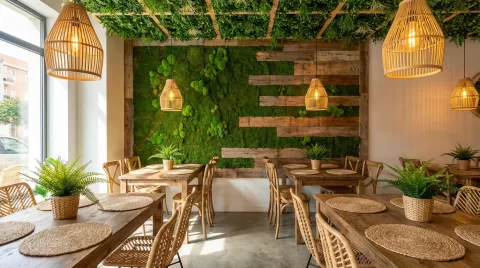
Prioritize a low-budget restaurant interior by protecting code, operations, durability, accessibility, and phased design decisions...
Sylvia2026-04-04
Subscribe to RON GROUP
Stay up-to-date with the latest industry insights and expert advice. Together, we'll create your ideal restaurant.