
Content
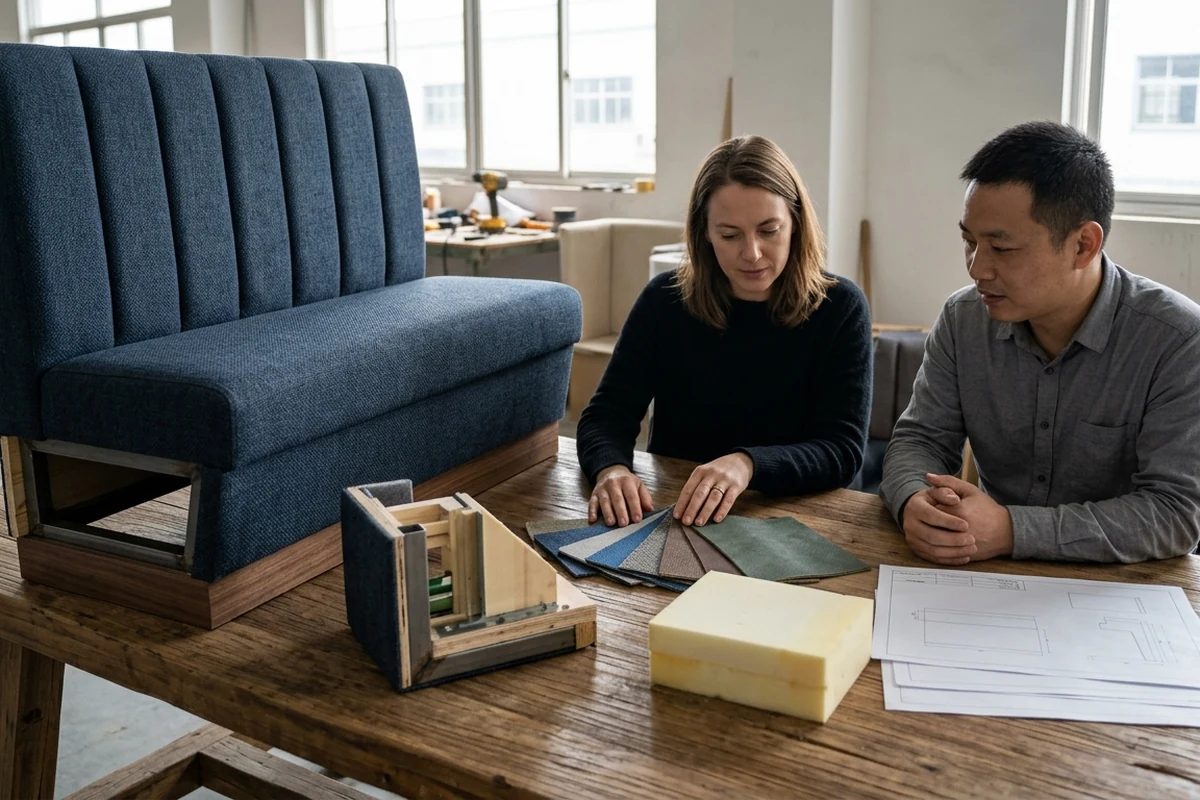
Restaurant booth manufacturers in China should be evaluated through a production release file, not only through upholstery photos or a low unit price. Booth seating is tied to floor plans, aisle assumptions, upholstery selection, frame construction, foam or fill route, packing dimensions, and site installation sequence.
The right shortlist question is practical: can this manufacturer convert booth drawings, samples, and site constraints into controlled production records before the buyer releases the order?
Start With the Booth Type and Site Constraint
A booth manufacturer cannot quote accurately from a mood image. The buyer should describe the booth type, dimensions to be confirmed, site condition, upholstery direction, frame or base preference, and whether the booth is loose, wall-backed, or built into a millwork package.
| Booth scope | Evidence to request | Why it matters |
|---|---|---|
| Single or double booth | Dimensioned drawing response and frame route | Controls repetition across a dining room |
| L-shaped or corner booth | Plan-view drawing and site interface questions | Prevents corner gaps and installation surprises |
| Channel-tufted booth | Upholstery sample and stitching detail | Controls visual alignment and labor expectations |
| Loose banquette | Base, glide, or fixing method | Affects movement, cleaning, and maintenance |
| Wall-backed booth | Wall condition and installation responsibility | Separates furniture supply from site works |
RON GROUP's restaurant furniture category can support the product-scope discussion. RON GROUP's furniture production capabilities can frame sample, production, quality, and packing questions.
This first file should also state what the booth manufacturer is not responsible for. Site floor leveling, wall blocking, electrical work, millwork interfaces, and final installation may sit outside the furniture supplier's scope. If those boundaries are unclear, the booth maker may quote a product that cannot be installed cleanly, while the contractor assumes the furniture supplier solved site issues. Put open site conditions in the release file before price approval.
For restaurants with tight aisles or mixed table types, ask the supplier to mark the dimensions that must be confirmed by the buyer. Seat depth, back angle, base toe-kick, and overall footprint affect comfort and circulation. A supplier that never asks these questions may still produce an attractive booth, but it may not fit the dining layout.
Require a Drawing and Sample Control File
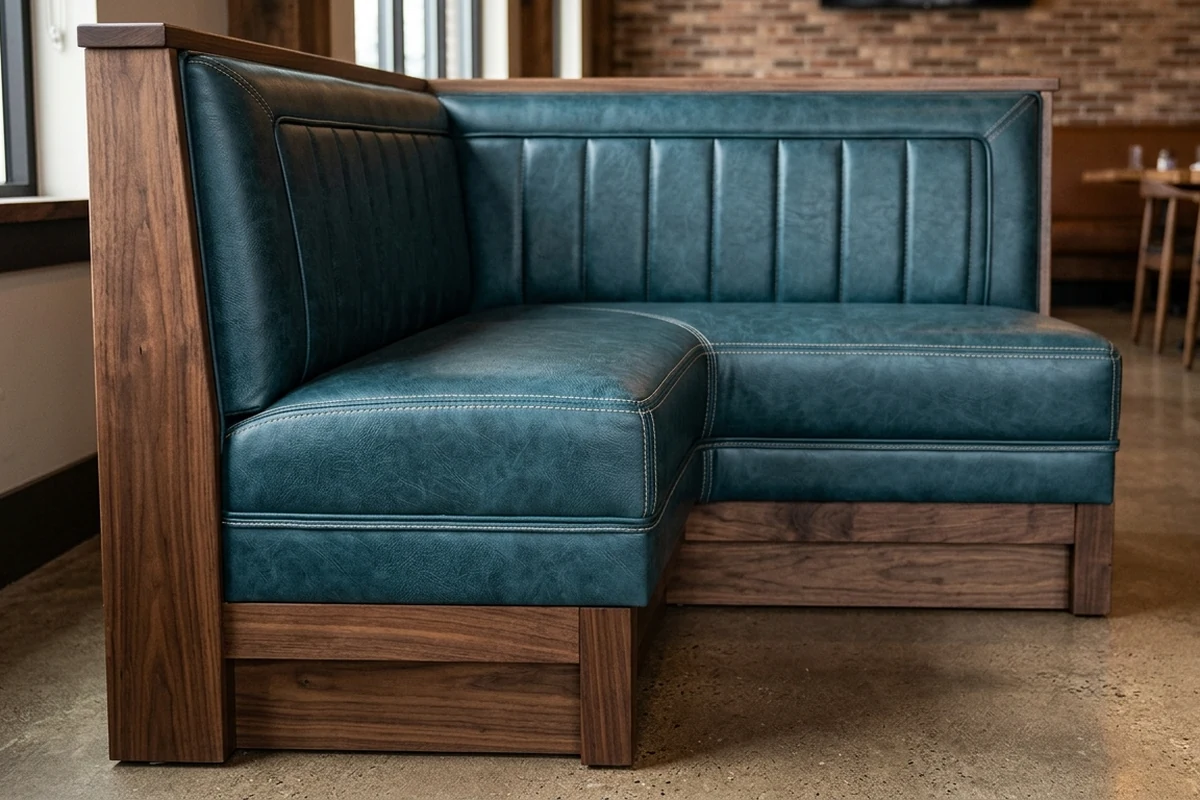
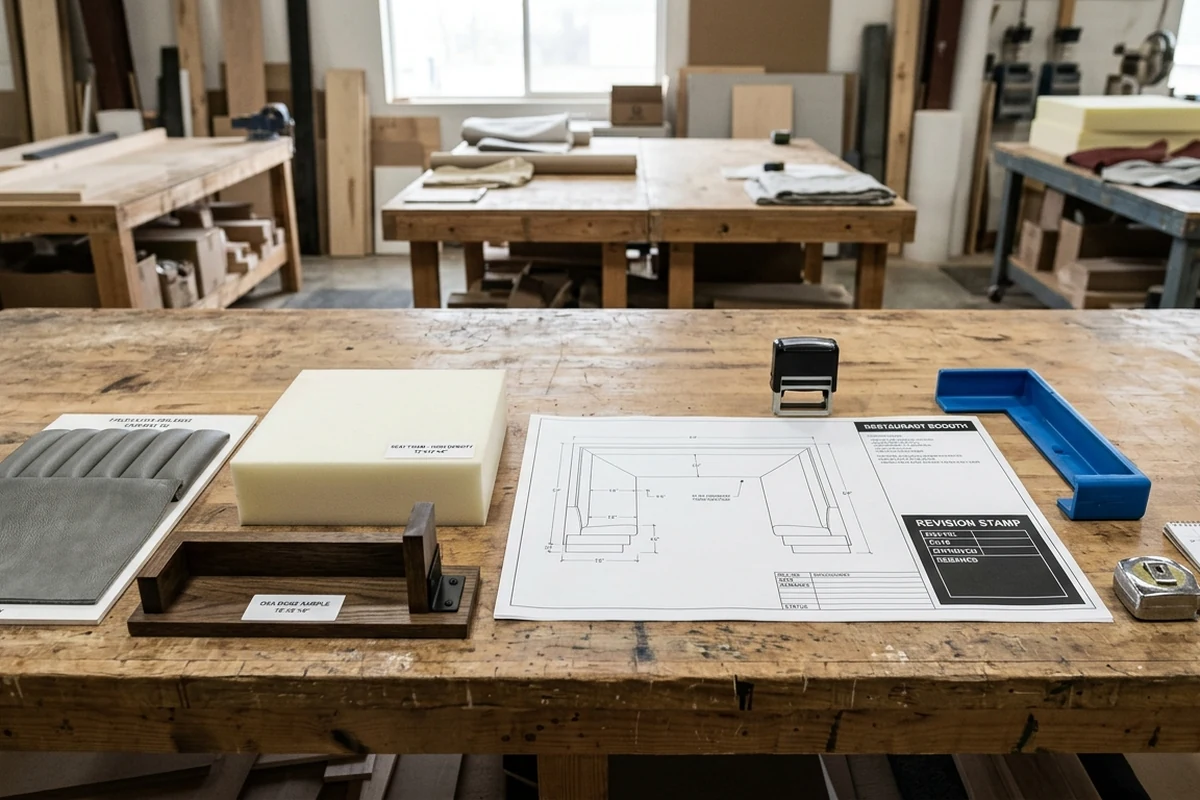
A booth supplier should not move into production from a photo and a price. Ask for a release file that ties drawings, upholstery, foam, frame, dimensions, and packing to the same item code.
The release file should include:
booth item code and restaurant zone;
plan-view and elevation drawing reference;
width, depth, back height, seat height, and base assumption to be confirmed by project drawings;
upholstery sample code and approval date;
stitching, channel, seam, or piping detail when relevant;
frame and base route;
foam or fill specification route;
accepted deviations;
carton label and packing note;
installation or site responsibility boundary.
Do not treat generated or showroom images as proof of dimensions, clearance, construction, or commercial suitability. They are only visual references.
The file should freeze one version of each decision before production. If the designer changes channel width, the operator changes vinyl color, and the site team changes booth length, the supplier needs a single final instruction. Version control is not bureaucracy here; it prevents expensive mismatches across repeated booth units.
Ask for one annotated drawing response before final quote. The supplier should mark accepted dimensions, open dimensions, construction assumptions, upholstery direction, and packing constraints. A quote that arrives without a drawing response can still be useful for early budgeting, but it should not be treated as production-ready.
Evaluate Manufacturing Capability by Evidence Level
The International Trade Administration's due-diligence guidance supports evaluating potential business partners before commitments. For China booth manufacturers, due diligence should connect directly to production control.
| Evidence level | Booth example | Buyer action |
|---|---|---|
| Claim only | "We make restaurant booths" | Keep in early discovery only |
| Sample document | Blank inspection template or upholstery approval sheet | Use for process discussion |
| Comparable record | Redacted booth drawing, sample record, packing photo, or inspection note | Use for shortlist comparison |
| Buyer-verifiable record | Current project sample, signed drawing, test report, or certificate when claimed | Stronger evidence before production release |
If a supplier references BIFMA or another standard, ask for the exact standard, item, test report, date, and scope. Do not generalize a standard reference to every booth design.
Manufacturing evidence should include the points where errors are likely to happen. For booth seating, those points are usually frame dimensions, upholstery cutting, stitching alignment, foam or fill consistency, base detail, and packing protection. A general factory tour video is weaker than a small set of records that show how a similar booth was controlled.
If the booth has repeating channels or panels, ask how the supplier keeps alignment consistent across units. If the booth uses a custom curve or corner, ask what template or drawing controls the shape. If the booth uses multiple upholstery materials, ask how the material direction and batch are recorded. These questions are practical signals of production discipline.
Check China Supplier Identity and Screening
A booth manufacturer may work through a sales company, factory, exporter, or furniture project coordinator. Before sending full restaurant drawings, map the counterparty.
| Identity item | What to clarify |
|---|---|
| Contracting entity | Who signs and takes responsibility |
| Payee | Whether payment entity matches the commercial route |
| Factory or coordinator role | Who controls sample, production, and inspection records |
| Export document owner | Who prepares invoice, packing list, and carton marks |
| File owner | Who receives drawings, finish boards, and revision approvals |
The ITA Consolidated Screening List can be used as part of restricted-party screening. It is not a supplier approval. It is one tool in a broader commercial review.
Run the identity check before full restaurant drawings are released. Share enough information for the supplier to understand the category, quantity range, destination, and quality expectation, but keep final plans, finish boards, and value engineering details until the commercial route is clear. If the supplier refuses to identify the contracting party, payment route, or document owner, the buyer should pause even if the sample photos look strong.
For export projects, ask who will prepare the commercial invoice, packing list, and carton marks. Booth shipments can include large pieces, separate bases, hardware, replacement material, or mixed booth types. If the document owner cannot link each carton to the release file, receiving becomes harder and claim resolution becomes slower.
Compare Manufacturers by Release Readiness
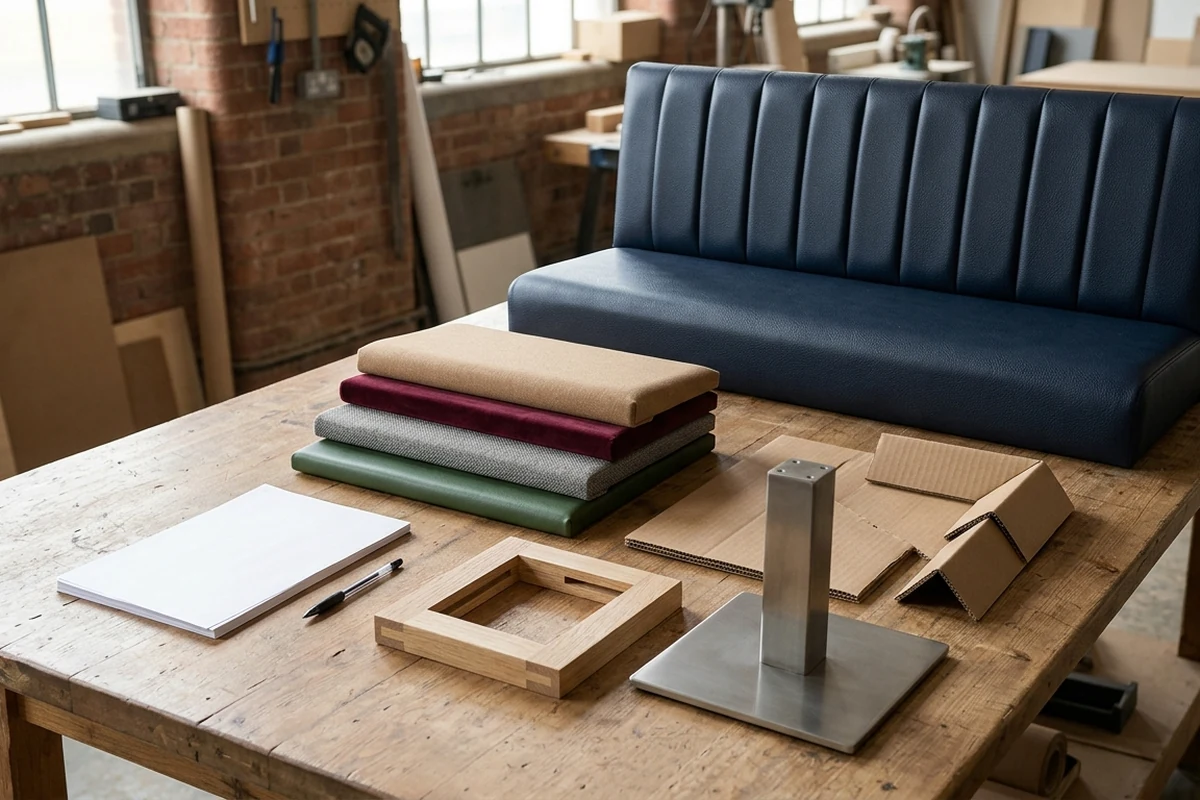
A booth supplier is release-ready when it can answer technical, sample, production, packing, and responsibility questions in one file.
| Review area | Weak response | Release-ready response |
|---|---|---|
| Drawing | Uses reference photos only | Marks dimensions, open questions, and site boundaries |
| Upholstery | Offers broad material names | Names sample code, finish, seam, and approval status |
| Construction | Says frame is strong | Explains frame route and inspection point without unsupported claims |
| Packing | Says export packing is standard | Shows carton labels, protection method, and item-code link |
| Communication | Uses scattered messages | Names one owner for drawings, samples, and revisions |
The buyer should pause a supplier that cannot connect drawings, samples, packing, and production notes. That supplier may still be useful for price discovery, but not for production release.
Use a staged release decision:
| Stage | Supplier can receive | Release condition |
|---|---|---|
| Discovery | Category, quantity range, destination region | Basic identity and capability response |
| Budget quote | Reference photos, approximate dimensions, upholstery direction | Supplier states assumptions and exclusions |
| Sample stage | Detailed upholstery, drawing, and construction target | Sample owner and revision log are named |
| Production release | Final drawings, final sample code, packing requirement | Release file is complete and approved |
This staged approach reduces the chance that a low early quote becomes an uncontrolled production order. It also gives the buyer a fair way to compare suppliers: not only by price, but by how quickly they can remove uncertainty.
What to Send for a Booth Supplier Review
Relevant restaurant and hospitality project examples can support context, but current booth drawings and samples should drive the decision. When ready, request a booth supplier review with booth types, quantities, restaurant floor plan, target upholstery, finish direction, sample needs, packing concerns, destination context, and open site constraints.
The review request should include the decision deadline and the current risk list. For example, note whether the buyer is still choosing upholstery, confirming wall dimensions, deciding between loose and fixed booths, or waiting for import document review. A supplier can then answer the real project questions instead of sending a generic booth catalog.
If the goal is a multi-store rollout, ask how the supplier will preserve the approved booth file for reorders. The first order may be managed by close attention. The second or third order depends on whether item codes, upholstery references, drawings, and packing instructions remain traceable.
Sources and Further Reading
RON GROUP Restaurant Furniture supports restaurant booth and furniture product-scope context.
RON GROUP Factory Showcase supports production, sample, quality, packing, and communication context.
International Trade Administration due-diligence guidance supports business-partner due diligence.
BIFMA Standards Overview supports asking for precise commercial furniture standard and test-report evidence when relevant.
ITA Consolidated Screening List supports restricted-party screening workflow context.
Get the week's latest industry information
-
Real-Life Professional Restaurant Case Studies
Explore Now
-
Create a unique restaurant with over 95,700+products
Explore Now
-
Protessional Free 3D Restaurant Design
Explore Now
-
Still Have Questions About Opening a Restaurant?
Explore Now

Sylvia
With 8 years in catering & hospitality industry, sales manager of Ron Group, specialise in providing one stop solutions to restaurants, hotels and weddings.
Discover Our Exclusive Products
Explore our extensive range of restaurant and hotel supplies designed to enhance your operations. Find the perfect solutions to meet your needs.
Browse Our ProductsFREE 3D DESIGN
Boost your restaurant's success with our free 3D design service. Start building the restaurant of your dreams today!
Explore 3D Design Case
RECOMMENDED CASES
-

La Rambla by Catalunya: Crafting Barcelona's Soul in Hong Kong - Custom Furniture Excellence
RON Group's custom Spanish-inspired furniture elevates La Rambla with artisanal aesthetics...
Learn More -

Cardinal Point: Elevating Outdoor Seating with Tailored Cushion Upgrades
Discover how Cardinal Point transformed its outdoor dining experience with custom cushions, achievin
Learn More
RECOMMENDED BLOGS
-
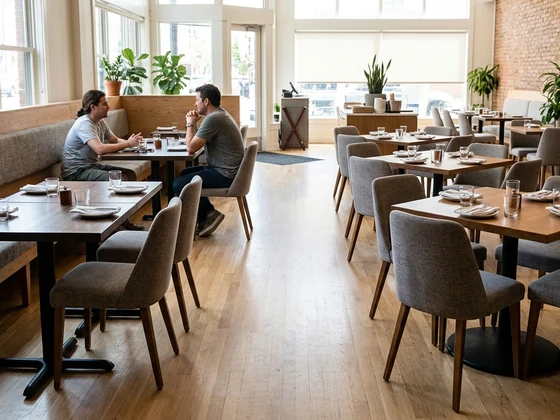
Restaurant Table Spacing and Aisle Clearance: Supplier Drawing Checklist
Check restaurant table spacing, aisle clearance, chair pullout, service path, and supplier drawing proof before approving a...
Sylvia2026-07-20 -

5 Mistakes to Avoid When Buying Restaurant Furniture from China
Don't fall for costly oversights! Learn the 5 mistakes to avoid when buying restaurant furniture from China and ensure a...
 Ron2025-01-079 min read
 -

RON GROUP Launches VR Experience to Explore Our Dynamic Showroom
Discover RON GROUP's VR showroom! Explore dining furniture, tableware, and customized services virtually or visit us in person to...
Sylvia2024-12-163 min read
Subscribe to RON GROUP
Stay up-to-date with the latest industry insights and expert advice. Together, we'll create your ideal restaurant.