
Content
Outdoor restaurant furniture procurement should start with the outdoor conditions the furniture must survive, not with a catalog style. A patio set that works under a covered urban canopy may fail on an open coastal terrace, and a stackable chair that looks convenient in a sample photo may become a daily handling problem if staff have nowhere dry to store it. The buyer's job is to turn weather, cleaning, storage, accessibility review, and replacement needs into a supplier-ready specification before final pricing.

Direct answer
The best way to buy outdoor restaurant furniture is to map each dining zone by exposure, then choose materials, frame details, stacking rules, cleaning methods, and replacement plans for that exact zone. Treat "outdoor" as a starting label, not as proof that the table, chair, fastener, finish, cushion, or tabletop is suitable for sun, rain, humidity, salt air, wind, staff handling, and site storage. For United States projects, use U.S. Access Board and ADA National Network material as accessibility context for outdoor dining routes and accessible dining surfaces, then confirm local and project-specific requirements separately. Use ANSI/BIFMA standards references as prompts for supplier evidence where relevant, but do not claim compliance until the supplier provides product-specific documentation. A purchase order is ready only when the exposure map, samples, drawings, cleaning notes, storage plan, packing labels, and replacement route all match the same outdoor furniture schedule.
Build the exposure map before selecting products
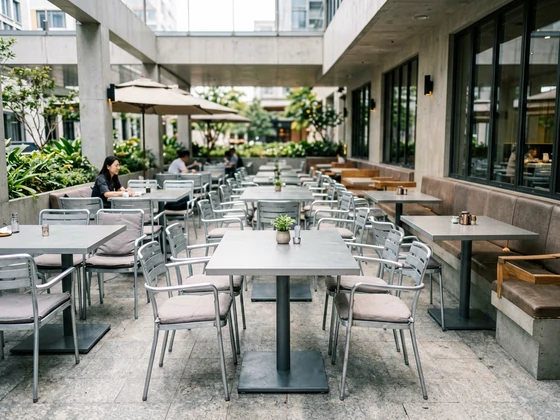
Outdoor restaurant furniture often fails in the gap between design approval and daily operations. The designer approves a look, the operator expects quick cleaning and stacking, procurement compares prices, and the supplier quotes "outdoor use" without knowing whether the furniture will sit in direct sun, under a roof, near planters, close to cooking exhaust, or beside a windy sidewalk. Start by dividing the outdoor area into exposure zones.
An exposure zone can be a street-side dining strip, an open terrace, a covered patio, a rooftop bar, a poolside restaurant, a garden courtyard, or a seasonal pop-up deck. Each zone should record confirmed facts and open questions. If the buyer does not know whether furniture will be moved indoors every night, mark that as an operations decision. If rainwater can collect under seats or table bases, mark it as a drainage review item. If salt air is possible, ask the supplier to describe frame, hardware, fastener, and finish assumptions without turning that answer into a blanket corrosion guarantee.
| Outdoor exposure zone | Main condition to map | Procurement decision | Supplier evidence to request | Release boundary |
|---|---|---|---|---|
| Covered patio | Indirect sun, occasional rain, cleaning splash | Balance comfort, finish consistency, and easy cleaning | Material swatches, frame finish sample, cleaning instruction | Release after samples and cleaning route are approved |
| Open terrace | Direct sun, rain, drainage, staff handling | Prioritize drainage, surface heat review, and stable storage | Detail photos, material declaration, stack or cover instructions | Do not release from catalog images only |
| Coastal or humid site | Humidity, salt air, hardware exposure | Review frame, fastener, edge, and finish assumptions | Hardware description, finish sample, maintenance note | Keep supplier claims tied to project evidence |
| Wind-prone street dining | Wind, sidewalk movement, public route limits | Confirm furniture weight, movement plan, and storage rules | Handling instruction, stacking method, layout note | Assign operations owner before purchase order |
| Seasonal deck or rooftop | Delivery access, off-season storage, replacement | Specify modular packing, labels, and replacement path | Packing plan, carton label, spare-part route | Block release until receiving and storage are defined |
This table is the first decision tool. It keeps outdoor restaurant furniture procurement focused on exposure and operations, not on a broad indoor dining-room logic. It also gives every supplier the same starting point, which makes quotes more comparable.
Choose material systems by exposure, not by one material name
The question is not whether aluminum, steel, wood, laminate, plastic, rope, wicker, upholstery, or stone is "best." The better question is which material system fits the exact outdoor exposure, cleaning method, storage habit, brand expectation, and replacement cycle. A chair frame, seat surface, tabletop edge, glide, screw, cushion, and carton label are all part of the system.
Use RON GROUP's restaurant furniture category as product-scope context, then narrow the discussion to commercial restaurant tables, commercial restaurant chairs, and the outdoor dining schedule. Category pages show what may be sourced. They do not replace exposure-specific samples, shop drawings, and supplier documentation.
| Material or component decision | Good procurement use case | Main outdoor risk to test | Evidence to request before approval |
|---|---|---|---|
| Metal frame and hardware | High-turnover patios, stackable chairs, lightweight tables | Finish wear, hardware exposure, foot or glide damage | Frame sample, fastener description, detail photos, cleaning note |
| Timber, wood-look, or composite surface | Warm brand tone for terraces or garden dining | Edge exposure, color shift, standing water, touch-up route | Surface sample, edge detail, maintenance instruction, replacement route |
| Compact laminate or outdoor-grade tabletop proposal | Dining tables that need repeatable cleaning | Edge sealing, corner impact, heat and cleaning response | Tabletop sample, edge photo, supplier material sheet |
| Upholstery, cushion, rope, or woven element | Lounge-style outdoor restaurants or covered patios | Drying time, staining, seam detail, off-season storage | Swatch, seam photo, backing detail, cleaning compatibility note |
| Plastic, resin, or molded shell | Casual concepts, poolside, seasonal seating | Surface scratching, fading, stacking scuff, guest comfort | Physical sample, stack photo, cleaning and replacement method |
| Feet, glides, levelers, and bases | Uneven pavement, deck boards, rooftop floors | Floor damage, wobble, water collection, lost parts | Base detail drawing, spare part route, receiving checklist |
Use the BIFMA standards descriptions as standards-awareness context when a supplier references commercial furniture standards. The source helps procurement ask better questions. It does not prove that a quoted outdoor chair or table complies. Product-specific evidence must come from the supplier submittal.
Plan wind, rain, sun, salt, stacking, and storage together
Outdoor furniture is operational equipment. Staff move it, wash around it, stack it, cover it, replace parts, and sometimes store it quickly before weather changes. A strong procurement package does not separate material choice from operations.
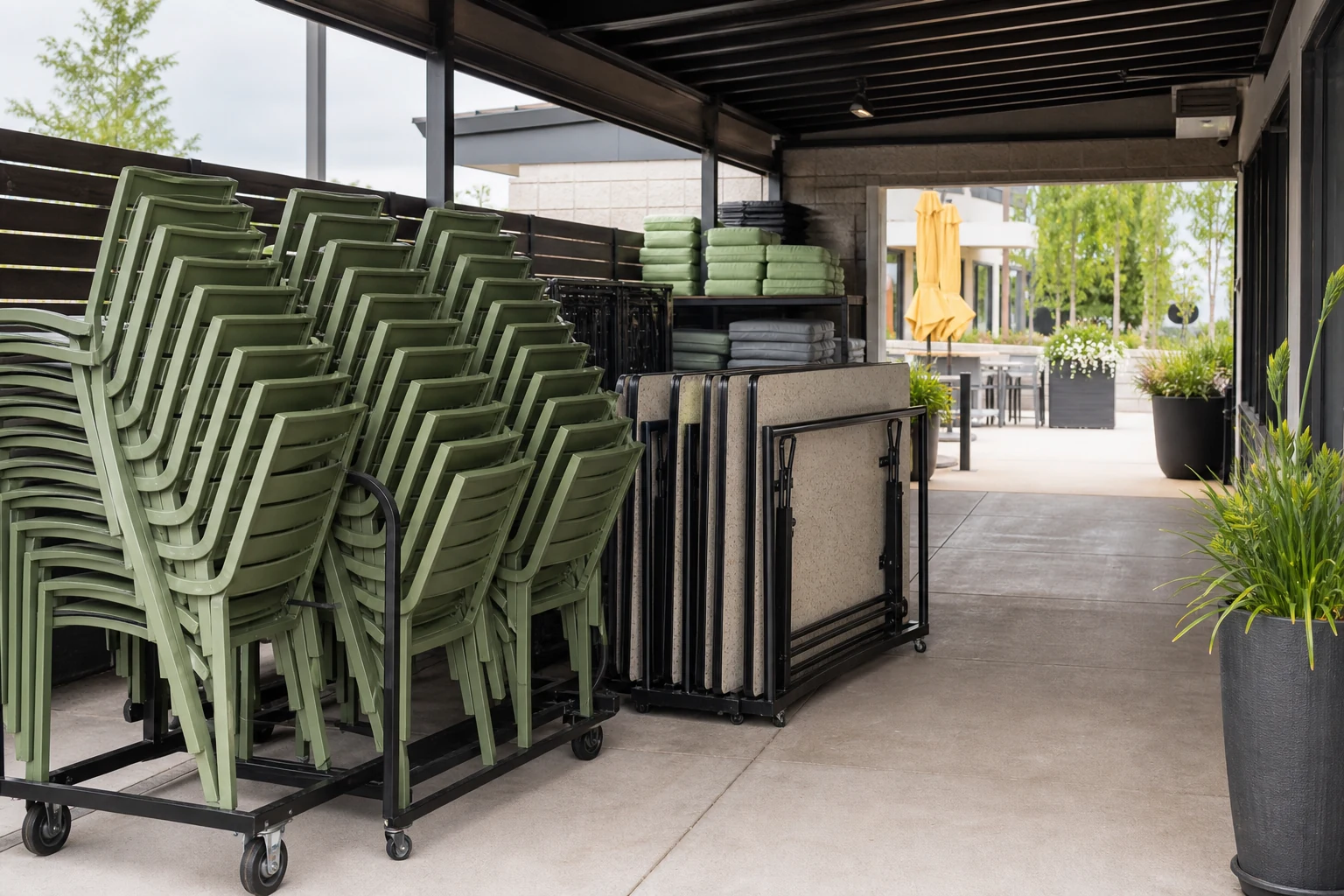
For rain and drainage, ask where water can sit: on seat pans, inside woven details, around tabletop edges, under bases, inside tube ends, or near feet. For sun and heat, request finish and surface samples, then review comfort and color expectations with operations and design. For salt air or humidity, ask for frame, fastener, and maintenance assumptions in writing. For wind, avoid a vague "stable enough" conversation. Ask how staff will position, move, stack, or secure the furniture under the site's actual operating rules. For storage, identify where stacked chairs, loose cushions, covers, spare tables, and replacement parts will go during daily close, storm preparation, and off-season periods.
The supplier should not be asked to make legal or site-safety decisions in isolation. In US outdoor dining and sidewalk contexts, the U.S. Access Board ADA Standards, Chapter 2 scoping requirements, and ADA National Network guidance on accessibility of sidewalk spaces provide accessibility context. The project team still needs local, fire, health, landlord, brand, and site-specific review.
Procurement risk scenarios to resolve before deposit
Risk scenario 1: the patio is priced as one zone. The supplier quotes the same chair, table, and finish for covered seats, uncovered seats, and the street edge. The project later discovers that one zone needs a different storage method, base detail, or material response. Fix this by issuing an exposure map with zone labels before final quotation.
Risk scenario 2: the furniture is "outdoor" but not operationally maintainable. A sample can be suitable for outdoor presentation yet still be hard to clean, slow to dry, difficult to stack, or fragile when staff move it daily. Fix this by requiring cleaning instructions, handling guidance, stack photos, and replacement routes in the supplier response.
Risk scenario 3: wind and public-space rules appear after purchase. Outdoor dining on sidewalks, rooftops, decks, or open terraces can involve route, movement, storage, and site authority questions. Fix this by assigning wind, layout, and accessibility review owners before deposit, and by asking the supplier for drawings and handling evidence rather than legal conclusions.
Risk scenario 4: salt air or humidity assumptions are hidden. The buyer assumes the hardware, frame, and finish are suitable for the site, while the supplier assumes ordinary outdoor conditions. Fix this by asking suppliers to state frame, fastener, finish, edge, and maintenance assumptions by zone.
Risk scenario 5: seasonal storage is missing from the quote. Furniture arrives ready for opening day but has no carton label logic, cover plan, off-season storage method, or spare-part route. Fix this by requiring packing labels, storage instructions, and replacement planning before release.
Risk scenario 6: sample approval does not connect to production. A tabletop, chair frame, rope color, or cushion fabric is approved in isolation, but the purchase order does not reference sample code, revision, or accepted deviation. Fix this by keeping a sample log with item code, zone, date, approver, retained sample owner, and production release status.
Supplier evidence checklist for outdoor restaurant furniture
Ask suppliers to respond with evidence that matches the exposure map. The list should be practical enough for procurement to compare across bidders and strict enough to prevent vague "outdoor use" promises.
Zone-by-zone furniture schedule with item code, quantity, destination, exposure note, and approval status.
Material declaration for frame, tabletop, seat surface, woven element, cushion, hardware, feet, and glides.
Physical samples for tabletop, frame finish, chair shell or seat surface, upholstery or rope, and key hardware finish.
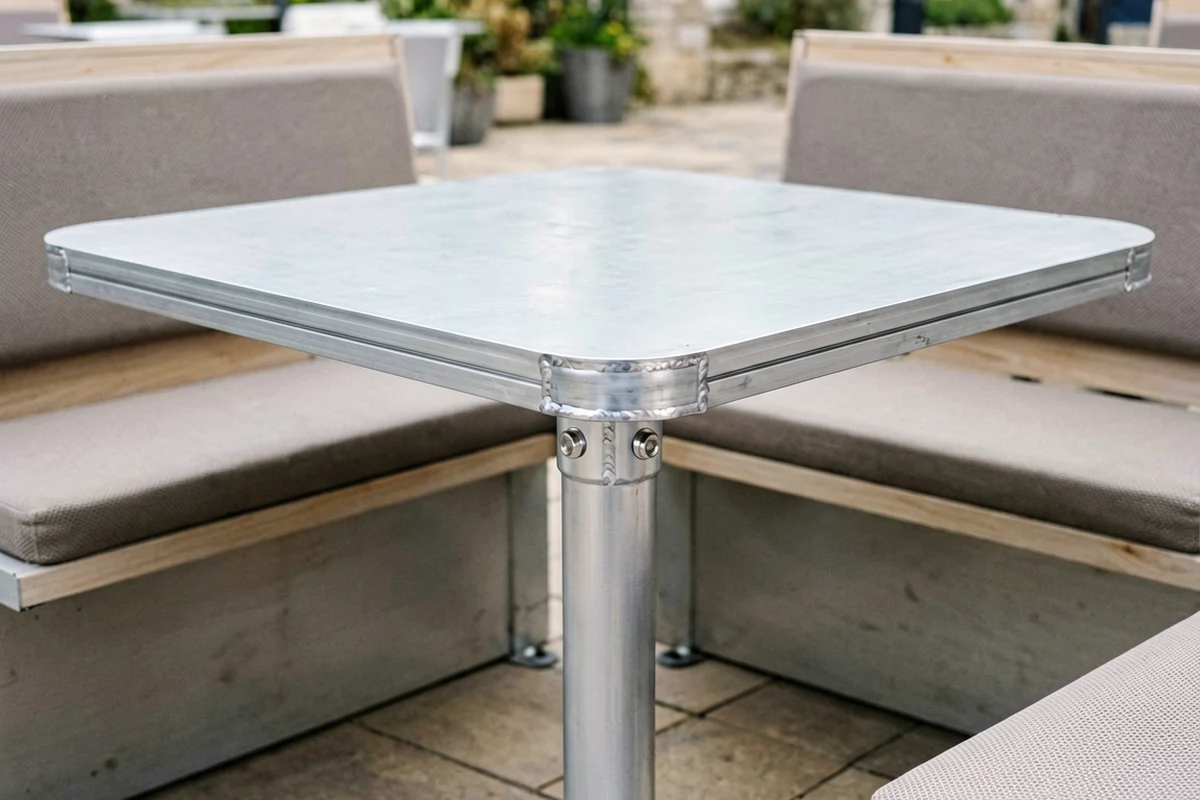
Detail photos or drawings showing water-shedding points, tube ends, edges, fasteners, feet, bases, and stacking contact points.
Cleaning and maintenance instructions matched to each material system.
Supplier note on relevant standards or product-specific test evidence where standards are claimed or required.
Stack or storage photo showing how many items are handled together and where contact marks may occur.
Wind or handling instruction that explains ordinary staff movement and storage assumptions.
Replacement part route for feet, glides, hardware, cushions, tabletops, slings, rope, or finish touch-up.
Sample approval log with code, date, retained sample owner, accepted deviation, and pending decision.
Pre-shipment inspection checklist with photo requirements for finish, hardware, edges, table level, frame damage, and packing.
Packing method and carton label example showing zone, item code, finish, destination, and hardware pack reference.
Delivery and receiving note covering access constraints, seasonal timing, weather risk, and site storage limit.
Deviation log separating buyer-fixed requirements, supplier proposals, exclusions, and open questions.
This evidence list gives the buyer at least ten concrete items to request. It also protects the supplier from unclear expectations because the response format is tied to the actual outdoor dining environment.
Outdoor samples and weathering evidence
Outdoor samples need a different review mindset from indoor dining samples. A single showroom chair can confirm proportion and comfort, but it cannot answer every exposure question. Ask for physical samples of the parts most likely to face weather and handling: tabletop edge, frame finish, hardware, feet, woven material, upholstery, cushion, and cleaning-sensitive surfaces. Label every sample by item code and zone.
Where a supplier references outdoor durability, weather resistance, or standards, ask what evidence supports the specific product and material combination in the quote. A standards description or category page is not enough. The supplier should provide the product-specific documentation it relies on, and procurement should record whether the evidence is approved, pending, not applicable, or supplier proposal.
For seasonal restaurants, test the operations logic too. Can staff carry the furniture without damaging frames? Are chair stacks stable enough for the storage room? Do covers have somewhere to dry? Do cushions need labeled bags? Are replacement glides and feet stocked before opening? Those questions are not decorative details. They determine whether the furniture remains serviceable after the first operating season.
How RON GROUP supports the middle of the outdoor procurement process
The middle of outdoor restaurant furniture procurement is where RON GROUP can add the most practical value. The buyer may have a design direction and a rough budget, but the supplier still needs a zone schedule, material samples, quote assumptions, quality checkpoints, packing labels, and delivery coordination. RON GROUP's factory showcase can support first-party discussions about production scope, sample coordination, finish coordination, quality records, packaging, and project communication. It should be used as RON capability context, not as proof that any particular outdoor item meets a project condition.
Three procurement insights matter here.
First, outdoor restaurant packages are rarely one-product purchases. A buyer may need dining chairs, dining tables, lounge seats, side tables, umbrellas or shade-adjacent furniture, spare tabletops, covers, and replacement parts. Those items can involve different material systems and production streams. One coordination layer keeps samples, item codes, finish names, and packing marks from drifting.
Second, exposure should drive sample priority. A street-edge chair, uncovered tabletop, coastal hardware detail, and stackable frame contact point may need earlier review than a low-risk covered side table. This helps the project release decisions in the right order instead of waiting for every decorative sample to arrive at once.
Third, packing and receiving are part of outdoor performance. If cartons are not labeled by zone and item code, site teams may place the wrong furniture in the wrong exposure condition. RON GROUP can help connect quote lines, samples, QC photos, carton labels, and receiving notes to the same outdoor schedule so installation teams are not guessing during opening week.
Seasonal logistics and site receiving
Outdoor furniture often moves on a seasonal clock. A restaurant may need furniture ready before patio opening, a resort may need poolside items before peak season, and a city dining permit may create a fixed installation window. The purchase order should therefore include approval milestones, not only a delivery target. Ask suppliers to confirm the sequence: drawing review, sample approval, deposit, production release, inspection, packing, shipment, site receiving, and replacement support.
Site receiving deserves its own checklist. Outdoor furniture may arrive when the patio is unfinished, when storage is temporary, or when weather makes unpacking difficult. Carton labels should match the exposure map: zone, item code, finish, quantity, destination, and hardware pack. The receiving team should know which cartons can stay packed, which items need immediate inspection, which cushions or loose parts require dry storage, and who records damage or missing hardware.
If the project has multiple dining zones, do not accept generic carton names such as "chair" or "table." Require labels that connect each carton to the same item codes used in the RFQ, sample log, and inspection checklist.
Internal links for the buyer's next steps
Use these internal links as procurement context, not as broad keyword anchors.
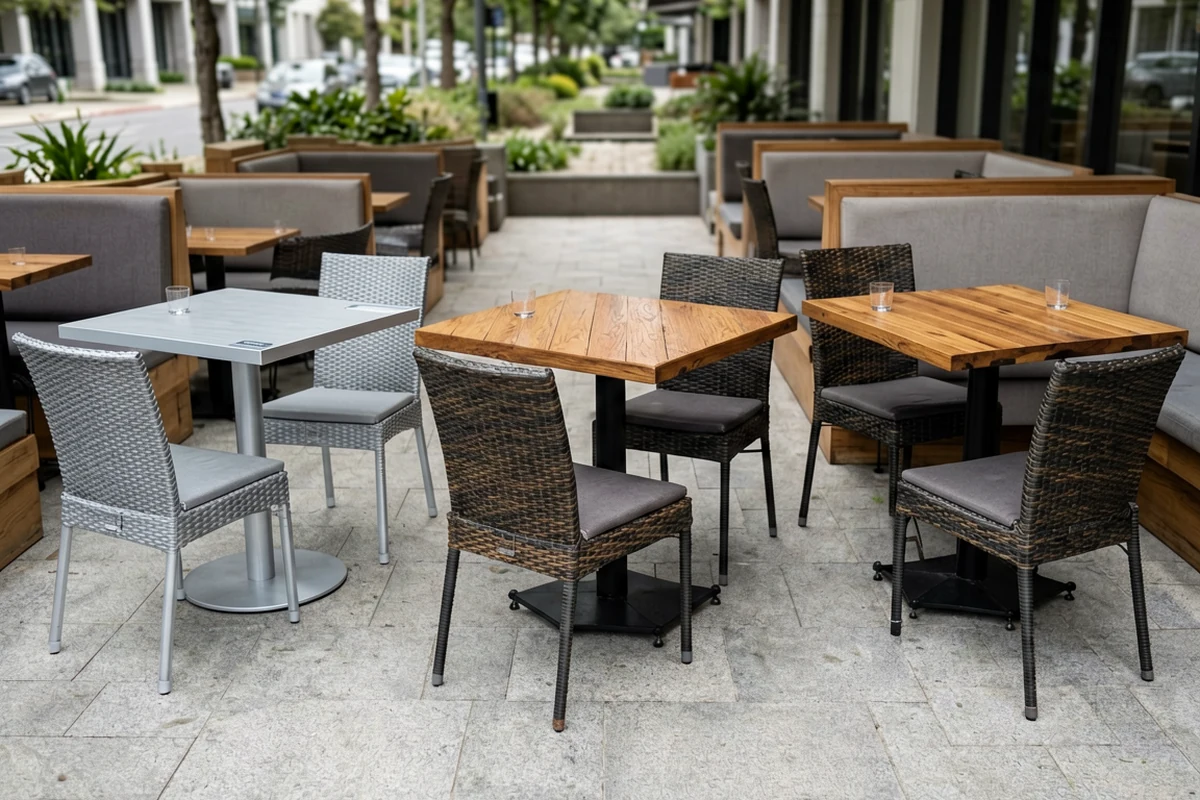
Review restaurant furniture when you need category scope for dining, patio, and restaurant seating discussions.
Compare commercial restaurant tables when the outdoor schedule needs tabletop, base, edge, and replacement questions.
Check commercial restaurant chairs when staff handling, stacking, comfort, frame finish, and seating quantity are being defined.
Use the contact path to request a project consultation once the exposure map, sample list, and destination are ready for sourcing review.
Final decision tool: outdoor furniture RFQ release checklist
Before issuing the final RFQ or purchase order, require the project team and supplier to answer the same release questions.
| Release field | Buyer sends | Supplier returns | Pass condition |
|---|---|---|---|
| Exposure map | Zone labels, site conditions, open questions | Confirmation, assumptions, and exceptions by zone | Every item is tied to one exposure zone |
| Material system | Target frame, seat, tabletop, hardware, feet, cushion, or woven direction | Material declaration, samples, detail photos | Physical samples and written assumptions match the quote |
| Operations plan | Cleaning method, stack or storage expectation, daily movement rules | Cleaning instructions, stacking evidence, handling notes | Operations owner accepts the method before deposit |
| Review boundary | Accessibility, wind, site, landlord, brand, and local review questions | Drawings and product evidence for project review | Supplier is not asked to make unsupported compliance claims |
| Quality control | Inspection stage, photo needs, accepted deviations | QC checklist, sample log, deviation log | Production release references approved samples and deviations |
| Packing and receiving | Zone labels, destination, hardware packs, seasonal timing | Carton label example, packing method, delivery sequence | Site team can receive by zone without guessing |
| Replacement plan | High-wear parts and future support needs | Spare-part route, touch-up route, reorder identifiers | Replacement logic is known before opening |
Outdoor restaurant furniture procurement is complete when the buyer can release one controlled package: exposure map, item schedule, samples, supplier evidence, cleaning and storage notes, QC plan, packing labels, and replacement route. RON GROUP can support that handoff by organizing supplier comparisons, coordinating outdoor samples, checking quote assumptions, recording QC evidence, and aligning packing marks with the site receiving plan. To move from a generic patio furniture list to a supplier-ready outdoor procurement package, Request an outdoor furniture exposure review with the dining zones, target products, material direction, destination, timing, and open exposure questions.
Get the week's latest industry information
-
Real-Life Professional Restaurant Case Studies
Explore Now
-
Create a unique restaurant with over 95,700+products
Explore Now
-
Protessional Free 3D Restaurant Design
Explore Now
-
Still Have Questions About Opening a Restaurant?
Explore Now

Sylvia
With 8 years in catering & hospitality industry, sales manager of Ron Group, specialise in providing one stop solutions to restaurants, hotels and weddings.
Discover Our Exclusive Products
Explore our extensive range of restaurant and hotel supplies designed to enhance your operations. Find the perfect solutions to meet your needs.
Browse Our ProductsFREE 3D DESIGN
Boost your restaurant's success with our free 3D design service. Start building the restaurant of your dreams today!
Explore 3D Design Case
RECOMMENDED CASES
-

La Rambla by Catalunya: Crafting Barcelona's Soul in Hong Kong - Custom Furniture Excellence
RON Group's custom Spanish-inspired furniture elevates La Rambla with artisanal aesthetics...
Learn More -

Cardinal Point: Elevating Outdoor Seating with Tailored Cushion Upgrades
Discover how Cardinal Point transformed its outdoor dining experience with custom cushions, achievin
Learn More
RECOMMENDED BLOGS
-
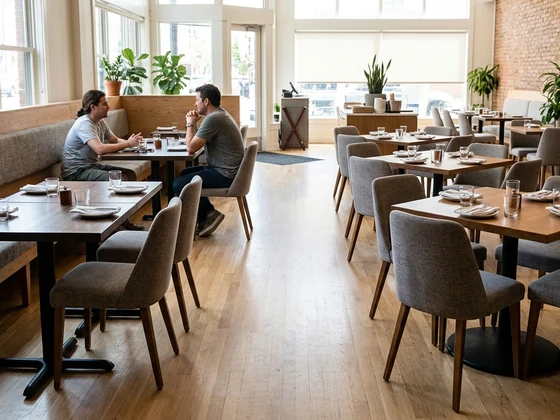
Restaurant Table Spacing and Aisle Clearance: Supplier Drawing Checklist
Check restaurant table spacing, aisle clearance, chair pullout, service path, and supplier drawing proof before approving a...
Sylvia2026-07-20 -

5 Mistakes to Avoid When Buying Restaurant Furniture from China
Don't fall for costly oversights! Learn the 5 mistakes to avoid when buying restaurant furniture from China and ensure a...
 Ron2025-01-079 min read
 -

RON GROUP Launches VR Experience to Explore Our Dynamic Showroom
Discover RON GROUP's VR showroom! Explore dining furniture, tableware, and customized services virtually or visit us in person to...
Sylvia2024-12-163 min read
Subscribe to RON GROUP
Stay up-to-date with the latest industry insights and expert advice. Together, we'll create your ideal restaurant.