
Content
A hotel can approve a good-looking guest room and still buy the wrong furniture. The mock-up may photograph well, yet production arrives with a different board, veneer, edge detail, drawer slide, finish tone, packing label, or wall-fixing condition. The quotation still says "hotel room furniture," but the evidence no longer proves what will be installed in the rooms.
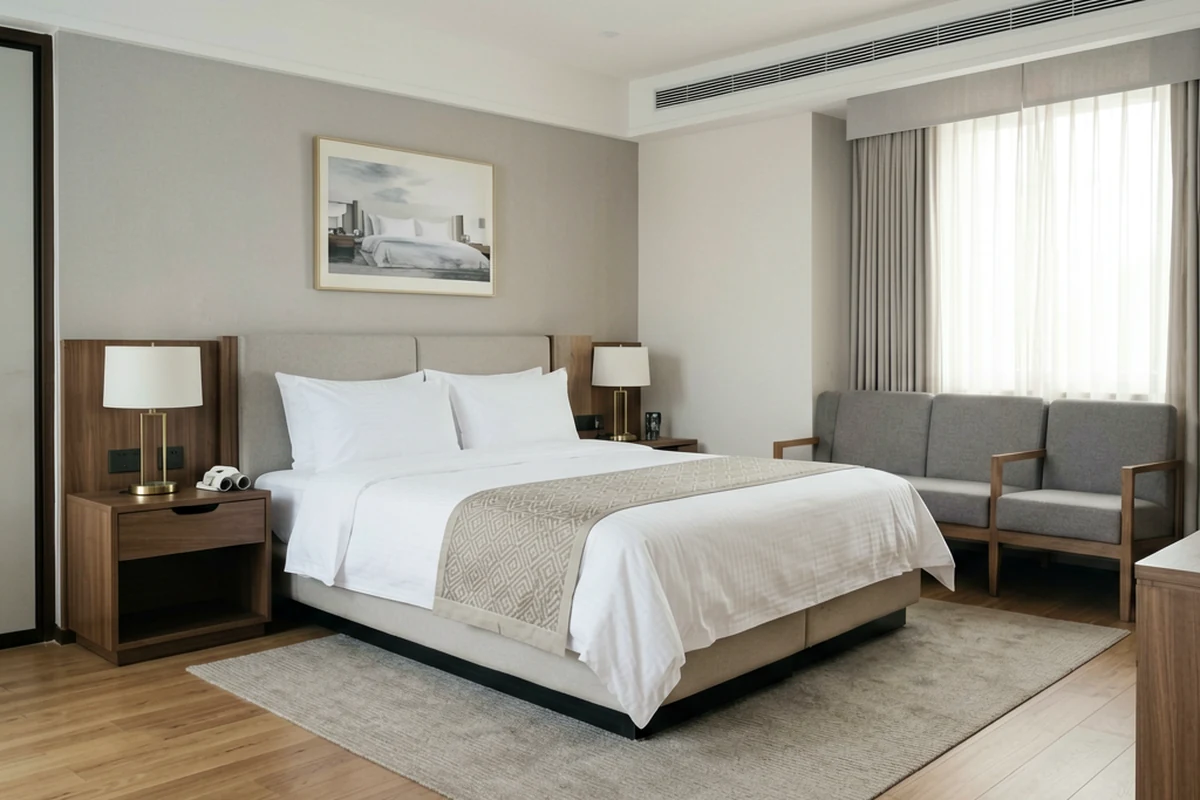
The procurement decision is therefore not "Which set looks best?" It is: Is this exact room furniture package defined, evidenced, sampled, and controlled well enough to release to the next project gate?
Start With the Room Schedule
Build the decision from the room schedule before comparing supplier catalogs. Give every bed base, headboard, nightstand, desk, chair, wardrobe, luggage bench, minibar cabinet, mirror, loose panel, and special-room variation an item code. Connect that code to room type, quantity, drawing revision, finished dimensions, installation condition, finish family, hardware, power or data interface where relevant, and the approved replacement route.
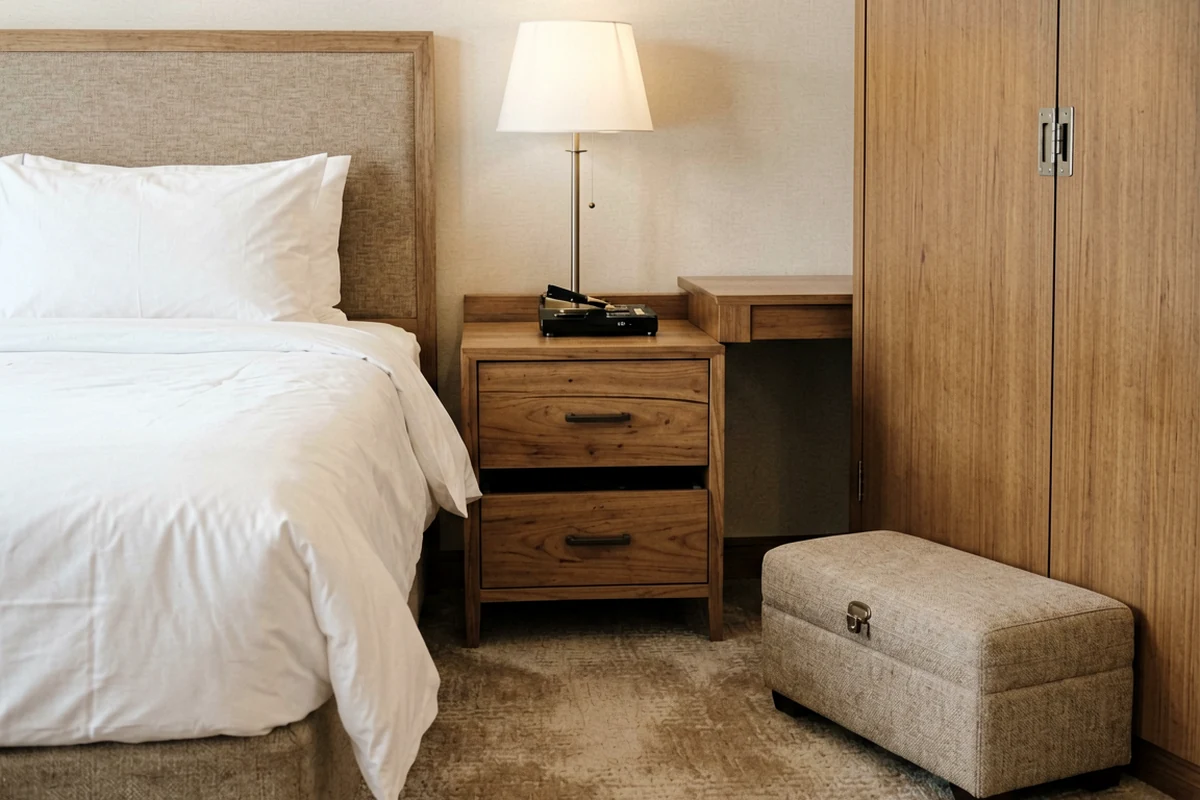
The schedule also protects the buyer from false comparisons. One supplier may quote a veneer headboard with wall panels and integrated lighting cutouts. Another may quote a laminate panel without the fixing detail, loose wiring allowance, or spare finish plan. Those offers are not comparable until the scope is normalized.
Use the commercial hospitality furniture category as a product-family reference, but keep the final specification tied to the property's room types, drawings, sample room, and operating model.
Define the Furniture Before You Price It
For each supplier, require one controlled product definition. A useful file names the substrate or frame, exposed surface, edge treatment, hardware, finish, installation method, packing method, and approval record. It should also state who owns changes after sample approval.
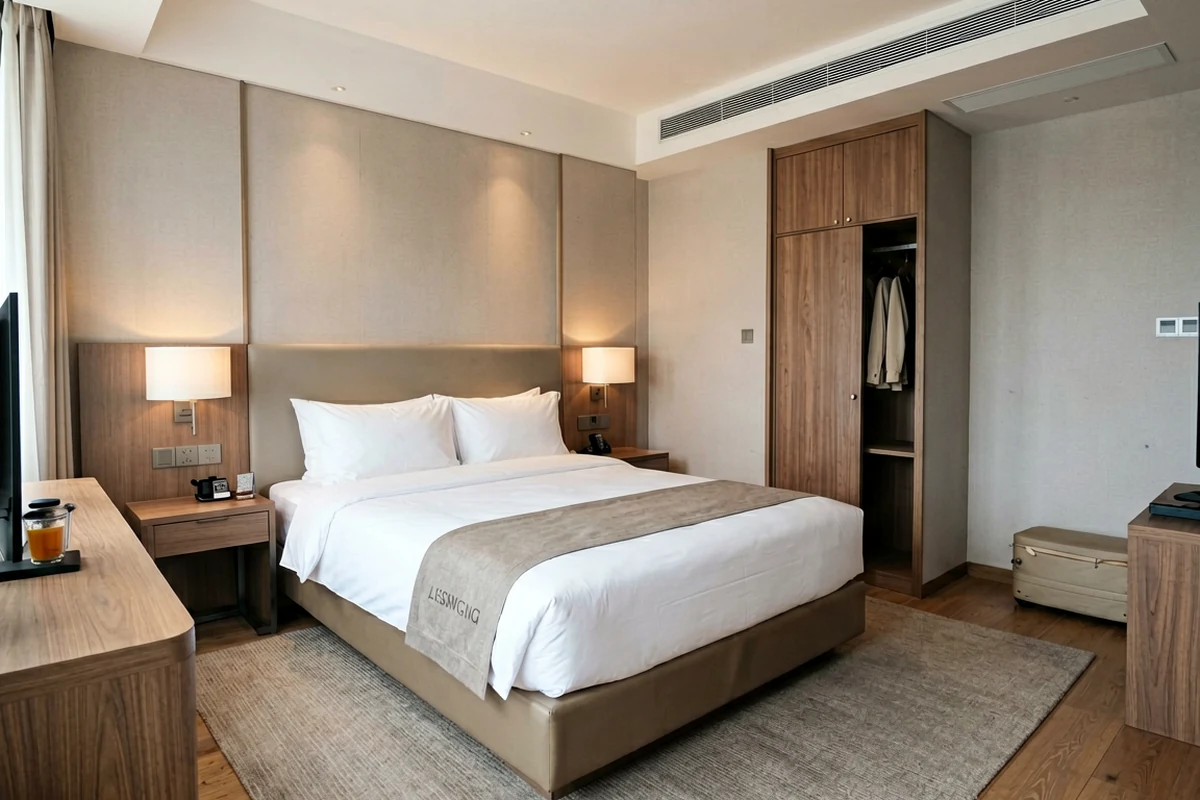
| Decision area | Evidence to request | Stop condition |
|---|---|---|
| Item identity | Item code, room type, drawing revision, and quantity | One model name covers several undefined versions |
| Material route | Board or frame type, veneer/laminate/paint/lacquer/metal/glass/upholstery references | Supplier describes only "wood," "MDF," or "hotel grade" |
| Finish control | Physical sample, color tolerance, sheen, lighting condition, touch-up method | Finish is approved from a photo only |
| Hardware and use points | Drawer slides, hinges, handles, glides, wall fixing, anti-tip or fixing needs where relevant | Moving parts are not named or reviewable |
| Replacement plan | Spare panels, handles, glides, finish reference, and reorder identity | Buyer cannot replace a damaged component later |
| Packing and receiving | Carton mark, room or area label, protection method, packing list, and photos | Site cannot identify items without unpacking |
The USDA Forest Products Laboratory Wood Handbook is a useful technical reminder that wood and wood-based materials are systems affected by construction, moisture behavior, adhesives, finishes, and service conditions. For procurement, that does not mean the buyer must become a wood technologist. It means the supplier's offer should identify the construction and the conditions under which the approved sample remains meaningful.
Avoid broad claims such as "solid wood quality," "waterproof," "commercial grade," or "luxury finish" unless the supplier has defined the material, finish, test or project basis, maintenance conditions, and limits of the claim.
Check Composite-Wood Evidence for U.S. Projects
If the furniture enters United States commerce, composite-wood evidence needs a specific review. The EPA's TSCA Title VI composite wood products guidance explains the formaldehyde-emission program for regulated composite wood products, and the controlling regulation is 40 CFR Part 770.
For hotel room furniture, this can matter when headboards, wardrobes, nightstands, desks, panels, or drawer parts include hardwood plywood, medium-density fiberboard, particleboard, laminated products, or fabricated components within the rule's scope. Do not approve from a generic "E0," "CARB," "low formaldehyde," or "compliant board" statement alone. Ask the supplier to connect the offered components to the relevant panel producer, certification or exemption basis, labels, records, fabricator responsibility, importer responsibility, and shipment documents where U.S. scope applies.
This is a destination-specific compliance question, not a global hotel rule. A non-U.S. project may have different chemical, labeling, import, or hotel-brand requirements. The practical buyer response is to mark the destination, list every composite-wood component, identify the responsible parties, and hold unresolved evidence before production release.
Treat FSC and Sustainability Claims as Controlled Claims
Sustainability language can create procurement risk when it is handled as decoration. If the specification, operator, investor, or tender asks for FSC or similar wood-origin claims, require transaction evidence. The FSC's own label and claim information should push the buyer toward controlled claim language, not informal statements such as "FSC style," "eco wood," or "responsible material."
At minimum, ask for the supplier's certificate identity where relevant, product-group scope, claim type, invoice wording, chain-of-custody path, and which furniture items the claim covers. If the supplier cannot connect the claim to the actual item codes and transaction documents, keep the sustainability language out of the approved specification until a qualified reviewer resolves it.
Shortlist Suppliers Against Evidence, Not Confidence
Supplier selection is part of the furniture specification. The U.S. International Trade Administration's due-diligence guidance supports checking potential business partners before commercial relationships. For China-related sourcing, its China market-entry guidance supports careful partner vetting and business-goal alignment.
Translate that into a supplier file. Confirm who signs the contract, who controls drawings, who owns the sample record, where production occurs, who approves substitutions, who inspects packing, who keeps records, and who responds when finish, hardware, quantity, damage, or labeling does not match the approved file. A trading company, factory, installer, and project coordinator may all be involved; the buyer needs the responsibility map before award.
The related furniture project supplier planning guide can support wider supplier-comparison structure, but the hotel room furniture decision still needs the current property's item schedule and evidence record.
Make the Sample Room a Release Gate
The sample room should be a documented release gate, not a design mood board. General construction practice treats product data, samples, and shop drawings as submittal tools for review; the AIA Contracts explainer on construction submittals supports that basic project-control role. Apply the same discipline to hotel furniture.
Review the sample room against the schedule:
Measure bed, desk, wardrobe, luggage bench, and circulation clearances against drawings.
Check headboard height, bedside reach, power/data alignment, wall-panel joints, door swings, and housekeeping access.
Review finish tone under project lighting, not only under showroom lighting.
Open drawers and doors; check slide, hinge, handle, glide, and alignment behavior without turning one inspection into a lifetime durability claim.
Confirm labels, carton marks, spare parts, touch-up method, and replacement identity.
Record every deviation by item code, owner, decision, and affected room type.
Use four outcomes. Approve when the sample record, material evidence, finish record, supplier responsibility, packing plan, and receiving checks are complete for the next gate. Revise when the product may work but drawings, materials, finish, hardware, packing, or evidence are incomplete. Reject when the supplier will not define or control the package. Escalate when TSCA scope, FSC claims, fire-safety, wall fixing, accessibility, local code, hotel-brand standards, or technical interpretation need a qualified specialist.
Control Production, Packing, and Receiving
Before mass production, freeze the item schedule, drawings, material list, finish samples, hardware list, labels, packing method, inspection plan, and deviation register. A change in board, veneer, laminate, lacquer, paint, metal finish, fabric, adhesive, edge band, drawer slide, hinge, handle, factory, packaging, or installation method should trigger documented review before production or shipment.
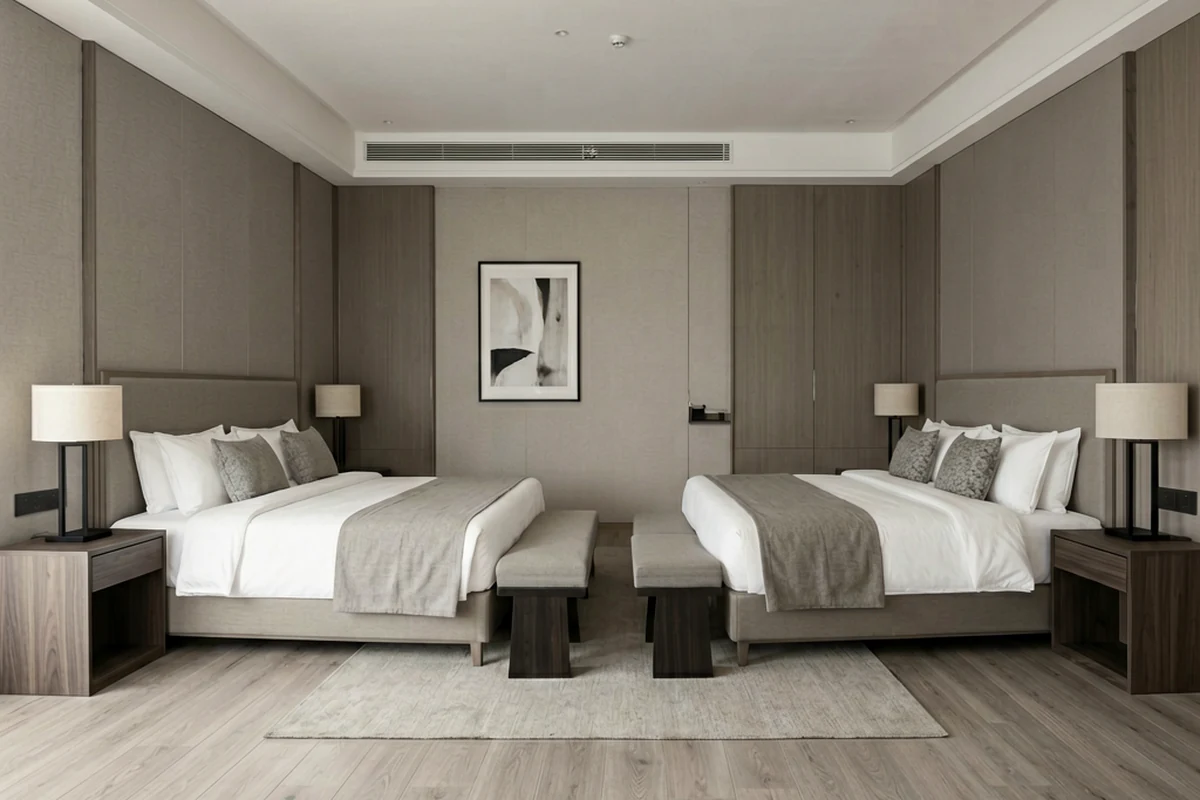
At receiving, match delivery to the approved file. Check carton marks, item code, room type, quantity, model or drawing revision, visible damage, moisture concerns, finish variation, hardware, labels, and spare parts. Quarantine unexplained differences instead of distributing them to rooms.
Hotel and restaurant project support can help frame the coordination discussion among schedule, sample approval, packing, delivery sequence, and site receiving. Keep that coordination practical: the buyer should be able to point to one approved record for each item in each room type.
Decide the Next Gate
Approve the package only when the supplier can connect room schedule, material definition, destination requirements, sustainability claims if used, supplier responsibility, sample-room approval, production change control, packing, and receiving checks.
Revise when the offer is promising but evidence gaps remain. Reject when the supplier depends on vague product names, photo-only approval, uncontrolled substitutions, or unrelated certificates. Escalate when compliance, sustainability, structural fixing, local code, or brand-standard interpretation is outside the procurement team's competence.
To start a useful review, send your hotel room furniture package with the destination, room schedule, quantities, drawings, finish samples, material schedule, TSCA or FSC scope if relevant, supplier evidence, sample-room status, packing plan, delivery sequence, and opening milestone.
Get the week's latest industry information
-
Real-Life Professional Restaurant Case Studies
Explore Now
-
Create a unique restaurant with over 95,700+products
Explore Now
-
Protessional Free 3D Restaurant Design
Explore Now
-
Still Have Questions About Opening a Restaurant?
Explore Now

Sylvia
With 8 years in catering & hospitality industry, sales manager of Ron Group, specialise in providing one stop solutions to restaurants, hotels and weddings.
Discover Our Exclusive Products
Explore our extensive range of restaurant and hotel supplies designed to enhance your operations. Find the perfect solutions to meet your needs.
Browse Our ProductsFREE 3D DESIGN
Boost your restaurant's success with our free 3D design service. Start building the restaurant of your dreams today!
Explore 3D Design Case
RECOMMENDED CASES
-

La Rambla by Catalunya: Crafting Barcelona's Soul in Hong Kong - Custom Furniture Excellence
RON Group's custom Spanish-inspired furniture elevates La Rambla with artisanal aesthetics...
Learn More -

Cardinal Point: Elevating Outdoor Seating with Tailored Cushion Upgrades
Discover how Cardinal Point transformed its outdoor dining experience with custom cushions, achievin
Learn More
RECOMMENDED BLOGS
-

Restaurant Table Spacing and Aisle Clearance: Supplier Drawing Checklist
Check restaurant table spacing, aisle clearance, chair pullout, service path, and supplier drawing proof before approving a...
Sylvia2026-07-20 -

5 Mistakes to Avoid When Buying Restaurant Furniture from China
Don't fall for costly oversights! Learn the 5 mistakes to avoid when buying restaurant furniture from China and ensure a...
 Ron2025-01-079 min read
 -

RON GROUP Launches VR Experience to Explore Our Dynamic Showroom
Discover RON GROUP's VR showroom! Explore dining furniture, tableware, and customized services virtually or visit us in person to...
Sylvia2024-12-163 min read
Subscribe to RON GROUP
Stay up-to-date with the latest industry insights and expert advice. Together, we'll create your ideal restaurant.