
Content
A hotel public area furniture specifications package should control what can be quoted, reviewed, sampled, revised, and released to production. The mistake is treating the document as a style list. Public-area furniture touches guest circulation, accessibility review, cleaning, brand approval, installation sequencing, and supplier accountability, so every item needs measurable fields and a traceable approval record.
Direct answer
Write hotel public area furniture specifications as a controlled workflow, not as a loose buying guide. Start with an item schedule, define measurable product fields, assign owner/operator/brand/code review boundaries, request supplier submittals in one package, record open issues, approve physical samples, freeze revisions, and release only the approved version for production. For United States projects, use ADA Standards and Chapter 2 scoping as accessibility review prompts, then confirm state, local, fire, health, brand, and project-specific requirements separately. Use ANSI/BIFMA references as standards-awareness prompts where relevant, but do not claim that any chair, sofa, table, or casegood complies until the supplier provides product-specific evidence. The result should be one reviewable specification file that design, procurement, operations, and the supplier can all sign off before deposit or production release.
Start with the specification control file
The first deliverable is not a mood board. It is a control file that shows what the project is asking suppliers to build and what still needs approval. Public areas can include lobby seating, lounge tables, corridor benches, waiting-area chairs, concierge desks, communal work tables, loose ottomans, decorative screens, planters with integrated furniture, and other guest-facing furniture. The specification should separate these areas without turning the article into a lobby-zone procurement schedule.
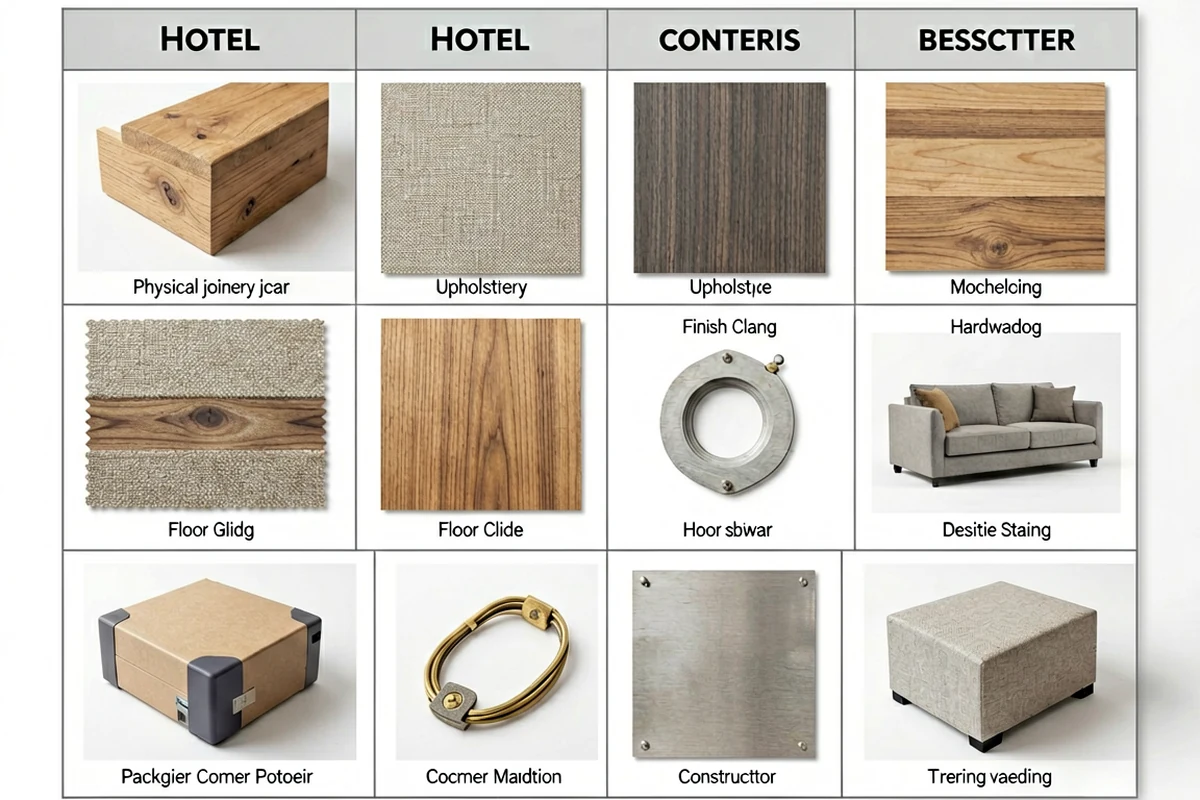
Use one item code per product type and keep the item code consistent across drawings, RFQs, samples, purchase orders, packing labels, and inspection reports. If a lounge chair appears in both the lobby and a waiting area but needs different fabric, glides, or cleaning instructions, treat it as a controlled variant. If it is identical, keep the same item code and show the room quantities clearly.
This is where many projects lose control. A designer may issue a visual reference, procurement may request a quote, operations may later reject the cleanability, and the supplier may price a similar product instead of the intended construction. A specification-control workflow prevents that drift by requiring every item to answer six questions before release: what is it, where is it used, what must be built, what must be submitted, who approves it, and what version is released.
Decision tool 1: measurable specification field matrix
Use this matrix as the backbone of the public-area specification. It keeps design intent, procurement comparison, operations review, and supplier evidence in the same document.
| Specification field | Required entry | Approval owner | Supplier evidence to request |
|---|---|---|---|
| Item identity | Item code, room or area, quantity, drawing reference, revision number | Designer or specifier | Quote line matching the exact item code |
| Intended use | Lounge seating, waiting, corridor pause point, shared work, concierge, or display support | Owner/operator | Supplier acknowledgement of use condition |
| Dimensions | Overall size, seat height where relevant, table height where relevant, clearance notes, and tolerances only if project-approved | Designer plus code reviewer where applicable | Shop drawing with dimensions and material callouts |
| Construction | Frame type, joinery expectation, substrate, cushion build-up, base, glides, hardware, and service-access notes | Designer and procurement | Construction drawing, component description, and factory photos when available |
| Materials and finish | Surface material, upholstery, veneer, metal finish, stone or solid surface, edge, stitch detail, finish sample code | Designer and brand reviewer | Finish sample, material swatch, technical sheet, and retained sample label |
| Accessibility/code prompts | Public accommodation context, accessible route impact, fixed/loose furniture boundary, protruding object or circulation concerns where applicable | Code consultant or project authority | Supplier dimensions and installation notes for review; not legal interpretation |
| Operations review | Cleaning method, replacement access, touch-up route, spare parts, maintenance limits, and site handling | Hotel operations | Cleaning instruction, replacement part plan, and maintenance note |
| Packaging and delivery | Carton label, item code, room tag, sequence, destination, protection method, and receiving constraints | Procurement and logistics | Packing method, label template, carton mark sample, and loading plan |
| Approval record | Required samples, approver, date, accepted deviations, rejected alternatives, and release status | Project manager or owner representative | Signed sample photo record and deviation log |
| Production release | Final revision, frozen quantities, approved sample reference, PO link, and no-open-issue confirmation | Procurement | Supplier production confirmation tied to the released revision |
Do not fill weak fields with vague language such as "commercial quality" or "as per image." If the requirement is not known yet, label it as an open issue, supplier proposal, or project review item. That wording is more useful than false certainty because it keeps unresolved decisions visible.
Define approval boundaries before supplier pricing
Public-area furniture crosses several decision boundaries. Design may own the look and finish. The owner may own budget and brand impact. Operations may own cleaning, replacement, and daily handling. A brand team may approve the guest-facing appearance. A code consultant or project authority may review accessibility, fire, health, and local requirements. Procurement owns comparable supplier pricing and production release discipline.
Write these boundaries into the specification before requesting a quote. A supplier can provide shop drawings, material samples, finish samples, test reports where available, packing information, and production schedules. The supplier should not be asked to silently decide project code compliance, hotel brand acceptance, or operations tolerance. For US public accommodation context, the U.S. Access Board ADA Standards and Chapter 2 scoping requirements are useful review prompts, but the project team still needs its own applicable review.
This distinction protects both sides. The buyer receives comparable submittals instead of sales descriptions. The supplier knows which evidence to prepare and which decisions require owner, brand, operations, or project-authority signoff.
Decision tool 2: approval boundary map
Use this table before RFQ release and again before sample approval.
| Decision area | Who should approve | What the supplier can prove | What should stay with the project team |
|---|---|---|---|
| Visual design | Designer, owner, brand reviewer | Renderings, reference photos, shop drawings, finish samples | Final aesthetic acceptance and brand alignment |
| Dimensions and fit | Designer, site team, code reviewer where applicable | Measured drawings, prototype dimensions, installation notes | Site condition approval and accessibility interpretation |
| Materials and finishes | Designer, operator, procurement | Swatches, finish panels, technical sheets, bulk-lot confirmation | Final finish selection and retained-sample control |
| Durability and standards | Specifier, procurement, technical reviewer | Product-specific test reports where available and applicable standards references | Whether the evidence satisfies project requirements |
| Cleaning and maintenance | Hotel operations | Cleaning instructions, replacement route, touch-up instructions | Operational acceptance and chemical compatibility decisions |
| Packaging and logistics | Procurement, freight forwarder, site receiver | Packing method, label format, loading plan, carton protection | Receiving sequence, storage limits, and installation plan |
| Production release | Procurement and owner representative | Production confirmation tied to approved samples and revision | Final release authority and change-control approval |
This map is also useful when a supplier asks for clarification. Instead of answering in email only, update the issue register and revision record. The written trail matters more than the speed of one reply.
Build the supplier submittal package
Send suppliers a controlled package rather than scattered screenshots. The RFQ should include the furniture schedule, drawings or marked-up plans, finish direction, sample expectations, target destination, packaging expectations, and the required response format. Ask every bidder to respond against the same item codes and evidence list so procurement can compare like with like.
At minimum, request these supplier evidence items:
Item-by-item quotation using the exact specification codes.
Shop drawings with dimensions, construction notes, materials, finish callouts, and revision number.
Material swatches for upholstery, veneer, laminate, metal, stone, solid surface, or other specified surfaces.
Finish samples with retained-sample labels and bulk-production matching method.
Construction or assembly photos where the product is custom or semi-custom.
Applicable product-specific test reports where standards are claimed or required.
Cleaning and maintenance instructions written for hotel operations.
Replacement part or touch-up plan for high-contact public-area items.
Packaging method, carton or crate label template, and item-code marking system.
Pre-shipment inspection checklist with photo requirements.
Deviation log showing every proposed exception to the specification.
Production timeline tied to sample approval, not only to deposit date.
Container loading or delivery sequence plan when the project has multiple public-area zones.
These items are not paperwork for its own sake. They are the evidence chain that lets a hotel team decide whether a supplier understands the specification, can control samples, and can ship furniture that matches the approved version.
Keep an issue register instead of burying questions
Every unresolved point should be in an issue register. This is the most important difference between a specification-control workflow and a general buying guide. A public-area furniture spec should not pretend to be final when cleaning approval, finish direction, code review, sample ownership, or packaging sequence is still open.
The issue register should include the item code, issue description, owner, required evidence, target decision date, status, and final decision. Use simple statuses: open, supplier response received, project review, accepted, rejected, or carried to revision. Avoid informal phrases such as "probably OK" or "to be checked later." Those phrases do not help the factory, the hotel operator, or the person approving payment.
Four common procurement risk scenarios belong in the issue register early:
Finish sample drift: The design team approves a small finish chip, but bulk production varies because the supplier did not define the retained sample and matching process. The register should require a retained sample label, sample photo, approver, and bulk finish confirmation.
Operations rejection after design approval: A lounge chair looks correct, but hotel operations rejects the upholstery or base detail because cleaning access is poor. The register should require cleaning instructions and operations approval before production release.
Accessibility or circulation conflict: A bench, table, or display-adjacent seating item affects public circulation or accessible route review. The register should assign review to the project authority and require supplier dimensions, not supplier legal conclusions.
Quote mismatch across bidders: One supplier prices the drawing, another prices a visual reference, and a third excludes packaging or installation-related labels. The register should force each bidder to state included scope, exclusions, and deviations against the same item codes.
Sample approval without production linkage: A physical sample is approved, but the purchase order does not reference the sample code or revision. The register should block production release until the PO, approved sample, and final specification revision match.
Public-area delivery confusion: Cartons arrive without room labels or sequence marks, creating site sorting and handling problems. The register should require label templates and packing marks before shipment.
Procurement teams do not remove risk by writing longer descriptions. They remove risk by making unresolved decisions visible and assigning each one to an accountable owner.
Sample signoff should be a gate, not a courtesy
For public areas, physical samples are part of the control system. They are not decorative extras. A sample signoff package should include the sample item or finish panel, item code, revision, supplier name, date, approver, accepted deviations, rejected alternatives, and photos of the retained sample. If a material swatch is approved but the construction drawing is still open, the signoff should say so.
Separate four kinds of sample approval:
Finish sample approval: color, grain, sheen, metal tone, stone or solid-surface direction, edge finish, and retained sample label.
Material sample approval: upholstery, backing, surface, substrate, foam or cushion feel where relevant, and cleaning compatibility review.
Construction sample approval: frame, joinery, cushion build-up, glides, hardware, base, stitching, access panels, and serviceability.
Full item sample or mock-up approval: complete product appearance, comfort, dimensions, workmanship, packing method, and installation handling.
The production release should identify exactly which of these samples are approved. If the project skips a full item sample because schedule or budget requires it, document the risk and release authority. Do not let the absence of a sample become an invisible assumption.
Revision control before production release
Hotel furniture specifications often change after pricing: a fabric is replaced, a table dimension is adjusted, a base finish changes, a brand reviewer asks for a different edge, or operations requests a cleaner-friendly material. Revision control keeps these changes from leaking into production unevenly.
Use a simple revision rule. Every change receives a revision number, date, changed field, reason, owner, supplier acknowledgement, and impact note. The impact note should say whether the change affects price, sample approval, production lead time, packaging, or inspection. A supplier should not start production from a drawing revision that procurement has not released.
This is also where RON GROUP can add practical value as a sourcing and procurement partner. In multi-category hotel furniture work, a public-area package may combine lounge seating, loose tables, custom millwork-like furniture, metal details, upholstery, and stone or surface materials. Coordinating those items may require several production streams. RON GROUP's role is not to replace project approval; it is to help organize supplier evidence, sample status, factory communication, QC records, packing labels, and revision discipline so the buyer can see which items are ready and which are still blocked.
Three procurement insights are especially important:
A finish decision is not controlled until the retained sample, shop drawing, and supplier production note all reference the same revision.
A quote is not comparable unless every supplier responds to the same item codes, packaging expectations, deviation format, and sample requirements.
A production schedule is not reliable unless it starts from sample approval and frozen revision status, not only from deposit date.
Public-area specification fields by furniture type
Different public-area products need different measurable fields. Do not force every item into the same description style.
| Furniture type | Fields that usually need extra control | Common release blocker |
|---|---|---|
| Lounge chair or sofa | Upholstery, cushion feel, stitch detail, frame, glides, cleaning method, replacement route | Material approval separated from construction approval |
| Coffee table or side table | Top material, edge, base, levelers, finish, corner treatment, packing protection | Finish or top material approved without base detail |
| Corridor bench | Length, base, wall clearance, floor protection, upholstery or surface, cleaning access | Site circulation or fixed/loose boundary not reviewed |
| Shared work table | Top size, power or cable coordination if applicable, base stability, finish, edge, cleaning | Supplier assumes scope for integrated components not in RFQ |
| Concierge or reception-adjacent loose furniture | Finish match, guest-facing surface, storage/access notes, installation interface | Custom detail priced from image rather than shop drawing |
| Decorative screen or divider | Dimensions, stability, finish, attachment or freestanding status, packing method | Code/site review not assigned before supplier pricing |
This type-by-type view keeps the specification measurable without turning it into a long list of generic adjectives. It also helps suppliers identify which submittals are essential for each item.
Internal links for the specification workflow
Use internal links as task support, not as decoration. For category context, review RON GROUP's hotel furniture page when framing the product scope. For production-scope discussion, the furniture production capabilities page can support RON-specific capability claims. For first-party project context, browse hospitality project examples, while keeping project evidence separate from current-spec compliance. When the specification file, issue register, and sample questions are ready, use the request a project consultation path to start a controlled review.

Final decision tool: hotel public area furniture specifications release checklist
Before production release, the project team should be able to answer every line below from the current controlled file, not from memory.
| Release question | Pass condition | If not passed |
|---|---|---|
| Does every item have a stable code, room or area, quantity, drawing reference, and revision? | Schedule, drawings, quote, and sample records use the same codes | Freeze item codes before comparing supplier quotes |
| Are dimensions, construction, materials, finishes, and hardware measurable? | Fixed fields or supplier-proposal fields are clearly marked | Move vague language into open issues |
| Are accessibility, code, operations, and brand review boundaries assigned? | Each review owner and decision status is visible | Do not ask the supplier to infer project approvals |
| Are supplier submittals complete? | Drawings, samples, evidence, cleaning instructions, packaging, and deviations are logged | Return the RFQ or submittal package for completion |
| Are risk scenarios resolved or accepted by an authorized owner? | Issue register shows accepted, rejected, or approved carry-forward status | Keep the item out of production release |
| Is sample signoff tied to the final revision? | Sample code, approver, date, photo, and accepted deviations match the release revision | Update the sample record or block production |
| Are packing labels and delivery sequence defined? | Item code, room tag, carton mark, and destination plan are documented | Require packing evidence before shipment |
| Has procurement issued the final release? | Supplier confirmation references the approved revision and sample record | Do not rely on old emails or informal approval |
The hotel public area furniture specifications package is ready when design, procurement, operations, and the supplier are looking at the same item codes, same samples, same open-issue status, and same released revision. RON GROUP can support that handoff by reviewing the schedule, organizing supplier evidence, coordinating samples, tracking deviations, and preparing the sourcing questions that make supplier quotations comparable. To move from a loose public-area furniture list to a controlled procurement file, Request a public-area specification review with the schedule, drawings, finish direction, open issues, sample requirements, and destination details.
Get the week's latest industry information
-
Real-Life Professional Restaurant Case Studies
Explore Now
-
Create a unique restaurant with over 95,700+products
Explore Now
-
Protessional Free 3D Restaurant Design
Explore Now
-
Still Have Questions About Opening a Restaurant?
Explore Now

Sylvia
With 8 years in catering & hospitality industry, sales manager of Ron Group, specialise in providing one stop solutions to restaurants, hotels and weddings.
Discover Our Exclusive Products
Explore our extensive range of restaurant and hotel supplies designed to enhance your operations. Find the perfect solutions to meet your needs.
Browse Our ProductsFREE 3D DESIGN
Boost your restaurant's success with our free 3D design service. Start building the restaurant of your dreams today!
Explore 3D Design Case
RECOMMENDED CASES
-

La Rambla by Catalunya: Crafting Barcelona's Soul in Hong Kong - Custom Furniture Excellence
RON Group's custom Spanish-inspired furniture elevates La Rambla with artisanal aesthetics...
Learn More -

Cardinal Point: Elevating Outdoor Seating with Tailored Cushion Upgrades
Discover how Cardinal Point transformed its outdoor dining experience with custom cushions, achievin
Learn More
RECOMMENDED BLOGS
-
Restaurant Table Spacing and Aisle Clearance: Supplier Drawing Checklist
Check restaurant table spacing, aisle clearance, chair pullout, service path, and supplier drawing proof before approving a...
Sylvia2026-07-20 -

5 Mistakes to Avoid When Buying Restaurant Furniture from China
Don't fall for costly oversights! Learn the 5 mistakes to avoid when buying restaurant furniture from China and ensure a...
 Ron2025-01-079 min read
 -

RON GROUP Launches VR Experience to Explore Our Dynamic Showroom
Discover RON GROUP's VR showroom! Explore dining furniture, tableware, and customized services virtually or visit us in person to...
Sylvia2024-12-163 min read
Subscribe to RON GROUP
Stay up-to-date with the latest industry insights and expert advice. Together, we'll create your ideal restaurant.