













Content

Hotel OS&E procurement should be managed as an opening-readiness system, not as a late shopping list. OS&E items touch rooms, housekeeping, front office, food and beverage, engineering, spa, public areas, and back-of-house storage. The buyer needs category ownership, item files, receiving rules, storage plans, and issue handling before purchase release.
The useful checklist is not simply a list of products. It is a control file that tells the opening team what is being bought, who approved it, where it will be received, how it will be counted, where it will be stored, and what must be escalated before opening day.
Define OS&E by Operating Area
OS&E usually covers operating supplies and equipment that support hotel service after fit-out. The exact scope differs by property, brand, operator, and contract structure, so the first task is category definition.
| Operating area | Typical OS&E file questions | Owner to name |
|---|---|---|
| Guestrooms | Linen, hangers, bins, trays, kettles, irons, safes, accessories | Rooms or housekeeping lead |
| Bathrooms | Towels, bins, amenities, trays, mirrors, hair dryers | Housekeeping and rooms lead |
| Front office | Queue items, desk accessories, key-card materials, signage support | Front office lead |
| F&B | Serviceware, small equipment, menu holders, buffet accessories | F&B lead |
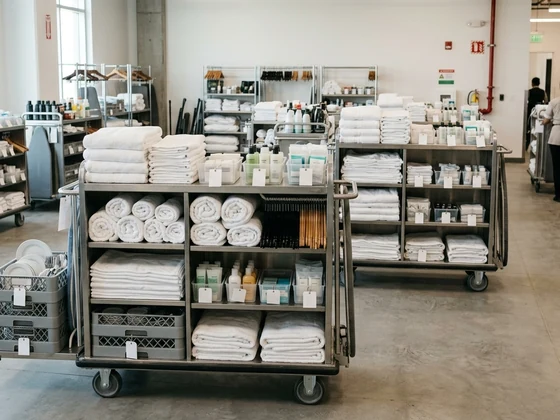
| Housekeeping | Carts, cleaning support items, storage labels | Housekeeping lead |
| Engineering | Maintenance support items and spare parts route | Engineering lead |
| Public areas | Waste bins, loose accessories, umbrella stands, queue items | Operations lead |
RON GROUP's hotel project support can help frame procurement coordination, while hotel furniture remains a separate FF&E or furniture scope. Use the broader hotel OS&E procurement guide for category context and the hotel FF&E vs OS&E guide when responsibility boundaries need clarification. The hotel supplies collection is the commercial receiver for item-level sourcing. Keeping those scopes separate reduces late confusion.
The category boundary should be written down before the first supplier list is built. In many projects, the same meeting discusses furniture, linen, amenities, signs, small equipment, housekeeping tools, and back-of-house storage. That is convenient for conversation, but dangerous for purchasing. FF&E decisions often depend on drawings, finishes, and installation. OS&E decisions depend more on operating counts, department ownership, replenishment, storage, and opening stock. Mixing them can hide missing items until the property is close to handover.
Name one owner for each operating area and one procurement controller for the master log. The department owner confirms operating fit. The procurement controller checks item code, supplier, quantity basis, delivery, and receiving status. Without this split, the team may think an item is approved because a department liked it, while purchasing still lacks a sample, quote, carton mark, or delivery route.
Build an Item File Before Supplier Award

Every OS&E item needs a file before purchase release. The file does not need to be complex, but it should be complete enough for ordering, receiving, replacement, and opening handoff.
| Item file field | Why it matters |
|---|---|
| Item code and category | Connects supplier quote, receiving, and storage |
| Operating area | Names the department that will use the item |
| Quantity basis | Separates per room, per outlet, per floor, spare stock, or opening stock |
| Approved sample or reference | Prevents visual or functional drift |
| Supplier and contact | Creates an issue route after delivery |
| Packing and carton mark | Helps receiving teams count and locate items |
| Storage location | Prevents goods from being lost during fit-out |
| Replacement route | Supports opening defects and early operation needs |
The American Society for Quality's supplier-quality guidance supports looking beyond price and considering supplier performance, quality, delivery, support, and evidence. For OS&E, translate that into item-file discipline.
The item file should also show the counting logic. A guestroom item may be counted per key, per bed, per bathroom, per floor pantry, or per housekeeping cart. An F&B item may be counted by seat, cover, outlet, service style, or opening stock. A public-area item may be counted by location instead of room count. When the basis is not visible, the purchase order can look correct while the property still opens short.
Add a status field that uses plain terms: proposed, sampled, approved, ordered, received, short, damaged, stored, handed over, or closed. This gives operations a way to read the procurement file without interpreting purchasing notes. It also makes gaps easier to find during the final weeks before opening.
Separate Procurement, Receiving, and Storage Decisions
A hotel may order OS&E correctly and still fail operationally if receiving and storage are not planned. The purchasing team should not release a bulk order until it knows how items will move through the building.
| Decision | Procurement question | Receiving question | Storage question |
|---|---|---|---|
| Guestroom OS&E | How many per room and what spare stock? | Are cartons labeled by room type or floor? | Where are spares stored after opening? |
| F&B OS&E | Which outlet owns the item? | Are breakable items counted and inspected? | Is secure storage available before opening? |
| Housekeeping items | Who approves operating fit? | Are carts or supplies inspected on arrival? | Where will departments collect them? |
| Public area items | Who approves finish and location? | Are damages visible at receiving? | Can items be protected until installation? |
The International Trade Administration's due-diligence guidance supports evaluating potential business partners before commitments. Apply that mindset to OS&E suppliers: the buyer should know who owns samples, packing, damage resolution, and replacement support.
Receiving and storage should be designed by risk. Breakable serviceware needs count and damage checks quickly, while bulky housekeeping carts need access routes and temporary holding space. Linen, amenities, and consumables may need secure storage because early loss can look like a purchasing shortage. Branded or guest-facing items need stricter sample and substitution control because a small visual mismatch can be obvious to the operator.
For hotel openings, the storage plan should include who can move goods, how cartons are labeled, where quarantine items go, and which department signs handoff. If those rules are missing, goods can be moved repeatedly by contractors, operators, and suppliers. The result is not just delay; it can become a dispute over whether an item was missing, damaged, or misplaced after delivery.
Run a Receiving Checklist Before Goods Arrive
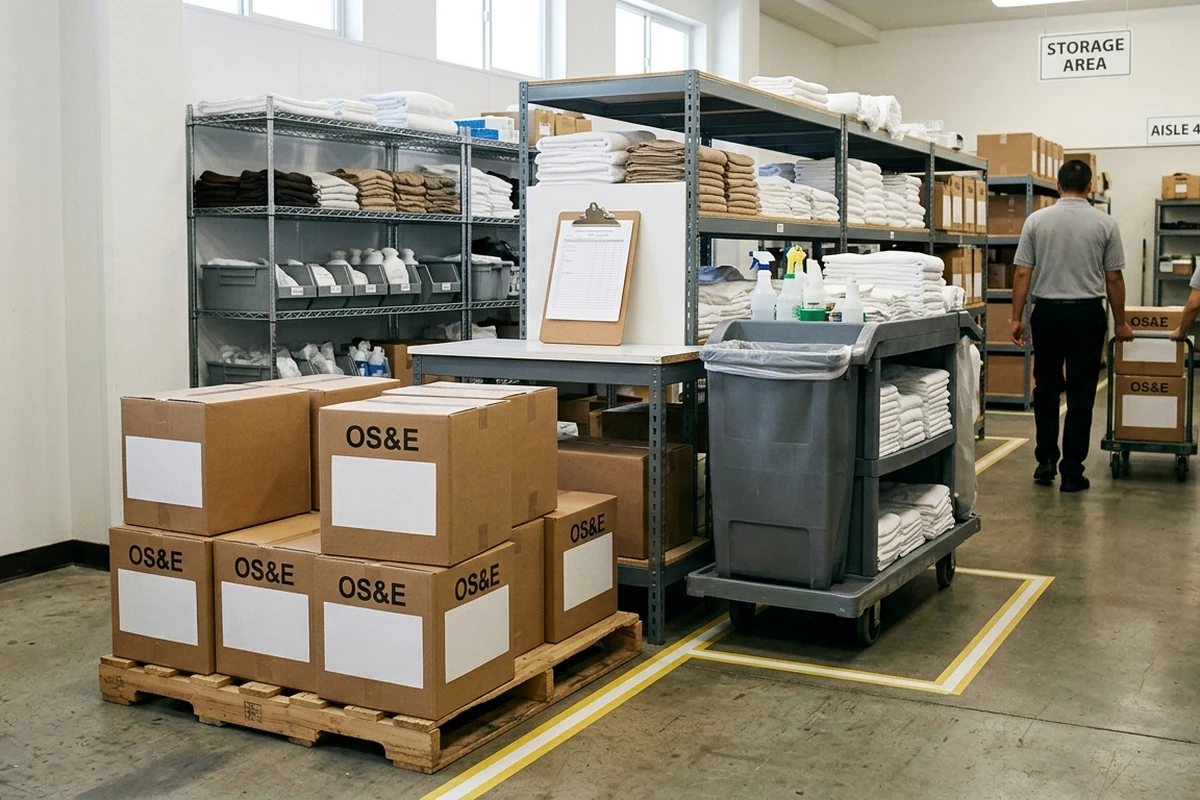
A receiving checklist is useful only if it is written before delivery. Use it to define what the site team should count, photograph, quarantine, or escalate.
The receiving checklist should include:
purchase order and item code;
supplier name and contact route;
carton count and visible carton condition;
sample or approved reference when relevant;
quantity received and shortage notes;
visible damage record;
location moved to storage;
department owner notified;
issue deadline for supplier response.
For items that affect safe operation or emergency routes, assign the correct local review owner. OSHA's exit-route lighting and marking rule is relevant when OS&E, signs, or operational equipment intersect with exit-route visibility; it is not a general proof that an OS&E purchase is compliant.
The receiving checklist should be tested with one delivery before the largest shipment arrives. Choose a category with enough variation, such as guestroom bins, trays, hangers, and amenities, and confirm whether the team can match carton labels to item codes and storage locations. If the trial receiving event creates confusion, fix the log before the main arrival window.
Photographs should be consistent. Capture carton condition, label, item code, visible damage, and storage location. Random photos in a chat thread are rarely useful later. A simple folder structure by supplier and item code makes shortage and damage discussions much easier.
Control Substitutions and Late Additions
Late OS&E substitutions are common because opening teams discover missing quantities, discontinued items, budget pressure, or operator preferences. Do not let substitutions move through informal messages.
Use a substitution log:
| Substitution field | Required note |
|---|---|
| Original item code | What was approved first |
| Proposed substitute | Supplier name, image, sample, or product document |
| Reason | Discontinued, delayed, budget, operating preference, or damage replacement |
| Approver | Department and owner representative if needed |
| Impact | Quantity, cost, delivery, storage, brand standard, and opening risk |
| Final decision | Accept, reject, or hold |
This keeps the opening team from receiving products that no one formally approved.
Substitutions should also define whether the replacement is temporary or final. A temporary item may help the hotel open but still require a later correction. A final substitution changes the operating standard and should update the item file, reorder route, spare stock, and department handoff. Treating those two cases the same creates confusion after opening, when operations tries to reorder an item that purchasing never formally accepted.
Set a deadline after which substitutions require escalation. Early substitutions may be normal procurement work. Late substitutions can affect training, room setup, brand review, safety coordination, or guest experience. The closer the opening date, the more important it is to record who accepted the tradeoff.
Handoff OS&E to Operations
OS&E procurement is complete only when operations can use and reorder the items. The final handoff should include the item file, supplier contacts, spare stock, storage location, accepted samples, substitution log, unresolved issues, and warranty or replacement route when relevant.
Use a closeout review by department:
| Department handoff question | Good closeout evidence |
|---|---|
| Can the department find the item? | Storage location and quantity received are recorded |
| Can the department reorder it? | Supplier, item code, and approved reference are in the file |
| Can the department report a defect? | Issue owner and response route are named |
| Can the department explain a substitution? | Substitution log shows reason, approver, and final status |
| Can the hotel separate opening stock from spare stock? | Quantity basis and remaining stock are visible |
This closeout is where OS&E becomes an operating system rather than a purchase history. The procurement team should not disappear with the only usable item knowledge.
Opening-Readiness Checklist
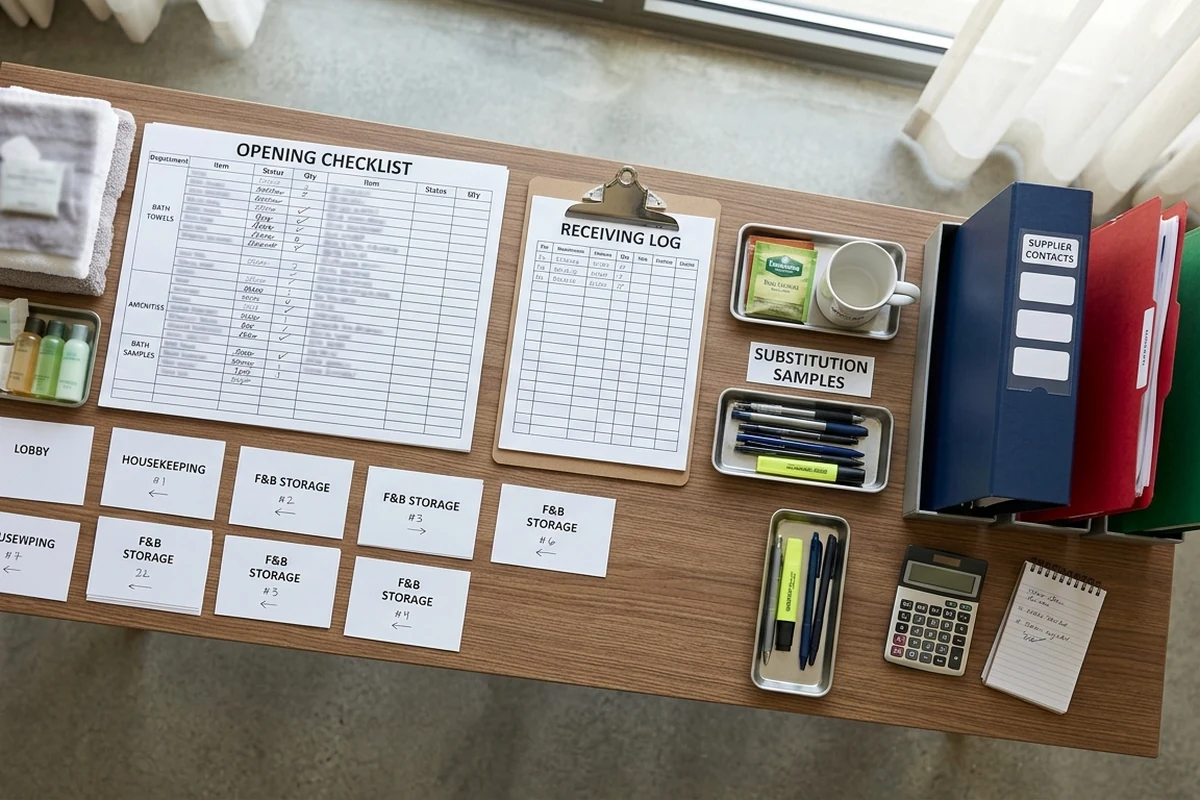
Use this checklist before the hotel treats OS&E procurement as ready for opening:
| Checkpoint | Pass condition | If not ready |
|---|---|---|
| Scope boundary | OS&E, FF&E, consumables, and operator-supplied items are separated | Hold supplier release until the category owner confirms scope |
| Item file | Every active item has code, owner, quantity basis, approved reference, supplier, and status | Return the item to proposed or sampled status |
| Supplier route | Supplier, sample owner, packing owner, and issue route are named | Keep supplier in review, not final award |
| Quantity logic | Counts show room, outlet, floor, spare, opening stock, or replacement basis | Recalculate before purchase order release |
| Packing and marks | Cartons can be matched to item code, operating area, and receiving location | Ask supplier to revise marks before shipment |
| Receiving plan | Count, damage, quarantine, photo, and escalation rules are written | Do a trial receiving event before bulk arrival |
| Storage plan | Secure and department-level storage locations are assigned | Delay delivery or split shipment where practical |
| Substitution log | Every substitute has reason, approver, impact, and final status | Do not receive as approved stock |
| Department handoff | Operations can find, use, reorder, and report issues for each item | Keep procurement file open after soft opening |
This checklist is intentionally operational. It helps the buyer see whether a line item can survive the opening week, not only whether it was purchased.
Relevant hospitality project examples can support context discussion, but the current hotel's item files and receiving records should own the handoff. When ready, request an OS&E procurement review with the room count, operating areas, brand or operator requirements, item list, receiving plan, and opening date.
Sources and Further Reading
RON GROUP Project Support supports hotel project procurement coordination context.
RON GROUP Hotel Furniture supports adjacent hotel furniture scope context.
American Society for Quality supplier quality guidance supports supplier-quality evaluation beyond price.
International Trade Administration due-diligence guidance supports supplier due diligence.
OSHA 29 CFR 1910.37 supports exit-route lighting and marking coordination context when relevant.
Get the week's latest industry information
-
Real-Life Professional Restaurant Case Studies
Explore Now
-
Create a unique restaurant with over 95,700+products
Explore Now
-
Protessional Free 3D Restaurant Design
Explore Now
-
Still Have Questions About Opening a Restaurant?
Explore Now

Sylvia
With 8 years in catering & hospitality industry, sales manager of Ron Group, specialise in providing one stop solutions to restaurants, hotels and weddings.
Discover Our Exclusive Products
Explore our extensive range of restaurant and hotel supplies designed to enhance your operations. Find the perfect solutions to meet your needs.
Browse Our ProductsFREE 3D DESIGN
Boost your restaurant's success with our free 3D design service. Start building the restaurant of your dreams today!
Explore 3D Design Case
RECOMMENDED CASES
-
La Rambla by Catalunya: Crafting Barcelona's Soul in Hong Kong - Custom Furniture Excellence
RON Group's custom Spanish-inspired furniture elevates La Rambla with artisanal aesthetics...
Learn More -

Cardinal Point: Elevating Outdoor Seating with Tailored Cushion Upgrades
Discover how Cardinal Point transformed its outdoor dining experience with custom cushions, achievin
Learn More
RECOMMENDED BLOGS
-

Bar Glassware 101: Types, Names, Uses, and How to Stock Your Bar
Learn the 10 core bar glassware types, names, and uses. Discover how to stock your bar with the right glasses for cocktails, beer,...
Sylvia2026-07-26 -

Complete Bar Equipment List for Opening a Bar
Plan a complete commercial bar equipment list by menu, service volume, refrigeration, ice, glassware, utilities, sanitation,...
Sylvia2026-06-11 -

Low Budget Restaurant Interior Design: 2026 Trends
Prioritize a low-budget restaurant interior by protecting code, operations, durability, accessibility, and phased design decisions...
Sylvia2026-04-04
Subscribe to RON GROUP
Stay up-to-date with the latest industry insights and expert advice. Together, we'll create your ideal restaurant.

Contact Us Today
Connect With Us Today