
Hotel Lobby Design: 2026 Trends That Transform Spaces!
Want a viral hotel lobby? Master the art of visual anchors and biophilic design. Solve your maintenance nightmares with performance fabrics that last years.
Content
Executive Summary
The hospitality industry is currently navigating a profound transformation in how physical spaces are utilized, monetized, and perceived. The hotel lobby, once a transient corridor for check-in and departure, has metamorphosed into a complex, multi-functional “third place”—a destination that anchors the guest experience, facilitates social interaction, and generates significant ancillary revenue. For stakeholders in the hospitality sector—specifically hotel owners, restaurant operators, and procurement managers—the deployment of lobby furniture has shifted from a purely aesthetic consideration to a critical strategic asset allocation. In 2025, the lobby is the “living room” of the hotel, a co-working space, a casual dining venue, and the primary stage for brand storytelling.
This comprehensive research report, commissioned for RON Group Global, provides an exhaustive analysis of the four pillars of successful furniture deployment: Fabric Durability (Material Science), Guest Flow Dynamics (Circulation), Visual Anchoring (Psychological Design), and Lifecycle Maintenance (Operational Resilience). By synthesizing rigorous global standards—including NSF, UL, and ADA requirements—with emerging trends and financial modeling, this document offers a blueprint for navigating the complexities of modern hospitality procurement.
The analysis reveals that the distinction between “residential” and “contract-grade” furniture is not merely marketing nomenclature but a quantifiable engineering standard that directly impacts the Total Cost of Ownership (TCO). With the hospitality sector facing inflationary pressures, the efficiency of sourcing becomes paramount. The report highlights how integrated solutions providers like RON Group Global, leveraging mature Chinese manufacturing capabilities to deliver global standards, offer a competitive advantage. This approach can reduce procurement costs by up to 65%. Furthermore, the integration of biophilic design, smart technology, and strategic zoning is shown to increase guest dwell time, thereby driving higher Food and Beverage (F&B) capture rates and enhancing the property’s Net Promoter Score (NPS).
1. The Strategic Evolution of the Hotel Lobby: From Transit to Destination
1.1 The Lobby as the New Revenue Center
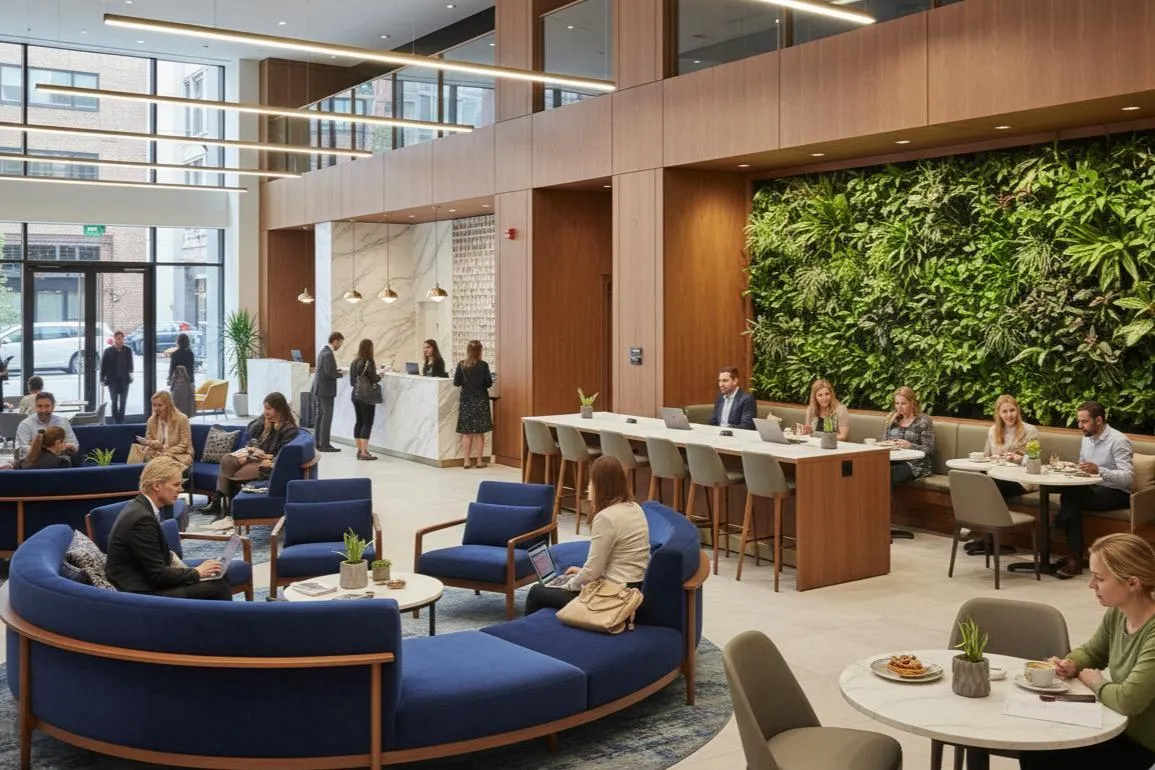
Historically, the hotel lobby was a cost center—a necessary expanse of marble and seating required to process arrivals. Today, astute hoteliers view the lobby as a high-yield revenue center. The rise of the “Open Lobby” concept, championed by major international chains, dissolves the boundaries between the front desk, the bar, the business center, and the lounge. This architectural convergence, documented in academic analyses of front-line hotel operations, demands a new category of furniture: pieces versatile enough to support a morning coffee meeting, an afternoon of laptop work, and an evening cocktail service.
Data indicates that guests are increasingly seeking “bleisure” (business + leisure) experiences, where the ability to work comfortably in public areas is a decisive factor in booking. Consequently, furniture deployment must prioritize ergonomics and electrification alongside aesthetics. A sofa is no longer just a place to wait; it is a workstation. A coffee table is a dining surface. This functional density increases the mechanical stress on furniture assets, necessitating a “performance-first” procurement philosophy. Furniture failure in a high-traffic lobby is not just an operational nuisance; it is a revenue disruption. If a guest cannot find a comfortable, powered seat, they retreat to their room or leave the property, taking their F&B spend with them.
1.2 The Financial Imperative of “Instagrammability”
In the digital age, the lobby is the primary backdrop for user-generated content (UGC). A visually striking lobby serves as free marketing, amplified through social media channels. However, this “Instagrammability” creates a tension between delicate, high-design aesthetics and the brutal reality of commercial wear and tear. The strategic challenge lies in deploying “Visual Anchors”—statement pieces that capture the eye—while ensuring they are constructed with materials capable of withstanding the rigors of 24/7 public use.
Procurement managers must navigate this dichotomy by selecting “contract-grade” items that mimic the visual language of high-end residential design but possess the structural integrity of industrial equipment. This balance is often achieved by utilizing suppliers who bridge the gap between bespoke design and mass-manufacturing efficiency, a key topic in modern hotel furniture purchasing guides.
1.3 The RON Group Value Proposition in Global Sourcing
In an environment where capital expenditure (CapEx) budgets are scrutinized, the efficiency of the supply chain is a critical differentiator. RON Group Global exemplifies the modern procurement model, offering a “one-stop solution” that integrates design, manufacturing, and logistics. With over 19 years of experience and a footprint in 108 countries, the brand demonstrates that high-quality hospitality furniture need not come with a prohibitive price tag. By leveraging the scale of Chinese manufacturing, RON Group’s hotel furniture collections provide a pathway for hoteliers to access commercial-grade durability—tested to international standards—at a cost structure that supports a healthy ROI. This vertical integration allows for stricter quality control (QC) and the flexibility to customize furniture to specific brand standards, a crucial capability in a market moving away from cookie-cutter design toward localization.
2. Material Science and Durability Engineering: Defining “Contract-Grade”
The foundation of any successful furniture deployment is the material science that dictates its longevity. “Contract-grade” is the industry standard for furniture intended for commercial use, distinguishing it from residential furniture which is ill-equipped for the demands of hospitality.
2.1 The Physics of Abrasion: Martindale vs. Wyzenbeek
The primary metric for assessing upholstery durability is abrasion resistance. This is determined through standardized mechanical testing where fabric is rubbed against an abrasive surface until failure. Two dominant standards govern the global market, and understanding the difference is vital for procurement managers operating across regions.
Predominant in Europe, Asia, and Oceania, the Martindale test utilizes a specialized machine that rubs the fabric sample against a standard abrasive (usually wool or wire mesh) in a Lissajous figure—a complex, multi-directional figure-eight pattern. This process is detailed in interior design material testing standards.
Mechanism: The fabric is mounted flat and subjected to a specific pressure (typically 12 kPa for upholstery). The multi-directional rubbing simulates the natural wear of a user sitting, shifting weight, and twisting on a cushion.
Scoring: The result is expressed in “cycles.” The test concludes when two yarns break or there is a significant change in appearance.
Hospitality Benchmarks:
< 10,000 cycles: Decorative/Accent use only. Suitable for throw pillows or drapes.
20,000 - 30,000 cycles: Heavy Domestic/General Commercial. Suitable for guest room desk chairs.
> 40,000 cycles: Contract Commercial. This is the minimum standard for hotel lobbies, restaurant banquettes, and public areas.
> 100,000 cycles: Extreme Duty. Required for 24-hour environments like casinos or airport lounges.
Standard in North America, the Wyzenbeek test involves a machine rubbing the fabric back and forth in a linear motion against a cotton duck or wire mesh abradant.
Mechanism: The fabric is pulled tight over a curved surface, and the abradant rubs against it. Each back-and-forth motion counts as one “double rub.” This test is more aggressive than Martindale and simulates the friction of sliding in and out of a booth or the wear on armrests.
Hospitality Benchmarks:
15,000 double rubs: Residential use.
30,000 double rubs: Heavy Duty Commercial. The standard requirement for hotel lobby seating, aligning with the Association for Contract Textiles (ACT) guidelines.
> 100,000 double rubs: Often specified for high-traffic zones to ensure extended lifecycle.
Table 1: Comparative Abrasion Standards for Hospitality Zoning
| Zone Application | Martindale Cycles (ISO) | Wyzenbeek Double Rubs (ASTM) | Operational Context |
|---|---|---|---|
| Guest Room Accent | 15,000 - 20,000 | 15,000 | Occasional use chairs, headboards. |
| Guest Room Desk | 25,000 - 30,000 | 20,000 - 30,000 | Moderate daily use. |
| Lobby Lounge | 40,000 - 50,000 | 30,000 - 50,000 | High traffic, continuous use, varied clothing textures. |
| Restaurant Booth | 60,000+ | 50,000+ | Sliding friction, food spills, rigid cleaning protocols. |
| Bar Stool | 80,000+ | 60,000+ | Extreme friction on seat edges, denim abrasion. |
| 24/7 Concierge | 100,000+ | 100,000+ | Constant occupation, heavy uniformed gear. |
Critical Insight: There is no direct conversion formula between Martindale and Wyzenbeek. A fabric might pass 50,000 Martindale cycles because it handles surface friction well but fail at 15,000 Wyzenbeek rubs because its weave structure unravels under linear stress. Best Practice: For global hotel chains, procurement managers should request both test results to ensure universal durability.
2.2 Advanced Performance Technologies
Beyond abrasion, the chemical resilience of fabric is crucial. Lobbies are high-risk zones for spills (coffee, wine) and biological contaminants. “Performance Fabrics” are engineered to mitigate these risks.
Crypton is a patented system where the fabric fibers are encapsulated in a protective barrier that is resistant to stains, moisture, and bacteria. Unlike topical treatments (like Scotchgard) that can wear off, Crypton is integrated into the fiber itself. It creates a moisture barrier that prevents liquids from penetrating into the foam cushion, which is the primary cause of deep odors and mold. Similarly, nanotechnology finishes (like Nano-Tex) modify the fabric at the molecular level to repel spills while maintaining breathability, avoiding the “plastic” feel of older vinyl backings.
For lobbies with significant natural light, Solution-Dyed Acrylic or Nylon is essential. In this process, the color pigment is mixed into the liquid polymer before the fiber is extruded. This means the color goes all the way through the fiber (like a carrot), rather than sitting on the surface (like a radish). These fabrics are virtually fade-proof and can be cleaned with aggressive bleach solutions without losing color, making them ideal for sanitizing protocols.
A major trend for 2025 is the shift away from PVC (vinyl) and PU (polyurethane) faux leathers toward Silicone Leather. Made from silica (sand), this material is inherently stain-resistant (even to ink and denim dye), does not hydrolyze (peel and crack) in humid environments, and is eco-friendly. It offers the soft hand of leather with the durability of a synthetic, making it a premier choice for high-end sustainable lobbies. For a deeper dive into material selection, see our insights on avoiding furniture purchase mistakes.
2.3 Fire Safety and Compliance
Safety codes are non-negotiable. Furniture must meet the specific flammability standards of the region where the hotel is located.
CAL 117-2013 (USA): The standard for upholstered furniture flammability. Most commercial fabrics must pass this.
NFPA 260 / UFAC Class 1: Cigarette ignition resistance.
BS 5852 (UK/Europe) - “Crib 5”: A stricter test involving a wood crib ignition source. Furniture destined for the UK or markets following British Standards must be “Crib 5” compliant. This often requires an additional FR (Fire Retardant) back-coating, a critical specification in global furnishing safety codes.
Procurement Warning: When sourcing globally, specifically from China, it is critical to explicitly state the destination market’s fire code (e.g., “Must be Crib 5 compliant for London project”). Standard foam and fabric may not meet these stricter codes without specific additives.
3. The Physics of Hospitality: Circulation and Flow Dynamics
The placement of furniture is an exercise in engineering human movement. A lobby layout must guide guests intuitively while providing comfortable “eddies” for rest and interaction. This section analyzes the geometry of flow using the principles of Proxemics and Universal Design (ADA).
3.1 Proxemics: The Geometry of Social Interaction
Anthropologist Edward T. Hall’s theory of Proxemics defines four zones of interpersonal distance. Understanding these zones is critical for placing furniture to encourage specific behaviors, a concept rooted in hospitality proxemics research.
The Public Zone (> 12 ft / 3.6m): The distance maintained between strangers. In a lobby, this corresponds to the main arterial walkways. Furniture should not intrude here.
The Social Zone (4 - 12 ft / 1.2 - 3.6m): The distance for impersonal business or casual interaction. Furniture arrangements in this zone (e.g., sofas facing each other) should be spaced to allow conversation without forcing intimacy. Ideally, face-to-face seating should be 4-6 feet apart.
The Personal Zone (1.5 - 4 ft / 0.45 - 1.2m): Reserved for friends and family. Small clusters of armchairs with a shared coffee table fit here.
The Intimate Zone (< 1.5 ft / 0.45m): Private interactions. High-backed “pod” chairs or secluded booths cater to this need for privacy within a public space.
Strategic Application: A successful lobby layout layers these zones. A purely open-plan lobby with vast distances between seats feels sterile (the “airport effect”). Conversely, too many high-backed booths can make the space feel defensive. The trend for 2025 is “variable density”—creating high-energy social hubs near the bar and quiet, lower-density zones on the periphery, reflecting the evolution of the hotel lobby as a social space.
3.2 ADA Compliance and Universal Design
Accessibility is a legal mandate in the US (Americans with Disabilities Act) and a best practice globally. Failure to comply creates legal liability and alienates guests with mobility challenges.
Circulation Paths: Main aisles must be at least 36 inches (915 mm) wide continuously, with passing spaces of 60 inches (1525 mm) every 200 feet, as mandated by ADA accessible route guidelines.
Turning Space: Wheelchairs require a 60-inch (1525 mm) diameter circle to turn 180 degrees. Furniture layouts must leave these “turning circles” at key decision points (e.g., in front of elevators, check-in desks, restrooms).
Table Metrics: Accessible dining or work tables should have a surface height between 28 and 34 inches, with at least 27 inches of clear knee space underneath.
Reach Ranges: Controls (lamps, power outlets integrated into furniture) must be reachable from a seated position, typically between 15 and 48 inches from the floor.
Table 2: Critical Dimensions for Accessible Lobby Layouts
| Dimension Type | Minimum Requirement (ADA) | Recommended for Luxury Feel | Rationale |
|---|---|---|---|
| Main Aisle Width | 36 inches (915 mm) | 48 - 60 inches | Accommodates luggage carts and two-way guest traffic comfortably. |
| Secondary Aisle | 32 inches (815 mm) | 36 - 42 inches | Allows easier navigation between furniture clusters. |
| Space Between Tables | 36 inches | 42 - 48 inches | Prevents “chair clash” when guests push back; enhances acoustic privacy. |
| Table Surface Height | 28 - 34 inches | 30 inches | Standard dining/work height comfortable for typing and eating. |
| Knee Clearance | 27 inches high | 28 - 29 inches | Accommodates guests crossing legs or larger power wheelchairs. |
3.3 Zoning Strategies for Guest Flow
To maximize utility, the lobby should be segmented into distinct zones, each with specific furniture requirements.
The Arrival Zone (Decompression):
Goal: Orient the guest and handle luggage.
Furniture: High consoles for resting bags, minimal seating.
Flow: Wide, unobstructed paths to the reception. No low furniture that could be a trip hazard.
The Social Hub (The “Hearth”):
Goal: Encourage dwelling and F&B consumption.
Furniture: Lounge sofas, low coffee tables, clustered armchairs.
Flow: Positioned as an “eddy” in the main river of traffic—visible but not intersected by the primary walkway.
The Co-Working Zone (Productivity):
Goal: Facilitate work and meetings.
Furniture: Communal tables (30" height) with integrated power, ergonomic task chairs, acoustic wingback chairs.
Flow: Peripheral placement to reduce visual distraction and noise.
The Solitary Zone (Rest):
Goal: Provide privacy for reading or waiting.
Furniture: Single lounge chairs with ottomans, alcove seating, high-backed “pods.”
Flow: Tucked into corners or shielded by bookshelves/dividers.
4. Psychological Architecture and Visual Anchoring
Furniture is the tangible interface of the hotel’s brand. While architecture creates the shell, furniture creates the feeling. The concept of “Visual Anchors” refers to key pieces that capture attention, orient the guest, and communicate the hotel’s narrative.
4.1 The Neuroscience of First Impressions
Research indicates that guests form lasting opinions about a property within the first 30 seconds of entry, highlighting the importance of lobby design and front desk arrangements. This judgment is driven by sensory inputs: light, scale, and the visual weight of furniture.
The Centerpiece: A central lobby arrangement acts as the “heart.” While a round table with florals is traditional, modern trends favor a “sculptural seating island”—a circular banquette or a tessellation of modular ottomans that invites 360-degree engagement.
Scale and Proportion: High ceilings demand high-backed furniture. Placing low-profile modern furniture in a grand, double-height lobby can make the furniture look like miniatures, causing subconscious unease (agoraphobia). “Throne” chairs or wingbacks provide a sense of enclosure and protection in vast spaces.
4.2 Biophilic Design: Reducing Stress through Form
Biophilia—the innate human tendency to seek connections with nature—is a dominant trend for 2025. It moves beyond simply adding plants to incorporating biomimicry in furniture forms.
Organic Geometries: Furniture with curved lines, rounded corners, and kidney shapes mimics natural forms and is perceived as more welcoming and safer than sharp, angular designs.
Fractal Patterns: Fabrics with complex, self-repeating patterns (like leaves or waves) are visually soothing.
Natural Materiality: Exposure to wood grain, stone textures, and natural fibers (wool, linen, rattan) has been proven to lower cortisol (stress) levels. Sourcing furniture that highlights natural imperfections (e.g., live-edge tables) grounds the guest and creates a “sanctuary” feel.
4.3 Narrative Anchors and “Instagrammability”
Guests increasingly seek “local” experiences. Furniture can narrate the location’s history.
Materiality as Story: A coastal hotel might use driftwood-inspired finishes or rope weaving. A city hotel might use industrial metals and leather.
The “Selfie Spot”: A Visual Anchor is also a marketing tool. A unique, oversized, or artistically distinct chair often becomes a focal point for social media sharing. This piece doesn’t need to be the most comfortable; it needs to be the most photogenic. It serves as a visual signature that proves the guest was there.
5. Operational Resilience: The Maintenance Mandate
The most beautiful furniture is a liability if it cannot be maintained. A rigorous maintenance plan extends the lifecycle of assets, protects the TCO, and ensures the brand standard is upheld.
5.1 The Maintenance Matrix
Maintenance is a tiered strategy of Prevention, Routine Care, and Restoration.
Glides and Felt Pads: Every movable chair must have high-quality floor glides. These protect both the flooring and the chair legs. They must be checked monthly as they wear down and collect grit.
Fabric Treatments: Re-application of stain repellents should be considered after deep cleanings, although factory-integrated treatments (Crypton) last longer.
Rotation: Furniture near windows fades faster due to UV exposure. Rotate chairs and cushions quarterly to ensure even wear and fading, a standard step in hotel preventive maintenance checklists.
Housekeeping staff must be trained on the cleaning codes found on furniture tags to avoid damaging assets:
Code W (Water-based): Safe for water-based shampoos/foam. Use distilled water to avoid mineral rings.
Code S (Solvent): Dry clean only. Water will cause shrinking or water spots. Use water-free solvents in a well-ventilated area.
Code WS (Water/Solvent): Can use either, but mild detergent foam is usually safest.
Code X (Vacuum Only): Do not use liquids. Brushing and vacuuming only. Recommendation: Avoid specifying Code X fabrics for high-traffic lobbies.
A digitized checklist is essential for accountability.
Table 3: Hotel Lobby Furniture Maintenance Schedule
| Frequency | Task | Responsible Party |
|---|---|---|
| Daily | Visual inspection for spills/stains. Fluff cushions. Re-align furniture to floor plan markers. | Housekeeping / Porters |
| Weekly | Vacuum upholstered crevices. Wipe down hard surfaces (wood/metal) with appropriate polish. Check for loose legs/wobbles. | Housekeeping / Engineering |
| Monthly | Inspect floor glides/felt pads. Check mechanism function (swivels, recliners). Deep clean high-traffic spots. | Engineering / External Vendor |
| Quarterly | Rotate cushions and furniture positions (UV/Wear management). Steam clean (Code W fabrics). Tighten all structural bolts. | Engineering / External Vendor |
| Annually | Professional deep extraction cleaning. Wood touch-ups (scratches/dents). Assess for replacement/reupholstery. | External Specialist |
6. Financial Intelligence: TCO and Procurement Strategy
Procurement decisions often hinge on the initial purchase price, but the “sticker price” is a poor indicator of value. The Total Cost of Ownership (TCO) model provides a realistic financial picture over the asset’s life.
6.1 The TCO Formula
The TCO of a piece of furniture is calculated as:
TCO = P + I + (M x Y) - S + R
Where:
P: Purchase Price (including freight/duty).
I: Installation/Assembly costs.
M: Annual Maintenance costs (cleaning, repairs).
Y: Years of useful life (Lifecycle).
R: Replacement/Disposal costs.
S: Salvage value (often negligible for contract furniture).
6.2 Scenario Analysis: Residential vs. Contract Grade
Let’s compare a Residential Grade Chair ($300) purchased locally vs. a Contract Grade Chair ($600) sourced from a supplier like RON Group.
Scenario A (Residential Chair):
Price: $300.
Durability: 15,000 double rubs.
Lifespan in Lobby: 1.5 years.
Replacements over 6 years: 4.
Total Cost (6 Years): $300 x 4 + Installation x 4 + Disposal x 3 = >$1,500+ (plus operations disruption).
Scenario B (Contract Chair):
Price: $600.
Durability: 100,000 double rubs.
Lifespan in Lobby: 7+ years.
Replacements over 6 years: 0.
Total Cost (6 Years): $600 + Maintenance.
Financial Insight: The contract chair, despite being double the initial price, costs less than half over a standard 6-year Property Improvement Plan (PIP) cycle. This logic underpins the B2B sales argument for high-quality manufacturing. For a detailed breakdown of costs, refer to our guide on restaurant furniture sourcing and pricing.
6.3 Soft Goods vs. Case Goods Replacement Cycles
Budgeting must account for different replacement cadences.
Soft Goods (Upholstery, Drapes, Rugs): Replaced every 5-7 years (aligned with typical brand PIP cycles).
Case Goods (Hard furniture, Desks, Tables): Replaced every 10-14 years.
Sourcing Strategy: For soft goods, prioritize frames that can be reupholstered. A quality hardwood frame (kiln-dried maple or beech) can be reupholstered 2-3 times, saving significant capital compared to buying new.

7. Future Horizons: Technology and Sustainability (2025 Outlook)
As we look toward 2025 and beyond, two major forces are shaping the landscape of lobby furniture: the integration of smart technology and the imperative for environmental sustainability.
7.1 The “Smart” Lobby: Tech-Integrated Furniture
The modern traveler carries an average of three connected devices. Furniture is evolving into the charging infrastructure of the hotel.
Integrated Power: Tables and sofa bases with built-in USB-C and wireless charging pads (Qi standard) are becoming standard requirements. These must be spill-proof and easily serviceable.
Cable Management: Furniture must be designed with hidden channels to route power cords to floor boxes, preventing trip hazards (ADA liability) and visual clutter.
Flexibility: Battery-powered charging tables allow furniture to be moved without being tethered to wall outlets, offering ultimate layout flexibility for events. (Contact RON Group Global to discuss custom smart furniture integration).
7.2 Sustainability and “Green” Procurement
Corporate Social Responsibility (CSR) and guest demand are driving hotels to seek eco-certifications (LEED, WELL).
Certified Wood: Sourcing FSC (Forest Stewardship Council) certified wood ensures responsible forestry practices.
Recycled Fabrics: Upholstery made from recycled ocean plastics (PET bottles) or biodegradable fibers (hemp, organic cotton) is entering the mainstream contract market.
Circular Economy: Suppliers who offer “take-back” programs or modular designs where parts (like arms or seat pans) can be replaced individually without discarding the whole chair are gaining market share.
Conclusion
Deploying hotel lobby furniture is a sophisticated interplay of engineering, psychology, law, and finance. It requires balancing the scientific (abrasion testing, ergonomics), the legal (ADA, fire codes), the psychological (proxemics, biophilia), and the financial (TCO, ROI).
For industry professionals partnering with solution providers like RON Group Global, the path to success involves a disciplined approach:
Specify Rigorously: Move beyond generic descriptions to specifying “100,000 Wyzenbeek double rubs, Crypton finish, CAL 117 compliant.”
Plan for Flow: Use zoning and proxemics to create a dynamic mix of social and private spaces.
Invest for Life: View furniture as a 7-10 year asset, utilizing TCO calculations to justify quality.
Maintain with Discipline: Implement digitized maintenance schedules to protect the investment.
By adhering to these principles, hoteliers can transform their lobbies from passive waiting rooms into vibrant, revenue-generating assets that define the guest experience and build lasting brand equity.
Get the week's latest industry information
-
Real-Life Professional Restaurant Case Studies
Explore Now
-
Create a unique restaurant with over 95,700+products
Explore Now
-
Protessional Free 3D Restaurant Design
Explore Now
-
Still Have Questions About Opening a Restaurant?
Explore Now

Sylvia
With 8 years in catering & hospitality industry, sales manager of Ron Group, specialise in providing one stop solutions to restaurants, hotels and weddings.
Discover Our Exclusive Products
Explore our extensive range of restaurant and hotel supplies designed to enhance your operations. Find the perfect solutions to meet your needs.
Browse Our ProductsFREE 3D DESIGN
Boost your restaurant's success with our free 3D design service. Start building the restaurant of your dreams today!
Explore 3D Design Case
RECOMMENDED CASES
-

La Rambla by Catalunya: Crafting Barcelona's Soul in Hong Kong - Custom Furniture Excellence
RON Group's custom Spanish-inspired furniture elevates La Rambla with artisanal aesthetics...
Learn More -

Cardinal Point: Elevating Outdoor Seating with Tailored Cushion Upgrades
Discover how Cardinal Point transformed its outdoor dining experience with custom cushions, achievin
Learn More
RECOMMENDED BLOGS
-
Restaurant Table Spacing and Aisle Clearance: Supplier Drawing Checklist
Check restaurant table spacing, aisle clearance, chair pullout, service path, and supplier drawing proof before approving a...
Sylvia2026-07-20 -

5 Mistakes to Avoid When Buying Restaurant Furniture from China
Don't fall for costly oversights! Learn the 5 mistakes to avoid when buying restaurant furniture from China and ensure a...
 Ron2025-01-079 min read
 -

RON GROUP Launches VR Experience to Explore Our Dynamic Showroom
Discover RON GROUP's VR showroom! Explore dining furniture, tableware, and customized services virtually or visit us in person to...
Sylvia2024-12-163 min read
Subscribe to RON GROUP
Stay up-to-date with the latest industry insights and expert advice. Together, we'll create your ideal restaurant.