
Why More Hotels Are Investing in Custom Furniture: The ROI of Brand Consistency
Learn how custom hotel furniture drives 7–11% RevPAR uplift, lowers ownership costs, and why 58% of hospitality brands see it as key to guest experience.
Content
In an industry where a single point increase in guest satisfaction scores can lift RevPAR by 5–9%, hotel owners are rethinking where their renovation dollars deliver the highest return. The global hotel furniture customization market, valued at $14.72 billion in 2024 and projected to reach $21.49 billion by 2033, tells a clear story: custom furniture is no longer a luxury line item — it is a strategic investment in brand equity. This article examines the financial case for custom hotel furniture, compares it against off-the-shelf alternatives, and provides a framework for calculating your return on investment.
The Economics of Hotel Furniture: Why the Numbers Are Shifting
Hotel renovation cycles typically run on a 6–8 year schedule for full property refreshes, with soft goods and FF&E (furniture, fixtures, and equipment) turning over every 3–6 years. According to industry cost analysis data, FF&E accounts for 7–10% of total construction costs, and furniture alone represents 30–40% of FF&E budgets.
Here is where the economics get interesting. Standard off-the-shelf hotel furniture may cost 15–25% less at the point of purchase, but properties using commodity furniture typically replace it 2–3 times during the lifespan of a single well-constructed custom piece. When you factor in replacement costs, shipping, installation labor, and operational disruption from repeated renovation cycles, the total cost of ownership often favors custom.
| Cost Factor | Off-the-Shelf Furniture | Custom Hotel Furniture |
|---|---|---|
| Initial cost per room | $3,000 – $7,000 | $5,000 – $12,000 |
| Average lifespan | 3 – 5 years | 8 – 12 years |
| Replacement cycles over 12 years | 2 – 3 replacements | 0 – 1 replacement |
| 12-year total cost per room (furniture only) | $9,000 – $21,000 | $5,000 – $18,000 |
| Revenue lost during renovations | Multiple disruption periods | Minimal disruption |
For a 200-room property, the difference in total cost of ownership over a 12-year period can range from $600,000 to over $1.2 million — before accounting for the revenue impact of rooms taken offline during refurbishment.
Brand Consistency: The Revenue Driver Most Hotels Undervalue
According to a Riveron hospitality analysis, a brand's long-term value is defined by its ability to deliver on the guest promise consistently. Research indicates that 58% of hospitality brands now consider customized furniture essential for maintaining consistent guest experiences across multiple locations.
Brand consistency in furniture design affects three measurable revenue drivers:
1. Guest Recognition and Loyalty
When a business traveler checks into a Sofitel in Shanghai and finds the same design language, material quality, and spatial experience as a Sofitel in Paris, that consistency reinforces brand trust. Custom furniture designed to brand specifications ensures this continuity across properties — something impossible to achieve when sourcing generic pieces from different vendors in different markets.
2. Review Scores and Online Reputation
Data from Amerail Systems research shows that when hotel details align with brand standards and modern guest expectations, review scores quickly reflect the positive change. A boutique hotel in New York documented a 15% increase in positive reviews within three months of refurbishing guest rooms with high-quality, design-forward furniture. Since online review scores directly influence booking decisions, the furniture investment creates a compounding return through improved digital reputation.
3. ADR and RevPAR Uplift
Cornell University's School of Hotel Administration found that hotels investing in premium furnishings experienced average RevPAR increases of 7–11% within one year. Properties that renovate proactively — 6–12 months before their competitive set — achieve 12–18% higher post-renovation RevPAR gains compared to those renovating reactively. Custom furniture, designed specifically to elevate a property's positioning, amplifies this effect.
For a hotel generating $120 RevPAR, even a conservative 7% improvement translates to an additional $8.40 per available room per night. For a 200-room property at 75% occupancy, that is approximately $460,000 in additional annual revenue.
Custom vs. Modular: Finding the Right Approach
The choice is not always binary between fully bespoke and entirely off-the-shelf. Many hotel groups are adopting a hybrid strategy that balances brand consistency with cost efficiency:
Fully custom: Best for flagship properties, luxury brands, and hotels where design is a core differentiator. Every piece is manufactured to exact specifications for material, dimension, finish, and hardware.
Semi-custom (modular customization): A base design is adapted with brand-specific finishes, fabrics, and dimensions. This approach delivers 80–90% of the brand consistency of fully bespoke at 60–70% of the cost. Modular systems let you replicate your brand identity without the complexity of coordinating unique fabrication for every location.
Standardized with brand accents: Off-the-shelf frames paired with custom upholstery, hardware, or finishing. Suitable for select-service and economy tiers where cost sensitivity is highest.
Regardless of which approach a hotel group selects, the key is working with a manufacturer that offers comprehensive hotel furniture solutions spanning all three tiers, so you can match the investment level to each property's positioning without sacrificing design coherence.
The Hidden Costs of Inconsistent Furniture Sourcing
Hotels that source furniture from multiple vendors across different markets often encounter costs that never appear on the purchase order:
Quality variance: Different manufacturers use different materials, construction methods, and quality control standards. A nightstand that holds up perfectly from one vendor may fail within 18 months from another, even if the product photos look identical.
Color and finish drift: Matching wood tones, fabric colors, and metal finishes across vendors is notoriously difficult. Even small variations become visible when pieces sit next to each other in a guest room, creating an impression of inconsistency that erodes perceived value.
Supply chain fragmentation: Managing multiple vendor relationships, lead times, warranty terms, and replacement part inventories increases procurement complexity and administrative overhead.
Compliance risk: Hospitality furniture must meet fire retardancy, structural load, and durability standards that vary by market. A single-source manufacturer with integrated factory capabilities ensures all pieces meet or exceed applicable standards.
Consolidating your furniture supply chain under one manufacturer that can handle guest room furniture, lobby seating, restaurant tables, and public area pieces eliminates these hidden costs and ensures material and design consistency across your entire property.
Calculating Your Custom Furniture ROI: A Practical Framework
To build a business case for custom hotel furniture investment, quantify returns across four categories:
Category 1: Direct Cost Savings (Total Cost of Ownership)
Compare the 10–12 year total cost of ownership, including:
Purchase price per unit
Shipping and logistics (custom furniture from a single source often ships more efficiently)
Installation and assembly labor
Projected replacement frequency and cost
Disposal costs for replaced furniture
Category 2: Revenue Impact
Model the RevPAR and ADR improvement based on:
Current guest satisfaction scores and their correlation with room rate
Competitive set positioning — how your property's design compares with peers
Historical data from previous renovations (if available)
Industry benchmarks: 7–11% RevPAR lift from premium furniture upgrades
Category 3: Operational Efficiency
Estimate savings from:
Reduced vendor management overhead (fewer suppliers, fewer POs, fewer invoices)
Lower maintenance and repair costs (custom pieces built to hospitality-grade durability standards)
Fewer rooms offline for furniture-related maintenance
Simplified reordering for replacements and expansions
Category 4: Brand Value Contribution
While harder to quantify directly, consider:
Impact on franchise or management agreement compliance scores
Guest photography and social media exposure (distinctive design drives organic sharing)
Staff pride and operational morale (employees perform better in well-designed environments)
Competitive differentiation in a market moving toward design-led hospitality
Properties that track all four categories consistently find that custom furniture pays for the cost premium within 2–3 years, with compounding returns over the remaining lifespan of the pieces.
What to Look for in a Custom Hotel Furniture Partner
Not all manufacturers are equipped to deliver true hospitality-grade custom furniture at scale. When evaluating partners, prioritize these capabilities:
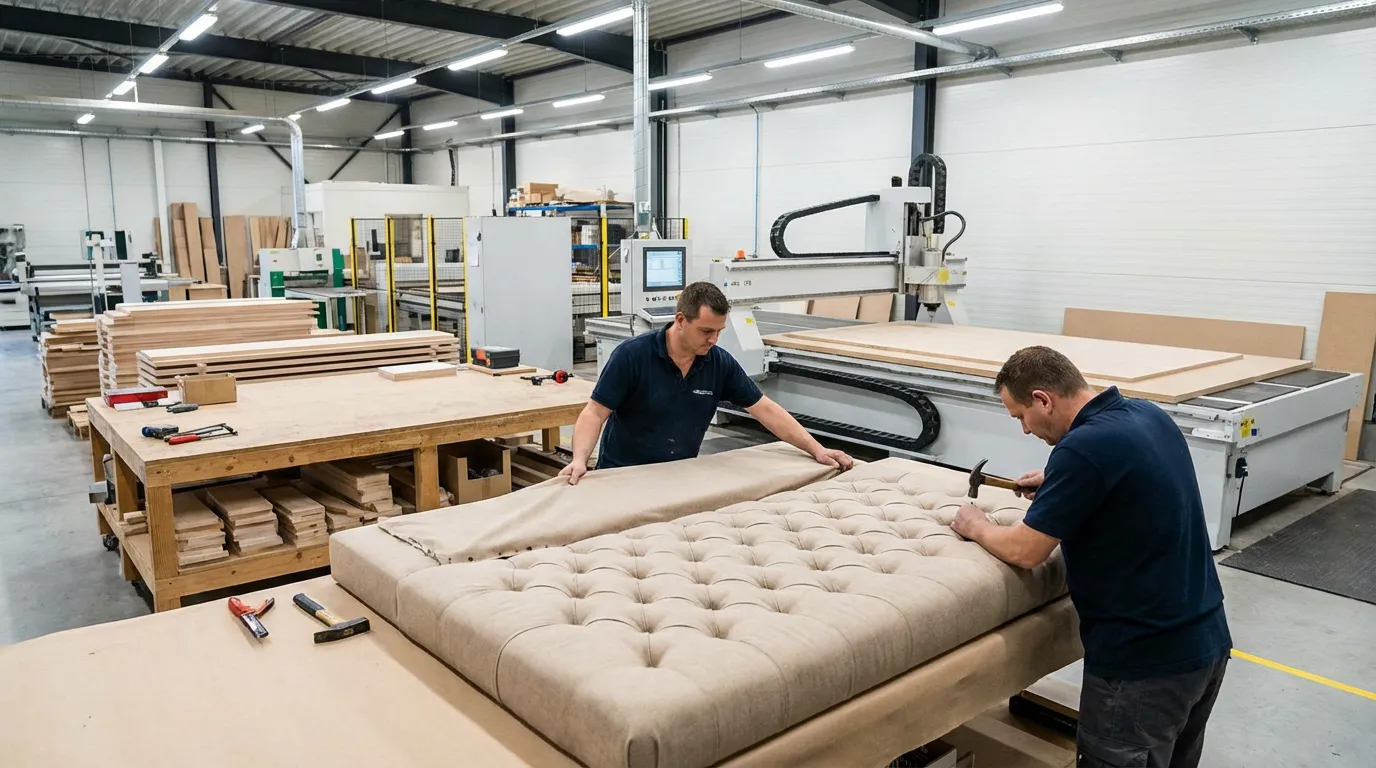
Vertical integration: Manufacturers that control wood processing, metalwork, upholstery, and finishing in-house deliver more consistent quality and faster turnaround than those that subcontract stages of production.
Design and engineering support: The best partners offer 3D design and rendering services so you can visualize, refine, and approve furniture designs before production begins. This eliminates costly revisions during manufacturing.
Proven hospitality experience: Request case studies and project references from hotels in your tier and market. A manufacturer that has furnished 4-star and 5-star properties understands the durability, aesthetic, and compliance requirements that general furniture makers often miss.
Scalable production: Whether you are furnishing a 50-room boutique or a 500-room convention hotel, your partner should have the factory capacity to deliver on schedule without quality compromises.
Logistics and project management: International hotel projects require coordinated shipping, customs clearance, and phased delivery. Experienced suppliers manage the entire supply chain from factory floor to guest room installation.
Industry Trends Accelerating Custom Furniture Adoption
Several macro trends are making the case for custom furniture even stronger in 2026:
Sustainability mandates. Hotels under ESG reporting requirements need to document material sourcing, manufacturing processes, and product lifecycle data. Custom furniture from a single, auditable manufacturer simplifies compliance with sustainability certifications like LEED, BREEAM, and Green Key. According to BFP Furniture's 2026 trend analysis, the industry is decisively moving toward furniture that enhances guest well-being while reinforcing environmental responsibility.
Experience-driven travel. Guests increasingly choose hotels based on design and atmosphere rather than brand name alone. Custom furniture allows properties to create distinctive, photographable spaces that perform on social media and travel platforms — a factor that directly influences booking behavior among millennial and Gen Z travelers.
Technology integration. Modern guest rooms require furniture that integrates wireless charging, cable management, adjustable lighting, and connectivity infrastructure. Off-the-shelf furniture rarely accommodates these requirements without awkward modifications. Custom pieces are engineered from the outset to house the technology stack your property needs.
Adaptive hospitality. The rise of hybrid spaces — guest rooms that function as offices, lobbies that serve as coworking areas, restaurants that convert to event spaces — demands furniture that is both versatile and brand-aligned. Custom modular designs solve this in ways that fixed-specification catalog furniture cannot.
Making the Investment Decision
The data points toward a straightforward conclusion. For hotels where brand perception, guest experience, and long-term cost management matter — which describes nearly every competitive property in 2026 — custom furniture delivers measurably superior returns compared to the revolving cycle of off-the-shelf replacements.
The key is approaching furniture procurement as a strategic investment rather than a purchasing transaction. That means evaluating total cost of ownership over 10–12 years rather than comparing unit prices, measuring the revenue impact of design quality on ADR and occupancy, and selecting a manufacturing partner with the capabilities to execute consistently across properties and product categories.
Properties that make this shift consistently report stronger financial performance, higher guest satisfaction, and more durable brand positioning in their competitive set.
Start with the Right Partner
RON GROUP has spent over 20 years manufacturing and supplying furniture for hotels, restaurants, and hospitality venues across more than 50 countries. With vertically integrated factory operations, in-house 3D design capabilities, and a portfolio of 95,700+ products, we work with hotel groups to develop custom furniture programs that align with brand standards, meet international compliance requirements, and deliver on both design intent and budget targets. Whether you are planning a new build or a renovation refresh, contact our project team for a consultation on your furniture requirements and a detailed cost-of-ownership analysis.
Get the week's latest industry information
-
Real-Life Professional Restaurant Case Studies
Explore Now
-
Create a unique restaurant with over 95,700+products
Explore Now
-
Protessional Free 3D Restaurant Design
Explore Now
-
Still Have Questions About Opening a Restaurant?
Explore Now

Sylvia
With 8 years in catering & hospitality industry, sales manager of Ron Group, specialise in providing one stop solutions to restaurants, hotels and weddings.
Discover Our Exclusive Products
Explore our extensive range of restaurant and hotel supplies designed to enhance your operations. Find the perfect solutions to meet your needs.
Browse Our ProductsFREE 3D DESIGN
Boost your restaurant's success with our free 3D design service. Start building the restaurant of your dreams today!
Explore 3D Design Case
RECOMMENDED CASES
-

La Rambla by Catalunya: Crafting Barcelona's Soul in Hong Kong - Custom Furniture Excellence
RON Group's custom Spanish-inspired furniture elevates La Rambla with artisanal aesthetics...
Learn More -

Cardinal Point: Elevating Outdoor Seating with Tailored Cushion Upgrades
Discover how Cardinal Point transformed its outdoor dining experience with custom cushions, achievin
Learn More
RECOMMENDED BLOGS
-
Restaurant Table Spacing and Aisle Clearance: Supplier Drawing Checklist
Check restaurant table spacing, aisle clearance, chair pullout, service path, and supplier drawing proof before approving a...
Sylvia2026-07-20 -

5 Mistakes to Avoid When Buying Restaurant Furniture from China
Don't fall for costly oversights! Learn the 5 mistakes to avoid when buying restaurant furniture from China and ensure a...
 Ron2025-01-079 min read
 -

RON GROUP Launches VR Experience to Explore Our Dynamic Showroom
Discover RON GROUP's VR showroom! Explore dining furniture, tableware, and customized services virtually or visit us in person to...
Sylvia2024-12-163 min read
Subscribe to RON GROUP
Stay up-to-date with the latest industry insights and expert advice. Together, we'll create your ideal restaurant.