



Content
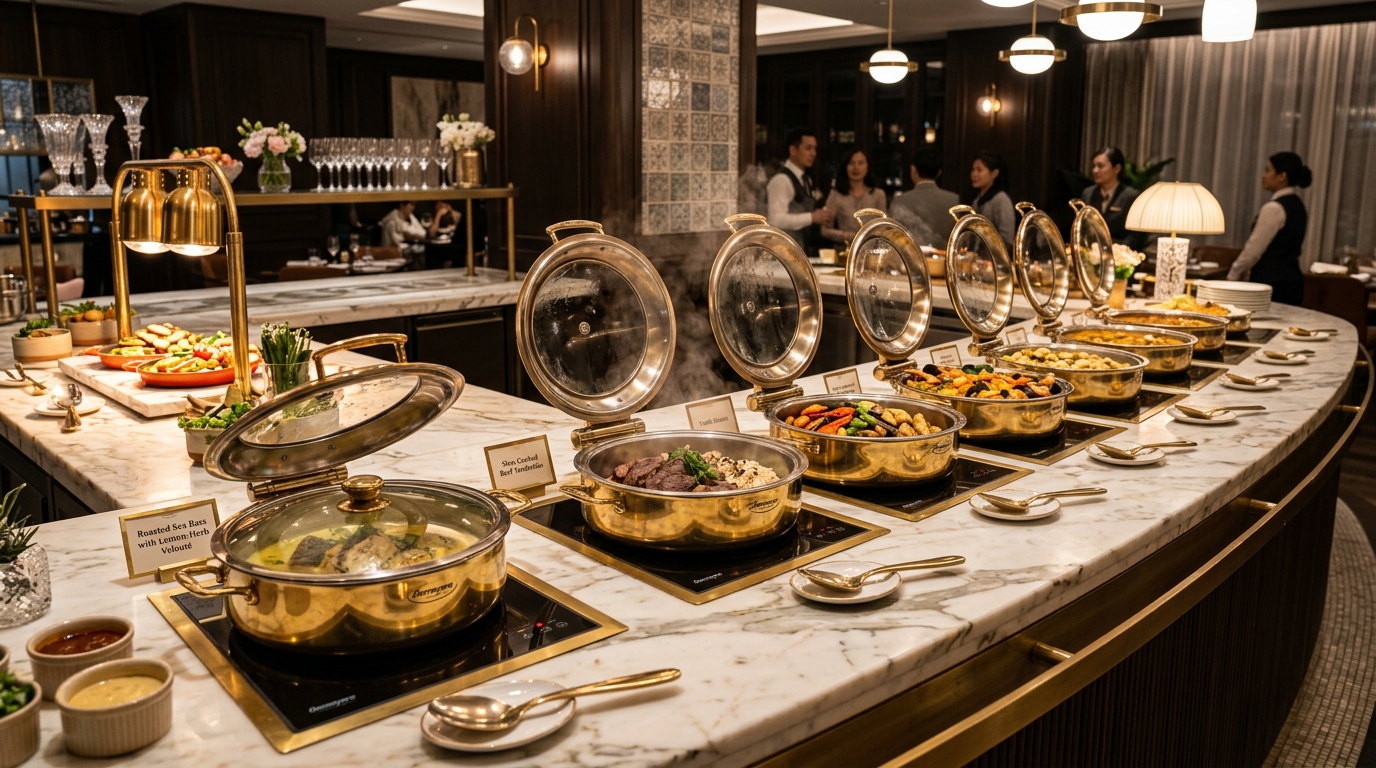
Operating a commercial buffet or hotel banquet line requires engineering precision, strict adherence to sanitation codes, and seamless interior ergonomics. Whether deploying a high-throughput breakfast line for a 500-key resort, an upscale corporate catering service, or an all-day dining operation, equipment failures directly destroy guest satisfaction and inflate food waste.
A successful buffet system bridges front-of-house (FOH) presentation with back-of-house (BOH) kitchen production. Selecting the right commercial buffet warmers, refrigerated drops, and display wares prevents thermal drop-offs, simplifies sanitation cycles, and keeps peak guest queues moving smoothly.
+-----------------------------------------------------------------------------------+
|                        COMMERCIAL BUFFET SYSTEM TOPOLOGY                          |
|                                                                                   |
|  [ Back-of-House Prep & Cook ]                                                    |
|           |                                                                       |
|           v                                                                       |
|  [ Hot/Cold Holding Staging ] ---> [ Dedicated Replenishment Corridor ]           |
|                                                     |                             |
|  +--------------------------------------------------v--------------------------+  |
|  | FRONT-OF-HOUSE PRESENTATION LINE                                            |  |
|  |                                                                             |  |
|  |  [ Plate Dispenser ]                                                        |  |
|  |         |                                                                   |  |
|  |         v                                                                   |  |
|  |  [ Cold Salads / Seafood ] ---> Insulated Wells / Frost Tops (34F - 38F)     |  |
|  |         |                                                                   |  |
|  |         v                                                                   |  |
|  |  [ Hot Entrees / Starches ] --> Induction Chafers / Dry Wells (140F - 160F) |  |
|  |         |                                                                   |  |
|  |         v                                                                   |  |
|  |  [ Carving / Action ] --------> Tempered Infrared Carving Decks             |  |
|  |         |                                                                   |  |
|  |         v                                                                   |  |
|  |  [ Bakery / Desserts ] -------> Tiered Ambient Risers & Sneeze Guards       |  |
|  |         |                                                                   |  |
|  |         v                                                                   |  |
|  |  [ Beverage Station ] --------> Chilled Dispensers / Insulated Urns         |  |
|  +-----------------------------------------------------------------------------+  |
|                                                     |                             |
|                                                     v                             |
|                                    [ Guest Seating & Dining Area ]                |
+-----------------------------------------------------------------------------------+
Build the Buffet Equipment List from the Menu and Service Model
Buffet equipment requirements cannot be copied from a generic catalog. Hardware procurement must stem directly from your menu profile, physical service footprint, and throughput targets. Specifying hardware without mapping food density, fat content, and moisture loss leads to dried-out proteins, congealed sauces, or melted cold displays.
+----------------------------------------------------------------------------------+
|               MENU DYNAMICS VS. HOLDING TECHNOLOGY MATRIX                       |
+-------------------+-----------------------------+--------------------------------+
| Food Category     | Primary Degradation Threat  | Optimal Holding Technology     |
+-------------------+-----------------------------+--------------------------------+
| Braised Meats     | Surface skinning / Scorch   | Water-bath induction chafers   |
| Fried Starches    | Moisture entrapment (soggy) | Dry heated wells w/ top IR     |
| Cream/Sauce Pastas| Oil separation (>165 F)     | Low-wattage PID induction      |
| Leafy Greens      | Cell wilt / Freezing burn   | Eutectic cold wells (36-38 F)  |
| Carved Roasts     | Core cooking / Desiccation  | Heated granite deck + Dual IR  |
+-------------------+-----------------------------+--------------------------------+
1. High-Volume Hotel Breakfast Buffets
Breakfast service demands rapid turnover and dynamic temperature management. Scrambled eggs, breakfast meats, potatoes, and oatmeal require constant heat without bottom-scorching.
- Core hardware includes induction drop-in warmers with precise PID temperature control, dual-well drop-in dry warmers, drop-in chilled wells for yogurt and cut fruits, and high-output continuous conveyor toasters.
- Smallwares demand dedicated egg spatulas, high-heat silicone tongs, and non-drip sauce warmers for gravies and syrups.
2. Banquet and Event Catering Operations
Banquet hardware prioritizes transportability, stackability, modular power draw, and setup speed.
- Traditional gel-fuel chafers are rapidly being replaced by modular plug-in electric chafer systems and insulated dry-heat food pan carriers.
- Systems require heavy-gauge nesting bases, collapsible risers, and multi-tier buffet presentation tables that assemble without mechanical tools.
3. Action and Live-Cooking Stations
Live stations (omelet stations, carved meats, stir-fry, pasta tossed-to-order) act as anchor points that regulate guest flow.
- Equipment requires heavy-duty drop-in or countertop commercial induction hobs (2,500W to 3,500W), integrated downdraft air filtration systems (or portable recirculating hoods where permitted by NFPA 96), carving boards with perimeter gravy channels mounted on heated composite bases, and flexible overhead infrared quartz warmers.
4. High-End All-Day Dining (ADD) Buffets
Upscale resort and casino installations focus on continuous presentation where hardware recedes into the millwork.
- Invisible under-counter induction warmers mounted beneath engineered stone countertops (such as granite or technical ceramics) allow seamless transitions between meal periods.
- Frost tops that drop from ambient to below-freezing temperatures within 20 minutes allow the same counter space to serve sushi at noon and hot carving items at night.
TECHNICAL NOTE // KEY ENGINEERING STANDARD
Menu items with delicate emulsion structures (such as hollandaise, bearnaise, or cream reductions) break when held above 158 degrees F (70 degrees C). Always select holding equipment featuring liquid-temperature sensing probes or digital surface thermistors rather than crude infinite-control rheostats.
Buffet Equipment List by Function
Organizing procurement by station function prevents operational gaps and simplifies trade coordination across mechanical, electrical, and plumbing (MEP) teams.
Hot Food Holding and Serving Equipment
Hot holding equipment must counter ambient convective heat loss while preventing localized hotspots from scorching food pans.
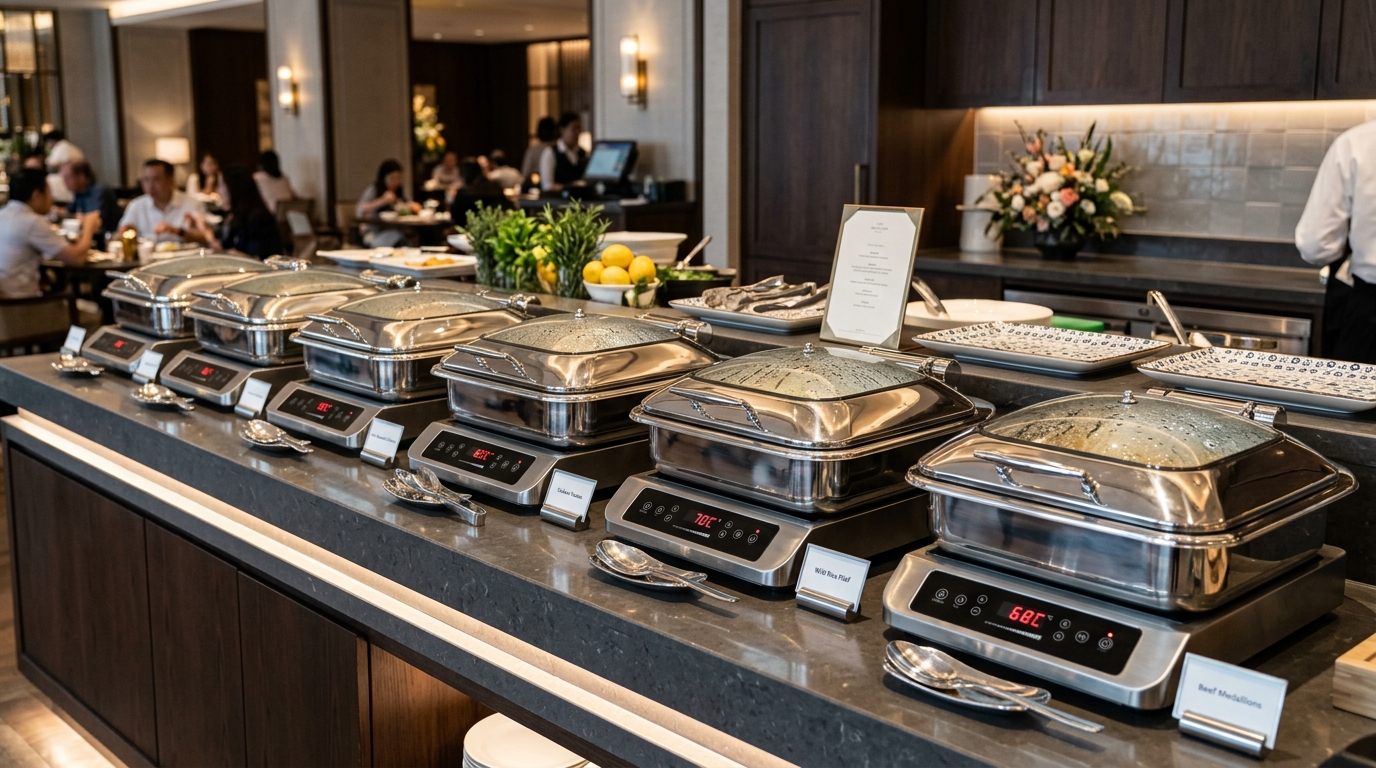
+------------------------------------------------------------------------------+
|             THERMAL TRANSFER PROFILE: WATER WELL VS. INDUCTION               |
|                                                                              |
| Traditional Bain-Marie (Water Bath)                                          |
| [ Heating Element ] -> [ Water (212 F) ] -> [ Steam Pan ] -> [ Food Pan ]    |
| * Inefficient thermal transfer; constant descaling and refills required.     |
|                                                                              |
| Direct Induction Buffet System                                               |
| [ Induction Coil ] -> [ Magnetic Field ] -> [ Chafer Base (Direct Heat) ]   |
| * Instant PID feedback; zero water consumption; 65% lower energy draw.       |
+------------------------------------------------------------------------------+
+----------------------------------------------------------------------------------------------------+
|                      COMMERCIAL BUFFET WARMING & HOLDING SPECIFICATIONS                           |
+-------------------------+----------------------+--------------------+---------------+--------------+
| Equipment Category      | Common Dimensions    | Electrical / Power | Heat Transfer | NSF / ASTM   |
|                         | (W x D x H, inches)  | Rating             | Method        | Standard     |
+-------------------------+----------------------+--------------------+---------------+--------------+
| Full-Size (GN 1/1)      | 23.0 x 17.5 x 15.0   | 120V, 60Hz, 8.3A   | Dry Induction | NSF/ANSI 4   |
| Induction Chafer        |                      | (1,000 W)          | Core Base     | ASTM F1605   |
+-------------------------+----------------------+--------------------+---------------+--------------+
| Drop-in Modular 3-Well  | 44.5 x 26.0 x 15.0   | 208V, 60Hz, 15.0A  | Sealed Dry /  | NSF/ANSI 4   |
| Heated Well Base        |                      | (3,120 W)          | Water Hybrid  | UL 197       |
+-------------------------+----------------------+--------------------+---------------+--------------+
| Countertop Infrared     | 36.0 x 15.0 x 22.0   | 120V, 60Hz, 7.5A   | Radiant Tube  | NSF/ANSI 2   |
| Food Warmer Bar         |                      | (900 W)            | + Sheathed    | UL Listed    |
+-------------------------+----------------------+--------------------+---------------+--------------+
| Heated Granite Base     | 24.0 x 20.0 x 3.0    | 120V, 60Hz, 4.2A   | Conduction    | NSF/ANSI 4   |
| Carving Station         | (Plus lamp fixture)  | (500 W Base + IR)  | + Infrared    | CSA C22.2    |
+-------------------------+----------------------+--------------------+---------------+--------------+
| Round Induction Soup    | 14.5 x 14.5 x 13.5   | 120V, 60Hz, 3.8A   | Indirect 3D   | NSF/ANSI 4   |
| Tureen (10-Liter)       |                      | (450 W)            | Induction     | Energy Star  |
+-------------------------+----------------------+--------------------+---------------+--------------+
- Induction Chafing Dishes: Look for commercial 18/10 stainless steel bodies with ferromagnetic bottom layers. Chafers must have hydraulic soft-close mechanisms tested to at least 50,000 hinge cycles. Units should feature integrated condensation-recirculation channels that channel water back to the lower pan rather than dripping onto the food or table surface.
- Drop-in Heated Wells: Specify insulated dry-well technology. Traditional wet bain-maries consume substantial treated water, require dedicated copper drain lines, and create calcification headaches. Dry wells use high-emissivity heating envelopes to radiate heat through the gastro-norm (GN) pans without needing an open water bath.
- Overhead Heat Lamps: Mount ceramic infrared or quartz halogen heating bars underneath breath guards. Ensure fixtures are height-adjustable (between 14 and 20 inches above the deck) to avoid drying out delicate proteins.
- Soup and Sauce Tureens: Specify double-kettle induction tureens with digital dial-in temperature increments of 1 degree F. These prevent crust formation around the rim, an issue common in mechanical well systems.
For back-of-house staging that feeds these stations, reference our comprehensive commercial kitchen equipment checklist.
Cold Food, Beverage, Bakery, and Display Equipment
Maintaining cold holding lines requires calculating the thermal load added by ambient dining room heat and bright display lighting.
+----------------------------------------------------------------------------------------------------+
|                         COLD HOLDING & DISPLAY SELECTION METRICS                                  |
+-------------------------+----------------------+--------------------+---------------+--------------+
| Equipment Category      | Common Dimensions    | Electrical / Refr. | Operating     | NSF / ASTM   |
|                         | (W x D x H, inches)  | System             | Temp Range    | Standard     |
+-------------------------+----------------------+--------------------+---------------+--------------+
| 3-Pan Drop-In Cold      | 44.0 x 26.0 x 24.5   | 115V, 1/3 HP       | 34 F to 38 F  | NSF/ANSI 7   |
| Well (Forced-Air)       |                      | R290 Refrigerant   | (Holding)     | Type II Env. |
+-------------------------+----------------------+--------------------+---------------+--------------+
| Countertop Frost Top    | 36.0 x 24.0 x 8.0    | 115V, 1/4 HP       | 15 F to 25 F  | NSF/ANSI 7   |
| (Cold Deck Station)     |                      | Direct Expansion   | (Frosted Top) | UL 471       |
+-------------------------+----------------------+--------------------+---------------+--------------+
| Refrigerated Juice      | 16.0 x 18.0 x 26.5   | 115V, 60Hz, 3.5A   | 35 F to 40 F  | NSF/ANSI 18  |
| Dispenser (Dual 3-Gal)  |                      | Hermetic Base      | (Circulating) | UL Sanitation|
+-------------------------+----------------------+--------------------+---------------+--------------+
| Modular Acrylic Tiered  | 28.0 x 14.0 x 18.0   | Ambient (Passive)  | Ambient Store | NSF/ANSI 2   |
| Pastry Case             |                      | Heavy Acrylic Case | (Enclosed)    | BPA-Free Std |
+-------------------------+----------------------+--------------------+---------------+--------------+
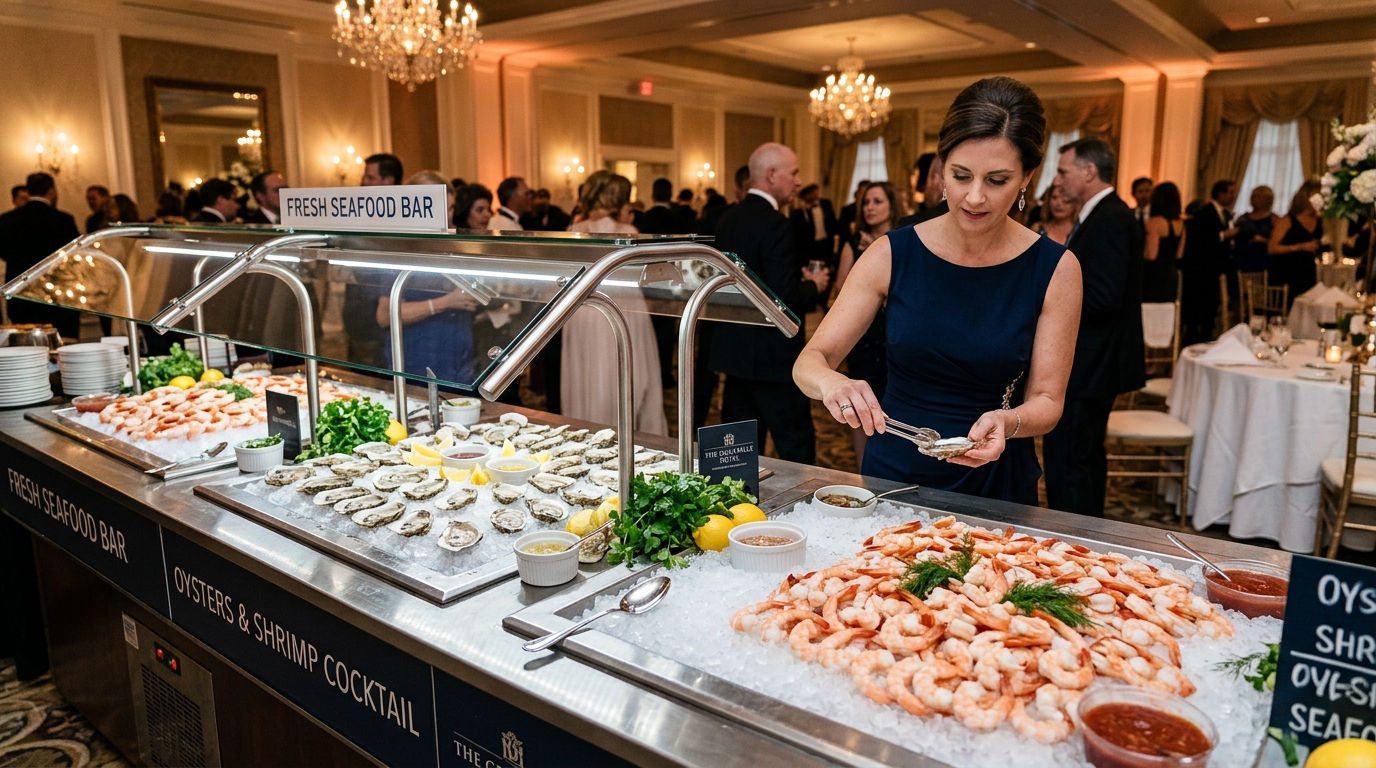
- Forced-Air Refrigerated Drop-In Wells: Traditional static-coil cold wells drop food pan temperatures only along the bottom. For open buffets, choose forced-air curtain systems (compliant with NSF Standard 7 Type II). These circulate a blanket of sub-38 degree F air across the top surface of the food pans, insulating it from warm dining-room air.
- Frost Tops and Cold Slabs: Engineered for cold charcuterie, chilled desserts, and raw bar displays. High-conductivity aluminum alloy or technical ceramic decks frost evenly without hot corners. Verify that the unit includes an all-around condensation gutter linked to an evaporator pan or drain line.
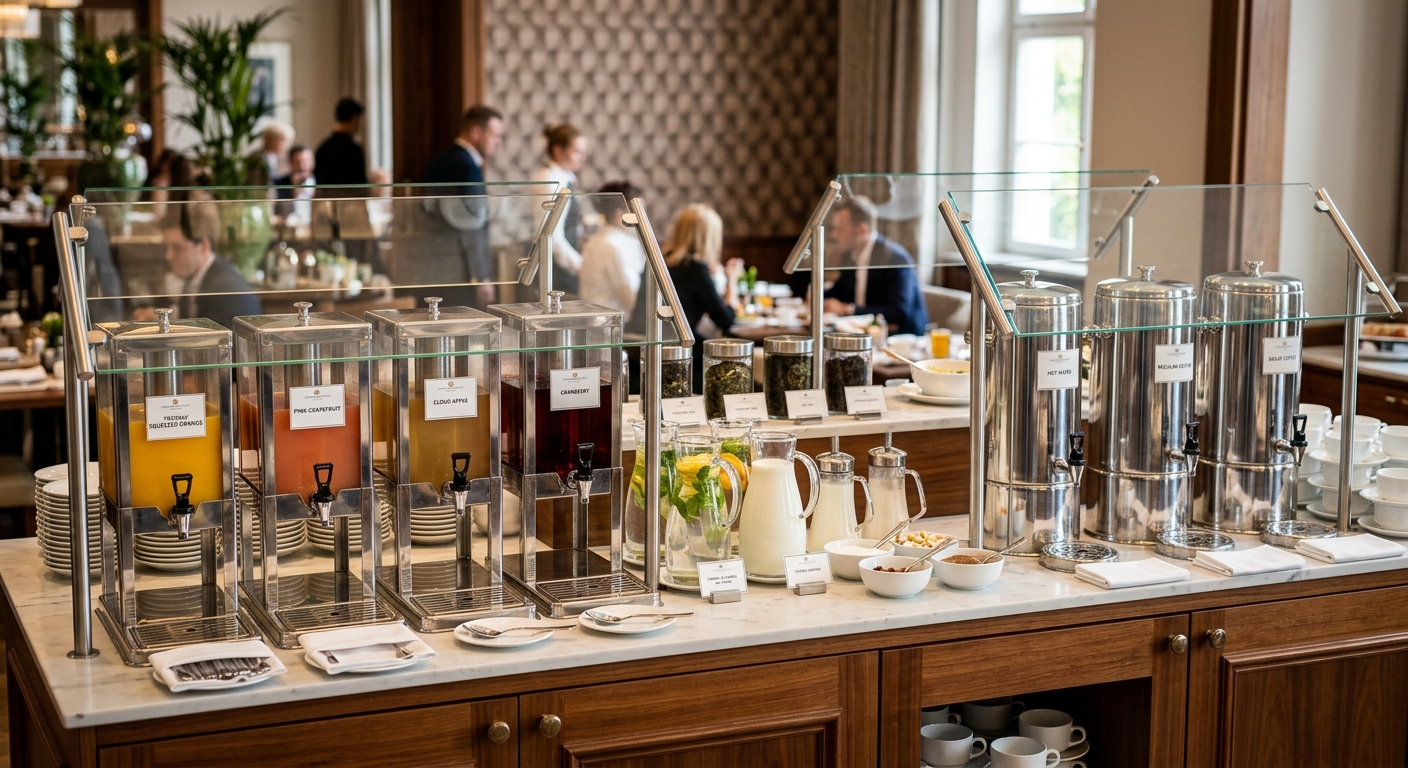
- Commercial Juice and Beverage Dispensers: Specify non-carbonated dispensers with food-grade polycarbonate or Tritan co-polyester bowls. Select circulating magnet-driven impeller pumps for pulpless juices, or slow-moving agitation paddles for juices containing pulp to prevent foaming and oxidation.
- Bakery Risers and Dispensers: Display bread and baked goods using food-safe melamine, solid acacia sealed with moisture-resistant polyurethane, or passivated stainless steel wire systems. Bread cases require rear-loading operator doors and self-closing front customer doors to prevent drying out.
To size your staging and reserve storage refrigeration, review our commercial refrigerator guide.
Smallwares, Signage, and Guest-Service Accessories
A buffet line can grind to a halt without the proper smallwares. Utensil ergonomic weighting, thermal conductivity, and pan depths determine the speed of guest service.
+------------------------------------------------------------------------------+
|                   SERVING UTENSIL PROFILE & CAPACITY                         |
+---------------------+-------------------+------------------------------------+
| Utensil Class       | Material Spec     | Ergonomic / Safety Feature         |
+---------------------+-------------------+------------------------------------+
| One-Piece Tongs     | 1.2mm 18/10 SS    | Zero springs; handle bend notch    |
| Scalloped Spoons    | 18/10 Heavy Gauge | Handle stay-cool insulated polymer |
| Perforated Ladles   | 18/10 Mirror SS   | Stamped capacity markings on shank |
| Carving Knives      | High-Carbon 4116  | Granton edge; non-slip composite   |
+---------------------+-------------------+------------------------------------+
- Service Utensils (Tongs, Spoons, Ladles): Standardize on one-piece stamped 18/10 stainless steel construction. Never purchase spring-hinged multi-part tongs for self-service lines; food debris accumulates in the spring pocket, creating a breeding ground for bacteria. Use solid-handled spoons with built-in notches to keep the handle from slipping down into the food pan.
- Gastro-Norm (GN) Pans: Specify 0.8mm (20-gauge) or 1.0mm (18-gauge) 304 stainless steel hotel pans. Avoid shallow 22-gauge pans, which warp easily along the rim when moved in and out of hot wells. Warped edges break the steam seal, bleeding heat and skewing temperature control.
- Clear-Shield Breath Guards (Sneeze Guards): All self-service buffet lines must feature NSF/ANSI Standard 2 compliant breath guards. Glass panels must consist of fully tempered glass (minimum 1/4-inch to 3/8-inch thickness) with polished pencil edges. Structural support posts should use 1.5-inch diameter brushed 304 stainless steel tubing.
- Allergen and Menu Signage: Deploy magnetic or weighted stainless steel tabletop cardholders displaying the 9 major FDA allergens. Use engraved metal plates or rewritable, non-porous synthetic tags that stand up to daily chemical sanitizing.
Plan the Buffet Line, Guest Flow, and Replenishment Route
Buffet line flow determines table turns and revenue in high-volume settings. If guests must pause, reach across one another, or wait for empty pans, service queues stall and guest satisfaction drops.
+------------------------------------------------------------------------------+
|                         SINGLE-SIDED VS. DUAL-SIDED FLOW                     |
|                                                                              |
| SINGLE-SIDED WALL-MOUNT LINE (Throughput: 35-45 guests / 10 minutes)         |
| [ Plates ] -> [ Cold / Salads ] -> [ Hot Entrees ] -> [ Carving ] -> [ Bread]|
|                                                                              |
| DUAL-SIDED ISLAND LINE (Throughput: 75-90 guests / 10 minutes)              |
|               [ Center BOH Replenishment Spine ]                             |
| Line A: [ Plates ] -> [ Cold ] -> [ Hot Entree ] -> [ Carv ] -> [ Pastry ]  |
|                                                                              |
| Line B: [ Plates ] -> [ Cold ] -> [ Hot Entree ] -> [ Carv ] -> [ Pastry ]  |
+------------------------------------------------------------------------------+
Flow Geometry and Line Routing
- The Single-Sided Straight Line: Suitable for lower guest volumes (up to 120 seats). The line runs along a perimeter wall. Throughput averages 3.5 to 4.5 guests per minute per side.
- The Island Double-Sided Line: Essential for banquets and operations exceeding 200 seats. Guests access mirrored hot and cold setups from both sides. Double-sided service doubles throughput without requiring two separate kitchen staging routes.
- The Scramble (Zone-Based) Layout: Ideal for casino buffets and high-volume corporate dining. Breaking food categories into separate stations (Cold Raw Bar, Asian Wok, Italian Pasta/Pizza, Carvery, Dessert Emporium) spreads guests across the room, eliminating single-line bottlenecks.
Ergonomic Clearances and Dimensional Baselines
- Guest Queue Aisle Clearance: Maintain a minimum clear width of 48 inches (1,220 mm) along single-sided lines. For dual-sided islands or high-traffic scramble layouts, provide at least 72 inches (1,830 mm) between facing equipment surfaces to accommodate two guest lanes plus a bypass lane.
- Counter Surface Height and Reach: Set standard adult service heights to 34 inches (864 mm) above the finished floor, strictly aligning with ADA maximum reach compliance (no more than 24 inches of horizontal reach to the center of any serving pan).
- Tray Slide Integration: If trays are utilized, install heavy-wall 304 stainless steel tubular or embossed runner rails at 32 to 34 inches high. Run these continuously along the line, ensuring a 2-inch continuous slope run-off to prevent trapped liquids.
+------------------------------------------------------------------------------+
|                BACK-OF-HOUSE TO FRONT-OF-HOUSE ISOLATION                     |
|                                                                              |
|  [ KITCHEN COOK LINE ]                                                       |
|         |                                                                    |
|         | (BOH Heated Pass-Through Cabinet: Hot Holding Staging)             |
|         v                                                                    |
|  [ SERVICE CORRIDOR ]  <-- Clear 48-inch BOH Roll-in Access Route            |
|         |                                                                    |
|   +-----+---------------------------------------------------------------+    |
|   | BUFFET MILLWORK REAR PANEL                                          |    |
|   | [ Rear Access Well ]  [ Rear Access Well ]  [ Drop-in Holding Plate]|    |
|   +---------------------------------------------------------------------+    |
|   | FRONT DISPLAY / GUEST LINE (Zero Kitchen Crossover Interruption)   |    |
|   +---------------------------------------------------------------------+    |
+------------------------------------------------------------------------------+
Dedicated Replenishment Routing
Never route BOH replenishment staff directly through guest queues. Carrying heavy, 180-degree F pans of food through crowded guest areas presents a burn hazard and slows down service.
- Specify pass-through buffet counters with rear sliding access doors whenever space allows. BOH staff can replenish pans directly from the rear service corridor without entering the guest zone.
- Where pass-through counters are impossible, design a secondary service corridor behind the buffet wall, complete with 48-inch double swing doors positioned away from the head of the guest queue.
Food Safety, Temperature Control, and Cleaning Checks
Operating a commercial buffet means balancing visual presentation with strict public health compliance. Food exposed to ambient air degrades quickly if holding temperatures are not monitored and maintained.
EXECUTIVE MANDATE // PROCUREMENT COMPLIANCE AUDIT
The Critical Temperature Danger Zone (TDZ): As specified in FDA Food Code Section 3-501.16, all Time/Temperature Control for Safety (TCS) foods must be maintained at or above 135 degrees F (57.2 degrees C) for hot holding, or at or below 41 degrees F (5 degrees C) for cold holding. Equipment must have sufficient thermal recovery power to hold these internal temperatures indefinitely against ambient drafts.
+------------------------------------------------------------------------------+
|                    TEMPERATURE AND SANITATION CONTROL ZONES                  |
|                                                                              |
|  HOT HOLDING ZONE: Minimum 135 F (57.2 C) / Target 145 F to 155 F            |
|  -----------------------------------------------------------------           |
|  CRITICAL DANGER ZONE: 42 F to 134 F (Bacterial Proliferation Threshold)     |
|  -----------------------------------------------------------------           |
|  COLD HOLDING ZONE: Maximum 41 F (5.0 C) / Target 34 F to 38 F               |
+------------------------------------------------------------------------------+
Serving Utensil Replacement Protocols
The search inquiry regarding "serving utensils used at a self service buffet should be replaced" addresses an important public health regulation often flagged during health inspections.
According to FDA Food Code Section 4-602.11(C):
- Four-Hour Replacement Rule: In a self-service buffet environment where utensils are held in TCS food wells, the utensils must be removed, cleaned, and sanitized at least every 4 hours.
- Continuous Replacement Dynamic: If the room temperature is higher than 70 degrees F (21.1 degrees C), or if the handles show any visible cross-contamination, splashes, or drops into the pan, staff must swap out the utensils immediately.
- Storage Configuration: Utensils must be stored:
- Inside the food pan with the handle extending out of the food zone;
- Inside a running-water well that maintains sufficient water flow to flush debris to the drain; or
- In a dedicated dry container that is cleaned, washed, and sanitized every 4 hours.
Automated Temperature Monitoring and HACCP Logging
- Eliminate manual pencil-and-paper temperature logs. Modern commercial buffets should use fixed wireless temperature sensors (such as Zigbee or LoRaWAN probes) mounted in the well bases.
- Use commercial-grade non-contact infrared surface thermometers alongside calibrated, rapid-response needle penetration probes (compliant with ASTM F2339). Log pan temperatures every 60 minutes. If an entree drops below 135 degrees F for more than two cumulative hours, food safety codes mandate discarding the product.
+------------------------------------------------------------------------------+
|               BUFFET LINE SANITATION CHECKLIST & FREQUENCY MATRIX            |
+-------------------+----------------------------+-----------------------------+
| System Component  | Cleaning Frequency         | Chemical / Procedure        |
+-------------------+----------------------------+-----------------------------+
| Sneeze Guards     | Every 60-90 minutes        | Ammonia-free glass cleaner  |
| Serving Tongs     | Maximum 4 hours (per FDA)  | 3-compartment sink or dish  |
| Dry Heated Wells  | End of shift (daily)       | Mild alkaline degreaser     |
| Water Bain-Maries | End of shift (daily)       | Citric acid scale descaler  |
| Frost Top Decks   | End of shift (daily)       | Warm water + quat sanitizer |
+-------------------+----------------------------+-----------------------------+
For back-of-house warewashing sizing required to clean this volume of pans and utensils, refer to our commercial dishwasher sizing guide.
Utilities, Installation, and Commissioning Requirements
Procuring high-end buffet equipment without coordinating architectural, plumbing, and electrical loads can cause costly field delays during commissioning.
+------------------------------------------------------------------------------+
|             MEP UTILITIES COMMISSIONING ARCHITECTURE                         |
|                                                                              |
|  [ Dedicated 208V 3-Phase Subpanel ]                                         |
|         |                                                                    |
|         +---> Circuit A (Breaker 20A): Induction Units 1 & 2 (1,000W each)   |
|         +---> Circuit B (Breaker 20A): Induction Units 3 & 4 (1,000W each)   |
|         +---> Circuit C (Breaker 20A): Cold Well Forced Air (Compressor)     |
|                                                                              |
|  [ Direct Potable Water Supply ]                                             |
|         |                                                                    |
|         +---> Pressure Regulator (45 PSI) -> Reverse Osmosis Filtration      |
|                                                  |                           |
|                                                  v                           |
|                                       [ Auto-fill Soup & Bain-Maries ]       |
|                                                  |                           |
|  [ Indirect Gravity Waste Drain ] <--- Air Gap --+ (Air gap prevents siphon) |
+------------------------------------------------------------------------------+
Electrical Engineering Demands
- Continuous Load Safety Derating: Per the National Electrical Code (NEC Article 210-19), branch circuits powering continuous commercial heating loads (running for 3 hours or more) must draw no more than 80% of the breaker's rated capacity. A standard 20A, 120V circuit can only handle a continuous load of 16A (1,920 Watts).
- Induction Multi-Unit Circuit Planning: A typical 4-pan buffet counter using four 1,000W drop-in induction chafers draws 4,000 Watts. Operating this entire line on a single 120V line requires over 33 Amps, which will immediately trip a standard commercial breaker. Split these warmers across dedicated 208V/240V multi-phase circuits, running no more than two modular drop-ins per 20A circuit.
- Wire Routing and Cable Drops: Never run extension cords or rubber threshold wire covers across guest walkways. Use recessed, heavy-cast brass floor boxes with spring-loaded flush covers (such as Hubbell or Wiremold systems), installed directly under the millwork footprint.
Plumbing and Ventilation Constraints
- Backflow Prevention & Air Gaps: Drop-in wet wells or beverage stations must not connect directly to a sanitary sewer without an indirect drain. Local plumbing codes mandate an approved indirect waste connection with an air gap of at least twice the diameter of the drain pipe (minimum 1.0 inch) above the flood-level rim of the floor sink.
- Cabinet Ventilation for Refrigeration Compressors: Drop-in cold wells and self-contained frost tops use integrated compressors that reject significant heat under the counter. The millwork base must include at least 150 square inches of unobstructed louvered air intake, alongside an equivalent exhaust louver. If heat builds up inside the cabinet above 104 degrees F (40 degrees C), the refrigeration compressor will enter thermal lockout, warming your salads and desserts into the danger zone.
SOURCING AUDIT TIP // DIRECT PROCUREMENT SPECIFICATION
Ensure custom millwork incorporates a 2-inch internal ventilation plenum behind the drop-in wells. Add 120V whisper-quiet muffin exhaust fans (producing 50 to 80 CFM) wired into the main lighting circuit. This actively expels warm air generated by induction bases and compressor condensing units, preventing thermal throttling.
Size Capacity and Quantities from Peak Demand
Procurement volume is driven by peak guest throughput and kitchen replenishment cycles, not just dining room capacity.
Capacity Calculations
To calculate the number of GN pans and chafing units required for a specific buffet operation, use the following operational formula:
$$\text{Pans In Service} = \frac{\text{Guests Per Hour} \times \text{Portion Weight (lbs)} \times \text{Menu Split Ratio}}{\text{Safe Usable Pan Weight Capacity (lbs)}}$$
Guests Per Hour*: Peak hourly service volume (for example, 300 guests/hour). Portion Weight*: Typical meal consumption ranges from 0.85 lbs (breakfast) to 1.35 lbs (dinner). Menu Split Ratio*: Percentage of guests who select a specific item (for example, 0.40 for eggs; 0.25 for bacon). Safe Usable Pan Weight Capacity*: A standard full-size 2.5-inch deep GN 1/1 pan holds roughly 14 lbs of liquid/dense entree comfortably without overfilling (at 70% brim capacity to prevent spills).
Establishing Smallware Par Levels
Maintain a strict par level of 3.5 to 4.0 for all buffet smallwares, pans, and serving utensils:
- Par 1.0: On the active buffet line in front of guests.
- Par 1.0: In the kitchen, held in hot staging cabinets, pre-filled and ready to deploy.
- Par 1.0: In the dishroom cycling through washing, descaling, and sanitation.
- Par 0.5 - 1.0: Held in dry storage as a backup for peak turnover days, sudden menu shifts, or accidental damage.
+----------------------------------------------------------------------------------------------------+
|               5-YEAR TOTAL COST OF OWNERSHIP (TCO): CHAFING TECHNOLOGIES                          |
|               (Baseline: 16-Pan Active Banquet Line, 300 Days Operation/Year)                     |
+----------------------------------------+-------------------+-------------------+-------------------+
| Metric / Cost Component                | Liquid Gel Fuel   | Electric Water-Pan| Drop-In Induction |
|                                        | Chafing System    | Drop-in Base      | Buffets (Dry)     |
+----------------------------------------+-------------------+-------------------+-------------------+
| Initial Capital Purchase (16 Units)    | $3,200            | $9,800            | $17,600           |
| Installation, Millwork, & MEP Wiring   | $0                | $4,500            | $5,800            |
| Annual Energy / Fuel Operating Cost    | $11,520 (Gel cans)| $1,150 (Elec kWh) | $410 (Elec kWh)   |
| Annual Labor (Filling, Water, Clean)   | $8,400 (480 hrs)  | $4,200 (240 hrs)  | $1,050 (60 hrs)   |
| 5-Year Consumable / Replacement Costs  | $57,600           | $3,500            | $1,200            |
| 5-Year Energy & Operational Labor      | $42,000           | $26,750           | $7,300            |
+----------------------------------------+-------------------+-------------------+-------------------+
| 5-YEAR COMPREHENSIVE TCO TOTAL         | $102,800          | $44,550           | $31,910           |
+----------------------------------------+-------------------+-------------------+-------------------+
While drop-in induction hardware requires higher upfront capital expenditure, it achieves full return on investment (ROI) within 14 to 18 months. Eliminating open-flame gel fuels cuts fire risks, stabilizes holding temperatures, reduces consumable costs, and lowers labor overhead.
Buffet Equipment RFQ and Supplier Checklist
When issuing a Request for Quotation (RFQ) to commercial foodservice equipment manufacturers, vague specifications invite cut corners. Poor-quality proposals often swap out 304 food-grade stainless steel for corrosion-prone 201/430 series steels, or offer non-certified electrical parts that fail municipal building inspections.
+------------------------------------------------------------------------------+
|                         RFQ ENGINEERING SPECIFICATION                        |
|                                                                              |
| Material Grade Spec: ASTM A240 Type 304 (18/10 Chromium-Nickel)             |
| Surface Polish Spec: ASTM A480 No. 4 Satin / Architectural Mirror Finish     |
| Thickness Spec: Minimum 1.0mm (20 Ga) Chafers / 1.5mm (16 Ga) Well Enclosures|
|                                                                              |
| Certification Mandates:                                                      |
|   - Mechanical & Food Contact: NSF/ANSI Standard 2 & Standard 4               |
|   - Refrigeration Dynamics:    NSF/ANSI Standard 7 (Type II Curtain Air)     |
|   - Electrical Compliance:     UL 197 / CSA C22.2 / CE-EMC Intertek Listed   |
|                                                                              |
| Internal Hardware & Mechanisms:                                              |
|   - Soft-Close Hinges: Hydraulic Axis Rated for 50,000 Cycles Minimum        |
|   - Temp Control Core: PID Digital Microprocessor With PT100/NTC Sensor      |
+------------------------------------------------------------------------------+
Critical RFQ Tender Verification Checklist
Before releasing funds or issuing purchase orders for commercial buffet warmers, lines, and supplies, confirm every supplier meets the following parameters:
- [ ] Material Composition Verified: All food-contact surfaces must use ASTM Type 304 (18/10) stainless steel. Request mill test certificates to verify nickel content is at or above 8.0%. Reject lower-cost Type 201 stainless steel, which rusts quickly when exposed to salted food pans and steam.
- [ ] Sanitation and Electrical Safety Listings: Ensure hardware carries recognized certification marks (such as NSF, UL, ETL, CSA, or CE). Equipment lacking verified electrical marks will fail building inspections, potentially voiding your facility's fire insurance.
- [ ] Serviceability and Spare Parts Availability: Confirm the supplier stocks replacement hydraulic hinges, thermistors, induction control boards, and glass panels, with guaranteed shipping windows for at least 5 years.
- [ ] Clear B2B Shipping Terms: Specify transparent logistics parameters. Avoid CIF ocean delivery, which passes off unexpected port clearance, container demurrage, and handling fees to the buyer. For partial shipments (LCL), use fully transparent Delivered Duty Paid (DDP) terms. For full installations, use direct-sealed factory Full Container Loads (FCL) managed via transparent Ex-Works (EXW) or Free on Board (FOB) terms with a vetted freight partner.
- [ ] Heavy-Duty Export Crating: Require high-density honeycomb carton corners, double-wall corrugated packaging, and heat-treated wooden crates that comply with ISPM-15 export regulations. Sneeze guard glass must be packed in isolated, high-density polyethylene (HDPE) foam cutouts to prevent transit breakage.
Engineering Complete Buffet Solutions with Ron Group
Selecting the right commercial buffet equipment requires balancing menu design, guest throughput, mechanical planning, and reliable manufacturing. A high-volume buffet line succeeds on durable construction, precise temperature controls, and smooth replenishment logistics that keep service moving.
Ron Group works directly with hospitality designers, procurement managers, and hotel operators worldwide to design, manufacture, and deliver commercial-grade buffet systems.
+------------------------------------------------------------------------------+
|                     RON GROUP END-TO-END PROCUREMENT FLOW                    |
|                                                                              |
| [ Architectural CAD/BIM Layout ]                                             |
|               |                                                              |
|               v                                                              |
| [ Custom Factory Manufacturing & Quality Control Testing ]                   |
|   - CNC Laser-Cut 304 Stainless Steel Frames                                 |
|   - Hydraulic Hinge Life Cycle Testing (50,000 Actuations)                   |
|   - Thermal Probe & Electronics Burn-in Run (72 Hours)                       |
|               |                                                              |
|               v                                                              |
| [ Factory Container Loading & Global Freight Logistics ]                     |
|   - ISPM-15 Certified Crating                                                |
|   - FCL Direct-Sealed Ocean Transit (FOB/EXW) or Transparent DDP Solutions  |
|               |                                                              |
|               v                                                              |
| [ On-Site Facility Commissioning & Operations Staff Handover ]               |
+------------------------------------------------------------------------------+
Our manufacturing and supply capabilities provide hospitality projects with end-to-end support:
- Commercial Durability: High-grade ASTM 304 stainless steel induction chafing systems, custom-built modular cold drop-in wells, and sleek frameless sneeze guard systems engineered to meet NSF/ANSI requirements.
- Custom Millwork Design: Drop-in heated and chilled food stations that seamlessly integrate into luxury stone, granite, and technical ceramic architectural millwork.
- Streamlined B2B Procurement: A single supply source for drop-in warmers, custom banquet tables, high-density GN pans, serving smallwares, and tabletop displays.
- Global Logistics & Project Support: From technical CAD/BIM layout planning to secure export crating and reliable FCL/LCL ocean shipping, our logistics teams support your project timeline through delivery and commissioning.
Contact Ron Group today to speak with our commercial hospitality specialists, request project-specific CAD submittals, or receive a tailored quotation for your upcoming buffet and banquet installations.
Commercial Procurement & Specification Benchmark
| Specification Category | Budget / Residential Grade | Heavy Commercial Grade (Ron Group Standard) | Compliance & Test Verification |
|---|---|---|---|
| Structural Material | Thin gauge 430 stainless / laminated particle board | 16-18 Gauge 304 Stainless Steel / Solid Hardwood Core | NSF/ANSI Standard 2 / ANSI/BIFMA X5.5 |
| Operational Duty Cycle | 2-4 hours intermittent | 18-24 hours continuous commercial turnover | UL Commercial / CE / ETL Sanitation Certified |
| Thermal / Mechanical Tolerance | Rapid fatigue after 6-12 months | 5-10 year commercial design lifespan | High thermal shock resistance (180 deg C delta) |
| 5-Year Total Cost of Ownership | High (frequent breakdown & replacement) | 35-45% lower net amortized TCO | Fully warrantied commercial supply chain |
Get the week's latest industry information
-
Real-Life Professional Restaurant Case Studies
Explore Now
-
Create a unique restaurant with over 95,700+products
Explore Now
-
Protessional Free 3D Restaurant Design
Explore Now
-
Still Have Questions About Opening a Restaurant?
Explore Now

Sylvia
With 8 years in catering & hospitality industry, sales manager of Ron Group, specialise in providing one stop solutions to restaurants, hotels and weddings.
Discover Our Exclusive Products
Explore our extensive range of restaurant and hotel supplies designed to enhance your operations. Find the perfect solutions to meet your needs.
Browse Our ProductsFREE 3D DESIGN
Boost your restaurant's success with our free 3D design service. Start building the restaurant of your dreams today!
Explore 3D Design Case
RECOMMENDED CASES
-
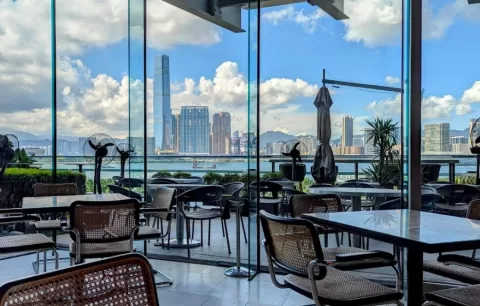
La Rambla by Catalunya: Crafting Barcelona's Soul in Hong Kong - Custom Furniture Excellence
RON Group's custom Spanish-inspired furniture elevates La Rambla with artisanal aesthetics...
Learn More -
Cardinal Point: Elevating Outdoor Seating with Tailored Cushion Upgrades
Discover how Cardinal Point transformed its outdoor dining experience with custom cushions, achievin
Learn More
RECOMMENDED BLOGS
-
Bar Glassware 101: Types, Names, Uses, and How to Stock Your Bar
Learn the 10 core bar glassware types, names, and uses. Discover how to stock your bar with the right glasses for cocktails, beer,...
Sylvia2026-07-26 -
Complete Bar Equipment List for Opening a Bar
Plan a complete commercial bar equipment list by menu, service volume, refrigeration, ice, glassware, utilities, sanitation,...
Sylvia2026-06-11 -
Low Budget Restaurant Interior Design: 2026 Trends
Prioritize a low-budget restaurant interior by protecting code, operations, durability, accessibility, and phased design decisions...
Sylvia2026-04-04
Subscribe to RON GROUP
Stay up-to-date with the latest industry insights and expert advice. Together, we'll create your ideal restaurant.